







Abstract

We have focused our efforts on biorepositories for infectious diseases and, in particular, on access to well-characterized biological samples critical for research, vaccine efficacy, and diagnostic tests. The terminology used to describe sample collections is not dependent on disease emphasis: both “biorepository” and “biobank” are frequently used interchangeably,1– 3 but some organizations may use distinct criteria to differentiate between the terms. At a basic level, they represent preservation of biological samples under standardized conditions, and at a more complete level, the entire system that includes the sample collections and associated data, the infrastructure, and all aspects of governance and management in accordance with recognized best practices. 4
The Virtual Biorepository System (VBS) was conceptualized as an equitable, global-good sample-sharing system locally managed by partners to reflect the need to be inclusive of diversity. 5 We have engaged a founding group (10 members × 10 collections, or 10 × 10) selected for their geography (region and country), entity status (national to clinical), and their agreement to participate in a pilot to each acquire 10, 10 mL, serum/plasma samples to test feasibility of: (1) navigating multiple regulatory and ethics requirements, (2) constructing a benefits-sharing package to incentivize long-term sustainability, and (3) demonstrating the capacity to characterize and “pre-position” for easy access for outbreak response. 6
During the VBS launch in 2023, we learned that the 10 × 10 members used the terms “biobank” and “biorepository” either interchangeably or for distinct use cases, differing from regions and countries and from individual organizational perspectives. As names reflect purpose, which guides function and defines expectations of stakeholders, it became critically important to reconcile the terms prior to advancing the project.
Our survey results showed that a member’s geographic location could contribute to their definition of terms; for example, most Southeast Asian members used the terms interchangeably, while both Latin American members differentiated between the terms. The rationale for different usage included compliance with local, regional, and national guidance/regulations.7–9 The main distinction was based on the purpose and use of the samples: for specific projects or for broader sharing and use, but there was no consistency across the sites regarding which terms were used for the different types of collections (Table 1). Through our 10 × 10 outreach to existing biorepositories, we found that another country not currently part of the 10 × 10 has adopted legislation language distinguishing between the definitions of biorepositories and biobanks using similar purpose and use of criteria, 10 adding to our growing awareness that use of biorepositories and biobanks are viewed differently.
Summary of Usage of Biobank and Biorepository Terms by 10 × 10 Members
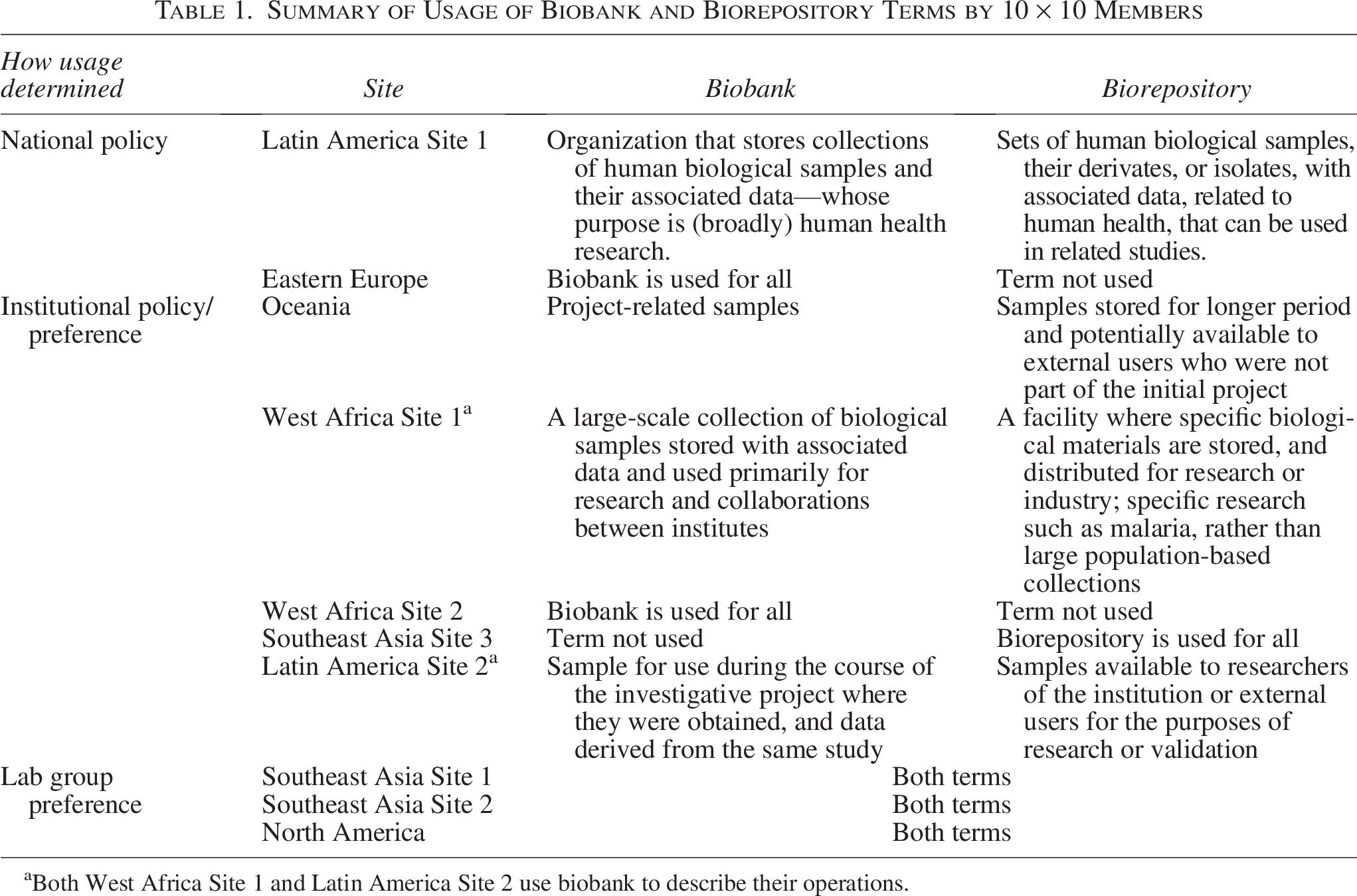
Both West Africa Site 1 and Latin America Site 2 use biobank to describe their operations.
The first step of the harmonization process was the generation and dissemination of a survey requesting that member groups provide information as to how their sites used the terms “biobank” and “biorepository” internally, either interchangeably or as distinct concepts. In addition, members were asked to provide their working definitions in their working language to explore if language differences or translational differences could contribute to differences in usage. Once completed surveys were received from 100% of the members, quantitative and qualitative analysis of the results was conducted, including translations of non-English definitions by team members proficient in these working languages (back translation accuracy was confirmed by the member sites prior to their inclusion in the analysis).
Members were asked through videoconferencing whether they would be willing to adopt the working definitions generated exclusively for VBS-related work. The working definitions were agreed to by all the members, allowing the team to move forward adopting a working definition of terms to be used for VBS-related work:
Biorepository—used to indicate the storage infrastructure and management (protocols, SOPs) and the sample collections with their associated data, which are purposefully accumulated and stored over longer time periods for specified or future projects.
Biobank—used to indicate samples and their associated data to be used locally and/or for specific research purposes.
Members will now use these definitions for purposes involving the VBS while utilizing their own definitions for internal work to ensure compliance with relevant governance.
Our experience with the harmonization of terminology proved to be both challenging and informative. This exercise demonstrated the importance of recognizing our diversity, minimizing assumptions, and providing a collaborative solution consistent with the expectations of all the stakeholders while retaining member group autonomy and a form of workable compromise across our sites. Our hope is that our process can be utilized by others involved in biorepository work and for greater global health.
Footnotes
Author Disclosure Statement
No competing financial interests exist.
Funding Information
No funding was received for this article.