






Abstract
Abstract
I present and analyze the results of a survey—broadly along the lines of the 2008 Berkeley Patent Survey (a survey of patenting among U.S. high-tech entrepreneurs)—conducted among South African biotechnology entrepreneurs. All 41 companies that qualified as part of the target population participated in the online survey. The results show that almost 60% (24) of South African entrepreneurial biotechnology companies sought patent protection for their innovations; 79% (19/24) of South African entrepreneurial biotechnology companies that have sought patent protection did so internationally, with the greater portions of these companies patenting in five to ten, or more than ten, major countries in the world. The responses by the South African entrepreneurial biotechnology companies support the main findings made by Graham et al. (that analyzed the 2008 Berkeley Patent Survey) regarding U.S. high-tech entrepreneurs: in brief, that patenting is one of multiple elements that can be part of a biotechnology entrepreneur's appropriation strategy, and that the decision whether to utilize patenting as part of an appropriation strategy is informed by various combinations of reasons that are not limited by the traditional legal rationales for patenting, but also include purely strategic rationales. There are, within the broad parameters of these main findings, also significant differences between South African biotechnology entrepreneurs and their U.S. counterparts, such as the relative importance of patenting as an element of a company's appropriation strategy, and the frequency of cost considerations as reason for forgoing patenting.
I. Introduction
T
The three main findings made by Graham et al. based on the 2008 Berkeley Patent Survey are as follows (my formulation):
• Patents can help high-tech entrepreneurs gain competitive advantage; patenting is one of multiple appropriation mechanisms that can be utilized by high-tech entrepreneurs to capture returns on their innovative activities. • High-tech entrepreneurs have differing motives for patenting; these motives are not limited to the classic legal rationales associated with patenting, such as stopping others from copying one's innovative product or service, but also include completely non-legal, strategic motives, such as attracting investment. • High-tech entrepreneurs also vary in their reasons for not patenting, which are different from the mere absence of motives in favor of patenting; again, these reasons are not limited to the legal reasons, such as the sufficiency of trade secrets, but include non-legal considerations, such as the cost of patenting.
However, how applicable are the findings made by Graham et al. beyond the borders of the U.S.? This present study aims to answer this question with reference to biotechnology entrepreneurs in South Africa. This present article presents and analyzes the results of a survey—broadly along the lines of the 2008 Berkeley Patent Survey—conducted among South African biotechnology entrepreneurs.
This article is structured as follows: Part II provides a brief overview of the South African biotechnology sector. Part III describes the methodology that I followed in designing and conducting the survey. Part IV reports and analyzes the results of the survey in comparison with the results reported by Graham et al. from the 2008 Berkeley Patent Survey. Part V concludes this article and provides some pointers for possible future research.
II. The South African Biotechnology Sector: A Brief Overview
The most recent data regarding the South African biotechnology sector that are reported by the Organization for Economic Cooperation and Development (OECD) is based on a survey conducted in 2009 by the Centre for Science, Technology and Innovation Indicators (CeSTII), 2 which is part of the Human Sciences Research Council, a South African government research institution. According to the CeSTII survey, as reported by the OECD, South Africa's biotechnology research and development (R&D) expenditures per annum are $69.9 million in the private sector and $122.9 million in the government and higher education sectors. 3 The CeSTII survey further reports that there are 30 biotechnology R&D companies in South Africa, of which seven are small in size (fewer than 50 employees). 4 I suggest that the CeSTII survey relied on by the OECD significantly underreports the South African reality—at least regarding the number of biotechnology R&D companies; I discuss this further in Part III, below. An earlier 2006 survey conducted by the South African government did not make use of the qualifier of R&D that was apparently employed in the CeSTII survey, and reported as many as 78 biotechnology companies in South Africa, of which 57 were small. 5 The 2006 survey differentiated a subclass of biotechnology company, namely, the dedicated biotechnology company: a company whose predominant activity involves the application of biotech techniques to produce goods or services and/or to perform biotechnology R&D. Thirty-eight dedicated biotechnology companies were identified, of which 34 were small. 6
Perhaps the most prominent aspect of the South African biotechnology ecosystem from the perspective of a biotechnology entrepreneur is that private funding for biotechnology R&D is virtually non-existent. 7 Foreign direct investment as a source of funding for biotechnology R&D in South Africa is also problematic: South Africa has so-called “Exchange Control Regulations.” 8 These Regulations entail, amongst others, that the South African Reserve Bank (the country's central bank) must preapprove all international transactions in terms of which local or foreign patents that are owned by a South African entity are to be a) assigned to a foreign entity, or b) licensed out on an exclusive basis to a foreign entity. Given that these Regulations clearly complicate possible exit strategies for foreign investors, they are generally perceived as a hindrance for attracting foreign direct investment in South African biotechnology companies. 9
In practice, therefore, biotechnology entrepreneurs in South Africa are required to self-fund their R&D from their own revenue (necessitating a dual revenue-generation and R&D focus), or attempt to obtain public funding to support their R&D, or a combination of both.
III. Methodology
A. The point of departure: The study by Graham et al.
For purposes of the 2008 Berkeley Patent Survey, Graham et al. identified about 15,000 entrepreneurial high-tech companies all over the U.S. as its target group,
10
and achieved a response rate of 8.7% (± 1,300) on its questionnaire.
11
The authors employed two important qualifiers to delineate its target group:
• High-tech sectors. Graham et al. focused primarily on the biotechnology, medical devices, and software sectors; although the authors often differentiate between and compare the results of these sectors, they do not provide an overall breakdown of the number of respondents per sector.
12
In the case of a specific question, namely, motivation for non-patenting, Graham et al. indicate that 136 biotechnology companies responded.
13
• Entrepreneurial. Using as rationale the work of economist Daniel Spulber, who argued that entrepreneurs “play a central role in the economy because they are the prime movers—the makers of companies,” Graham et al. exclusively focused on entrepreneurs.
14
An “entrepreneurial company” was defined by Graham et al. as a company founded within the decade preceding the survey.
15
B. Defining the target population: Differences in design between the present study and the study by Graham et al.
In order to facilitate comparability of the U.S. and South African survey results, the present study broadly adopts the same methodology and question formulation as Graham et al. Apart from the change of country from the U.S. to South Africa, the two most pertinent differences between the present study's methodology and that of Graham et al. are the following:
Firstly, the present study focuses only on one of the high-tech sectors included by Graham et al., namely, biotechnology. Furthermore, in order to ensure fit into the present context of strategic decision making concerning appropriating value from innovation, the present study requires that the biotechnology company must already have generated a biotechnological innovation of some kind—irrespective of whether it was patented or not. Accordingly, the entrepreneur would be able to provide answers based on his or her actual experience of strategic decision making concerning appropriating value from innovation, rather than intentions regarding possible future decision making.
Secondly, I apply the concept “entrepreneurial” differently. I agree with the vital role of entrepreneurs as prime movers in an economy, and hence with the focus placed by Graham et al. on entrepreneurs. However, Graham et al. used an age criterion (the company must not be older than one decade) for “entrepreneurial,” with the rationale that in a younger company, the founder-entrepreneur would be more likely to still be involved. I do not find this rationale convincing: if an entrepreneur is passionate about a certain venture and the venture enjoys a reasonable measure of success—at least from the entrepreneur's own perspective—would the entrepreneur not be likely to remain with such venture for the long haul, i.e., longer than the ten-year cut-off period employed by Graham et al.? Also, in the case of a serial entrepreneur who simply enjoys establishing and building early-stage ventures, the ten-year period may be far too long. However, it is not the ten-year cut-off period per se that poses the main problem, but the underlying assumption by Graham et al. that the mere involvement by a founder-entrepreneur in a company qualifies the company as “entrepreneurial.” This assumption appears unconvincing when considering the following two factors.
The first factor relates to the practicality of entrepreneurs’ involvement in the making of decisions regarding patenting. As a general observation, I suggest that the smaller the venture, the more practical it is for entrepreneurs to concentrate broad decision-making power in themselves; moreover, the smaller the venture, the more practical it is for entrepreneurs to allocate sufficient time in their schedules to immerse themselves in the patenting decisions of each innovative output of their ventures’ R&D. This practical opportunity has an inverse correlation with the company's size. Given that the OECD's biotechnology statistics specifically use <50 or ≥50 employees as its sole differentiator regarding company size, it was convenient to use the same number as the cutting-off mark for purposes of the present study: To qualify as an “entrepreneurial” company, the present study required that the company must have fewer than fifty employees.
The second factor relates to entrepreneurs’ actual power to make independent decisions regarding patenting. Ideally, the company's stock must be under the effective control of the entrepreneur(s); however, given the reality of the need for significant angel investment, venture capital, and/or—most likely in the South African context—public investment to support a company's biotechnology R&D program, this ideal would likely set the benchmark too high to apply as a general criterion. Also, such investors-cum-stockholders may be supportive of the entrepreneurs in which they have invested and of the entrepreneurs’ seemingly maverick decisions regarding patenting; they may also provide useful advice and mentoring without imposing their own views. However, at the opposite extreme of the ideal would be a company that is merely a subsidiary of a large company or that is owned by the state (or public funding instrument). In such cases, I suggest that the opportunity for bold and imaginative deviation from established business patterns and practices would likely be curtailed, if not entirely eliminated. As such, this present study employed a second criterion: to qualify as an “entrepreneurial” company, the company must neither be a subsidiary of a large company, nor be owned by the state (either directly or via a public funding instrument).
In summary, therefore, this study delineates its target population as small South African biotechnology companies that are neither subsidiaries of large companies, nor owned by the state, and that have generated biotechnological innovation. This delineation is designed to ensure that feedback about patenting decisions are based on actual experience rather than untested future intentions, and to optimize the possibility of the involvement of an entrepreneur who is personally involved in the strategic decision-making process regarding patenting of innovation, and has the actual power to make such decisions.
C. Identifying and Recruiting the Respondents
Potential respondents from the target population were identified using the following initial sources:
• Data from PatentScope on biotechnology PCT application applicant names with a South African address. • Lists of potential biotechnology companies obtained from the South African national government's Department of Science and Technology.
In addition, snowball sampling was also employed: during conversations with potential respondents (see section III.C, below), the potential respondent was prompted to provide references to other potential respondents.
All potential respondents were screened using Internet searches to ascertain whether they fall in the target population. In cases where I could not find sufficient information on the Internet, I phoned the potential respondent to obtain the relevant information. In this fashion, I identified 41 companies that qualified as part of the target population.
The present study utilized an online survey platform to conduct the survey amongst the target population. Whenever a question entailed multiple items that had to be ranked relative to one another, the item-order was randomized. I should also mention that the survey itself served as a confirmatory screening, as it posed questions to confirm that the respondent in fact qualified as part of the target population.
During the period of August 2014 to June 2015, I telephonically contacted all the potential respondent companies and spoke to the entrepreneur (or one of the entrepreneurs) driving the venture. This was followed by an e-mail, providing the hyperlink to the online survey. In cases where response was not forthcoming within a reasonable time, I followed up with reminder e-mails and telephone calls.
IV. The Survey Results
I achieved a 100% response rate: all 41 companies that qualified as part of the target population participated in the online survey. In the following section, I discuss the survey results. For ease of reading in the comparative context with the U.S., I also refer to the respondents as “South African entrepreneurial biotechnology companies,” and where I refer to the individual decision makers within the respondents, I refer to “South African biotechnology entrepreneurs.”
A. General observations
Graham et al. observed that there are “important differences” between venture-backed companies and non-venture-backed companies. 16 Given the dearth of venture capital in South Africa, I employ public funding as the nearest analogous differentiator in the South African context. Just over half (22) of South African entrepreneurial biotechnology companies received public funding for R&D. I refer to this subset as “PF” respondents, and to the subset that did not receive public funding for R&D as “non-PF” respondents.
Overall, almost 60% (24) of South African entrepreneurial biotechnology companies sought patent protection for their innovations. However, when South African entrepreneurial biotechnology companies are differentiated according to whether they received public funding for R&D or not, the picture changes: 73% (18/22) of PF respondents, in contrast with 42% (8/19) of non-PF respondents, sought patent protection for their innovations. In the U.S., 75% of entrepreneurial biotechnology companies in a subset that Graham et al. uses as representative of the general population of U.S. biotechnology entrepreneurial companies hold patents. 17 This percentage jumps to almost all (97%) in the subset of venture-backed U.S. entrepreneurial biotechnology companies. 18 Accordingly, although a majority of South African entrepreneurial biotechnology companies hold patents, patent holding is significantly less widespread among South African entrepreneurial biotechnology companies than among their U.S. counterparts; also, the observation holds true in both countries that patent holding is sharply differentiated along the line of external funding—whether in the form of private venture-backing in the U.S., or public funding in the South African context.
Whereas U.S. entrepreneurial biotechnology companies have the world's largest economy as its local market in which to commercialize their innovative output, their South African counterparts have a local market of only about 2% the size of the U.S. economy. Accordingly, South African entrepreneurial biotechnology companies have a greater economic incentive—and perhaps even necessity—to adopt a more global commercialization and patenting strategy. While Graham et al. could therefore limit their study of U.S. entrepreneurial biotechnology companies to patenting in the U.S., 19 the survey that I conducted specifically investigated the geographic reach of patenting by each South African entrepreneurial biotechnology company.
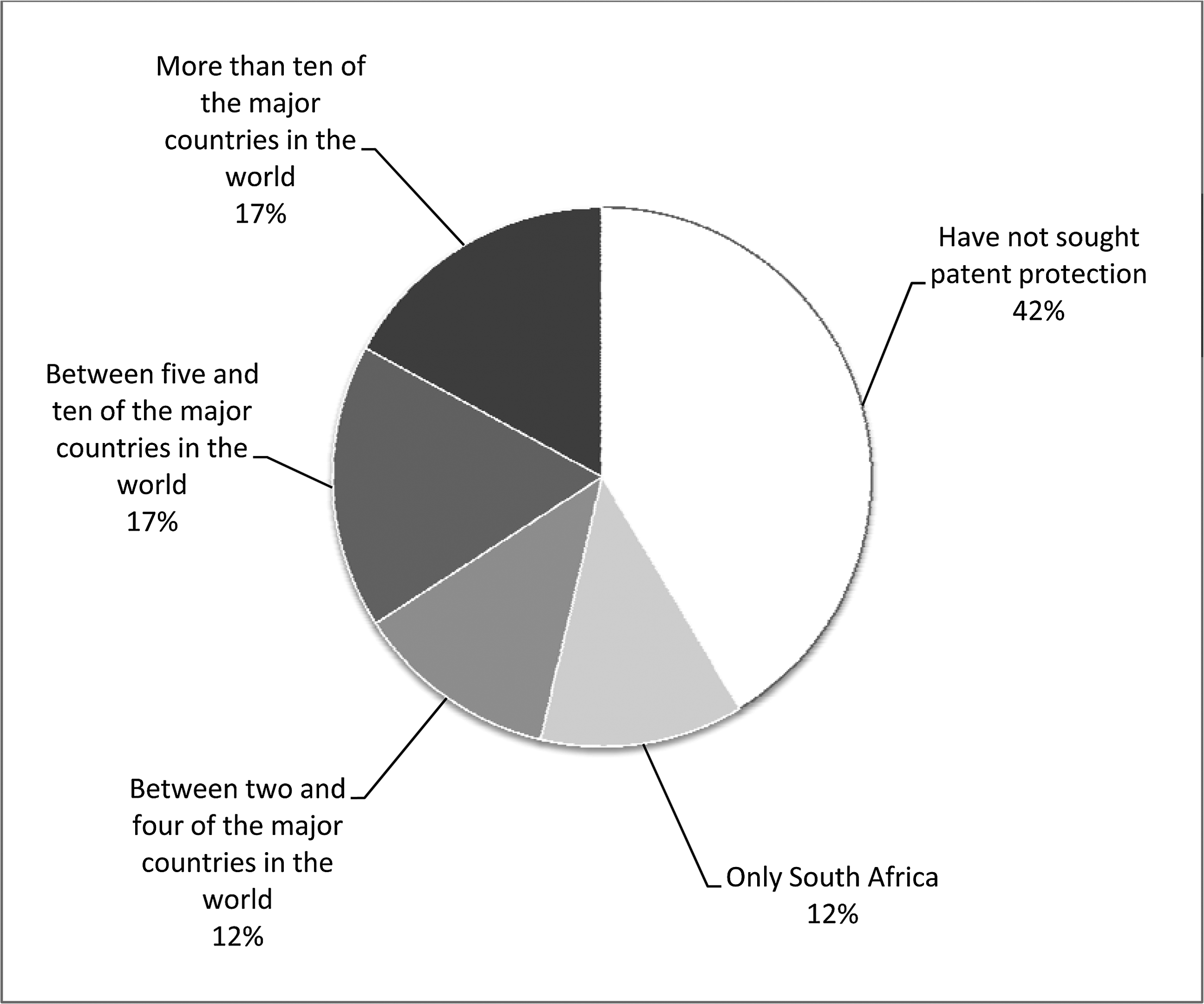
Figure 1 illustrates the global commercial ambitions of South African entrepreneurial biotechnology companies, as reflected in the geographic extent their patenting activity. A remarkable 79% (19/24) of South African entrepreneurial biotechnology companies that have sought patent protection did so internationally, with the greater portions of these companies patenting in five to ten, or more than ten, major countries in the world.
Geographic reach of patent families held by South African entrepreneurial biotechnology companies, if any.
I now turn to the strategic reasoning behind these patenting statistics. My analysis is structured according to the three main findings made by Graham et al. While there are of course differences between individual responses, for purposes of this study I employ group averages throughout, similar to Graham et al.
B. The first strategic dimension: The relative importance of patenting as a means of appropriating value from innovation
Innovation in itself does not guarantee any economic return to the innovator: the innovator must have a successful strategy to appropriate value from the innovation. Appropriation strategies may consist of various elements, ranging from employing legal means, namely, securing intellectual property rights, such as patents, to access to complementary assets, which are infrastructure or capabilities needed to support the successful commercialization of the innovation, other than those assets fundamentally associated with the innovation. Graham et al. found that U.S. high-tech entrepreneurs indeed rely on an aggregate of elements in their appropriation strategies. 20 U.S. biotechnology entrepreneurs in particular rely heavily on patenting in their appropriation strategies. 21
The 2008 Berkeley Patent Survey asked its respondents to indicate how important or unimportant each of the following seven items were to the company in securing competitive advantage from its technology innovations: first-mover advantage, secrecy, patents, copyrights, trademarks, difficulty of reverse engineering, and access to complementary assets. In the survey that I conducted, I retained the same seven items, with the exception of “first-mover advantage,” which I changed to a more generic “fast time to market.” There is an academic debate about the advantages and disadvantages of being the first-mover relative to the fast second-mover. 22 Accordingly, in order to avoid this debate, but recognize the strategic advantage common to both a first-mover and a fast second-mover, I used the phrase “fast time to market.”
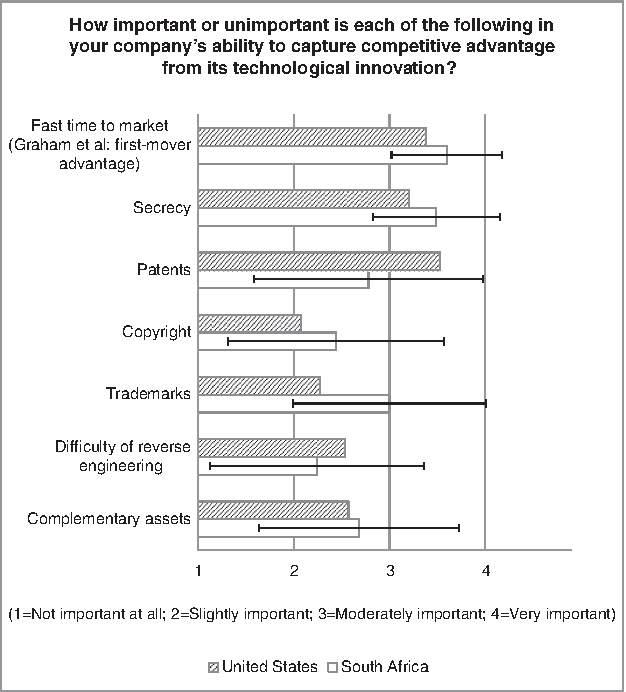
Figure 2 compares the appropriation strategies of biotechnology entrepreneurs in U.S. with their South African counterparts. Although Graham et al. only provided the average ranking of each element of appropriation, I also include the standard deviation in each case, as I suggest that it yields important insights. With the exception of fast time to market and secrecy (standard deviation of 0.58 and 0.67, respectively), it is striking that all the elements of appropriation as ranked by South African biotechnology entrepreneurs have relatively great standard deviation (> 1; or greater than the unit of ranking)—especially patenting, with a standard deviation of 1.2—indicating a broad spread of opinion. I analyze this further in Figure 3.
Biotechnology entrepreneurs’ appropriation strategies in U.S. and South Africa. U.S. data from Stuart J. H. Graham et al., High Technology Entrepreneurs and the Patent System: Results of the 2008 Berkeley Patent Survey, 24
Spread of rankings of three selected appropriation strategies by South African biotechnology entrepreneurs.
The significantly lower level of patent holding in the South African context, as discussed in IV.A.2 above, is clearly reflected in the different approaches to appropriation between South African and U.S. biotechnology entrepreneurs. The most striking difference is the level of importance placed on patents: while U.S. biotechnology entrepreneurs rank patenting as the most important element of appropriation—even slightly more important than first-mover advantage—patenting takes a middle-range position of importance to South African biotechnology entrepreneurs. 23 Rather than patenting, South African biotechnology entrepreneurs place more importance on fast time to market and secrecy to capture competitive advantage from their innovations. It is also noteworthy that South African biotechnology entrepreneurs allocate significantly more importance to trademarks than their U.S. counterparts—trademarks are perceived as even more important than patents. I suggest that the importance of trademarks works in tandem with the emphasis on fast time to market: the competitive advantages gained from fast time to market can, in the absence of patents, best be sustained by using lead time to establish brand loyalty, which is facilitated by trademarking one's innovation.
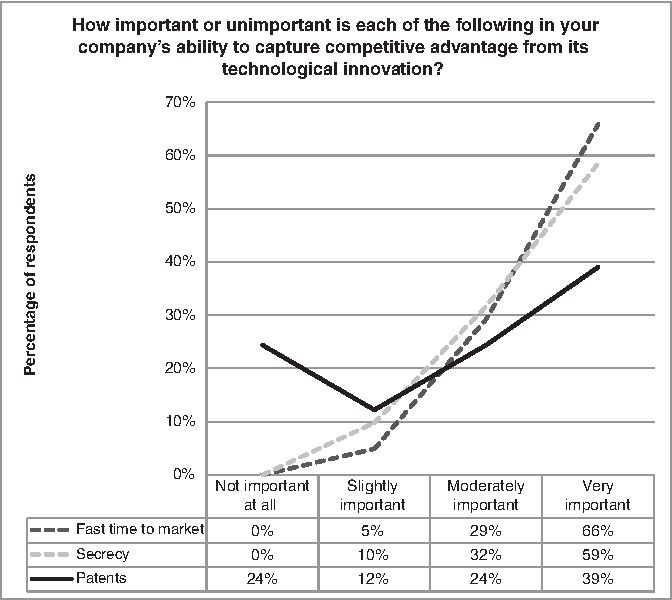
Figure 3 compares the spread of rankings of fast time to market, secrecy, and patents as elements of appropriation strategies by South African biotechnology entrepreneurs. From this graph, it should be clear why the standard deviations of fast time to market and secrecy as illustrated in Figure 2 are relatively small, in contrast with the standard deviation of patents. Given this strong divergence in opinion regarding patents, the average ranking of 2.78 received by patenting may be of limited relevance on its own, without the context of the 1.2 standard variation. It would be more accurate to state that, while there is broad consensus among South African biotechnology entrepreneurs on the high importance of fast time to market and secrecy as elements of their appropriation strategies, there is strong divergence in opinion among South African biotechnology entrepreneurs on the importance of patents as an element of their appropriation strategies, with a plurality (39%) of respondents ranking patents as very important, and a significant opposing minority (24%) of respondents ranking patents as not important at all.
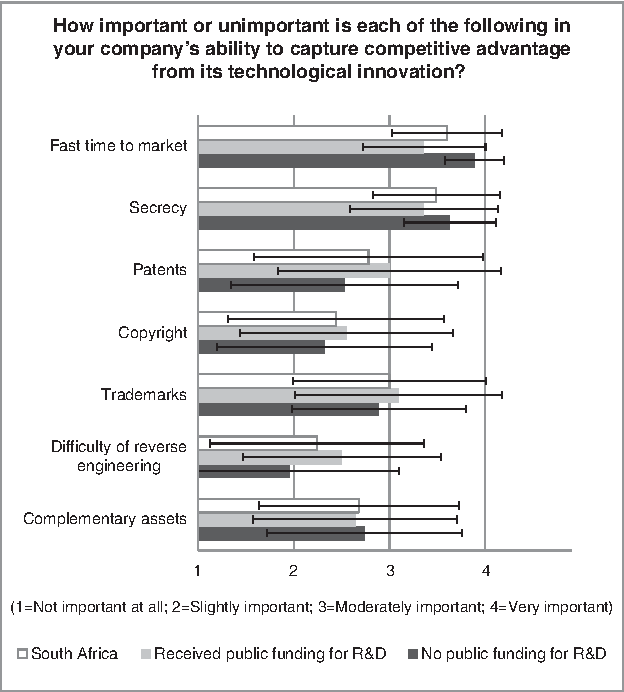
Figure 4 unpacks the strategic reasoning of the PF respondent and non-PF respondent subsets. It is noteworthy that the non-PF respondents place more importance on fast time to market and secrecy, while placing less importance on patents. Essentially, the non-PF respondent subset causes the U.S.–South Africa variance in the case of these items to be more pronounced. This should be seen in light of the fact that the non-PF respondent subset holds significantly fewer patents (42%) than the PF subset (73%), or the average U.S. entrepreneurial biotechnology company (75%).
South African biotechnology entrepreneurs’ appropriation strategies, differentiated by public funding for R&D.
Figure 5 delves deeper into the make-up of the spread of rankings of patents as an element of appropriation strategies by South African biotechnology entrepreneurs. In the case of PF respondents, the divergence between the extremes is less accentuated, while the divergence in opinion is more pertinent among non-PF respondents.
Next, I focus on motivation for patenting: if a biotechnology entrepreneur decides to use patenting as an element of an appropriation strategy, what are the rationales, and how do these rationales weigh relative to one another?
C. The second strategic dimension: Biotechnology entrepreneurs’ motivations for patenting
Graham et al. found that that when high-tech entrepreneurs seek patent protection, they often do so for varying and, sometimes, complementary reasons. 24 Given the authors’ study of the literature and their pre-survey conversations with entrepreneurs and investors, they identified seven reasons or motivations for patenting that were most prominent: namely, preventing others from copying products or services; improving the chances of securing investment; improving the chances/quality of liquidity (e.g., acquisition/initial public offering); enhancing the company's reputation/product image; improving the company's negotiating position with other companies (e.g., cross-licensing); preventing patent infringement actions against the company; and obtaining licensing revenues. 25 In the 2008 Berkeley Patent Survey, the authors asked their respondents whether they had filed at least one patent, and among those answering in the affirmative, the authors inquired into the importance of these seven motivations for patenting. 26
In my survey, I adopted a similar approach and used the same seven motivations for patenting. Given the exclusion of non-patent-holding companies from this question relating to the motivations for patenting, the number of respondents to this question was 24.
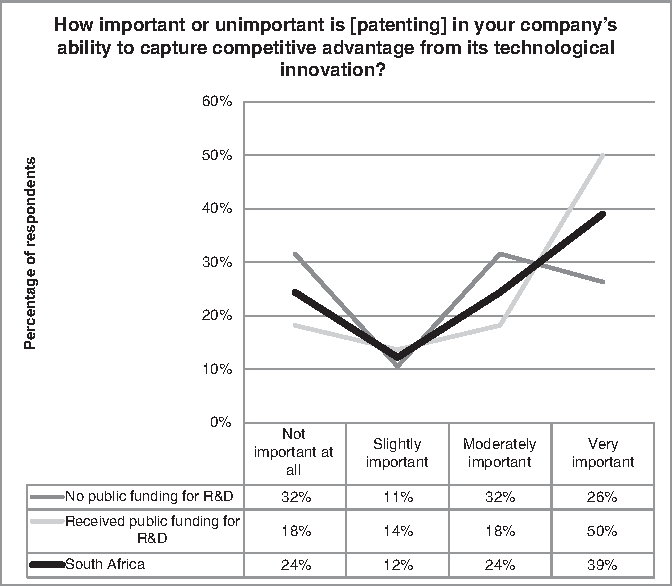
Spread of rankings of patenting as appropriation strategy by South African biotechnology entrepreneurs, differentiated by public funding for R&D.
Figure 6 compares the motivations for patenting of biotechnology entrepreneurs in U.S. with their South African counterparts. Most remarkable, I suggest, is that South African biotechnology entrepreneurs’ top motivation for patenting is purely strategic in nature: namely, to improve their chances of securing investment. That said, similar to U.S. biotechnology entrepreneurs, South African biotechnology entrepreneurs clearly seek patent protection for a variety of reasons, which mostly converge around a moderately important ranking. There are two notable exceptions to the general alignment between the U.S. and South African biotechnology entrepreneurs’ motivations for patenting—both pertaining to the classic “sword and shield” legal reasons for patenting—namely, preventing others from copying products or services, and preventing patent infringement actions against the company. In the case of both of these motivations, South African biotechnology entrepreneurs have allocated about 10%–20% less importance to these legal motivations than their U.S. counterparts. Can one hypothesize that South African biotechnology entrepreneurs have less of an appetite for litigation, or perhaps less access to resources to support patent infringement lawsuits, or both? This question will have to be answered by future research.
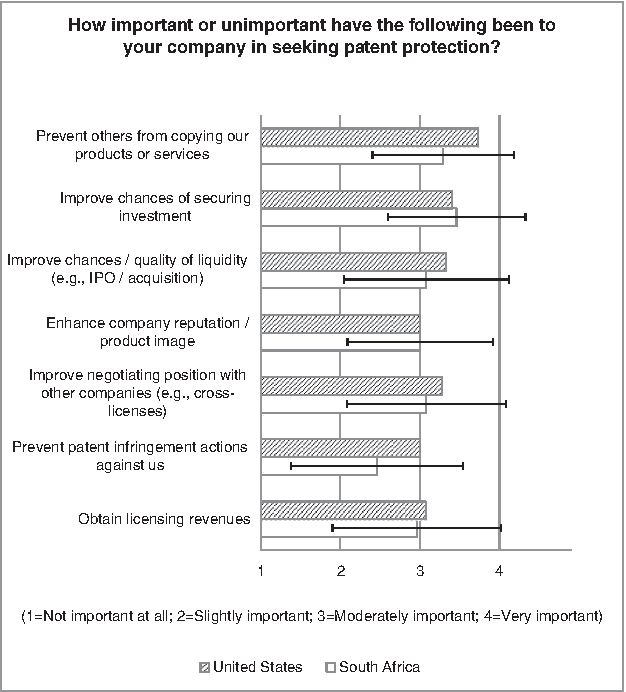
Biotechnology entrepreneurs’ motivations for patenting in U.S. and South Africa. U.S. data from Stuart J. H. Graham et al., High Technology Entrepreneurs and the Patent System: Results of the 2008 Berkeley Patent Survey, 24
The caveat regarding my observations above is, as shown by Figure 4, that the standard deviations of all the motivations are all approximately one unit of ranking (ranging from 0.87 to 1.07), indicating a broad variance in opinion.
Figure 7 shows significant differences in the motivations for patenting between South African biotechnology entrepreneurs in the PF and non-PF subsets (limited to South African entrepreneurial biotechnology companies that have patented). Among the PF respondents, all the purely strategic motivations are more emphasized—especially the top motivation of improving chances of securing investment. The standard deviation among PF respondents regarding the top motivation of improving chances of securing investment (0.58) is also significantly less than among all respondents (0.87). In contrast, amongst the non-PF respondents, these strategic motivations are significantly less important than for their PF peers. While the legal “sword” of preventing copying takes top position amongst non-PF respondents, it should be noted that improving chances of securing investment is still the second-strongest motivation amongst these entrepreneurs—be it with a standard deviation of 1.12, which is indicative of substantial divergence in opinion. I analyze this divergence in more detail in Figure 8.
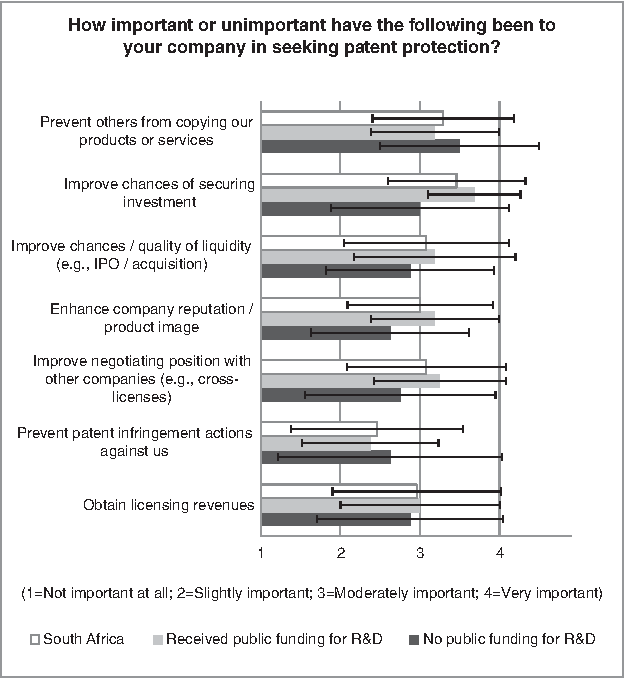
South African biotechnology entrepreneurs’ motivations for patenting, differentiated by public funding for R&D.
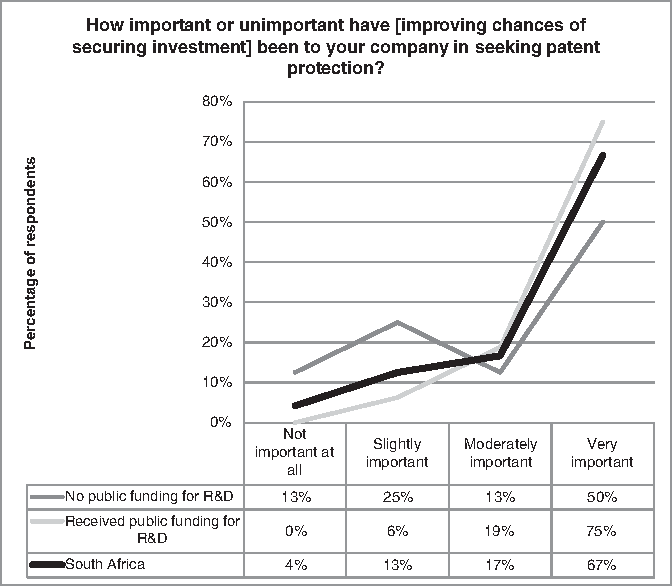
Spread of rankings of improving chances of securing investment as motivation for patenting by South African biotechnology entrepreneurs, differentiated by public funding for R&D.
Figure 8 delves deeper into the leading motivation for patenting among South African biotechnology entrepreneurs: namely, improving chances of securing investment. The line graph representing PF respondents is shaped like an exponential curve, with a strong convergence of 75% of respondents on the very important pole, and 0% at the opposing pole; in contrast, the line graph of the non-PF respondents is an S-curve that shows more divergence of opinion—yet, 50% of non-PF respondents are still at the very important pole, with a secondary apex of 25% at slightly important. Given the paucity of R&D funding from non-public sources, this S-curve may mean that non-PF respondents who have used patenting can be typified as having one of two main strategic orientations towards receiving public funding: those who are seriously aspiring to receive public funding (the 50% at the very important pole), and those who perceive public funding as marginal to their strategies, but who do not completely dismiss the possibility of attracting public funding (the 25% at slightly important).
Next, I turn to motivation for forgoing patenting, which is not simply the absence of motivation in favor of patenting.
D. The third strategic dimension: Biotechnology entrepreneurs’ motivations for not patenting
Based on their study of the literature, previous surveys, and their pre-survey conversations with entrepreneurs and investors, Graham et al. generated a list of the most common reasons why, reportedly, entrepreneurs elect not to patent their innovations. 27 This list includes: not wanting to disclose information; the cost of getting the patent, including attorneys’ fees; that competitors can easily invent around the patent; that they believe a trade secret is adequate protection; the cost of enforcing the patent, including actions in court; that they do not believe the technology to be patentable; and that they perceive no need for legal protection. 28 Instead of limiting the investigation into this strategic dimension (concerning motivations for not patenting) to respondents that hold no patents, Graham et al. were alert to the reality that patent-holding companies may elect to forgo patenting on any number of their innovations, and accordingly included all respondents in their investigation into this dimension. 29 The authors formulated the following question: thinking about the last major technological innovation that your company did not patent … which if any of the following influenced your company's decision not to patent? 30 Instead of requesting their respondents to rank each item in the list above in terms of its importance, the authors simply requested their respondents to indicate whether a particular item is relevant or not. Given this binary method, standard deviation would clearly not be useful.
Graham et al. found that cost considerations “loom large” in U.S. high-tech entrepreneurs’ decisions not to patent. However, in the case of U.S. biotechnology entrepreneurs, the most important reason for not pursuing a patent on their last major innovation is a reluctance to disclose information.
As per usual, to facilitate ease of comparison, I used the exact same approach and formulation as Graham et al. It is interesting to note that Graham et al. provide the exact number, namely, 136, of U.S. biotechnology entrepreneurs who responded to this question. 31 It is not clear what proportion of the total number of respondents in the biotechnology category this number represents. In the survey that I conducted in South Africa, all 41 respondents answered this question.
Figure 9 compares the motivations for forgoing patenting of innovations by biotechnology entrepreneurs in the U.S. with their South African counterparts. Similar to the position in the U.S., reluctance to disclose is the top reason for the decision to forgo patenting cited by South African biotechnology entrepreneurs. However, cost considerations—especially the cost of enforcing a patent—appears to loom larger for South African biotechnology entrepreneurs than their U.S. peers. One explanation for this difference that may superficially appear apparent is that the U.S. is a developed country (assumedly more well-resourced), while South Africa is a developing country (assumedly less well-resourced), and that cost considerations can accordingly be expected to play a larger role in the South African context. However, this explanation is called into question when the findings by Graham et al. regarding U.S. software entrepreneurs are considered: whereas 49% of South African biotechnology entrepreneurs cited the cost of filing a patent as reason to forgo patenting, 64% of U.S. software entrepreneurs cited this reason; also, whereas 51% of South African biotechnology entrepreneurs cited the cost of enforcing a patent as reason to forgo patenting, 52% of U.S. software entrepreneurs cited this reason. Accordingly, the economic status of a country as developed or developing (and assumedly more or less well-resourced) per se does not appear to account for the greater inhibiting effect of cost considerations on patenting by South African biotechnology entrepreneurs than on U.S. biotechnology entrepreneurs.
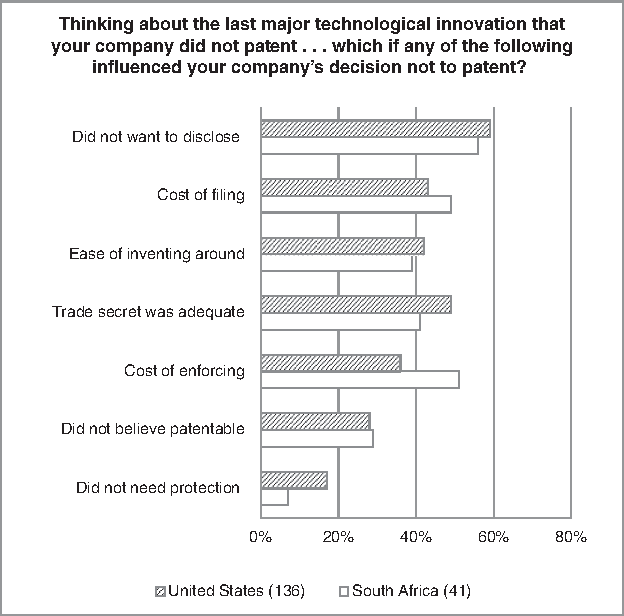
Biotechnology entrepreneurs’ motivations for not patenting in U.S. and South Africa. U.S. data from Stuart J. H. Graham et al., High Technology Entrepreneurs and the Patent System: Results of the 2008 Berkeley Patent Survey, 24
Perhaps a more likely explanation would relate to the fact, already mentioned above, that whereas U.S. biotechnology companies have the world's largest economy as its local market, South African biotechnology companies have a local market of only about 2% the size of the U.S. economy, and further to the fact that 79% of the subset of South African biotechnology entrepreneurial companies that hold patents, have patented internationally. I suggest that it is significantly easier—and less costly—for a biotechnology entrepreneurial company to enforce its patents in its own country's jurisdiction, than in a foreign jurisdiction. However, in the case of South African biotechnology entrepreneurial companies, the probability that patent enforcement will be in a foreign jurisdiction is highly likely, while the same is not necessarily the case with their U.S. counterparts.
Regarding secrecy, it should be noted that a higher proportion of U.S. than South African entrepreneurial biotechnology companies cited the adequacy of trade secrets as a reason for forgoing patenting. This result may at first glance appear to present a paradox when considering that South African entrepreneurial biotechnology companies rated secrecy as a more important element of appropriation strategy than did their U.S. counterparts. 32 However, the key to the apparent paradox is that the questions relate to two distinct concepts: the one question relates to the importance of secrecy relative to patenting, while the other to the adequacy of secrecy (in combination with other factors) for forgoing patenting. In fact, in all cases where a respondent in my survey cited the adequacy of trade secrets as a reason for forgoing patenting, the respondent cited at least one other reason for forgoing patenting as well; the average number of reasons for forgoing patenting cited together with the adequacy of trade secrets is three. Accordingly, at least in the context of South African biotechnology entrepreneurs, the decision to forgo patenting is not made based on the (perception of) adequacy of trade secrets alone, but is a complex decision entailing various factors.
In 2008, South Africa enacted its version of the Bayh–Dole Act, namely, the Intellectual Property Rights from Publicly Financed Research and Development Act (“IPR Act”). 33 The IPR Act differs from the Bayh–Dole Act in material aspects, 34 and is controversial for multiple reasons. 35 However, what is relevant for present purposes is that the IPR Act strongly favors the statutory protection—i.e., patenting in the case of biotechnological innovation—of publicly funded R&D, irrespective of whether the R&D was conducted at a university or at a private company. What is therefore surprising in Figure 10 is that a significantly higher proportion of PF respondents compared to non-PF respondents cited the cost of filing a patent application as reason for forgoing patenting. Given the public policy in South Africa, one would assume that once a biotechnology company receives public funding for R&D, the public funding system would be geared towards providing public funding for patenting the R&D results of such a company—especially if the company perceives patenting as a fitting appropriation mechanism.
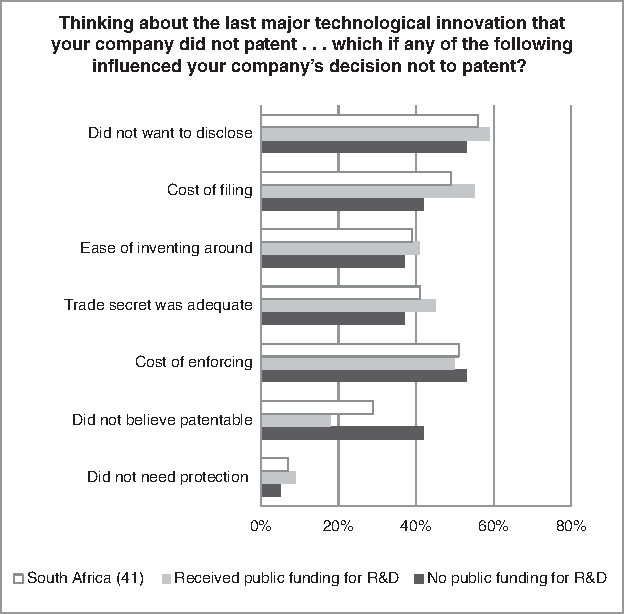
South African biotechnology entrepreneurs’ motivations for not patenting, differentiated by public funding for R&D.
However, this does not appear to be the case. In my survey, I inquired from all respondents whether they received public funding for patenting. About a quarter (11) of all respondents answered in the affirmative. All but one of this subset of respondents that received public funding for patenting are part of the PF subset. It appears that the public policy support for patenting is yet to be effectively implemented through actual financial support to biotechnology entrepreneurs who intend to patent their innovations.
The most striking feature of Figure 10 relates to the belief that the technology was not patentable. While this was a hindrance to patenting, only 18% of respondents in the PF subset, and 42% of non-PF respondents, cited it as a reason for not patenting. Assuming that the respondents’ “belief” in the patentability or not of their innovations is well-founded—i.e., based on sound legal advice—this statistic means that PF respondents generate more patentable innovations than non-PF respondents. I suggest that the most likely explanation for the patentability discrepancy is simply that PF respondents are substantially better resourced to conduct R&D than non-PF respondents, directly resulting in PF respondents conducting R&D of a relatively bigger scale that is more likely to yield results of a patentable nature. As I stated in the introduction, public funding is for all practical purposes the only external investment available for biotechnology R&D in South Africa. As such, non-PF respondents must rely on their own revenues to self-fund their R&D programs. However, the causal chain may start earlier: non-PF respondents’ R&D programs may not be of a sufficient standard to warrant public funding; this, in turn, may be the result of conceptualizing an R&D program within a paradigm of limited resources from their own revenues.
V. Conclusion
A. Comparison with the study by Graham et al.
The present study shows that the main findings made by Graham et al. are indeed applicable beyond the U.S.—at least to the South African entrepreneurial biotechnology context. In summary, patenting is one of multiple elements that can be part of a biotechnology entrepreneur's appropriation strategy, and the decision whether to utilize patenting as part of an appropriation strategy is informed by various combinations of reasons that are not limited by the traditional legal rationales for patenting.
Within the broad parameters of these main findings, there are meaningful points of both discrepancy and alignment between South African biotechnology entrepreneurs and their U.S. counterparts regarding the strategic considerations pertaining to the management of innovation and patents. In the following, I highlight the most salient of these points:
• U.S. biotechnology entrepreneurs perceive patenting as the most important element in their appropriation strategies, while their South African counterparts perceive patenting's importance relative to other means of appropriation as mid-range. South African biotechnology entrepreneurs place most importance on fast time to market and secrecy. These two means of appropriation rank third and second in the U.S. context, respectively. • U.S. biotechnology entrepreneurs’ top reason for patenting is the typical legal “sword” rationale of preventing competitors from copying one's innovation; their second most important reason is purely strategic in nature, namely, to improve chances of securing investment. This purely strategic reason is ranked as the most important motivation for patenting by South African biotechnology entrepreneurs, who perceive the legal “sword” as relatively less important. • Both U.S. and South African biotechnology entrepreneurs’ top reason for forgoing patenting is a reluctance to disclose. For both groups, but especially for the South African biotechnology entrepreneurs, cost considerations are an obstacle to patenting.
B. Profiling two types of South African biotechnology entrepreneur
Given the finding by Graham et al. that there are marked differences between venture-backed and non-venture-backed companies, I emulated this differentiation with the closest local equivalent, namely, whether a company has received public funding or not, and investigated whether this differentiation would yield significantly different results between the two subsets of respondents. My analysis above shows that the differences between these two subsets of South African entrepreneurial biotechnology companies are often more pronounced than the differences between South African entrepreneurial biotechnology companies as a whole and their U.S. counterparts. Based on the survey results, one can construct profiles of these two types of South African biotechnology entrepreneur:
• The biotechnology entrepreneur who received public funding. The entrepreneur's company holds an international patent portfolio,
36
but the entrepreneur engaged in patenting primarily to secure public funding, although a variety of other reasons also played a part. In fact, the entrepreneur values secrecy and a fast time to market more than patenting as elements of his or her company's appropriation strategy. Given the irreconcilability of secrecy with disclosure (that is required for patenting), I suggest that it is likely that the typical entrepreneur in this subset is not patenting a substantial portion of his or her company's innovative output, but is intentionally keeping it under the radar. In the event that the entrepreneur does decide to patent his or her company's innovative output, the cost of filing an application and concerns about the cost of enforcement are the most prominent hindrances to patenting. • The biotechnology entrepreneur who did not receive public funding. The entrepreneur's company holds no patents,
37
and self-funds its R&D. To this entrepreneur, fast time to market and secrecy are all-important. When the entrepreneur's company does apply for a patent, the entrepreneur is primarily motivated by the traditional monopoly incentive: preventing others from copying the innovation. However, the entrepreneur does not eschew the possibility of joining the club of publicly funded companies, and recognizes the strategic value of patenting to potentially secure investment.
38
In the event that the entrepreneur explores the possibility of patenting his or her company's innovative output, cost considerations are the foremost impediment, as is the fact that a “major innovation” from this entrepreneur's perspective is less likely to be a patentable invention than in the case of an entrepreneur whose company receives public funding.
C. Future research
The public policy rationale for patenting is that disclosure of know-how regarding an invention is in the public interest and is incentivized by granting the inventor a temporary monopoly on the use of the invention. Both the study by Graham et al. and the present study show that the incentives to patent include far more than obtaining a monopoly (which may in any event be illusory, given that the legal costs and risks—and entrepreneurial time and effort—may be more than a biotechnology entrepreneur would be willing to commit). These incentives include strategic advantages, such as improving chances of obtaining funding, boosting negotiation power, and improving reputation. However, both studies suggest that all of these incentives may be insufficient for paying the strategic price required for patenting: disclosure of know-how. Both studies show that reluctance to disclose is the most often cited reason why biotechnology entrepreneurs forgo patenting. This result must also be considered in light of the fact that secrecy, while on its own not a sufficient reason to forgo patenting, received a relatively high ranking as an element of appropriation strategies in both studies. There is, accordingly, tension between the strategic advantages of patenting and the strategic disadvantage of disclosure. Especially in the case of small companies, disclosure can mean the end of their R&D programs: once disclosure is made, large, far-better-resourced companies can anticipate the future innovation trajectory of the disclosed invention, allocate more R&D resources to such future innovation trajectory, outcompete the small company to the next patentable steps in the innovation trajectory, file for patents, and block the small company in its own innovation tracks. It is therefore not surprising that the respondents in the present study—all small companies—place such a high premium on secrecy, rather than on patenting.
From both studies we know that patent holding is widespread amongst biotechnology entrepreneurs, although significantly less so in South Africa. However, from the perspective of an inquiry into the extent to which the patent system is working for biotechnology entrepreneurs, I suggest that measuring the ubiquity or counting the number of patents only touches the surface. Given the acuteness of the tension between the strategic advantages of patenting and the strategic disadvantage of disclosure, the question that should yield more insight and must still be asked and answered is the following: what proportion of the patentable R&D results generated by entrepreneurial biotechnology companies is kept secret, and what proportion is patented? And, delving even deeper, how do biotechnology entrepreneurs decide which of their R&D results to keep secret and which to patent?
Clearly, the strategic dimensions of patenting by biotechnology entrepreneurs are fertile fields for further research.