







Abstract
The early dispute resolution mechanism created a new foundation for pharmaceutical innovation and expanding access to generics in China. This article examines the evolution of pharmaceutical regulation, explores the structure of early dispute resolution provisions, and analyzes the implications for generics and innovators through a comparative approach. It concludes that the early dispute resolution will encourage generic companies to challenge patents early and often. For example, the long exclusivity, the short waiting period, and the bifurcated adjudication system provide legal incentives to early generic entry. The unclarified and unlimited notification system set legal impediments to disincentive innovators asserting their right. Moreover, an increase in filing of weak generic claims motivated by the prospect of a future long exclusivity might bring little consumer benefit.
1. Introduction
The design of innovation policies is crucial for the pharmaceutical industry, which responds much more positively to patent protection than most other industries. 1 Within the drug regulatory framework, the U.S. Hatch-Waxman Act created the revolutionary patent linkage system aimed at encouraging pharmaceutical innovation and increasing access to medicine. Through this comprehensive interest-balancing system, the U.S. attempts to protect drug patent rights while helping generic drugs entering the market. The evidence shows that after the Hatch-Waxman Act, the U.S. had both the largest innovative drug and generic drugs industries in the world. 2 The benefit was clear.
For years, whether China should establish a pharmaceutical patent linkage system was argued and controversial. 3 Recently, China updated and improved its drug regulatory patent protection measures. In the fourth amendment of the patent law, China incorporated a significant provision for the drug patent linkage system. Then, on July 4, 2021, the National Medical Products Administration (NMPA) and the China National Intellectual Property Administration (CNIPA) jointly issued the Implementation Measures for the Early Resolution Mechanism of Drug Patent Disputes. These nascent regulations regarding early resolution of patent dispute are overall good news for both innovative drug patentees and the generic industry. However, the provisions establishing the patent linkage system leave a degree of ambiguity and flexibility which may potentially lead to a lack of clarity and uncertainty in their implementation.
The article attempts to explicate the generic drug and innovative drug incentives provided by the early dispute resolution mechanism in China. The first part of this article examines the evolution of the pharmaceutical patent protection system in China. It then reviews the background and features of the early resolution mechanisms for drug patent disputes in China. This is followed by a comparative analysis of the patent linkage systems in the U.S. and South Korea, which aims to identify problems in the implementation of early dispute mechanisms for drug patent dispute. The article concludes with possible strategic behavior might which be adopted by pharmaceutical companies, patent owners, or generic companies and tries to propose potential solutions to overcome current difficulties.
2. Historical Development of Chinese Drug Patent Regulation: The Introduction of the Bolar Exemption
In order to understand the recent change in drug patent regulation, it is necessary to comparatively and historically examine its evolution and understand the interplay between access to medicine and patent protection in China. In response to the lack of exemptions for generic drug testing, the U.S. Drug Price Competition and Patent Term Restoration Act (Hatch-Waxman Act) created an industry-specific research exemption (Bolar exemption) for biomedical research to obtain governmental regulatory approval. 4 Despite the fact that the Bolar case was the impetus for congressional enactment of the Hatch-Waxman Act, it provided patent term extension for innovative drugs in exchange for permitting manufacturers of generic drugs to gain FDA marketing approval. Therefore, under the Hatch-Waxman Act, the abbreviated new drug applications, Bolar exemptions, patent-term extensions, and data exclusivity constitutes an integral system balancing both the innovator's and the public's interests in U.S. 5
The historical evidence showed that neither the TRIPS agreement nor other international instruments required a patent term extension as a condition for providing a regulatory approval exception. In case DS114 Canada—Patent Protection of Pharmaceutical Products, the panel explicitly indicated the Bolar exemption did not have to be accompanied by a patent term extension. The regulatory regimes of many developing countries and transitional economies, such as Poland, Thailand, Argentina, etc., contain a regulatory approval exception with no patent term extension. 6 Naturally, China also introduced the Bolar exemption in the third amendment of the patent law for the purpose of promoting the marketing of generic drugs, but left behind patent term extension and other provisions protecting the innovator's interest. At that time, drug innovation was focused on chemical modifications of the structure of existing drugs, such as changing acid or basic group, altering optical configuration, and developing isomers of original drugs, in order to develop “me-too” drugs in China. 7 Therefore, the application of Bolar exemption seemed to be a sound choice as it resonated with the goals at that time.
In practice, Bolar exemption gradually became a safe harbor for exempting the clinical trial of generic drugs from patent infringement in China. 8 Some criticized the Bolar exemption on the grounds it essentially swallowed the linkage rule and traditional infringement analysis for pre-approval conducts. 9 The incomplete nature of the linkage rule was also echoed in the rigorous application of the Bolar exemption so as not to harm the legitimate interests of patentees. Compared with Bolar exemptions in other countries, the scope of exemption was significantly narrower. For example, submission of information required by the Chinese patent law is limited to Chinese authorities, while India and Philippines allow authorities in foreign countries to be submitted. 10 In China, the court usually only exempt acts necessary for fulfilling the purpose of regulatory approval of drugs, including making, using, or importing the patented invention, while the U.S. provides ab exemption for an act of infringement by an offer to sell by a generic manufacturer. 11 Moreover, the Bolar exemption is only applicable to obtain the marketing approval of a generic drug but not apply when a patented invention is used for the development of a new product in China, while Canada and Argentina extended the Bolar exemption to encompass material that is subject to potential inspection. 12
China neither provides resolution to accelerated challenges faced by patent holders nor compensates the innovative drug developer for the losses of the patent term. 13 In fact, the NMPA has previously established the experimental patent infringement certification in the process of drug registration. 14 Based on the drug registration regulation, an innovative drug can list patents involving the approved drug and the NMPA can establish a database of such listed patents. However, the gaps between the drug registration law and the patent law cause a problem of coordination. The Bolar exemption unduly enlarges the coverage of this provision and swallows the linkage rule. With this background, establishing the patent linkage system in China has become an increasingly eye-catching topic, as well as one of the most-important highlights in the recent revision of the Patent Law.
3. Recent Developments in Drug Patent Regulation: The Early Dispute Resolution System
The cumulation of “naked Bolar” led to a situation that a wrong signal was sent to the innovative pharmaceutical sector that China was not fully committed to protecting innovative drugs. 15 Despite the fact that there was no nexus between Bolar exemption and patent term extension or the patent linkage system, it has been open to the Chinese regulators to make specific provisions for augmenting the enjoyment of patent rights in the case of drugs requiring time-consuming regulatory approval. The fourth amendment of the Chinese patent law provides a basis for patent linkage, which gives the originator/patentee a right to bring an infringement claim in a court or the CNIPA on discovering a generic application and drug patent term extension. Then in July 2021, State Council measures jointly launched by the NMPA and CNIPA created a patent early resolution mechanism to expedited regulatory approval process for innovative new drugs. 16
The main infrastructure and regime for the patent linkage system includes information disclosure, patent registration system, generic drug patent declaration system, and market exclusivity system. The legislative purpose of drug patent dispute early resolution mechanism is to establish a connecting channel between drug registration and pharmaceutical patents and to resolve possible patent disputes before the marketing of generic drugs. 17 The Measure in essence (Fig. 1) requires that when a new drug application is filed, applicants must provide a “Patent Statement” to declare that the drug being applied for will not infringe any existing patent recorded on the Patent Information Platform for Marketed Drugs maintained by NMPA. If a patent holder disagrees and believes the technical solution of the new drug applying for market approval will infringe their patent, they can either file a lawsuit in court or apply to the patent administrations for an administrative ruling within 45 days of the publication of the generic application. The NMPA will then halt the administrative approval process for 9 months to wait for a court decision or an administrative ruling.
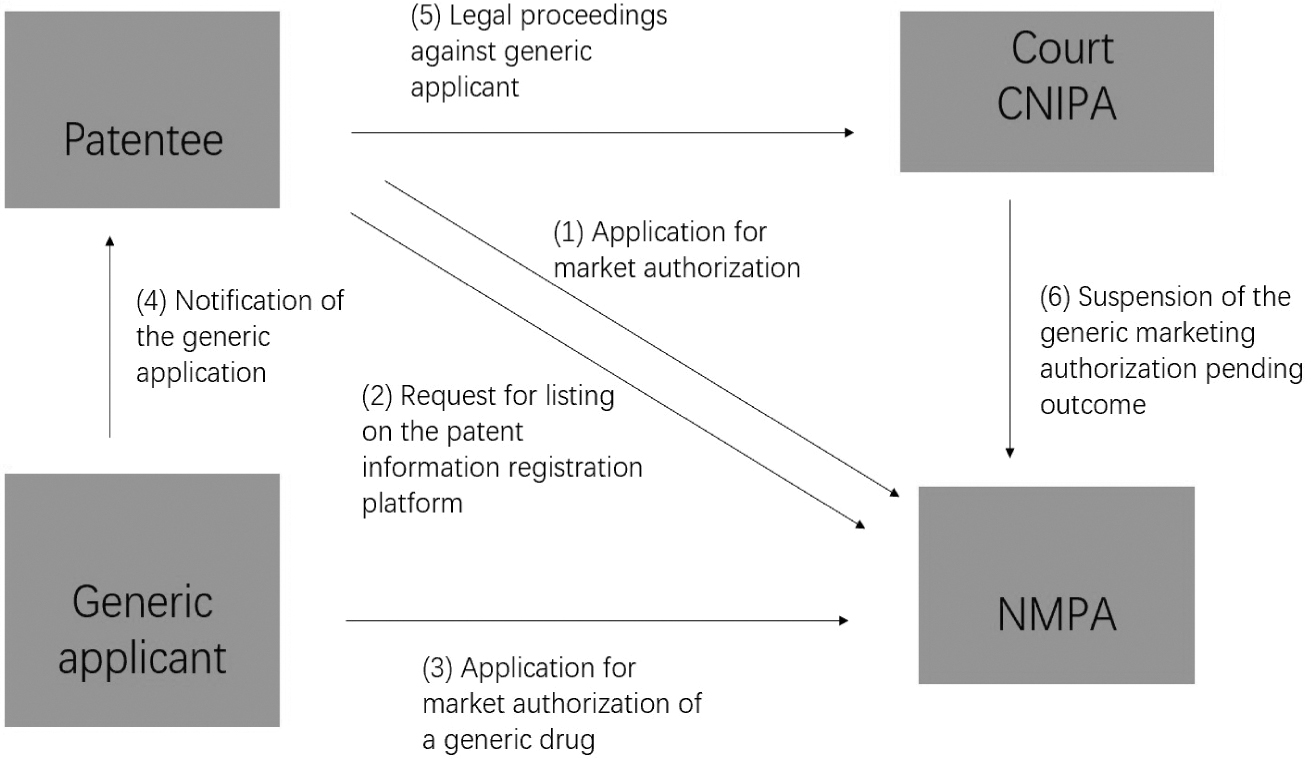
Early resolution scenario for drug patent dispute.
Notably, there are some constructive differences in the implementation of the patent linkage mechanism compared with those in the U.S. and South Korea, in which the U.S. might be considered to be the prototypical mechanism and the South Korea is the model for reforming the U.S. mechanism (Fig. 2). Similar to the Hatch-Waxman system, both China and South Korean establish an official database listing patents related to approved drugs, allowing pharmaceutical substance, formulation, composition, and medical use patents to be eligible for listing. Moreover, both China and South Korea require that the generic applicant certify the status of listed patents under one of four following categories: Category I—No Originator Patent; Category II—The Originator Patent has expired or been invalidated, or the generic applicant has obtained a patent license; Category III—The generic applicant undertakes not to market the generic drug before the expiry of the Originator Patent; and Category IV—The Originator Patent should be invalidated, or the generic drug does not fall within the scope of Originator Patent. 18 However, China and South Korea allow a longer exclusivity period for the first generic than the U.S. In addition, both of them choose to have a shorter waiting period than the US. Significantly, China creates a unique bifurcated adjudication system which provides judicial and administrative approaches to asserting the right.
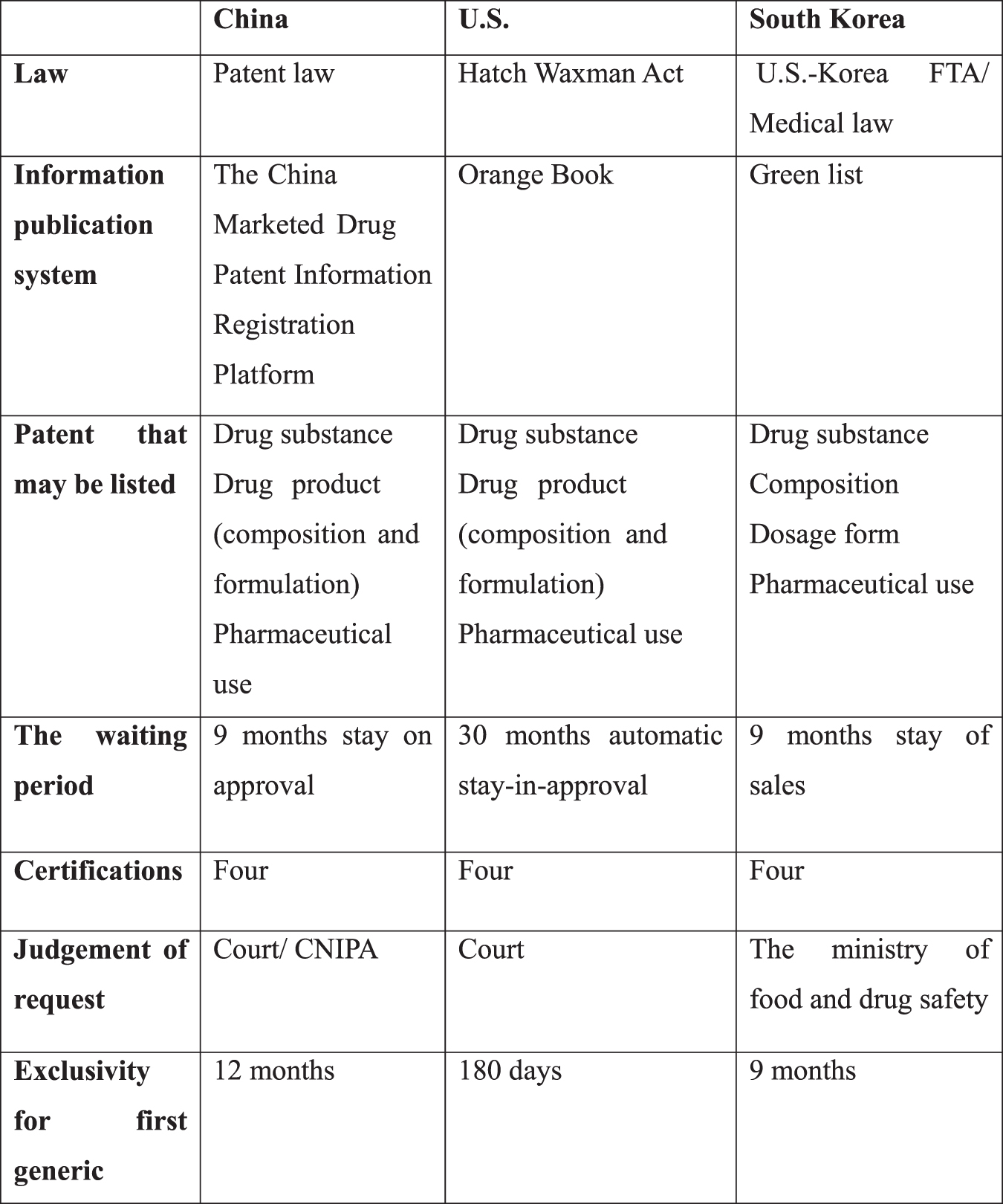
The implementation of patent linkage mechanisms in China, U.S., and South Korea.
4. Problems and Pitfalls in the Implementation of the Patent Linkage System in China
The above provided an overview of pharmaceutical regulatory system and the major differences among the Chinese, U.S., and Korean patent linkage system. In this section, these differences will be analyzed in greater depth, leading to the conclusion that a well-functioning early resolution mechanism would resolve the drug patent disputes and avoid significant damage. However, the patentee and generic should take great care with each step; otherwise, the early resolution mechanism may be dysfunctional and detrimental to the pharmaceutical industry.
4.1 The narrow and unclear eligibility patents of the platform
The NMPA established an official patent information registration platform (the platform) for listing related approved drugs patents. However, the NMPA is in a neutral administrative position and purely operates the platform; it lacks an explicit grant of authority to correct or delete any patent information. As the platform is newly established, it might be subject to a deluge of discrete drug patent entries of uncertain accuracy. For example, during the trial of the platform, Chenxin Pharmaceutical CO. Ltd. (Chenxin) listed a drug patent (ZL201810920417.8) under its product name as Valsartan and Amlodipine Tablets. While the Chinese patent ZL 201810920417.8 held by Beijing Baoao Pharmaceutical Co. Ltd. (Baoao) itself is a generic drug which is based on the innovative drug produced by Novartis PharmaSchweiz AG. 19 A question existed as to whether the generic patents related to the innovative drug could be covered by the drug-related patents of the platform or not? The platform lacks accuracy and comprehensiveness in regard to the eligibility patent scope. Improper and defective entries, such as the patents in a reexamination/invalidation or an ownership dispute, will sever linkage and allow the registration of infringing drugs. Unscrupulous generics might deliberately propose false, non-infringement certifications without fear of being called out by the patentee.
It is noteworthy that the scope of the patent list in the platform is narrower than that of the Orange Book under the Hatch-Waxman Act. Despite chemical drugs, biologics, and Traditional Chinese medicine being registrable on the platform, only chemical generic drug applicants need to submit four types of patent declarations (Article 6 of the implementation). And only the registered chemical generic drug has a 9-month waiting period (Article 8 of the implementation). Regarding biologics and traditional Chinese medicines, there are few relevant provisions in the implementation compared with those for chemical generic drugs. The eligibility patents listed on the platform do not cover patents for intermediates, crystal forms, metabolites, detection, or preparation methods. However, the method of use patents for some active pharmaceutical ingredient (API) specific crystal forms were already listed in the platform. 20 The NMPA might consider taking a more-active role in managing the platform, emulating the FDA's active or affirmative approach to the Orange Book, such as by providing explicit guidance and clear interpretations.
4.2 The absence of time limit in the notification process
A timely and accurate statutorily required notice from generics to innovators is critical to effectively any implement dispute resolution system. Compared to the draft, the implementation added a notification process: the generic applicant is responsible for notifying the market authorization (MA) holder and provide supporting documents. If the MA holder is not the owner of the patent, the MA is responsible for notifying the patentee. However, in contrast to the U.S. and South Korea 21 , the statutorily required notice to the innovator does not have time limit. Considering the realities that the drug patent dispute early resolution system is newly established, it is questionable whether the notification obligation stipulated can adequately serve to notify patentees or interested parties in a timely manner. The early drug patent dispute resolution mechanism might often involve an unreasonable delay for the generic to notify the innovator of its application.
For a dispute resolution system to work properly, it needs to be considered whether the notification system should be varied in regard to different categories or situations so as to decrease the burden on generic applicant. For example, South Korea does not require the notification process when the generic applicants certify that they will not begin selling the medicine until the expiration of the listed patents (category III). 22 Similarly, in Australia, the notification process is not mandated in the circumstance that the generic applicant certifies that the generic will not infringe a valid claim of the patent (category IV). 23 Since the generic application information and the certification is readily available from the platform, it would be an extra burden on the generic drug applicants to provide notice.
4.3 The bifurcated adjudication system
One important feature of the early patent dispute resolution is the bifurcated adjudication system including both judicial and administrative approaches. The rights holder could seek either administrative or judicial review when facing a generic application. More importantly, there is both administrative- and judicial-route facilitated mediation, which has proved to be quite successful in resolving intellectual property infringement disputes. 24 Both the court and CNIPA launched measures and provided interpretation to guide the implementation of early dispute resolution system, improve the linkage of the judicial and administrative proceedings, and promote the unification of enforcement standards between the judicial and administrative routes. 25
From a practical perspective, the administrative route seems to be preferable as it is a less time-consuming, more effective, and lower-cost remedy. 26 Compared with the judicial route, oral hearings are not mandatory in administrative adjudication. 27 Timelines are an important factor to be considered when deciding on the appropriate path to take, since it is possible to obtain an administrative decision within the waiting period, but it can be difficult to receive an effective judicial judgement in time. The administrative route also has less-stringent formalities and more interaction with patent invalidation proceedings compared to the judicial route. 28 Nevertheless, uncertainty associated with the administrative route is a factor that needs to be considered since the administrative decision can be examined subject to judicial review.
4.4 The easily missed legal proceeding time and short waiting period
Importantly, the early dispute resolution mechanism provides innovative drug access to effective proceedings, grants an automatic stay, and blocks approval of the generic version. Against the generic drug submitted with four category patent certifications, the patentee or an interested party can file a lawsuit to the court or CNIPA within 45 days of the generic MA application being published by the NMPA. Once the legal proceeding is docketed or accepted by the CNIPA and court, NMPA's administrative review of generic chemical drug will be stayed for nine months after the acceptance date. The NMPA is automatically prevented from approving the generic drug until it receives a favorable judgement of noninfringement or invalidity or the nine-months waiting period has expired. Therefore, commencing a legal proceeding within the 45-day period is critical for the patentee to obtain this nine-month waiting period for generic approval, which greatly incentives branded pharmaceutical manufacturers to file patent infringement suits against generics. However, the starting point of bringing an action is the generic MA application being published by the NMPA in China rather than the date of receiving the notification in U.S. In the circumstance that the generic does not promptly send notification, it is questionable whether the innovative drugs can timely file a lawsuit or request an administrative ruling.
Compared with the 30-month waiting period in the U.S., the waiting period stipulated in China is much shorter. It appears as a double-edged sword. On the one hand, the short waiting period places a heavy burden on the patentee or innovative drug applicant, as both the administrative or judicial procedures take time to run their course to resolve an infringement or invalidity dispute. The expiration of nine-months might occur before the litigation resolves, then the administrative review of the generic would continue on due course. On the otbher hand, it also imposes time limitations on the innovative drug manufacturers to engage in patent evergreening—filling the platform with as many secondary and Risk Evaluation and Mitigation Strategies (REMS) patents as possible, no matter how small the change to the regulated product. The short waiting period could avoid either party unreasonably cooperate in expediting the action and improperly delaying the pending litigation.
4.5 The long exclusivity period
Similar to the Hatch-Waxman Act, the early dispute resolution mechanism grants a 12-month exclusivity period to the first chemical generic applicant who successfully challenges patent validity and commercially entry into the market. During the period of monopolization, the NMPA shall not undertake market authorization review of other generics. The point is to offer a bonus to the first generic manufacturer to challenge and seek to invalidate bad patents, so that consumers can get earlier access to less-expensive generic drugs. Thus, the exclusivity period is only provided to the first generic that files under Category IV and successfully challenges the relevant patent. During the exclusivity period, this generic enjoys a quasi-exclusive right for generics, which, like a patent right, is a profitable mechanism for excluding competitors. The Chinese 12-month exclusivity period is much longer than U.S.'s 180-days (six-month) exclusivity. It should provide a sufficient profit motive for generic drug applicants to assert Category IV certification. Compared with previous patent invalidation suits, the generic will receive a 12-month bounty.
In China, the evidence shows that many requests for invalidation of drug patent are based on the argument that the invention is within prior art. 29 The generic can use the litigation defenses of prior use or existing technology in patent challenges. Therefore, it is foreseeable that generics would shift from patent invalidation litigation to patent linkage suits. The long exclusivity period, in which the first generic drug enjoys monopoly prices, is quite valuable. Consumers, however, might suffer from the elimination of a chance at early generic competition due to higher prices during the 12-months of generic exclusivity. For those the generic drug makers who file Category I, II, or III certifications, the patentee or interested parties might deliberately file lawsuits or requests to trigger the nine-month waiting period without fear of a patent challenge and the exclusivity period. It is arguable whether consumers will benefit from the long exclusivity period or worse off. 30
5. Conclusion
Establishing a modern and accountable dispute resolution system for drug patent is not an easy task. Even in the U.S., branded pharmaceutical companies and generic makers routinely exploit the Hatch-Waxman loopholes thirty years after enactment. In general, the Chinese early dispute resolution mechanism provides a well-functioning linkage mechanism which is endowed with a series of checks and balances that ensure they can achieve the right balance between protecting innovators and promoting generic competition. The enactment of the early dispute resolution mechanism will accelerate pharmaceutical competition and increase innovation. Considering the high bar for patent-invalidation in pharmaceutical industry, the generic firms may rush to file IV certification in order to have a high chance of successfully challenging the patent and earn the long exclusivity period. While it might become a time-consuming, uncertain, and costly process to file the later generic entry, the 12-month exclusivity period could block generic entry on the blockbuster version. The fact is that consumers benefit somewhat from first generic entry, but they surely gain yet more from subsequent entry by other generic firms. Therefore, future corrections may be needed. Particularly, an efficient and mandate notification system should be regulated to ensure the timely assertion of a patent owner's rights.
6. Funding Information
This work was funded by the National Social Science Foundation of China 18CFX066, “Research on Legal Issues of Gene Editing under Ethical Dilemma.”