







Abstract
Michigan's unique geological features and highly variable climatic conditions make distribution of medical countermeasures during a public health emergency situation very challenging. To enhance distribution during these situations, the Civil Air Patrol (CAP) has agreed to support the state of Michigan by transporting life-saving medical countermeasures to remote areas of the state. The Michigan Strategic National Stockpile (MISNS) program has successfully developed, exercised, and enhanced its partnership with the CAP to include distribution of federally provided Strategic National Stockpile (SNS) assets. The CAP has proven to be a reliable and valuable partner, as well as a cost-effective and time-efficient means of transporting vital resources during a public health emergency.
Michigan's unique geological features and highly variable climate make distribution of medical countermeasures during a public health emergency situation challenging. The Civil Air Patrol agreed to transport life-saving medical countermeasures to remote areas of the state. The program was successfully developed and exercised.
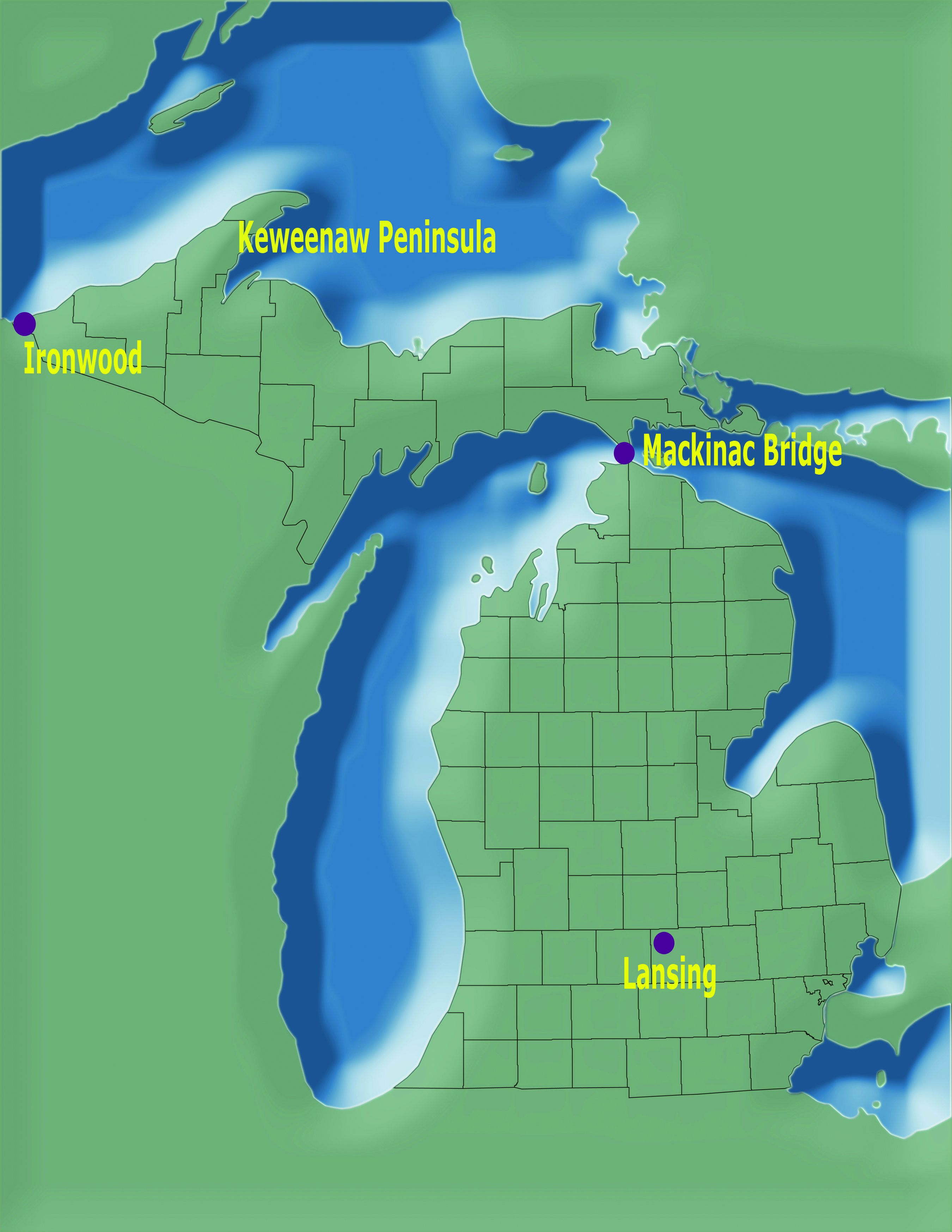
A map of Michigan with key locations showing the long distances required for travel. Color graphics available online at www.liebertonline.com/bsp
Civil Air Patrol History
The Civil Air Patrol (CAP) was founded in 1941 just before the Pearl Harbor attacks that thrust the United States into World War II. The CAP is a group of civilian volunteers who joined together to serve their country. After World War II, because of their wartime efforts, the CAP became a permanent part of the new United States Air Force (USAF). 4
Today, the CAP has 3 chief functions: aerospace education, cadet programs, and emergency services. 4 Under its emergency services mission, the CAP provides 5 distinct functions: search and rescue (for which it is best known), disaster relief, humanitarian services, USAF support, and counterdrug assistance. 4 The CAP can provide manpower for communications and emergency operations centers, search and rescue teams, and ground support teams. As the civilian auxiliary of the USAF, the CAP is placed under the Air Force Homeland Security Directorate. 4 Nationally, the CAP has 52 wings in 8 regions across the country with a total of 550 aircraft. 4 The CAP can place airplanes over any major city or strategic resource in the country in less than 2 hours.
Each wing of the CAP around the country is unique. The Michigan Wing of the CAP provides 85% of Michigan's inland search and rescue efforts and currently has more than 40 squadrons that span each of the 8 regions of Michigan. 5 These squadrons receive federal grant funding from the USAF and the Department of Defense in the form of cooperative agreements for training, exercises, and operations. 6 The CAP crews are National Incident Management System (NIMS) compliant. They regularly participate in required educational training, exercises, and flight hours. In Michigan, the CAP can respond to an identified airport within 90 minutes of initial activation. This response time is carefully coordinated with Michigan response and security personnel to ensure that the assets to be transported are organized and ready to be deployed when the aircraft arrive.
The majority of the aircraft used by the CAP are Cessna 172s (C-172) and 182s (C-182) and Gippsland A8s (GA8). The aircraft can hold a minimum of 220 pounds (in the C-172) and a maximum of 1,070 pounds (in the GA8) of cargo in 36 to 196 cubic feet of cargo space. The rear seats can be removed from each plane prior to loading assets for maximum cargo space. Eleven aircraft are available for use in Michigan to distribute supplies. 7 The 11 aircraft include: 5 C-172s, 4 C-182s, and 2 regional GA8s, with all being instrument flight rules (IRF) certified. 7 The aircraft's navigation systems, NEXRAD (Next Generation Radar) weather system, and the regular reports that the pilots receive from air traffic control assist the CAP pilots in making decisions about the safety of cargo and personnel.
The Strategic National Stockpile
The Centers for Disease Control and Prevention (CDC) manages and maintains strategically located stockpiles of medications and medical supplies across the nation. 8 These assets include antibiotics, chemical antidotes, antitoxins, life-support medications, vaccines, IV supplies, airway maintenance supplies, and medical/surgical items. 8 In the event of an emergency, the CDC will deliver assets from the Strategic National Stockpile (SNS) to a pre-identified location in Michigan within 12 hours of the federal decision to deploy. 9
The Office of Public Health Preparedness (OPHP) is the emergency response organization for the Michigan Department of Community Health (MDCH) and coordinates the activities of the MDCH Community Health Emergency Coordination Center (CHECC). The primary function of the CHECC is to coordinate a statewide public health and medical response in support of the State Emergency Operations Center (SEOC), such as providing real-time public health information, subject matter expertise, and strategic countermeasure distribution.
The CHECC is responsible for the rapid distribution of medical countermeasures (MCMs) in the event of a man-made or natural health crisis in the state of Michigan. It facilitates the rapid distribution of SNS assets to the affected areas of the state, which could conceivably include the entire population. To address these distribution requirements, the Michigan Strategic National Stockpile (MISNS) program maintains a detailed distribution plan that includes partnerships with government, military, volunteer, and private sector partners. An important planning consideration, however, is that government and/or military partners may be unavailable, depending on the national situation. Further, standing contracts with commercial carriers may prove unaffordable and/or unreliable. To address these concerns, Michigan has partnered with the CAP to provide a redundant means of transportation to locations across the entire state.
Once the federal SNS assets are transferred over to the state of Michigan, the MISNS team will coordinate efforts to redistribute these resources to local health departments and hospitals across the state. 9 Michigan has 45 local health departments that serve the entire state population. Because Michigan is a home-rule state, each local health department is autonomous from MDCH and locally maintains a comprehensive plan to receive and distribute SNS assets quickly. 9 The 8 Regional Medical Coordination Centers (MCCs) coordinate the distribution of SNS assets to approximately 155 hospitals statewide (Figure 2). Each of the 155 hospitals maintains an internal plan for requesting, receiving, and managing SNS assets. Local health departments and MCCs work together with Local Emergency Operations Centers (LEOCs) to ensure that the SNS assets are distributed to the areas of highest need in their jurisdiction.
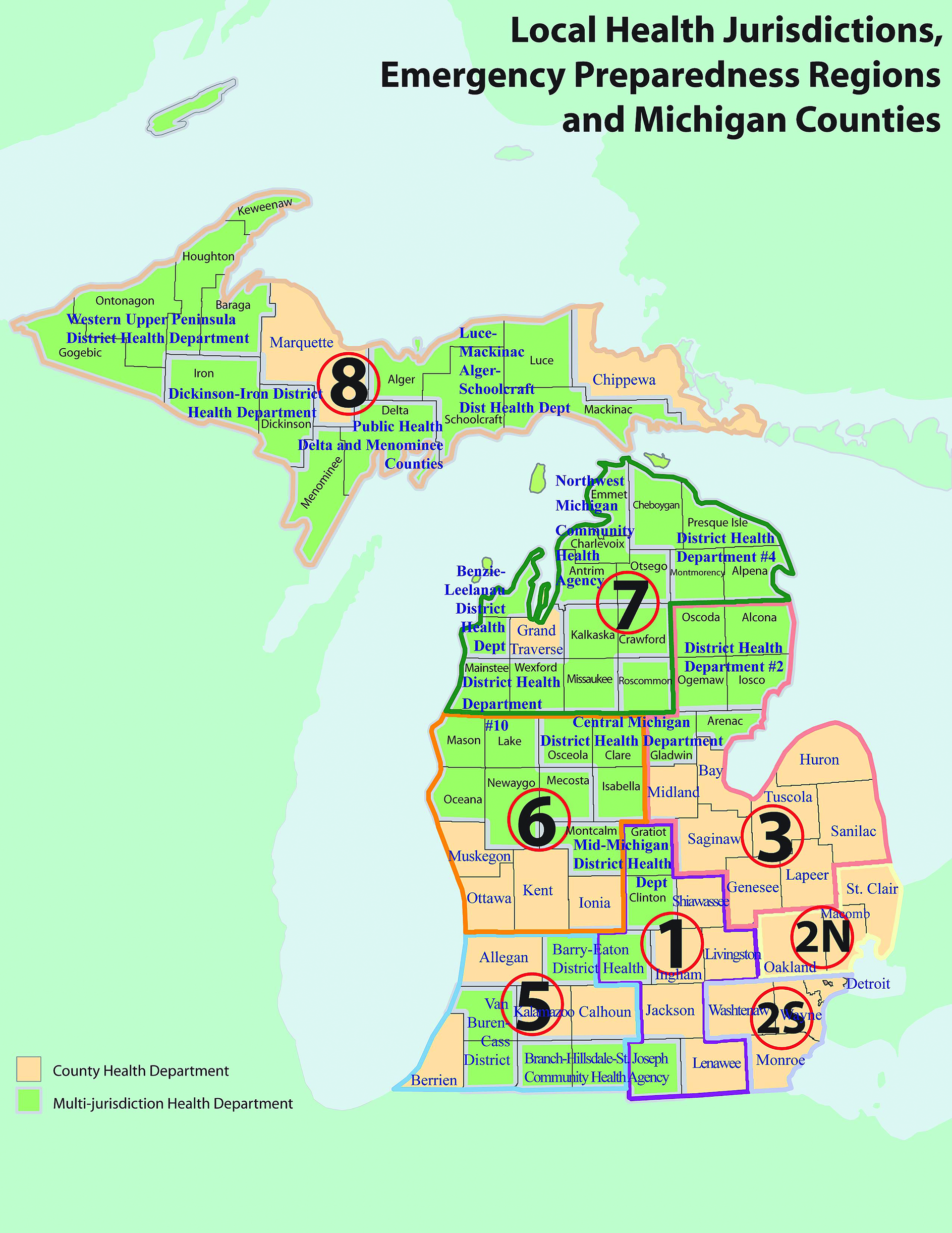
A map of Michigan local health department jurisdictions and preparedness regions. Color graphics available online at www.liebertonline.com/bsp
Many factors can affect delivery times for both air and ground transportation of SNS assets to local partners. The CAP is able to safely complete transportation missions during many situations where ground transportation of assets would be limited or impossible. For this reason, a partnership with the CAP was considered a reasonable transportation option to test.
Methods
In order to test the partnership between the state of Michigan and the CAP, 2 exercises were conducted, the first on September 6, 2008, followed by a second on September 25, 2008. MDCH/OPHP developed the MISNS/CAP exercises to test several important mass prophylaxis and communications functions, including chain of custody procedures, redundant transportation methods, and tactical communications. The objectives for both exercises included:
• Demonstration of state-to-local chain of custody procedures; • Evaluation of the air transportation method for delivery of medical countermeasures and personnel; • Demonstration of aircraft cabin temperature; • Demonstration of redundant communications capabilities in flight and on the ground; and • Demonstration of CAP personnel functionality in the CHECC.
First Exercise
The September 6, 2008, exercise scenario simulated CAP deployment in response to a biological event and included the transport of a simulated box of SNS antibiotics and a MISNS emergency responder, flown from Muskegon to Marquette, Michigan. During the flight, communications equipment and procedures using 800 MHz radios and satellite phones were tested. In addition, the temperature of the aircraft was monitored throughout the flight to ensure that the assets could be kept at the proper temperatures for the duration of the flight. The exercise was conducted in partnership with the CAP, the Marquette County Health Department, and the MDCH/OPHP. 10
Second Exercise
On September 25, 2008, the MISNS team and the CAP conducted a second exercise designed to transport SNS assets to each local health jurisdiction in the UP. The exercise began when MISNS staff rendezvoused with CAP personnel in Lansing. Two CAP aircraft were deployed to the UP, each having a mission to deliver simulated SNS assets and subsequently perform chain of custody protocols with local health officials at each of the 6 local health departments in the UP. While on the ground, the state-to-local chain of custody procedures were completed as was the performance of proper security escort measures, tactical communications functions, and airport accommodation activities.
Communications between CAP staff positioned in the CHECC and MISNS and local health department staff, both on the ground and while in flight, were repeatedly tested via 800 MHz radio. During both flights, satellite phones were also tested by MISNS staff to ensure functionality at different altitudes and inside various aircraft. The exercise was conducted in partnership with the CAP, the Chippewa County Health Department, Public Health of Delta Menominee Counties, the Dickinson-Iron District Health Department, the Luce-Mackinac-Alger-Schoolcraft (LMAS) District Health Department, the Marquette County Health Department, the Western Upper Peninsula District Health Department, and the MDCH/OPHP. 11
2009 H1N1 Pandemic Influenza
On April 26, 2009, Michigan confirmed its first case of 2009 H1N1 pandemic influenza. This triggered a full CHECC activation. The federal government declared a Public Health Emergency. 12 The CHECC responded by monitoring syndromic surveillance systems and hospital bed capacities statewide, providing public information resources to the State Joint Information Center and guidance to local and regional public health partners, and distributing emergency medical countermeasures to all 45 local health departments and 8 regional MCCs in Michigan. The CHECC facilitated a request to the National Operations Center (NOC) for the assistance of the Civil Air Patrol in distributing medical countermeasures to the northern region of Michigan. The CAP was activated through an official mission assignment and completed delivery of SNS assets to the 6 local health departments and 1 regional MCC in the UP.
Results
First Exercise
The exercise began in Muskegon, Michigan. Weather conditions forced several modifications to the anticipated flight plan of the C-182 and eventually necessitated an unexpected diversion to a nearby airport located in Escanaba. The MISNS staff member contacted OPHP and the Marquette County Health Department to notify both partners of the delay and to arrange for alternative transportation of the simulated assets to be available at the destination airport. The pilot closely monitored weather conditions on the ground and, after an hour and a half delay, determined it was safe to continue on to the destination airport in Marquette.
Once the plane landed in Marquette, the MISNS staff member was transported to the point-of-dispensing location by the Marquette County Health Department, where custody of the simulated assets was successfully transferred to the local level. In the afternoon, a local dispensing exercise was conducted at a football game, with arriving spectators participating in the exercise.
While the local dispensing exercise was under way, the CAP pilot remained at the airport to refuel the aircraft and perform routine inspections prior to returning to Muskegon. Once the dispensing exercise was complete, the MISNS staff member notified the CAP pilot so that final preparations for the return flight could be completed. The exercise concluded when the aircraft safely landed back in Muskegon.
CAP aircraft can maintain the acceptable range of 59°F to 86°F while in flight through the heating system. Because of this, the flight elevation had no effect on the cabin temperature. The simulated SNS supplies remained at controlled room temperatures throughout the flight. 800 MHz radios were operational in flight, but noise in the aircraft as well as incompatibility with the pilot's and passengers' headsets proved challenging. The satellite phones worked on the return flight but not on the initial flight, due to poor reception.
Driving the flight path from Muskegon to Marquette would take approximately 7.5 hours one way. By comparison, the actual flight time, including the delay of 1.5 hours, totaled 4.5 hours one way.
Second Exercise
The first aircraft, the GA8, departed from Lansing in the morning. The first landing of the aircraft was in Marquette, the second in Houghton, and the third in Escanaba. The second aircraft, the C-182, also left Lansing in the morning and first landed in Chippewa, then Schoolcraft, and completed its last delivery in Iron Mountain. Following the delivery of the simulated assets, both aircraft and crew arrived safely back in Lansing in the evening.
The exercise was completed in less than 9 hours, resulting in the completion of all exercise objectives. In comparison, driving the flight path of the GA8 would take 12 hours, not including the return trip from Escanaba to Lansing. In particular, chain of custody protocols were followed and proper security of crew and assets was maintained throughout the exercise. Additionally, the exercise demonstrated that tactical communications with the 800 MHz radios were fully functional in flight and on the ground at all delivery points, while satellite phone reception was limited during flight. Finally, the MISNS team and the CAP were both able to communicate and coordinate activities with the CHECC throughout the duration of the mission.
2009 H1N1 Pandemic Influenza
The MDCH Executive Group decided to deliver SNS assets directly to all local health departments and regional MCCs in response to the emerging influenza threat. The MISNS team first shipped antiviral medications to the local “hotspots” where H1N1 cases were either probable or confirmed. The MISNS team then delivered antivirals to the remaining jurisdictions in Michigan via ground transportation provided through state resources and commercial partners, or through air transportation via the CAP. When personal protective equipment (PPE) became available from the SNS, those items were also shipped from the state to the local level as needed.
On April 30, 2009, Michigan requested that the CAP prepare for delivery of SNS assets to the UP, to begin the following morning. The request process began with the state SNS coordinator contacting the CAP National Operations Center (NOC) and facilitating a formal written request to assign the mission to the Michigan Wing of the CAP for SNS distribution to the 6 local health departments and the regional MCC in the UP. Within minutes of the request being submitted, the mission was approved by the NOC, and the state SNS coordinator began working with CAP partners to plan the distribution of SNS assets. All 7 antiviral shipments were delivered by the CAP on May 1, 2009, and the CAP returned safely that same day during normal business hours. Because the CAP had previously exercised the air transportation of SNS assets with MISNS staff and local partners, the mission ran according to plan.
Discussion
The September 6, 2008, exercise lasted less than 12 hours from start to finish, but it provided several important after-action items that were incorporated into subsequent exercises and the 2009 H1N1 pandemic influenza response. Though slight weather delays affected the exercise schedule, air transportation of the simulated assets was still completed more rapidly than ground transportation could have delivered the materials, providing further evidence that aircraft delivery of SNS assets is a viable alternative for SNS distribution in Michigan. Additionally, communications protocols were evaluated, the state-to-local chain of custody process was tested, the ability to maintain temperature control of the assets was verified, and the developing partnership between Michigan and the CAP was strengthened. 10
The September 25, 2008, exercise was completed in less than 9 hours, with all exercise objectives met. In particular, chain of custody protocols were followed and proper security of crew and assets was maintained throughout the exercise. Additionally, the exercise demonstrated that tactical communications with the 800 MHz radios were fully functional in flight and on the ground at all delivery points, while satellite phone reception was limited during flight. Finally, the MISNS team and the CAP pilots were both able to successfully communicate and coordinate activities with the CHECC throughout the entire duration of the mission via 800MHz radio. 13 This demonstrates that the CAP is capable of redundant communications, which are essential during an emergency response. 11
During the 2009 H1N1 pandemic influenza response, it was determined that having a CAP representative in the CHECC allowed efficient planning and effective communication. 13 Having this representative present in the CHECC allowed for more rapid communications between the CAP and the MISNS team. Because the CAP representative was also in command for the mission, alterations could be made to flight routes and up-to-the-minute status updates for the CHECC could be provided. The CAP representative in the CHECC was in constant communication via 800MHz radio with the pilots, both while in flight and when the pilots were on the ground. 13 The partnership with the CAP greatly enhances the overall SNS distribution plan for Michigan, and effective planning resulted in a successful real-event emergency response. Because the CAP had previously exercised the air transportation of SNS assets with MISNS staff and local partners, the mission was effective and efficient.
While there are many transportation issues unique to Michigan, other states may also experience similar challenges. The CAP is capable of traveling to areas where many motor vehicles are unable to go in less time than it would take by ground. If road closures and weather delays exist, the CAP is capable of flying above some storms in order to complete deliveries to rural and isolated delivery sites.
Emergency response planners and partners nationwide should consider visiting the national CAP website (www.gocivilairpatrol.com) to locate contact information for the nearest available CAP wings in their area. Once a point of contact is established between agencies, it is recommended that a face-to-face meeting be arranged to discuss what types of planes are available as well as crew capabilities in that area. State and local emergency management officials should also be included in these discussions. In addition, it is recommended that SNS planners contact the local airports in their area to discuss the possibility of using the CAP for distribution of medical countermeasures during a public health emergency.
If all parties are in agreement that using the CAP is a viable option for asset distribution, it is suggested that a memorandum of understanding be signed between the CAP and respective agencies. This agreement will outline what role the CAP will fulfill during emergencies. After the partnership is established, training and exercises with all partners is recommended to take place on a regular basis to ensure that the policy and procedures are in place and will function appropriately during an emergency. Michigan was able to exercise this partnership and process months before a real-world event occurred, which undoubtedly led to the success of the mission and the ability for the remote regions of Michigan to receive emergency medical countermeasures well ahead of ground transportation.
All CAP wings can be mission assigned by the USAF as a federal asset; therefore, any state can request the CAP to include the use of aircraft in other states. If the emergency is large enough, CAP wings from other states can be used to augment a state response. One aspect that's favorable to other emergency planners around the country is that the USAF covers the cost of each CAP mission that is approved by the NOC.
Limitations
The MDCH was not able to test all aspects of using the CAP for SNS asset transport. Antibiotic use by pilots is a concern. Pilots are not recommended to fly while taking an antibiotic because of the possibility of their experiencing adverse events or side effects from the medication. Therefore, this item was not exercised during the CAP drills. MDCH will work with the Civil Air Patrol at the time of the event to determine the appropriate time to provide CAP volunteers with prophylactic medication if necessary.
While the exercises show that temperatures were maintained during flight of SNS assets, it has to be taken into account that the readings were taken during September, which, in Michigan, is a temperate month without high or low extremes. If the exercises were performed during a hot or cold month, there would have to be more care taken to keep the temperature of the SNS assets in the proper range. A drill with the CAP took place on July 9, 2011, in another simulated transport of SNS assets, and preliminary data show the temperature of the assets remained in the acceptable range.
Transporting SNS assets during the winter months in Michigan can be difficult. One issue when flying during the winter months is the ability for some airport runways to be clear of ice and snow for safely landing planes. Again, MDCH was not able to test during the winter; however, the CAP takes into account the conditions at each airport before selecting their destination.
Footnotes
Acknowledgments
These resources and activities are supported by grant 5U90/TP517018-09 from the Centers for Disease Control and Prevention. The authors acknowledge Mary Sharp, Elizabeth Ritchie, MS, and Dr. Jacqueline Scott, PhD, DVM, from the MDCH OPHP for their contributions to the manuscript. The authors would also like to acknowledge the Michigan Wing of the Civil Air Patrol for their assistance.