







Abstract

Case Report
The subject is an 8-year-old boy who presented with his mother due to typical symptoms of ADHD. He was given a diagnosis of ADHD combined type with normal intellectual capacity. His prenatal, postnatal, and early developmental history was unremarkable. He had a generalized tonic–clonic seizure at 3 years of age, but has been seizure free since then. He had been on valproate 150–250 mg/day treatment between 3 and 4 years of age. However because his control electroencephalogram (EEG) revealed abnormality, he was restarted with valproate 400 mg/day for the last 3 months. He has no known drug or food allergies so far. He has never been treated with any psychopharmacological agent except for the previous and current antiepileptic treatments. No dermatologic reactions or eruptions have been reported with valproate.
He first started IR MPH at 10–20 mg/day. He generally tolerated IR MPH well with some level of decreased appetite but without significant change in his weight. He did not report any SE with IR MPH. He was in school all day and reported forgetting to take his medication sometimes. Therefore, although his ADHD symptoms showed moderate improvement on IR MPH 20 mg/day, we switched to OROS MPH 18 mg/day treatment after 2 months. He then presented in an emergency department due to emergence of maculopapular pruritic SE on his neck, arms, and legs 1 week after starting OROS MPH treatment. The mother was recommended to stop the medication. We saw him again after 1 week of a medication-free period. He had multiple scabby skin lesions, particularly on his legs, arms, and neck. He reported that they were extremely pruritic, and he scratched them until they bled and scarred over. A general pediatric and dermatological consultation revealed no significant cause to explain these eruptions.
Meanwhile, neurology switched his antiepileptic medication from valproate to gabapentine 300 mg/day. He was reviewed after 5 weeks of a medication-free period; his skin lesions almost were healed, although leaving some visible scars. His ADHD symptoms continued and the mother consented to readminister OROS MPH 18 mg/day. However, he developed the same SE at the ninth day of OROS MPH treatment with the same severity. The mother and child denied eating any unusual food, taking other medication rather than OROS MPH and gabapentine, or being exposed any allergic environment during that time. A dermatologist designated these SE as maculopapular. He did not have mucosal lesions or constitutional symptoms suggestive of Stevens–Johnson syndrome (SJS) or more severe toxic epidermal necrosis (TEN). We discontinued medication and skin lesions abated within the next several weeks. We interpreted these SE as an unusual adverse event related with OROS MPH treatment. Subsequently we restarted IR MPH 10–20 mg/day. He did not develop any SE while he was on IR MPH 20 mg/day during the next 4 months. However, his previous skin lesions persisted in that they left some amount of visible scarring (Fig. 1).
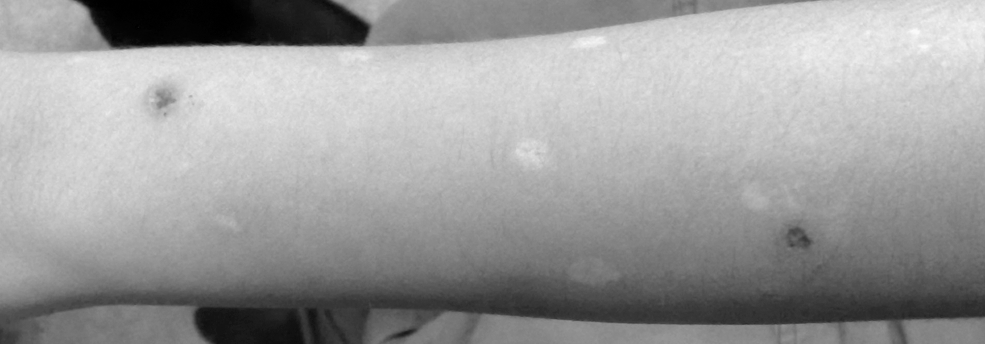
Photo of patient's arm taken after 8 days of discontinuation of first OROS MPH trial. The lesions were originally smaller maculopapular lesions that are not apparent here. The lesions in the picture (scabby and healed lesions seen together) were produced by severe scratching.
Discussion
MPH has rarely been reported to cause SE in subjects with ADHD (Cohen et al. 1992; Confino and Goldberg 2005). However, in our opinion, the unique aspect of this case is that SE occurred only with OROS MPH treatment. The patient developed SE with OROS MPH at two different occasions, but no SE with IR MPH at two different trials. Emergence of SE with OROS MPH and disappearance with discontinuation at both trials may suggest enough causality between SE and OROS MPH treatment.
The package inserts of Concerta and Ritalin by the manufacturer include allergic reactions and/or skin rash among possible adverse events. However, the issue in this case is that the patient developed SE only with OROS MPH treatment. Given the fact that IR MPH did not cause SE, a question may be raised as to whether this reaction was due to MPH itself or another substance available in OROS MPH capsules. In line with this consideration, we noted that Concerta capsules contain several substances (such as butylated hydroxytoluene, carnauba wax, cellulose acetate, hypromellose, phosphoric acid, poloxamer, polyethylene oxides, povidone, propylene glycol, sodium chloride stearic acid, succinic acid, synthetic iron oxides, titanium dioxide, and triacetin) not available in Ritalin tablets (Food and Drug Administration website). Despite the statement “hypersensitivity to methylphenidate or other components of product” included as a contraindication in package insert of Concerta, there is no further information that one of those substances may cause allergic reactions or skin eruptions.
Meanwhile, in the case of drug-induced SE, clinicians should be aware of the possibility of SJS or more severe TEN. They are usually acute life-threatening conditions. TEN causes erosions of the mucous membranes, extensive detachment of the epidermis, and severe constitutional symptoms. Milder forms are known as SJS. A limited number of drugs, including sulfonamides, anticonvulsant agents, and allopurinol, are the most consistently associated with these conditions (Roujheau et al. 1995). Our case had been followed-up for the possibility of developing a more severe clinical picture. However, he had no mucousal erosions or constitutional symptoms suggestive of SJS or TEN during 2 months of close follow-up.
The presence of another medication, valproate, in the first trial and gabapentine in the second trial is another concern regarding possible drug interactions in this case. However, both valproate and gabapentine did not cause any SE either alone or in combination with IR MPH. This may further suggest the role of OROS MPH in the emergence of SE. However, it remains unclear at this point whether OROS MPH would cause same SE alone. In the presence of MPH-induced SE, clinicians may consider either switching to another psychostimulant or desensitization procedure against MPH. Confino and Goldberg (2005) previously reported successful desensitization of MPH-induced rash in a subject with ADHD.
In conclusion, prescribers and users of OROS MPH should be alert to the possibility of such an adverse reaction. To our knowledge, this is the first reported case of such a dermatologic reaction occurring only with OROS MPH treatment. Further research is needed to explain this unusual phenomenon.
Footnotes
Disclosure
Drs. Coskun, Tutkunkardas, and Zoroglu have no conflict of interests or ties to report.