







Abstract
The aim of this brief report is to offer a solution for a problem that compromises the quality of in vitro-produced mammalian embryos. The harmful effects of evaporation-induced osmotic changes in mammalian embryo cultures have been recognized only recently. In this technical report, we describe a modified embryo culture dish (Humdish) that provides consistent >97% humidity and fully eliminates osmotic changes in the commonly used drop-under-oil culture systems from day 0 to 6. As an additional benefit, the Humdish also increases the temperature stability of cultures. If subsequent laboratory and clinical experiments prove its value, our suggested approach may help to improve the in vitro environment and quality of all preimplantation stage mammalian embryos, including the most sensitive ones produced from artificial gametes or by somatic cell nuclear transfer.
Introduction
Although osmolality was always regarded as a crucial parameter of media used in assisted reproduction, its change during embryo culture was ignored until recently (Fawzy et al., 2017; Mestres et al., 2021; Mullen, 2021; Swain, 2014). During the first decades of in vitro fertilization (IVF), when short-term group cultures were used in a humid atmosphere, no dramatic changes in osmolality occurred, and most embryologists supposed that the oil overlay prevented dehydration completely. This false assumption led to the introduction of purpose-made dry benchtop topload incubators from the early 2000s, with the declared purpose of increasing the accuracy of sensors and decreasing the hazards of infection and corrosion.
Although retrospectively none of these reasons was entirely justifiable, various versions of dry incubators flooded the market. In addition, extended culture and blastocyst transfer were also introduced those years; fortunately, the two-phase culture systems recommended at that time counterbalanced the problem caused by the lack of humidity for another decade. It was only after 2010, with the introduction of time-lapse machines and the consequent application of single media-single embryo-uninterrupted cultures that the controversial results drew attention to dehydration. A growing number of studies found a considerable elevation of osmolality with a potential or actual harmful impact on embryo development in vitro and subsequently in vivo.
The increased osmolality of the embryo culture media may cause shrinkage, oxidative stress, protein carbonylation, mitochondrial depolarization, DNA damage, cell cycle arrest, and apoptosis (Chi et al., 2020). The transfer of human embryos cultured in dry incubators resulted in decreased implantation and pregnancy rates (Fawzy et al., 2017). In contrast to other damaging factors, high osmolality was found more harmful during late preimplantation development, a period when uninterrupted cultures in dry incubators lead to peak levels of dehydration (Chi et al., 2020).
Evaporation is by far the most significant mechanism of dehydration in embryo culture drops. Although it may be modified by several factors, including the thickness and viscosity of the covering oil layer or the shape of the dishes and droplets, there is only one way to prevent it completely: maximum humidity, that is, an atmosphere fully saturated with water. The lack of humidity in dry incubators may cause a significant increase in osmolality as early as 24 hours after the beginning of culture. Unfortunately, even humidified incubators may show marked variations in the basic level of humidity and recovery rates after door opening (Mestres et al., 2021). Moreover, certain recent attempts of manufacturers to create humidified incubators from dry ones have been made in a rather primitive and uncontrollable way.
In contrast, replacing the ubiquitous dry incubators with highly reliable humidified ones would be a demanding task for laboratories worldwide, and the process might last for decades. Let us refer to a similar situation: the harmfulness of atmospheric oxygen levels during embryo culture was generally acknowledged 10–15 years ago. Nevertheless, the majority of human IVF laboratories worldwide still fail to use tri-gas incubators, primarily for financial reasons (Sciorio and Smith, 2019; Vajta et al., 2021). The situation is similar in many domestic animal embryo laboratories, where the financial situation is even more restrictive.
The safest—and most affordable—way to eliminate the problem of evaporation is to establish and maintain a stable humid atmosphere in the embryo culture dish itself. However, the available dishes are not suitable for the purpose. The storage capacity of the center of Nunc four-well dishes (Gasperin et al., 2010) as well as organ culture (Chi et al., 2020) or Cooper Surgical GPS dishes (manufacturer's manual) is insufficient (7, 4, and 4 mL, respectively); this means that in dry incubators, the water placed in them may evaporate in 2–4 days. In contrast, the <45% humidity achieved by adding water-filled extra petri dishes to the compartments of benchtop incubators was far below the required level (Holmes and Swain, 2018).
The purpose of this study was to find a simple, inexpensive, and reliable solution that is applicable in almost all commercially available incubators and eliminates completely osmolality changes in the widely applied drop-under-oil culture systems.
Materials and Methods
Our purpose-designed humidifying dish (Humdish) consists of a 60-mm-diameter round plastic petri dish with a 25-mm-diameter central inner well, separated from the outer ring by a single-layer wall (Fig. 1). The dish may store up to 13 and 4 mL fluids in the outer ring and the well, respectively, without the risk of spilling during manipulation and transportation in the laboratory. By using the wash-drop method (i.e., placing 5 μL medium to the bottom, then quickly covering it with oil, and replacing the drop with the required final volume; Swain et al., 2012) 16 or 12 drops with 10 or 20 μL volume, respectively, can safely be placed in the central well.
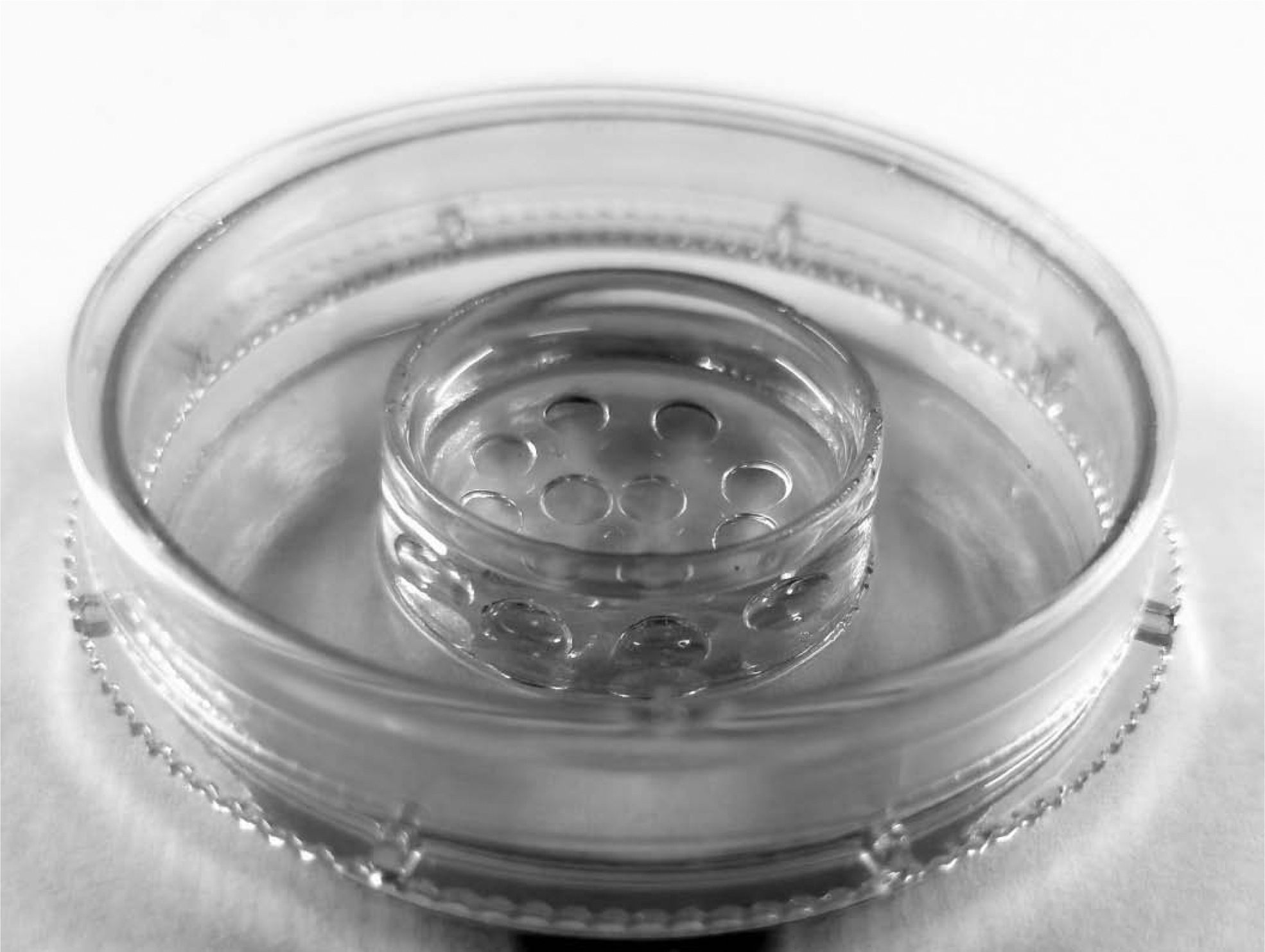
The Humdish, with 20 μL medium drops covered with 3 mL mineral oil.
Evaporation and humidity tests were made in a laboratory with 25°C room temperature, in a DHP-9052 incubator (YiLin, China) without humidification, adjusted to 37°C and filled with atmospheric air. Humidity was measured with a DT2 device (Elitech, China) with an external sensor placed in the incubator or attached to the inner surface of the lid of the Humdish. The humidity levels in the laboratory and incubator were 47% ± 3% and 35% ± 2%, respectively.
The outer rings of the Humdishes were filled with 13 mL sterile distilled water; in the central well, 12 20 μL drops were placed and covered with 3 mL of mineral oil (M5310; Sigma-Aldrich). In control dishes, no water was added to the outer ring. The temperature of all fluids was 25°C. An ambient temperature laboratory bench was used for dish preparation, no airflow was applied, and the room ventilation was turned to the lowest level. The osmolality of the medium of the drops was measured before and after incubation with an 030-D type osmometer (Gonotec, Germany).
We also investigated if the Humdish provides enough ventilation for maintaining the required pH of bicarbonate-buffered media. Wells of Nunc four-well dishes (Z688754-120EA; Merck, Australia) and central wells of Humdishes were filled with 1.8 mL embryo culture medium (V-0040; VitaVitro, China) and incubated at 37°C in an MCO-18M incubator (Sanyo Electric, Japan) under a 5% CO2, 5% O2, and 90% N2 atmosphere with maximum humidity. The pH was determined with a PHS-3E pH meter (INESA, China).
Results and Discussion
During the 6-day incubation period, the humidity level inside Humdishes was consistently between 97% and 99%. On day 6, the amount of water in the inner ring was 7.6 mL, providing a safe reserve for an extended incubation period and/or a drier incubator atmosphere. In control dishes without water in the outer ring, the humidity varied between 46% and 37%, with an average of 40%. Consequently, the average osmolality in the drops of Humdishes was 266 ± 1 both before and after incubation. In the control dishes, with the empty ring, the osmolality increased to 279 ± 2.
The initial pH of the embryo culture medium was 8.30. In four-well dishes, pH 7.61 and 7.50 were detected after 2 and 24 hours incubation, respectively. The corresponding values in Humdishes were 7.51 and 7.51, respectively. The differences were not significant.
Although similar tissue, organ and embryo culture dishes are commercially available, none of them offers the unique benefits and features of the Humdish. Owing to the 60%–200% larger volume of the outer ring and narrower gap between the walls of the dish and the lid, high and consistent humidity levels can be maintained in the Humdish even for an extended period of time (day 0–6) during human embryo culture. For additional assurance, high walls of the inner ring allow the safe use of a 7-mm high oil layer, doubling the standard thickness applied in 35-mm petri dishes, and decreasing further the chances of evaporation.
There is no need for sophisticated monitoring systems; the presence of ample amount of water in the outer ring at the end of the culture provides evidence for proper humidification. The size and shape of the dish are compatible with almost all incubators used for embryo cultures, including several time-lapse machines. The Humdish is a straightforward way to eliminate the differences between humid and dry incubators, the humidity level inside the dish is entirely independent of the external environment. In addition, it prevents the humidity changes caused by door openings and decreases the fluctuation when the dish is removed, for example, for optical control on day 3—if required. As a consequence of these features, the osmolality level of the media remains constant during the entire culture period.
As the central well can hold 16 or 12 embryos individually in 10 or 20 μL droplets, respectively, one or two dishes seem to be enough for an average IVF cycle. Moreover, the future combination of the Humdish with microwells may allow individual tracking of up to 50 embryos per dish (Vajta et al., 2021). An additional benefit is that the high amount of water also prevents sudden and sharp fluctuations of temperatures during door opening or temporary removal of the dish from the incubator.
In conclusion, the Humdish offers a simple, inexpensive, and logical solution to eliminate completely evaporation-induced osmolality changes, while also contributing to temperature stabilization of embryo cultures. The dish is easy to install, it does not require an expensive investment, and could be applied without delay in most embryology units. It is a proof of concept; experiments in various laboratories and different experimental models are needed to prove its practical value. It offers the possibility to improve embryo quality and in vivo developmental competence, and may contribute to the overall efficiency of special systems, including those based on nuclear or cytoplasmic transfer, or artificial gametes.
Footnotes
Author Disclosure Statement
W.B.C. and G.V. are employees of VitaVitro Biotech Co., Ltd., Shenzhen, China. The company has a potential interest in producing new devices for embryo culture. Other authors declare no conflicts of interest.
Funding Information
No funding was received for this article.