







Abstract

As omics technologies continue to migrate toward clinical applications, a market involving prognostic and predictive biomarkers is growing rapidly. This is an important space as it represents the segregation of biomarkers into classes based on their clinical utility. Biomarkers will be fundamental to the success of targeted therapeutics in the future.
The implementation of personalized medicine in oncology and beyond requires a precise understanding of disease progression as well as molecular targeting of therapies to interrogate molecular lesions. Prognostic and predictive biomarkers have the power to affect these two functions, respectively. Indeed, many putative biomarkers have been postulated in the literature, but few have successfully been utilized in the clinic. If personalized medicine is to expand and scale across therapeutic classes, biomarkers must proliferate and find clinical utility.
Prognostic biomarkers provide a trajectory for the clinical progression of disease without providing any guidance on the course of treatment or dosage. Predictive biomarkers offer guidance on the type of therapy to be considered for a given patient in a disease class and may be useful regarding questions on dosage/administration, that is, which patient(s) require a higher dosage vs. others based on in vivo drug metabolism.
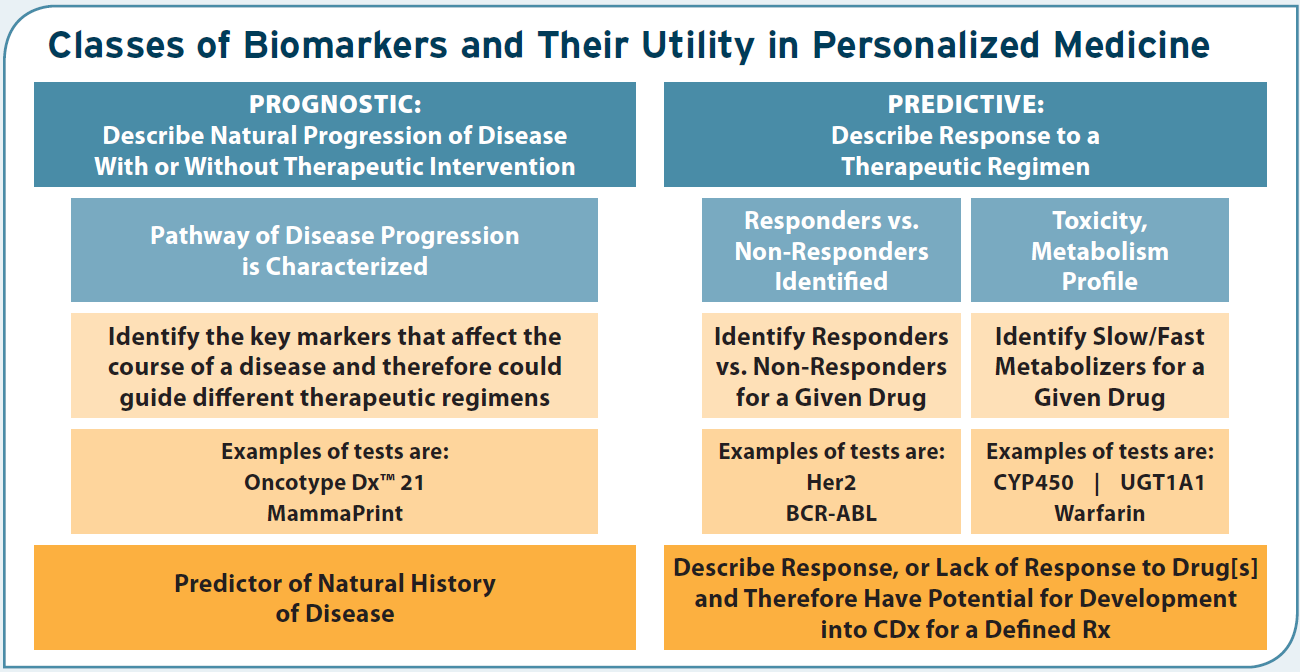
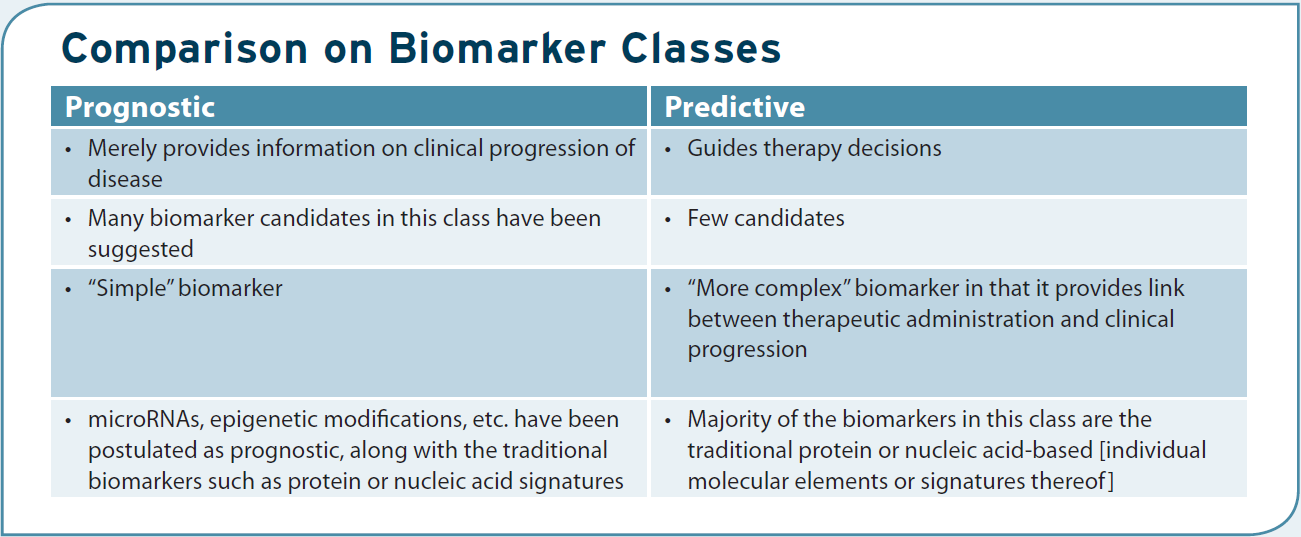
Some examples of prognostic biomarkers in clinical use in cancer medicine are BRCA1 (breast cancer), CEA (colorectal), and c-KIT (gastrointestinal stromal tumors). Predictive clinical biomarkers for cancer include EGFR1 (non-small cell lung cancer and colorectal cancer) and ER (breast cancer).
In the future, classes of biomarkers such as circulating biomarkers, microRNAs, as well as epigenetic modifications may serve to broaden the repertoire of prognostic and predictive biomarkers.
The progression of biomarkers from prognostic through predictive is heading toward the deployment of assays/ tests in point-of-care settings and, with a smartphone or other telemetry-based approach, mobile point-of-care applications. Such a paradigm is crucial since it enables the full potential of biomarkers to be unleashed outside of traditional hospitals and clinics.
Potential benefits include the broad adoption of these tests worldwide, the lowering of costs, and the expansion of addressable disease areas.