







Abstract

The initial diagnosis of cancer is usually based on taking a physical biopsy and then a skilled interpretation by a pathologist followed by tumor genome sequencing to generate informed treatment decisions.
Numerous genomic targets have been utilized as diagnostic markers for treatment with specific therapeutics. Indeed several anticancer therapies require that pharmacogenomic information is obtained before treatment can be initiated. Diagnostic tests that have established this new standard of care include ER and HER2 in breast cancer, BCR-ABL in chronic myeloid leukemia, c-Kit in gastrointestinal stromal tumors, BRAF in melanoma, KRAS in colorectal cancer, and EGFR and ALK in lung cancers.
With increasing development of targeted therapeutic agents in oncology comes a corresponding need for personalized treatment strategies. These strategies will facilitate the selection of patients who are most likely to benefit from a particular therapy, while simultaneously avoiding the cost and morbidity of futile interventions.
Currently tailored therapy relies on the identification of the correct molecular tumor target based on the biopsy of tumor tissue, generally from the primary tumor. This process is central to the management of cancer even though these biopsies carry some risks for patients; they are painful, they are costly and, importantly, the process takes time. In addition, given the complexities of tumor heterogeneity, both within a tumor and between a primary tumor and metastasis, a tissue sample may not be a true representation of the molecular profile.
Next-Generation Sequencing
Now there is a possibility of using next-generation sequencing (NGS) to not only diagnose but to also characterize cancers, based on circulating cancer cells or circulating cancer DNA found in various bodily fluids, typically whole blood, plasma, and urine. The benefit of using a liquid biopsy is that samples are easier to obtain and can be taken many times to routinely monitor the state of the tumor and follow any genomic changes that are occurring with the minimum of discomfort to the patient.
In addition, a liquid biopsy, will capture the entire heterogeneity of the disease where tumor genotypes are notoriously unstable and prone to changes under selection pressure, e.g., from drug treatment. In this regard, liquid biopsies offer what tissue biopsies cannot in respect to the opportunity to take serial samples in order to monitor tumor genomic changes in real time allowing clinicians to ensure that the therapy they have selected, based on a particular molecular target, remains relevant.
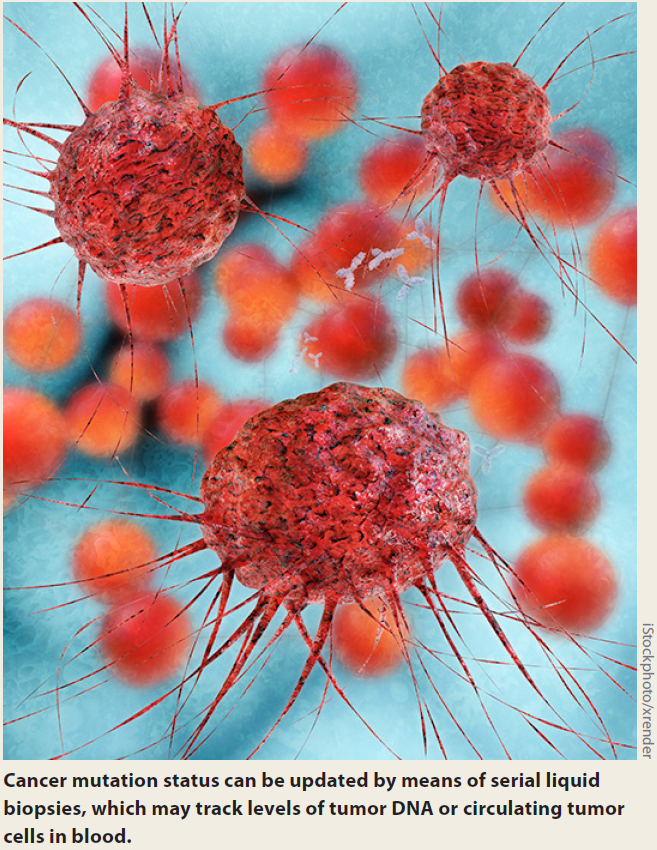
Using NGS allows the identification of the changing genome of the tumor and could indicate when the current treatment is becoming less effective and a new treatment regimen is required to treat different molecular targets. Tracking levels of tumor DNA or circulating tumor cells (CTCs) in a patient's blood could be the most powerful method to track a patient's changing cancer mutation status during treatment progression.
It is now possible to identify at an earlier stage if a treatment is not working and to spare the patient the unnecessary toxicity of a drug that no longer provides any benefit. At the same time, it is possible to observe if new molecular targets are expressed that could be suitable for treatment with a different drug regimen. All this could help to provide patients with the right treatment for the right target at the right time.
Although relatively abundant in late-stage diseases, the tumor burden found in the blood is limited compared with the number of cells obtained via tissue biopsy. Most key predictive biomarker tests would need sensitivities at the single-cell level in order to successfully be detected in blood. In a best-case scenario, detection of expression, amplification, and mutation changes requires sensitivities of one tumor cell in 100,000 nucleated blood cells. However, tumor cells are more likely to occur at only 1:1,000,000, or even down to 1:100,000,000 in the total nucleated cell population.
iStockphoto/xrender
Tumor DNA
Currently, the focus for clinically actionable markers include circulating tumor cells (CTCs) and tumor DNA. For women with breast cancer who had a reasonably large number of escapee cancer cells in their blood, the number of these cells mirrored their response to treatment reasonably well—the number of cells fell after chemotherapy, and slowly climbed back up again as the cancer returned. However when there were relatively small number of cancer cells in their blood to start with (reflecting the fact that they have fewer and/or smaller tumors) there was no match to treatment response.
Measuring the levels of tumor DNA in the blood provided an even better match in most of the women, tracking the changes in their cancer through several cycles of treatment. Measuring tumor DNA can reveal how a patient's cancer is changing and evolving at the genetic level—something which is vital if there is to be progress in “personalizing” treatment.
How is this personalization achieved? Ideally you need a technology that will be specific, highly sensitive, and work on a small sample that requires minimal preparation. There are various NGS technologies available that can be used, but each has its shortcomings.
EKF's PointMan™
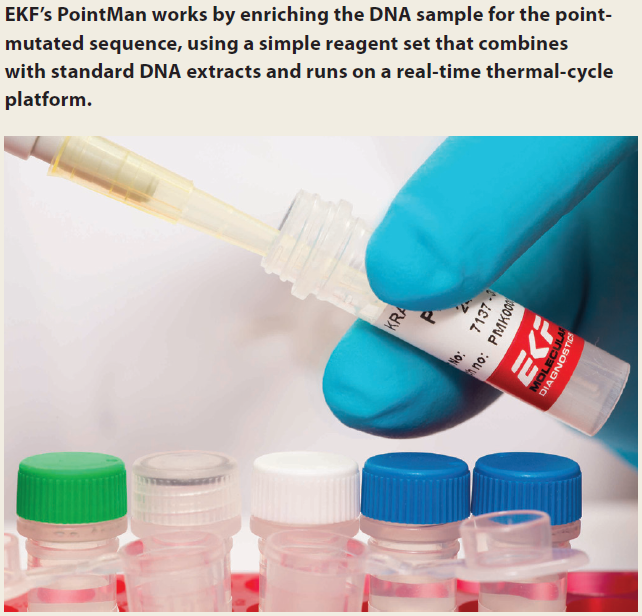
This technology works by enriching the DNA sample for the point-mutated sequence, using a simple reagent set that combines with standard DNA extracts and runs on a real-time thermal-cycle platform. The product of the PointMan enrichment assay is used in combination with standard detection methodologies such as PCR, pyrosequencing, and Sanger sequencing. PointMan works with all industry-standard instrumentation and laboratory-based systems for extracting DNA, and the whole test occurs in real time, taking less than two hours from a minimally prepared sample.
Advantages of PointMan include:
Minimal amount of sample required
Ultra-sensitive, mutations enriched down to 0.001% in a background of wild type
Multiple mutations enriched as 3' and sub 3' mismatches to the enriching primer
Highly specific: reagents do not encode for the mutation of interest, so no risk of mis-priming and false positives
Rapid analysis, time to result is fast (<2 hours)
Compatible with industry standard instruments and DNA extraction methods
For measuring the DNA in circulating blood, serum or urine it must be possible to efficiently enrich and recover minute amounts of small, fragmented nucleic acids from these fluids, which is exactly what PointMan is capable of doing on a routine, predictable and reliable basis.