







Abstract

The dominant paradigm in clinical oncology is personalized (therapeutic) medicine driven by precision diagnostics based on a solid foundation of basic and translational research in oncogenesis and signaling pathways. It is recognized that malignant transformation occurs through the accumulation of somatic mutations with the ultimate evolution to a malignant tumor that is “addicted” to the signaling programmed by a driver mutation. Advances in medicinal chemistry have allowed oncologists to directly attack this process with agents specifically targeted to block the oncogenic signaling resulting from the driver mutation, thereby releasing the addiction.
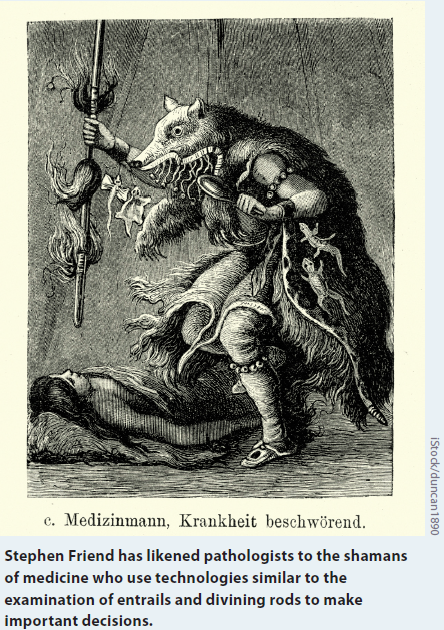
The success of multiple individual targeted therapies and the inability to make associations between histopathology and somatic genetic mutations has led to an enthusiasm, perhaps quixotic, for genomic diagnosis and has fostered the temptation to consider pathologic diagnoses antiquated. In fact, Stephen Friend, who cloned the retinoblastoma gene in Robert Weinberg's laboratory, has likened pathologists to the shamans of medicine who use technologies similar to the examination of entrails and divining rods to make important decisions (He & Friend. Nature Medicine 2001;7:658-9). The overall result is that current approaches stress aggressive genomic diagnostics and targeted therapies, which are expensive, creating a perfect storm in the current climate of financial efficiency that emphasizes value in medicine.
The critical importance of genomic diagnostics has come to the forefront of clinical research in the form of basket trials in which treatment decisions are based on the detection of actionable driver mutations and are agnostic to pathologic type (including tissue of origin). Clearly, there have been some therapeutic successes with this approach, such as the effective therapy of hairy cell leukemia (demonstrated in multiple reports, including Dietrich et al. N Engl J Med 2012;366:2038-40) that have the BRAF (V600E) mutation with antagonists that are effective in melanomas that carry this mutation. There have also been failures, exemplified by the lack of significant clinical responses to these agents in colorectal adenocarcinomas positive for BRAF (V600E).
The preliminary findings from two therapeutic trials directed by genomic diagnosis (von Hoff et al. J Clin Oncol 2010;28:4877-83 and Tsimberidou et al. Clin Cancer Res 2012;18:6373-83) have suggested that this approach may be clinically useful. This question has been more thoroughly addressed in a recently published well-controlled, randomized prospective Phase II trial, designated SHIVA (LeTourneau et al. Lancet Oncol 2015). The relative clinical efficacy of molecularly targeted therapy directed by the genomic diagnosis, agnostic to pathologic diagnosis and anatomic origin, was compared to conventional chemotherapy with 99 patients in the experimental group and 96 patients (with a similar inventory of mutations!) in the control group. The results of the SHIVA study did not show a statistically significant difference in progression-free survival between patients receiving the molecularly targeted therapy (mean = 2.3 months) and those receiving conventional therapy (mean = 2.0 months). Surprisingly, there was a higher incidence of significant adverse toxicity in patients receiving targeted therapy (43% versus 35%).
Although SHIVA represents an important milestone in the progression of emerging oncology therapeutics, it is premature to minimize the importance of genomic analysis in the design of antitumor strategies and it is important to learn from the limitations of the study. While substantial numbers of patients with actionable genomic alterations were studied, the total numbers of patients were limited. Since the mutational analysis was performed using a pan-cancer panel of approximately 50 genes, the overall genomic context of somatic sequence variations that could modify the effects of the dominant driver gene could not be determined. In addition, other genomic changes such as methylation and gene copy number variations, which currently attract limited analysis, could increase the complexity of differences in gene expression of these tumors.
iStock/duncan1890
While dramatic clinical responses have resulted from therapy with molecularly targeted agents, they are frequently temporary because of the emergence of resistance, manifested from one of a variety of mechanisms, and, potentially, by tumor heterogeneity. So…after a decade of experience of targeted therapy in colon cancer and a few years in lung cancer, it is recognized that the evolution of therapy is not as simple as one driver gene, one therapy, and next generation of antagonists to combat resistance. Remembering that both oncogenesis and the development of resistance are multistep processes, a more comprehensive genomic analysis, including expression, may be required to adequately survey the composite of targets required for effective therapy.
The SHIVA trial has raised significant questions regarding the efficacy of using molecularly targeted therapies outside of indications established in clinical trials based on pathologic diagnosis and anatomic site of origin of the malignancy. Interestingly, Shiva, as one of the major deities in Hinduism, is known as “the destroyer”, inviting the question whether the SHIVA clinical trial could be a significant set back for therapeutic strategies that are pathology-agonistic and exclusively driven by genomic alterations. Shiva is also known as “the transformer” and, the understanding gained from the limitations in the trial (Shiva's third eye) along with the NIH-sponsored MATCH trial (Molecular Analysis for Therapy Choice) may provide critical insights that lead to the next steps critical for cancer therapy. Until then, pathologists can safely keep their microscopes!