







Abstract

Writing in The CRISPR Journal, researchers at InBio recently reported progress in characterizing and targeting a key gene responsible for cat allergies, paving the way (perhaps) for a hypoallergenic kitty.
Genome editing, including CRISPR technologies, provides an exciting new avenue for the development of therapeutics and the potential to cure genetic diseases and cancers. 1 These technologies will edit the genome of a cell line or a developing embryo, attempting to correct flaws and deficiencies, thereby producing genetically modified products or organisms (GMOs). As the world struggles with the acceptance of GMOs in their hearts and minds, 2 what better way to demonstrate the utility of genome editing by implementing a modification in not only a well-established biomedical model for diseases but also a beloved companion animal, the domestic cat.
Although we continue to argue the virtues and sins of using companion animals in biomedical research, there is no doubt that the standards of animal husbandry and welfare have vastly improved for laboratory animals as a direct outcome of debates and discussions concerning animal care and use. The three R's—refine, reduce, replace—are part of the certain dogma for animal studies, 3 which was highlighted in the cover research article by Brackett et al. in the April 2022 issue of The CRISPR Journal (Fig. 1). 4 Brackett's team at InBio, a biotech company in Virginia, launched investigations for producing a genome-edited knockout of the major cat-specific allergen gene, termed Fel d 1. Their report provides a comparative genomic analysis of the Fel d 1 gene as a prelude to taking the first in vitro, if not yet in vivo, steps.
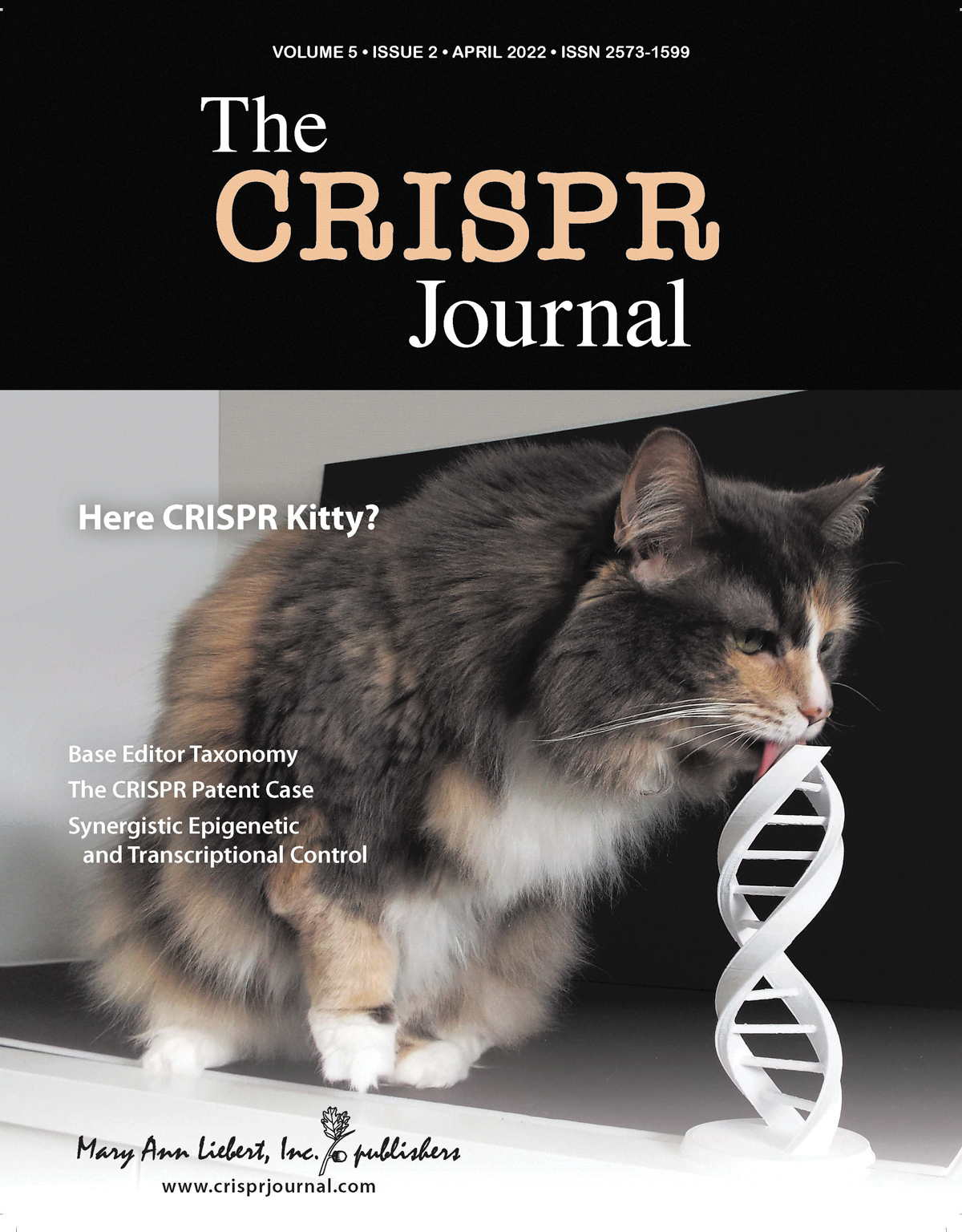
Purrfectly possible: CRISPRed kitties that shed less allergen are a step closer, thanks to the study of Brackett et al. The study was published in the April 2022 issue of The CRISPR Journal.
The domestic cat (Felis catus) is the most common source of mammalian allergen, with cat allergies affecting up to 15% of adults and children, producing symptoms that range from rhinoconjunctivitis to severe asthma. 4 Globally, domestic cats are considered the second most common cause of indoor respiratory allergies and the third most common overall (after pollens and house dust mites). Some individuals can react so strongly to cat allergens that the shear presence of a cat in the same room can induce anaphylactic shock. 5
A recent review of human allergy to cats regarding prevalence, causes, symptoms, and control discusses several avenues for reduction on allergen production in the cat. 6 Fel d 1 is produced primarily in cat saliva, spreads to the haircoat during grooming, and is then transferred to the environment through hair and dander. Grooming also assists distribution of Fel d 1 from the sebaceous glands. The levels of cat allergen produced by any given cat can vary and there are likely breed differences. 7 For example, the Siberian cat breed is suspected to have more individuals that may produce less allergen, although scientific evidence is lacking. Although cat allergen immunotherapies have been developed, their inconsistent results imply that standard treatments for cat allergen are the alleviation of symptoms.
Pet food companies have also addressed cat allergen with a novel approach that reduces allergenic Fel d 1 exposure by binding Fel d 1 with an anti-Fel d 1 polyclonal egg IgY antibody. Cats are fed foods coated with the IgY antibody, thereby reducing an individual cat's production and deposition of allergen on the hair. “Treated” cats show a significant reduction in active Fel d 1 (aFel d 1), hence elicit less of an allergen response in humans. Other studies have attempted immunization of cats to induce anti-Fel d 1 autoantibodies, however, vaccines are not commercially available to date and we await long-term safety studies of vaccine-induced autoimmunity in cats.
The Brackett et al. study uses DNA variant information from 50 domestic cat genomes, to define the most efficient coding regions of the Fel d 1 gene to produce the single-guide RNA for the CRISPR-Cas9 construct capable of removing both the CH1 and CH2 chains of the allergen gene from a commercially available cat cell line. Fel d 1 is a strong candidate for genome editing as it encodes a small 35-kDa tetrameric protein composed of two heterodimers, each of which consists of two chains: chain 1 (70 aa, 8 kDa protein) and chain 2 (92 aa, 10 kDa). This compact genomic region should support a complete deletion using CRISPR-Cas9 editing. Studies by the InBio team of genomic variation across felids demonstrate high genetic diversity (low conservation) and low sequence homology in other species.
Future Felines
Despite the considerable media interest this study has attracted, some caution in the interpretation of these data is warranted. The biological function of Fel d 1 is unknown; studies suggest the protein may play a role in chemical communication, epithelium defense, or immune regulation. The high genetic variation within Fel d 1, as noted by the ratios of the nonsynonymous and synonymous substitution rates and the low conservation across felids, may suggest a region under positive selection with vital functions for some aspect of cat biology and/or behavior, perhaps more important than indicated in the study. Perhaps Fel d 1 is essential for a wild or feral cat, but not in the domestic environment of a companion animal?
Furthermore, Fel d 1 is not expressed in species beyond the family Felidae, although it should be noted that several other cat allergens have been identified—eight cat allergens are currently recognized by the World Health Organization/International Union of Immunological Societies. 8 Although less allergenic and clinically significant, any individual human needs to be cognizant of these secondary allergens as they could elicit an allergic response—even with your future Fel d 1 knockout feline.
Overall, the study by Brackett et al. demonstrates a feasible use for genome-editing technology that could support those who love cats but hate cat allergens. The study conducts the necessary in vitro and in silico studies to define the cat Fel d 1 protein, demonstrates the fears of off-target genome editing are not evident, in this case, and supports future in vivo studies to produce a Fel d 1 knockout cat.