






Abstract
Abstract
This research studies the differences between productivity-oriented (or utilitarian) and entertainment-oriented (or hedonic) usefulness for a multipurpose information system in user acceptance models, as information systems can be high or low in both hedonic and utilitarian attributes. Accordingly, perceived usefulness (PU) is divided into perceived utilitarian usefulness (PUU) and perceived hedonic usefulness (PHU) to provide a better understanding of users' intention for accepting IT. To test the proposed model more effectively, this research targets instant messaging (IM), which is an extremely popular and increasingly important communication system, both utilitarian and hedonic in nature. This research compares the difference across two groups: students for hedonic purpose and employees for utilitarian purpose. We conclude that the proposed model, which distinguishes between utilitarian and hedonic usefulness, is more effective than previous models in which the usefulness was not distinguished. Both PUU and PHU have an effect on intention to use. Employees consider PUU more important in their intention to use IM, while students are more influenced by PHU.
Introduction
Since its publication, the TAM model has been extended by diverse factors in various fields of IT industry. Early TAM-related research focused on increasing productivity in the office environment because IT (word processing, spreadsheets, legacy systems, etc.) was mainly used for productivity-oriented purpose.3–5 With diffusion of Internet, another main reason for using IT (Web browsing, online gaming, etc.) is for leisure and pleasure (entertainment-oriented purposes).1,6,7
Viewed from a unidimensional perspective that all products are either utilitarian or hedonic, researchers divided information systems into those categories6,8,9 depending on the utilitarian or hedonic nature of the information systems. The nature of a utilitarian system is to increase the user's task performance, while a hedonic system provides pleasure. 6
However, recent ITs (instant messaging, virtual community, etc.) have both a utilitarian and hedonic nature, called multipurpose information systems. In line with consumer behavior literature claiming that products can be high or low in both hedonic and utilitarian attributes, we believe an information system should not be classified as hedonic or utilitarian.10,11 The consumer behavior literature demonstrates that products offer both hedonic and utilitarian benefits to the consumer in the form of either experiential enjoyment or practical functionality.8,11–13 Based on a multidimension perspective that hedonism and utilitarianism are not two ends of a single dimension, we divide perceived usefulness in the original TAM into perceived utilitarian usefulness and perceived hedonic usefulness to provide a better understanding of users' intention in accepting IT with both utilitarian and hedonic characteristics.
To test the proposed model, this research targets instant messaging (IM), an extremely popular and increasingly important communication system embedding both utilitarian and hedonic natures. IM can be used for work-related communications among employees or social communications among friends. The former (utilitarian) is used for improving job efficiency, and the latter (hedonic) is for pursuing pleasure. Thus, users are using IM simultaneously for both utilitarian and hedonic purposes.
Different groups of users pursue different needs from the usage of IT. This research compares the differences across two groups: students for hedonic purpose and employees for utilitarian purpose. Teenage users of IM use it most frequently for social entertainment, primarily for informal conversation or socialization, such as everyday chitchat and event planning.14,15 For adults in the workplace, IM is used for work-related communication because it is a valuable tool supporting spontaneous and opportunistic communication between colleagues and real-time communication with customers for work-related projects. 16 Our research studies the relative importance of beliefs in predicting users' intention to use IT across the groups.
We investigate the difference in productivity-oriented and entertainment-oriented usefulness for an information system in user acceptance models. For a more detailed explanation, this research compares the difference across students and employees. With features for improving job efficiency and pursuing pleasure, IM is used as the target IT. This research uses structural equation modeling (SEM) to confirm the validity and analyze the causal relationship of the suggested model. Multigroup structural equation modeling (MSEM) is used for comparisons between groups in the model.
Theory
Our hypotheses are logically adapted from the proposed by Davis (1989). 2 It is one of the most popular theoretical models for explaining and predicting users' acceptance of a new IT. TAM proposes that individuals' intention of IT usage is influenced by their attitude toward the usage, which is predicted by PU and PEOU of the IT. Some research argues that attitude is viewed as having low influence on intention to use, or it is similar to the construct of intention. Thus, most of the research excludes it from the model.17,18 According to TAM, PU has been considered as the primary belief and an extremely important determinant of intention to use in most technology acceptance studies.17–21 In other words, users would accept IT once they perceive IT provides them with utilities, regardless of whether it is difficult to use. 22
Initially, PU was defined by Davis (1989) 2 as “the extent to which one believes that using a specific application system will increase his or her job performance within an organizational context.” However, with the later development of diverse ITs, users engage in activities such as surfing the Internet, playing games, commercial transactions, communication, and e-learning.7,23–26 Since the purposes for using IT are diverse, it is restrictive to define usefulness as increasing job efficiency in a work-related environment. Recently, “to increase his or her job performance” has been changed to “to achieve the purpose and to reach the goal.”6,7,27
Previous research assumed that what determines intention to system usage depends on the utilitarian or hedonic nature of the systems, shown in Table 1. Usefulness is examined unitarily for either utilitarian systems or hedonic systems. The purpose of hedonic systems is to provide users with relaxation, playfulness, fun, chat, transaction, etc. in individual's life.1,6,7 In contrast, the purpose of utilitarian systems is to improve performance and productivity.23–31 However, using only one perspective of usefulness is insufficient to fully understand users' IT acceptance because it only stands for half of the value of usefulness.
Consumer behavior literature indicates that users pursue both utilitarian and hedonic value in their consumption activities. It has been shown that utilitarian and hedonic are just two domains of user behavior and that many activities preserve both hedonic and utilitarian aspects.32–34 Users adopt the system for two purposes: utilitarian for productivity (e.g., IMing with colleagues and clients to improve performance) and hedonic (e.g., IMing with friends for everyday chitchat, entertainment, event planning, and so on, for pleasure).
Accordingly, the original concept of perceived usefulness is divided into perceived utilitarian usefulness and hedonic usefulness. Perceived utilitarian usefulness is individuals' perception that the IT would be useful to improve their performance. Perceived hedonic usefulness is individuals' perception that using the IT increases pleasure. Perceived usefulness has been demonstrated to have a direct and positive influence on intention to use, as users would be willing to adopt the IT once they think it is useful. Based on this causal relationship of perceived usefulness and intention to use, we propose these hypotheses:
Perceived ease of use, another primary belief, is the prospective users' perception that using the target system is free of effort. Perceived ease of use, along with the belief of perceived usefulness, strongly influences intention to use IT. Perceived ease of use is found to have a positive effect on users' perceived usefulness.
2
The causal relationship between perceived ease of use and perceived utilitarian usefulness is based on TAM-related studies of traditional IT focusing on work efficiency, while the causal relationship between perceived ease of use and perceived hedonic usefulness is based on TAM-related studies of IT focusing on individual's pleasure, such as online games.
6
Especially for the purpose of hedonic usage, perceived ease of use will have a direct and positive effect on hedonic factors because ITs that are difficult to use are less likely to be perceived as enjoyable.
35
Also, ITs that are easier to use will be less threatening to the individual, which in turn increases the perception of pleasurable experience.
36
Accordingly, perceived ease of use is supposed to have a positive effect on other beliefs:
According to MacInnis and Jaworski, 37 different groups of users pursue different needs through IT. Previous TAM-related research attempts to explain individuals' usage with a group comparison.7,38,39 Those literatures report that determinants of intention to use are different among groups of gender, experience, age, and so on. Perceived usefulness is more important for male users, and perceived ease of use has more influence on female users.40,41 In the case of experienced users with little experience, perceived usefulness does not influence behavior intention, or it has a lower effect. 26
The basic causal relationship follows that of the previous research. But the construct of usefulness is extended to users' purpose of IT usage. In particular, IM has diverse functions such as e-mail, audio-teleconference, videoconference, and SMS (Short Message Service) for efficient communication, as well as emoticons, online games, social networking sites, and so on, for entertaining communication. Therefore, different users will mainly adopt different functions based on their purpose. Students use IM mainly for social communications among friends, and employees use it more for work-related communications among colleagues. Accordingly, this research proposes the following hypotheses:
This research model, based on TAM, is depicted in Figure 1. The determinants of intention to use IM are perceived ease of use, perceived utilitarian usefulness, and perceived hedonic usefulness. This research hypothesizes that these determinants have a direct and positive influence on users' behavioral intention, and at the same time, the causal relations among these three constructs are proposed. It also proposes that the causal relationships among constructs are different between different groups of IM users.
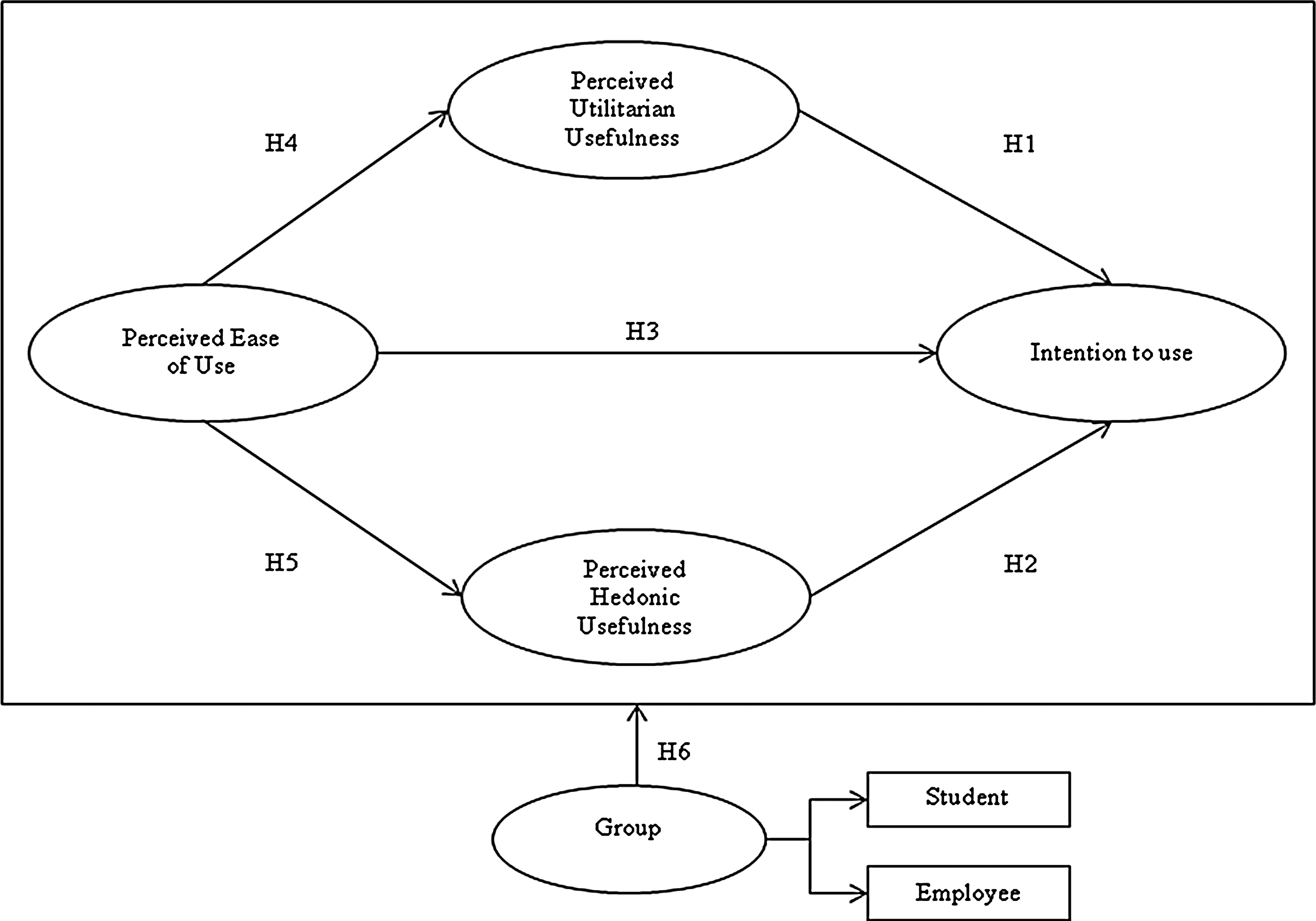
Research model.
Research Method
Measurement
This research developed multi-item measures for each construct. First, a draft of the questionnaire was prepared by reviewing the literature. Perceived ease of use and intention to use were measured using validated items from Davis, 2 while perceived utilitarian usefulness was derived from scale items of perceived usefulness in original TAM. Scale items of perceived hedonic usefulness were developed from that of perceived usefulness in Hsu and Lu, which was defined specifically as the extent to which one believes that playing on-line games would be helpful for achieving relaxation, playfulness, fun, chat, transaction, etc. All of the items were translated into Chinese and slightly modified to suit the context of IM. The scale of items was measured on a 7-point Likert scale ranging from 1, strongly disagree, to 4, neutral, to 7, strongly agree. Second, we conducted field interviews with Chinese students and workers. Respondents were asked to assess the terminology and clarity of instructions and response format. Improved by literature review and field interviews, 12 items for four variables were finally selected. Perceived ease of use was measured by three items (PEOU 1–3), perceived utilitarian usefulness by three items (PUU 1–3), perceived hedonic usefulness by three items (PHU 1–3), and intention to use by two items (INT 1–2).
Data collection
To test the model, a Web-based survey and an offline survey (face to face) were employed. The main data were collected from users of IM in China. Most of the online respondents were employees (EM), while offline questionnaires were mainly collected from students (ST) in schools and universities. We received responses from 222 online and 155 offline questionnaires. After dropping respondents because of useless data, we used data from 318 respondents for our research.
The demographics indicated that there were more female (61.0%) than male (39.0%) and more single (94.0%) than married (6.0%) respondents. The respondents were in their teens (48.4%) and 20s (47.8%). Most were students (56.9%) and employees (32.1%). The most frequently used IM services were QQ (74.8%) and MSN (10.4%). Among the respondents, 5.7% had used IT for less than 1 year, 15.1% for 1 to 2 years, 27.4% for 3 to 4 years, 30.8% for 5 to 6 years, and 21.1% for more than 7 years. Most of the users indicated that they did not have prior experience with IM usage before using their current IM (45.0%), and 31.1% of the users use MSN as another IM service in addition to their most frequently used service. The profiles of respondents are summarized in Table 2.
Data Analysis and Results
Measurement model
To test the hypotheses, we used a two-stage methodology proposed by Gerbing and Anderson 42 in which the measurement model and structural model are developed and evaluated separately. First, the confirmatory factor analysis (CFA) was used to establish the convergent and discriminant validity of the constructs. In this analysis, the unreliable items are eliminated, one at a time, by several criteria.43–46 When a satisfactory measurement model is developed, a structural model is used to identify the causality among theoretical factors. Next, multigroup structural equation modeling (SEM) is conducted to compare the causalities in the proposed model.
We conducted unconstrained confirmatory factor analysis across the two groups (students and employees) by using AMOS 7.0 to evaluate convergent validity for four constructs. The purpose of convergent validity is to ensure unidimensionality of the multi-item constructs and to eliminate unreliable items. 47 Items should load at least 0.70 on their respective hypothesized component, and all loadings need to be significant (p < 0.05, t ≥ 2.0).48,49 The result was that INT2 was eliminated. The value of standardized factor loading for each item to its respective construct was significant (p < 0.05), and all loadings ranged from 0.72 (ST)/0.74 (EM) to 0.91 (ST)/0.92 (EM), as shown in Appendix A.
Reliability for all items of a construct should be evaluated jointly by investigating composite reliability (CR) and the average variance extracted (AVE). For a construct to possess good reliability, CR should be at least 0.70 and AVE should be at least 0.5.43–46 As shown in Appendix A, CR and AVE of all constructs in the final model were proper. The fit statistics for the finial models were good. The chi-square of the model at 60.571 with 39 degrees of freedom (df), the ratio of chi-square to df at 1.553, goodness of fit index (GFI) at 0.965, adjusted goodness of fit index (AGFI) at 0.941, normed fit index (NFI) at 0.973, comparative fit index (CFI) at 0.990, and root-mean-squared error of approximation (RMSEA) at 0.042 were acceptable.
Finally, we tested the discriminant validity, the purpose of which is to identify whether the constructs differ from each other.47,50 Discriminant validity was tested by comparing the interconstruct correlations with their respective variance extracted measures. Table 3 indicates the interconstruct correlations (below the diagonal) and the square roots of the average variances extracted (on the diagonal) of the constructs. It shows that all squared correlations between two constructs were less than the variance extracted measures of both constructs. The results indicate that the discriminant validity of the model constructs was satisfactory.
PUU, perceived utilitarian usefulness; PHU, perceived hedonic usefulness; PEOU, perceived ease of use; INT, intention.
Multigroup confirmatory factor analysis
Before multigroup SEM is conducted, it is necessary to verify the measurement equivalence or invariance, which addresses the question whether the same models hold true across different groups.43,51–53 To diagnose measurement equivalence, multigroup confirmatory factor analysis (MCFA) is used by evaluating measurement models for common form and invariance of factor loadings.47,52,54 To test measurement equivalence, we conducted a constrained confirmatory factor analysis and compared the unconstrained model conducted previously. Comparing the two models, the difference in chi-square value of 6.297 with 7 df (p = 0.506) indicated that factor structure was not different across the two groups in Table 4. All the fit statistics of the constrained and unconstrained models were acceptable.
df, degrees of freedom; GFI, goodness of fit; AGFI, adjusted goodness of fit; NFI, normed goodness of fit; CFI, comparative fit index; RMR, root-mean residual; RMSEA, root-mean-squared error of approximation.
Structural model
After the measurement equivalence was satisfied, the structural model was evaluated for each of the two groups. For the students, all of the six paths were significant (p < 0.05), as shown in Table 5 and Figure 2. For the employees, five of the six paths were significant (p < 0.05). The path from PUU to INT was not significant. The chi-square of the structural model at 21.265 (ST)/104.291 (EM) with 39 df, GFI at 0.960/0.871, AGFI at 0.932/0.782, NFI at 0.963/0.910, CFI at 0.998/0.941, root mean residual (RMR) at 0.018/0.111, and RMSEA at 0.125/0.112 were acceptable. Squared multiple correlations were perceived utilitarian usefulness, 27.3%/22.0%; perceived hedonic usefulness, 12.0%/16.3%; and intention 59.2%/45.4%.
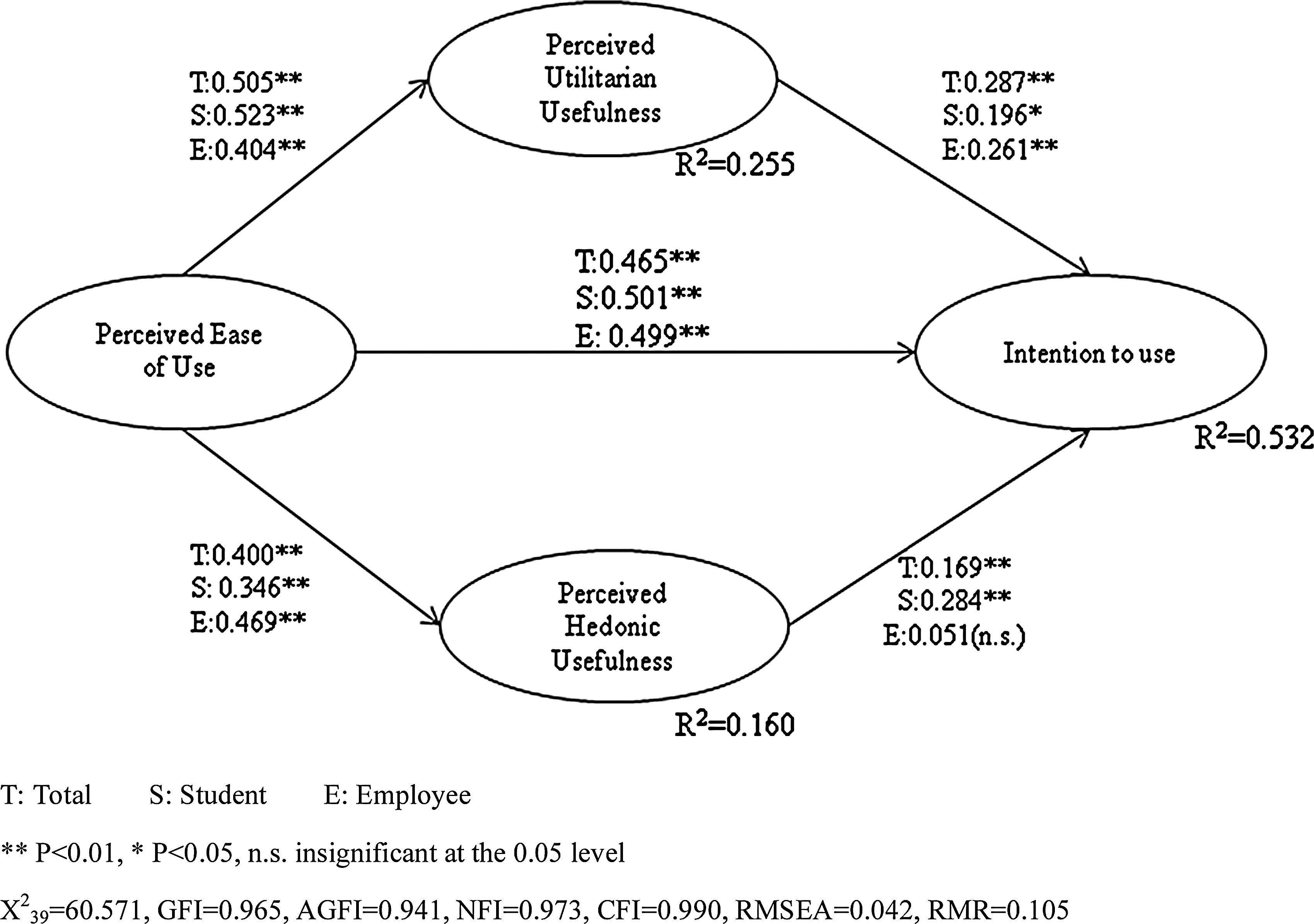
Results of structural equation model.
PUU, perceived utilitarian usefulness; PHU, perceived hedonic usefulness; PEOU, perceived ease of use; INT, intention; df, degrees of freedom; GFI, goodness of fit; AGFI, adjusted goodness of fit; NFI, normed goodness of fit; CFI, comparative fit index; RMR, root-mean residual; RMSEA, root-mean-squared error of approximation.
p < 0.05; **p < 0.01.
Multigroup comparison test
The purpose of a multigroup comparison test was to evaluate whether the path coefficients were different across the two groups. 55 One group was a constrained model in which one path was constrained to be equal. The other was an unconstrained model in which this path was estimated freely. The results of the multigroup comparison test indicated that the path coefficients from perceived hedonic usefulness to intention to use were different across the two groups (Table 6).
PUU, perceived utilitarian usefulness; PHU, perceived hedonic usefulness; PEOU, perceived ease of use; INT, intention.
Results
This research aims to more precisely explain an individual's decision to accept IT by dividing perceived usefulness into perceived utilitarian usefulness and perceived hedonic usefulness. For estimating the modification effect size on original TAM, this research adopted the procedure of Chin et al.
50
The effect size was estimated by computing Cohen's f2 method
56
following the guidelines of Chin et al.
50
The difference between the squared multiple correlations was used to assess the overall effect size f2, where 0.02, 0.15, and 0.35 have been suggested as small, moderate, and large effects respectively.
53
In order to estimate the modification effect size of our suggested model, we integrated the data for utilitarian usefulness and hedonic usefulness as one construct named perceived usefulness and compared it with our suggested model. The TAM model proposed by this research, shown in Figure 3, states the squared multiple correlations of 0.532. In contrast, the results of the original TAM model, as shown in Figure 3, states the squared multiple correlations of 0.444. The proposed model has an effect size of 0.158, which is between medium and large effect. The results indicated that the proposed model, which distinguishes between utilitarian and hedonic usefulness, is more effective than the previous.
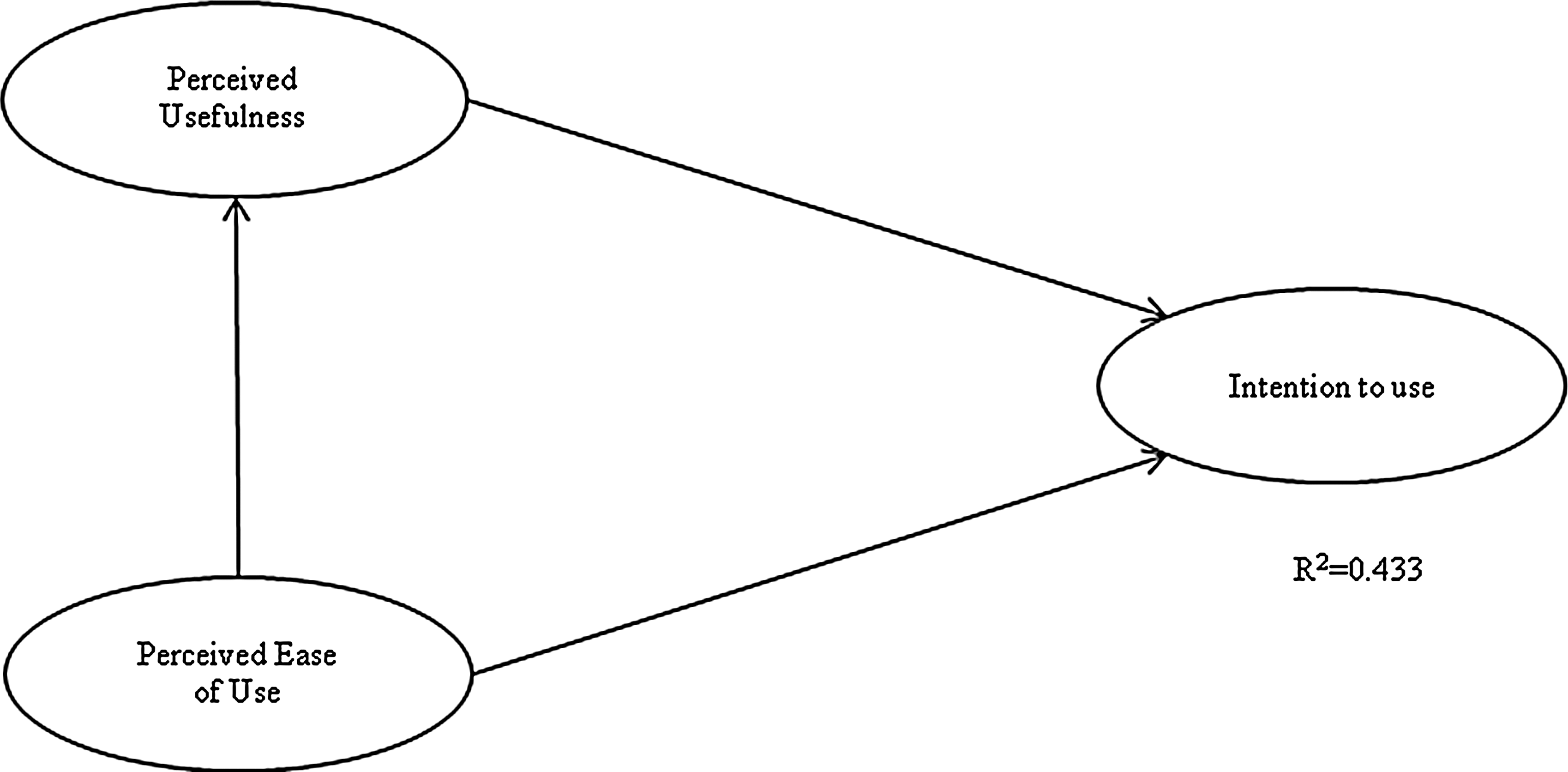
Results of the original TAM model.
Discussion
This research focuses on perceived usefulness because it is regarded as the most important determinant in technology acceptance studies.1,18,41,57 In order to precisely describe perceived usefulness, this research adapts the consumer behavior literature and classifies perceived usefulness in the original TAM into perceived utilitarian usefulness and perceived hedonic usefulness, as recent IT embeds both utilitarian and hedonic natures. The validity of the proposed model is demonstrated, indicating 53.2% of the variance in intention to use IM. This model has an effect size of 0.158, so it is more effective than the basic TAM model.50,56
Consistent with consumer behavior literature claiming that users pursue both utilitarian and hedonic value from a good, users use IT simultaneously for utilitarian and hedonic purposes, both for improving job efficiency and pursuing pleasure.8,11–13,32–34 Since recent ITs offer both hedonic and utilitarian benefits to users in the form of enjoyment and functionality, this model is suggested to more precisely explain an individual's behavior of accepting a multipurpose IT.
The results of this research generally support that of previous TAM-related research.57,58 The key determinants of behavioral intention in IM are perceived ease of use (β = 0.465), perceived utilitarian usefulness (β = 0.287), and perceived hedonic usefulness (β = 0.169). Perceived ease of use has an effect on both perceived utilitarian usefulness (β = 0.505) and perceived hedonic usefulness (β = 0.400).
Perceived ease of use is revealed as the most important construct in influencing behavior intention. As shown in Table 2, most of the respondents have been using IM for over 1 year. Therefore, the effect of perceived ease of use should have been lower because it subsides over time.17,57 We interpret this finding to mean that users do not believe they should have to possess greater expertise in order to use ITs with more features. Recently, IM services provide diverse functions like games, shopping, and e-mail, in addition to traditional functions for real-time communication. Thus, we conclude that perceived ease of use has a more important influence than perceived usefulness in predicting individuals' behavioral intention.
This result is similar to previous research in which hedonic is represented as another construct, such as playfulness, enjoyment, and fun. In those studies, perceived ease of use is found to be the most important predictor of IT usage.1,6,7,28 However, those studies indicate that hedonic factors have a more important influence on intention to use than does perceived usefulness in hedonic information systems, such as Web sites,1,36 games,6,7 and handheld Internet devices. 28 Those findings are different from the result in this research, which reveals a stronger effect of perceived utilitarian usefulness than perceived hedonic usefulness in a multipurpose IT usage.
The other purpose of this research is to study the differences of utilitarian and hedonic usefulness for an information system in user acceptance models, especially to compare the differences across the two groups, students (hedonic) and employees (utilitarian). The results indicate that both PUU and PHU have an effect on intention to use. Additionally, as previous research already indicates, the effect of usefulness can be different under different task contexts. 36 The causal relationship between perceived utilitarian usefulness and perceived hedonic usefulness to intention to use is different, according to different groups of users.
For employees, perceived utilitarian usefulness shows a significant positive effect (β = 0.266), while perceived hedonic usefulness shows no significant influence on intention to use. IM has been used as a promising and useful tool for communications between colleagues and customers for work-related projects. The interactions support joint problem solving, coordination, social bonding, and social learning, all of which are essential for complex collaboration. In addition, the presence, awareness, and immediacy of IM are useful in filling some of the gaps in traditional business communication systems for connecting distance workers, telecommuters, and business partners. 59 For these reasons, employees perceive the utilitarian usefulness as important to improve their job efficiency in work-related contexts. Meanwhile, enterprises attempt to develop their own communication tools, which allow employees to communicate only for work-related business among colleagues. These communication tools, under the supervision of the enterprise, would not be used for any hedonic usage.
For students, perceived hedonic usefulness (β = 0.285) and perceived utilitarian usefulness (β = 0.189) are both predictors of intention to use. IM is used by students because it provides the function of social entertainment for informal conversation or socialization, such as everyday chitchatting, event planning, and relaxation.14,15 These purposes of IM usage for pursuing pleasure establish the more important role of perceived hedonic usefulness. Utilitarian usefulness, however, cannot be entirely ignored because IM can be simultaneously used for study, sharing curriculum-related information, and communicating with advisors or students.
Conclusion
Over the past two decades, TAM has been extended to more precisely explain an individual's behavior of accepting IT. We focused on perceived usefulness in hedonic and utilitarian perspectives. The model proposed in this research, which distinguishes between utilitarian and hedonic usefulness, is empirically demonstrated by using IM. Several interesting results are found.
First, the results indicate that the proposed model is more effective than previous models in which usefulness is not divided. The conclusion is that IT invokes multiple usefulness dimensions that additively contribute to users' intention of IT usage. Therefore, researchers have to consider both utilitarian and hedonic usefulness when they study an individual's behavior of accepting a multipurpose IT.
Second, this research finds that determinants of behavior intention are quite different from that in previous research. Perceived ease of use has the most important influence on intention to use, followed by perceived utilitarian usefulness and perceived hedonic usefulness sequentially. In other words, IM users will be strengthened in their behavior intention due to ease of use, because recent IM services are becoming more complex with diverse functions and various purposes.
The result on usefulness demonstrates that users still consider it one of the basic functions of IM. IM services are primarily designed for efficient communication. When utilitarian and hedonic factors are considered together, the utilitarian usefulness in this perspective is perceived more important, though diverse functions for pleasure are provided. This point is different from previous literature that studied IT from a unidimensional perspective.
Finally, we proposed that the usefulness will be different according to users' purpose of usage, which is confirmed through a comparison test across different groups. Employees are strongly affected by utilitarian usefulness, while students are more greatly affected by hedonic usefulness. Employees accept an IT more for work efficiency, while students use it more for individual pleasure, although users accept an IT for both utilitarian and hedonic usefulness simultaneously.
From management's perspective, the results imply that developers of complex and multipurpose information systems such as IM should regard both the utilitarian and hedonic nature of a system. If users reject a system due to either aspect of usefulness, system developers may enhance other features to achieve user acceptance. As diverse functions of recent IT may bring difficulties to users, system developers should take the greatest possible care for this point.
In addition, system developers should distinguish their target users. As demonstrated by this research, the importance of utilitarian and hedonic factors is perceived differently by different groups of users. Thus, complex and multipurpose information systems should provide both hedonic and utilitarian features. However, a system for specific purposes or particular users should focus on one aspect. IM, for instance, provides diverse functions such as e-mail, audio-teleconference, videoconference, and SMS in addition to basic chatting for efficient communication. At the same time, the emoticons, online games, and such make it helpful for communication for pleasure.
Despite the findings, this research has certain limitations. First, China is a country where IT is experiencing fast development. The results may be different in other countries where the IT market is mature. Second, since this research focuses on the perceived usefulness of IT usage, neither an external factor nor a belief is tested. Factors like playfulness, enjoyment, and fun have been widely studied in technology acceptance research. Thus, if we add hedonic as a separate factor, or if we distinguish IT to be higher in hedonic or utilitarian nature, there may be other interesting outcomes. Finally, different from previous research, the result indicates that perceived ease of use is a more important influence on intention to use than is perceived usefulness. Although this point is not deeply studied in this research, a comparison on the importance of perceived usefulness and perceived ease of use based on the complexity of technologies may provide further insight into IT usage.
Footnotes
Appendix
| Estimate | CR | AVE | ||||||||
|---|---|---|---|---|---|---|---|---|---|---|
| Items | Wording | T | S | E | T | S | E | T | S | E |
| Perceived utilitarian usefulness | ||||||||||
| Instructions: Utilitarian usefulness of using IM refers to the usefulness for improving work efficiency or increasing job productivity. | ||||||||||
| PUU1 | It enables me to accomplish this utilitarian purpose more quickly | 0.85 | 0.82 | 0.87 | 0.81 | 0.79 | 0.83 | 0.58 | 0.57 | 0.61 |
| PUU2 | It enables me to fulfill this utilitarian purpose more effectively | 0.86 | 0.82 | 0.91 | ||||||
| PUU3 | It enables me to satisfy this utilitarian purpose more easily | 0.82 | 0.85 | 0.76 | ||||||
| Perceived hedonic usefulness | ||||||||||
| Instructions: Hedonic usefulness of using IM refers to the usefulness for pursuing pleasure | ||||||||||
| PHU1 | It enables me to accomplish this hedonic purpose more quickly | 0.87 | 0.86 | 0.90 | 0.85 | 0.83 | 0.70 | 0.65 | 0.59 | 0.71 |
| PHU2 | It enables me to fulfill this hedonic purpose more effectively | 0.90 | 0.88 | 0.92 | ||||||
| PHU3 | It enables me to satisfy this hedonic purpose more easily | 0.87 | 0.85 | 0.91 | ||||||
| Perceived ease of use | ||||||||||
| PEOU1 | It is easy to become skilful at using IM | 0.78 | 0.72 | 0.86 | 0.83 | 0.78 | 0.89 | 0.61 | 0.54 | 0.73 |
| PEOU2 | I would find it easy to get IM to do what I want it to do | 0.83 | 0.78 | 0.90 | ||||||
| PEOU3 | The interface of IM is easy to understand | 0.92 | 0.91 | 0.92 | ||||||
| Intention to use | ||||||||||
| INT1 | I intend to use the IM continuously in the future | 0.85 | 0.82 | 0.80 | 0.7 | 0.68 | 0.81 | 0.58 | 0.52 | 0.686 |
| INT3 | I will frequently use the IM in the future | 0.78 | 0.78 | 0.74 | ||||||
T, total; S, student; E, employee.