







Abstract
Abstract
Problematic Internet use has long been a matter of concern; however, few studies extend this line of research from general Internet use to the use of social network sites (SNSs), or explicate the problematic use of SNSs by understanding what factors may enhance or reduce users' compulsive behaviors and excessive form of use on SNSs. Building on literature that found a positive relationship between gratifications sought from the Internet and problematic Internet use, this study first explores the types of gratifications sought from SNSs and examines their relationship with problematic SNS use. It found that three types of gratifications—diversion, self-presentation, and relationship building—were positively related to problematic SNS use. In addition, with a growing body of research on SNS privacy, a moderating role of privacy concerns on SNSs has been proposed to understand how it can influence the relationship between gratifications sought from SNSs and problematic SNS use. The findings suggest that different subdimensions of privacy concerns interact with gratifications sought in different manners. In other words, privacy concerns, including unauthorized secondary use and improper access, play a more influential role in constraining the positive relationship between gratifications sought and problematic SNS use when individuals seek to build relationships on SNSs. However, if individuals seek to have diversion on SNSs, their privacy concerns will be overridden by their gratifications sought, which in turn leads to problematic SNS use. Implications of these findings for future research are discussed.
Introduction
This study, therefore, seeks to further the literature of problematic use by concentrating on SNSs, and understanding what factors influence problematic SNS use. SNSs allow users to maintain profiles with personal information for online and offline networking and offer many interactive functions with user-friendly designs and lightweight technologies. Therefore, people go to SNSs for different gratifications.16–18 Building on literature that has documented the positive relationship between gratifications sought from the Internet and problematic Internet use,19,20 this study, first, examines gratifications sought from SNSs as the contributor to problematic SNS use.
While individuals' problematic SNS use may be heightened by gratifications sought from SNSs, their privacy concerns may play a different role in affecting the relationship by reducing individuals' problematic use. There is a growing body of research on SNS privacy as scholars have appealed for caution regarding privacy risks on SNSs.21,22 Nevertheless, the question left unanswered is how the influence of gratifications sought on problematic SNS use can be conditionally affected by privacy concerns on SNSs. It is possible that when people encounter potential threats to privacy, they may still disclose their personal information for some gratifications on SNSs.21,23,24 In this sense, this study also aims to understand how privacy concerns interact with gratifications sought that lead to problematic use of SNSs.
Literature Review
Gratifications sought from SNSs and problematic SNS use
The uses and gratifications approach has been employed to understand people's motivations for specific Internet applications, such as e-mail, instant messaging, and blogs. While different gratifications have been identified across diverse Internet applications, some similar gratifications have been observed, such as surveillance, information seeking, entertainment, social contact, and so on.25–31 Because SNSs incorporate many functions provided by different Internet applications, those basic motivations underlying the applications can shed light on the SNS users' gratification seeking. Researchers, therefore, have found that the gratifications sought from using SNSs focus mainly on personal fulfillment (e.g., information seeking and entertainment), and social interaction (e.g., maintaining or developing new friendships).17,32–34 Self-presentation was also identified in several studies.16,33,35,36
Gratifications sought, however, are among the most significant predictors that lead individuals to problematic Internet use, which includes two types of usage for interaction on the Internet—excessive and compulsive.19,20,37,38 Those terms indicate that users exceed a normal or planned amount of time online, and cannot control their online activity along with a feeling of guilt. 4 Also, process gratifications—the actual use of the medium itself that pulls users away from the outside world to the virtual world—are more likely than content gratifications—gratifications that result from obtaining mediated messages from media content—to give rise to problematic Internet use.8,19,20
Previous literature has shown that usage patterns for Internet addicts center on engagement in interactive services.20,39 Thus, SNSs with a lot of interactive features provide a good opportunity to examine individuals' problematic use. Extending previous research, this study emphasizes individuals' active gratification seeking on SNSs that may lead to problematic SNS use.19,20,26,40 It first explores the types of gratifications sought from SNSs, and then examines their relationship with problematic SNS use. The following research questions are proposed:
Privacy in an online networked environment
The concept of privacy has developed along with the evolving communication environment.41–43 As information technologies have facilitated greater abilities to collect, share, and use personal information, privacy has become a dominant concern.22,44,45 In particular, privacy risks on SNS, such as disclosure of personal information, identity theft, sharing inappropriate information, unwanted contact, and use and collection of personal data by third parties have gained a lot of attention from scholars and the public.22,23,46–50
In view of the rapid interweaving of social network technologies into the fabric of daily life, privacy has become a dynamic process of continuous negotiation, and a dialectic process of regulation that is conditioned by people's own expectations and experiences and by those of others they interact with, in network environments. 44 Many privacy issue cases have received much attention from media, such as damaged reputations due to improper information sharing, stalking, or other personal tragedies, which in turn influence individuals' privacy concerns with regard to applications for interpersonal communication and social networking. 48 However, on SNSs people are more likely to ignore privacy risks by voluntarily providing personal information and actively sharing it for the benefit of SNSs.47,51 Users' privacy concerns do not always constrain them from using SNSs and can be overridden by expected gratifications.21,23,48,52,53
Although previous research has recognized the competing roles of gratifications and privacy concerns on SNSs, no research to date has brought together the body of research on SNS privacy to the relationship between gratifications sought and problematic use. Especially, when people regard SNSs as an opportunity to engage in social interaction instead of as a platform to operate privacy controls, 54 the privacy paradox may be higher for SNSs than for other Internet applications.
Accordingly, this study examines whether privacy concerns on SNSs can influence individuals' compulsive behaviors on SNSs, and further explores how the role of privacy concerns plays in the relationship between gratifications sought and problematic use. The following research questions are proposed:
Method
Participants
An online survey was conducted targeting users of SNSs. It used a nonsystematic convenience sample by combining two sampling methods: a systematic random sample was selected from email addresses from two large universities in the Southwest obtained through an open-records request, and then supplemented with a convenience sample in which respondents were asked to forward the survey link to other friends who are using SNSs. This sample framework was chosen mainly because it is useful when trying to reach SNS users; a large number of them are university students, who have high levels of participation in SNSs.36,55 In all, 1,044 respondents completed the survey with 91 percent of those from the random sample and 9 percent from the convenience sample.
Measures
Gratifications sought from SNSs
To identify the gratifications people have on SNSs, the study drew on motives identified in previous studies on SNSs and other Internet applications, such as instant messaging and blogs.19,26,31,33,56 This measurement therefore included 33 items. SNS users were instructed: “Please indicate the degree to which the following statements correspond to your reasons for using SNSs,” for instance, for specific information of interest; for passing time and escaping boredom; to update my friends/relatives/classmates' information. For each statement, response choices were ranked on a 5-point Likert scale from disagree (=1) to agree (=5).
Privacy concerns on SNSs
This study adopted the Concern for Information Privacy instrument developed by Smith et al. 45 Respondents were asked to indicate the extent to which they have privacy concerns while using SNSs on a 5-point Likert scale from disagree (=1) to agree (=5). The four subdimensions of information privacy concerns include unauthorized secondary use (M=4.72, SD=0.53, Chronbach's α=0.85), indicating that users worry that their online information will be improperly shared without their authorization; improper access (M=4.62, SD=0.60, Chronbach's α=0.80), referring to users' concerns about websites' responsibility to protect personal information instead of hinder users' rights by abusing their information in a nontransparent manner; errors (M=3.90, SD=0.85, Chronbach's α=0.87), related to the data quality on the websites, such as “websites should make an effort to verify the accuracy of personal information”; and collection (M=4.35, SD=0.68, Chronbach's α=0.79), indicating users' worry that websites collect too much personal information. A confirmatory factor analysis with a weighed least squares mean and variance adjusted (WLSMV) was employed to confirm the measurements for each subdimension of privacy concern. WLSMV is a more appropriate estimator because the data is ordinal and the index of subdimension of unauthorized secondary use is slightly skewed. Results indicated that the measurement model fits the data well across goodness-of-fit indexes and the item-loading estimates of the factors were significant (p<0.001).
Problematic SNS use
This study adopted Young's 20-item version of problematic Internet use and adjusted the terms for the context of SNSs.9,10 For example, in the questionnaire, the respondents were asked if they find themselves staying on SNSs longer than they intended, and if they fear that life without SNSs would be boring, empty, and joyless. Respondents' answers to these questions were reported on a 5-point Likert scale from never (=1) to always (=5). The index of problematic SNS use was formed by averaging scores across the twenty items (M=2.00, SD=0.69, Chronbach's α=0.94).
Control variables
Demographic information, including gender, age, ethnic group, and education, was included. Also, respondents' hours of Internet use and SNS use in a day were separately measured by asking “How many hours a day do you use the Internet?” (M=3.82, SD=2.58), and “How many hours a day do you use MySpace, Facebook, or other SNSs?” (M=1.46, SD=1.77).
Results
Among those who responded to the survey, 86 percent (=898) have used SNSs. Most were undergraduate students (67.6 percent): 15.4 percent freshmen, 13.4 percent sophomore, 15.6 percent juniors, and 23.2 percent seniors. The remaining 32.4 percent were graduate students with a mean age of 24. Sixty-two percent of respondents were women and 38 percent men. Women (M=1.59, SD=1.97) are more likely than men (M=1.25, SD=1.36) to spend more hours a day on SNSs (t=2.79, p<0.01).
To identify different types of gratifications sought from SNSs (RQ1), a factor analysis with the extraction method of generalized least square and direct oblimin rotation was adopted. An item was included if it had a primary loading at 0.50 or higher. A six-factor structure with Eigenvalues greater than 1.0 and a minimum reliability of more than 0.70, accounting for 53.26 percent of total variance, were extracted (see Table 1).
n=898.
Extraction method: Generalized least squares.
Rotation method: Oblimin with Kaiser normalization.
The full table, including the 29 items with each loading, is available upon request.
The first factor, virtual community, includes items related to online social life, such as letting my opinions be known, and finding out about issues affecting people like myself (see Table 1 for the percentage of explained variance and Chronbach's α). The second factor is diversion. It is about gratifications derived from pleasurable experiences in the using process, such as entertaining and relaxing.
The third factor, self-presentation, indicates that users like to present themselves and impress other people. The fourth factor, relationship maintenance, emphasized maintaining existing acquaintances. The fifth factor, relationship building, includes items that focus on building new relationships. Finally, information seeking refers to keeping up with the issues of the day, learning something new, school or research uses, and so on.
Hierarchical regression analysis was used to examine the influence of different types of gratifications sought from SNSs (RQ2), and the four subdimensions of privacy concerns on SNSs (RQ3) on problematic SNS use. Demographic variables, Internet use, and SNS use were entered as controls in the first block. The six gratification-factor variables identified in RQ1 and the four subdimensions of privacy concerns were entered in the second block in predicting problematic SNS use. Table 2 shows that self-presentation (β=0.186, p<0.001), and relationship building (β=0.275, p<0.001) were significant predictors of problematic SNS use. As a result, SNS users who seek self-presentation and relationship building on SNSs are more likely to have problematic SNS use.
n=898.
p<0.001.
Cell entries are standardized regression coefficients.
In terms of the relationship between the four subdimensions of privacy concerns on SNSs and problematic SNS use (RQ3), first, a logarithm transformation was applied to the index of subdimension of unauthorized secondary use given the skew presented in the index. None of the subdimensions of privacy concerns was found significantly related to problematic SNS use. In other words, respondents' privacy concerns for unauthorized secondary use, improper access, error, and collection did not play significant roles in constraining their compulsive, problematic SNS use.
Finally, to answer RQ4 regarding the moderating role of each subdimensions of privacy concerns, hierarchical regression analyses models were built with the control variables entered in the first block, followed by main effects (i.e., gratifications sought and privacy concerns) entered in the second block. These two blocks are the same as those presented in Table 2. In the third block, the four subdimensions of privacy concerns were examined in separate models. The interaction terms were formed by mean-centering the main effects first to avoid multicollinearity, and then multiplying the two main effects based on the traditional method of testing interaction effects (see Table 3).57,58
n=898.
Among the interaction terms, the “privacy concerns” in Model 1 represents the subdimension of “unauthorized secondary use”; in Model 2, the “privacy concerns” indicates the subdimension of “improper access”; in Model 3, the “privacy concerns” represents the subdimension of “errors; and the “privacy concerns” in Model 4 is the privacy concern for “collection.”
Prior blocks, which are identical to Table 2, include age, gender, education, race, Internet use, SNS use, privacy concerns, and gratifications sought. Cell entries are standardized regression coefficients after controlling for the prior blocks.
p<0.05, **p<0.01, ***p<0.001.
The first model explored the interactive effects between privacy concern for unauthorized secondary use and gratifications sought on SNSs. Two significant interaction effects were found. The interaction between privacy concern for unauthorized secondary use and diversion (β=0.086, p<0.01) is plotted in Figure 1, and the other interaction between privacy concern for unauthorized secondary use and relationship building (β=−0.101, p<0.01) is plotted in Figure 2.
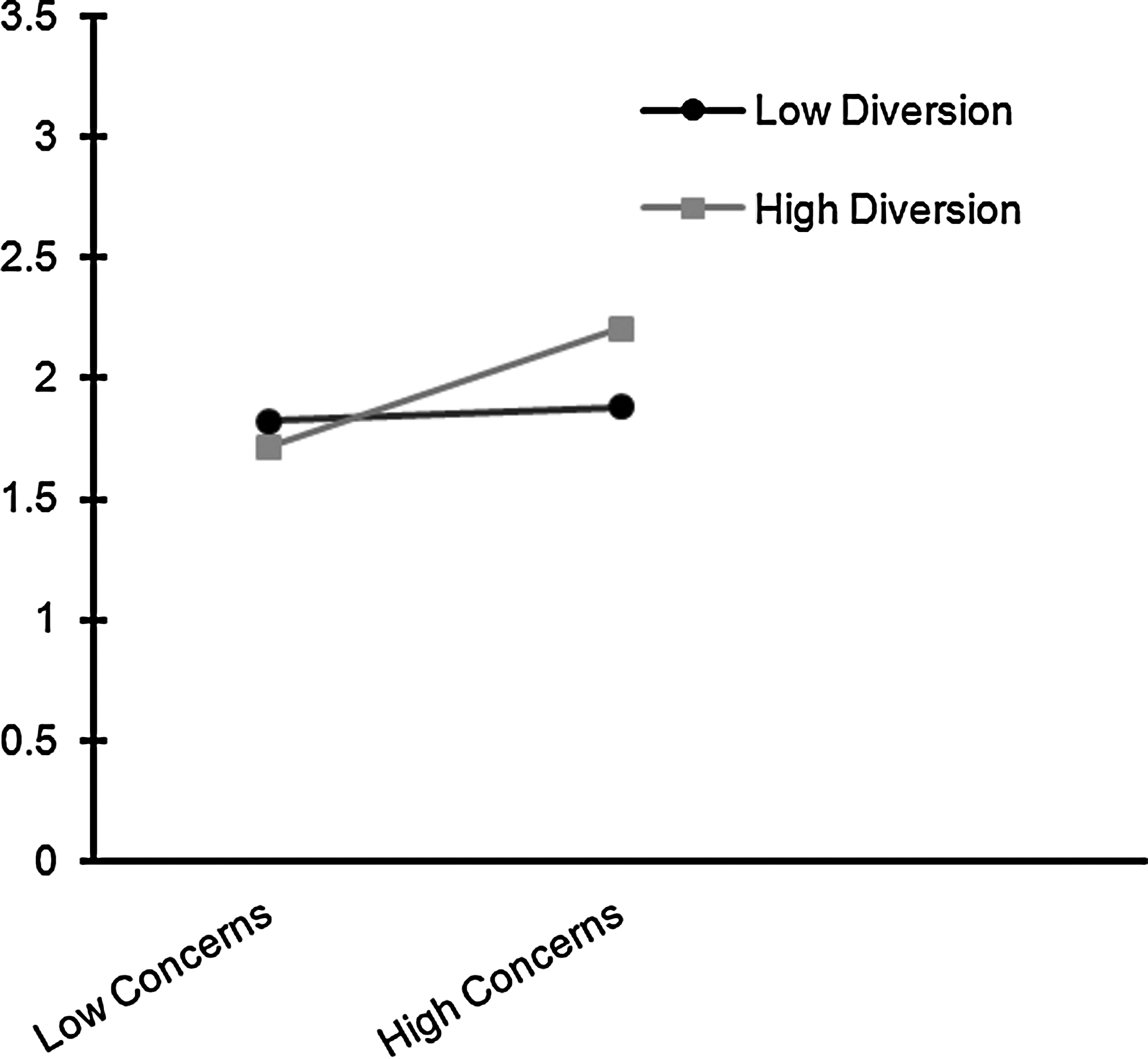
Interaction between privacy concerns for unauthorized secondary use and diversion on problematic SNS use. SNS, social network site.
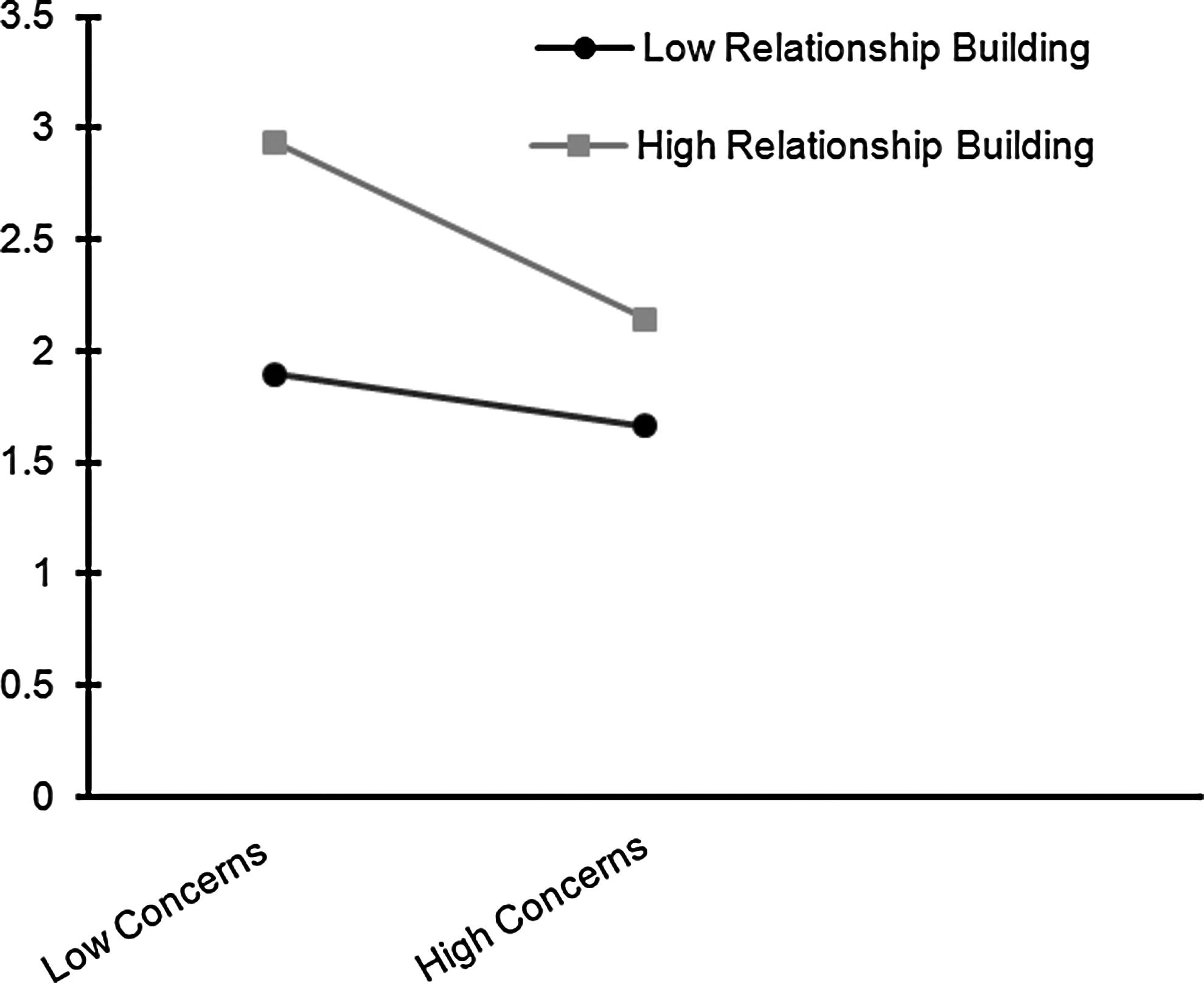
Interaction between privacy concerns for unauthorized secondary use and relationship building on problematic SNS use.
In Table 3, the second model, two significant interaction effects appeared as well between privacy concerns for improper access and diversion (β=0.115, p<0.001) and between privacy concerns for improper access and relationship building (β=−0.074, p<0.05). The pattern of the former interactive relationship is similar to the one plotted in Figure 1, and the latter one is similar to the pattern plotted in Figure 2.
In terms of the third subdimension of privacy concerns—errors, the third model (see Table 3) investigated its interaction with gratifications sought in affecting problematic SNS use. No interaction effects were found. Similarly, no interactions between the fourth subdimension of privacy concerns—collection, and gratifications sought were found in the fourth model.
Overall, in Models 1 and 2, privacy concerns for unauthorized secondary use and improper access were found to interact with two types of gratifications sought—diversion and relationship building. The four significant interactive relationships demonstrate two types of patterns. Among SNS users with high privacy concerns for unauthorized secondary use, or improper access, those who seek greater gratifications of diversion from SNSs had a higher problematic SNS use than those who seek less diversion from SNSs (see Fig. 1). This finding demonstrates that when users seek diversion on SNSs, their privacy concerns for unauthorized secondary use and improper access do not prevent their problematic SNS use. Another pattern of interactive effects illustrates a more influential role of privacy concerns in affecting users' problematic SNS use. SNSs users seeking greater gratification of relationship building from SNSs with fewer privacy concerns about unauthorized secondary use or improper access had the highest problematic SNS use, while those seeking less relationship building from SNSs with more privacy concerns about unauthorized secondary use, or improper access, had the lowest levels of problematic SNS use (see Fig. 2).
Discussion
Our results identify six primary reasons for using SNSs. Virtual community suggests that SNS users seek to gain a sense of community and participate in online discussions. Diversion means that people go to SNSs for entertainment and pleasure. Another gratification sought is self-presentation, which was also identified in previous research on online photo albums, blogs, and SNSs.26,35 The other two gratifications sought are relationship building and relationship maintenance, emphasizing the significant role of SNSs in bridging and bonding social connections in SNS users' daily lives. Lastly, information seeking indicates that people rely on relationships on SNSs to gain new information.
This study found that neither process nor content gratification, the typical two types of gratifications sought from the Internet use, showed a significant relationship to problematic SNS use. However, self-presentation and relationship building, as a third potential Internet gratification—social gratification emphasizing social usage dimensions on SNSs—were found to be significant predictors of problematic SNS use.29,59
In addition, this study found that SNS users' privacy concerns did not significantly affect their problematic SNS use. This finding implies that when users have different kinds of privacy concerns, those concerns do not necessarily prevent them from using SNS compulsively.
Most importantly, the study emphasizes the interplay between privacy concerns and gratifications sought related to problematic SNS use. It identifies four interactive relationships, and two of them related to diversion gratifications, revealed a similar pattern: If people go to SNSs for entertainment or pleasure, those desires can override privacy concerns, such as unauthorized secondary use and improper access, and lead to greater problematic SNS use.
Two other interactive relationships, related to relationship-building gratifications, demonstrated another pattern of interactive effects. It appears that high privacy concerns, including unauthorized secondary use and improper access, can constrain the relationship between gratifications sought and problematic use when the type of gratification sought is relationship building. It may be because privacy risks that catch the most attention from the media and the public, such as risks to reputation and unwanted contact, are closely related to relationship building on SNSs.
The two different patterns of interactive effects highlight a significant implication: SNS users may consider what gratifications they are looking for on SNSs, and then develop a gain–risk ratio to help them decide whether to seek more gratification and ignore privacy risks, or seek less gratification and reveal less private information.
This study, however, has its limitations. First, it was built on a survey of a nonsystematic convenience sample of relatively young, well-educated, and prosperous respondents at two large universities, so it may have limited generalizability. In addition, the uneven gender ratio of the sample, with a much larger proportion of females, may limit the generalizability although the gender differences were controlled in the statistical analyses of the study. This may also relate to the finding in the sample that women spent more hours a day on SNSs than men, which is consistent with findings in the previous research.18,60 The variables of privacy concerns in the research were self-reported. Future research can conduct a behavioral measure to examine how individuals use privacy settings to conduct their privacy practices on the basis of their concerns, or a measure of privacy practices can be included in the survey to examine its relationship with privacy concerns in the context of SNSs. Lastly, it is worth noting that although the logarithm transformation improved normality of the index of unauthorized secondary use that the skewness is within the acceptable range, it did not completely correct the non-normal distribution. The results, therefore, should be interpreted with caution.
Despite the limitations, this study highlights the importance of the dynamic process of continuous negotiation between privacy concerns on SNSs and gratifications sought from SNSs in influencing individuals' psychological and behavioral outcomes.
Footnotes
Author Disclosure Statement
No competing financial interests exist.