







Abstract
Abstract
The present study examined the factors associated with individuals' use of three different text-based communication media: e-mail, cell-phone texting, and Facebook Wall postings. Three theoretical perspectives, including media richness theory, uses and gratifications, and perceived network effects, were examined. Using data from a survey of college students (N=280), the study found that the theoretical constructs from these theories play different roles when applied to different technologies. The results suggest that a simultaneous consideration of technological attributes, users' motivations, and social circumstances in which users select and use the technology is useful for fully understanding the dynamics of the selection and the use of a given technology.
Introduction
Early efforts that explain people's technology selection and use employed the social presence model and media richness theory and focused on the attributes of the technology.1,2 Later research, however, shifted attention to individuals' social surrounding and motivations as factors explaining the use of new communication technologies.3–5 For example, the social influence model6–8 proposed that technology use is affected by social settings and decisions made by close relationships. The uses and gratifications approach9,10 focused on the active role of individuals in seeking the satisfaction of their needs by the use of the technology in question.
Studies conducted on technology selection and use have largely focused on a single theory. We propose that a fuller understanding of individuals' technology selection and use requires a simultaneous examination of multiple theories, considering that today's technologies offer more diverse functions and serve multiple roles. In particular, we consider both media attributes and individual factors, along with social circumstances surrounding technology selection and use. To this end, three different sets of theories are examined: (a) the social presence model and media richness theory; (b) the uses and gratification approach; and (c) theory of network effects.
In the current study, we focus on three popular text-based communication technologies: e-mail, cell-phone texting, and Facebook Wall postings. Although all three are based on text communication, each of these technologies presents unique characteristics as a communication platform. We aim at investigating the differences among the three technologies in their use, resulting from their respective characteristics in media richness, motivation, and social influence. E-mail has been one of the earliest and most popular applications on the Internet. It is a prototype of computer-mediated communication media that lacks nonverbal cues and synchronicity. Cell phones are characterized as a ubiquitous, faster, and more convenient medium. 11 In particular, text messaging (or texting) has become increasingly popular, especially among young users, surpassing voice calling, face-to-face talk, and e-mail in terms of frequency of use.12–14 Cell phone users both send and receive a greater number of text messages than voice calls, and also about 30 percent of text users reported that they prefer texting over voice calling. 15 Lastly, Facebook Wall postings offer a unique platform of communication in which the comments posted by one's friends can be viewed by other users as well as the profile owner, facilitating the sharing of messages among one's circle of social connections. 16 While abundant literature has examined various uses of these communication channels, a few have simultaneously explained the determinants of uses based on multiple theoretical frameworks. We take this as an opportunity to empirically test the relative importance of the aforementioned theories.
The social presence model and media richness theory
The social presence model 1 posits that communication technologies vary in their attribute of social presence, “the feeling that other actors are jointly involved in communicative interactions.” 1 (p65) According to the model, communication technologies can be arrayed along a continuum from low to high social presence, and users select a specific medium that they perceive to have the highest social presence.17–19
Similarly, the media richness theory 2 proposes that individuals distinguish communication technologies from “lean” to “rich” based on the technologies' intrinsic properties.20,21 Specifically, four factors affect media richness: (a) transmission of multiple cues (e.g., vocal inflection, gestures); (b) immediacy of feedback; (c) language variety; and (d) the personal focus. The media richness theory claims that individuals seek to match the richness of a medium with the complexity of the task for which it is used. 3 In empirical studies, face-to-face interaction was preferred for ambiguous tasks or messages, whereas written or electronic media were preferred for unambiguous communications. 20 The ability to match the richness of a medium to the communicated messages was also found to be a valued communication skill in organizations.20,22
Several studies reported results that are inconsistent with the media richness theory's predictions.5,23 For example, Markus 5 uncovered that electronic mail, a lean medium, was used for communication tasks that involved high degrees of ambiguity. Faced with these contrasting findings, Fulk and Boyd 4 emphasized the need to clarify the dimensions of media richness and to explain the core processes that drive the perception of media richness. They also noted that the media richness theory is more supportive of traditional media rather than new media.4,5
Nevertheless, the following reasons necessitate the re-examination of the social presence model and the media richness theory as frameworks for understanding media use behaviors. First, today's communication technologies provide unique features and include new attributes that were not tested in previous studies. In particular, in order to fully understand the attributes of new technologies and their impacts on individuals' media use, three technologies that operate on three unique platforms and applications are selected for investigation. By limiting the investigation to text-based communication, the current study seeks to explore the variations in media use that result from the attributes of media platforms. For example, individuals' use of Facebook Wall postings can be uniquely affected by media attributes compared with that of e-mail or texting, because its medium, Facebook, may limit the immediacy of feedback and the privacy, or personal focus, of exchanged messages. Second, the social presence model and media richness theory have been primarily tested in organizational contexts. Thus, the current study retests them in the context of interpersonal communication:
Uses and gratifications
As a reaction to an effects-driven, passive audience model, the uses and gratifications approach emphasizes active roles of audiences in media choice and use.24,25 This approach posits that individual differences in media selection and consumption originate from their specific needs and motivations. 26 Examining the motivations behind adoption and use is particularly important for new technologies. 27 A new technology that can neither satisfy needs already fulfilled by old technologies nor create novel needs will not survive. The success of a new technology is contingent on the adoption and utilization of users, rather than its own attributes. For instance, a newly invented device that features a variety of complicated functions may fail if its potential adopters do not see the unique benefits out of its use and are not motivated to try it out.
The uses and gratifications framework has been extensively employed to explore individuals' motivations for using a specific medium. The three communication technologies under scrutiny in this study are no exception. Stafford et al. 28 found that the main reasons behind e-mail use are interpersonal communication, personal gain, and business reasons. In terms of cell-phone use, Wei and Lo 29 identified six motivations: information seeking, social utility, affection, fashion status, mobility, and accessibility. Lastly, for the use of social networking sites, including Facebook, Raacke and Bonds-Raacke 30 and Joinson 31 identified motivations such as social connection, shared identities, sharing photographs, content gratifications, social investigation, social network surfing, and status updating. Although previous studies have identified motivations for using the three technologies under scrutiny, the extent to which motivations differentially affect use behaviors in each technology has been largely undocumented. Individuals' motivations may play a stronger role for a certain medium compared with others in that the use of easy-to-access and spontaneous medium (such as texting) can be less constrained by situational and technical factors and more directly affected by individuals' needs for communication. In the current study, we investigate the three most popular text-based technologies for interpersonal communication and compare motivations that drive their use:
Theory of network effects
There has been an increasing emphasis on social influence as a determinant of technology use. Rogers 32 suggested perceived social norms as a measure of one's perceptions about others' expectations influencing the diffusion of innovation. In organizational settings, social influence has been proposed as being an important predictor of technology use.6–8 Schmitz and Fulk 8 found that the use of e-mail by supervisors and co-workers and the extent to which they think of it as useful influenced the focal actor's use of e-mail. Given that most of today's communication technologies exhibit network externalities (i.e., if everybody else is using a certain technology, I also need to use it in order to communicate with others), this study extends the theory of network effects to the context of interpersonal text-based communication.
From an economic perspective, the utility from consuming a good increases with the number of other users. 33 In other words, the willingness to adopt a new technology positively correlates with the number of existing adopters. 34 Communication technologies, in particular, cannot be studied in isolation from their users' social environment. The social network approach has been also used to examine the behavior of the focal person and their social surroundings. Especially, the notion of personal network threshold captures the idea that individuals decide to engage in a behavior such as adopting an innovation depending on the proportion of previous adopters in the social system. 35
In the study of network effects, several studies34,36 have adopted perceptions about the popularity of a given technology as a measure of social network effects and found that such perceptions affects individuals' adoption and use of the new technology. Communication technologies, social media in particular, are increasingly used in the context of social systems. Unlike e-mail and text messaging, which are one-to-one interpersonal communication, Facebook Wall postings facilitate interpersonal communication in the presence of a larger number of social relations. However, a few studies have examined the varying influences of network effects on the use of new communication technologies. The current study proposes a closer examination into such varying influences:
Method
Survey administration
An online survey was conducted in a Southwestern public university in the United States in April 2011. From the university-issued directory of all students, 1,500 were randomly selected. An e-mail invitation including a link to the survey on SurveyMonkey (
Measures
Media richness was measured with eight statements modified from Daft and Lengel, 37 including “E-mail (cell-phone texting/Facebook Wall posting) helps me communicate quickly with my communication partner(s), giving and receiving timely feedback” and “With e-mail (cell-phone texting/Facebook Wall posting), I can easily deliver a variety of different cues beyond written messages” (α=0.70, 0.78, and 0.80 for e-mail, cell-phone texting, and Facebook Wall posting, respectively). Each statement was anchored by a 5-point Likert scale ranging from “strongly disagree (1)” to “strongly agree (7)” (Other variables were anchored by the same scale unless otherwise indicated).
Perceived network effect was measured with six statements modified from Slyke et al., 38 including “Of the people I communicate with regularly, many use e-mail (cell-phone texting/Facebook Wall posting)” and “People whose opinion I value think I should use e-mail (cell-phone texting/Facebook Wall posting)” (α=0.87, 0.86, and 0.89 for e-mail, cell-phone texting, and Facebook Wall posting, respectively).
Motivations were measured with 11 statements that were gleaned and modified from past studies and factor analyzed. By using an orthogonal Varimax rotation, two types of motivations were extracted—strong-tie communication and weak-tie communication. Factor loadings, eigenvalues, and reliability are presented in Table 1.
Technology use was measured with the following question: “On average, how much time do you spend on e-mail (cell-phone texting/Facebook Wall posting) in a typical day?” Additionally, age and sex were included as control variables.
Results
Descriptive statistics
Among 414 participants, 280 provided valid responses; the remaining completed less than half of the survey. There were 189 female (67.5 percent) and 88 male participants (31.4 percent), while 3 did not indicate their sex. The average age of the participants was 22.54 (SD=5.75). The ethnic composition of the sample was as follows: 70.7 percent Whites, 3.2 percent African Americans, 6.8 percent Hispanics, 5.0 percent American Indians/Alaskan Natives, and 8.9 percent Asians or Pacific Islanders. Fifteen participants did not indicate their ethnicity.
On average, participants used 92.59 minutes (SD=90.64, Median=60.00, skewness=2.36, kurtosis=7.08) of e-mail, 155.24 minutes (SD=179.34, Median=120.00, skewness=2.32, kurtosis=5.80) of cell-phone texting, and 110.85 minutes (SD=140.16, Median=60.00, skewness=2.46, kurtosis=6.81) of Facebook Wall posting. Due to high skewness and kurtosis, they were log transformed to achieve normality.
Figure 1 shows the respondents' perception of each medium regarding media richness, motivations, and perceived network effects. Respondents considered cell-phone texting to be superior than the other two due to its richness and abilities to satisfy the needs to communicate with both strong and weak tie networks. In addition, respondents reported the greatest amount of social pressure to use cell-phone texting compared with the other two communication technologies. Compared with the other two, the respondents did not use e-mail much to communicate with their strong-tie network.
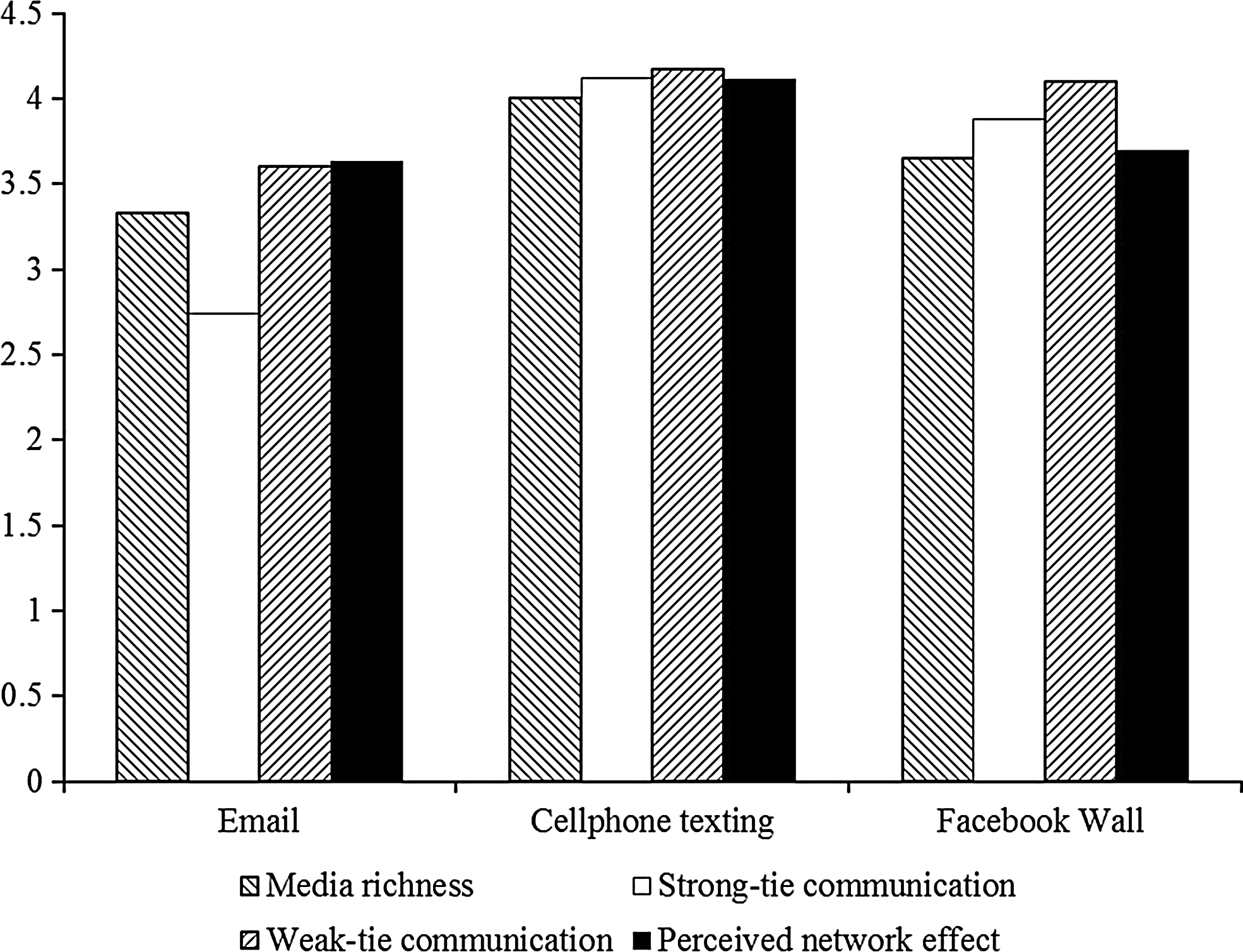
Mean comparisons of four independent variables by each medium.
Answering research questions
Before answering the research questions, a correlation analysis was conducted (see Tables 2–4). All pairwise associations were positive. All correlation coefficients were below the recommended threshold of 0.70, 39 suggesting the absence of severe multicollinearity problems.
Note: **significant at the 0.01 level (two-tailed).
Note: **significant at the 0.01 level (two-tailed).
Note: **significant at the 0.01 level (two-tailed).
A series of hierarchical regression analyses were conducted with the blocks of control variables and independent variables. RQ1 addressed the effect of media richness on the use of the three technologies. As shown in Table 5, media richness was not significantly associated with e-mail use, yet it was significantly associated with both cell-phone texting (p<0.05) and Facebook Wall use (p<0.001). RQ2 dealt with the impact of motivations (strong-tie communication and weak-tie communication) on the use of the three technologies. Strong-tie communication did not have any significant impact on the use of the technologies. In contrast, weak-tie communication was significantly associated with cell-phone texting (p<0.05). RQ3 addressed the effect of perceived network on the use of the technologies. It was associated with e-mail use with a marginal significance (p<0.10), but not significantly associated with cell-phone texting and Facebook Wall use.
Note: +significant at the 0.10 level, **significant at the 0.01 level, ***significant at the 0.001 level.
Betas refer to standardized regression coefficients in a respective equation.
Control variables, age and sex, were statistically significant in explaining the use of the three technologies. Specifically, younger participants were more likely to use cell-phone texting and Facebook Wall postings, while older respondents were more likely to use e-mail. With regard to sex, women reported spending more time on all three technologies than men. In terms of R2, it was 13.1 percent, 34.1 percent, and 26.7 percent for the use of e-mail, cell-phone texting, and Facebook Wall use, respectively. In the case of cell-phone texting, the variance explained by control variables (22.1 percent) was greater than that by independent variables (12.0 percent).
Discussion
The communication landscape has changed drastically over the last decade. Particularly among young adults and teenagers, large parts of their communication are based on texts and other multimedia forms.12,13,15 Beyond voice-based conversations, cell phones embody various functions, including the Internet, e-mail, taking and sharing pictures, and playing music, video, and games. Moreover, social networking sites have emerged as novel platforms for sharing and communicating within close and distant social connections.
With a wider variety of communication devices and rich features, it is important to understand the forces driving individuals to choose and use one medium compared with others for different purposes. To understand such forces, the present study employed media richness theory, the uses and gratifications perspective, and theory of network effects. Findings from this study support the view that one theory alone cannot adequately explain the use of technologies. We next discuss the findings and implications in greater detail.
First, media richness was significantly associated with the use of cell-phone texting and Facebook Wall posting, but not with e-mail. Given the wide use of e-mail in institutional or work-related settings, the finding is understandable. In addition, the finding that the perceived network effect is the sole significant factor which affects people's e-mail use indirectly supports this explanation; that is, e-mail use, often associated with instrumental purposes, and the reasons for people to use e-mail, might be better explained by the fact that it makes necessary communication with other users possible than by the features of the medium itself. In contrast, in the case of cell-phone texting and Facebook Wall, media richness of the technologies played an essential role, indicating that technological characteristics drive the use of these technologies.
It is somewhat surprising that motivation variables were significantly associated with cell-phone texting only. While previous studies have proved the role of motivations in explaining people's use of technologies in question, it could be that users' motivations lose significance when other factors are controlled for, such as media attributes in the case of Facebook Wall postings and perceived network effects in the case of e-mail. In addition, it is possible that the social circle of cell-phone texting might be different from that of Facebook or e-mail. In Facebook, there are generally a few hundred of “friends,” while in e-mail, it is possible to receive messages from strangers. In contrast, the social circle in cell phones largely consists of the people whom one already knows. Thus, the motives for communication may be weaker in Facebook Wall posting and e-mail than in cell-phone texting. In addition, it is notable that only weak-tie communication was significantly associated with texting use. The results show that when other factors are controlled, the motivations to maintain ties with distant others and to communicate for instrumental goals are significant factors which explain people's use of texting. On the other hand, strong-tie communication did not significantly explain any of the technologies examined in this study. While this study does not provide a direct account for the reasons, it could be that face-to-face or voice-based communication channels that were not included in the current study better satisfy motivations for strong-tie communication, such as showing expressive feelings and strengthening relationships with close friends.
The influence of perceived network effect was also not substantial, contrary to expectation. It was significantly associated only with e-mail use, suggesting that e-mail might be used in a more passive way to connect to other people for work-related communication. Respondents reported spending the least amount of time on e-mail. Their perceptions of e-mail for both providing a rich environment for interpersonal communication and meeting their needs for communication were low. This is in line with the claim that other media, such as cell-phone texting and Facebook Wall use, are preferred over e-mail for quicker and more informal communication. 40
It is notable that control variables, age and sex, were important factors that explained the use of the three different technologies. In terms of age, there was a positive relationship with e-mail use, whereas there were negative relationships with cell-phone texting and Facebook Wall use. However, given that the population of the current study is college students, the interpretation of this finding should be cautious. It was also found that women were more likely to use all three technologies. This finding is consistent with the general trend shown in previous studies: Female teenagers were more likely than men to interact frequently via text messaging, 14 and women comprise more than 56 percent of the overall Facebook population. 41
The overall findings indicate that the factors affecting the use of communication technologies are not identical. It can be assumed that the use of a given technology can be maximized when there is a match among technological characteristics, the goal achieved by using the technology, and social circumstances. In particular, while recent studies have placed less emphasis on media richness theory than on other explanations of media use, the present study demonstrated that it is too early to discard the value of media richness theory compared with others. Technological attributes played a more influential role in explaining the use of relatively recent technologies examined in the present study—cell-phone texting and Facebook Wall postings—suggesting that media attributes remain an important aspect of individuals' decision making.
The limitations include the following: First, while a random sampling method was utilized to maintain representativeness of the sample, the present study was conducted with college students in a single university, which limits external validity. For instance, the imbalance of sex in the study might affect the findings of the present study. Second, the use of each technology was measured with the amount of time spent, which made it difficult to capture more diverse and reliable usage patterns. Analyzing the frequency of sending and receiving cell-phone text messages or the number of Facebook Wall messages would have provided useful information about the actual use of these technologies.
In conclusion, the present study examined the factors associated with people's use of three types of text-based technologies based on three different theoretical perspectives. The study found that the theoretical constructs from these theories play different roles when applied to different technologies. Thus, in order to fully understand the dynamics of selection and the use of a given technology, more relevant theoretical perspectives need to be employed, considering technological attributes, users' motivations, and the social circumstances in which users select and use the technology.
Footnotes
Acknowledgments
This work was supported by the Faculty Enrichment Grant of the Gaylord College of Journalism and Mass Communication, the University of Oklahoma.
Author Disclosure Statement
No competing financial interests exist.