







Abstract
Abstract
This paper focuses on the Global Youth Coalition for HIV/AIDS (GYCA), a collaboration of young people who utilize the Internet to organize and inform the global youth HIV/AIDS social movement. We used a trans-disciplinary conceptual framework guided by the diffusion of innovations approach to explore factors that influence online participation among the coalition's members and to explain perceived effects of participation. We used a randomized stratified sampling strategy to conduct an online 7 week survey of GYCA's members (n=275). Descriptive statistics revealed that the majority of participants were from Africa (∼54%) and Asia (∼24%), with an average age of 27 years. Multiple linear regression analyses showed that participation in the e-consultations (R2=0.39, p<0.001) was influenced by a greater number of factors compared to the listserv (R2=0.20, p<0.001). Online participation significantly influenced perceptions about the coalition's social networking utility (R2=0.21, p<0.001). Perceived social networking utility significantly explained perceived effects on program areas such as knowledge sharing (R2=0.49, p<0.001), capacity building (R2=0.48, p<0.001), and political advocacy (R2=0.44, p<0.001). We concluded that a range of factors shapes participation in online health social movements. Initiatives such as GYCA need regular, intensive assessments to understand these factors for better tailoring their online activities to members' needs and for greater impact.
Introduction
T
Our approach to examining online participation is informed by the diffusion of innovations (DOI) framework, which suggests that technological adoption is shaped by three considerations: 15 (a) characteristics of intended users, (b) attributes of the system (technology), and (c) factors in the context in which the technology is situated. Mapping this framework to the Global Youth Coalition for HIV/AIDS (GYCA), we postulate that online participation is shaped by factors at three levels: (a) intrapersonal factors, which pertain to personality traits of individual members; (b) technological factors, which include structural issues such as access, cost, perceived usefulness, and ease of use; and (c) contextual factors, which pertain to variables in GYCA's context such as social stigma, institutional trust.
The aims of this study are (a) to identify variables that influence online participation in e-consultations and listserv; (b) to study the relationship between online participation and perceptions about GYCA's social networking utility among members; and (c) to examine if perceptions about social networking utility can explain members' perceived effects on GYCA's three priority areas.
Methodology
The Global Youth Coalition for HIV/AIDS: a profile
We studied GYCA, an online coalition of around 6,000 youth leaders from 170 countries, whose conception was inspired by: (a) widespread discontent about lack of youth integration into the HIV/AIDS policy making and program design process, and (b) lack of synergy among existing youth-led community efforts worldwide, leading to minimal impact on policy.
16
In 2004, youth leaders met at the International AIDS Conference in Bangkok and concurred that the Internet offered cost and time effective options to create a global network to share information and resources, strategize on collaborative projects and campaigns, increase coverage of HIV/AIDS interventions worldwide, and disseminate/monitor policy commitments. Today, the coalition has assumed a critical presence in the global HIV discourse, and is coordinated by a North Secretariat (United States) and a South Secretariat (Ghana). GYCA's mission is guided by three program priorities (for details, see Appendix 1 or
Data were collected through a cross-sectional survey among a stratified random sample of GYCA's membership. The strata were defined as a combination of region and panel tenure. Specifically, three region groups—Africa (comprising the Middle East, North Africa, and Africa), America and Europe (comprising North, South, and Central America, and Europe), and Asia (comprising Asia, Oceania, and Polar regions)—were crossed with four tenure classifications—<1 year old (new), 1 year old (recent), 2 years old (primary), and ≥3 years old (charter)—resulting in a total of 12 sampling strata (3 regions×4 membership tenure categories). Simple random samples of GYCA members were selected from each of these 12 sampling strata, with sample sizes allocated in direct proportion to their overall membership size. The final sample is weighted to account for differential selection probabilities and nonresponse adjustments. Our sampling universe comprised 3,932 members, while the sampling frame comprised 2,067 members.
Variables
User characteristics assessed were life satisfaction, level of sociability, and leadership traits. 17 Technological factors included perceptions about usefulness and ease of use18,19 and time spent on the Internet. Contextual factors included perceptions about social and institutional trust, individual and collective effectiveness, and importance of the issue, 20 HIV-related stigma, 21 and access to the Internet. Dependent variables included level of participation, perceived social networking utility, and perceived effects on GYCA's three program areas. Likert scales were used with an assumption of linearity in the independent variables. Details about individual constructs, respective items, and corresponding reliabilities (or correlations in case of two-item constructs) are presented in Appendices 2 and 3.
Data analysis
For the final sample, nonresponse adjustments were performed using the weighting class adjustment method with classes determined using Chi-Square Automatic Interaction Detection (CHAID) 22 analysis. Sampling frame variables available from GYCA/TakingITGlobal (TIG) included participation rank, gender, age, region, and tenure.
Intensity of participation was calculated as follows. Each level of passive participation (reading the listserv and following the e-consultation) was coded in simple increments. We assumed that active participation (writing to the listserv; contributing to the e-consultation) takes at least twice as much effort as passive participation. Thus, each level of active participation was re-coded as twice the corresponding score for passive participation. The cumulative score for each participant was a sum total of his/her passive and active participation scores. Data were analyzed using SPSS v16 (SPSS, Inc., Chicago, IL).
Statistical analysis
Univariate analyses were conducted to generate respondents' profile. Multivariate linear regression analyses using the stepwise method were conducted to identify predictors of online participation, perceived social networking utility, and perceived program effects. We controlled for demographic variables across all regression analyses.
Results
We surveyed 2,067 members of which 275 (13.3%) responded. Of these, nearly 54% were from Africa, 24% from Asia, and 22% from America and Europe. As seen in Figure 1, these figures closely represent our sampling frame.
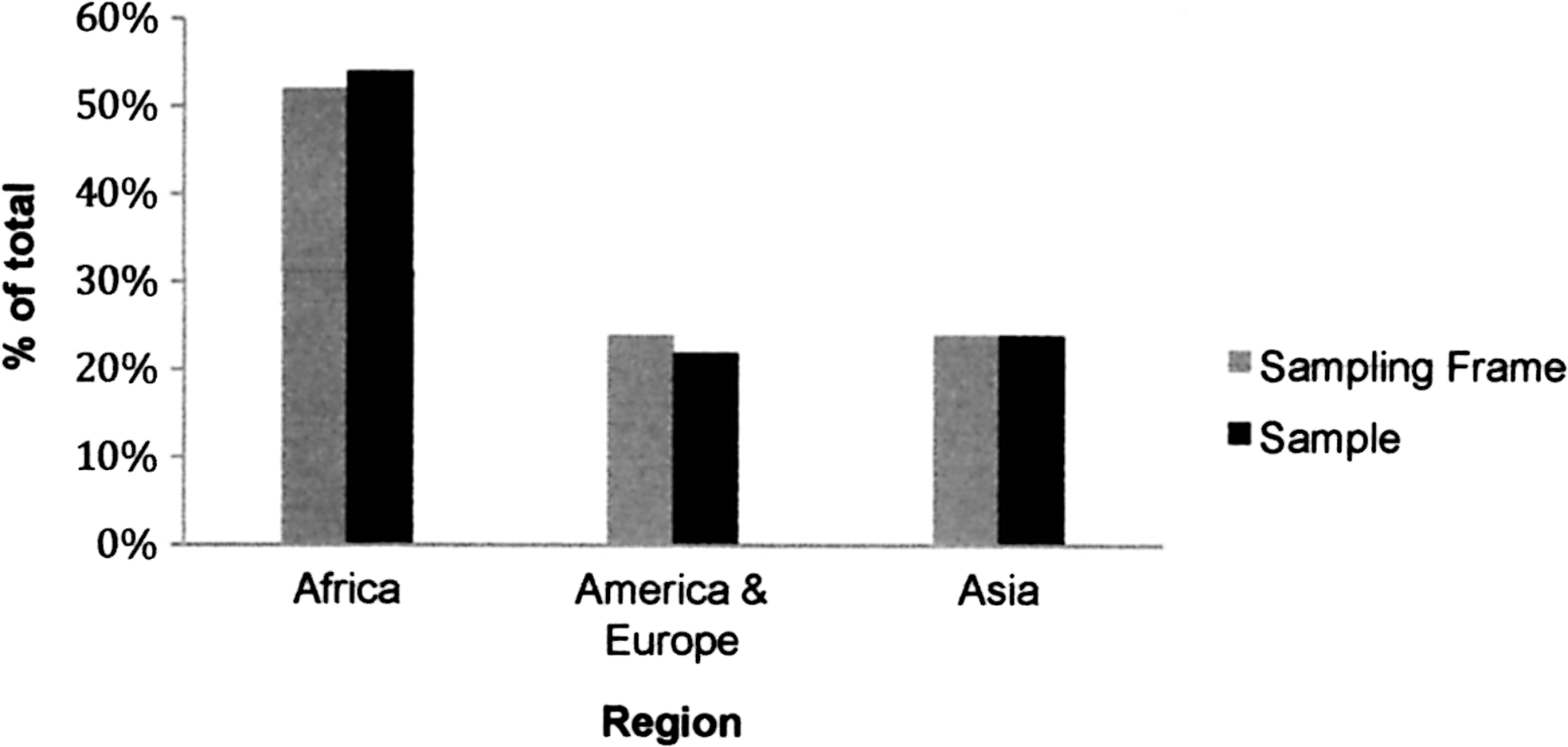
Study sample represents Global Youth Coalition for HIV/AIDS (GYCA)'s actual geographic distribution of members.
As seen in Figure 2, distribution by membership tenure partially represented our sampling frame. New (<1 year) and recent (≥1 year) members constituted 24% of the sample each, while primary (≥2 years) and charter (≥3 years) constituted 15% and 27% of the sample respectively.
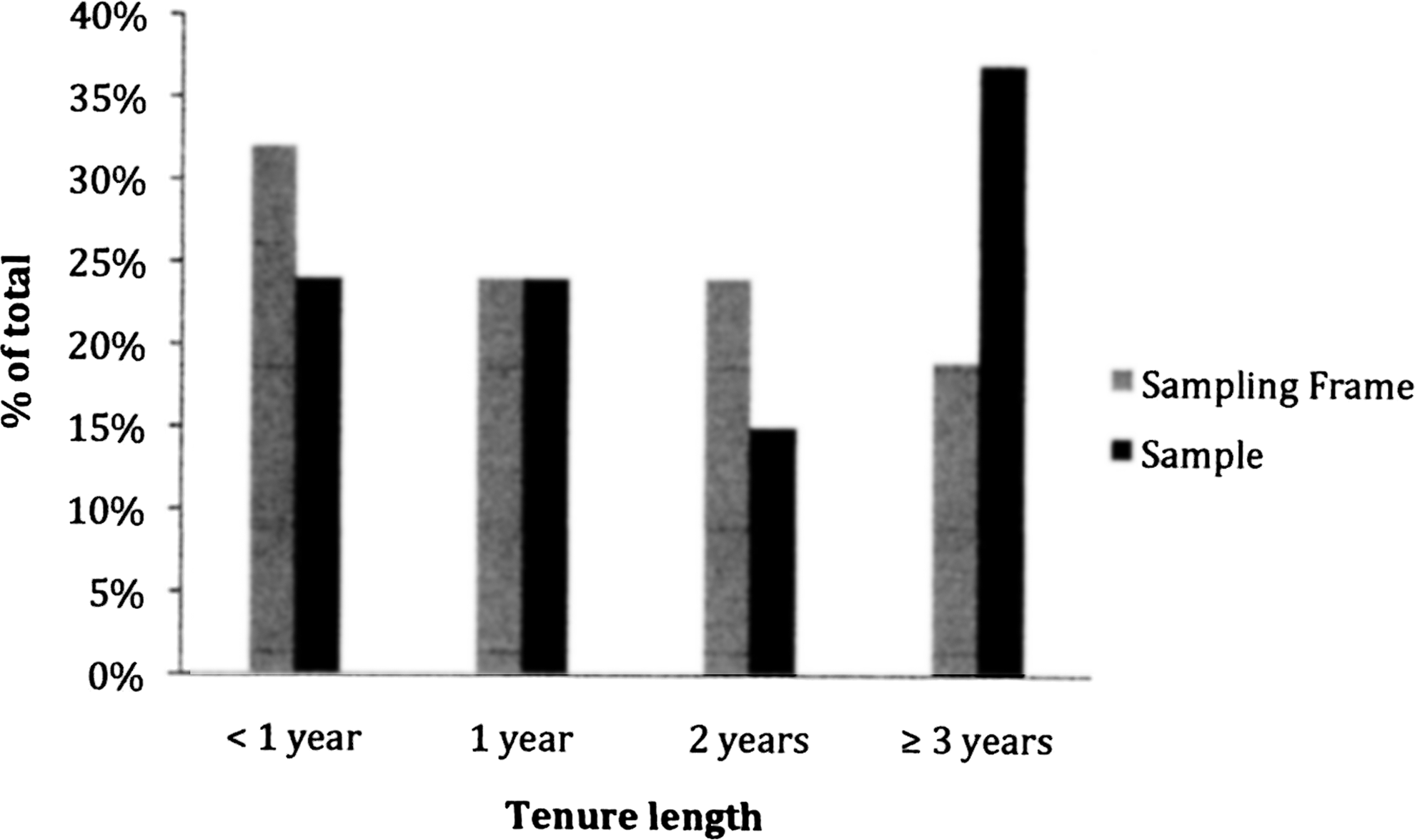
Sample distribution by GYCA membership tenure.
Sample description
Seventy-one percent of the survey respondents were male and 29% were female (Table 1). With an average age of nearly 27 years, nearly 45% of the survey respondents were employed full time, 22% employed part time, 15% were freelancers, and 18% were unemployed. More than 80% of respondents were educated for 13 years or more.
Predictors of listserv participation
The model comprising contextual and technological factors predicted 20% of the variance in listserv participation (Table 2). Apart from gender, we found that greater perceived contribution of oneself to the movement (β=0.22), and more time spent on the Internet (β=0.28) was associated with greater participation in the listserv.
R2=0.20; F=16.29, p<0.001.
Predictors of e-consultation participation
The model comprising individual, contextual, and technological factors predicted 33% of the variance in participation in the e-consultation (Table 3). Greater leadership (β=−0.24) and more social trust (β=−0.25) were significantly associated with participation. Greater institutional trust (β=0.19), greater perceived contribution of self (β=0.17), more time spent on the Internet (β=0.21), better access to the Internet (β=0.26), and higher ease of use of the e-consultations (β=0.23) were all associated with greater participation.
R2=0.39; F=7.90; p<0.001.
Online participation and social networking utility
Online participation, in concert with demographic variables, predicted 21% of the variance in perceived social networking utility (Table 4). More participation in e-consultations (β=0.26) was significantly associated, while greater listserv participation (β=0.12) was not significantly associated with positive perceptions of the social networking utility of GYCA.
R2=0.21; F=3.22; p=0.01.
Social networking utility and program effects
Further, we found that perceptions of social networking utility explain 49% of the variance in effects on knowledge sharing, 48% of effects on capacity building, and 44% of effects of political advocacy skills (β=0.71, 0.69, and 0.66 respectively) (Table 5).
Discussion
Our study strengthened evidence about the potential influence of intrapersonal, contextual, and technological variables on participation in OHSMs. Greater perceived contribution of the self and more time spent on the Internet were two factors that significantly affected participation in both listserv and e-consultations. According to Passy,18(p36) perceived individual contribution pertains to an individual's belief about the effectiveness of his own actions in relation to the movement's agenda. In the case of HIV/AIDS, the nature of this perception could depend upon whether the individual concerned is a Person Living with HIV/AIDS (PLWHA). A PLWHA who has been discriminated against or has been unable to gain access to antiretroviral drugs might consider himself in a strong position to share his experiences with other activists and actively contribute to discussions on such topics, thereby influencing GYCA's advocacy agenda. Among non-PLWHAs, individuals' perception might be shaped by intellectual influences (such as education/prior knowledge of the issue), personal experiences with PLWHAs, and a newfound ability—catalyzed by the Internet—to engage with a social issue.
Participation in e-consultations is influenced by a greater number of factors. Possible explanations lie in the very nature of these activities. A listserv is an ongoing activity, is temporally stable, primarily involves information sharing, and thus commands passive and active participation in equal measure. Because stakes in the eventual outcome of this activity might be lower, participation is relatively less affected by user attributes, technology characteristics, and contextual factors. In contrast, e-consultations are event based, temporally sporadic, and involve sharing information and opinions with the aim of influencing a larger agenda. This activity commands a greater emphasis on active participation and is thus likely to be influenced by a combination of user attributes, technology characteristics, and contextual factors. Negative betas associated with interpersonal traits demonstrate that members with lower self-perception as leaders, and lower social trust, were associated with greater participation in the e-consultation. We suggest that those individuals who usually hesitate to engage in face-to-face (offline) communication despite being affected by lack of social trust might find e-consultations an effective medium to channel their opinions and concerns.
These findings are important from the viewpoint of OHSMs, and inform the practices of organizations undertaking similar initiatives. For instance, GYCA may reconsider their existing information service delivery model to create and manage a space that facilitates the kinds of linkages that are more organic and community driven. Then, GYCA could benefit from a special focus on usability issues while designing e-consultations and other online activities, especially since ease-of-use appears an important technological factor influencing participation. GYCA's listserv could further benefit by efforts to encourage participation from program leaders, activists, and African membership who could expand the understanding of HIV/AIDS in the region by actively participating in the listserv.
Our findings must be considered in the context of study limitations. The response rate (13%) constrains the generalizability of the study. Survey respondents (27) were, on average, older than the target constituency for GYCA (15–24 year olds), thereby rendering our sample less representative than desired. In terms of membership tenure, new and charter members were underrepresented in the study, while charter members were overrepresented. Lastly, the lack of region-specific analyses limits our ability to understand the facilitators and barriers to participation by region.
In conclusion, the study explored factors influencing participation in an OHSM and tested a trans-disciplinary conceptual model of effects. We call for scholarship to generate innovative approaches to measure the effects of OHSMs on the intended outcomes of social change given the shortage of understanding of how online participation translates to on-the-ground action. 23
Footnotes
Acknowledgments
The authors would like to thank Franzeska Seel for helping to facilitate this study and Prajakta Adsul for assistance with data analysis.
Author Disclosure Statement
No competing financial interests exist.