







Abstract
Abstract
In recent years, social networking sites have received increased attention because of the potential of this medium to transform business by building virtual communities. However, theoretical and empirical studies investigating how specific features of social networking sites contribute to building a sense of virtual community (SOVC)—an important dimension of a successful virtual community—are rare. Furthermore, SOVC scales have been developed, and research on this issue has been called for, but few studies have heeded this call. On the basis of prior literature, this study proposes that perceptions of the three most salient features of social networking sites—system quality (SQ), information quality (IQ), and social information exchange (SIE)—play a key role in fostering SOVC. In particular, SQ is proposed to increase IQ and SIE, and SIE is proposed to enhance IQ, both of which thereafter build SOVC. The research model was examined in the context of Facebook, one of the most popular social networking sites in the world. We adopted Blanchard's scales to measure SOVC. Data gathered using a Web-based questionnaire, and analyzed with partial least squares, were utilized to test the model. The results demonstrate that SIE, SQ, and IQ are the factors that form SOVC. The findings also suggest that SQ plays a fundamental role in supporting SIE and IQ in social networking sites. Implications for theory, practice, and future research directions are discussed.
Introduction
T
Social networking sits are socially oriented Web-based platforms that contain several computer-mediated communication (CMC) technologies such as online feedback mechanisms. 7 These CMC technologies facilitate members connecting as a network to generate, share, comment on, and exchange different contents posted by other members.8–10 On this basis, social networking sites refer to a combination of three salient features: (a) system (socially oriented Web-based platform), (b) content, and (c) social information exchange. These features coexist and have to be considered together when studying social networking sites.
However, prior studies only include either one or two features of social networking sites (e.g., Hsiao and Chiou
11
considered system and social information exchange; Zhang
5
took system and content into account). Little research has considered all three features in a model, resulting in a knowledge gap about how they interact with each other in fostering SOVC. Hence, this study attempts to fill this knowledge gap by arguing that system quality (SQ), information quality (IQ), and social information exchange (SIE) are indicators that correspond to these features and investigate the role of features of social networking sites in building SOVC. More specifically, this study focuses on Facebook, one of the most well-known social networking sites in the world,
12
and aims to address the following previously neglected research questions:
Literature Review and Hypothesis Development
SOVC
The concept of SOVC is derived from the sense of community (SOC), an idea proposed in early 1974 by Sarason, who asserted that SOC is formed because members share similar interests, are willing to maintain friendships, are interdependent, and have a feeling of belonging to the community. 13 Indeed, prior research has indicated that SOC is typically cultivated through strong social ties among members, who know each other and exchange information mostly through face-to-face interaction, which facilitates feelings of membership, a sense of influence, and mutual affective connection. 14 SOVC, conversely, is normally not directly formed through speaking and exchanging information through face-to-face interaction with others, resulting in a lower social presence and diminished social cues. 6 SOVC can be fostered with CMC technologies (i.e., SQ). With CMC capabilities, SIE is quite active, IQ is achieved, 15 and a sense of belonging can still be built. Hence, SIE, SQ, and IQ seem to influence SOVC positively and need to be considered together.
SQ
The quality of a system lies in its interactivity because the nature of virtual communities is to provide users with the ability to connect to and interact with others by sharing, exchanging, and commenting. Song and Zinkhan
16
used interactivity to measure how users perceive SQ when they receive different types of chatting messages in the context of an online shopping environment. Results suggest that interactivity can be measured by control (ease of use), responsiveness (processing responses quickly), and communication (facilitating two-way communication), which thereby have been recognized as SQ dimensions.
16
Hence, this study treats these three factors as formative indicators of SQ because they are expected to measure interactivity.
16
It is suggested that a site's interactivity enables social systems to evolve over time and to generate different member behavior and ongoing social and community activities, which may lead to forming SOVC.
4
Thus, we hypothesize:
IQ
IQ may foster SOVC. Members comment on questions, share a variety of information, and discuss and debate issues, which creates content on social networking sites. All the content can be encoded into different formats (such as text, audio, video, and/or graphics), saved in a database or repository, and then retrieved when needed.
17
Also, the content can be modified, refined, and expanded by other members. These features can enhance IQ because once the content is refined and added to several times, clearer answers can be obtained. A study focusing on IQ to measure Web customer satisfaction identified six indicators of IQ: (a) relevance, (b) understandability, (c) reliability, (d) usefulness, (e) adequacy, and (f) scope.
18
These six indicators can be achieved by reciprocal interaction that refines the original content and creates quality of information, which encourages other members' intentions to share more content,
19
creating a higher possibility of increasing SOVC. Follow-up studies have studied the IQ of social networking sites and have found a positive relationship between IQ and SOVC.
5
Therefore, these six factors describe and define the construct, and are thereby treated in this study as formative indicators of IQ. We thus posit:
Social networking sites create a platform for members to provide support to other members and to receive other members' support. 9 This providing and receiving behavior is called reciprocity, and can be classified into two types: observing support and post support. 6 We propose that these two support types together form SIE, that is, SIE consists of observing and post supports of emotional and informational messages. This study treats them as formative indicators of SIE, since they can describe and define the construct of SIE.
Interpersonal and reciprocal communication exchanges between individuals are valued and sustained over time in social networking sites.20,21 Such a public exchange of support within a social networking site may enhance members' perceptions of being part of a supportive group, leading to the positive relationship between SIE and SOVC. Moreover, several empirical studies have also supported this association.
22
Thus, we posit:
SQ, IQ, and SIE
CMC technologies are critical functions in social networking sites and can be viewed as enablers or facilitators because they provide a way to spread information, facilitate multiple ways of communication, and easily navigate and respond to members' requests quickly. With such functionality, messages can be broadcasted, content shared in the social networking site can be read, and thereby SIE can be achieved.
23
Therefore, we predict:
The social networking site system creates a mechanism for members to provide high IQ. Facebook and YouTube, for instance, allow members to express that they like, support, and/or agree with content by clicking “Like.” YouTube also provides a “Dislike” button. When members find that IQ is low, they can dislike content by clicking this button. This mechanism encourages members to provide better IQ if they want to get more positive attention. Thus, while the mechanism creates the perception of interactivity, they also enhance the quality of content shared by members, leading to a positive relationship between SQ and IQ. We therefore suggest:
In addition to SQ, SIE is another key reason why members are willing to contribute their valuable knowledge to online social networking sites. SIE is characterized by actions that enable people to help one another. 24 If members perceive higher levels of SIE, they will be more likely to share their thoughts with high IQ on threads, increasing the diversity of the information and raising the accumulated knowledge. 25 Thus the higher the level of SIE, the greater the IQ will be.
On the basis of the foregoing discussion, hypothesized relationships among these factors are summarized in Figure 1. SQ is the main foundation of social networking sites that enable interactions among users and information (i.e., SIE and IQ). Also, IQ plays as an important mediating role between SQ, SIE, and SOVC.
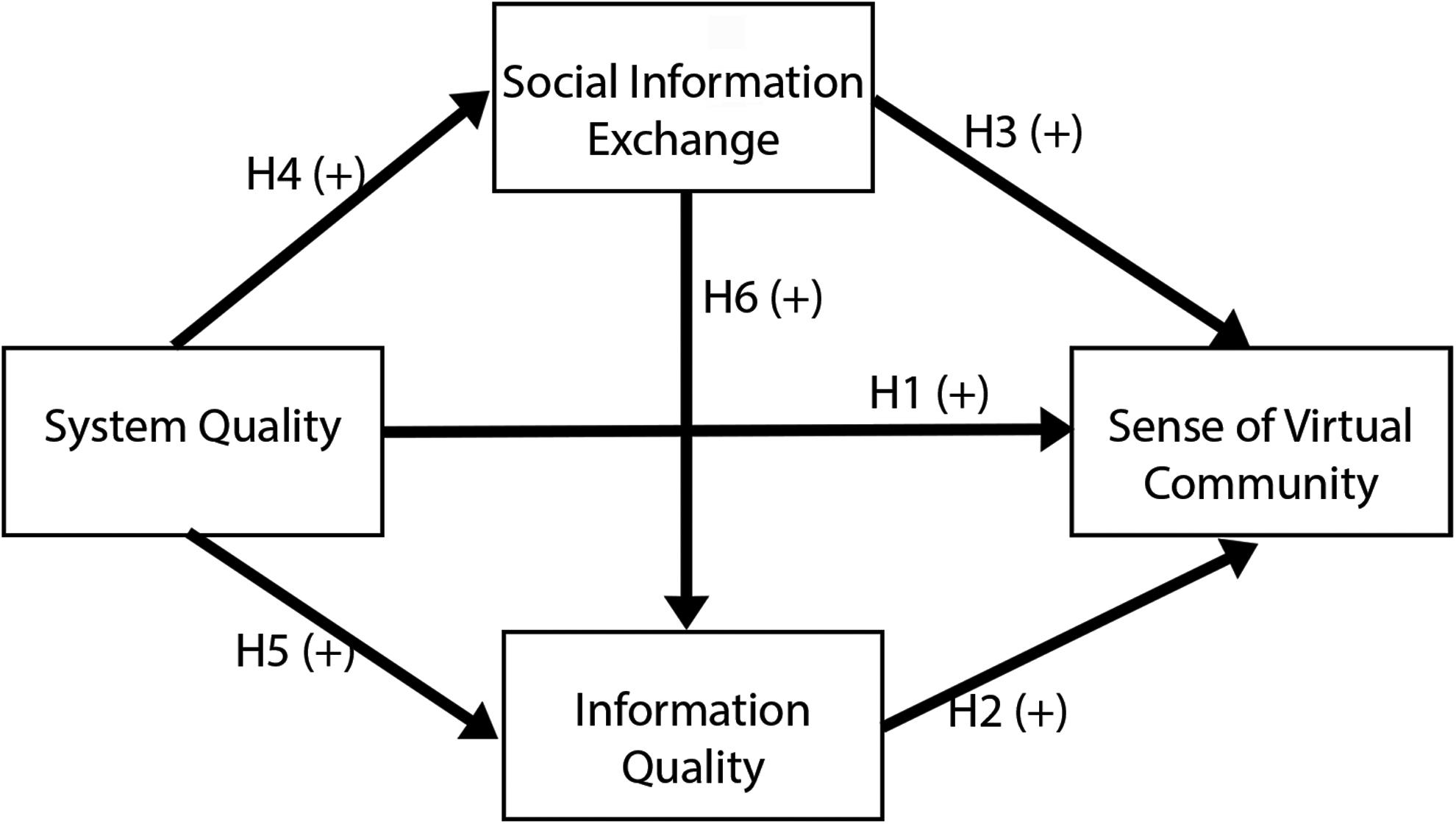
Proposed research model.
Method
Research methodology
A web-based survey instrument was designed to test the hypotheses proposed previously. Undergraduate student subjects from a business school in a Northeast United States University were recruited; their participation in this study earned them credits toward class research requirements. Only participants with experience in Facebook were recruited. An advantage of using students as study subjects is that they make up the majority of the population using social networking sites.12,26
Measures
Measurement items were all adapted from the literature. SOVC was adapted from the scale developed by Blanchard. 27 Blanchard systematically reviewed literature on the measure of SOC and took into account the unique features of virtual community to develop 18 new items to assess SOVC. Measurement of SQ was adapted from the scale developed by Song and Zinkhan. 16 Twenty-one items (six for communication, nine for control, and six for responsiveness) were used to assess SQ. SIE was measured using Welbourne et al.'s 14-item scale (three items for emotional post support, four items for emotional observing support, four items for informational post support, and three items for informational observing support). 22 IQ was assessed with items adapted from Mckinney and Yoon. 18 These items measured six attributes of content quality: adequacy (four items), quality relevance (four items), reliability (four items), scope (four items), understandability (four items), and usefulness (three items). For all items, a 7-point Likert scale was used.
Data collection
A total of 271 subjects took part in the survey. Thirty-four data points were removed because of incomplete or extreme outliers, resulting in a sample size of 237. The sample included 122 females and 115 males. Most respondents were between 21 and 25 years of age, and had extensive Internet experience at the time the data were collected.
Analysis and Results
Partial least square (PLS) analysis was used to examine the model for two reasons. First, contrary to SEM techniques such as LISREL, PLS does not require a larger sample. 28 Second, SEM cannot accommodate formative indicators. 28 Given that small data points were being tested for this study as well as the fact that the research model included both formative and reflective constructs, PLS is suitable for this study.
Following procedures recommended by Anderson and Gerbin, 29 this study conducted a two-stage analysis using Smart PLS 2.0. The first stage assessed the reliability and validity of the measurement model using factor analysis with maximum likelihood and promax rotation, as this study expected the underlying factors to be correlated. The second stage examined the structural model itself.
Test of the measurement models
Item reliability was assessed by examining the loadings of the measures with their respective constructs. In order to test the validity of our constructs, we performed confirmatory factor analysis (CFA) using structural equation modeling with AMOS 4.0. The CFA model's fit statistics (χ2/df=2.54, p<0.001, goodness of fit index [GFI]=0.934, adjusted goodness of fit index [AGFI]=0.897, normed fit index [NFI]=0.960, comparative fit index [CFI]=0.975, root mean square error of approximation [RMSEA]=0.069) showed that the model had good fit. The significant chi square value can be disregarded due to its sensitivity to the sample size and large number of items. 30 The results eliminated three items from SQ and eight items from SOVC because of poor factor loadings (<0.60). 31 Items that were eliminated from SQ include: (a) while I was on the site, I could choose freely what I wanted to see; (b) I had absolutely no control over what I could do on the site; (c) my actions decided the kind of experiences I got. Items that were eliminated from SOVC include: (a) I can recognize the names of most members in this virtual community; (b) I feel at home in this virtual community; (c) I care about what other virtual community members think of my actions; (d) if there is a problem in this virtual community, there are members here who can solve it; (e) I anticipate how some members will react to certain questions or issues in this virtual community; (f) some members of this virtual community have friendships with each other; (g) I have friends in this virtual community; and (h) some members of this virtual community can be counted on to help others.
After trimming items, all items' loadings were higher than 0.60, indicating convergent validity and reflecting that they share more variance with the construct than the amount of error variance. 31 Internal consistency was assessed in a PLS model using composite reliability (CR). Table 1 shows that the CR for each construct is >0.9, suggesting internal consistency. Additionally, the AVE values are all >0.5, demonstrating that the latent variable has a high degree of reliability and that the variance captured by the construct was greater than the variance due to measurement error. 32 Furthermore, a cross-loading matrix was examined to ensure that no item loaded higher on another construct than it did on the construct it measured. The square root of the AVE is higher than any of the correlations among the constructs, proving discriminant validity. 33 Thus, the results of internal consistency and discriminant validity show that all reflective constructs and subconstructs in the adoption model are adequate. Table 2 shows each construct's mean, standard deviation, and Cronbach's alpha.
Diagonal elements are the square root of average variance extracted (AVE). The left most column shows the composite reliability (CR) for each construct.
COM, communication; CONT, control; RES, responsiveness; EPS, emotional post support; EOS, emotional observing support; IOS, informational observing support; RELE, relevance; USE, usefulness; UND, understandability; SCO, scope; RELA, reliability; SOVC, sense of virtual community.
M, mean; SD, standard deviation.
In addition, since all constructs in this paper are perceptual measures collected in the same instrument, there is a possibility of common method bias. This study used Harman's single-factor test to examine the extent of common method bias. The factor analysis produced neither a single factor nor one general factor that accounted for the majority of the total variance, suggesting that the data did not suffer from common method variance. 34
Test of the structural models
The results of the PLS analysis are shown in Figure 2. The model supports all hypotheses. All features of social networking sites positively affect SOVC, suggesting that SQ, IQ, and SIE play essential roles in building SOVC in social networking sites. Furthermore, SQ positively correlates with SIE and IQ, with values of 0.47 (p<0.05) and 0.33 (p<0.05) respectively. Additionally, IQ mediates the relationship between SIE and SOVC, with values of 0.31 (p<0.05).
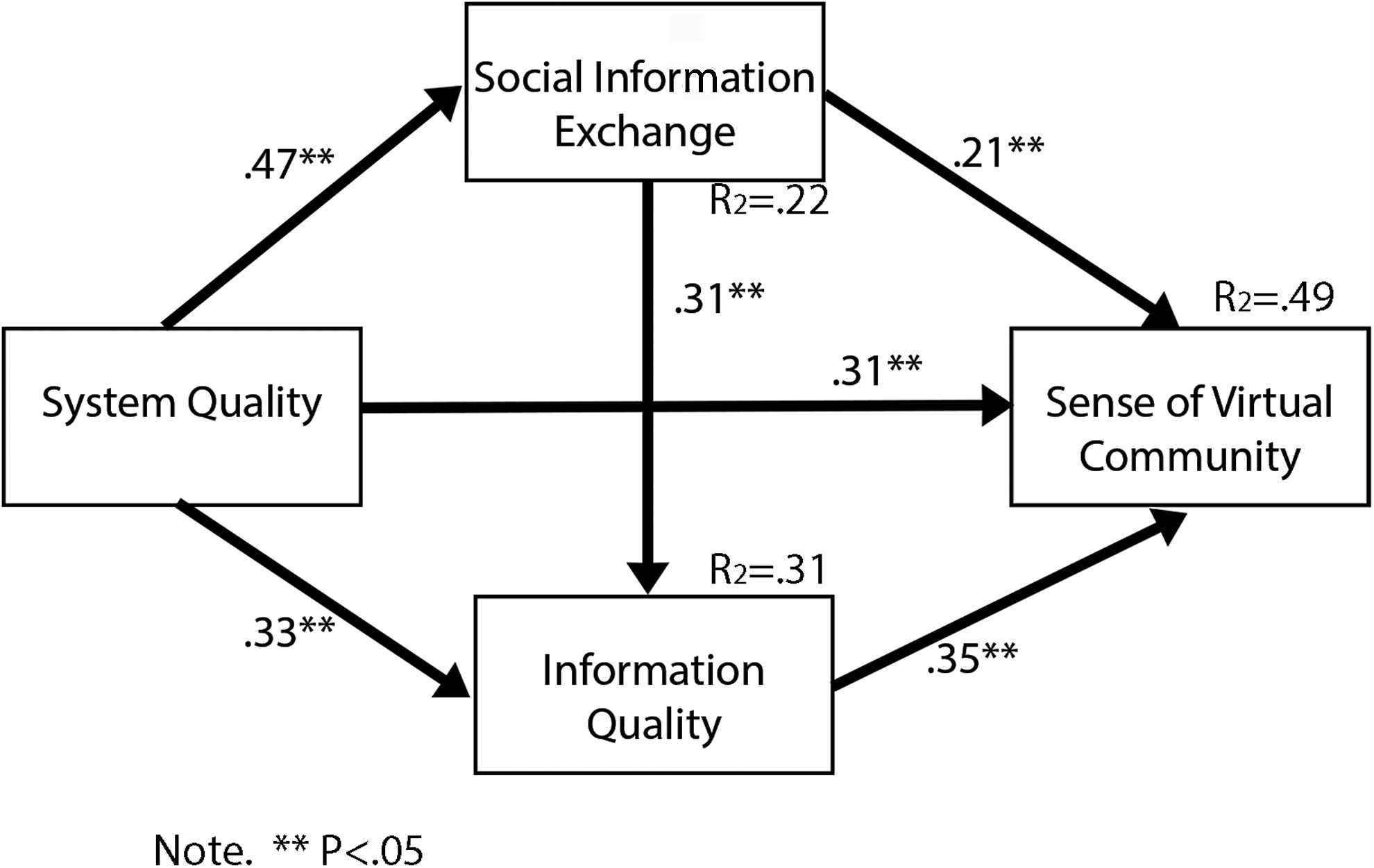
Results of standardized path analysis.
Discussion and Conclusion
The major contribution of this study highlights the important role of features of social networking sites—SQ, IQ, and SIE—in building SOVC. The present study also enhances previous studies' findings by delineating a more detailed relationship between SQ, IQ, SIE, and SOVC. First, IQ positively correlates with SOVC, indicating that the quality of the content posted on social networking sites may foster SOVC. Further analysis on IQ shows that social networking sites have strong emotional message support and weak informational message support, suggesting that members in social networking sites prefer to post emotional messages. Also, IQ has been found as a mediator between SQ, SIE, and SOVC in the proposed model, indicating that the quality of the content posted on social networking sites plays an important role in governing the relationship between SQ, SIE, and SOVC. Second, SIE positively correlates with SOVC, showing that information exchange is another factor that forms SOVC. Indeed, prior studies suggest that when members share information, they might have a strong desire to see responses to this information by people they know—by clicking “Like” or by posting comments. 35 If people always interact (i.e., exchange information) with each other, they are more likely to get a lot out of being in social networking sites, resulting in forming SOVC. Third, SQ positively correlates with SOVC, highlighting the supporting role of SQ in building SOVC. As members perceive the social networking systems' quality, it may positively influence members' perceptions of SIE and IQ. This finding thereby emphasizes the value of technology in social networking sites.
Implications
For practitioners, stoical networking site managers can develop strategies to create SOVC based on this study's model. One practical direction is that if a manager plans to build a social networking site, encouraging members by building a friendly mechanism, such as a feedback system, through which to share information and maintain good content is key to building SOVC. This direction can be achieved by using different CMC technologies in social networking sites, including online chatrooms, online games, friend lists, photo tagging, and online albums. For researchers, this study provides a comprehensive model for building SOVC in social networking sites. Accordingly, when developing their models, researchers can consider this study's model as a framework so that they can capture a more complete picture of their results.
Limitations and further research
Although the findings are informative and useful, a few limitations should be mentioned. First, SOVC was measured at a static point rather than as it was developing, thus losing the time aspect of explanation. Therefore, the data presented are cross-sectional, and spurious cause–effect inferences may have occurred. Future studies could adopt a longitudinal methodology that might provide a dynamic perspective on how SOVC can be built. The second limitation stems from the research scope of the study. This study did not focus on the psychological level. It would be interesting to take some psychological factors such as personality or motivation into account in building a clearer understanding of the impact of social networking sites' features. Moreover, this study only included Facebook in its study of social networking sites. Therefore, the findings might not be representative of all types of social networking sites. However, because Facebook dominates in the study's sample frame (student subjects), the results still represent best practices. Future research can focus on other social networking sites to improve the general picture of the findings reflected by the study.
Footnotes
Author Disclosure Statement
No competing financial interests exist.