







Abstract
Abstract
Positive attitudes toward a new communication technology tend to be a significant motivator in subsequent adoption and use. The recent spurt in the adoption of social media tools such as social networking sites (SNSs) demands the examination of attitudinal variables on motives to use these Web sites. This study explicated a multidimensional measure of attitudes toward SNSs and tested a theoretical model to examine the effect of attitudes on motives to use SNSs and SNS activity. Participants (N=674) completed a cross-sectional survey consisting of measures of attitudes toward SNSs, motives of SNS use, and level of activity. Results showed support for a revised model in which attitudinal variables—ease of use, self-disclosure, and social connection—strongly predicted motives of SNS use such as passing time, information/entertainment, social conformity, and, most importantly, socialization. The motive of using SNSs as a social tool superseded the direct effect of other motives on SNS activity, suggesting that users' primary activity on SNSs was for socialization and for relational development and maintenance.
Introduction
I
Attitudes and media choice
Technology-oriented and social-oriented theories on media choice look exclusively at the attributes of the medium or the encompassing social framework to explain people's reasons for choosing certain media,11,12 while ignoring the effect of attitudes. The connection between attitude and behavior has been well documented in persuasion literature. The Theory of Reasoned Action (TRA) suggests that attitudes are significant predictors of behavioral intentions, which in turn are predictive of behavior. 13 There is some evidence in the CMC literature of a connection between attitude toward an online tool and consequent adoption and use.14,15 With respect to SNSs, Gangadharbatla 6 utilized the TRA and the Technology Acceptance Model (TAM) to examine attitudes and SNS adoption, and showed that attitudes significantly predicted people's willingness and intention to join SNSs, which in turn positively predicted actual usage. A similar examination, 10 however, did not find a relationship between perceived usefulness and ease of use toward intent to use SNSs. An explanation for the discrepancies in these studies could be the narrow definition of the attitudinal construct. Perceived usefulness and ease of use are certainly variables of interest, but they do not wholly capture the range of feelings and thoughts that go into making behavioral decisions.
The first broad conceptualization of online communication attitude was offered by Ledbetter, 7 (p465) who defined it as “a cluster of cognitive and affective orientations that may foster or inhibit an individual's tendency to communicate online.” The multidimensional construct Measure of Online Communication Attitude (MOCA) consists of five sub-factors: self-disclosure, apprehension, miscommunication, ease, and social connection. The dimensions of ease and apprehension are conceptually similar to attitudinal variables in the TAM.6,16 However, in contrast to the TAM, the MOCA encompasses a broad range of attitudinal dimensions. Despite Ledbetter's assertion that the MOCA can be adapted and used to examine any form of CMC media, it has scarcely been tested. Only recently has it been extended to predict the effect of online self-disclosure and social connection attitudes on Facebook activity and relational closeness, 17 and on problematic Internet use. 18 In order to extend the MOCA, this study proposes to explicate a multidimensional measure of attitudes toward SNSs and investigates the subsequent effects on motives for SNS use and level of SNS activity.
Theoretical rationale
The uses and gratifications (U&G) framework 19 is well suited for examining the relationship between attitudes, motives, and behavioral consequences. A synthesis of literature on U&G reveals a consistent pattern of SNS user motives. Using SNSs for passing time, entertainment, social conformity, and communication have consistently been explicated as motives,20–23 which seems to suggest that SNSs function primarily for maintaining relationships with current contacts. 20 Despite the plethora of U&G studies in relation to SNSs, there is a visible hole in the theoretical rationale utilized thus far. Motives of SNS use have been explicated without regard to antecedent influencers or consequential behaviors. One exception would be the role of gender in predicting motives for SNS use. Female gender has been shown to be a significant predictor of relational motives and to self-disclose.20,24 In order to achieve an expansive view of SNS behavior, this study proposes to explicate various motives of SNS use and examine the influence of attitudes in explaining motives most pertinent to SNS users.
Hypotheses and research questions
Based on the discussion of the literature on SNSs and attitudinal variables, the following hypotheses and research questions are proffered (Fig. 1):
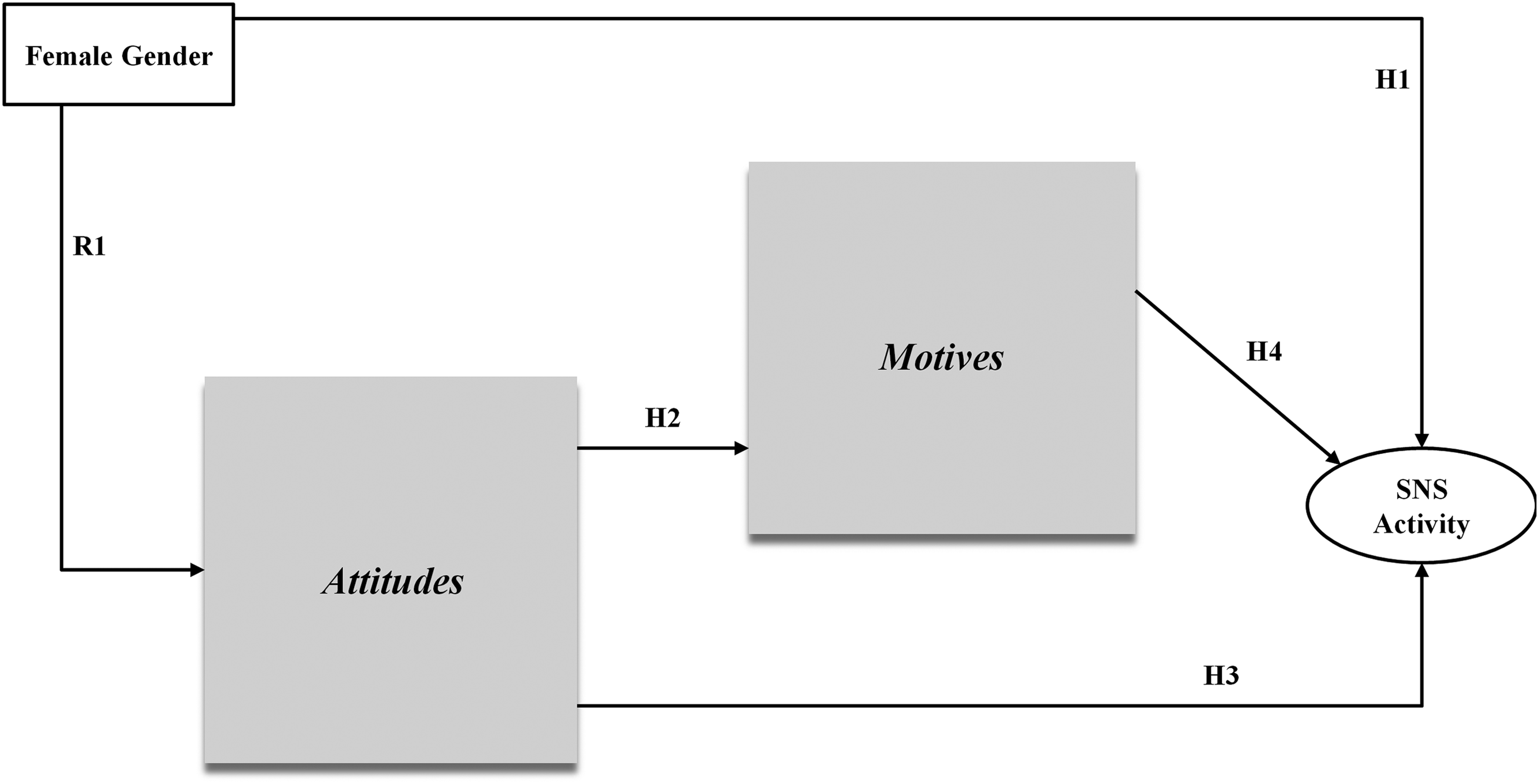
Hypothesized model of social networking site (SNS) attitudes, motives, and level of activity.
The hypothesized model (see Fig. 1) can be visualized as a structural model consisting of four blocks of variables: gender, attitudes, SNS motives, and SNS activity. Since the structural model was proposed a priori, it shows the proposed relationships as occurring between high-level constructs (i.e., attitudes, motives) as opposed to their underlying dimensions, which were explicated later and are discussed below.
Methods
Study sample and procedure
The sample consisted of 674 undergraduate students at a large, public university in the Northeastern United States. College students are often sampled to study social media use because of their high levels of adoption and frequency of SNS use.20,24 Thus, the college setting was considered ideal for the purposes of this study. The inclusion criteria were that participants had to be 18 years or older and have membership in at least one SNS (e.g., Facebook, MySpace, Instagram, etc.) to participate in the Web-based survey. Of the 674 participants in the sample, 300 (44.5%) were male and 374 (55.5%) were female, with a mean age of 19.64 years (SD=1.33 years). An overwhelming majority (81.2%) identified themselves as Caucasian/white, followed by Asian (6.9%), African American (4.5%), and Hispanic/Latino (4.8%).
Measures
Attitudes toward SNSs
Attitude toward SNSs was measured using the Measure of Attitudes Toward SNSs (MATS), which was adapted from the MOCA. 7 The MATS was constructed using 14 items adapted from the MOCA's original 31 items. The items were reworded to reflect attitudes toward using SNSs and revised to be scored on a 7-point Likert scale (ranging from 1=“strongly disagree” to 7=“strongly agree”). An exploratory factor analysis (EFA) conducted on the MATS using principal components analysis with a varimax rotation yielded a four-factor solution that explained 70.31% of the total variance (see Table 1). All four factors seemed to relate with the dimensions of the original MOCA scale (apprehension, social connection, ease of use, and self-disclosure). One of the reverse-coded items had poor primary factor loadings on the social connection factor and was removed. In order to render the MATS as a wholly positive attitudinal scale, all items in the apprehension subscale were reverse-coded in order to form a positive attitudinal subscale and labeled as “confidence in using SNSs.” The structure of the MATS was tested as a hierarchical model using confirmatory factor analysis (CFA) with attitudes toward SNSs as the second-order factor causing the four first-order factors. This model showed good fit, χ2 (61)=302.51, p<0.01, root mean square error of approximation (RMSEA)=0.077, normed fit index (NFI)=0.93, and comparative fit index (CFI)=0.94. Reliabilities of the MATS dimensions were good: confidence in using SNSs (4 items; α=0.85), social connection (4 items; α=0.84), ease of use (3 items; α=0.83), and self-disclosure (2 items; α=0.87).
All items were scored on a 7-point Likert scale where 1=“strongly disagree” and 7=“strongly agree.” Items marked with (R) are reverse-coded.
Numbers in boldface indicate primary factor loadings.
MATS, Measure of Attitude Toward SNSs.
Motives of SNS use
SNS motives was measured using a self-constructed uses and gratifications of SNS (UGS) scale consisting of self-constructed items and items adapted from three previously established scales: the Uses and Gratifications of the Internet Scale, 25 Motives for Using MySpace Scale, 23 and the Uses and Gratifications of Facebook Scale. 26 The 21 items in the scale were scored on a 7-point Likert scale (ranging from 1=“strongly disagree” to 7=“strongly agree”). Since U&G scales in the literature have almost always yielded underlying dimensions,23,27,28 an EFA was conducted to extrapolate the sub-dimensions of the UGS (see Table 2). Using principal components analysis with a varimax rotation, a four-factor solution was obtained that explained 69.34% of the total variance. Reliabilities of the four UGS dimensions were high: infotainment (7 items; α=0.90), social tool (6 items; α=0.90), passing time (4 items; α=0.91), and conformity (4 items; α=0.82).
All items were scored on a 7-point Likert scale, where 1=“strongly disagree” and 7=“strongly agree.”
Numbers in boldface indicate primary factor loadings.
Activity on SNSs
Level of activity on SNSs was measured with a self-constructed scale for determining the frequency of activity on specific SNS pastimes (e.g., “uploading photos, videos and links”). The SNS activity scale consisted of seven items and was scored on a 5-point scale, with responses ranging from 1=“never” to 5=“frequently” regarding the frequency of an SNS activity. An EFA performed to explicate potential dimensions yielded only a unidimensional scale. Reliability analysis showed good internal consistency (α=0.79).
Results
Test of hypothesized model
Structural equation modeling (SEM) using IBM SPSS Amos v19.0 with the maximum likelihood method provided the basis for hypothesis testing. Table 3 presents the means, standard deviations, reliabilities, and zero-order correlations of all the endogenous variables. As can be seen in Figure 2, H1 and H2 were both supported. H3 was partially supported; only social connection and self-disclosure had significant effects on SNS activity. H4 was also partially supported; only the social tool and social conformity motives had significant positive effects on SNS activity. With respect to R1, results showed that female gender had a positive significant effect on ease of use and a negative significant effect on self-disclosure. This tested model, however, indicated the presence of several nonsignificant regression paths and poor model fit: χ2 (24)=800.87, p<0.001, RMSEA=0.22, CMIN/DF=33.37, NFI=0.58, CFI=0.58 (Fig. 2). In order to increase model parsimony and fit, the model was revised by trimming the nonsignificant paths and adding paths as suggested by modification indices and theoretical reasoning.
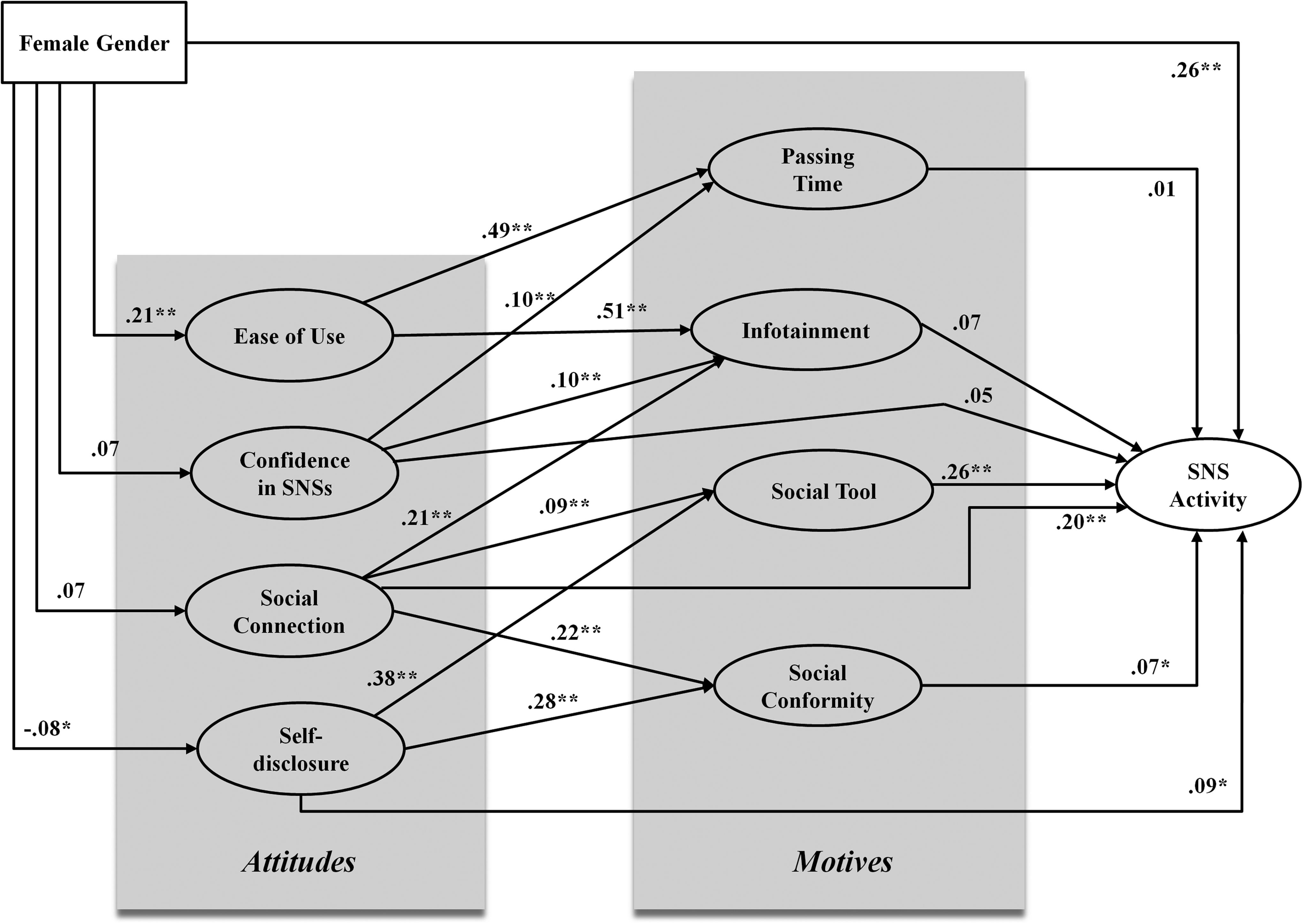
Test of hypothesized model showing the relationship between attitudes, motives for using SNSs, and level of activity: χ2(24)=800.87, p<0.001, root mean square error of approximation (RMSEA)=0.22, CMIN DF=33.37, normed fit index (NFI)=0.58; comparative fit index (CFI)=0.58. *p<0.05; **p<0.01.
* p<0.05; **p<0.01.
UGS, uses and gratifications of SNS.
Revised model
As suggested by Kline's 29 model-trimming procedures, nonsignificant paths were removed in an iterative process. The nonsignificant paths from female gender to confidence and social connection were removed, as were the paths from social connection to social tool, and from infotainment, passing time, and social conformity to SNS activity. Two paths—from confidence to passing time and infotainment—were deleted based on theoretical reasoning. This variable's conceptual definition matches closely to that of Internet efficacy. Prior research has shown that Internet efficacy, due to its close ties with frequent use, has little to no effect on related CMC phenomena. 30 This deletion revealed a more parsimonious explanation of the association between attitudes and motives.
The structural model was also modified by adding paths as indicated by modification indices. The first set of paths to be considered was between the attitudinal variables of ease of use and social connection (β=0.36, p<0.01), ease of use and self-disclosure (β=0.33, p<0.01), and self-disclosure and social connection (β=0.18, p<0.01). The relative strengths of the beta weights and the improvement in model fit lends to the credibility of the additions. The model suggests that SNS attitudes can be conceptualized as secondary and primary attitudes, with ease of use and self-disclosure serving as secondary attitudes and social connection as a primary attitude. The second set of paths considered for addition were between the motives of passing time and infotainment (β=0.52, p<0.01), infotainment and social tool (β=0.09, p<0.05), and social conformity and social tool (β=0.39, p<0.01). Similar to the attitudinal variables, motives of SNS use also seemed to be grouped into secondary motives—passing time, infotainment, and social conformity—and primary motives—social tool. The final addition was a path from female gender to the social tool motive (β=−0.20, p<0.01).
The revised model showed good fit: χ2 (18)=84.45, p<0.001, RMSEA=0.07, CMIN/DF=4.69, NFI=0.95, CFI=0.96. Additionally, the model explained a sizeable variance in SNS activity (R2=0.27) and the four motives: passing time (R2=0.16), infotainment (R2=0.61), social conformity (R2=0.26), and social tool (R2=0.35). The revised model (Fig. 3) showed support for H1 with a significant path between female gender and level of activity (β=0.39, p<0.01). H2 was also supported: ease of use significantly predicted the passing time (β=0.51, p<0.01) and infotainment motives (β=0.30, p<0.01); social connection predicted infotainment (β=0.13, p<0.01) and social conformity (β=0.22, p<0.01); and self-disclosure predicted social conformity (β=0.28, p<0.01). The model showed partial support for H3 and H4. Only attitudes of self-disclosure had a significant direct effect (β=0.26, p<0.01) on SNS activity. Similarly, only social tool had a significant direct effect (β=0.34, p<0.01) on SNS activity; the remaining three motives had indirect effects on SNS activity through their direct effect on social tool. With respect to RQ1, a significant effect was found from female gender to ease of use (β=0.21, p<0.01), and a significant negative effect was found from female gender to self-disclosure (β=−0.14, p<0.01).
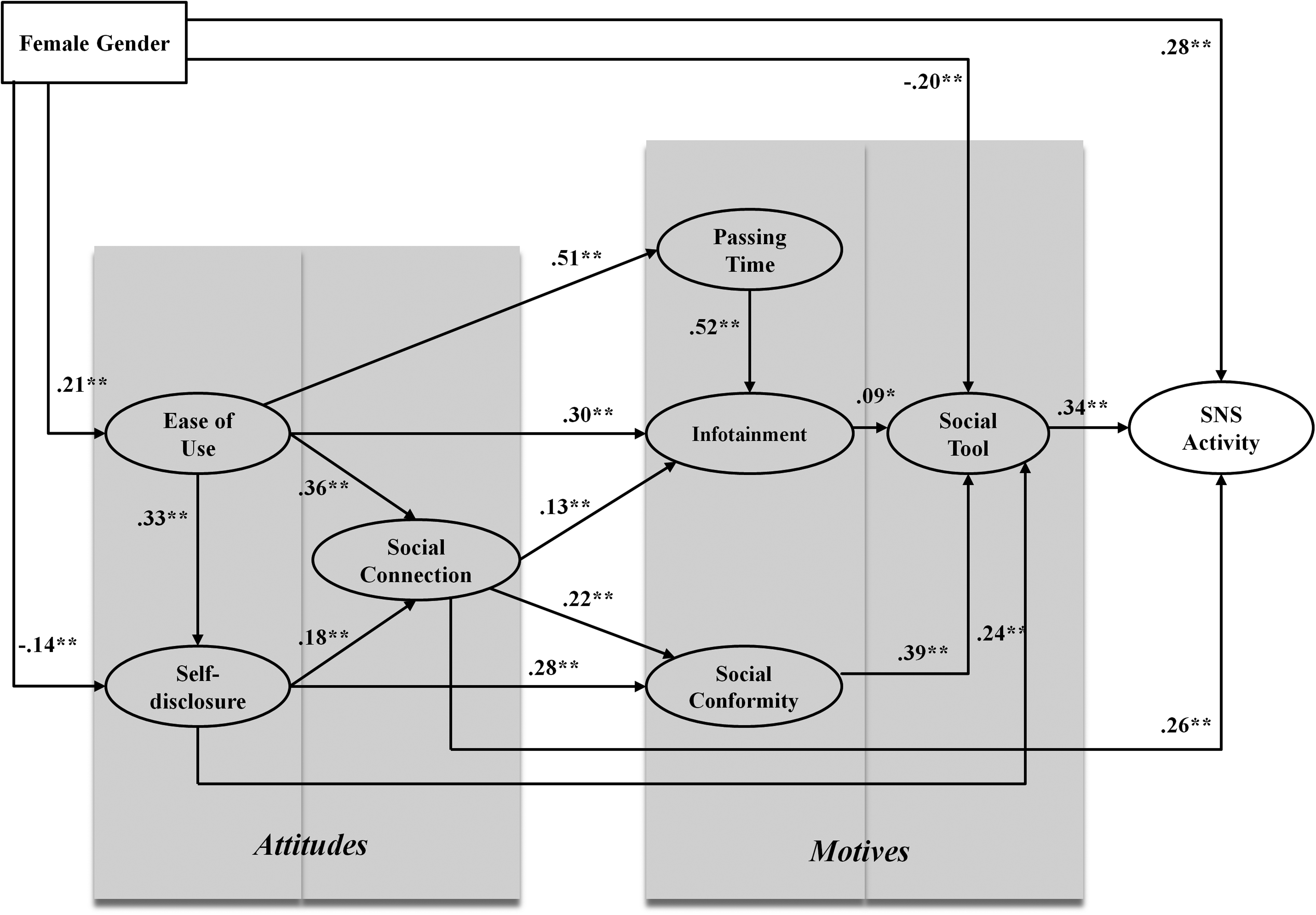
Revised model showing the relationship between attitudes, motives for using SNSs, and level of activity: χ2 (18)=84.45, p<0.001, RMSEA=0.07, CMIN DF=4.69, NFI=0.95, CFI=0.96. *p<0.05; **p<0.01.
Discussion
The goals of this study were to explicate a multidimensional measurement model of attitudes toward SNSs, examine the effect of these attitudes on motives, and to observe the effects of attitudes and motives on SNS users' level of activity. In general, the data did show support for the structural model, albeit in a revised form. As proposed, attitudes toward SNSs predicted various motives for using SNSs. Specifically, perceptions of ease of use influenced motives to use SNSs for passing time and infotainment. This finding supports results from TAM studies that have consistently shown a link between ease of use of a technology and eventual adoption and use. 6 Positive attitudes of self-disclosure on SNSs had a positive influence on the use of SNSs for purposes of social conformity and socialization. Similarly, perceptions of SNSs as facilitators of social connection predicted infotainment and social conformity motives.
The attitudinal variables in the revised model depicted a hierarchical structure; that is, attitudes toward SNSs served as either primary or secondary attitudes. Ease of use and self-disclosure can be viewed as secondary attitudes predicting the primary attitude: social connection. This finding is of importance, as it suggests that one can have positive attitudes of SNSs as a means of social connection only if one has positive attitudes of SNSs as being easy to use and of facilitating self-disclosure. Thus, the extent to how much an SNS user values the Web site's social capability depends on how easy they find the Web site to use and their comfort with being able to self-disclose. This is a significant extension of the MOCA, 7 as it suggests that some attitudinal dimensions can actually act as antecedents to other attitudinal dimensions. This finding also complements recent research 17 that shows that attitudes of social connection influence active communication on Facebook.
Similar to the hierarchical nature of attitudes, the structural model showed support for a hierarchy of SNS motives. Motive of using SNSs as a social tool overrode the direct effect of any other motive on SNS activity. This suggests that users' primary activity on SNSs is relational development and maintenance. This is consistent with U&G literature that has consistently found social interaction to be the primary function of SNSs.31,28 Although passing time and infotainment have frequently been found to be motives of SNS use,20,23 this study shows that these motives can be categorized as secondary motives, with social tool functioning as the primary motive. Although SNS users use these Web sites to obtain information or conform to others, the primary purpose is to maintain social and personal relationships.
The findings also reveal gender differences, some of which are consistent with previous studies.32,33 Female users tended to be more active on SNSs and had more favorable perceptions of SNS as easy to use compared to male users who had more favorable perceptions of SNSs as a medium for self-disclosure. The latter finding suggests that men find SNSs a relatively simple and effortless way of disclosing information. A gender difference was also found for motives to use SNSs as a social tool. Contrary to previous assertions 28 that women use SNSs primarily to maintain relational contacts, this study found that men tend to use SNSs more for social reasons. Since SNSs provide an easy and convenient method to connect with others, male users may be taking advantage of this medium in order to connect with known and unknown contacts. This result ties in previous research 34 that showed that men tend not to be as choosy as women in adding contacts to their online network.
Overall, perceptions of SNSs as being easy to use and acting as a medium of social connection and self-disclosure strongly predicted SNS motives of information/entertainment, conformity, and, most importantly, socialization. Uses and gratifications research is often criticized for not outlining the effect of attitudes and motives on communicative outcomes clearly. This paper is not only instrumental in defining attitudes and motives as distinct constructs and thereby extending the MOCA, but presents a model with direct and indirect effects of antecedents on level of activity. The findings discussed herein extend the uses and gratifications theory by explicating a model that parcels out the influence of attitudes and motives on SNS activity.
Conclusion
The Internet can be viewed as a mass medium, an interpersonal medium, and now, with the presence of online social networking, a social medium. Open CMC environments such as SNSs have profound effects on online social and communicative behavior. Online social networks are changing the way people communicate using the Internet. However, only recently have researchers started to investigate this phenomenon. Despite limitations of the cross-sectional nature of this study and the nonprobability and convenience sample, the present study will add to the burgeoning literature on social networking. This study has made a significant contribution by showing support for the effect of attitudes in explaining motives for SNS use and activity. Although this study explicated similar motives found in previous studies—passing time, social tool, conformity22,26—it has illustrated that these motives are only secondary in nature and that the motive of using SNSs as a social tool is the primary motive of using SNSs. This concept of different degrees or levels of motives is a novel extension of the U&G theory, and future work needs to be cognizant of this approach.
Footnotes
Author Disclosure Statement
No competing financial interests exist.