







Abstract
Abstract
A network perspective was adopted in this study to identify influential users in an online HIV community in China. Specifically, the indegree centrality, outdegree centrality, betweenness centrality, eigenvector centrality, and clustering coefficient of individuals were evaluated to measure the user influence in such a community. Moreover, this study examined how the digital divide, which is presently one of the major social equity issues in the information society, is associated with an individual's influence within the community. Two networks were formed on the basis of the behavioral data retrieved from the HIV community: the follower–followee network and the post-reply network. In the follower–followee network, members from areas with well-developed technologies demonstrated more connections, received more attention, and secured more critical positions in the network than their counterparts. However, such differences were insignificant in the post-reply network.
T
In health campaigns on SNSs, the influence of individual users is prominent for two reasons. First, individuals integrate their offline social networks into SNSs, 7 thereby making interpersonal communication convenient and efficient. Second, user-generated content, such as comments and retweets, has become an indispensable part of health campaign messages on SNSs. 8 Such user-generated content might strengthen the influence of certain users on other SNS users. 8 Thus, the identification of potential interpersonal influencers on SNSs will provide health professionals with valuable information for designing and implementing health campaigns on SNSs. The purpose of this study is to identify influential users in an HIV/AIDS community on SNSs. Moreover, we examine how the digital divide, one of the major social equity issues in the current information society, 9 is associated with an individual's influence in this community.
Online Communities and HIV
The stigma associated with HIV/AIDS is prevalent over the world.10,11 Consequently, people living with HIV/AIDS (PLWHA) are hesitant to request support from ordinary people in their daily lives. Nevertheless, the emergence of SNSs has offered PLWHA with a novel and anonymous way to create communities and seek HIV-related information and social support. 12 Several health professionals have created HIV intervention communities on SNSs to provide HIV-related information and promote HIV testing behavior.13,14
For instance, Ko et al. 13 created an HIV prevention Facebook page and trained 369 gay opinion leaders to lead discussions on this page. They found that participants who visited the prevention Facebook page were more likely to receive HIV-related information and discuss HIV issues with others than those who visited the control Web site without trained peer leaders. Similarly, Young et al. 14 introduced trained peer leaders to deliver HIV-related information in a Facebook intervention group. They found that increased network ties were significantly and positively related to the likelihood of individuals to undergo HIV testing and seek follow-up test results. Such empirical evidence indicates that influential individuals in SNS communities can facilitate HIV-related information dissemination and promote HIV testing behavior. However, limited effort has been conducted to identify influential individuals in such communities in a real-life context as well as to uncover factors relevant to individual influences in these communities.
Measurement of Users’ Influence in Online Communities
Network metrics specify how well a node is connected with other nodes, thus serving as measures of a node's influential power. 15 Scholars have proposed several network metrics that can be used as indicators of an individual's influence in online networks and communities.15,16 Examples of these network metrics include the indegree, outdegree, eigenvector, and betweenness centralities, as well as the clustering coefficient.
The indegree and outdegree centralities measure the number of incoming and outgoing ties, respectively. 17 In a social network, the indegree and the outdegree represent the popularity and sociality of a node and are associated with a node's influence and power.18,19 Other indicators of a user's influential power are the structural positions of an individual in a network, which are captured by the eigenvector and betweenness centralities.20–22 The eigenvector centrality, which measures the number of nodes adjacent to a given node and weighs each adjacent node on the basis of its degree centrality, is an indicator of a node's status and reputation in a network. 23 The betweenness centrality measures the frequency that a node falls along the shortest path between two other nodes, thus describing a node's potential influence in controlling the information flow in a network. 24 The clustering coefficient is an indicator of a node's embeddedness in a network. A higher clustering coefficient indicates that more information was transferred and better communication and cooperation were facilitated within the network. 25 Previous studies have suggested that a node's embeddedness is associated with its influence in the network.25,26
Therefore, the current study used the indegree, outdegree, eigenvector, betweenness centralities, and the cluster coefficient to identify the influential individuals in online communities.
Digital Divide and Individuals’ Influential Power
Aside from an individual's structural positions, external environmental factors also contribute to an individual's influence in a social network. In this study, we focused on the digital divide, which is presently one of the major social equity issues in the current information society. 9 The digital divide refers to “the gap between individuals, households, businesses, and geographic areas at different socioeconomic levels with regard both to their opportunities to access ICTs and to their use of the Internet for a wide variety of activities.” 27 (p5) The digital divide is apparent between developed and developing countries, 28 as well as within countries, 29 particularly between rural and urban areas. 30
The digital divide leads to inequalities in obtaining information and opportunities, 31 thus affecting the online social capabilities of individuals. 32 The digital divide can be construed as inequalities in Internet self-efficacy, which is an individual's perception of the capabilities to apply Internet skills.33,34 Previous studies have posited that Internet self-efficacy is positively associated with an individual's social outcomes. 35 Individuals with high Internet self-efficacy tend to have good capabilities to develop and maintain online social networks, which in turn may strengthen their influential power in online communities. Thus, we expect that individuals who come from areas with well-developed technologies would secure more critical roles in online communities compared with those who come from areas with underdeveloped technologies.
Materials and Methods
We focused on an HIV/AIDS Weibo Group created in January 2011. Weibo is a Twitter-like microblogging site that has become one of the most popular social media in China. 36 In this study, the boundary of the network was clearly defined by focusing on a Weibo group, thereby enabling the analysis of a full network. Data were collected from the HIV/AIDS Weibo Group's Web site with the use of the Python web crawler in February 2014. At that time, the HIV/AIDS Weibo Group had 1,636 registrants, making it one of the largest HIV/AIDS groups on Weibo. To ensure that the collected data reflected interpersonal interactions within this community, 37 users who registered but did not post any message were excluded. Company accounts were also excluded. The final data set comprised 724 active individuals who posted at least one message in the group and reported their geographic location in their Weibo profiles.
We examined the influential power of individuals in two networks, namely, the follower–followee network and the post-reply network. For the follower–followee network, if group member i followed group member j, then i formed a link to j. This link was unweighted and directed. For the post-reply network, if group member i posted a message in the HIV/AIDS group and group member j replied to it, then j formed a link to i. This link was weighted and directed. The weight of the tie was measured by the frequency of replies between i and j. The group member's gender, self-reported province (or municipality), number of tweets, and date of registration were also collected.
The individual's influential power was measured using multiple indicators, including the indegree, outdegree, betweenness, eigenvector centralities, as well as the clustering coefficient. China's ICT Development Index (IDI) 38 was adopted as a measurement of the digital divide. We categorized the members in this community into three groups according to the IDI value of their geolocation: high, medium, and low in ICT development. The three groups had a comparable amount of users (nHigh = 182, nMedium = 242, nLow = 300). Multivariate analysis of variance (MANOVA) using network centralities as dependent variables was performed to test the differences between groups. The distributions of the five network metrics were left-skewed distributed. Thus, we performed log transformations of the dependent variables. Furthermore, we included the HIV epidemic level, which refers to the number of reported HIV/AIDS cases in each province or municipality, 39 as a control variable. Bonferroni pairwise comparison tests were conducted to identify which paired groups were significantly different.
Results
Descriptive statistics
Among the 724 group members, 652 were males. Their mean registration period on Weibo was 1,019 days (standard deviations [SD] = 293), and the mean number of tweets was 748 (SD = 1,618). The 724 users were dispersed across 31 provinces and municipalities in China. Among these users, 16.3% (n = 118) were from Beijing, 11.5% (n = 83) were from Guangdong, and 8.8% (n = 64) were from Shanghai. Individuals from these three locations accounted for 36.4% of the sample, which was greater than the proportion of Internet users in these three areas among all netizens in China in 2014. 40
The follower–followee network of the 724 users was weakly correlated with the post-reply network (quadratic assignment procedure correlation: r = 0.15, p < 0.001). The HIV group's post-reply network was sparser than the follower–followee network. There were 19,198 and 3,648 edges in the follower–followee and post-reply networks, accounting for 3.7% and 0.5% of all possible ties among 724 members, respectively. Not all group members were followed or replied to by other members, and those who were not connected are called isolates. Isolates made up 10.5% and 15.7% of the group members in the follower–followee and post-reply networks, respectively. Figures 1 and 2 visualized the follower–followee and post-reply networks, respectively.
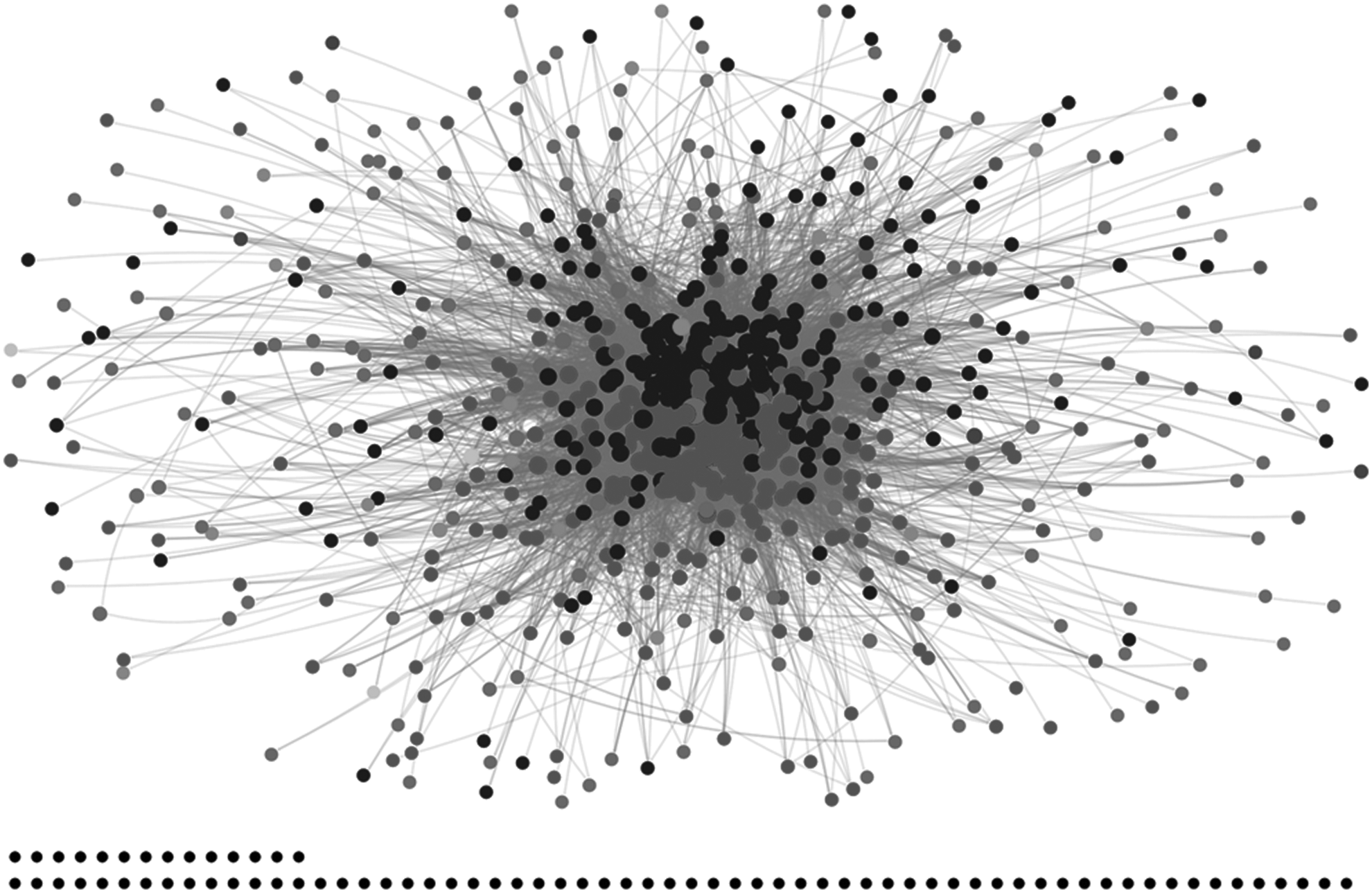
Visualization of the follower network among the group members of the virtual HIV/AIDS community on Weibo.
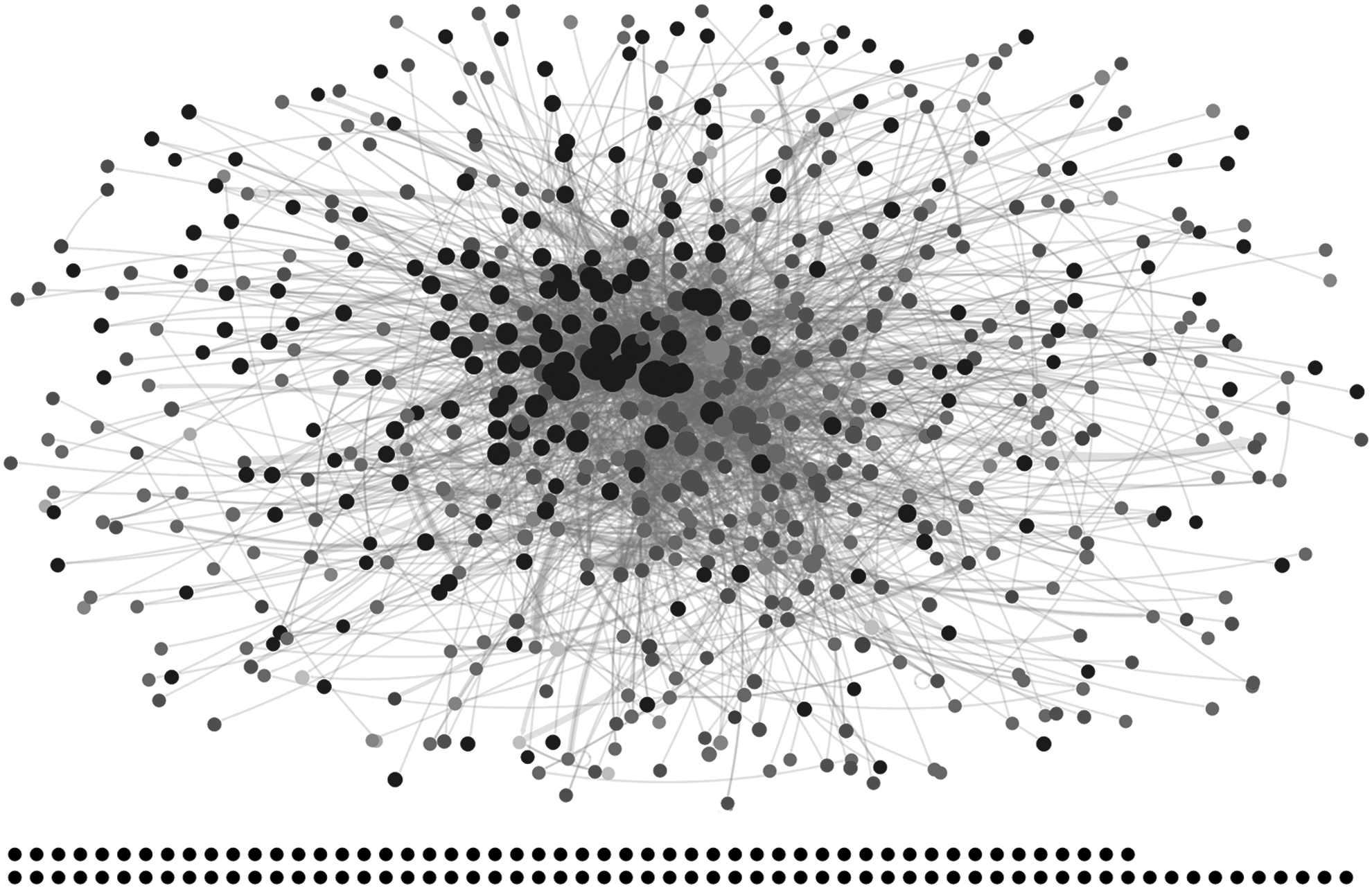
Visualization of the communication network among the group members of the virtual HIV/AIDS community on Weibo.
Individuals’ influential power
Table 1 reports the descriptive statistics of the five measures of influential power in the follower–followee and post-reply networks. The number of following relationships among users varied from 0 to 310 (M = 26.5, SD = 41.2), and the number of replies each member received varied from 0 to 64 (M = 3.4, SD = 6.6), indicating different levels of connectivity across the networks. The degree centrality in the two networks demonstrated a long-tail distribution, suggesting that a small portion of the PLWHA possessed a large amount of social ties.
As reported in Table 2, the four network centralities, namely, indegree, outdegree, betweenness, and eigenvector were highly correlated in both networks (ranging from 0.55 to 0.93 in the follower–followee network and from 0.65 to 0.85 in the post-reply network). The high correlations revealed that the four centrality measures consistently represented the influence of individuals and were distinctive of one another. By contrast, the correlations of centralities across two networks were small, indicating that group members who played central roles in one network were not necessarily influential in another network.
p < 0.01; *p < 0.05.
Metric1, indegree centrality; Metric2, outdegree centrality; Metric3, betweenness centrality; Metric4, Eigenvector centrality; Metric5, clustering coefficient.
The clustering coefficients had weak correlations with all other four indicators ranging from −0.09 to 0.21. They were even negatively correlated with the betweenness in both networks, revealing that a highly embedded individual was unlikely to act as a gatekeeper in the information flow. In view of the weak associations between clustering coefficients and other measures, clustering coefficients would not be counted as an influence indicator in the following discussions:
To identify influential individuals in this HIV community, Table 3 presents the top 10 nodes (individuals) of each network centrality in the two networks. Most of the individuals who had a high rank of indegree or outdegree also outperformed in the ranks of betweenness and eigenvector. It shows that those who were popular and active also secured crucial roles in controlling information flow and possessed a high reputation in the network such as Node 021, Node 067, and Node 154. Nonetheless, the ranks of the clustering coefficient did not overlap with the ranks of other indicators of influence. Moreover, group members who ranked high in the follower–followee network generally did not obtain high ranks in the post-reply network and vice versa. Nevertheless, Node 021 secured high ranks in most of the influence indicators of both networks, making it highly influential in this community.
Digital divide and individuals’ influence
Tables 4 and 5 display the mean and SD of the three ICT development groups with regard to network centralities. The group members from regions with low-level ICT development had smaller centralities than those from regions with well-developed ICTs in the follower–followee network. Nevertheless, in the post-reply network, those who come from areas with less well-developed ICTs had slightly higher network centralities.
Note. Standard deviations are in parentheses.
Note. Standard deviations are in parentheses.
In the follower–followee network, the MANOVA test showed that there was at least one significant difference among the network centralities of the three ICT development groups, F(2, 720) = 3.50, p < 0.001. Significant differences among the three groups were found in terms of indegree, F(2, 720) = 13.33, p < 0.001; outdegree, F(2, 720) = 11.09, p < 0.001; betweenness, F(2, 720) = 9.17, p < 0.01; and eigenvector, F(2, 720) = 14.49, p < 0.001. The difference in clustering coefficient was insignificant, F(2, 720) = 2.16, p = 0.12. Bonferroni pairwise comparison tests showed that the high ICT development group had significantly higher centralities than the other two groups. No differences in network centralities existed between the low- and medium-level groups. In the post-reply network, the network metrics were not significantly different among the three ICT development groups, F(2, 720) = 0.50, p = 0.89. The HIV epidemic level was nonsignificant in both networks.
Discussion
This study explored the influence of individuals in an HIV/AIDS community on Weibo. In addition, this study examined the impact of the digital divide on the individuals’ influence. We identified influential individuals in the HIV community by using several network centrality measures, which were determined by analyzing behavioral data from an SNS. Moreover, we found that in the follower–followee network, members who come from areas with well-developed technologies possess more connections, receive more attention, and secure more critical positions in the network than their counterparts. However, within the post-reply network, ICT-related geographical inequality is not associated with the influencing power of individuals.
Individuals’ influence in social network
Our analyses of individuals’ influence in two networks among the HIV community members show that the influence indicators, namely, the indegree, outdegree, betweenness, and eigenvector centralities, are medially or strongly correlated to one another. These four centrality measures consistently represent an individual's influence; however, each centrality metric explains a distinct meaning. Therefore, we argue that multiple indicators are needed to comprehensively measure one's influence in a network. Moreover, we find that those who play central roles in one network are not necessarily influential in the other network, indicating that the follower–followee and post-reply networks function differently.
We identify influential individuals who play critical roles in information diffusion and social relationships among the HIV community members. This information is worthwhile to public health professionals, given that those influential individuals may serve as interpersonal influencers in SNS health campaigns. Such individuals may help disseminate intervention messages and spur behavioral changes in future SNS health promotions.
Digital divide and individuals’ influence
Furthermore, we analyze the association between digital divide and the individuals’ influence in the HIV community. In the follower–followee network, members from areas with well-developed ICTs have significantly higher network centralities than those from areas with less-developed ICTs. In other words, individuals from areas with well-developed technologies receive and send out more connections and are designated with more influential positions than their counterparts in the follower–followee network. Clustering coefficient is not significantly different among all three groups. One possible explanation is that the overall environment of the social network in which the node is located, rather than a node's individual attributes, affects its embeddedness. Although we divide all members into three groups according to the ICT development level, all members actually are in the same online social network, which may lead to nonsignificantly different clustering coefficients across the three groups.
In contrast, our results document that the digital divide is not related to the influence of individuals in the post-reply network. The follower–followee network represents a communication as well as a social network within which they build friendships. Alternatively, the post-reply network illustrates only communications among group members in terms of a specific topic. The digital divide is construed as inequalities in Internet self-efficacy, which generally affects an individual's ability to build online social networks. 34 Nevertheless, it may not affect individual's performance on exchanging HIV/AIDS-related information within this group. This is the reason why the digital divide is associated with an individual's influence in the follower–followee network but not in the post-reply network. This result indicates that although inequalities in ICT development may affect an individual's influence in an online social network, it has little impact on individuals’ connectivity when they talk within the HIV community. It shows that creating virtual communities on SNSs for PLWHA can be an effective strategy for reducing the effect of inequalities in ICT development.
Limitation and future research
The current research has some limitations that warrant mention. First, a group is only one unique category of social networks, and individuals usually interact with others “in ways that ramify across group boundaries.” 41 (p2031) Given that the HIV online community examined in this study defines a clear boundary for the social network, we neglect cross-boundary interactions that some of the group members might have. Second, we examined only one HIV community in this study, which may limit the generalizability of our results. Third, 912 participants were excluded because they have limited behavior data in this community. Future study investigating this group of participants in virtual community may give an added insight.
Footnotes
Acknowledgment
The study was supported by Academic Research Fund (AcRF) Tier 1 Grant (M4011299.060) from Nanyang Technological University.
Author Disclosure Statement
No competing financial interests exist.