







Abstract
Abstract
A bone marrow transplant is often the only key to recovery and survival for patients suffering from blood cancers. Social media platforms have allowed nonprofit organizations as well as family members and friends of patients in need of a matching donor to make their solicitation messages go viral and reach out to the broadest possible audience to increase the likelihood of finding a matching donor. Noting that social media audiences are exposed not only to the content of a social media message but also to the metrics representing the virality of the message (i.e., how many times the content has been shared), we conducted an online experiment to investigate the effects of virality metrics on perceived social norms and behavioral intention to join a bone marrow registry. In doing so, we considered the potential moderating role of perceived threat posed by blood cancers. The experiment was conducted with 152 participants who met the general eligibility guidelines set by the National Marrow Donor Program (NMDP). The results of the experiment showed that exposure to high virality metrics led to greater perceived injunctive norms. The results also revealed that the effect of virality metrics on perceived injunctive norms was significant among those perceiving low levels of blood cancer threat. Furthermore, the results demonstrated that high virality metrics led to greater intention to join a bone marrow registry through perceived injunctive norms only when perceived threat of blood cancers was low. Theoretical and practical implications of these findings are discussed.
Introduction
F
In the effort to beat the odds and save lives by finding matching donors, social media platforms such as blogs and social network sites (SNSs) have played an important role. Social media platforms have enabled nonprofit organizations as well as family members and friends of patients in need of a matching donor to make their solicitation messages go viral and reach out to the broadest possible audience. 3
When reading a message on social media platforms, people are exposed not only to the content of the message but also to the cues generated by the platforms. These system-generated cues include metrics that represent virality—in particular, the number of times the content has been shared.4,5 Virality metrics associated with popular SNSs such as Facebook and Twitter are widely being used on online news sites and blogs through the use of social sharing buttons.6,7
Past research has shown that virality metrics exert significant influence on persuasive outcomes.4,8 Yet, little research has examined the effects of social media virality metrics on the mobilization of support for unknown others. The present research investigated whether and how social media virality metrics influence persuasive outcomes in bone marrow donation contexts. Specifically, we considered the mediating role of injunctive norms, which exert significant influence on charitable giving. 9 We also examined the moderating role of perceived threat posed by blood cancers.
Social Influence of Virality Metrics
Virality metrics and injunctive norms
Audience reaction to media content is one important way in which injunctive norms—people's beliefs regarding what is approved by others and what ought to be done10,11—are communicated. 12 As a representation of audience reaction to online content, 13 social media virality metrics can serve as cues to people's motives and intentions underlying their sharing behavior. Although a wide range of self-serving (e.g., enjoyment, reputation) and other-serving (e.g., altruism) motives drive sharing behavior, 14 people often share content they find interesting and important through SNSs such as Facebook and Twitter with the intent to encourage their SNS connections to become interested and involved in the issue.15,16 Given this, high virality metrics displayed alongside a bone marrow drive message may signal that many people believe the charitable behavior is important and ought to be performed, which may heighten perceptions of injunctive norms in favor of joining the registry. Therefore, we predicted the following:
Injunctive norms and behavioral intention
Perceived injunctive norms heightened by high virality metrics, as hypothesized in H1, may increase intention to perform the behavior promoted in the message. Research based on the theory of reasoned action and the theory of planned behavior17,18 has shown that injunctive norms significantly predict behavioral intention.9,19 In the context of blog-based communication, user-generated comments evoking injunctive norms in favor of preventive health behaviors promoted in a blog post increased the audience's intention to comply with the behaviors. 20 Given these findings, we predicted the following:
The role of perceived threat
Engagement in protective behaviors often results from perceptions of threat to self and/or others and the motivation to ameliorate the threat. Although a considerable amount of research has studied factors that increase perceived threat and how they motivate people to perform protective behaviors, 21 relatively little attention has been paid to how perceptions of threat, as an individual difference variable, influence processing of persuasive messages.
The effect of virality metrics on perceived injunctive norms and behavioral intention may vary depending on differences in perceptions of threat posed by blood cancers. On the one hand, those who perceive high levels of blood cancer threat may pay close attention to a bone marrow drive message; upon seeing that the message has been shared many times, they may readily perceive that joining a bone marrow registry is what one ought to do, which can, in turn, lead to greater behavioral intention (as posited in H2). On the other hand, virality metrics may be considered “easily noticed cues” 22 (p247) that serve as a bandwagon 23 or endorsement heuristic,4,24 which refers to the cognitive shortcut in which people base their perception of a message on other people's reaction to the message. 25 According to the heuristic-systematic model, people with low motivation for processing issue-relevant information are more likely to rely on heuristic processing than those with high motivation. 26 Those perceiving low levels of blood cancer threat may lack the motivation to effortfully process the message on bone marrow donation and therefore may be more susceptible to the influence of virality metrics as a cognitive heuristic. However, the role of perceived threat as an individual difference variable in the effect of message virality on injunctive norms and intention to help unknown others has not yet been examined. Given the lack of prior research on the possible moderating role of perceived threat, we asked the following research questions:
The conceptual model representing the proposed hypotheses and research questions is illustrated in Figure 1.
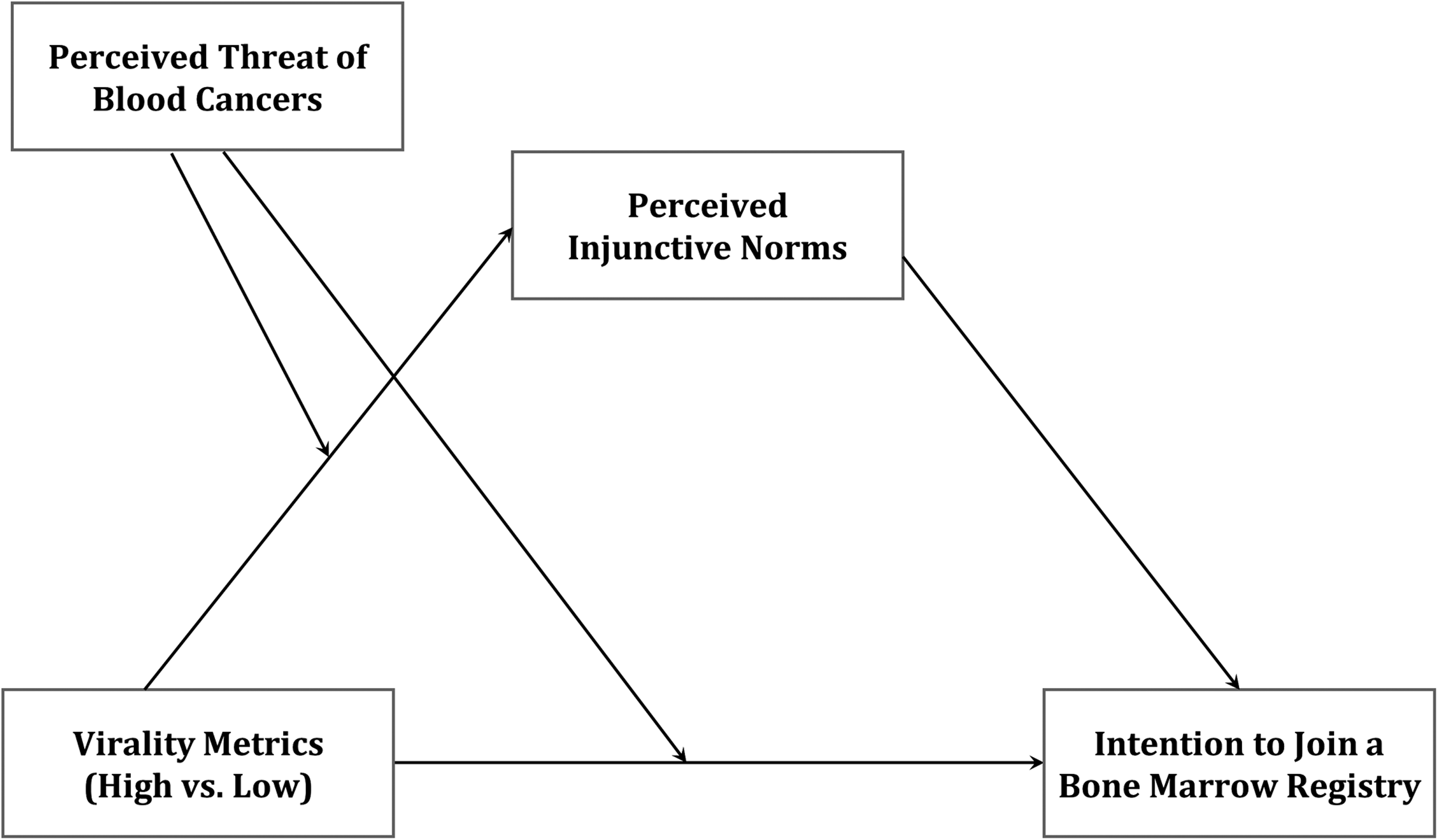
Conceptual model.
Method
Participants and design
An online experiment was conducted with participants recruited through the Qualtrics Panels based in the United States. Following past research, 2 we recruited individuals who had never joined a bone marrow registry; we also followed the general eligibility criteria set by the National Marrow Donor Program (NMDP), targeting only those who are between 18 and 44 years old without any health conditions that would disqualify them from becoming a donor.
The sample consisted of 152 individuals (76 females and 76 males) with the mean age of 34.01 years (SD = 6.34). The racial/ethnic distribution of the sample was 77.0 percent white/Caucasian, 15.7 percent black/African American, 5.3 percent Asian, 1.3 percent Hispanic/Latino(a), and 0.7 percent American Indian or Alaska Native. With gender balanced, the participants were randomly assigned to one of the two between-participant conditions: low virality (n = 76) versus high virality (n = 76).
Stimuli
The experiment was set in a context in which a nonprofit organization, through their blog, solicited the audience to join a bone marrow registry. The stimuli presented a blog post emphasizing how patients with life-threatening blood cancers are in need of bone marrow donors; this message was identical for both experimental conditions. As in past research,4,5 the message was displayed with symbols that represented virality metrics of popular SNSs. Specifically, our stimuli displayed virality metric icons for Facebook and Twitter—the two popular SNSs widely being used for information sharing. 27
We manipulated virality metrics by varying the number of times the blog post had ostensibly been shared through Facebook and Twitter, respectively. The numbers that represented low virality metrics were 1 and 3; the numbers that represented high virality metrics were 995 and 997. These numbers were randomly counterbalanced between Facebook and Twitter: Half of the participants in the low virality condition saw 1 for Facebook and 3 for Twitter, and the other half saw 1 for Twitter and 3 for Facebook. Likewise, half of the participants in the high virality condition saw 995 for Facebook and 997 for Twitter, and the other half saw 995 for Twitter and 997 for Facebook (see Fig. 2 for sample images).
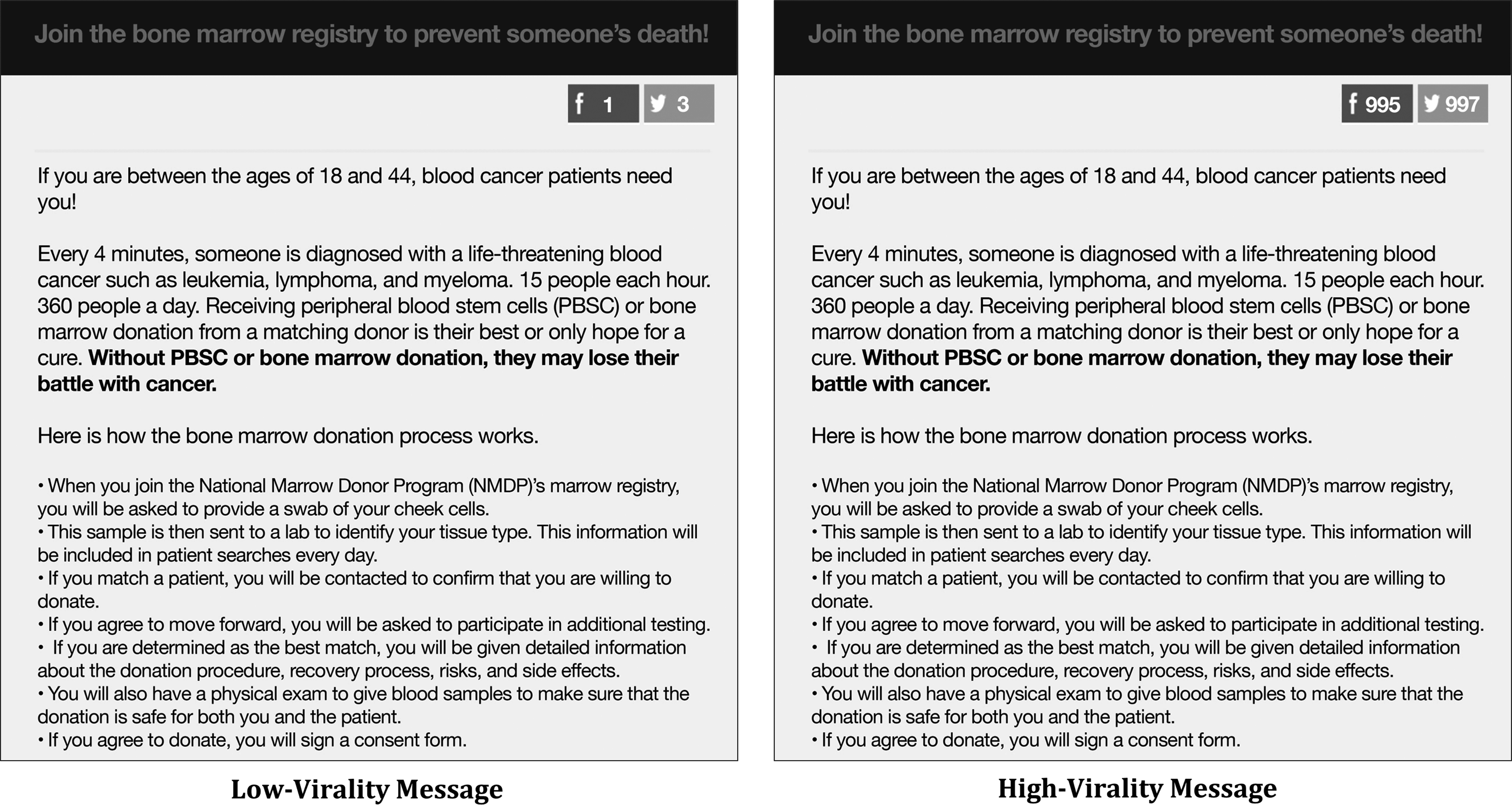
Sample images of experimental stimuli.
Procedure
After providing consent, participants completed a pretest questionnaire containing the items for the measurement of perceived blood cancer threat and control variables (trait empathy and social media use). Next, participants were randomly assigned to the experimental stimuli through the online experiment system. Finally, participants completed a post-test questionnaire containing dependent measures, demographic questions, and manipulation checks.
Measures
Perceived threat of blood cancers
The extent to which participants perceived blood cancers as a severe threat was measured with four items adapted from Lindsey 2 (e.g., “I believe that blood cancers, such as leukemia, lymphoma, and myeloma, are severe health problems”; 1 = strongly disagree, 7 = strongly agree); the items (α = 0.90) were averaged. Because the distribution was negatively skewed, we transformed the variable using the recommended method of reflection and inversion28,29 to remedy the non-normal distribution.
Injunctive norms
We measured injunctive norms with three items adapted from White et al. 30 (e.g., “Most people who are important to me would think I should join the bone marrow registry”; 1 = strongly disagree, 7 = strongly agree). The items (α = 0.87) were averaged.
Intention to join a bone marrow registry
Participants' intention to join a bone marrow registry was measured with three items adapted from Lindsey 2 and Stukas et al. 31 (e.g., “How likely is it that you will join the bone marrow registry in the next 12 months?”; 1 = very unlikely, 7 = very likely). The items (α = 0.96) were averaged.
Covariates
Three variables—Facebook use, Twitter use, and trait empathy—were included as covariates. We controlled for Facebook and Twitter use, considering that users of a social media platform are influenced by system-generated cues of the platform to a greater extent when compared with nonusers. 32 Participants were asked whether they used Facebook and Twitter, respectively (0 = no vs. 1 = yes). We also controlled for trait empathy, considering its significant correlation with prosocial behavior in general. 33 Following past research,33,34 we measured trait empathy by combining two Interpersonal Reactivity Index (IRI) 35 subscales (each with seven items): the empathic concern subscale (e.g., “I often have tender, concerned feelings for people less fortunate than me”) and the perspective-taking subscale (e.g., “Before criticizing somebody, I try to imagine how I would feel if I were in their place”). All of the items were rated on a 7-point scale (1 = does not describe me very well, 7 = describes me very well; α = 0.87) and were averaged.
Results
Manipulation check
For the experimental manipulation of virality metrics, participants were asked to identify the number of times the blog post had been shared through Facebook and Twitter, respectively (“<5 times” vs. “almost 1,000 items”). For the Facebook metric, a chi-square test showed that 94.7 percent of the participants in the low virality condition responded correctly (“<5 times”) and 96.1 percent of those in the high virality condition responded correctly (“almost 1,000 times”), χ2 (1, N = 152) = 125.31, p < 0.0001. For the Twitter metric, 97.4 percent of those in the low virality condition responded correctly (“<5 times”) and 96.1 percent of those in the high virality condition answered correctly (“almost 1,000 times”), χ2 (1, N = 152) = 132.68, p < 0.0001.
Hypothesis testing
The correlation coefficients of the variables, along with their means and standard deviations, are presented in Table 1. As perceived threat of blood cancers—the proposed moderator—was a continuous variable, we employed ordinary least squares regression based on Models 1 and 8 of the PROCESS macro (Table 2). 36 The three control variables—Facebook use, Twitter use, and trait empathy—were included as covariates.
p < 0.05, **p < 0.01, ***p < 0.001 (two-tailed).
A moderation analysis based on PROCESS Model 1 showed that high virality metrics resulted in greater perceived injunctive norms than did low virality metrics (b = 1.38, SE = 0.60, p = 0.024), supporting H1. As to RQ1, which asked whether perceived threat of blood cancers moderated the effects of virality metrics on perceived injunctive norms, the interaction effect of virality metrics and perceived threat was significant (b = −1.67, SE = 0.78, p = 0.035). Following the recommendation of Hayes, 37 we probed this interaction with the Johnson–Neyman technique to identify the range of perceived threat values in which the relationship between virality metrics and perceived injunctive norms was significant. As Figure 3 shows, the conditional effect of virality metrics on perceived injunctive norms was significant only when the perceived blood cancer threat was low (≤0.5268).
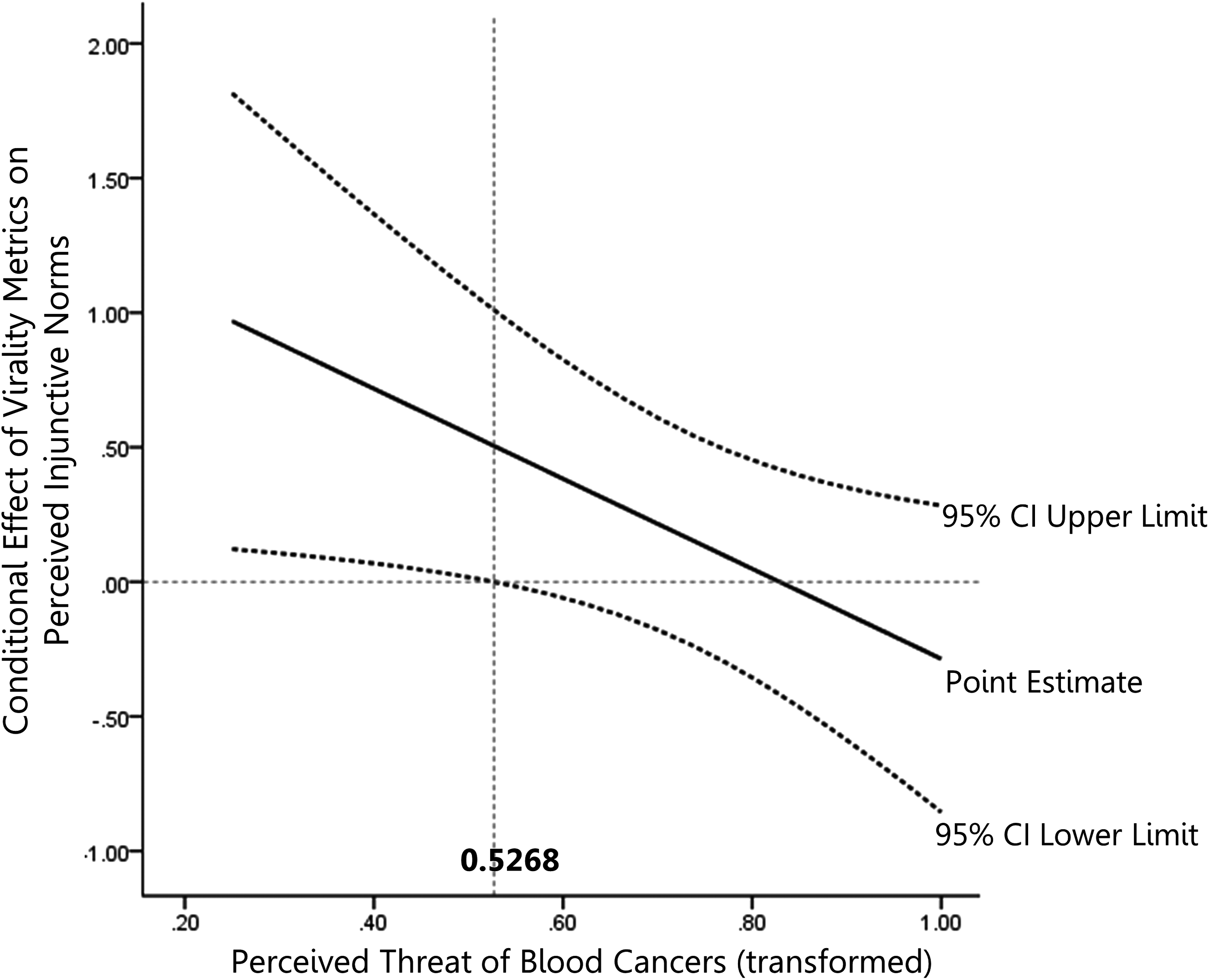
The conditional effect of virality metrics on perceived injunctive norms as a function of perceived threat of blood cancers.
Next, regression analyses based on Model 8 of the PROCESS macro showed that perceived injunctive norms had a positive association with intention to join a bone marrow registry (b = 0.82, SE = 0.08, p < 0.0001). Thus, H2 was supported.
To address RQ2 on moderated mediation, we conducted a formal test of linear moderated mediation 38 with 10,000 bootstrap samples. The index of moderated mediation for intention to join a bone marrow registry was significant, index = −1.38, SE = 0.63, 95 percent bias-corrected bootstrap confidence interval [−2.6342, −0.1321], which indicated that the indirect effects of virality metrics on behavioral intention through perceived injunctive norms were moderated by perceived threat. Further probing of the conditional indirect effects (Table 3) showed that the indirect effect was significant and positive only when the level of perceived blood cancer threat was low. In addition, none of the conditional direct effects were significant.
Boldfaced values are statistically significant. The moderated mediation analysis based on the PROCESS macro sets the levels of perceived threat (transformed) at three values. The low value was set at 1 SD below the mean (0.52) and the moderate value was set at the mean (0.78). The high value was set at the maximum value (1.00) because 1 SD above the mean was outside of the range of the data.
CI, confidence interval.
Discussion
Theoretical and practical implications
The present research provides insights into the psychological mechanism underlying the social influence of social media metrics that represent viral reach of online content (i.e., how frequently and widely the content has been shared). 5 Extending past research,4,5,8 our findings show that online messages with high virality metrics—compared with those with low virality metrics—can result in stronger persuasive outcomes.
The current findings also highlight the role of normative influence in the effects of virality metrics. With the actual content of the message being held constant, high virality metrics resulted in greater perceived injunctive norms; this suggests that virality metrics, as a heuristic cue,4,24 can signal shared normative beliefs regarding what others approve and what ought to be done.4,39 Our data further revealed that the effect of virality metrics on perceived injunctive norms was significant only among those who perceived low levels of blood cancer threat. When forming perceptions about norms, individuals often make inferences from cues that are available to them. 40 In light of the heuristic-systematic model,26,41 we speculate that those who perceived low levels of blood cancer threat (and therefore had low levels of motivation for processing information) were more likely to draw inferences from the virality metrics, which can function as a bandwagon or endorsement heuristic4,23,25 (e.g., “If other people think this is highly important, then I, too, should do so”).
We also found that high virality metrics led to greater intention to join a bone marrow registry through perceived injunctive norms only when perceived blood cancer threat was low. The moderated mediation results not only confirmed the mediating role of injunctive norms in persuasion processes found in past research 20 but also, more importantly, specified the condition under which the normative influence of virality metrics is most likely to occur. This finding suggests that the level of perceived threat—as with other motivational factors studied in the research based on the heuristic-systematic model—may determine the level of reliance on heuristic information processing, particularly in contexts entailing persuasive messages designed to relieve the suffering of unknown others.
In addition, the present research offers important practical implications. In light of our findings on the moderating role of perceived threat, organizations and individuals attempting to mobilize charitable activities through social media should make conscious efforts to increase the viral reach of their messages, particularly so if the target audience lacks understanding of the problem and the severity of the threat it poses. According to past research, online messages that evoke high-arousal emotions42–45 or contain strong visual appeal46,47 are more likely to go viral. Incorporation of these characteristics in campaign messages may help increase the frequency of sharing, allowing campaigners to capitalize on the normative influence of virality metrics. In addition, it will be important to make the metrics visible and salient to the audiences, and this consideration should be reflected in the design and adoption of virality metrics on social media platforms.
Limitations and future directions
The present study has several limitations. First, the virality metrics were restricted to those of Facebook and Twitter. Although Facebook and Twitter are the two most popular social networking platforms of information sharing, 27 it will be important to investigate the effects of virality metrics concerning other communication platforms. Second, the high virality numbers employed in the present study could be perceived as moderate or even low depending on the proprietor of the site 13 (e.g., an individual vs. an organization) and on the size of its audience. Given these aspects, the manipulation of virality metrics in the present experiment may lack generalizability. In addition, future research should replicate the present findings in contexts of charitable activities and helping behaviors other than bone marrow donation. Doing so will allow researchers to examine the extent to which the model tested in the present study can predict other types of behaviors intended to help unknown others.
Conclusion
As one of the first empirical studies on the effects of social media virality metrics on perceived social norms and intention to perform a charitable activity, our findings suggest that virality metrics signal injunctive norms that can play an important role in persuasion processes. We hope that the present findings will stimulate additional research on the normative influence of virality metrics on charitable activities across a variety of contexts, which will provide further insight into the role of social media in the enhancement of the social good.
Footnotes
Acknowledgments
We thank the anonymous reviewers for their helpful and constructive suggestions. We also would like to acknowledge the School of Communication at The Ohio State University for providing research participants through the Time-Sharing Experiments for the School of Communication (TESoC) program.
Author Disclosure Statement
No competing financial interests exist.