







Abstract
Abstract
Online social networking sites (SNSs) such as Facebook, Twitter, and MySpace are used by billions of people every day to communicate and interact with others. There has been increasing interest in the potential impact of online social networking on wellbeing, with a broadening body of new research into factors associated with both positive and negative mental health outcomes such as depression. This systematic review of empirical studies (n = 30) adds to existing research in this field by examining current quantitative studies focused on the relationship between online social networking and symptoms of depression. The academic databases PsycINFO, Web of Science, CINAHL, MEDLINE, and EMBASE were searched systematically using terms related to online social networking and depression. Reporting quality was critically appraised and the findings discussed with reference to their wider implications. The findings suggest that the relationship between online social networking and symptoms of depression may be complex and associated with multiple psychological, social, behavioral, and individual factors. Furthermore, the impact of online social networking on wellbeing may be both positive and negative, highlighting the need for future research to determine the impact of candidate mediators and moderators underlying these heterogeneous outcomes across evolving networks.
Introduction
T
Online social networking
Online social networking has previously been defined as the process of developing and engaging with a virtual network of people with whom one has articulated a personal or professional connection within the online environment of an SNS. 11 While the rapid growth and evolution in functionality of SNSs challenge our conceptualization of the phenomenon, the notion of internet-based applications that allow users to connect with other individuals or groups remains the salient feature, which differentiates online social networking from types of on- and offline activity. 12 SNSs are not primarily used as a forum to meet strangers, although this is generally possible, but to maintain established offline networks 13 and to communicate within an extended social network, which may include people known to the user and others with whom connections would not otherwise be made. 11 Importantly, this network then enables the user to see what their peers or other contacts are doing. 14 Examples of currently popular SNSs include Facebook, Twitter, and Instagram, although new sites are being developed frequently and the functionality of sites continues to evolve.
Technology use and depression
Several studies have observed a significant association between depression experiences and the personal use of technology such as addictive internet use for nonacademic or nonemployment purposes, 15 the use of video games, 16 the use of information communication technology such as online chat, email and short message service, 17 and the use of mobile phones. 18 These studies indicate that some people may be susceptible to developing depression when they use technology for long periods of time or become detached from their social or occupational environments. Despite the known links between the use of online technology and depression and the recent surge in the use of SNSs, however, there are no systematic reviews that comprehensively synthesize and evaluate the quantitative research in this area. The aim of this review is therefore to examine quantitative studies addressing the association between online social networking and depression.
Methods
Selection of studies
Academic databases were chosen based on their relevance to the concepts under review. Five databases were identified: PsycINFO, Web of Science, CINAHL, MEDLINE, and EMBASE. As the nature of the relationship between online social networking and depression is complex and has received considerable attention in previous years, we chose to narrow our focus on the current quantitative research, considering that a review of qualitative studies deserves an individual future review by itself. To be eligible for inclusion, articles were therefore required to use a quantitative design comparing measures of SNS use and depression. Articles were not excluded by participant age group or gender, publication date, or country of origin, but were excluded if unavailable in English. Search terms were identified to include the two key concepts of depression and online social networking. Different terms for online social networking were trialed during an initial scoping exercise that included the names of specific SNSs of interest. The main concepts were operationalized to include the following search terms: “online social network*,” “online social media,” “Facebook*,” “Twitter,” “MySpace,” and “depression.” Search terms such as Instagram, QQ, LinkedIn, and Tumblr did not yield any relevant results, therefore, these were not included in searches. Unlike terms for online social networking, the term “depression” was not further operationalized as related concepts such as low mood, hopelessness, or low self-esteem without a quantifiable measure of depression did not meet the inclusion criteria of the review. The searches for online social networking and depression were run in databases and combined to comprehensively capture the relevant literature. Searches were completed in April 2016. A flow chart of the search process is provided in Figure 1.
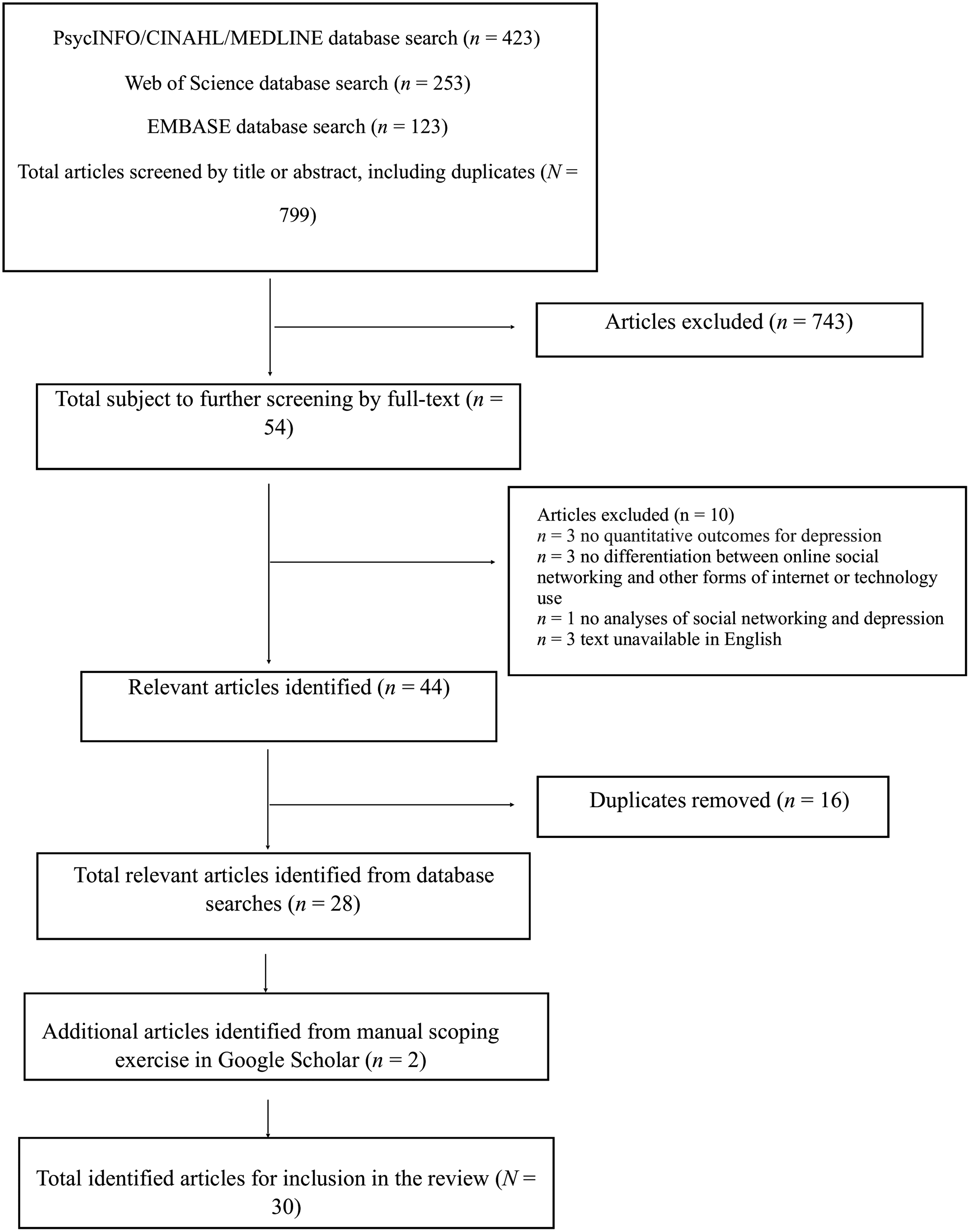
Flowchart of search and inclusion/exclusion process.
Appraisal of reporting quality
To assess the quality of reporting, the Strengthening the Reporting of Observational Studies in Epidemiology (STROBE) Statement tool for cross-sectional studies 19 was used. Studies were scored on relevant items and assigned an overall percentage to indicate an appraisal of the reporting quality. A summary of findings is provided in the results section.
Results
Study characteristics
Table 1 provides an overview of the characteristics of the studies meeting the criteria of the review (n = 30). The total number of participants across all reviewed studies was 35,044. Research was identified from 14 countries including the Philippines,20,21 Turkey,22,23 Serbia,24,25 Australia, 26 Greece, 27 and Korea, 28 reflecting the global nature of the phenomenon under study. Participant age ranged from 15 years 29 to 88 years. 30 Populations were diverse, including hemodialysis patients, 22 high school and college students, 31 working age adults, 32 and earthquake survivors. 33 Twenty-seven studies were cross sectional in design and only three were longitudinal or had longitudinal components. Seven studies used only correlational analyses and 23 included regression analyses. All studies were interested in the relationship between depression and online social networking but some focused on specific variables such as time spent engaged in social networking, 34 social networking features such as the number of Facebook friends, 21 the frequency of social networking behaviors such as the number of self-portrait photographs shared on Facebook, 24 or the impact of individual differences on this relationship. 35
Studies used the same sample and have therefore been counted as single entry in the review.
Quality of reporting
The quality of reporting based on the STROBE tool for cross-sectional studies ranged from 48% to 93%. The reporting of results and discussion sections was generally strong with most providing indications of key findings, limitations, interpretations, and issues of generalizability. However, common issues were identified across the studies. For example, details of study design and methods such as the point in time, setting, and eligibility criteria were typically implied but not explicitly reported. Possible sources of bias and methodological efforts to minimize their effects were rarely discussed. For example, it was not always clear how and when participants were recruited and how this may have affected samples or survey responses. Clear information about sample size, for example, power calculations were reported in only 5 out of 30 studies. Sources of funding were reported in only 11 out of 30 studies.
Key findings
The aim of the review was to identify quantitative studies addressing the association of online social networking and depression. Overall, the findings were mixed. In total, 16% of the studies (n = 5) found a positive correlation between engagement in online social networking and presence of symptoms of depression, reflecting small effect sizes (correlations ranged between r = 0.15 to r = 0.26).21,25,27,36,37 Six percent (n = 2) found a negative correlation (POR = 0.50, r = −0.303), which authors argue may be a result of low motivation to engage in online social networking or of SNS use providing a coping tool to protect against mental health difficulties.22,33 Thirteen percent (n = 4) found no significant correlations between online social networking and symptoms of depression.10,20,24,38
The majority of studies suggested a complex relationship between online social networking and depression involving factors that may mediate or moderate this relationship, helping to explain the variability of findings. These factors can be categorized “usage variables” such as frequency, quality, and type of SNS use. Individual differences and social factors were also found to be candidate mediators or moderators. In relation to the quality of SNS use, for example, positive correlations were found between depression and negative social networking interactions,34,39,40 whereas negative correlations were found between depression and Facebook social support satisfaction, 36 positive social comparison, 41 number of Facebook friends, 32 and perceived Facebook social connectedness. 26 In terms of frequency, positive correlations were found between depression and Facebook addiction or pathological SNS use,23,42,43 and Facebook intrusion, 44 although conversely one study found a negative correlation between depression and addictive SNS use. 30 In relation to type of online social networking behavior, positive correlations were found between Facebook impression management, 32 envy triggered by Facebook surveillance, 31 accepting former partners' invitations to become Facebook friends, 45 producing more content or engaging in greater interactive communication on Facebook, 46 social comparison with others,39,47 and frequent negative status updates or negative comparison with others leading to increased rumination.39,48 In contrast, negative correlations were found between depression and location tagging, 28 and frequent posting of positive Facebook status updates leading to reduced rumination. 48
Gender and personality were also found to influence the relationship between online social networking and depression,27,34,35,45,47 highlighting the role of individual differences alongside usage variables cited above. For example, Giota & Kleftaras 27 found that participants higher in neuroticism had significantly higher levels of problematic SNS use and exhibited more depressive symptoms than those who scored lower on measures of neuroticism. Indirect social factors such as place of residence were also found to influence problematic social network use, which in turn correlated with depression.
Significant associations between online social networking and depression remained after controlling for the effects of confounding such as age, gender, socioeconomic status, social networking usage variables, and offline behavior, highlighting variables of particular significance in this relationship. For example, negative comparison with others when using Facebook was found to predict depression via increased rumination even when a general tendency to engage in social comparison was controlled for. 39 Similarly, frequent posting on Facebook was found to be associated with depression via rumination when gender and other variables such as length of time using a Facebook account, time spent using Facebook per day, and number of Facebook friends were controlled for. 48
Discussion
The findings of this review suggest a complex relationship between online social networking and depression, which can be influenced by a number of mediating and moderating factors. The frequency, quality, and type of online social networking and depression appear to be in some ways intertwined. However, in light of this new evidence, some authors are continuing to question the validity of the notion of “Facebook depression,” with one study describing it as “a dubious hypothesis” 20 and another as potentially “premature.” 10
A key finding of this review, adding to those from internet and mental health research elsewhere, 7 is that the nature of online social network use may be more important in influencing symptoms of depression or vice versa than the frequency or duration of engagement alone. For example, Davila et al. 34 conclude from their findings that it is the quality of social networking experiences that is, whether a person perceives their online interactions to be either positive or negative, rather than the frequency of social network use, which predicts negative mental health outcomes. A number of studies suggest alternatively that depression outcomes may be determined by whether or not users engage in specific online activities, that is, whether they post updates frequently, accept ex-partners as friends, or follow strangers. Wright et al. 36 argues that it is not time spent using Facebook that is likely to be of importance, but what people do while they are using it. Similarly, Steers et al. 47 suggest that spending a great deal of time on Facebook can indirectly affect depression, but only if one engages in social comparison with others, regardless of the direction of this comparison.
A further finding of this review is that in the context of online social networking, social comparison and rumination are likely to be candidate mediators in the relationship between SNS use and depression. The fact that negative comparison with others when using Facebook was found to predict depression via increased rumination even when a general tendency to engage in social comparison offline was controlled for 39 suggests that the effect of social comparison on Facebook is inherently different and may be more detrimental to psychological wellbeing than social comparison in real life. It is possible that where time usage variables and individual differences have been identified as significant within this relationship, this may be due to their effect on engagement with specific SNS behaviors that can influence social comparison and rumination such as posting, impression management, or surveillance. This may in turn influence feelings of social connectedness, envy, social interaction, and social support, which have been associated with symptoms of depression elsewhere in the findings of this review.26,31,34,36. These results taken together indicate the possibility that these processes could be cyclical in nature, and that problematic SNS use may result from a combination of some or all of these intervening factors.
The results reviewed here also suggest that the impact of online social networking may be both positive and negative. Banjanin et al. 24 argue that this dual effect may have made it difficult for researchers to establish connections between the two, and suggest furthermore that social networking may be beneficial for mental health if it enhances social support or detrimental if excessive computer-mediated communication reduces time for face-to-face interaction. Positive outcomes emerged as significant across a number of studies and findings suggest that for some social networking may act as a resource in managing depression. Park et al. 28 found that people scoring higher on measures of depression were more likely to use a Facebook application to read tips about depression, highlighting potential opportunities for online social networking as a mental health resource or intervention—an idea that is already starting to generate interest in the literature elsewhere. 49 If networks evolve to include more (or less) of these features, then this will no doubt alter the relationship between SNS use and depression. Socially, such opportunities, supported by limited evidence so far, may begin to challenge narratives of online social networking as an inherently dangerous or risky behavior, although such findings should be taken in context of the wider body of research identified in this review and in the transitionary nature of the field in question.
The exact nature of the influences in this relationship remains unclear, although some suggestions have been posited. In relation to associations between social networking and positive mental health, Afsar 22 suggests that people who are less depressed may have more motivation to engage in internet use and that those who do may be able to develop social support mechanisms. In response to possible gender differences highlighted in their study, Steers et al. 47 favor an evolutionary explanation, suggesting that depression in men may be the result of feelings of inadequacy associated with competitiveness, as men have previously been found to be significantly more likely to use SNSs for dating purposes than females. 50 Simoncic et al. 35 suggest that the regulated social environment offered by Facebook, which allows users to carefully craft messages, may facilitate some to maintain relationships and promote their positive qualities in an adaptive way. Elsewhere, Facebook use has been found to help students form and maintain social capital 51 and this is a factor previously found to reduce the risks of developing depression. 52 The relationship between online social networking and depression appears to have complex influences and suggestions of a unidirectional causal link are likely to fall down under scrutiny.
The findings of this review may have significant implications when taken in the context of public mental health. It has been suggested that psychologists should be aware of potential problematic relationships with online social networking and how this could impact mental health. 27 Recent United Kingdom (UK) policy has also emphasized the importance of helping people to achieve better wellbeing and good mental health and of affording people greater ability to recover from mental health problems; 53 therefore an understanding of risk and protective factors and mechanisms explaining the complex relationship between SNS use and depression is important. Furthermore, an increased emphasis has been placed on bringing together evidence and guidance around mental health and wellbeing in children and in promoting wellbeing from a young age, 54 a group for whom the impact of technology use is likely to be particularly relevant.
Limitations
Despite the benefits of this review, a number of limitations in the research evidence and review process have been identified. First, a significant challenge was working to an agreed conceptualization of online social networking. The diversification of technology has led to an increasing variability of online platforms that, while sharing characteristics, have significant differences in design and function. This evolution can already be seen in the wide range of features now incorporated into SNSs such as advertising, professional media channels, and news feeds. This diversification may already be clouding the way in which we view these sites 55 and may make it increasingly difficult to define and research. Kaplan and Haenlein 56 suggest that the classification of various forms of social media and SNSs is likely to require a systematic categorization scheme to distinguish them further. However, this may be challenging and compounded further by cultural and geographical variation. This review identified a significant bias toward research into Facebook over other platforms, which, while not necessarily surprising given its user-base and media interest, could limit generalizability of findings across platforms. Clearer definitions and classifications of online social networking are likely to help address these issues in the future.
Second, while some studies have identified a relationship between engagement in online social networking and symptoms of depression, due to the high prevalence of cross-sectional studies, it is not possible to determine causation. 57 This is an important distinction with significant ethical implications, as incorrect causal assumptions could arguably lead to misregulation and dissemination of misinformation with significant repercussions for public health. Furthermore, cross-sectional designs have been criticized for an over assumption on the idea that variables remain stable over time and for failing to address chronological variability, leading to biased estimates and incorrect inferences, 58 therefore, further longitudinal and experimental research would be beneficial.
Third, issues were identified in the reporting of research findings. Where lower quality of reporting was identified, less weight can be attributed to authors' conclusions. A primary issue was a lack of reporting in relation to bias across the studies. For example, many studies recruited student populations into their sample; however, little consideration was given to selection bias, that is, whether students who may be depressed or engage in specific online behaviors were more or less likely to take part in research. Similarly, where participants were linked to the organization conducting the research, for example, through their educational or healthcare institution, little consideration was given to the impact that social desirability may have had on some of the responses given. Depression was shown to be influenced by a large number of variables and, while some studies reported analyses used to control for confounding variables, issues of reporting create difficulties in our ability to assess the validity of findings. 59 Similarly, due to the wide scope of research, findings are potentially representative of and relevant to a wide range of populations. However, due to the cultural heterogeneity of research samples and potential issues of sampling, validity and generalizability should also be treated with caution.
Finally, limitations in the survey methodology used within all of the studies in this review are significant. The use of self-report measures, while appropriate research tools in this context, may not produce credible outcomes due to various forms of bias. These include participants' motives, for example for positive self-presentation, acquiescent or reactant responding, constraints on self-knowledge, or inaccuracies resulting from self-deception or memory. 60 Self-report measures may also be sensitive to culture, with participants of Asian heritage potentially responding differently to participants of European heritage, 61 further compromising the reliability of research findings.
Conclusions
The field of online behavior and psychology is ever-evolving and changes in the way in which people use technology for social purposes has important implications for healthcare providers such as psychologists and for public health more widely. It is difficult to overstate the extent to which online social networking has infiltrated the everyday lives of people globally, and to ignore the impact of this behavior from a clinical and social perspective may be highly detrimental. The aim of this review was to examine and critically appraise the current quantitative research into online social networking and depression to increase our understanding of this relationship, with a view to highlighting possible benefits and risks associated with this behavior. The evidence suggests that the ways in which people use online social networking and the meanings they make of their interactions are likely to be important determinants of depression, or vice versa. Usage variables such as time, quality, and type of social networking activity, and individual differences including sex and personality, have been found to influence this relationship. These factors may therefore be important for clinicians to consider in cases where depression or problematic SNS use are indicated. Within this, online behaviors that lead to rumination or social comparison may be particularly important.
Interpretations of the findings of this review and the way in which they are implemented are likely to be influenced by the stance one takes toward the role of technology in wellbeing more generally. While the concept of “Facebook depression'” may be over-simplistic and may fail to take into account the myriad of factors that affect this relationship both positively and negatively, and despite the limitations identified in the research, the findings suggest that for some people online social networking may be associated with increased symptoms of depression while for others the activity may be beneficial. This review provides insight into the past years of online social network use. However, as the functionality and nature of SNSs is in constant change, generalizability about the relationship between depression and previous networks such as MySpace to newer networks such as Instagram or Twitter needs further empirical consideration. It is possible that if newer sites differ in the extent to which they facilitate factors found to be important in the relationship between social networking and depression, such as rumination and social comparison versus social support and informational resources, then this may alter the relationship evaluated here. This work should therefore be perpetuated and further research into changing networks that tests mediational and moderational models to isolate the precise nature of this relationship using tighter controls—for example through experimental designs—and offers an indication of causal influences through longitudinal methods, would therefore be valuable. A repeat of this review in 5 years time will also contribute significantly to our understanding of this evolving field and the phenomenon in question.
Footnotes
Acknowledgment
This research was completed as part of the academic requirements for the Doctorate in Clinical Psychology (DClinPsy) programme at Lancaster University, United Kingdom.
Author Disclosure Statement
No competing financial interests exist.