







Abstract
Abstract
An experiment is reported that studied the effects of spatial embodiment in augmented reality on medical attitudes about the self. College students (N = 90) viewed public service announcements (PSAs) with overlaid virtual fetuses and X-rayed images of lungs on various interfaces representing embodiment—a two-dimensional screen, a three-dimensional (3D) mannequin, and the participants' bodies (3D). Results indicated that PSA messages with richer embodied interfaces increase the sense of “being there,” also known as spatial presence (SP), in sequential order; this leads to increased negative emotion regarding smoking cigarettes and an increased willingness to engage with a cigarette cessation campaign. When the SP mediates the dual model process, only affective attitudes increase the behavioral intention to engage with the campaign.
Introduction
Projection mapping is one of the methods of spatial augmented reality (SAR) technology, which overlays virtual images on the real world.1–5 Also, SAR is defined as “projection-based augmented reality (AR) as the use of projection technology to augment and enhance three-dimensional (3D) objects and spaces in the real world.” 6 (p.32) Augmenting the physical world by projecting and overlaying 3D virtual images on physical objects or the environment is the defining characteristic of AR. 7
One of the application areas of AR is in the display and registration of medical imaging. The most common applications use AR to align guiding 3D images on patients during the surgical process,8–10 for example, projecting a virtual anatomy image on to the “real” skin of patients revealing their internal anatomy. 11 Incorporating AR with medical imaging and instruments results in a significant leveraging of the spatial cognition of the physician, assisting them in understanding the structure, shape, and position of internal anatomy. 12 AR helps surgeons to master tasks thereby reducing the number of working hours.13–15 Rolland et al. introduced 3D medical visualization while comparing optical versus video see-through head-mounted displays in a surgical and diagnostic context: the results suggested that AR enhances the real world. 16 While the most medical application of AR is to service the spatial cognition of medical practitioners, there are applications where AR is designed to affect the patient, that is, stroke rehabilitation17–21 and phobic treatment. 22 With this patient intervention, exposure and subsequent habituation to virtual cockroaches close to or on the body helped to reduce the participants' phobic responses. However, there is potentially a large range of patient-oriented AR applications that seek to enhance a patient's understanding of their bodily conditions or as interventions that seek to alter patient attitudes or behaviors related to an existing or potential medical condition. By having people experience body-based simulations with SAR, attitudes on health-related issues might be changed. However, there are only a few instances of such applications. AR methods such as projection mapping have barely been applied for persuasion purposes; that is, attitude changes in health communication. Moreover, while many studies have focused on the antecedents to SAR usage as a technology, whether it be profiling benefits or identifying gratifications sought, 3 the psychological consequences of viewing SAR in a medical or persuasive application remain understudied.
Attitude change in the context of cigarette smoking (CS) has long been a call for research and extensive health campaigns in general 23 ; however, not to begin CS is the best way to reduce smoking-related deaths. 24 Therefore, in this study, we targeted nonsmokers and light/social smokers and tried to examine how public service announcements (PSA) messages with SAR enhance subjects' negative attitudes regarding CS and increase their behavioral engaging intention on the cessation campaign and its susceptibility. Visualizations of changes to the smoker's body have typically been used in the process of persuasion, that is, visualization of clogged lung tissue, mouth sores, and cancer lesions. However, SAR transcends the conventional means of a patient/user viewing a moving picture of anatomic images such as a lung or a fetus. By the means theoretically described below, within visualization of body images enabled by SAR augments the viewer/patient's ability to imagine how they and their body might suffer because of CS.
In sum, among various forms of SAR, this study focused on projection mapping and examined (a) how antismoking videos with anatomical images when embodied on body figures, for example, mannequin and human body, might shape the viewers' overall impressions of and attitudes toward CS; and (b) what psychological mechanism might underlie such persuasive effects.
In so doing, we compared individuals' reactions to the identical video on a flat (two-dimensional [2D]) screen with reactions to projections on a mannequin (3D) and those on the participants' bodies (3D). Second, drawing upon the literature on spatial presence (SP), we accounted for why medium effects emerge. The embodiment is the signature of SAR, and we suspected that exposure to the embodied message would foster a stronger sense of nonmediation than the flat (2D) screen. Furthermore, in anatomical messages embodied with the actual human body, the participant's body itself would induce a greater feeling of SP or nonmediation. Lastly, we examined the SAR's persuasive effects associated with SP and attitude changes toward cigarettes smoking and the cessation campaign.
Understanding the Effects of SAR and SP
The large body of work related to AR and SAR in the scholarships of technology has consistently indicated that, when AR is visualized in real-time and in more realistic physical spaces with depth (e.g., SAR), the results are positive in terms of user satisfaction, usability, presence, and immersion.2,3,8
The effects of SAR, specifically projection mapping, have increased the sense of “being there,” also known as SP.25,26 The SP is generalized as “a sense of transportation to any “space” created by media” 27 (p. 19), and also the perceptual illusion that users perceive it “as equally present” (p.19). 28
An Embodiment in AR: Changing Representations of the Self
The concept of embodiment is essential in virtual reality (VR); since the body senses and acquires information, the body becomes the portal to the mind. Thus, the embodiment becomes a cognitive prosthesis assisting perceive the synthetic world. 29
According to the Proteus effect research done by Yee and Bailenson, this hypothesis explains the notion of transforming (embodiment) that can occur as a “cognitive prostheses amplifying” or an “assisting cognitive processes,” or by “developing cognitive skills” in VR. Originated from the Greek god Proteus, who was able to take on many different self-representations; this notion of transformation shows a significant and instant impact on their behaviors along with its representations. 30 Thus, the effect of embodiment and orientation on self-perception results in attitude and behavior change outcomes.
The Sense of “Being There” with Another in an AR: Copresence and SP
The use of embodied agents, that is, avatars, in the VR, is concerned with the sense of copresence, which was introduced initially by Goffman. 31 Copresence presumes ideas of behavior in public places with other entities, which are accessible, and available to one another. 31 The empathetic simulation of “the other” tries to create the “internal states of another.” 29 If a perceiver is with “the other” in the space, the perception of “the other” is simulated in the perceivers' mind and body. Choi et al. defined that people presume the others with the bodily motion and cues. 27 Self-presence is the first awareness in VR and then that of the other's presence; finally, based on these perceptions, they become aware of space simultaneously.
That is, when we apply the notion of copresence to the mannequin condition, the self-awareness of the perceiver is the first step of cognition, empathizing simulation of the mannequin with the anatomic content is the second awareness, and finally, the awareness of “being-there” occurs. Further, if the anatomic content is directly projected on the perceiver's body—body condition, the perceiver may skip the simulation empathizing cognitive process; and the awareness of “being-there” emerges immediately (Fig. 1). Therefore, we propose that embodied conditions result in greater SP;
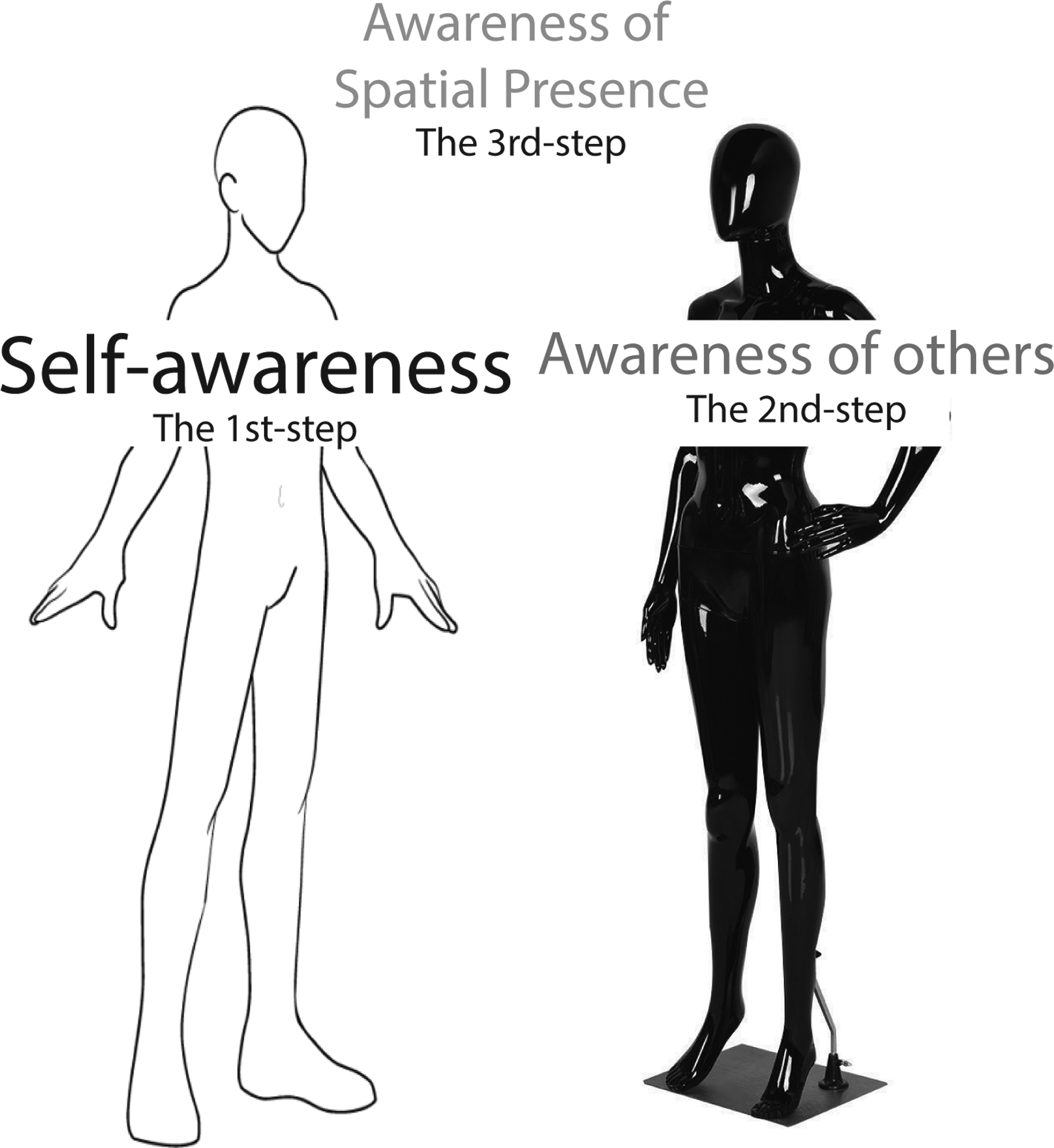
Feeling of self, social, and spatial presence.
There is evidence that increased presence generated by more immersive media leads to a greater affective trust of message content,
32
higher evaluations of a system,
7
attitudinal changes toward advertising content,
25
and increased behavioral intentions for behavioral change (e.g., purchasing behavior).
33
Thus, we propose the following hypothesis;
Effects of SAR on Message Processing and SP: Dual Model Process
The factors of SP that lead to attitude change, for example, changing attitude and increasing the engaging intention to the campaign, are not discussed sufficiently in VR literature. Previous research accounts for the mechanism of SP as a subjective experience of being in VR, which results from constructing a mental model of “being there,” emerges from the process of unconscious spatial cognition. 26 However, Wirth et al. have tried to demonstrate that after users immerse in the stimuli in VR, users simulate a mental model of the space, also known as spatial situation model. 34 Despite the dispute on presence, the scholarship agrees that SP is a subjective experience or feeling.26,35 Prototypical dimensions of SP as it is being experienced means that people are conscious of it, which distinguishes the experience of SP from an automatic and uncontrollable response to VR.36–38
The gap between the emergence of subjective experience and an unconscious cognitive process remains a mystery since the feeling of SP is a heuristic process.26,28 Schubert states that the moment of processing SP contains both a conscious experience and unconscious perceptions. Also, he describes that the SP is feedback from unconscious processes made available to conscious cognition so that “this feedback allows conscious, controlled processes to plan and initiate further regulatory behavior that goes beyond the primary unconscious process.” Thus, Schubert suggests a dual-model process—cognitive and affective—in which the users feel and experience SP. 26 (p.166)
The purpose of health messages is to change attitudes toward harmful behavior in an effort to change the harmful behaviors. 39 In the literature on persuasion, the clear separation between affectively and cognitively based attitudes came from the dual-model process—“as a deliberative thoughtful consideration” and contrastively as “experiential and heuristic or peripheral processing of affective cues”. 40 (p.956) In advertising research, the concept of attitude toward advertising is multidimensional and consists of cognitive and affective components as well. 41 Though the majority of persuasion studies have focused on cognitive attitudes, recent work has found that effect may be a better predictor of health behavior than cognition.42,43 However, this recent work was not examined in the persuasion context, so the present study investigates whether affective attitudes in reaction to an embodied message function differently in predicting behavior than cognitive attitudes.
Thus, in this study, we examined the role of a dual model process in persuasion for the effects of SAR:
Conceptual Model
In health communication research, the positive effects of affective and cognitive attitude on a health message increase the behavioral engagement with a health campaign (Fig. 2). 43 Taking all the theoretical predicting associations together, we propose the following conceptual model to answer the question: Will the effects of SAR (2D vs. 3D) and embodiment mode (mannequin versus perceiver's body) on adverse attitude change toward CS and on behavioral engagement intention with the cessation campaign be sequentially mediated by the feeling of presence and by the dual-model process?
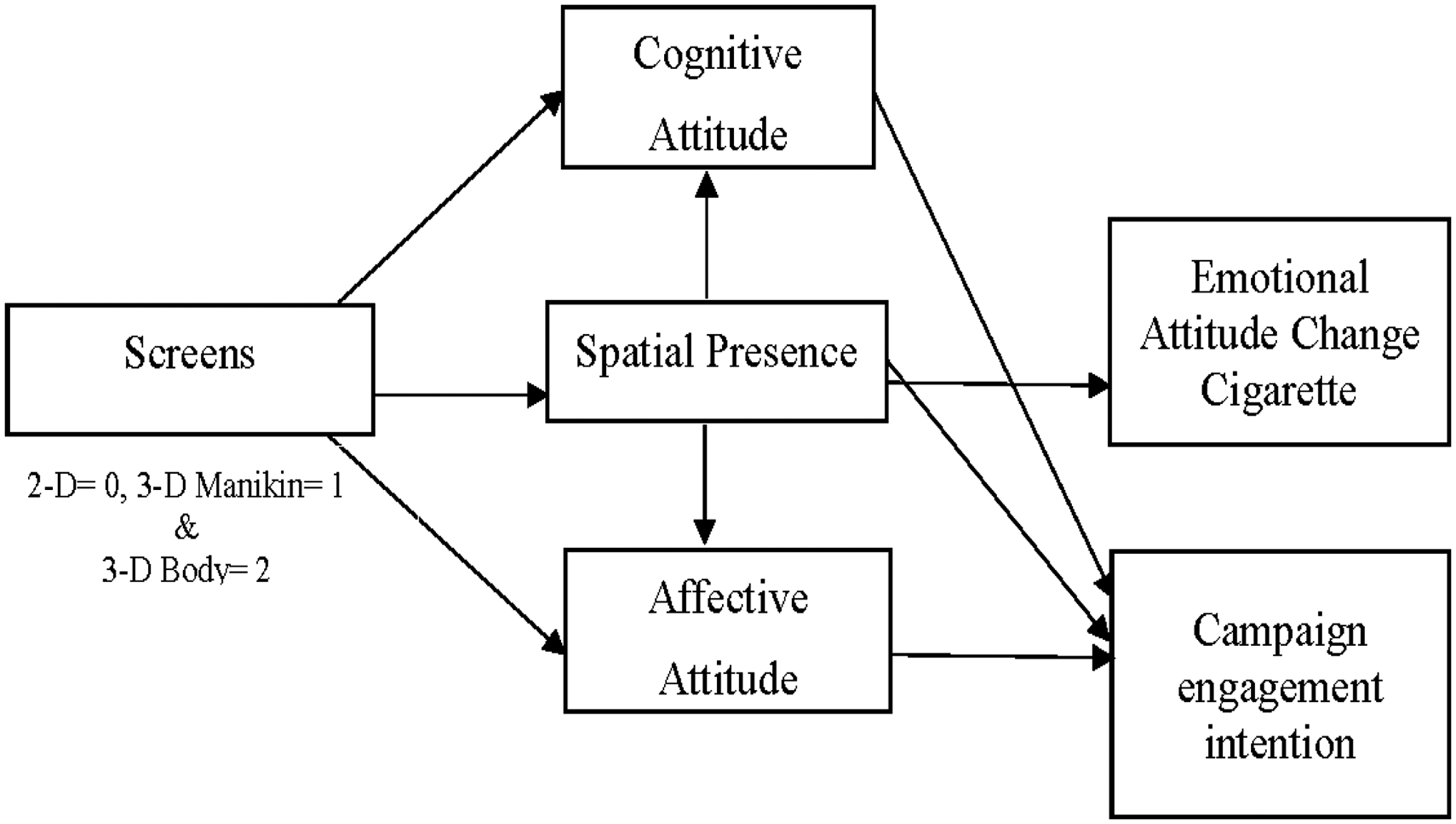
Predicted path model.
Materials
As a stimulus, we played a 2-minutes identical video of existing PSA CS cessation across three different conditions. The video contained X-ray images of smoking lungs with an iOS X plugin technology called syphone, which was used to calibrate the projected perspective transformation with physical object (Figs. 3–4). All items used in this study are indicated in Table 1.
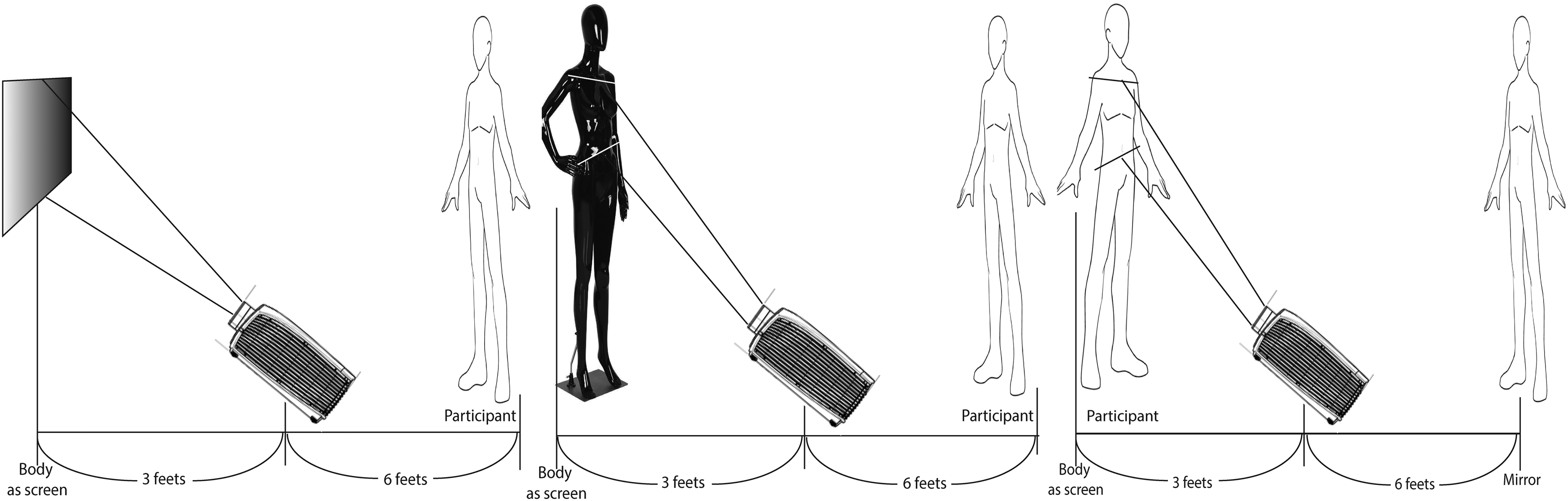
Stimulus conditions (screen vs. mannequin vs. Participant's body).
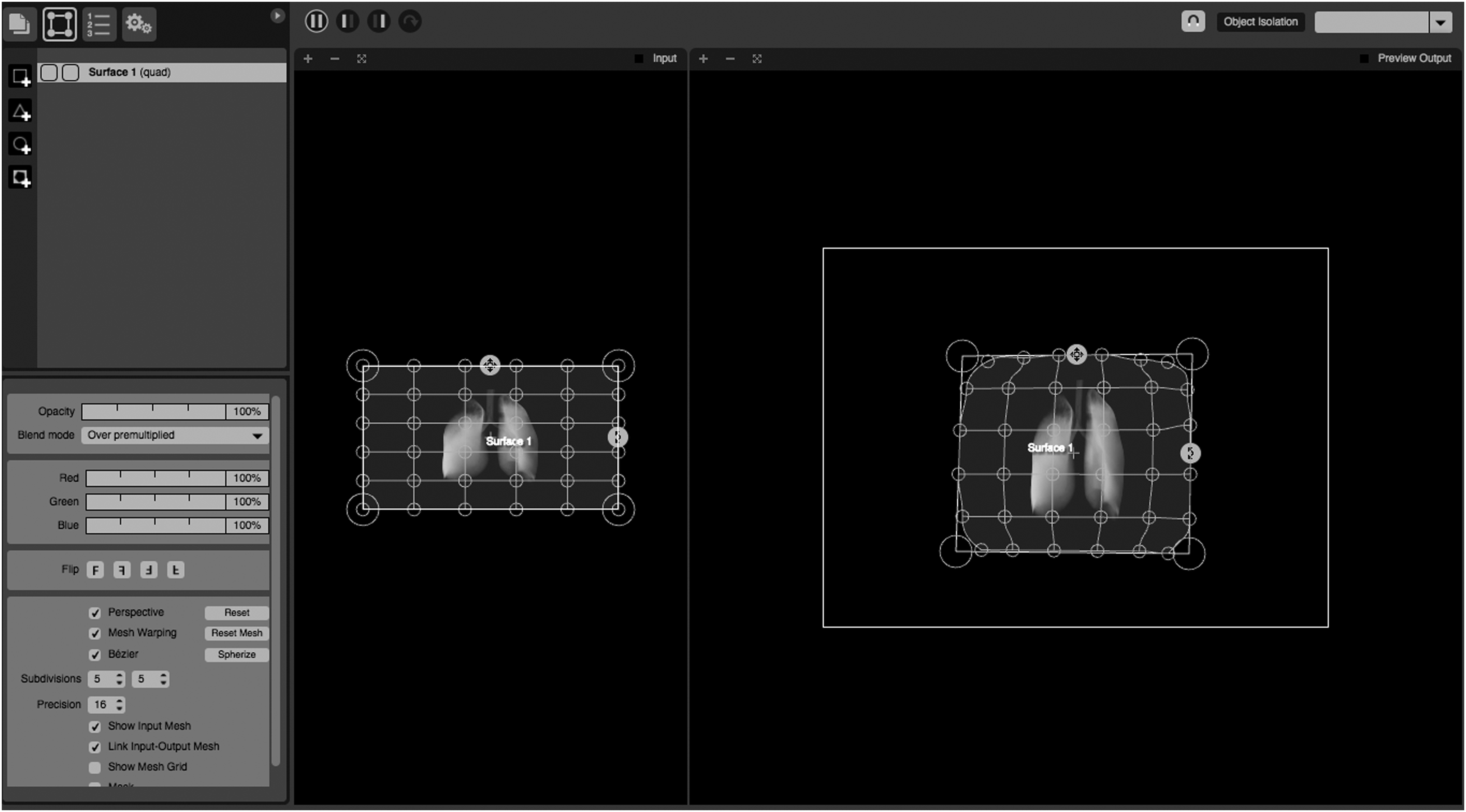
Screenshot of MadMapper.
Measures and Reliability Information
SP, spatial presence.
Methods
In this study, to examine the persuasive effect of SAR in a CS cessation campaign, we conducted a cross-sectional study and a between-subjects design with random assignments in which we compared a one-factor type of the visual projection using the control condition of a flat screen (2-D) versus a mannequin (3D) versus the perceiver's body (3D). We recruited 90 college students (Table 2) from an introductory communication and sports management class in one of the Eastern Universities, and their participation was compensated by extra-credit or $5.
Demographic Characteristics of the Participants
Results
Effects of SAR on presence
To examine whether the different formats of SAR—including a flat screen (2D, N = 28), a mannequin (3D, N = 31), and the participant's own body (N = 31)—induce a stronger feeling of SP sequentially (H1 a-c was supported), a one-way analysis of variance with planned contrast was conducted; the combination of each pair of conditions showed significant differences while the mean of SP kept on increasing. Significant effects of SAR on 3D mannequin and body on the level of SP F (2, 87) = 7.65, p < 0.05 was found. Also, there was a significant linear trend, F(1, 87) = 15.27, p < 0.05, indicating that as the enriched modality in SAR increased, (from 2D to mannequin [3D] to real body), SP increased proportionally. Planned contrasts revealed that while comparing mannequin and body-based AR. Specifically, the body-based AR increased the feeling of SP, t(87) = 2.01, p = 0.048 and compared with screen and mannequin, the mannequin increased the SP, t(87) = 1.95, p = 0.054. Examining the screen and body, the body significantly increases the SP, t(87) = 3.90, p = 0.00. A moderated hierarchical regression analysis was executed to control demographic backgrounds, for example, sex, age, race, technology usage, and existing health concern. Moreover, the control variable had no significant effects on SP.
The suggested conceptual model indicated the effect of SAR with SP and the mediated SP showed positive association between negative emotion changes toward CS and intention to engage in the cessation campaign (Figs. 2 and 5; Tables 3–5). The path model was performed with WarpPLS 44 and its model fit, average path coefficient = 0.253, p = 0.003; average R-squared = 0.186, p = 0.016; and average adjusted R-squared = 0.172, p = 0.022 support significant results. The average block VIF (AVIF) = 5 is acceptable and if average variance inflation factor (AVIF) <3.3, it is ideally acceptable. The path model's AVIF = 1.237, so it is ideally acceptable.
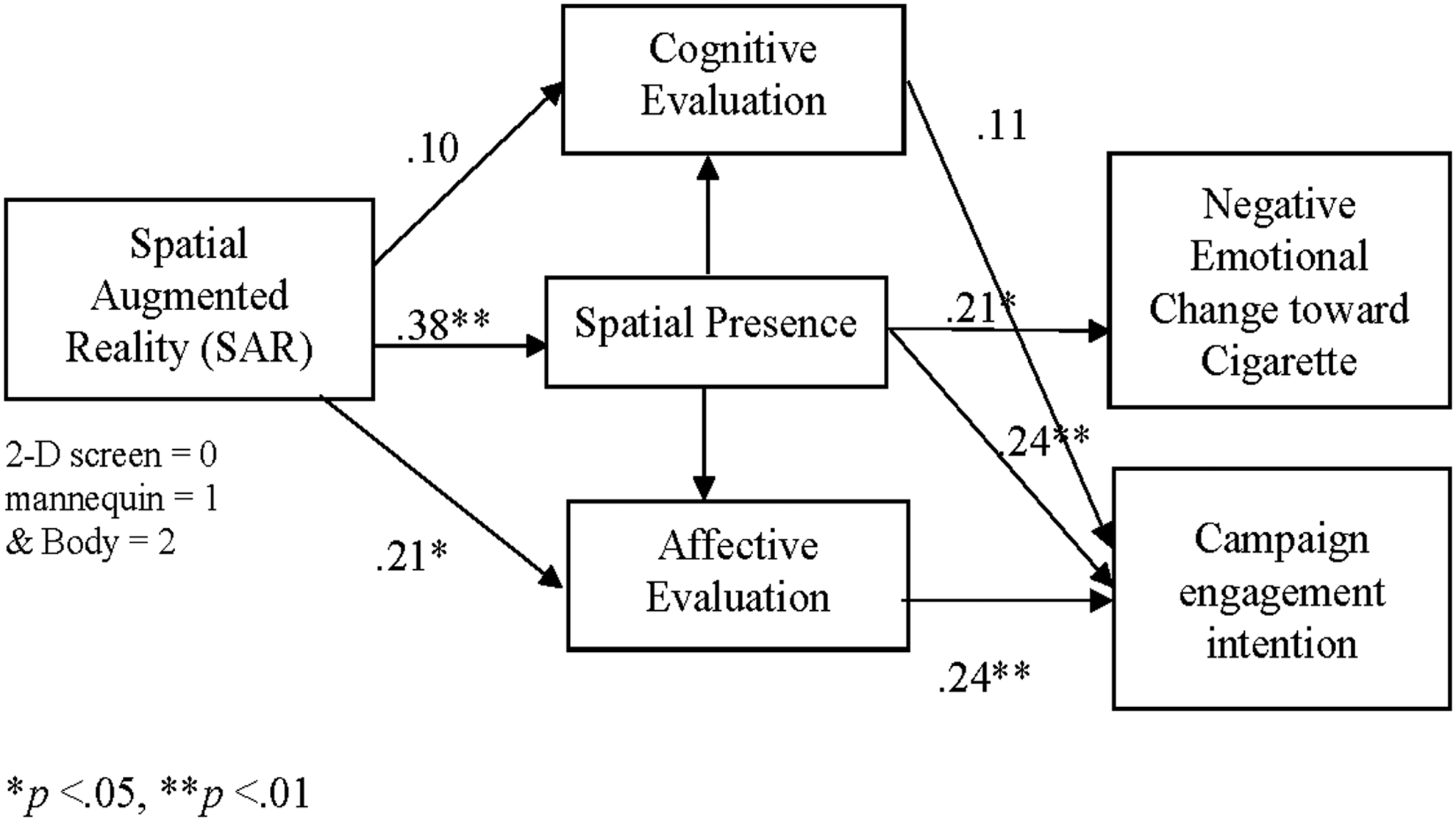
Analyzed path model.
Major Variables and Its Correlation
p < .05, **p < .01.
Hypothesis Testing Results by Path Analysis
The path model was performed with h WarpPLS44 and its model fit, average path coefficient = 0.253, p = 0.003; average R-squared = 0.186, p = 0.016; and average adjusted R-squared = 0.172, p = 0.022 support significant results. The average block VIF (AVIF) ≤5 is acceptable and if AVIF <3.3 is ideally acceptable. The path model's AVIF = 1.237 so it is ideally acceptable.
p < 0.05, **p < 0.01.
AVIF, average variance inflation factor; RQ, Research Question; SAR, spatial augmented reality.
Stimulus and Condition Explanation
2D, two-dimensional; 3D, three-dimensional.
Discussion
Extending the use of AR in a health communication setting, this study used projection AR to project simulations of a patient or user's internal anatomy on their own body. The imagery of lungs or fetal states were aligned with the body. We tested the effect using lung simulations and a fetus model within messages about the impact of CS on the lungs. The results may be a generalization to simulations of other health conditions and effects where the consequences can be simulated and projected on a significant section of the body.
This finding on the minimal effect on learning but a substantial effect on emotion might be explained with the limited-capacity model of motivated mediated-message processing (i.e., Lang’ LC4MP). Studies in using this approach demonstrate that increased rich sensory information and realism can overlay the process of cognitive encoding, cognitive decoding, and retrieving messages content due to demand on the user's limited attentional resources. When the participants observed simulations of lungs and a fetus projected on their bodies or even a mannequin in a realistic and natural simulation, the encoding/decoding of verbal information and details of the simulation were not significantly different across conditions. They did not have to use their simulation or cognitive evaluation process. Therefore, the affective attitude is mediated with SAR and results in further behavioral intention and attitude change.
Similar studies have also found higher visuospatial memory responses to SAR, although Jung et al. 29 found low memory capacity for messages. The limited-capacity model of mediated messages can explain how SAR's enriched spatial information makes mental shortcuts for spatial memory test responses; however, message-related memory, which requires more of the process of encoding and retrieving, shows lower scores than memory tests. They recalled the pattern of the surface and the color they needed to visualize and simulate the shape of SAR, and demonstrated more thought about the pattern information and color. Thus, retrieving a message with SAR takes more steps—to simulate the space, object, and the detailed images—but the spatial information was more accessible for them to retrieve.
In summary, first, for persuasion, increasing the feeling of SP is an essential factor in changing the attitude and increasing campaign engagement. Second, the changes in affective attitude induced by the medium also mediate the intention to act if not the attitude itself.
Therefore, embodied SAR might be useful in effecting health attitudes and behaviors for patient attitudes or health communication in the general population.
Notes
For the entire experiment with three conditions, a 3000-lumen full HD projector (made by ViewSonic; the model name is PRO 8300 home theater projector) was used. The projector is W × H × D: 13.11″ × 4.33″ × 10.35″ and it is compatible with PC and Mac through VGA and HDMI.
With the identical content of the video, the three different conditions were manipulated. In the 3-D projection conditions, a 3-D woman's body of a mannequin was used, and the lung shape of the video was projected on the surfaces of the mannequin's body. In a second condition, the participant's body was used to project the same content of the lung and the fetus video clips; they watched their body with moving images through/by means of a mirror. Lastly, in the 2-D projection condition, the participants viewed the same content on a 2-D flat screen.
Details of participants information are available in Table 2. The measurement of items, questionnaire, and its reliability are reported in Table 1.
Footnotes
Author Disclosure Statement
No competing financial interests exist.