







Abstract
Abstract
This study explored the Facebook addiction disorder (FAD) in Germany. Of the 520 participants, 6.2 percent reached the critical polythetic cutoff score and 2.5 percent reached the critical monothetic cutoff score. FAD was significantly positively related to Facebook use frequency, the personality trait narcissism, as well as depression and anxiety symptoms, but also to subjective happiness. Its association with resilience was significantly negative. Furthermore, Facebook use frequency partly mediated the positive relationship between narcissism and FAD. Current results provide a first overview of FAD in Germany. They demonstrate that FAD is not only the consequence of excessive Facebook use. The positive relationship between FAD and happiness contributes to the understanding of the mechanisms that are involved in the development and maintenance of FAD, and partly explains earlier inconsistencies. Practical applications for future studies and limitations of present results are discussed.
Introduction
U
Six typical characteristics of addiction disorders define FAD: salience (e.g., permanent thinking of Facebook), tolerance (e.g., requiring increasing time on Facebook to achieve previous positive using effect), mood modification (e.g., mood improvement by Facebook use), relapse (reverting to earlier use pattern after ineffective attempts of Facebook use reduction), withdrawal symptoms (e.g., becoming nervous without Facebook use), and conflict (e.g., interpersonal problems caused by intensive Facebook use).6–8
Previous studies described a positive relationship between Facebook use frequency and addictive Facebook use.9,10 Facebook members who frequently use the SNS seem to be at risk to develop FAD. Similar results have been reported for the risk to develop addictive video gaming behavior. 11 Also, similar to other forms of addiction, 12 studies investigating FAD described it to be positively related to depression and anxiety symptoms. It was assumed that depressed and anxious people excessively use Facebook to escape from their negative mood and to find relief, which, however, can negatively affect their self-regulation abilities.2,3,9,10
Narcissistic individuals are characterized by a positive and inflated self-view, self-love, sense of entitlement, and uniqueness. They search for popularity, attention, and admiration to increase their self-esteem, mood, and well-being.13,14 Therefore, they present themselves as charming interaction partners and initiate many superficial relations. On Facebook, these individuals have various possibilities to gain many interaction partners to present themselves and to get positive feedback (e.g., “Likes,” positive comments). Previous studies demonstrated a positive relationship between Facebook use frequency and narcissism.15,16 Considering that many online relationships mostly remain superficial, narcissistic people can maintain their positive self-presentation for a long time on Facebook—longer than in the offline world—and thus satisfy their motives “need for popularity” and “need for admiration.”17–20 This, however, may increase their Facebook use frequency, which may contribute to the development of FAD. Accordingly, earlier studies found a positive association between the trait narcissism and FAD. Moreover, they described narcissistic Facebook users to be at risk to develop FAD, inter alia because of their high use frequency.2,21,22
Considering previous research, for example, 6 it can be assumed that excessive Facebook users are at risk to develop FAD, which is associated with personality and mental health variables. However, there is not enough consistent empirical evidence to recognize FAD as a formal psychiatric disorder within the Diagnostic and Statistical Manual of Mental Disorders (5th ed., DSM-5). 23 Especially in Germany, where Facebook use belongs to the daily routine of a large part of the population, 24 appropriate studies of FAD are very rare. Brailovskaia and Margraf 2 conducted one of the few FAD studies in Germany. They described a significant increase in the number of users reaching the critical FAD cutoff score during a 1-year period.
Thus, the main aim of this study was to investigate FAD, and its associations with the personality trait narcissism and mental health variables in Germany. Our results can be expected to contribute to the exploration of this potential behavioral addiction, its risks and possible protective factors. Based on earlier results, we assumed that FAD is positively related to Facebook use frequency (Hypothesis 1). Further, we expected FAD to be positively associated with narcissism (Hypothesis 2). In addition, considering that earlier studies demonstrated narcissistic users to spend significantly more time on Facebook than members with lower narcissism values 19 and to engage in intensive social interaction, 16 we assumed that Facebook use frequency can serve as a positive mediator between narcissism and FAD (Hypothesis 3). Furthermore, we expected FAD to be positively related to depression and anxiety symptoms (Hypothesis 4).
Although several studies focused on the relationship between FAD, personality, and negative mental health, only little attention has been paid to variables of positive mental health, such as happiness or resilience. Following the dual-factor model of mental health that describes general mental health to consist of positive and negative mental health that are two interrelated but separate unipolar dimensions,25,26 we also included positive variables in our investigation: FAD was assumed to be negatively related to subjective happiness and to resilience (“psychological stress-resistance”; see27,28), which is described as the “ability to master stressful situations by involving individual resources”29(p266) (Hypothesis 5).
Materials and Methods
Procedure and participants
This study is part of the ongoing Bochum Optimism and Mental Health (BOOM) research program that investigates risk and protective factors of mental health. 30 Data from 520 participants (75 percent women; age [years]: M = 22.42, SD = 4.61, range: 17–64; 8.5 percent employees, 91.5 percent German university students from different faculties and semesters; 53.7 percent single, 42.9 percent with a romantic partner, 3.5 percent married) were collected from October to December 2017 through an online survey. The participation was voluntary and could be compensated by course credits for students. The requirement for participation was a current Facebook membership. The responsible Ethics Committee approved the implementation of this study. Participants were properly instructed and gave online their informed consent to participate.
Measures
Narcissism
To measure the personality trait narcissism, the brief German Narcissistic Personality Inventory (G-NPI-13) 31 that includes 13 forced-choice format items (0 = low narcissism, e.g., “I am not particularly interested in looking at myself in the mirror,” 1 = high narcissism, e.g., “I like to look at myself in the mirror”) was used. Higher values indicate higher levels of narcissism. The 13-item version has been demonstrated to have similar good psychometric properties as the full-length 40-item version. 32 Earlier studies reported an internal scale reliability of Cronbach's α = 0.67/0.73.31,33 Current reliability: α = 0.64.
Depression and anxiety
Depression and anxiety symptoms over the previous week were assessed by appropriate subscales of the Depression-Anxiety-Stress Scales 21 (DASS-21) 34 which is a well-established instrument in nonclinical and clinical samples. Each subscale consists of seven items (depression: e.g., “I couldn't seem to experience any positive feeling at all”; anxiety: e.g., “I felt scared without any good reason”) rated on a 4-point Likert scale (0 = did not apply to me at all, 3 = applied to me very much or most of the time). The higher the scores, the higher is the level of the symptom. The internal reliability has been reported to be α = 0.84 for the depression scale and α = 0.78 for the anxiety scale. 35 Current reliability: depression scale: α = 0.92, anxiety scale: α = 0.84.
Facebook addiction disorder
The brief version of the Bergen Facebook Addiction Scale (BFAS) assessed FAD over a time frame of the past year. 6 It consists of six items (e.g., “Become restless or troubled if you have been prohibited from using Facebook?”) according to the six core addiction features (i.e., salience, tolerance, mood modification, relapse, withdrawal, and conflict) rated on a 5-point Likert scale (1 = very rarely, 5 = very often). Higher values indicate higher levels of FAD. The brief BFAS has been demonstrated to have similar good psychometric properties as the long 18-item version. The internal scale reliability of the brief version has been reported to be α = 0.83–0.86.6,8,36 Current reliability: α = 0.86. Considering research on other forms of addiction, Andreassen, Torsheim 6 suggested two possible categorization approaches for problematic BFAS values: a more liberal approach concerning a polythetic scoring scheme (cutoff score: ≥3 on at least four of the six items) or a more conservative approach concerning a monothetic scoring scheme (cutoff score: ≥3 on all six items).
Subjective happiness
The Subjective Happiness Scale (SHS) 37 which consists of four items rated on a 7-point Likert scale (range: 1–7) was used to measure happiness (e.g., “In general, I consider myself”: as a not very happy person [ = 1] to as a very happy person [ = 7]). The higher the scores, the higher is the happiness level. The scale reliability of the SHS has been found to be α = 0.86. Current reliability: α = 0.84.
Resilience
Resilience was assessed with the Resilience Scale (RS-11). 38 It includes 11 items (e.g., “I feel that I can handle many things at any time”) rated on a 7-point Likert scale (1 = disagree, 7 = agree). Higher values indicate higher levels of resilience. The RS-11 has been reported to have an internal scale reliability of α = 0.91. Current reliability: α = 0.90.
Facebook use frequency
Frequency of Facebook use was rated on a 6-point Likert scale (0 = never, 5 = several times a day).
Statistical analyses
Statistical analyses were conducted with the Statistical Package for the Social Sciences (SPSS) 24 and the macro Process version 2.16.1 (
Results
Descriptive analyses
All investigated variables were close to normally distributed (indicated by Kolmogorov–Smirnov test, analyses of skew, kurtosis, and histogram). Table 1 presents their descriptive values.
n, 520; M, mean; Min, minimum; Max, maximum.
BFAS, Bergen Facebook Addiction Scale; due to rounding, the sum of listed figures is lower than 100 percent; DASS, depression-anxiety-stress scales; G-NPI, German Narcissistic Personality Inventory; RS, Resilience Scale; SD, standard deviation; SHS, subjective happiness scale.
Due to the polythetic scoring, 32 (6.2 percent) participants reached the critical cutoff score. According to the monothetic scoring, the critical cutoff score occurred for 13 (2.5 percent) participants. Item 1 (salience) reached the most critical values (Table 1).
Associations of FAD with Facebook use, narcissism, and mental health (Hypotheses 1–5)
The hierarchical regression analysis that investigated Hypotheses 1, 2, 4, and 5 revealed significant associations of FAD. Table 2 shows all statistical values of the regression model. While the first step of the regression model did not become significant (p = 0.052), the second step showed significant results (p < 0.001). FAD was significantly positively associated with Facebook use frequency (β = 0.394, p < 0.001; confirming Hypothesis 1) and narcissism (β = 0.136, p < 0.001; confirming Hypothesis 2), as well as depression symptoms (β = 0.177, p = 0.001) and anxiety symptoms (β = 0.188, p < 0.001; confirming Hypothesis 4). Furthermore, FAD was significantly negatively associated with resilience (β = −0.296, p < 0.001; partly confirming Hypothesis 5). However, in contrast to the expectations, FAD was significantly positively associated with happiness (β = 0.143, p = 0.004; partly contradicting Hypothesis 5).
n, 520; β, standardized coefficient beta; p, significance; CI, confidence interval.
Hypothesis 3 was investigated by bootstrapped mediation analysis. As presented in Figure 1, Facebook use frequency partly mediated the relationship between narcissism and FAD (total effect, c: p = 0.000; direct effect, c′: p = 0.001). The indirect effect (ab) became significant, b = 0.114, SE = 0.032, 95 percent CI [0.052–0.181]; PM: b = 0.298, SE = 0.123, 95 percent CI [0.154–0.573] (partly confirming Hypothesis 3).
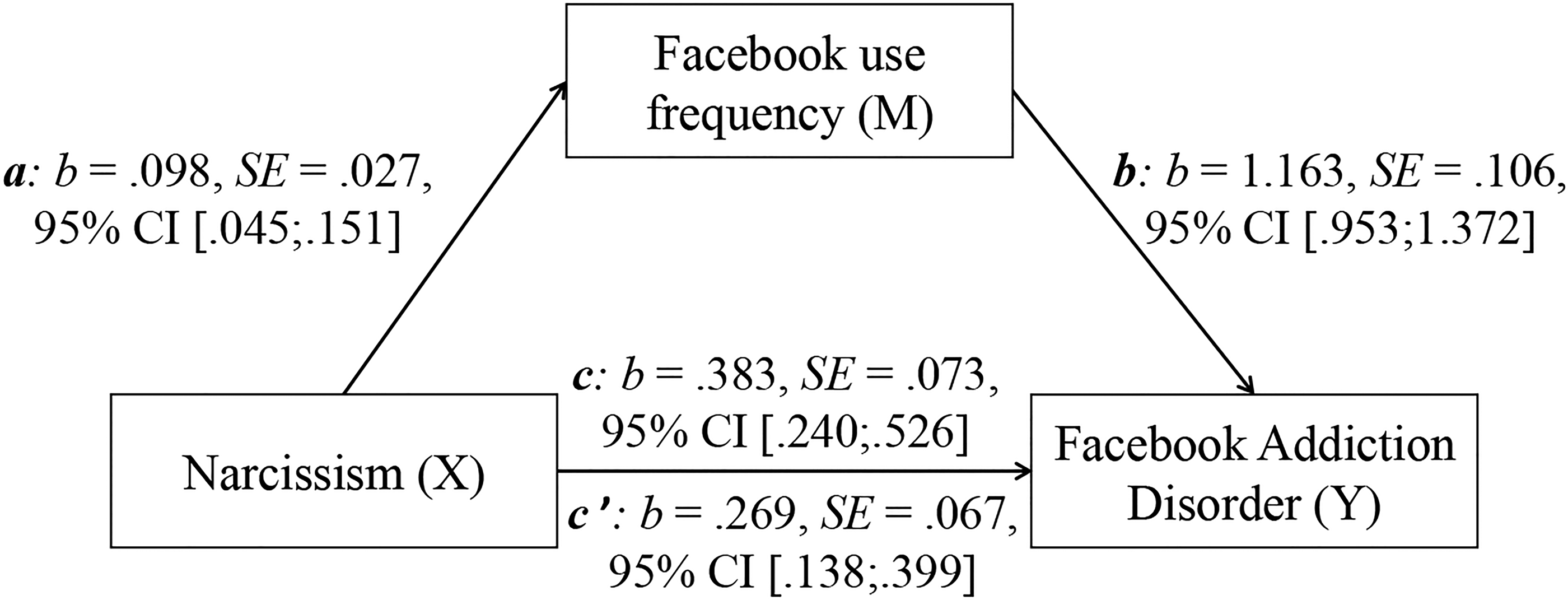
Mediation model including narcissism (X), Facebook use frequency (M), and Facebook addiction disorder (Y).
Discussion
Facebook use has become part of everyday activity of many people. Recent studies have demonstrated potential negative consequences of the Facebook use, such as a decrease of life satisfaction and of positive mood.40,41 However, so far, research on FAD, its development and possible consequences is insufficient to include FAD in the DSM. This study belongs to the first work to investigate FAD and its relationships with personality and mental health in Germany. We found significant associations that contribute to a better understanding of this addictive behavior.
Our mean FAD value was equally high as the results described by Brailovskaia and Margraf 2 for a German sample, and remarkably lower than the mean of a Norway sample described by Andreassen, Griffiths. 8 The number of participants who reached the critical FAD score according to the monothetic scoring (2.5 percent) was higher than the values described by Brailovskaia and Margraf 2 : 0.6 percent to 1.7 percent.
FAD was positively associated with Facebook use frequency and narcissism (confirming Hypotheses 1 and 2). This fits earlier assumptions that especially narcissistic users are at risk to develop FAD. 21 Typically, narcissists engage in intensive social interaction and positive self-presentation on Facebook to gain attention and admiration. 15 Positive feedback from other users promotes their self-esteem and increases the probability of further intensive Facebook use. Interestingly, Facebook use frequency only partly mediated the relationship between narcissism and FAD (partly confirming Hypothesis 3), which underlines the assumption that FAD is not only the consequence of excessive Facebook use.
We found significant associations of FAD with positive and negative mental health variables. Depression and anxiety symptoms were positively related to FAD (confirming Hypothesis 4). As reported by Ryan, Chester, 3 people with increased values of negative mental health tend to use Facebook for escape and relief. Moreover, several studies described users who cannot engage in SNSs use as often as desired to develop so-called “Fear of Missing out (FoMo)”—the fear to lose popularity, to miss social information and social inclusion in the community.42,43 Thus, the anxiety measured in this study could partly be related to FoMo that contains parallels to the withdrawal measured with Item 5 of the BFAS.
Similar to earlier results which showed resilience to be a protective factor against negative environmental impact and the development of mental disorders,28,29 we found resilience to be negatively related to FAD (partly confirming Hypothesis 5). However, against our expectations, happiness was positively associated with FAD (partly contradicting Hypothesis 5). This result emphasizes the necessity to focus specifically on single variables of positive mental health when investigating FAD, instead of making general conclusions.
The positive relationship between FAD and happiness can partly contribute to the explanation of earlier inconsistencies regarding the association between Facebook use and mental health. At short term, Facebook use seems to promote well-being by increasing, for example, happiness and life satisfaction.44,45 However, studies focusing on long-term use demonstrated Facebook use to be negatively related to mental health. 46 Thus, it may be that people using Facebook experience happiness when interacting with other members, sharing their daily experiences, and getting positive feedback. The more positive experiences they gain, the more they want to use Facebook to maintain and to increase their level of happiness. However, such use may have negative consequences; some users' happiness level is dependent on their Facebook use, and they use Facebook for mood modification and self-regulation ignoring other more suitable offline possibilities. This can increase their probability to develop FAD. However, due to the happiness experienced by using Facebook, people are not aware of becoming addictive of the use. Considering the cross-sectional design of this study, this assumption remains hypothetical and should be considered with caution until it is investigated by longitudinal research.
Limitations and further research
Similar to other studies on FAD, we investigated FAD by self-report surveys that are prone to social desirability and perception mistakes. This is especially meaningful considering that addicted people frequently do not recognize their symptoms and underestimate them. Therefore, future investigations of FAD should include potential physiological markers, such as heart rate, skin conductance, and blood pressure, that have been demonstrated to be involved in problematic Internet use.47,48 If similar physiological markers as have been shown for substance use disorders could also be found to be related to FAD, the understanding of the development of FAD and its recognition as a formal psychiatric disorder in the DSM would be substantially advantaged.
Furthermore, recent studies49,50 described some time-efficient methodologies; that is, a model using the Clustering Using Representatives (CURE) Algorithm and a model using a Gower-2 Coefficient (HA) and a Genetic Algorithm (GA) with the fitness-proportionate selection (FPS), that enable the classification of the valence of semantic content (i.e., positive, negative, and neutral). On the premise that the participants give their consent, these algorithms might be used to classify, for example, the status updates of the Facebook users and comments they get from other Facebook members. This would allow to investigate further research questions that cannot be answered by the analysis of quantitative data only. For example, it could be considered, whether especially these individuals who get positive feedback on Facebook engage in excessive Facebook use and therefore are at risk to develop FAD, as well as whether there are significant differences in the valence of status updates of low and high narcissistic users, or of users with low and high values of depression and anxiety symptoms, and whether this difference can predict FAD.
The present sample comprised young and mostly female participants, which obviously limits the generalization of our results. We partly tackled this limitation by controlling for the variables age and gender in our calculation. Nevertheless, we advise future studies to investigate the replicability of our findings working with a more representative sample with an equal gender ratio.
Moreover, given the cross-sectional nature of the present data, only hypothetical conclusions on causality can be drawn from our results. To make real causal statements, cross-sectional research must be extended through longitudinal prospective studies. 51
Nonetheless, the current findings belong to the first work in the investigation of FAD and its relationships in Germany. They give a rough overview of FAD in Germany, and demonstrate its associations with narcissism and various mental health variables, which strengthens the assumption that the development of FAD is not only the result of excessive Facebook use. The positive relationship between FAD and happiness can partly contribute to the explanation of earlier inconsistencies, and point out the mechanisms that are involved in the development of FAD. Thus, considering the high popularity of Facebook use—especially among younger generations—its potential consequences, and our present results, it is evident that there is a huge need for further investigations in this research field, focusing in particular on causal risks and protective factors of FAD.
Footnotes
Author Disclosure Statement
No competing financial interests exist.