







Abstract
Outcomes associated with cybervictimization in adolescence have been heavily studied, although less research has examined these associations in emerging adulthood. This study was designed to examine links between cybervictimization and social and emotional well-being, and internalizing and externalizing behavior in a sample of 447 college and noncollege attending emerging adults. Results suggest that cybervictimization is problematic for social and emotional well-being, internalizing, and externalizing behavior. The discussion emphasizes the importance of creating prevention programs and antibullying campaigns for individuals in the emerging adult age group, and provides suggestions for future research.
Introduction
Nearly all (88
Cybervictimization
Cybervictimization, or being the recipient or victim of hurtful or mean online messages, has been heavily studied in adolescence and is associated with mental health problems 8 including depression,9,10 alcohol use, binge drinking, and smoking. 11 In a recent meta-analysis on cyberbullying and victimization in adolescence, Kowalski et al. 12 systematically reviewed 131 studies and found that stress and suicide ideation were outcomes most strongly associated with cybervictimization.
The few existing studies examining cyberbullying and cybervictimization in emerging adulthood have revealed associations similar to those during adolescence. For example, among college students, cybervictimization has been linked with increased depression, suicidal ideation, 13 sadness, anxiety, embarrassment, and fear. 14 Another study found that being a victim of cyberbullying in the form of receiving unwanted sexual advances online was associated with increased odds of depression among female college students. 15 However, little is known about how cybervictimization is linked with well-being and externalizing behavior for college and noncollege attending emerging adults. Emerging adults are involved in different activities and social circles than are adolescents (e.g., the workplace, student dorms, and sororities/fraternities); the outcomes of cybervictimization may differ based upon the context for victimization and the age (and developmental differences) of those victimized.
Well-Being
Well-being includes life satisfaction, happiness, and quality of life. 16 Research suggests that for many, well-being increases during emerging adulthood, 17 and having positive peer relationships is an important contributor to well-being. 18 However, adolescent victims of cyberbullying experience social (e.g., social anxiety) 11 and emotional problems (e.g., low self-esteem and depression), 19 and it is possible that emerging adult victims will experience similar outcomes.
Social Capital Theory
Social capital theory suggests that investing in one's social network by building connections with others results in benefits 20 including trust, reciprocity, communication, and cooperation. 21 Access to social networks online and the ability to create and strengthen relationships online are one way to build social capital. 20 For example, emerging adults communicate online to strengthen relationships, 22 and seek to build capital by presenting themselves in a positive light 23 by posting idealized features of who they would like to become. 24 Cybervictimization in emerging adulthood likely interferes with the ability to use these strategies to build social capital online. Recipients of mean messages online may feel unsafe posting photos of themselves and communicating with others online, making those spaces less likely to be sources of social capital. It is possible that victims of cyberbullying are not only less able to receive social capital from online connections, but also those spaces become harmful to their emotional and social well-being.
The Current Study
Building on social capital theory and existing literature connecting cybervictimization to negative outcomes, there was one study hypothesis:
H1: Cybervictimization will be negatively associated with emotional and social well-being, and positively associated with internalizing and externalizing behavior.
Method
Participants were part of a larger study of emerging adult technology use and family relationships. Participants were recruited to participate in an online survey through Amazon Mechanical Turk (MTurK), an online global marketplace for workers paid to complete online tasks. This study included 447 emerging adult participants (59.3 percent female; mean age = 25.46 years). The majority of participants were white (71.8 percent), 9.8 percent were black, 8 percent were Asian, 6 percent were Latinx, and 3 percent reported being multiracial. In addition, 63 percent of participants reported not being in school over the past year, whereas 11 percent reported being enrolled in school part time, and 22 percent were enrolled in school full time. Sixty percent of participants reported working full time, 25 percent were employed part time, and the remaining 14 percent were unemployed. Finally, 42 percent of participants were never married, 22 percent were married, and 13 percent reported living with a significant other but not being married.
Measures
Cybervictimization
To assess cybervictimization, participants were asked one question (yes/no), “In the past 12 months, have you received nasty or hurtful messages on the Internet?” 25
Internalizing and externalizing behavior
Internalizing and externalizing behavior were measured using the Strengths and Difficulties Questionnaire. 26 Participants reported on internalizing behavior with 10 items (α = 0.78) and externalizing behavior with 10 items (α = 0.71; Table 1). Participants responded to all questions using a scale from 1 (not true) to 3 (certainly true).
Median Factor Loadings
Well-being
Emotional and social well-being were assessed using the Adolescent Mental Health Continuum. 27 Emotional well-being was measured with three items (α = 0.87) and social well-being was assessed using five items (α = 0.87; Table 1). Participants responded to all questions using a scale from 1 (never) to 6 (everyday).
Results
Preliminary analyses
Descriptive statistics and correlations between all study variables are presented in Table 2; 20 percent of participants reported cybervictimization within the past year.
Descriptive Statistics and Correlations Between All Study Variables
Note: Gender: male = 0 (41 percent), female = 1 (59 percent); cybervictimization: yes (1)/no (0).
p < 0.01, ***p < 0.001.
Structural equation modeling
To test the hypothesis, structural equation modeling was conducted using Lavaan 28 in R. 29 Cybervictimization was represented as an exogenous manifest variable, social and emotional well-being, internalizing, and externalizing behavior were represented as endogenous latent variables. Based on previous research demonstrating significant associations between gender and cybervictimization and well-being,30,31 gender (dummy coded) was included as a control variable.
The initial Confirmatory Factor Analysis (CFA) had adequate model fit [χ 2 (344) = 1395.90, p = <0.001, root-mean-squared error of approximation [RMSEA] = 0.085, comparative fit index [CFI] = 0.97],;however, two factors were below the acceptable factor loading value (>0.4), both were removed from the analysis (Table 1). Model fit after removing items with low factor loadings was slightly improved, [χ 2 (290) = 1000.00, p = <0.001, RMSEA = 0.07, CFI = 0.98].
The hypothesis was supported; cybervictimization was directly associated with lower levels of social (β = −0.18, p = 0.016) and emotional (β = −0.23, p = 0.003) well-being, and with higher levels of externalizing (β = 0.38, p < 0.001) and internalizing behavior (β = 0.35, p < 0.001; Fig. 1).
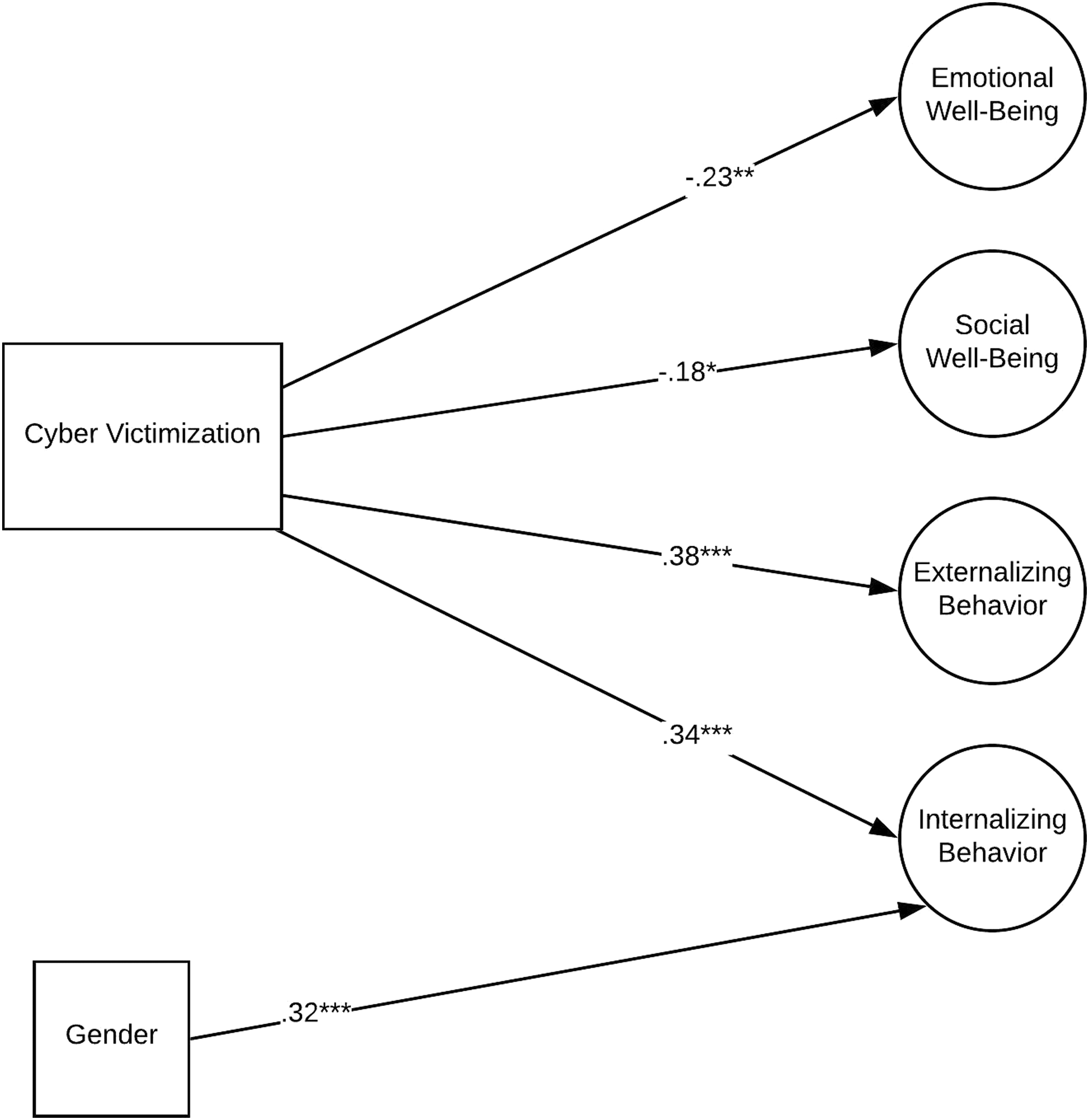
Associations between cybervictimization and well-being, internalizing, and externalizing behavior.
Discussion
Although the majority of emerging adults did not report being a victim of cyberbullying, cybervictimization was positively linked with internalizing and externalizing behavior, and negatively associated with social and emotional well-being. These results suggest that being a victim of cyberbullying may put emerging adults at risk for experiencing negative outcomes.
Because emerging adulthood is marked by both frequent use of technology and more specifically online interactions with peers, it is important to understand how cyberbullying impacts emerging adults' experiences of well-being, externalizing, and internalizing behavior. It is worth noting the presence or diagnosis of externalizing and/or internalizing behavior as possible intervention points for practitioners. Findings from this study suggest that emerging adults who report being victims of cyberbullying are at risk for experiencing externalizing and internalizing problems. Although causality cannot be determined in this study, it is important to identify those most at risk for experiencing internalizing and externalizing behavior as a result of cyberbullying, and consider whether internalizing or externalizing puts emerging adults at risk for cybervictimization.
Results further suggest that being the victim of cyberbullying is associated with negative outcomes in emerging adulthood. The majority of the literature on cybervictimization is focused on adolescents with many prevention programs and antibullying campaigns targeting adolescent cyberbullies and victims of cyberbullying. 32 Results of this study extend those findings and reveal that similarly, emerging adult victims of cyberbullying experience social and emotional problems. Cybervictimization during emerging adulthood may interfere with emerging adults' ability to build social capital online as it is detrimental to their emotional and social well-being. Age, however, was not associated with internalizing and externalizing behavior that is inconsistent with some literature that suggests that both internalizing and externalizing disorders begin in mid-adolescence and peak in early adulthood. 31
The results of this study suggest that emerging adults could also benefit from antibullying and cyberbullying prevention programs. However, the unique contexts for cyberbullying that may be different for adolescents and emerging adults need to be considered. For example, adolescent cyberbullying mainly occurs between students attending school together, 30 whereas in emerging adulthood when networks are larger and extend across more contexts, cybervictimization can happen between individuals from work, school, or in intimate relationships.
Limitations and future directions
Results of this study contribute to the literature on cybervictimization in emerging adulthood; victimization is problematic for internalizing and externalizing behavior, and for social and emotional well-being. However, this study was not without limitations. All measures were self-report that can lead to biased responses from participants; future research should include multiple reporters to gain a more comprehensive view of the experiences of victims of cyberbullying. In addition, cybervictimization was measured with one yes/no question, which limits understanding how often and in what context the behavior took place. Indeed, it would be important to note whether the participant was a victim of cyberbullying only once in the past year, or whether bullying occurs on a regular basis. Future research should examine cybervictimization according to the relationship between the individuals (e.g., from school, work, family, and intimate relationship), and the content of the cyberbullying messages (e.g., messages related to physical appearance) on a scale that allows for varying levels of frequency and intensity (e.g., the harshness of the messages). Finally, to inform prevention and intervention efforts, it is important for researchers to determine the direction of these effects to understand whether cybervictimization predicts greater internalizing and externalizing behavior and poor social and emotional well-being, whether these behavioral characteristics increase an individual's likelihood of cybervictimization, or whether in fact it is bidirectional. Longitudinal research would provide deeper insights into these relationships.
Conclusion
Results reveal that being the victim of cyberbullying is positively associated with internalizing and externalizing behavior, and negatively associated with social and emotional well-being. Findings suggest a need to develop prevention programs for emerging adult victims of cyberbullying, as outcomes for emerging adult cybervictims mirror outcomes for adolescents. Further exploration in emerging adulthood is suggested, as it is possible there are developmental (e.g., emerging adults may be less sensitive to cyberbullying because they are more socially and emotionally skilled than adolescents) and contextual differences (e.g., workplace, intimate relationship, classmates) between adolescents and emerging adults that could not be detected in this study but may impact these pathways.
Footnotes
Author Disclosure Statement
No competing financial interests exist.
Funding Information
This study was funded by Minnesota Agricultural Experiment Station (project number 52-088).