







Abstract
The parental expectation in adolescents' education is an essential factor of adolescents' social and emotional development. However, little is known about how it is related to adolescents' mobile phone addiction, especially for adolescents from low-income families. To address this issue, this study investigated the relationship between parental expectation and mobile phone addiction, and its underlying mechanisms in adolescents from low-income families. We hypothesized that parental expectation would negatively predict mobile phone addiction, and self-esteem and social anxiety would play multiple mediation roles in this relationship. Results from a sample of 1,953 Chinese adolescents in low-income families revealed that (a) parental expectation was negatively associated with adolescents' mobile phone addiction, (b) both social anxiety and self-esteem played partial and parallel mediating roles between parental expectation and mobile phone addiction, and (c) social anxiety and self-esteem mediated the association between parental expectation and mobile phone addiction sequentially. This study would advance our understanding of how proper parenting styles and social networks helped to prevent children's mobile phone addiction. The limitations and implications of this study are discussed.
Introduction
Mobile phones are everywhere in modern society, and adolescents using mobile phone devices have increased dramatically in many countries during the past decade. 1 Notably, according to the latest official statistics, China's mobile phone penetration has already reached 113 percent, with more than 0.98 billion people using mobile Internet at the end of 2020, in which adolescents' (age <22 years) amount of fraction is ever-increasing.
Despite great convenience, growing numbers of young people seem to develop an attachment to mobile phones, which may give rise to the phenomenon known as “mobile phone addiction.” 2 Mobile phone addiction was generally defined as the inability to control the impulse to use mobile phones or excessive use, which could exert unwanted influences, adversely affecting psychological and academic performance, 3 social behavior, and health status. 4 It has been suggested that the prevalence of mobile phone addiction seemed relatively higher among adolescents of low socioeconomic status due to family dysfunctions. 3
However, most literature has focused primarily on the risk factors associated with mobile phone addiction. 5 There has not been sufficient research conducted about protective factors. Among the few protective factors, parental style has been regarded as an essential one in preventing children's mobile phone addiction. 1 According to expectancy-value theory, parental expectations, particularly their beliefs about the long-term educational attainment of their children, have been proved to generate a much stronger relationship with children's psychological well-being and social behaviors. 6 Nevertheless, few studies, as far as we know, have revealed an association between parental expectations and mobile phone addiction among adolescents.
To fill these gaps, our study investigates the association between parental expectation and mobile phone addiction among Chinese adolescents from low-income families. Drawing upon the expectancy-value theory, 7 which offers a framework to explain the association between parental expectations and their children's problematic mobile phone use, we propose that parents' beliefs would influence children's behaviors through either intensifying positive psychological characteristics, such as self-esteem, or regulating their negative emotions, such as social anxiety. 8 Accordingly, it is reasonable to infer that parental educational expectations could also influence their children's problematic mobile phone use through the aforementioned paths. Thus, self-esteem and social anxiety were used as positive and negative psychological mechanisms, respectively, in mediating the relationship between parental expectations and their children's mobile phone addiction.
Literature Review and Hypotheses
Parental expectation and mobile phone addiction
Parental expectation has been defined as realistic beliefs and judgments that parents have about their children's development and achievement. 9 Particularly in China, parental expectations often manifest as long-term inspirations for the educational attainment, which encompass not only personal accomplishments but also cultural values to uphold honor to the family, especially those from rural areas or at disadvantaged socioeconomic status. 10
According to the expectancy-value theory, parental expectations affect their children's self-identity and subjective task values. 11 A growing body of empirical evidence suggests that parental expectations are not only associated with adolescents' cognitive and academic performance 12 but also related to their positive emotional and social development. 13 Specifically, parents with high expectations tend to devote more attachment or emotional bonds to children. Children with a secure attachment to their parents appear more capable of handling distress or trusting others. 14 On the contrary, insecure attachment is more likely to give rise to psychological discomfort and thus increase the likelihood of becoming obsessed with addictive behavior. 15
Furthermore, parents with high expectations tend to set more rules, regulations, and restrictions for their children to assure obedience as expected. Instead of leisure activities, children are usually required to focus on their school activities and homework. The parental expectation would even transform into strict parental control or mediation. Many studies have shown that parental active mediation or control was negatively associated with adolescents' mobile phone addiction. 16
Mediating role of social anxiety
Social anxiety is one of the most prevalent mental health disorders, which is characterized by excessive fear of social networking. 17 Parental styling serves as an important context for children's developing social behaviors and may affect their choices to approach or avoid social networks. 18 Various aspects of parental styles are associated with the children's development of social anxiety. Parental expectations, characterized by high levels of parent–children attachment and interaction, are theorized to affect adolescents' psychological experience of interpersonal relationships. 19
Parents with higher expectations are more likely to set higher requirements for their children's schooling and social behaviors. They are also more likely to encourage their children to behave gracefully and build a good rapport with teachers and peers in school. 13 In this case, positive parental expectations make adolescents not only feel parental attachment but also enabled them to build up their confidence. Previous literature has also shown that people would take mobile phones as a substitute for social networks when they felt anxious in the real world. 20 People with high social anxiety tended to communicate with others through mobile phones. 21
Thus, we hypothesize (H1):
Mediating role of self-esteem
Parental expectations would affect their behavior geared toward promoting children's self-appraisal of their own competencies, which is well known as self-esteem. 8 A growing number of studies have demonstrated that high self-esteem is inversely related to mobile phone addiction. 22 According to prior literature, the possible explanation of self-esteem's preventive effect on mobile phone addiction is that people with insufficient self-esteem usually have troubles in interpersonal relationships and seek to obtain security from mobile phone communication for the purpose to satisfy their security needs and compensating them for fear of social exclusion. 23 Accordingly, people with low self-esteem appear more likely to engage in excessive mobile phone use. Therefore, this study hypothesizes (H2):
Multiple mediating effects of self-esteem and social anxiety
To yield further insights, our study introduced an integrated multiple mediation model to investigate multiple effect mechanisms of parental expectation on mobile phone addiction. The multiple mediation model was developed by Hayes and Scharkow, 24 indicating that two mediators might function together through parallel or/and sequential mediation. 25 According to the sociometer theory, individuals with less social anxiety tend to make more positive self-evaluations, which thereby leads to high prevalence of self-esteem. 26 On the contrary, Cheng et al. found that lower family socioeconomic status (SES) caused lower social anxiety, which, in turn, was associated with a high prevalence of self-esteem among emerging adults in China. 27 Moreover, the pathways model of problematic mobile phone use revealed by Billieux suggested that insecure attachment style (e.g., social anxiety) was more likely to relate to low self-esteem, which usually acted as a risk factor of dysfunctional relationship maintenance and resulted in mobile phone addiction. 28
Given these, we hypothesize (H3):
Methods
Participants
The data included in this study were extracted from the Social Policy Support System for Disadvantaged Families (CSPSS) conducted by the Chinese Ministry of Civil Affairs and Peking University in 2018. The CSPPS is a large national survey conducted for adolescents from low-income families in China and has been approved by Biomedical Ethics Committee of Peking University. Sample households were recruited from a pool of 150 randomly selected communities. Both the child and parental questionnaires included parts of basic personal and family information, interfamily relationships. One child (aged 8–16 years) in each household was randomly chosen to take interviews. The scales of psychological health and mobile phone addiction were answered by children without their parents' presence. 1,953 adolescents from low-income families and 627 counterparts from non-low-income families were included in our analysis. More details of the low-income cohort's basic characteristics are summarized in Table 1.
Sample Characteristics
Note: The unit of income is yuan. The academic rank is the student's rank in his class in the latest examination, and the average class size is 49.
Measures
Parental expectations
Parental expectations for their children's educational attainments in the questionnaire consist of two aspects: short-term expectations for the grades or academic rank and long-term expectations for the education level. In this study, we focus on the long-term expectations, which were ascertained by the question “What education level do you want your children to finish?” answered by the parent. The measurement was coded as an 8-point scale: 1 = elementary school, 2 = secondary school, 3 = high school, 4 = junior college, 5 = undergraduate, 6 = postgraduate, 7 = PhD, 8 = did not attend school. Since this study was limited to students who attended school, we dropped the participant who chose 8. More than half of the 1,953 participants want their children to finish undergraduate courses (1,107); 540 participants chose the top educational level, and only 2 chose the elementary school. The mean and standard deviation (SD) are shown in Table 2.
Descriptive Statistics and Correlation Matrix of Core Variables (N = 1,953)
Correlation is significant at the 0.01 level.
Social anxiety
We use the Social Anxiety Scale for Children (SASC), a 10-item measurement developed by La Greca et al. as the measurement of social anxiety. 29 It employs a 3-point scoring system (0 = never, 1 = sometimes, 2 = always) in which students choose how much the statement “is true for you.” Two factors were included in the measurement: Fear of Negative Evaluation was assessed by six items such as “I worry about doing something new in front of other kids;” the other four items focused on Social Avoidance and Distress such as “I feel shy around kids I don't know.” The score theoretically ranges from 0 to 20, the mean and SD of the low-income cohort are shown in Table 2. A higher score indicates a higher level of social anxiety. Cronbach's alpha for SASC in this study was 0.85.
Self-esteem
The 10-item scale developed by Rosenberg that measures both positive and negative feelings about oneself was adopted as the measurement of self-esteem (such as “I feel that I have a number of good qualities” and “All in all, I am inclined to feel that I am a failure”). 30 The participants answered the question on a 4-point scale ranging from “strongly agree” to “strongly disagree.” A higher score implies higher self-esteem with a theoretical range from 10 to 40. The mean and SD are also shown in Table 2. Cronbach's alpha for self-esteem was 0.77 in these data.
Mobile phone addiction
To assess the degree of mobile phone addiction, we use a self-report 17-item Mobile Phone Addiction Index (MPAI) developed by Leung, which is composed of four aspects: inability to control craving, feeling anxious and lost, withdrawal/escape, and productivity loss. 31 For each item (such as “Your friends and family complained about your use of the mobile phone”), a 5-point scale is applied, ranging from 1 (not at all) to 5 (always). MPAI has been wildly used in research on Asian students and has shown signs of good reliability. Cronbach's alpha for mobile phone addiction was 0.85 in these data.
Results
Descriptive statistics
We first performed a descriptive analysis of participants' demographic characteristics, which we used in the models as covariates. The average age of the total 1,953 participants is 12.52 (SD = 2.18) with which the majority is in either elementary school or secondary school; 42.6 percent of the students live in the countryside, and the average annual family income is 27,000 yuan (SD = 2.53), whereas the average income per capita in 2018 is 28,200 yuan according to National Bureau of Statistics. The academic rank was addressed by the question “What's your rank in your class in the latest exam?” The average rank in our sample is 16.44, with a relatively large SD (14.48). Descriptive statistics and correlation analysis of the core variables are demonstrated in Table 2.
The average level of parental education expectation is 5.41 with an SD of 1.17 (5 = undergraduate); the average scores of social anxiety and self-esteem are 9.39 (SD = 5.02) and 30.06 (SD = 3.98), respectively. And the average score of mobile phone addiction is 34.65 (SD = 10.20). As shown in Table 2, parental expectations are strongly negatively related to social anxiety, whereas significantly positively associated with self-esteem, which indicates that higher parental expectations may be able to alleviate negative emotions and boost positive ones. Meanwhile, social anxiety displays a significant negative association with self-esteem, which implies a conflict between them. Overall, the results of correlation analysis primarily are in line with our hypotheses.
Mediating effect of social anxiety and self-esteem
The PROCESS macro for SPSS (Model 4) was applied to test the mediation effect of social anxiety. As shown in Figure 1, the coefficient of the total effect of parental expectations on mobile phone addiction was −0.43 (p < 0.05). The result of the mediation models is shown in Table 3. The indirect effect of parental expectations through social anxiety was −0.15 (p < 0.05), which supports our H1 that parental expectation prevents children from social anxiety. The indirect effect through social anxiety accounted for 34.9 percent of the total effect of parental expectations on mobile phone addiction. We also used the PROCESS macro for SPSS (Model 4) for testing H2.

Total effect model of direct relationship between parental expectations and mobile phone addiction. The path is significant at the 0.05 level. (N = 1,953).
Testing the Mediating Effect of Social Anxiety and Self-Esteem (N = 1,953)
The results showed that parental expectations strongly affected mobile phone addiction through self-esteem. The mediator was positively associated with parental expectation and negatively related to mobile phone addiction. The indirect effect of parental expectations through this path was −0.23 (p < 0.05). The indirect effect of parental expectation through self-esteem accounted for 53.5 percent of the total effect of parental expectation in this mediation model. In summary, the indirect effect of social anxiety and self-esteem both accounted for a large proportion of the total effect when modeled separately, which led us to the multiple mediation model.
Multiple mediation model
Considering the relation between two mediators, we performed a multiple mediation model using the PROCESS macro for SPSS (Model 6) as shown in Table 4 and Figure 2. The results in Table 4 backed up our H3. The result in Table 3 social anxiety and self-esteem functioned in a parallel way with an indirect effect, respectively. Yet, social anxiety also negatively affected self-esteem, which can lead to a higher score of mobile phone addiction. The coefficient of the third path was −0.02 (p < 0.05). After the three indirect paths were added to the model, the direct effect of parental expectation turned insignificant, whereas the respective mediation effects of social anxiety (β = −0.14, p < 0.05) and self-esteem (β = −0.09, p < 0.05) remained significant.
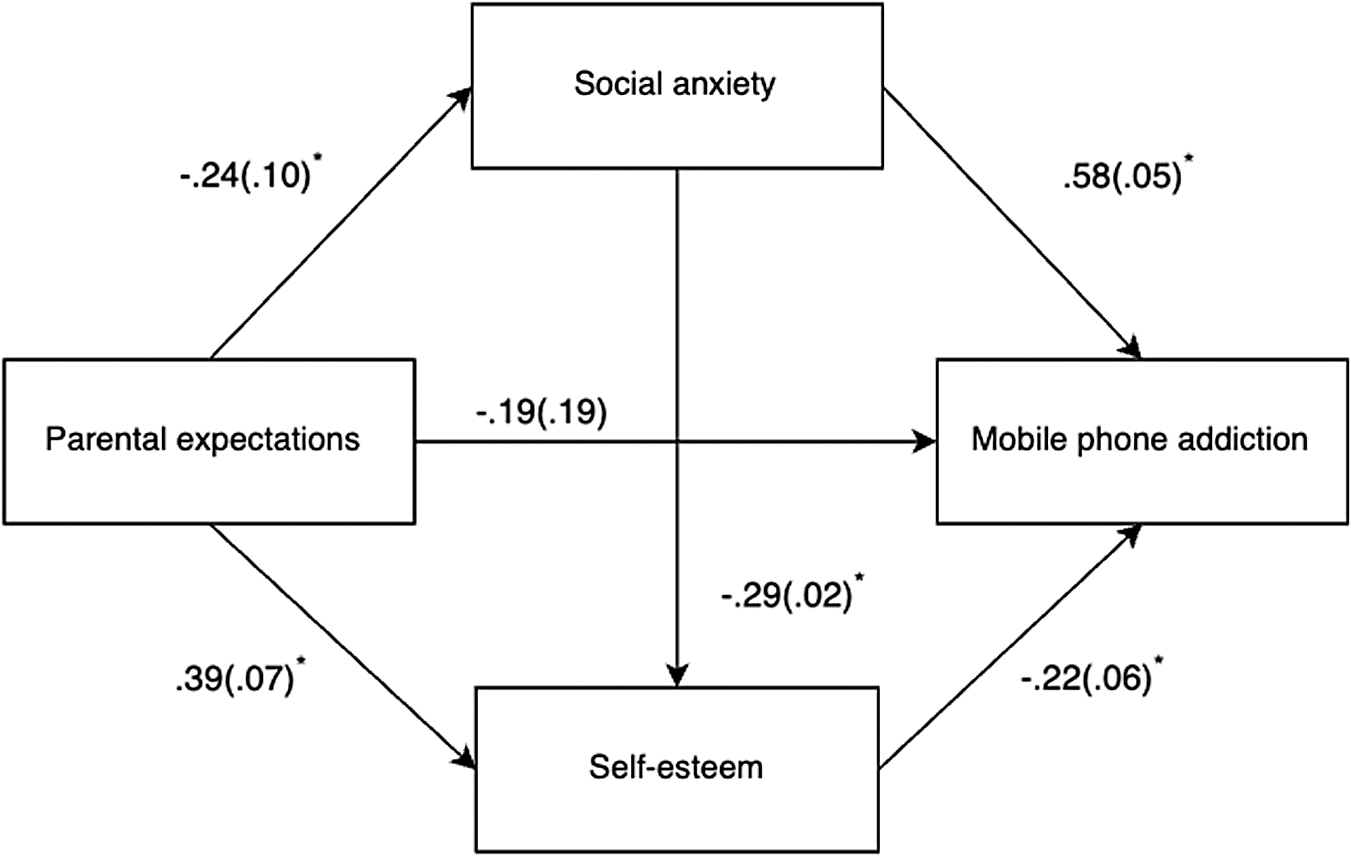
Multiple mediating effect model of the indirect relation between parental expectations and mobile phone addiction through social anxiety and self-esteem for low-income families. The path is significant at the 0.05 level. (N = 1,953).
Testing the Pathways of the Multiple Mediation Model (n = 1,953)
We also performed a multiple mediation model on those non-low-income families in our data set (Appendix Table A1), but the result suggested no significant mediating effect by social anxiety or both mediators simultaneously. The mediating effect of self-esteem was significant but slightly smaller compared with the model for low-income families. This again confirmed that social anxiety and self-esteem exert a stronger mediating effect on the relationship between parental expectations and mobile phone addiction among the low-income cohort. The multiple mediation model with self-esteem being the first mediator was also tested, which was not as significant as our model in Figure 2 and Table 4. The result is presented in Appendix Table A2.
Discussion and Conclusion
This study revealed significant associations between parental expectation, mobile phone addiction, self-esteem, and social anxiety among adolescents from low-income families in China. And the results were in line with the theoretical assumptions. The multiple mediation model showed that self-esteem and social anxiety played parallel mediating roles in the association between parental expectation and mobile phone addiction, thus, supporting H1 and H2, respectively. Self-esteem and social anxiety also sequentially mediate the linkage between parental expectation and mobile phone addiction, supporting H3.
This study contributed to current literature in mainly three ways. First, this study extends the literature on mobile phone addiction from a novel perspective of parental expectation. To our knowledge, this study was among the first to demonstrate the significant linkage between parental expectation and mobile phone addiction among adolescents. In the Chinese cultural context, parents tend to have high expectations of their children to compete and bring honor to the family. Second, our study also adds new insight into understanding the expectancy value theory by revealing the psychological effects of parental expectation on their children's problematic behavior.
These findings were in line with several studies suggesting that parental expectation is related to children's psychological adjustment, 32 such as self-esteem. 33 Moreover, adolescents with social anxiety or low self-esteem appear more likely to suffer mobile phone addiction. 34 Besides, the joint effect of social anxiety and self-esteem found in this study can also be verified by prior studies. For instance, Kong et al. suggested that socially anxious adolescents were negative in the accumulation of self-worth experiences, thereby weakening their self-esteem.
Accordingly, they were more likely to engage themselves in mobile phone use excessively. 35 Third, this study has extended the literature by taking family SES into account. The results suggested that the association between parental expectation and mobile phone addiction was particularly significant among adolescents from low-income families compared with their non-poverty counterparts. Although most prior studies suggested adolescents from low SES families are more likely to suffer from Internet or mobile phone addiction, fewer preventive factors have been revealed. 36 Therefore, this study sheds new light on that positive parental expectations would serve as more significant preventive factors for mobile phone addiction in low SES families.
According to the findings of this article, we draw some policy implications for interventions to prevent adolescents at a disadvantaged level from depending on mobile phones. We found that higher parental expectations are associated with a lower risk of mobile phone addiction. In this case, providing only financial resources to needy families without imparting child development knowledge and instilling high expectations for children is an incomplete solution.
Governments or NGOs should devote more to promoting public-funded parent involvement programs that focus exclusively on effectively teaching parents at low SES to engage in positive parent–child interactions. Particularly, administrators and educators need to take the negative effects of social anxiety into account and further provide disadvantaged adolescents with preventative assistance to improve their self-esteem in social networks. Equally important, clinicians should attend to better parents' caregiving abilities by guiding them on how to monitor their parenting style to strengthen their children's self-esteem and mitigate social anxiety.
Nevertheless, several limitations of this study should be acknowledged along with consideration of future research directions. First, it is barely possible to obtain causal estimation given the cross-sectional nature of the data. Thus, longitudinal or experimental research needs to be developed to provide evidence for causal relationships between parental expectation and mobile phone addiction. Second, the multiple mediation model has concluded that social anxiety and self-esteem only partially mediate the association between parental expectation and mobile phone addiction, suggesting some other mediators need to be explored in the future. Third, our study simply measured parental expectations for children's long-term educational attainment due to data limitations. Future research should include the short-term expectation for the grades or academic rank, or other kinds of parental expectations, such as occupational expectations.
Footnotes
Author Disclosure Statement
No competing financial interests exist.
Funding Information
The National Natural Science Foundation of China (No. 72171227) and the Research Foundation of Renmin University of China (No. 21XNA013).
Appendix
Testing the Pathway of the Multiple Mediation Model (with Self-Esteem Being the First Mediator)
| Path | Coefficient | Bootstrap 95 percent confidence interval | |
|---|---|---|---|
| Lower | Upper | ||
| Direct effects | |||
| Parental expectations→addiction | −0.19 | −0.56 | 0.18 |
| Parental expectations→social anxiety | −0.01 | −0.19 | 0.16 |
| Social anxiety→addiction | 0.58 | 0.48 | 0.67 |
| Parental expectations→self-esteem | 0.46 | 0.31 | 0.6 |
| Self-esteem→addiction | −0.22 | −0.35 | −0.1 |
| Self-esteem→social anxiety | −0.49 | −0.55 | −0.43 |
| Indirect effects | |||
| Parental expectations→social anxiety→addiction | −0.14 | −0.25 | −0.02 |
| Parental expectations→self-esteem→addiction | −0.006 | −0.113 | 0.097 |
| Parental expectations→social anxiety→self-esteem→addiction | −0.129 | −0.182 | −0.085 |
| N | 1,953 | ||