







Abstract
The advent of short video apps like Douyin has greatly popularized the practice of sharing travel experiences in the form of live-streaming or prerecorded videos. With the breakout of COVID-19, the feasibility and appeal of physical travel were substantially undermined such that people now become increasingly dependent on watching short videos as a means of consuming travel-related content. This revolutionary change in the landscape of destination marketing is reshaping the tourism industry, which calls for research efforts of both scholars and practitioners. Our study aimed to investigate how two major characteristics of tourism-themed short videos, namely, level of novelty and camera angle, influence viewers' behavioral intentions toward actually visiting the places, with the incorporation of several relevant psychological mediators, including immersion, positive surprise, spatial presence, and perceptual realism. A 2 (low- vs. high-level novelty) × 2 (first- vs. third-person view) factorial experiment was designed and conducted. Statistical analysis based on a sample of 480 participants suggested that the perception of positive surprise increased with the level of novelty contained in the videos, which was positively associated with viewers' visit intentions in an indirect manner. Moreover, compared to the third-person view, employing the first-person view to film sites and scenes produced a greater sense of immersion, which in turn stimulated interest in taking a tour. This study contributes to the growing body of research in digital travel and telepresence.
Introduction
Recent advances in information and communication technologies, such as video compression and data transformation, have substantially precipitated the popularity of short video apps like Douyin (TikTok's counterpart in mainland China). On these platforms, users can showcase and share their unique travel experiences through live-streaming or prerecorded videos.1,2 Recognizing the importance of this game-changing trend in destination marketing, tourism industry marketers have proactively begun utilizing short videos for promotional purposes. For example, Zhou et al. 3 indicated that TikTok can exert influence on the travel decision-making process of young Chinese tourists by igniting their trust and hedonic motivations.
Meanwhile, the COVID-19 pandemic significantly undermined the feasibility and appeal of physical travel for a large number of individuals, as lockdowns, border closures, and travel restrictions were frequently put into effect during this time.4,5 Accordingly, the adoption of online reservations, virtual tours, contactless check-in procedures, and digital health passports saw a remarkable increase in prevalence and recognition. As such, a combination of technological and situational factors, along with the growing acceptance of digitally visiting places and engaging with others in computer-mediated environments, has fostered the concept of replacing physical travel with digital alternatives.6–8
Also known as virtual travel, digital travel refers to “a broad spectrum of situations where people experience a sense of being in a place other than where their bodies are physically located, through the use of digital technologies.” 9 Inquiries into digital travel should incorporate established knowledge in both tourism and telepresence, with a focus on the feeling of being fully present (e.g., being able to observe surroundings or perform actions) in a virtual location distant from one's physical presence. 10 In particular, the sense of telepresence can be materialized through the use of video, audio, and sometimes haptic feedback to create a real-time, immersive experience.11,12 Technologywise, therefore, digital travel is largely enabled and facilitated by Internet-based technologies and devices, including virtual reality,13,14 video games,15,16 smartphones, 17 and so forth. It provides a wide range of application scenarios, from live musical and sporting events18,19 to formal conference meetings. 20
During the COVID-19 pandemic, UC Berkley hosted virtual graduation ceremonies characterized by Minecraft architectures and characters, 21 creating a fantasy experience that mirrored the actual campus buildings. By the same token, an unprecedented in-game concert featuring rapper Travis Scott drew millions of players from around the world and set a new record for concurrent players in the popular video game Fortnite, with over 10 million participants attending the event. 22 Both cases have well demonstrated the potential of digital travel to transcend physical boundaries and afford engaging experiences in times of crisis or limited mobility.
In comparison to the heated discussions about digital travel among tourism practitioners, 23 academic research on this topic is still at its infancy. While several studies have explored the effects of relevant resources on the Internet, such as travel blogs and social media, on young tourists' cognition, attitudes, and behaviors in relation to digital travel engagement,24–26 there has been insufficient attention to identifying what factors of online content surrounding tourism can effectively elicit certain psychological responses, which ultimately contribute to intentional or behavioral outcomes. To fill this gap, the current study conducted a 2 × 2 between-subject factorial experiment, with the inclusion of related psychological mediators, to investigate how level of novelty (low- vs. high-level novelty) and camera angle (first- vs. third-person view) of tourism-oriented short videos on Douyin impact would-be travelers' behavioral intentions toward actually visiting the places featured in the video clips.
In the tourism literature, there is a general consensus that novelty-seeking serves as one of the most fundamental motives for choosing a specific destination.27–30 Often used interchangeably with unexpectedness, novelty underscores the disconfirmation of revealed or hidden expectations. 31 Cohen 32 developed a seminal typology of tourist roles as per the degree to which tourists quest for novelty, including the organized mass tourist, the individual mass tourist, the explorer, and the drifter. Notably, a plethora of empirical studies have supported the positive relationship between travelers' novelty-seeking tendency and their intention to visit or revisit destinations.33–35 Additionally, considering that tourism can be epitomized as visual consumption, 10 some scholars have started to investigate the perceptual and emotional effects of media content's camera angle on interested travelers. For example, Winter and Adu-Ampong 36 demonstrated that the use of camera can invite reflection on tourism phenomena and experiences. In a similar vein, Wang 37 found that adopting the first-person view can elevate senses of immersion, social presence, and entertainment.
Lastly, this study integrated four psychological mediators into analysis, namely immersion, positive surprise, spatial presence, and perceptual realism that should be closely aligned with the two variables of primary interest (i.e., level of novelty and camera angle) and the related behavioral intentions.38–40 Previous research has shown that the presence of novelty usually entails elements such as exploration, discovery, and learning, which can be inherently motivating and gratifying and are able to provoke sensations like immersion and positive surprise.37,41 These beneficial psychological reactions may further lead up to intended behavioral consequences such as impulsive buying and subscribing.42,43 With the abovementioned factors in mind, we propose the related hypotheses and research model (Fig. 1) as follows:
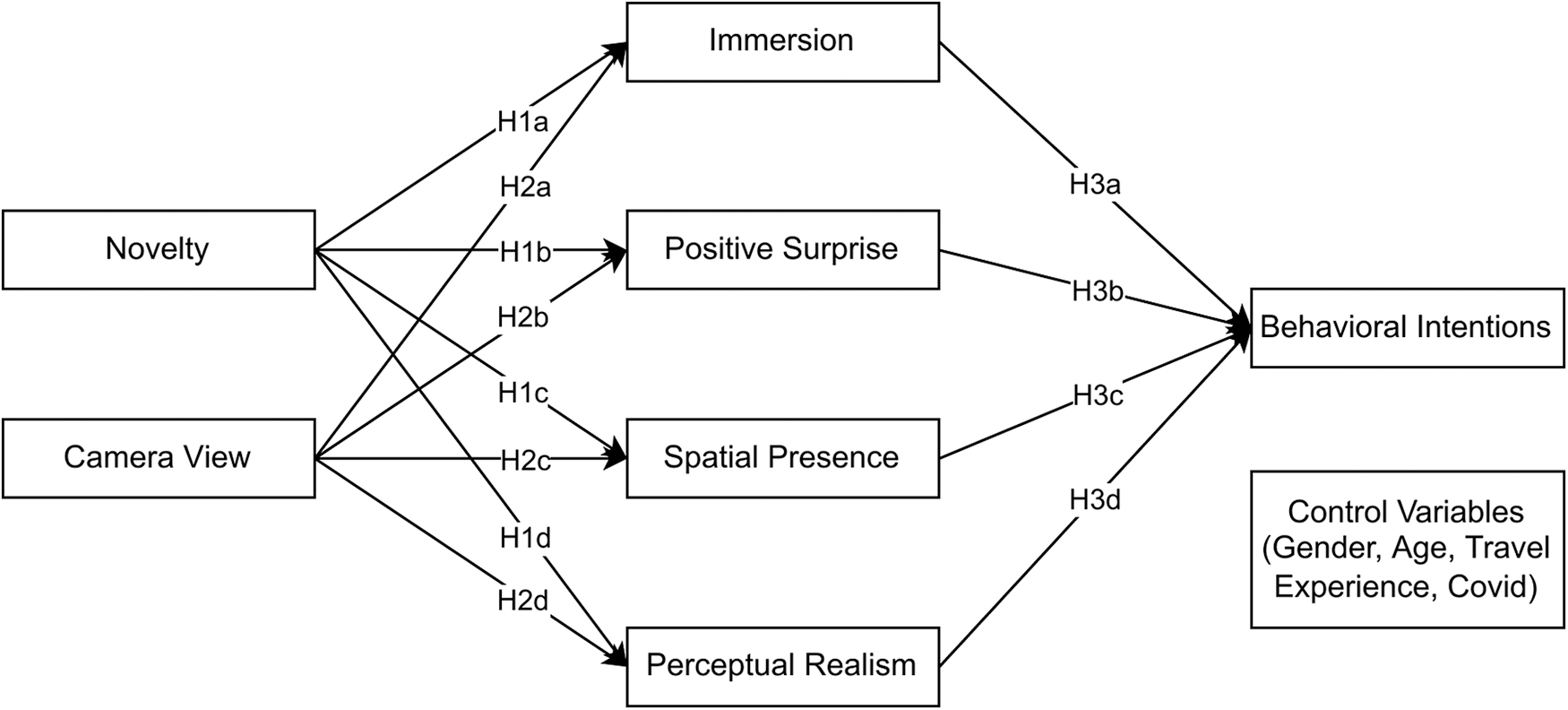
The conceptual research model.
Methods
Participants
This study was approved by the Institutional Review Board of the Communication University of Zhejiang in East China. The participants were recruited using a Douyin account, which regularly updates content about filming and video editing. Eight hundred invitation messages were randomly sent to the followers of the account, whose total number exceeded 18,000. While 482 followers indicated voluntary participation (response rate = 60.25 percent), 480 of them finally took part in our experiment. Having received and read an introduction of our study, the participants then provided their consent via Douyin private messages. In the sample, 51.25 percent (n = 246) were female, and the average age was 27.97 (SD = 5.95). With regard to past experience or frequency of physical travel, 55.21 percent of the participants (n = 265) reported that they took a tour more than twice a year before the breakout of COVID-19. Meanwhile, 96.25 percent (n = 462) of them acknowledged that the pandemic situation had a discernible impact on their life in general (i.e., scoring no smaller than 5 on a 7-point Likert scale).
Experiment design
The experiment in our study was a 2 (low- vs. high-level novelty) × 2 (first- vs. third-person view) factorial design, and the participants were randomly assigned to one of the four conditions (Table 1) within the Douyin app. We uploaded five different short videos that characterize the specific condition to each of the groups. Before watching the video clips, a survey was used to collect the participants' demographic information, past travel experience measured by annual frequency of physical travel without the impact of COVID-19, as well as how severe the pandemic situation has affected their life in general. Postwatching the clips, they further completed the questionnaire assessing their feelings of immersion, positive surprise, spatial presence, and perceptual realism, in addition to their visit, recommendation, and revisit intentions.
Classification of the Four Experimental Conditions
Materials
We capitalized on a set of search terms, including “digital travel” (数字旅行), “immersive travel” (沉浸式旅行), “first-person view travel” (第一人称视角旅行), “third-person view travel” (第三人称视角旅行), and “novel travelling” (新奇的旅行), to identify more than 200 tourism-themed short videos on Douyin. To focus on the effects of level of novelty and camera angle, we circumvented videos having confounding elements, such as horror (e.g., skydiving) and expensiveness (e.g., international travel), that might interfere with participants' choices. We worked independently to select candidate videos, as many as possible, for the four predefined experiment groups. We then conducted a pilot study by inviting 25 undergraduate students to help determine the perceived novelty of places featured in the videos. Level of novelty was measured using three 7-point Likert subscales that concentrate on the originality, rarity, and exclusivity, respectively. 44 Finally, 20 short videos whose duration did not exceed 60 seconds were selected for use, with each condition having five videos. Supplementary Videos S1–S4 provide an example for each condition.
Instruments
In light of that the respondents in this study were all native Chinese speakers, back translation was implemented by a lecturer, who received his PhD degree from a higher education institution in the United States, and another lecturer, holding a master's degree in English, to improve measurement accuracy.
Behavioral intentions
Participants' intentions toward actually visiting, recommending, and revisiting the sites featured in the videos were measured using three items adapted from Hu et al. 45 including “considerable chance to visit,” “recommend others to visit,” and “frequently visit.” They graded the items on a 7-point Likert scale, ranging from 1 (extremely unlikely) to 7 (extremely likely). Cronbach's alpha was 0.824, indicating acceptable internal consistency.
Immersion
The extent to which viewers felt involved or connected was measured by Bracken's 46 items, three of which are 7-point Likert scales, whereas the remaining are Semantic Differential scales. Cronbach's alpha was 0.796, indicating good internal consistency.
Positive surprise
Hosany and Gilbert's 47 destination emotion scale was used to measure participants' positive surprise with five items (i.e., amazement, astonishment, fascinated, inspired, and surprise). They responded from 1 (not at all) to 7 (very much) on a Likert-type scale. Cronbach's alpha was 0.877, indicating good internal consistency.
Spatial presence
Three questions on a 7-point Likert scale from Lombard and Ditton (2001) 48 measured to which extent viewers felt a sense of sharing a physical space as if they were situated there. Cronbach's alpha was 0.826, indicating acceptable internal consistency.
Perceptual realism
Participants rated on a 7-point Likert scale for six items designed by Lombard and Ditton (2001) to measure the degree to which media viewers felt a sense of realism. Cronbach's alpha was 0.913, indicating excellent internal consistency.
Results
Randomization and manipulation checks
The software R was used to process the data and conduct statistical analysis. For validating the effectiveness of group classification, randomization and manipulation checks were implemented, respectively. Results of a Chi-square test [χ 2 (3) = 3.933, p = 0.269] and a one-way analysis of variance (ANOVA) test [F(3, 476) = 0.805, p = 0.370] revealed that gender and age did not differ significantly among the four groups. That is, participants were randomly assigned as per demographic information. Also, the four groups exhibited limited difference in terms of travel experience [χ 2 (3) = 2.400, p = 0.494].
In the survey, three specific questions concerning the level of novelty was included to request participants to score from 1 (extremely not novel) to 7 (extremely novel). Results of two one-way ANOVA tests accompanied by Tukey's post hoc analysis showed that participants perceived the videos in Group B to have an increased level of novelty than those in Group A (Cohen's d = 1.833, p < 0.001), and likewise, the videos in Group D outperformed their Group C counterparts in terms of novel components (Cohen's d = 1.775, p < 0.001). As such, the experimental manipulation that dichotomized the tourism-themed videos into low and high levels of novelty should be considered effective.
Hypothesis testing
Level of novelty (H1) and camera angle (H2) on mediators
Two-way ANOVA tests were conducted to examine the impacts of level of novelty and camera angle on the participants' senses of immersion, positive surprise, spatial presence, and perceptual realism. First, using the first-person view to film scenes was observed to generate a greater sense of immersion than the third-person view [F(1, 474) = 325.326, p < 0.001; Cohen's d = 2.246, p < 0.001]. Level of novelty had no statistically significant impact on the sense of immersion [F(1, 474) = 0.071, p = 0.571]. The results supported H2a, but not H1a. Next, it was found that the participants' feeling of positive surprise increased with level of novelty in the videos [F(1, 474) = 255.023, p < 0.001; Cohen's d = 2.129, p < 0.001], whereas adopting different camera angels exerted negligible influence on their perceived surprise [F(1, 474) = 0.013, p = 0.925]. H1b was supported, but H2b was not.
Third, applying the first-person seemed to intensify the sense of spatial presence [F(1, 474) = 339.202, p < 0.001; Cohen's d = 2.313, p < 0.001], which was not significantly changed by level of novelty [F(1, 474) = 0.028, p = 0.868]. Thus, although H1c was not supported, the opposite direction of H2c was. Lastly, when it came to how the two variables of main interest affected the perception of perceptual realism, insignificant results were obtained regarding level of novelty [F(1, 474) = 0.724, p = 0.395], camera angle [F(1, 474) = 0.175, p = 0.676]. Neither H1d nor H2d was supported.
Mediators (H3) on behavioral intentions
Multivariate regression was conducted to test whether the four psychological mediators were effective in forecasting participants' behavioral intentions pertaining to physically visiting the sites and scenes displayed in the videos. Senses of immersion and positive surprise were found to be significant predictors, with the model explaining 75.7 percent of the overall variance [adjusted R2 = 0.757, F(1, 472) = 213.500, p < 0.001]. To be precise, with one additional point on grading the perceived immersion and positive surprise, participants' average score of the related behavioral intentions increased by 0.464 (p < 0.001) and 0.470 (p < 0.001), respectively. Interestingly, spatial presence was found to be negatively associated with behavioral intentions (β = −0.052, p < 0.01). The largest value of variance inflation factor was 1.258, indicating the absence of the multicollinearity problem. Hence, only H3a and H3b were supported.
The mediating effects of immersion (H5a), positive surprise (H4b), and spatial presence (H5c)
The above results suggested that H5a, H4b, and H5c could potentially be valid. We capitalized on the PROCESS model, attuned specifically to mediation tests in R, to implement the analysis. In addition to the direct effects, we reported the indirect effects and their 95% confidence intervals (CIs), which were computed based on 10,000 bootstrap samples.
While the direct effect of increased novelty was found to be insignificant (p = 0.453, CI [−0.316 to 0.141]), a higher level of novelty could stimulate participants' behavioral intentions indirectly through the mechanism of positive surprise (β = 1.041, CI [0.865 to 1.234]). Coincidentally, results showed that the direct effect of camera angle on behavioral intentions was not statistically significant (p = 0.236, CI [−0.471 to 0.117]). In contrast, the indirect effect of using different camera angles, mediated by immersion, significantly predicted participants' behavioral intentions (β = 1.081, CI [0.899 to 1.272]). However, the related indirect effect via spatial presence appeared to be insignificant (β = 0.009, CI [−0.172 to 0.154]). Final mediation models about level of novelty and camera angle are displayed in Figures 2 to 4.
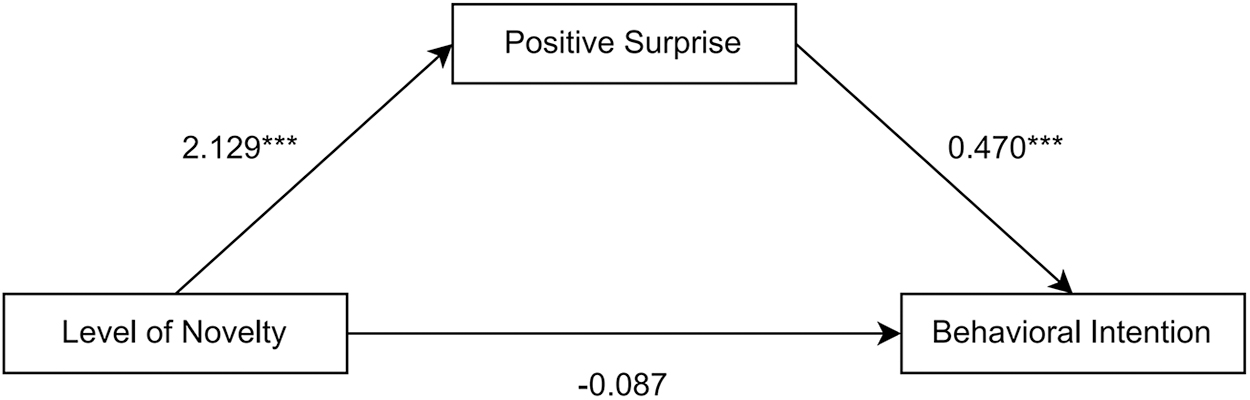
Mediation model of level of novelty. ***p < 0.001; **p < 0.01; *p < 0.05.
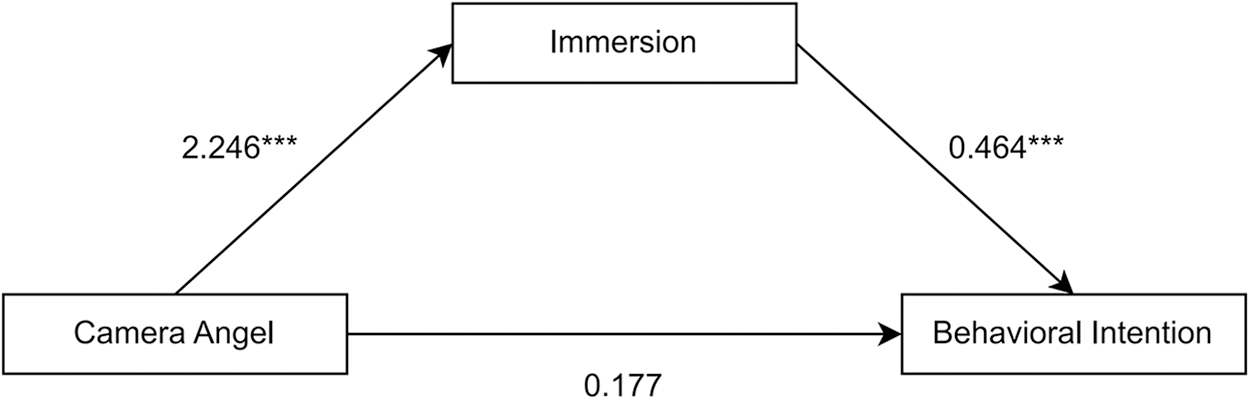
Mediation model of camera angel (immersion). ***p < 0.001; **p < 0.01; *p < 0.05.
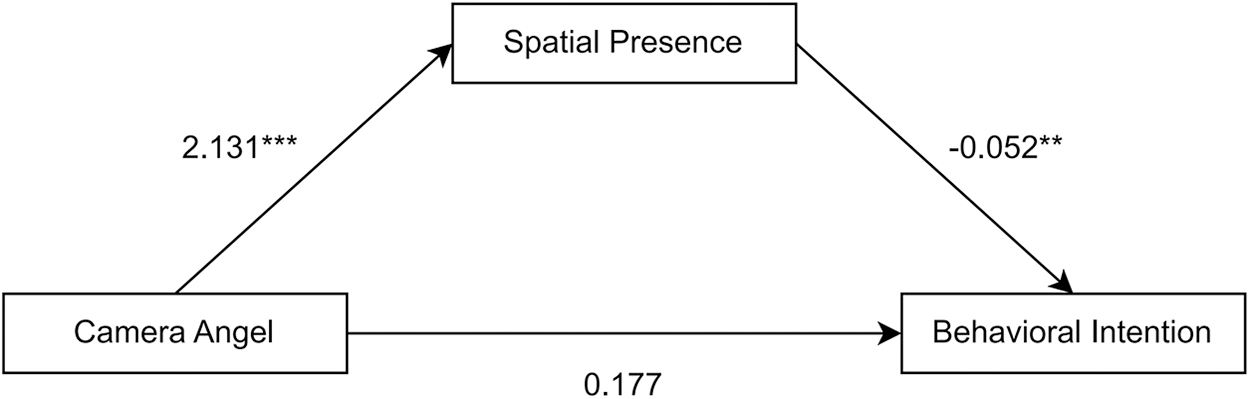
Mediation model of camera angel (spatial presence). ***p < 0.001; **p < 0.01; *p < 0.05.
Discussion and Conclusion
In this study, two major characteristics of tourism-themed short videos on Douyin, namely, level of novelty and camera angle, were analyzed using a 2 × 2 factorial design in an effort to examine their impacts on viewers' desire about actually visiting, recommending, and revisiting the places that appeared in the videos. Results were obtained by effectively classifying novelty into high and low levels, alongside comparing the first- and third-person views.
It was found that the perception of positive surprise increased with the level of novelty contained in the digital travel videos, which was positively associated with viewers' travel-related intentions in an indirect manner. On the other hand, compared to the third-person view, employing the first-person view to film sites and scenes produced an elevated sense of immersion, which in turn fueled interest in making a tour. No significant direct effects were detected regarding the two variables under consideration. In other words, level of novelty and camera angle influenced media viewers' behavioral intentions merely through the mediating roles of surprise and immersion, respectively. Moreover, the presence of a tour guide in the view (i.e., adopting the third-person instead of the first-person perspective) seemed to attenuate the feeling of spatial presence, which was negatively related to the behavioral intentions in question. Lastly, neither the dependent variable nor the independent variables were sensitive to the variation of perceptual realism.
Cognitively, positive surprise can incentivize the assimilation and accommodation of new information, encouraging travelers to reevaluate their existing schemas and mental models. 49 This cognitive restructuring process often results in a more refined and nuanced understanding of the world, which ultimately ameliorates the overall travel experience. In particular, the violation of expectations can enhance travelers' engagement, contributing to an increased sense of curiosity, adventure, and personal growth. 50 From an emotional perspective, immersion and positive surprise play vital roles in counterbalancing potential negative emotions that travelers may encounter, such as anxiety, frustration, or disappointment, thereby creating a more enjoyable experience for them. These two factors are also essential for establishing destination loyalty, not only increasing the likelihood of travelers returning to the destination and recommending it to others but also contributing to the tourism industry's long-term success. 51
In tourism research, novelty and surprise have been well documented and discussed,28,52,53 with the latter often being deemed a psychological appraisal of the former. 54 More recently, there is also growing attention to their co-occurrence in the field of new media.55,56 The current study explored this pair of concepts in a context combining both tourism and new media, that is, digital travel, and demonstrated that positive surprise played an important role in mediating the link between level of novelty and travel-related intentions. Furthermore, it was found in this study that adopting the first-person angle to film sites and scenes can make viewing experience more immersive than the third-person perspective, resonating with previous research with a focus on camera angle.37,57 Consequently, viewers expressed a higher proclivity to physically visit the places.
Footnotes

References
Supplementary Material
Please find the following supplemental material available below.
For Open Access articles published under a Creative Commons License, all supplemental material carries the same license as the article it is associated with.
For non-Open Access articles published, all supplemental material carries a non-exclusive license, and permission requests for re-use of supplemental material or any part of supplemental material shall be sent directly to the copyright owner as specified in the copyright notice associated with the article.
