







Abstract
This study examined two ways of using the TikTok application (active vs. passive use), and their association with female users' self-esteem pertaining to appearance and weight. By adopting a cross-sectional online survey design, this study recruited 7,750 adult female TikTok users from China (Douyin), and acquired self-reported data on 2 ways of using TikTok, state-level social comparison, appearance-esteem, weight-esteem, body mass index, and age. The results indicated that passive and active TikTok uses were negatively and positively associated with participants' appearance- and weight-esteem, respectively. A mediation analysis revealed that the participants' state-level social comparison while using TikTok mediated the association between two ways of TikTok use, and their effects on appearance- and weight-esteem. These results help us understand the complicated impact of TikTok use on body image, and design campaigns for promoting body acceptance.
Introduction
Certain flimsy social ideals—imposed and promoted by mass media—have exerted great pressure on women. With social media use becoming an everyday activity, several recent studies have focused on the effects of social media use on body image. 1 While most prior research has reported a positive relationship between exposure to idealized content on social media and varied negative body image outcomes, 2 a few studies have also reported a nonsignificant or reversed correlation between social media use (specifically, appearance- or photo-related activities), and body image concerns.3,4
One possible reason for these mixed findings could be the different conceptualizations and operationalizations of social media use. Prior studies have applied a preliminary differentiation between general and appearance-focused social media use.5–7 However, social media sites not only expose users to body-image-related content passively, but also provide various functions and affordances for active participation. Therefore, examining how different ways of using social media are associated with women's body image concerns posits importance.
The current study addresses this gap by focusing on two ways of body image-related social media use (active use and passive use), 8 and their associations with women's body-esteem. A theoretical distinction between these two ways of social media use would advance our understanding of how they are associated with female users' body-esteem, and shed light on the previous inconsistent findings. The current research is confined specifically to TikTok, considering its extensive user engagement, highly visual content, and popularity. Although the theory of social comparison is frequently cited as an explanatory mechanism, uncertainty prevails regarding which ways of TikTok use are most strongly associated with body-esteem, and whether social comparison can account for the association between them. Therefore, we examine whether the proposed associations between TikTok use and body-esteem are mediated by individuals' state-level social comparisons while using TikTok.
Active versus passive use of TikTok and body-esteem
Previous studies have found that individuals' use of social networking sites' appearance-related features—rather than general social media use—is a predictor of negative body image. 9 Other studies, focusing on image-based activities (photography), or high-visual social media such as Instagram, have reported that these types of social media use are associated with increased body image concerns and internalizing symptoms.10,11 A meta-analysis reveals that although both general and appearance-focused social media use are positively associated with disturbed body image, larger effect sizes are observed for the latter type of use. 2
However, social media not only exposes users to a wide range of body-image-related content, but also allows them to utilize different features, such as tagging, “like,” “favorite,” “share,” and “repost.” Recent research has indicated that the use of social media, especially Facebook, can be categorized into passive and active use. 12 Passive use refers to viewing online content without interacting or communicating with others (e.g., browsing through others' Facebook profiles), while active use refers to activities that facilitate interactions with targeted or nontargeted users (e.g., direct communication with others or broadcasting on social networking sites). 8 Active use can be further divided into active public use (e.g., status updates) and active private use (e.g., private one-on-one messaging). Passive social media use positively predict symptoms of anxiety and depression,13,14 while active social media use is negatively associated with symptoms of anxiety and depression.15,16
Thus far, studies have predominantly focused on Facebook and Instagram. However, other emerging sites/applications that are popular among the youth, have received limited attention. TikTok, an application (app) that features a constant stream of short videos, has become one of the most popular social media platforms worldwide. One in five Americans has used TikTok, 17 and the average number of daily active users in China is 600 million. 18 Moreover, TikTok can be perceived as a highly visual platform because of its predominance of visual content. 11 The content created by female users primarily features beauty, performances, dance, and topics related to sex appeal. 19
As an outcome variable, body-esteem can be defined as the self-evaluation of one's own attractiveness, weight, and physical appearance.20,21 It includes appearance-esteem (i.e., general physical appearance), weight-esteem (i.e., weight satisfaction), and attribution-esteem (i.e., how others evaluate my body and appearance). 22 The current study focuses on two dimensions of body-esteem, that is, appearance-esteem and weight-esteem, since these are directly linked to one's perception and attitude toward one's own body.
We distinguish between two ways of TikTok use, namely active TikTok use (i.e., publicly posting self-created short videos) and passive TikTok use (i.e., passively viewing others' short videos or comments, without “liking” or replying).
13
Several studies have reported that increased active social media use is positively associated with improved mental health, while passive use is associated with the opposite.8,13 Similarly, the two ways of TikTok use may have different associations with users' body-esteem. Thus, we predict:
Mediation of social comparison
Social comparison theory has been adopted to explain the effects of media exposure on individuals' body image.10,23–25 As members of society, individuals tend to compare their own abilities and attributes with those of others, to form a perception regarding themselves. 23 Scholars have further distinguished between appearance-related and general social comparisons, considering physical attractiveness and body size.26,27
The current study utilizes social comparison as a state that reflects the extent to which an individual engages in social comparison when using short-video apps such as TikTok. This state social comparison has been considered as a mediator between social media use and dissatisfaction with one's body.28,29 Most TikTok users are teenagers and adolescents, who seek to be praised and recognized, form and maintain relationships, and become famous.
30
The motivation to form a perception regarding oneself may trigger social comparison with other TikTok content creators, who resemble approachable peers in their life. When users passively view TikTok content created by others, they are more likely to engage in social comparison and feel that others look prettier or nicer. Therefore, we predict:
Although the active use of Facebook is positively associated with perceptions of social support and positive mood,8,13 it is unclear whether direct communication or broadcasting behavior encourages social comparison and, in turn, affects women's appearance-esteem and weight-esteem. The active use of TikTok implies that individuals would be more alert to others' feedback, and engage more in social comparisons. However, it may also imply that such individuals devote greater attention to themselves than to others and, therefore, would be less likely to compare themselves with others. Considering that existing literature does not clarify the association between active social media use and body-esteem, we propose the following research question:
Methods
Participants and procedure
This study received IRB approval from Renmin University of China. A cross-sectional survey was administered to female TikTok users in China. The online questionnaire was delivered via the TikTok app, targeting users who met the following criteria: self-reporting female users between 18 and 60 years old, who had been registered for at least 14 days, had logged into the app and used it for at least 60 of the past 90 days, and had received and clicked on at least 1 push notification in the last 30 days. A sample of 7,750 adult female TikTok users, with a mean age of 30.41 years (standard deviation [SD] = 7.69), and mean body mass index (BMI) of 21.27 (SD = 3.20), participated in the survey. Of them, 3,350 (43.2 percent) reported >4 hours of daily use, 2,227 (28.7 percent) reported an average of 2–4 hours of daily use, and the remaining 2,173 (28.1 percent) reported <2 hours of daily use.
First, the survey asked the participants about the frequency of their TikTok use. They were, thereafter, asked about their state-level social comparison, as well as their appearance- and weight-esteem. Finally, they were surveyed about their use of TikTok and other social media, and demographic information, including age, height, and weight. Their BMI was calculated as weight in kilograms, divided by the square of their height in meters.
The samples were collected from China. Therefore, the scales written in English were first translated into Chinese by a researcher proficient in both English and Chinese. The Chinese version was then retranslated into English by another research assistant proficient in both languages. The translated English version was subsequently compared with the original English scale. The differences were resolved through revision and retranslation.
Statistical analyses
Descriptive statistics and correlational analyses were conducted to examine the relationships between the key variables. Hierarchical regression analyses were performed to test the proposed associations between TikTok use, appearance-esteem, and weight-esteem. The mediating role of state-level social comparisons was tested using model 4 in the SPSS PROCESS macro. 31 The participants' active and passive use of TikTok were predictor variables, state-level social comparison was the mediator, appearance-esteem and weight-esteem were outcome variables, and age and BMI were covariates. IBM SPSS Statistics version 26 was used for all the analyses.
Measures
Active use of TikTok
The participants' frequency of active TikTok use was measured through six items on a five-point scale, ranging from “never” to “always.” The items were adapted from the Facebook Use Scale, and the original scale exhibited good reliability (α = 0.84). 8 Sample items included “I publicly posted short videos I made,” and the adapted scale exhibited acceptable reliability (α = 0.73).
Passive use of TikTok
The participants' frequency of passive TikTok use was measured through three items on a five-point scale, ranging from “never” to “always.” The items were adapted from the Multidimensional Scale of Facebook Use, and the reported Cronbach's alpha was 0.86. 12 Sample items included “I watch short videos but do not ‘like’ them or comment on them,” and the three items showed acceptable reliability (α = 0.68).
State-level social comparison
The frequency with which participants made social comparisons while watching short videos was measured through three items on a five-point scale, ranging from “never” to “always” (e.g., “While watching short videos, I would compare my appearance with that of others”). These items were adapted from the Appearance Comparison Scale-revised and exhibited good reliability (α = 0.91).
Appearance-esteem and weight-esteem
Two subscales, extracted from the Body-Esteem Scale for Adolescents and Adults (BESAA), were used for measuring the participants' appearance-esteem and weight-esteem. 22 Appearance-esteem was measured through 10 items (e.g., “I like what I see when I look in the mirror”) on a 5-point scale, ranging from “strongly disagree” to “strongly agree,” and exhibited acceptable reliability (α = 0.68). Weight-esteem was measured through seven items (e.g., “I feel I weigh the right amount for my height”), and exhibited good reliability (α = 0.91).
Results
The descriptive statistics and zero-order correlations for all variables were displayed in Table 1. All the hypotheses' tests were controlled for the participants' BMI and age. Previous studies have found that BMI was negatively associated with body satisfaction and body-esteem,32,33 and it has been measured as a covariate to show the discrepancy between participants' actual and perceived body types. 34 Regarding age, adolescent and young adult females were found most susceptible to body image concerns, and sensitive to their weight- and body-esteem.27,35
Descriptive Statistics and Correlations Among Key Variables
p < 0.01.
BMI, body mass index; SD, standard deviation.
The participants' BMI (M = 21.27, SD = 3.20) negatively predicted their appearance-esteem (M = 3.49, SD = 0.60), β = −0.15, t(7,747) = −13.45, p < 0.001, and weight-esteem (M = 3.30, SD = 1.04), β = −0.52, t(7,747) = −52.49, p < 0.001. The participants' age (M = 30.41, SD = 7.69) positively predicted their appearance-esteem, β = 0.22, t(7,747) = 19.44, p < 0.001, and weight-esteem, β = 0.23, t(7,747) = 22.68, p < 0.001. Hierarchical linear regression analyses were conducted to test H1(a), H1(b), H2(a), and H2(b). Table 2 presents the regression results.
Hierarchical Regression Analysis Results
p < 0.01, ***p < 0.001.
For H1(a), a positive association was predicted between active TikTok use and appearance-esteem. For H1(b), a positive association was predicted between active TikTok use and weight-esteem. The active use of TikTok by female users (M = 3.49, SD = 0.60) was found to positively predict their appearance-esteem, β = 0.06, t(7,746) = 5.30, p < 0.001, and weight-esteem, β = 0.03, t(7,746) = 3.22, p = 0.001. Thus, H1(a) and H1(b) were supported.
For H2(a), a negative association was predicted between passive TikTok use and appearance-esteem, and H2(b) predicted a negative association between passive TikTok use and weight-esteem. The female users' passive use of TikTok (M = 2.45, SD = 0.92) was found to negatively predict their appearance-esteem, β = −0.07, t(7,746) = −6.66, p < 0.001, and weight-esteem, β = −0.03, t(7,746) = −3.50, p < 0.001. Thus, H2(a) and H2(b) were also supported.
As presented in Figures 1 and 2, and Table 3, the total and direct effects of passive TikTok use, on both appearance- and weight-esteem, were significant. Results based on 5,000 bootstrapped samples, indicated a significant indirect effect mediated through state-level social comparisons on appearance- and weight-esteem. Thus, H3 was supported.
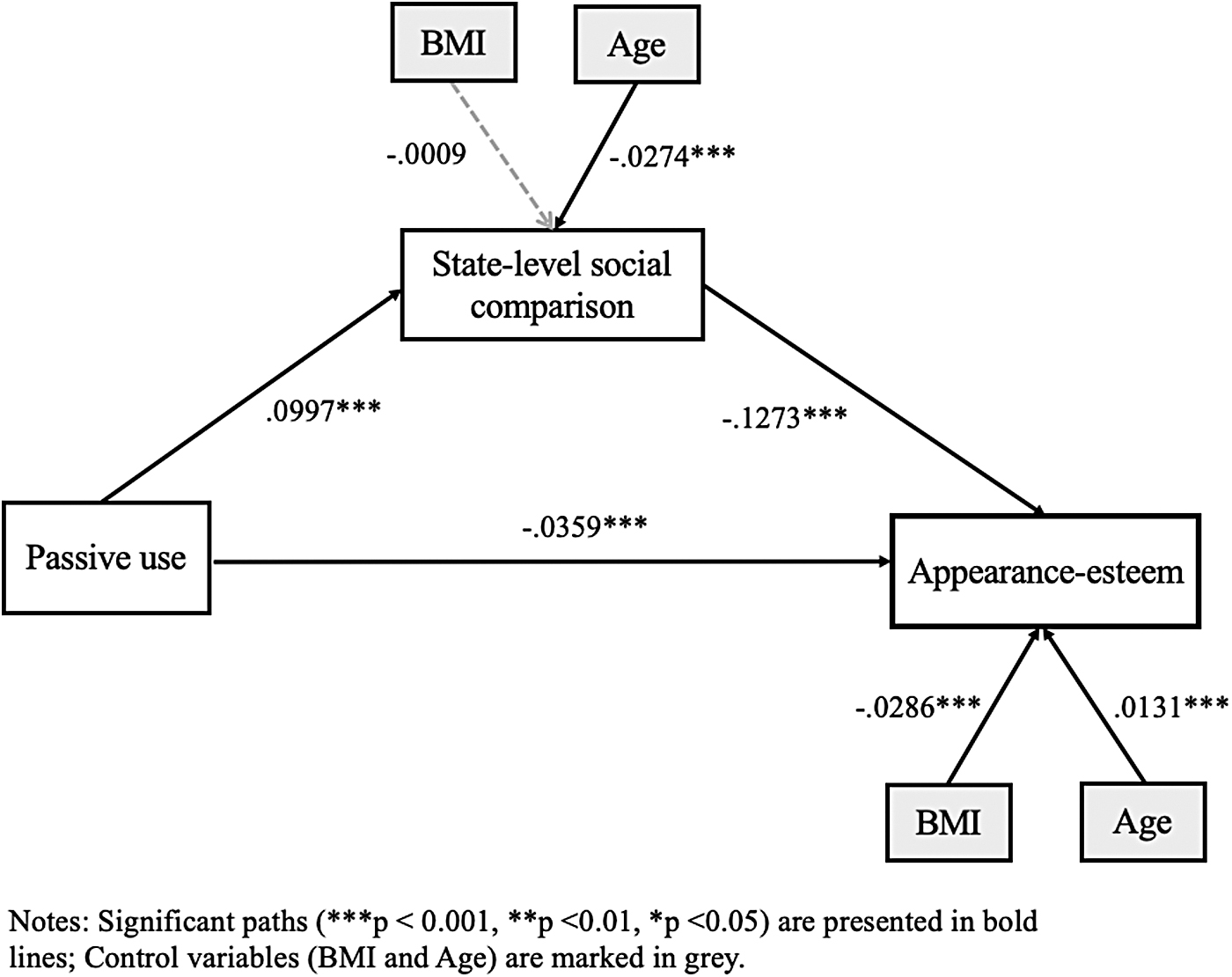
Path diagram illustrating the mediating effects of state-level social comparisons on the association between passive use and appearance-esteem.
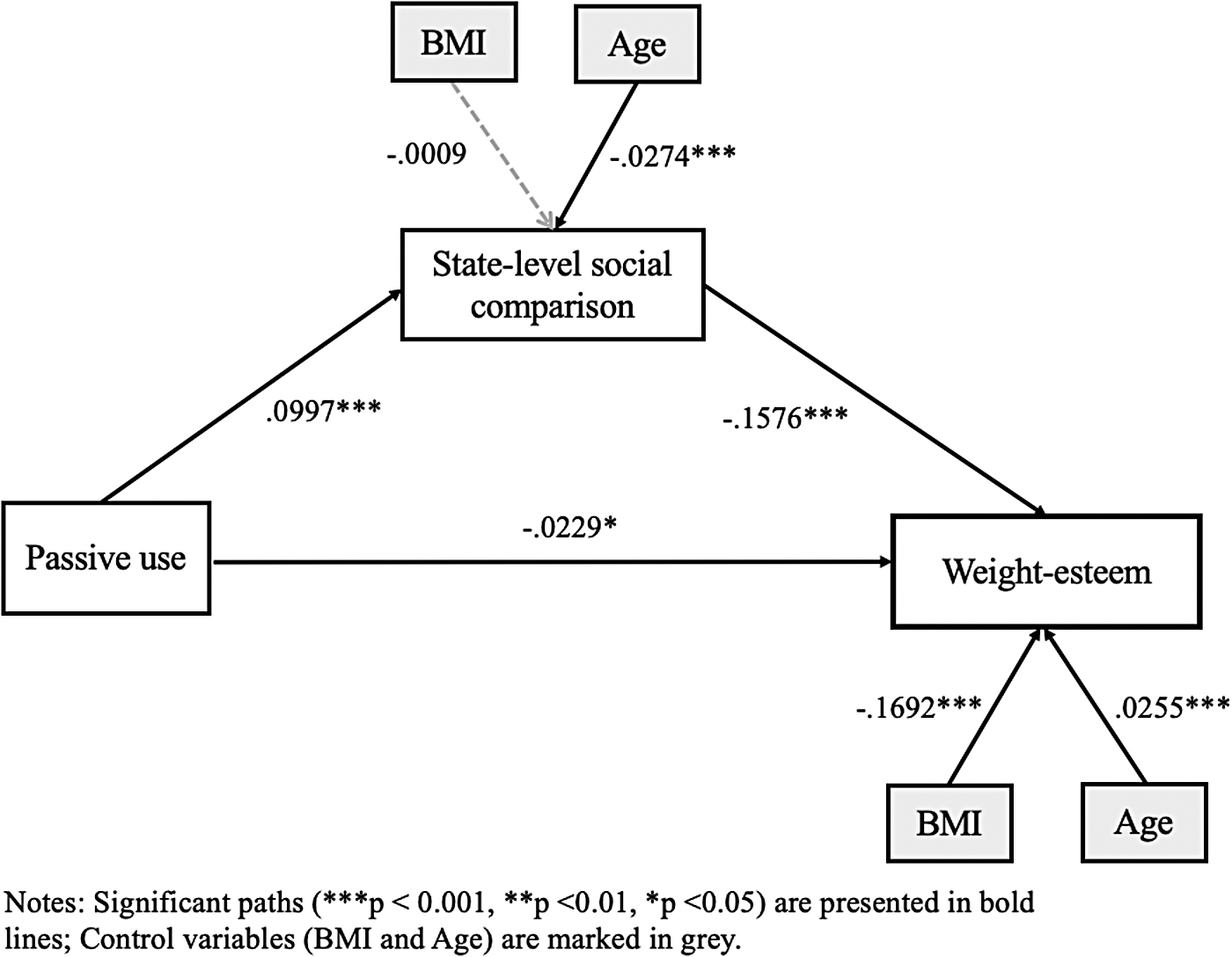
Path diagram illustrating the mediating effects of state-level social comparisons on the association between passive use and weight-esteem.
Total, Direct, and Indirect Effects
As presented in Figures 3 and 4, and Table 3, the total and direct effects of active TikTok use, on both appearance- and weight-esteem, were significant. The bootstrapping test revealed that the indirect effects of active use on appearance- and weight-esteem, mediated through state-level social comparisons, were also significant. Therefore, the mediating role of state-level social comparison between active TikTok use, and the two body-esteem outcomes, was confirmed. This answered RQ1.
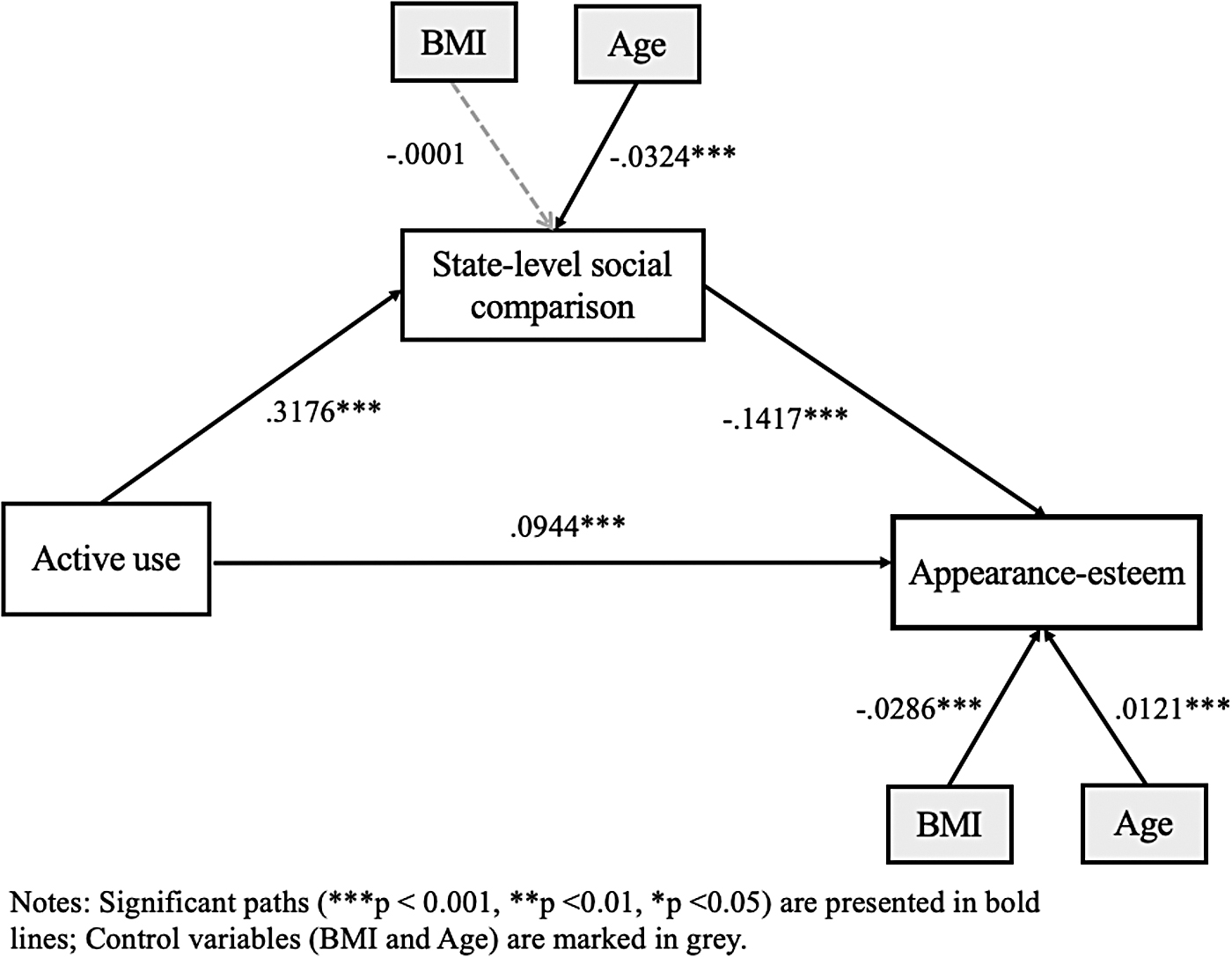
Path diagram illustrating the mediating effects of state-level social comparisons on the association between active use and appearance-esteem.
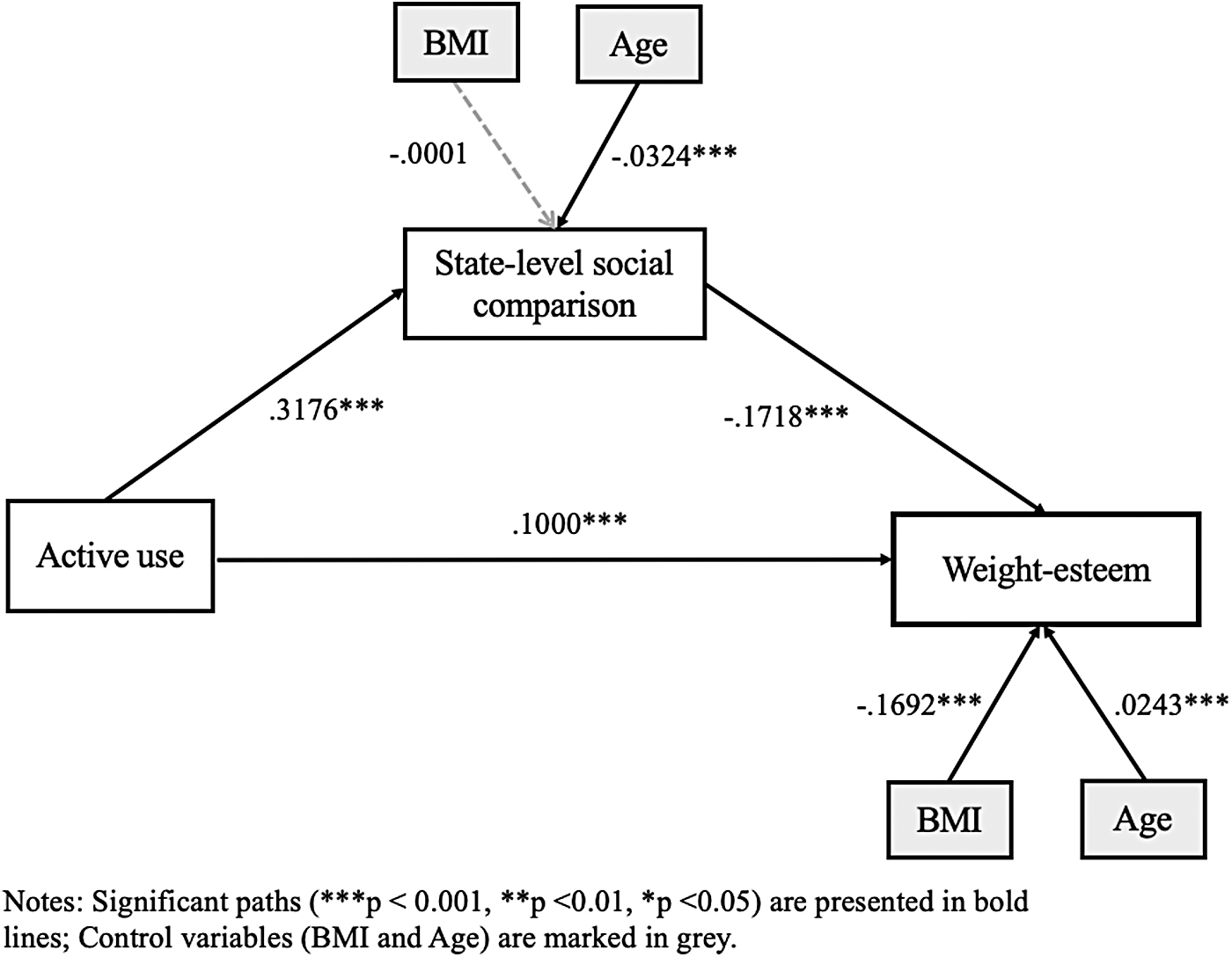
Path diagram illustrating the mediating effects of state-level social comparisons on the association between active use and weight-esteem.
Discussion
The current study found that the two ways of TikTok use have contradictory associations with female users' appearance-esteem and weight-esteem. This twofold distinction highlights the complex nature of social media use. In contrast to previous studies that report a positive association between social media use, and body dissatisfaction or negative mood, the current study found only passive TikTok use was negatively associated with female users' body-esteem. Active TikTok use was positively associated with body-esteem. These results underscore the importance of differentiating between various ways of social media use and their associations with body image, against the backdrop of wide-ranging social science research on people's adaptation to various social media platforms.
The findings on passive TikTok use and body-esteem were consistent with previous empirical studies on the associations between social media use, social comparison, and body image concerns.10,28,36 The current study extended prior research by focusing on the specific context of TikTok use, and providing empirical data on the negative association between passive TikTok use and body-esteem.
The positive association observed between active TikTok use and body-esteem was in line with studies reporting that the greater the extent of posting selfies, the higher the body satisfaction. 37 Uses and gratifications theory could shed light on this positive association. 38 Social media platforms provide users with all kinds of features and affordances, such as broadcasting, editability, and replicability.39,40 TikTok users can adapt by engaging in these various activities, such as editing, creating, and sharing content. Active TikTok use could result in social validation, and identity confirmation. Moreover, the option to edit enables users to selectively present the “best” version of themselves, and this perception boosts their appearance- and body-esteem.
The partial mediation achieved by state-level social comparison, in the association between the two ways of TikTok use and body-esteem, indicated the possibility of other mechanisms to similarly account for this association. For example, some studies have found internalization and self-objectification as alternative mechanisms for explaining the effects of media on body image. 2 Future studies should examine whether these alternative theoretical mechanisms work independently or collectively, to explain the association between various ways of social media use and body image.
Practically, considering that most of TikTok's popular videos are filtered or enhanced, exposure to such content may encourage social comparison, and create stronger self-discrepancy. Policies and regulations should be formulated, and media literacy programs should be developed, against the potential negative influences of passively using short-video apps on vulnerable populations, such as adolescents, and adults with body image concerns.
Limitations and future research
The current study exhibited certain limitations. First, the cross-sectional nature of the study design could not validate causal inferences. Although real TikTok users were surveyed, the causal relationships between different ways of TikTok use and users' body-esteem could not be established. Future studies could utilize longitudinal panel data, or adopt an experimental design, to test causal relationships between TikTok use and body image concerns.
Second, the scale for measuring participants' passive TikTok use, and appearance-esteem, exhibited relatively low reliability (both with a Cronbach's α of 0.68). 41 The limited number of items, and the reverse-phrased items, could have interfered with the participants' judgment. Future studies should adopt more sophisticated survey item designs, to increase the measurement's reliability and accuracy.
Third, the associations observed between the two ways of TikTok use and body-esteem were relatively small, although small effect sizes are consistent with previous studies. 42 Esteem is a comprehensive construct, and the participants' body-esteem may have been influenced by pre-existing perceptions shaped by cultural, societal, or psychological factors. Future studies should examine the other aforementioned factors.
Finally, the current study focused only on female TikTok users in China. Recent studies have suggested that male users also suffer from body image concerns. Furthermore, other factors—such as sexual identity, race, and culture—also affect individuals' body-esteem. Future studies should examine possible gender differences, and cultural similarities and differences in terms of social media use and body-esteem.
Footnotes
Author Disclosure Statement
Partial data collected from the same survey research were used in previous publication which focuses on the association between TikTok users' social media influencer viewing and their intentions to change appearance.
Funding Information
This research was supported by the Fundamental Research Funds for the Central Universities and the Research Funds of Renmin University of China, grant number 2022XWTD0006.