







Abstract
Although the concept of Fear of Missing Out (FoMO) is permeated with individual fears about the lack of social connection, the relationship between FoMO and feelings of loneliness has been the subject of limited research. The aim of this study was to examine bidirectional associations between FoMO and loneliness via a three-wave, random intercept, cross-lagged panel model. Drawing on a survey with 494 adult participants across three waves (45.3 percent participated in Time 2 and 38.7 percent participated at Time 3) during the COVID-19 pandemic, we found that participants with higher FoMO also reported heightened levels of loneliness across the three waves, at a between-person level. Furthermore, loneliness had significant negative cross-lagged associations with subsequent FoMO, at within-person level. The cross-lagged paths between FoMO and subsequent loneliness were not significant. Participants who usually spend more daily time using social media reported higher levels of FoMO. The findings of the study contribute to clarifying the temporal relationship between FoMO and loneliness, by suggesting that FoMO may not represent a risk factor for heightened feelings of loneliness, but it can be triggered by feelings of social isolation and lack of relationships.
Introduction
The construct of fear of missing out (FoMO) has received substantial research attention in the field of social media (SM) use. FoMO has been defined as “a pervasive apprehension that others might be having rewarding experiences from which one is absent,” 1 which has been linked to SM use, given it may fulfill individual desire to stay continually connected with friends.2,3 Specifically, the availability of continuously checking one's SM accounts and messaging apps on smartphones can trigger worries about the potentially rewarding experiences one is missing. 4 Meta-analytic evidence showed significant associations between FoMO and both Internet and SM use.5,6 However, its link with psychological distress variables remains a matter for debate. Prior research suggested that feeling excluded from one's social connections can lead to lower psychological wellbeing. 7 More recently, the relationship between FoMO, depression, and anxiety has been endorsed, 6 and it is suggested that negative mood, anxiety, or fear of negative evaluation could lead to experiences of FoMO.8–10
To date, the bidirectional link between FoMO and a sense of loneliness has received little research attention. Loneliness is the subjective feeling of social isolation owing to a perceived lack of closeness in interpersonal relationships 11 and there is evidence that it may negatively contribute to wellbeing.12,13 According to the self-determination theory (SDT), 14 effective self-regulation is based on the satisfaction of three basic psychological needs: autonomy, competence, and relatedness. Przybylski et al. 1 applied SDT to FoMO, proposing that FoMO is a negative emotional state resulting from unmet social relatedness needs. Prior research has shown that FoMO is permeated with individual fears about the lack of social connection, 1 and individuals with deficits in social relatedness may strongly engage with SM to alleviate feelings of loneliness.
However, the opposite direction is also possible, with FoMO resulting in an increased feeling of loneliness. For example, the individual's perception of missing out on online social relationships could heighten negative feelings, marked by a lack of social relatedness. More recently, Nowland et al. 15 proposed a model that posits a bidirectional and dynamic relationship between loneliness and social Internet use. Lonely people may report a preference for using the Internet for social interaction, but it is still unclear whether they may experience subsequent heightened levels of FoMO or, on the contrary, high FoMO might trigger heightened feelings of loneliness. There is some cross-sectional evidence that feelings of loneliness are associated with high levels of FoMO, particularly for individuals who report high SM engagement.16,17 However, drawing conclusions about the bidirectional relationship between FoMO and loneliness is challenging because, so far, cross-sectional studies have dominated literature.
Finally, this association could be worth examining during the COVID-19 pandemic, given that, since early 2020 18 many people have been experiencing social distancing or isolation. There is evidence that restrictive measures have drawbacks for individuals, by triggering social isolation and loneliness.19–22 Preliminary evidence showed that SM use was associated with increased feelings of loneliness during the pandemic and this relation was mediated by FoMO. 23 Despite this initial evidence, highlighting the role of loneliness in FoMO, what is currently lacking is an understanding of the extent to which loneliness may predict FoMO or vice versa.
The aim of this study was to examine bidirectional associations between FoMO and loneliness via a three-wave, random intercept, cross-lagged panel model (RI-CLPM). Specifically, this study contributes to the extant knowledge by exploring whether the relationship between FoMO and loneliness is driven by between-person (trait-like) or within-person (state-like) differences. 24 At a between-person level, we hypothesize an association between FoMO and loneliness, that is, individuals who report higher average FoMO would also report higher feelings of loneliness over time, consistently with previous research demonstrating the relationship between FoMO and poor psychological wellbeing. 6 At a within-person level, given the lack of prior longitudinal research on cross-lagged, bidirectional association between loneliness and FoMO, we proposed the following research question: are individuals who increase their loneliness above their own typical levels, more likely to report a subsequent increase in their own FoMO, and vice versa?
Materials and Methods
Participants and procedure
Data for this study come from a large-scale project on the relationship between SM use and psychological distress during the COVID-19 pandemic, which involved a general adult population sample from Italy. Respondents were recruited through online advertisements using e-mail lists and SM platforms (e.g., Facebook, Instagram) during the second wave of the pandemic. Data were collected in three different waves (October 2020, December 2020, February 2021). The recruitment window was open for one week at each time point. One week after the end of the recruitment window, an automated reminder to take the questionnaire was sent out twice to participants who had not yet answered.
At Time 1, the study included a total of 494 participants. Of this initial sample, 224 participants (45.3 percent) participated in Time 2 and 191 participants (38.7 percent) participated at Time 3. The study received IRB approval from the University of Palermo with written consent obtained from the survey participants. Participants were not compensated for completing the study. Participants' demographic and health-related data, as well as information about SM use, is given in Table 1.
Participants' Demographic, Psychosocial and Health-Related Data
T1, first time point (October 2020); T2, second time point (December 2020); T3, third time point (February 2021).
Respondents were allowed to select more than one option; SM daily use: responses being obtained using a Likert scale from 0 (0 hours) to 9 (≥9 hours).
SM, social media.
Measures
Participants were asked to report demographic data, SM data (i.e., Facebook, Instagram, Twitter and LinkedIn; responses being obtained using bimodal answer: yes/no), time spent daily using SM (responses being obtained using a scale from 0 to ≥9 hours), health-related data (i.e., personal and relatives COVID-19 infection) as well as measures of FoMO and loneliness.
FoMO was measured using the Fear of Missing Out Scale (FoMOs).1,25 This scale includes 10 items, rated on a 5-point Likert scale ranging from 1 (Not at all true of me) to 5 (Extremely true of me). Higher scores corresponded to a higher FoMO. In this study, the FoMOs showed good internal consistency (Cronbach's α: T1 = 0.816, T2 = 0.840, T3 = 0.839).
Loneliness was measured using the 20-item University of California at Los Angeles Loneliness Scale—version 3. 26 This scale includes 20 items, rated on a 4-point Likert scale ranging from 1 (Never) to 4 (Always). Higher scores corresponded to higher loneliness. In this study, this scale showed excellent internal consistency (Cronbach's α: T1 = 0.915, T2 = 0.925, T3 = 0.922).
Plan of data analysis
Data were screened for missing values; univariate distributions (i.e., skewness and kurtosis) were also examined. The internal consistency of the scales (Cronbach's α) and descriptive statistics were computed. Longitudinal bidirectional relationships between FoMO and loneliness were evaluated using the RI-CLPM, 27 which differentiates between- and within-person dynamics (Fig. 1). Autoregressive and cross-lagged paths were constrained to be equal across time. Age, gender, and time spent daily using SM were added in the model as covariates. The overall goodness-of-model fit was assessed using the χ 2 test statistics (χ 2 /df ratios <3 indicate reasonable fitting models), the comparative fit index (CFI; values >0.95 indicate a good fit 28 ), and the root-mean-square error of approximation (RMSEA; values <0.08 indicate a good fit 29 ). Missing data were handled using the full information maximum likelihood method, which has been shown to perform well in reducing bias in longitudinal studies even with high rates of missing data. 30 Data analyses were conducted using SPSS v. 22 and Mplus v. 7.0.
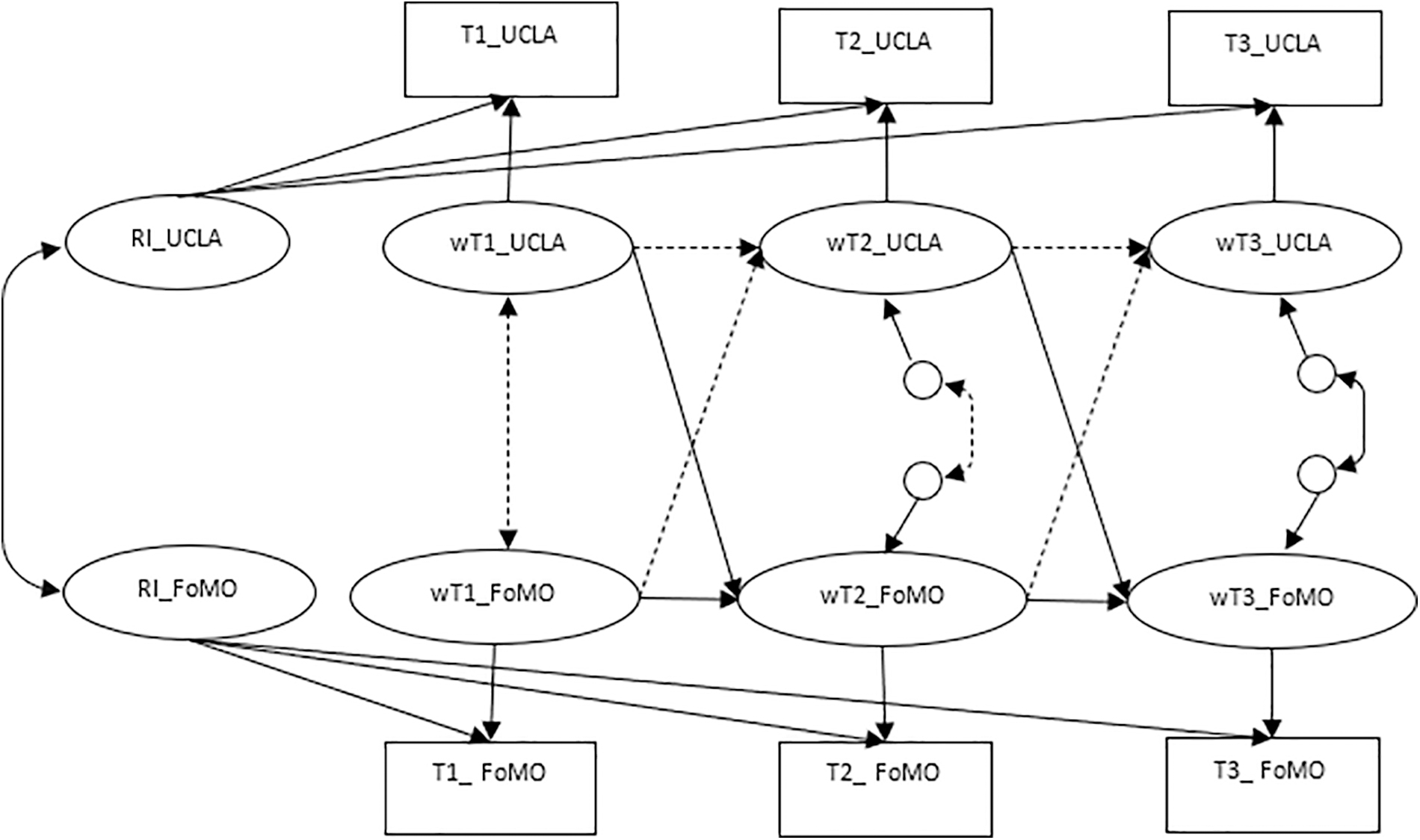
RI-CLPM for FoMO and loneliness across the three waves. Observed variables are represented by squares; latent variables at both the between- and the within-level are represented by ovals; RI (for FoMO and loneliness), which indicate the between-person variance; dashed lines, no significant paths. Age, gender, and daily time spent on social media have been inserted in the model as control variables, but they are not reported in the figure to improve clarity. FoMO, Fear of Missing Out; RI, random intercepts; RI-CLPM, random intercept, cross-lagged panel model.
Results
Preliminary analyses
No significant differences were found in demographics (i.e., age, gender, and marital status), or SM use, FoMO, and loneliness at T0 among participants with complete data in all waves and those with missing data. Significant differences were only found for participants' educational level and time spent daily using SM (M ± SD = 2.86 ± 1.72 and 2.47 ± 1.42 for participants with and without missing data; respectively; t = 2.659, p < 0.01). Little's Missing Completely at Random test 31 was significant, χ 2 (24) = 37.345, p = 0.040. All variables had a normal distribution, following the cutoff scores suggested by Hair at al. 32 and Byrne 33 (|Sk| < 3 and |Ku| < 7).
Test of hypotheses
The RI-CLPM (Fig. 1) showed good fit values: χ 2 = 2.354, df = 5, χ 2 /df = 0.471, RMSEA = 0.000, CFI = 1.000, 90 percent RMSEA = 0.000–0.040. Table 2 provides standardized coefficients and other model estimates. At the between-person level, a significant positive relationship between the random intercepts of FoMO and loneliness was found, indicating that participants who reported higher levels of FoMO also reported more loneliness across the three waves. Moreover, the results also showed a positive residual correlation at T3 between FoMO and loneliness. At the within-person level, significant cross-lagged, negative associations were found between changes in loneliness and subsequent changes in FoMO. Therefore, if state-like feelings of loneliness were lower than usual, then, the following time, the FoMO was higher than usual for the individual, and vice versa.
RI-CLPM Estimates Linking Fear of Missing Out and Loneliness with Covariates
T1, first time point (October, 2020); T2, second time point (December, 2020); T3, third time point (February, 2021); time SM, time spent daily using social media (0 to ≥9 hours); gender, coded as 0 for males and 1 for females.
FoMO, Fear of Missing Out; RI, random intercepts;
Moreover, there were significant autocorrelations for FoMO, whereas the autoregressive paths for loneliness were small and not significant. Regarding the covariates, younger participants showed higher levels of FoMO (at each time point) and loneliness (at T1), and participants who spent more daily time using SM showed higher FoMO (at each time point).
Finally, given the significant relationship between daily time using SM and FoMO (Table 2) and to enrich our understanding of the relationship between FoMO, loneliness, and SM use, we cross-sectionally tested the moderating effect of FoMO (or loneliness) on the relationship between loneliness (or FoMO) and daily time using SM. Results showed significant moderating effects (Supplementary Materials). Interaction effect showed that higher FoMO was associated with higher SM daily use only for individuals with lower feelings of loneliness (Supplementary Fig. S1).
Discussion
This study analyzed the relationship between FoMO and feelings of loneliness with a three-wave cross-lagged panel. With regard to the first hypothesis, at a between-person level, we found that individuals who reported more FoMO also experienced greater loneliness across time. Furthermore, at a within-person level we found a temporal association between loneliness at one time and FoMo at the subsequent time. However, the cross-lagged paths between FoMO and loneliness were all small and not significant. Taken together, these findings may suggest a temporal association between loneliness and FoMO, but no longitudinal link between FoMO and loneliness. In this study, the RI-CLPM attempted to disentangle the within-person process from stable, between-person differences, which are likely to be present in the data. 24
The findings revealed that when state-like, individual loneliness at one time was lower than his/her typical level, the FoMO at the subsequent time was higher than usual for the individual. Prior research suggested a role of loneliness in predicting FoMO.16,17 According to the SDT, 11 FoMO may arise from a shortage in psychological need satisfaction, especially a deficit in social relatedness. Our within-person analyses add a nuanced view of the relationship between loneliness and FoMO, suggesting that when individuals experience a greater than usual sense of social connection (i.e., diminished feeling of loneliness) they may experience subsequent, higher than usual fears of social disconnection, with higher FoMO.
It could be speculated that in the context of the COVID-19 outbreak, with concerns about a “loneliness pandemic,” 19 individuals experienced higher unmet needs of social relatedness, which may have triggered greater levels of FoMO as a strategy to stay connected to others. According to the bidirectional model on dynamic relationships between social Internet use and loneliness, 15 our finding suggests that people who have experienced loneliness for a while during the pandemic can use the Internet in a way that fosters their existing relationships, by heightening their level of FoMO.
The current findings did not confirm the detrimental effect of FoMO on subsequent loneliness. Although previous research has suggested that FoMO and problematic Internet use may lead to withdrawal from social relationships by fostering loneliness,1,34 the current results did not support this temporal path. It is worth noting that previous research evidencing an association between FoMO (or problematic Internet use) and loneliness16,35 mainly relied on cross-sectional data while the cause–effect relationship has remained elusive. The current findings suggest that FoMO may not represent a risk factor for heightened loneliness, but FoMO may be triggered by reduced unpleasant feelings regarding lack of relationships.
We might speculate that when individuals experience diminished loneliness, they may report a higher sense of relatedness that can trigger FoMO. It is worth noting that time spent on SM use was associated with FoMO across time but not with loneliness, and this finding seems to be in line with previous evidence regarding the association between FoMO and high Internet use, especially during the pandemic. 5 Previous studies showed that the association between SM use and loneliness during the pandemic may vary depending on how individuals use media. 36 Future research is necessary to examine what types of SM use were associated with FoMO during the pandemic (i.e., information seeking or social connection) and their link with loneliness. 37
Limitations to this study should be noted, particularly regarding the self-report nature of data. Second, recruitment occurred within a community context using a nonrepresentative sample and no information about racial and ethnic identification has been collected. Thus, our ability to draw firm conclusions and generalize the findings to the general population is limited. Moreover, our sample comprised a large percentage of female participants and further replication is needed with data derived from samples with a balanced gender ratio. It is also worth noting that the impact of other unobserved variables on both loneliness and FoMO cannot be excluded. For example, the level of social isolation owing to the pandemic might be a variable worth investigating.
Although the national lockdown in Italy ended on the May 4, 2020, the Italian government activated area-specific differential approaches for COVID-19 prevention after the spread of the second wave of the pandemic in October 2020. Thus, in this study we were unable to examine the role of participants' adherence to restriction measures, because they differed between regions and the assessment spanned a period in which these rules changed. Further research is needed to examine the impact of the level of social restrictions (i.e., lockdown vs. mild restrictions) on feelings of loneliness and SM use during the pandemic. Finally, further research needs to be repeated across longer time intervals during the pandemic.
In summary, this study provides initial evidence on the cross-lagged effects between loneliness and subsequent FoMO. Based upon these results, future research on the negative consequences of SM use needs to focus on the potential link between individual worries about the fears of social exclusion online and unreciprocated relatedness needs.
Ethics
The study was conducted in accordance with the ethical standards of the Italian Psychological Association (AIP), as well as the Declaration of Helsinki, and approved by the Ethics Committee of the University of Palermo (Ethic Committee approval code: 37/2021). Informed consent was obtained from all individual participants to be included in the study.
Data Availability Statement
The dataset generated for this study is available on request from the corresponding author.
Footnotes
Acknowledgment
The authors thank the participants who agreed to participate in this study.
Authors' Contributions
All authors contributed to the study conception and design. Material preparation and data collection were performed by G.L.C. and R.C.B. Analyses were performed by L.S. The first draft of the article was written by G.L.C. and L.S.; R.C.B. and S.R. commented on previous versions of the article. All authors read and approved the final version of the article.
Author Disclosure Statement
The authors declare no conflict of interest.
Funding Information
No funding was received for conducting this study.

References
Supplementary Material
Please find the following supplemental material available below.
For Open Access articles published under a Creative Commons License, all supplemental material carries the same license as the article it is associated with.
For non-Open Access articles published, all supplemental material carries a non-exclusive license, and permission requests for re-use of supplemental material or any part of supplemental material shall be sent directly to the copyright owner as specified in the copyright notice associated with the article.
