







Abstract
People are fundamentally social creatures, seeking connectedness driven by a need to belong. Belonging is a subjective feeling that helps us recognize our connection to people, social groups, culture, places, and experiences. In turn, belongingness can support mental well-being through positive interpersonal interactions and encouragement in both face-to-face and online environments. Advancements in technologies and social media platforms have created spaces for people to connect virtually; however, little is known about users’ online prosocial behaviors. Hence, this scoping review aimed to identify (a) how online prosocial behavior is defined; (b) explore the types of online prosocial behavior people are engaging in; and (c) explore what motivates people to engage in online prosocial behavior. Utilizing the Joanna Briggs Institute’s nine-step framework methodology, a review of the Scopus and PubMed databases was undertaken. From 755 retrieved articles, 43 were included. Various online prosocial behavioral definitions were identified, related to an individual’s attitudes, values, and beliefs, underpinned by the motives driving behavioral intent and action. Two categories of online prosocial behavior were identified: (1) intrinsic with two subcategories: (1.1) altruism and (1.2) reciprocity; and (2) extrinsic with one subcategory of (2.1) social connectedness. Two categories of motivators of online prosocial behavior were identified: (1) intrinsic with subcategories of (1.1) altruism, (1.2) empathy, (1.3) self-efficacy, (1.4) reciprocity, and (1.5) safety and trust; and (2) extrinsic with subcategories of (2.1) ease of use/practicality, (2.2) reputation, (2.3) personal gain, and (2.4) social connectedness.
Background
Individuals have a psychological drive to establish and maintain social connections and create a safe environment that promotes physical and emotional well-being. This innate drive is critical to human thriving.1,2 In contemporary society, our environments now exist within the physical and virtual worlds, with rapid technological advancements highlighting a growing connection between these two worlds. 3 Previous research into our virtual environments has focused on negative online behaviors (e.g., passive scrolling—browsing but not actively engaging with content; exposure to idealized body images) due to the impact this can have on well-being.4,5 For example, upward online social comparisons (i.e., comparing one’s sporting ability to a professional athlete) and passive scrolling are associated with negative emotional states (such as stress and anxiety), feeling that life lacks meaning, and body image dissatisfaction.4,5 While these findings highlight the complex and multifaceted nature of social media on well-being, the studies also acknowledge the potential for positive benefits for social connectedness when used actively. Therefore, it is important to recognize that each person’s perception is supported by their own personal experience and not all online interactions are negative or have a negative effect.
In more recent times, individuals have increasingly turned to social media platforms to establish and maintain connections, overcoming the constraints of physical proximity. This connection is possible by creating personal social networking profiles through platforms such as Facebook.3,6–9 Just as food and water are important for physical survival, humans require social connectedness to psychologically prosper.2,10 Feeling socially connected with others supports positive mental health states 11 and increases happiness, which is important for higher levels of life satisfaction. 12
However, individuals need to be motivated to socially connect with others. In accordance, Baumeister and Leary 2 asserted the need to belong is a fundamental human motivation underpinning our engagement to prosocially connect with others and adhere to social norms. This is because belongingness encourages prosocial behaviors through positive peer influences and community engagement, which can reduce antisocial behaviors. 13 Belonging has also been found to increase displays of empathy, altruism, cooperation, and social norm adherence, highlighting the connection between belonging and prosocial behavior. 14 Online environments are not exempt from our need to belong. In fact, online prosocial interactions allow for connection with like-minded people, building group networks, sharing online resources, and displaying empathy to others within one’s online community, which supports our need to belong and facilitates individual flourishing.13–15
Prosocial behaviors
Prosocial behaviors are often used to describe a collection of behaviors (e.g., cooperation, heroism, and trustworthiness), which meet societal expectations of appropriate reciprocal communication between people or groups.16,17 More specifically, prosocial behaviors may benefit others through volunteering, donating money, or giving up a seat to someone on public transport and can involve different cognitive or socialization processes, depending on culture, interpersonal factors, and context. 18 Anlı 19 defined offline prosocial behaviors as innate behaviors, such as empathy, compassion, care for others, cooperation, and sharing. Examples of online prosocial behaviors include shared information through links or posts, contributing to and supporting (i.e., sharing) online campaigns or donations, offering technical assistance, and providing online emotional comfort.7,20–23
Although many examples of prosocial behaviors exist online, the empirical nature of this construct is complex. Defining theoretical paradigms, exploring operational definitions for prosocial behaviors, and understanding behavioral motivators for these constructs is often challenging and to date, scholars have been more likely to investigate different parts of prosociality (e.g., volunteerism, altruism, charity donations). 18 This challenge is further amplified in digital environments, where anonymity, accessibility, and varying social cues shape behavior differently from offline settings. In support, Penner et al. 24 noted the complexity of prosocial behaviors is influenced by situational factors (e.g., everyday acts of kindness to heroic acts), personal beliefs and interpersonal relationships, and social norms. While theories such as social exchange theory and the theory of planned behavior have been applied to online prosociality, they were not developed for an online context. Our review highlights the need for an integrated theoretical model that accounts for intrinsic and extrinsic motivations and the unique features of digital interactions. These considerations emphasize why a single definition that encapsulates the broad scope of online prosocial behaviors remains elusive. Almost 20 years from Penner et al.’s 24 seminal work, a clear definition of online prosocial behaviors and a holistic understanding of online prosocial motivators still evade the social research community.
Motivation of Prosocial Behavior
The advancements of digital technologies add to the issue. We have seen an abundance of online media platforms developed (e.g., social media sites and professional networking sites). Social media sites, such as Facebook, are primarily used for entertainment and to share personal experiences with social connections, encouraging a casual communication style. 4 While professional networking sites, such as LinkedIn, focus on career development, sharing professional achievements and professional networking, they require a more formal communication style. 4 Each unique context fosters differing social norms, impacting the way people display online prosocial behaviors. Thus, clarifying the motivations behind people’s online prosocial behaviors is fundamental to our understanding of what drives these behavioral choices.
A notable example is Ryan and Deci’s 25 description of motivation through two drives: intrinsic, which is an internalized drive seeking satisfaction, and extrinsic, which is an external drive for seeking reward or avoiding punishment. These drives are underpinned by three basic psychological needs: autonomy (feeling of some control over one’s actions), competence (feeling effective and capable), and relatedness (feeling connected with others), each significantly influences a person’s behavioral choice. 25 Cognitive and socialization processes, such as self-regulation, interpersonal skills, decision making, culture, and perceived control and competence,2,12,25 highlight the diversity in people’s online behavior.
Current definitions explaining prosocial behaviors commonly include voluntary actions undertaken to help or benefit others but were defined within face-to-face situations.19,24 The context and environment in which online prosocial behaviors are examined differ in social norms, social cues, and social expectation and are influenced by diverse motivational intent.24,26,27 Thus far, research has shown that face-to-face prosocial behavior benefits our psychological health and well-being through a decrease in unpleasant emotions and an increase in empathy toward others. 15 Despite this, little progress has been made in our understanding of online prosocial behaviors and the motivations behind individuals engaging in these behaviors within their online environments.
Given the multifaceted nature of online prosocial behaviors and the proliferation of socially based digital environments, further research is warranted for us to understand the contextual factors and the cognitive processes required for online prosocial behaviors. This scoping review aims to systematically map the current literature focusing on (a) how online prosocial behaviors are defined; (b) what types of online prosocial behaviors people are engaging in; and (c) what motivates people to engage in online prosocial behaviors. By examining current literature, we seek to provide a comprehensive summary that identifies definitions of online prosocial behaviors and informs future research directions, fostering a holistic view of online prosociality.
Method
We followed the Joanna Briggs Institute (JBI) methodology for scoping reviews, 28 inclusive of the PRISMA-ScR principles 29 as recommended by Peters et al., 28 with the process including a nine-step framework. The nine-step framework was conducted within JBI SUMARI 30 and included (a) defining and aligning objective/s and questions; (b) developing and aligning the inclusion criteria; (c) describing the planned approach; (d) searching for the evidence; (e) selecting the evidence; (f) extracting the evidence; (g) analyzing the evidence; (h) presenting the results; and (i) summarizing the evidence, making conclusions, and noting implications of the findings. 28
Search strategy
The search terms were developed, and suitable databases identified in consultation with a research librarian and refined through piloting. The final terms included vocabulary exploring prosocial behavior, motivation, and online environments: “Altruism,” “prosocial behavior,” “prosociality,” “internet,” “online,” “web,” “social media,” “social network,” “Facebook,” “Meta,” “Snap Chat,” “Instagram,” “WhatsApp,” “zoom,” “Microsoft teams,” “ms teams,” “Twitter,” “Discord,” “motivation,” “choice,” and “decision.” Terms were searched across the abstract, title, and keyword fields. A full list of the search strings, including variations of key terms, can be found in Supplementary Appendix. Databases searched were PubMed (MEDLINE, PubMed Central) and Scopus. Inclusion criteria required peer-reviewed, empirical studies written in English, with a primary focus on online prosocial behaviors and/or their motivators. Studies examining only offline prosocial behavior or lacking empirical data were excluded. Searches were simultaneously conducted by two authors on March 28, 2023, with one author exporting the results into a shared Mendeley (reference management software) library and exporting them into JBI SUMARI, a scoping review tool 30 used for screening against the inclusion and exclusion criteria (see Table 1).
Inclusion and Exclusion Criteria
Results
Study selection
A total of 755 articles were identified during the searching for evidence stage. The first author utilized the duplicate identification tool in Mendeley and removed 198 duplicates, resulting in 557 empirical articles included for screening against the inclusion and exclusion criteria. The screening process consisted of two phases: title and abstract screening and then full-text screening. Two authors screened titles and abstracts, 30 with any disagreements resolved through discussion. Justifications for study exclusions were recorded within the title and abstract screening section. 30 Of the remaining studies, 127 empirical articles proceeded to full-text screening, with one author providing the article hyperlinks to the full-text articles. 30 Of the full-text review, 44 empirical studies were included for further review. Justification of study exclusion was recorded within the full-text screening section. 30 Following the full-text review, a quality appraisal was undertaken, with one article excluded due to inclusion criteria mismatch. The PRISMA diagram (see Fig. 1) outlines the selection process.29,31
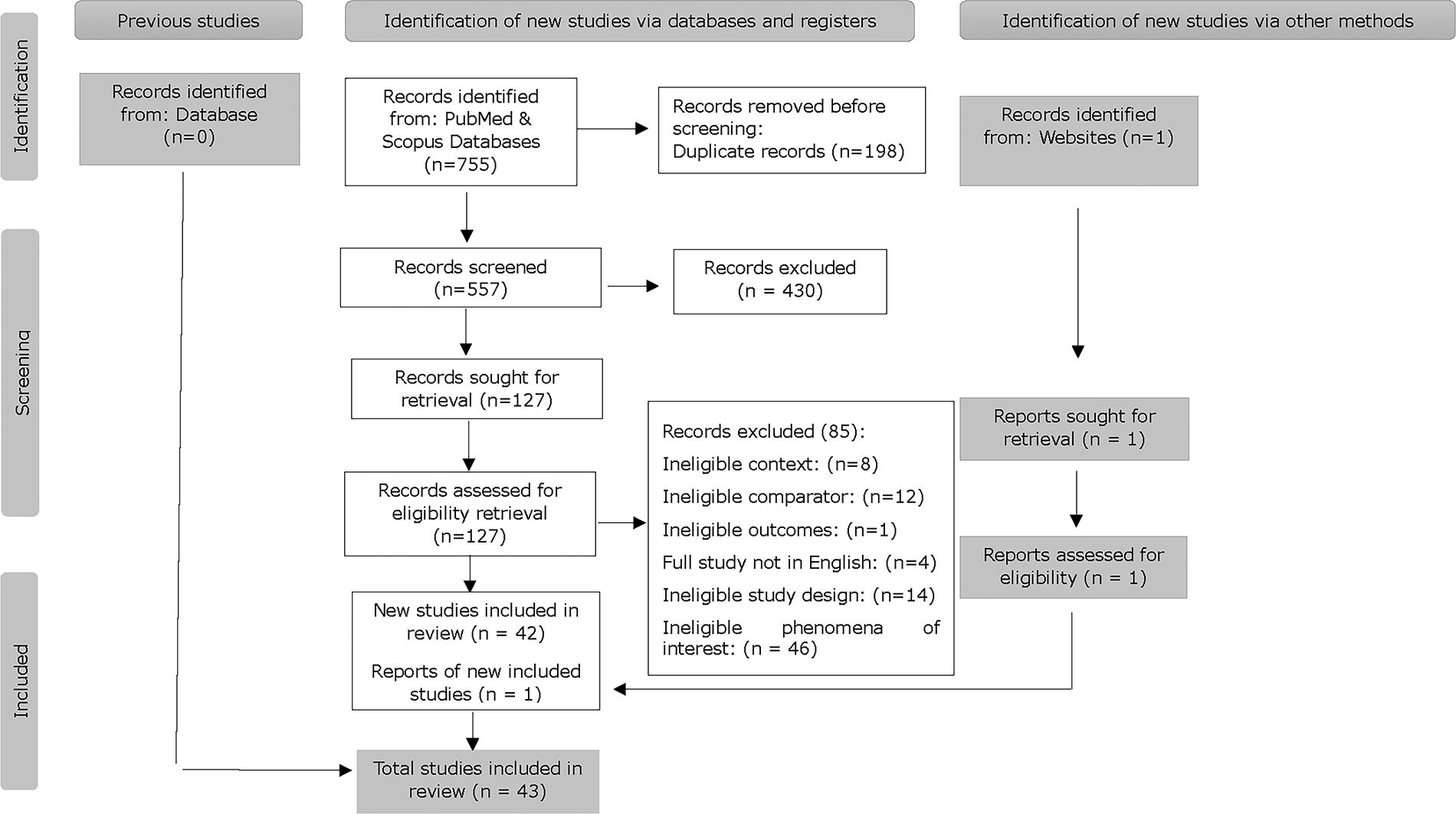
PRISMA-ScR flowchart for article inclusion based on initial search.
The data extraction process and coding were conducted and recorded. 30 One reviewer extracted relevant information from the selected studies, which aligned with the research objectives—(a) online prosocial behavior or (b) motivators for online prosocial behavior. Relevant information included study characteristics (e.g., country, year/time frame of data collection, setting/context/culture), participants, methods for data collection/analysis, and description of main results. Specifically, findings related to (a) definitions, (b) actions, or (c) motivations were extracted. Extracted findings were then categorized based on their similarities and supported by evidence from the original sources. This evidence was coded as either unequivocal (directly quoted from the text) or credible (logically inferred from the text, but not a direct quote). 30
The analyzed results are discussed under the three objectives of this review. Objectives (b) and (c) are further categorized as intrinsic or extrinsic, with specific subcategories detailed within the aggregated data.
Defining online prosocial behaviors
Existing research notes similarities between offline (e.g., thanking your taxi driver) and online prosocial behaviors (e.g., rating your Uber driver). Thus, to enhance our understanding of how online prosocial behaviors are defined, we investigated definitions used within the current literature. Fourteen unique definitions were identified across the 43 reviewed studies.7,9,20,21,32–70 One identified article provided a specific definition within an online context, conceptualizing online prosocial behaviors as “behaviors performed online to benefit others and can include information sharing and emotional support within a person’s social network.” 67 The remaining definitions were adapted from face-to-face definitions, with the assumption that online prosocial behaviors are representative of the same qualities (e.g., helpful, empathetic, cooperative) regardless of the differing environment.35,38,45–47,49,53,55–57,60,62,63,66
These findings, alongside the conceptualizations for each identified definition, are outlined in Table 2. Building on these conceptualizations, we examine the current literature on the types of online prosocial behaviors people engage in and the motivations that drive them. The type of prosocial behavior a person engages in is influenced by their underlying motivation, as motivation and behavior are inherently linked.2,53,57,67 The following section first explores the types of online prosocial behaviors observed, followed by an analysis of the motivations that shape these actions.
Definitions of Online Prosocial Behaviors Adopted by Researchers
Types of online prosocial behaviors
We analyzed studies of online prosocial behaviors in contexts such as social media platforms and virtual gaming environments. Two categories were identified within the literature: (1) intrinsic and (2) extrinsic. Intrinsic behaviors refer to actions undertaken for their inherent value, rather than for external rewards. 25 These behaviors are distinct from motivations, which describe the psychological drivers influencing why a person engages in a behavior. To illustrate this, we identified 20 studies7,9,21,32,34,35,37,38,42–46,48,50,58,60–62,69 examining intrinsic displays of online prosocial behaviors across two subcategories: (1.1) altruistic—directly or indirectly benefitting others without expectation of reward or praise and (1.2) reciprocity—exchange of knowledge and/or resources with others for mutual benefit. Altruistic behaviors were the most notable behaviors investigated within the reviewed studies. Sixteen studies7,9,21,32,34,35,37,38,43,45,46,48,50,58,60,61 provided examples of altruistic behaviors, which highlighted two themes: right thing to do, such as volunteering time or feeling morally obliged to share online reviews, and support or protect others, through posting information, combating online rumors, or providing online emotional support. Five studies7,42,44,62,69 provided examples of reciprocity across two themes: mutual benefit, such as helping other players during online game play, and paying it forward, such as mutual sharing/posting of health information displayed during the COVID-19 pandemic for the benefit of the wider community. These behaviors acknowledge the influence our internal belief systems have on our online prosocial behaviors.
Unlike the internal satisfaction gained from intrinsic behaviors, extrinsic behaviors are engaged in for the purpose of seeking a reward or benefit or avoiding punishment. 25 One subcategory was identified: (2.1) social connectedness—feeling of belonging and connectedness to others. Seven studies9,37,45,53,62,67,70 provided examples of social connectedness across two themes: socialize with others and developing belongingness, for instance, connecting with like-minded people with a similar perception to our own. These behaviors further acknowledge our innate human need of belongingness. Table 3 presents the findings. It outlines both categories, provides subcategory examples, and offers conceptualized explanations of associated prosocial behaviors identified within the literature. Exploring online prosocial behaviors enhances our understanding of people’s digital conduct. However, as previously stated, behaviors are intricately linked to a person’s motivations. Therefore, the following section examines the underlying motivations intertwined with the prosocial behaviors people display.
Categories of Online Prosocial Behaviors
Motivators of online prosocial behaviors
Behavioral motivators are relevant to both individual and group-based prosocial behaviors. These are complex psychological mechanisms required for one to act prosocially and display cooperative behavior toward others. 18 The development of online prosocial skills encompasses both personal and environmental considerations, which lay the foundation that drives one’s intention to act. 71 Scoping the literature exploring motivators within the digital environment, two online prosocial behavioral categories were identified: (1) intrinsic and (2) extrinsic motivators.
Intrinsic motivators are defined as the internal drives guiding a person’s behavior for the interest and enjoyment of an activity, rather than the outcome of the activity. 25 We identified 36 studies7,9,20,32–34,36,37,39–49,51–59,61–64,66–68,70 across five subcategories: (1.1) altruistic—to benefit others, (1.2) empathetic—to care for others, (1.3) self-efficacy—belief in oneself, (1.4) reciprocity—for mutual benefit, and (1.5) safety and trust. Ten studies20,39,41,44,51,53,54,61,64,66 identified two themes of altruistic motivators. The first theme was sharing to support or protect others, such as engaging in online activism by using one’s online presence to challenge unfair treatment or poor service on platforms such as Google Review. The second theme was acting in line with internal values and beliefs, such as donating to organizations such as Amnesty International to promote equity in human rights. Eight studies33,37,42,51,57–59,66 identified two themes of empathetic motivators. First, empathy can encourage online knowledge sharing—for example, sharing stories of genocide victims to evoke emotional responses and raise awareness for charitable causes. Second, empathy and related emotional states (e.g., sympathy) can prompt helping behaviors, such as reporting cyberbullying to Facebook group administrators to address antisocial behavior and remove harmful content.
Ten studies20,32,40,42,46,49,54,55,61,62 identified two self-efficacy themes. The first was being true to self—acting authentically and expressing one’s genuine identity within online communities. The second was confidence in one’s capability to share accurate information, such as medical practitioners feeling assured in posting reliable health advice in online health forums. Ten studies7,9,36,40,47,48,57,63,68,70 identified four themes related to safety and trust. These included (1) feeling safe to share online—contributing personal experiences without fear of judgment or backlash; (2) feeling supported within a respectful and trusted online environment; (3) developing trust to help others—sharing information or experiences confidently to encourage others to do the same; and (4) developing trust to seek help—feeling safe enough within the group or platform to ask for support or advice. The final intrinsic motivator, reciprocity, was identified in 10 studies7,34,43,45,47,48,52,56,58,67 and grouped into two themes. The first reflects how sharing thoughts, opinions, and information benefits both the individual and the community—for example, receiving positive feedback on posts encourages continued engagement. The second reflects the mutual nature of online support, where helping others also benefits the helper. This was particularly evident during the COVID-19 lockdowns, when sharing information online fostered a sense of connection. However, intrinsic motivators are not the only factors driving engagement in online prosocial behaviors.
Contrary to intrinsic motivators, extrinsic motivators are external factors that drive one’s engagement within an activity and are dependent on seeking or achieving an external reward or acknowledgment or avoiding punishment. 25 We identified 26 studies7,20,21,32,35–37,39,42,44,46–50,53,54,56–58,61–63,65,68,69 across four themes: (2.1) ease of use/practicality—easy to use online platform, (2.2) reputation—judgment of personal character, (2.3) personal gain—seeking reward, and (2.4) social connectedness—driven by sense of belonging. Seven studies7,48,50,53,57,58,62 identified ease of use/practicality motivators within one theme: engaging in easy-to-use online platforms serves a purpose to myself and others. For example, Facebook consumers find the platform easy to use and therefore are more likely to share thoughts and opinions. Eight studies35,42,47,48,54,56,58,69 identified reputation motivators grouped into two themes. First, sharing accurate information online builds a credible reputation—for example, physicians contributing reliable health information on medical forums. Second, helping others enhances one’s online standing, such as professionals sharing resources within their LinkedIn networks. Four studies39,44,46,49 identified personal gain as a motivator, also across two themes. The first involves gaining skills or experience through helping others online—for instance, volunteer translators enhancing their expertise to support future professional placements. The second concerns receiving rewards for sharing information, such as influencers gaining personal benefits for posting favorable product reviews. The final extrinsic motivator, social connectedness, was the most explored in the reviewed studies, identified in 12 studies20,21,32,36,37,46,56,61,63,65,68,69 across three themes. These included (1) sharing information to build social connections, such as engaging with local Facebook groups; (2) supporting others within socially connected networks, for example, parents exchanging advice in online parenting groups; and (3) helping others to maintain or strengthen friendships, such as using social media to stay connected with distant friends or family through shared photos, updates, and experiences. These motivators reflect the interplay between autonomy, competence, and relatedness, which underpin behavioral choices in digital environments. 25 Table 4 presents the findings, outlining the categories, subcategory examples, and conceptual explanations of prosocial motivators identified within the literature.
Motivators of Online Prosocial Behavior (n = 43)
Q&A, question and answer.
Discussion
Summary
Digital technologies have enriched the way individuals connect and maintain relationships with others, redefining the way we seek and offer help, volunteer our time and resources, and share information. Our drive to seek social connection and create a feeling of belonging is enhanced by our use of digital technologies and supported by online prosocial behaviors. In turn, breaking down the limitations of physical location for social connection and fostering our need to belong. The benefits of digital technologies (i.e., social media platforms) offer opportunities for prosocial engagement in a multitude of ways, such as supporting online charities and being able to see social media updates of the work these charities are providing (e.g., Amnesty International), gaining fast access to medical knowledge (e.g., medical forums), and seeking support in times of need (e.g., Beyond Blue’s chat service).7,9,37,48,67
In this scoping review, we examined the current literature to better understand how online prosocial behavior is currently defined, what types of online prosocial behaviors people are engaging in, and explored what motivates people to engage in these prosocial behaviors in cyberspace. As outlined in Table 2, the current literature offers various definitions to explain online prosocial behaviors; however, only one study 67 used a definition conceptualized for online prosocial behaviors. Other identified studies35,38,45–47,49,53,55–57,60,62,63,66 employed face-to-face prosocial behavior definitions on the assumption that the behavioral similarities are transferable. Most reviewed definitions agreed that prosocial behaviors involve helping others. While some similarities emerged (e.g., sharing opinions, following social norms), definitions typically focused on either intrinsic or extrinsic behaviors rather than integrating both. Notably, only one definition considered mutual benefit, despite reciprocity appearing in 32.5% of the studies.8,34,42–45,47,48,52,56,58,62,67,69 Existing definitions emphasized observable behaviors but overlooked underlying motivations, even though motivations and actions are inherently linked. Our review highlights the need for a definition that captures both dimensions.
As previously outlined, commonalities between face-to-face and online prosocial behaviors are evident.41,44 However, the context driving behavioral choice differs between online and offline settings. For example, being socially connected through social media versus meeting up with friends at a social gathering; gaining access to medical care through telehealth, rather than seeing a doctor in person; or sharing professional insights and knowledge through LinkedIn, rather than discussing professional opinions in a face-to-face workplace. These opportunities broaden connections with others and reduce time and location restraints. The digital environment can also offer anonymity in social discussion, sharing of opinions and reviews of businesses, which can support people’s engagement in social discussion and ability to provide opinions and feedback without fear of backlash. Hence, establishing a deeper understanding of online prosocial behaviors is required to ensure an accurate definition is conceptualized. Therefore, we propose the definition: Online prosocial behaviors encompass intrinsic and extrinsic attitudes, values, and beliefs, which drive one’s voluntary actions for the benefit of self and/or others (e.g., sharing information, seeking or offering support) within one’s online interactions.
Context matters, as actions taken by an individual, are not always reciprocal or for the direct benefit of others (e.g., providing direct assistance to an individual vs. supporting a broader cause) within cyberspace. Online donation sites are a primary example of how the digital environment can be leveraged. For instance, online charities that show contributors’ names encourage visibility and foster further support. This display of online prosocial behavior benefits the charitable cause through financial gain but also has the potential to create a snowball effect, motivating the donor’s friends to also donate. In turn, the donor themselves, through displayed online generosity, may vicariously receive an enhanced reputation within their online and offline communities. If the donor shares an online and offline social presence (e.g., physically and virtually connected), their online behavior may impact the perceptions of others within their offline environment. 55 While a person’s motivation may be altruistic, this example shows that the behavior itself may be more complex.
Our analysis revealed a blurring of the lines between online and offline prosocial behavior regarding intentions. 55 For instance, the rise of social media-driven societies and almost constant accessibility via smartphones has heightened people’s self-awareness of the distinction between their online and offline personas. This, in turn, appears to complicate the authentic presentation of self-concept through behavioral actions, highlighting a saliency between online and offline personas due to a perceived or actual audience. 55 As our online and offline worlds become more enmeshed, our contemporary definition of online prosocial behaviors offers a holistic framework for future research, enabling the exploration of various facets of prosociality. Furthermore, investigating how evolving identity formation influences social behaviors in digital and physical spaces would provide valuable insights for future studies. Drawn from the work of Ryan and Deci, 25 motivators of online prosocial behaviors operate in tandem with our offline prosocial behaviors. Our psychological needs influence our interpersonal communication within cyberspace. Collectively, researchers have identified various online prosocial behaviors: altruism, reciprocity, and social connectedness (see Table 3) and their motivators: altruistic, empathetic, self-efficacy, safety and trust, reciprocity, ease of use/practicality, reputation, personal gain, and social connectedness (see Table 4). However, individual studies only explore facets of online prosocial behavior. This fragmented approach continues to perpetuate our limited understanding of the holistic nature of online prosocial behaviors and their motivators.
While there is a plethora of research offering examples of face-to-face prosocial behavior, such as empathy and understanding toward others, within family or community, 15 increased social connectedness, relationship building and/or maintenance, and helping others,14,72 examples of online prosocial behaviors are only just emerging. A finding not discussed in existing literature is social justice as a motivator for helping others. An example of online social justice-based behavior is the sharing of information or reviews that provide a negative image of a business after a poor personal experience with a product or company; for example, Google reviews. 66 This appears to be an emerging consideration of online prosocial behaviors. While the intent of helping or benefiting others unpins the motivation behind such behavior, social justice holds intrinsic values drawn from personal beliefs. Further investigation of this concept is warranted to explore how social justice may be intrinsically or extrinsically connected to one’s behavioral intent and action.
Limitations
This scoping review is the first to systematically review definitions of online prosocial behaviors, holistically categorize examples of the types of online prosocial behaviors people are engaging in and consider the motivators that drive these online behavioral choices. Also, consideration of the similarities and differences between online and face-to-face prosocial behaviors is nuanced. The complex variations between social norms, social cues, and social expectations differ within digital environments, and the addition of multicultural connections and cultural differences adds further complexity to these behaviors.
This is a fast-changing research space, and future research might consider emerging languages not included in the current review, reflecting the evolving ways people conceptualize online prosocial behaviors. More specifically, we identified that differing social norms are introspective of prosocial behavioral responses within English articles. Our restriction of English language articles may mean there are cultural variations in the characteristics and motivators of online prosocial behaviors that we have yet to identify, and future research from non-Western countries would be valuable to address this.
Helping and protecting others motivates people to engage in sharing their negative experiences online to warn others. Future research might consider the impact of online civic engagement as a prosocial behavior, motivated by a person’s social justice beliefs. As an emerging field within contemporary research, a deeper understanding of the holistic nature of online prosocial behaviors will foster a culture of digital health.
Footnotes
Acknowledgment
This research was conducted in consultation with the Research Librarian.
Authors’ Contributions
M.N.: Conceptualization, methodology, validation, formal analysis, investigation, data curation, writing—original draft, writing—review and editing, and visualization. T.M.: Conceptualization, methodology, validation, writing—review and editing, supervision, and project administration. R.P.: Conceptualization, methodology, validation, writing—review and editing, and supervision. S.A.: Conceptualization, methodology, validation, formal analysis, investigation, data curation, writing—review and editing, and supervision. S.B.: Conceptualization, methodology, validation, writing—review and editing, and supervision.
Author Disclosure Statement
The authors have no conflicts of interest to disclose. This research was conducted with no financial interests in the results of the research.
Funding Information
No funding was provided for this research.

References
Supplementary Material
Please find the following supplemental material available below.
For Open Access articles published under a Creative Commons License, all supplemental material carries the same license as the article it is associated with.
For non-Open Access articles published, all supplemental material carries a non-exclusive license, and permission requests for re-use of supplemental material or any part of supplemental material shall be sent directly to the copyright owner as specified in the copyright notice associated with the article.
