







Abstract

A 54-year-old female complained of redness over the upper trunk confined to the blouse area for 5 days associated with itching. She gave the history of wearing a new red-colored blouse material 1 week back. On cutaneous examination, she had symmetrical erythema confined to the blouse area with clear demarcation with involvement of the axillary rim sparing the axillary vault and inframammary folds (Figs. 1 & 2). She was started on a short course of oral prednisolone, after which significant improvement was noticed. After 6 weeks, since the standard patch testing series was not available, the patch test was done with the patient’s own blouse material. The patient’s own blouse material was cut into 2 × 2 cm pieces and soaked in water for 10 minutes, and the patch testing using the wet clothing material in the Finn chamber was done over the back. After a 48-hour patch test, the reading showed a strong positive reaction (2+) as per the International Contact Dermatitis Research Group. The patient was diagnosed with textile contact dermatitis, possibly due to textile dyes or other components of clothing.
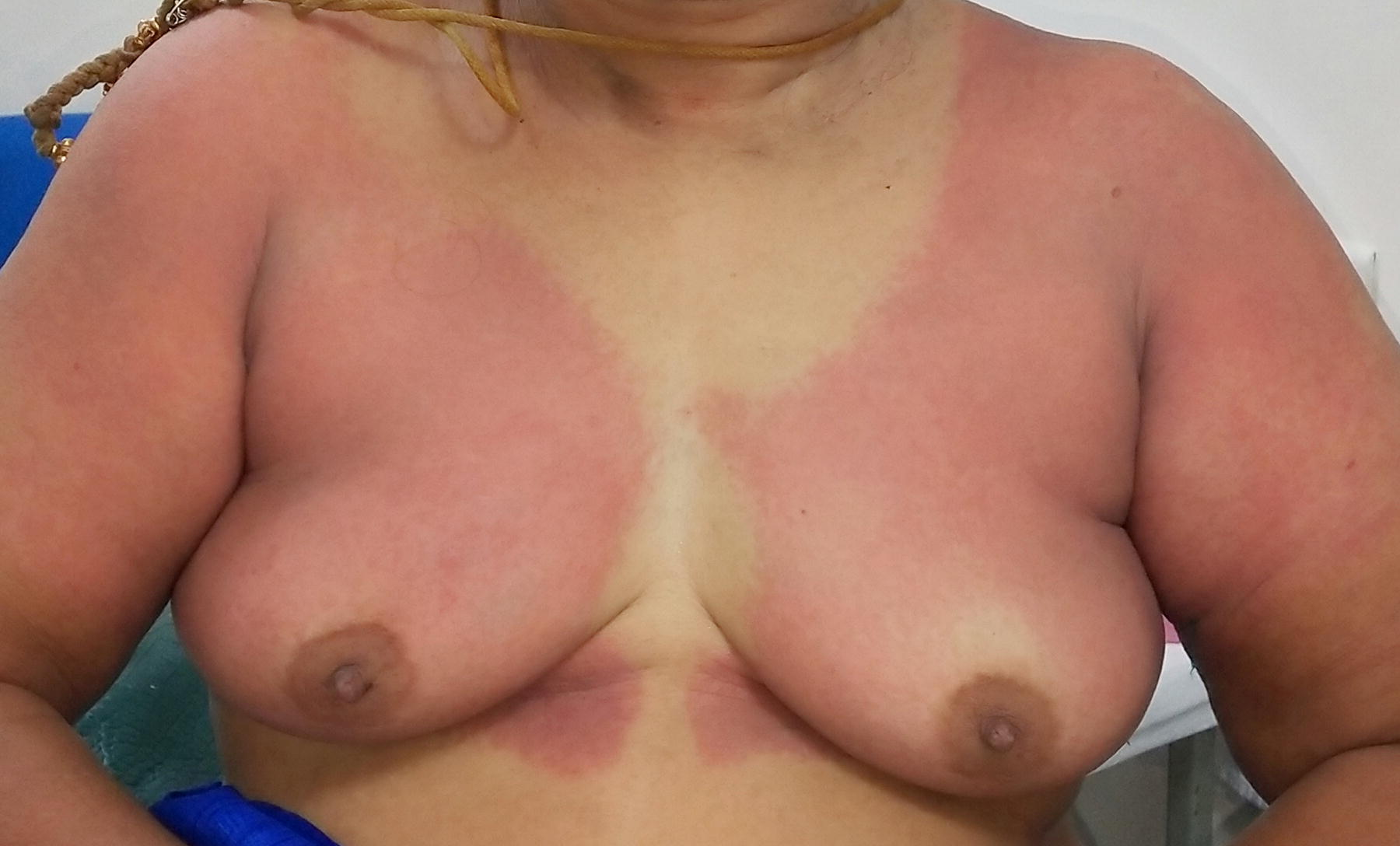
Well-demarcated symmetrical erythema present over the breast, inframammary area and arms with sparing of the inter-mammary region, confined to the blouse area.
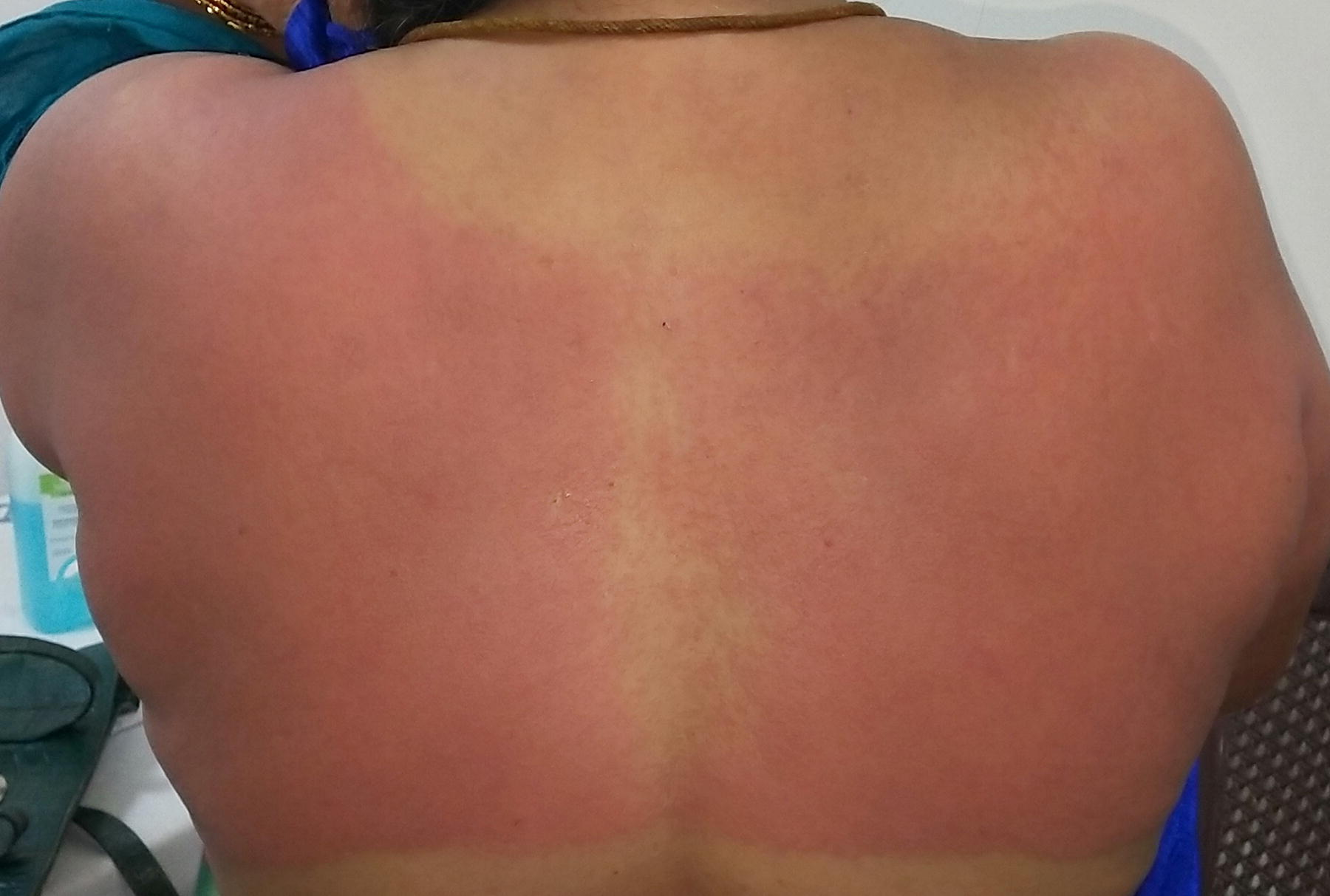
Well-demarcated symmetrical erythema confined to the blouse area over the upper back.
Textiles are made of fibers, such as wool, linen, cotton, silk, and polyamides. Metals or rubber components are added to give the textile a wanted characteristic. Textiles are colored or prepared with different substances to produce specific effects or give the garment a certain quality.
1
Textile contact dermatitis predominantly causes type-IV delayed hypersensitivity reactions and rarely type-I reactions. Disperse dyes (DDs) are used to color synthetic textile fibers. They are the most common contact sensitizers among textile dyes.
2
Textile contact dermatitis often looks like endogenous eczema, in which localization depends on intimate contact with the garment and is often seen in the skin fold. It is most commonly seen due to disperse azo dyes, but other substances present in clothes can occasionally also cause contact allergy, with the exception of the fibers themselves. Testing for textile dermatitis is recommended, which includes textile dye mix (TDX) like disperse blue 106 and 124, azo disperse dyes, arylamines, and halogenated dinitrobenzene compounds in clothing garments, formaldehyde resins, textile series, and own material “as is,” similar to our case, as well as with extracts made from it.3,4 If possible, performing a chemical investigation of the textiles that are positive on patch testing can prove the clinical relevance of positive tests and find new emerging allergens. The patient with a positive reaction in the patch test and dermatitis, which are explained by textile dermatitis, should be given accurate information on which garments may be safe to use. Reading textile labels may be necessary, but they does not contain information about the exact chemicals used. Knowing the fiber composition and care instructions can help in guessing the possible allergens. Any garments manufactured from 100% cotton, wool, silk, and linen are usually good alternatives in such scenarios; blends are not included among automatic safe alternative garment types. If polyester garments are worn, light-colored clothes are safer than dark-colored ones.

References
Supplementary Material
Please find the following supplemental material available below.
For Open Access articles published under a Creative Commons License, all supplemental material carries the same license as the article it is associated with.
For non-Open Access articles published, all supplemental material carries a non-exclusive license, and permission requests for re-use of supplemental material or any part of supplemental material shall be sent directly to the copyright owner as specified in the copyright notice associated with the article.
