







Abstract
Several studies have revealed that miR-205 plays important roles in the development of gynecological cancers and thus may serve as a potential prognostic biomarker, but the current conclusions remain controversial. Therefore, the goal of this study was to explore the prognostic significance and functional mechanisms of miR-205 based on a meta-analysis and bioinformatics investigation. A total of 14 published studies containing 5835 patients were enrolled by searching the PubMed, EMBASE, and Cochrane library databases, 13 (14 datasets) and 5 (6 datasets) of which evaluated the correlations between the expression level of miR-205 and overall survival (OS) or disease-free survival (DFS)/disease-specific survival (DSS)/progression-free survival (PFS)/distant metastasis-free survival (DMFS), respectively. Furthermore, the use of online Kaplan–Meier plotter database analysis supplemented another seven results for OS. Then, a meta-analysis using these 21 and 6 datasets was performed. As a result, the overall analysis failed to demonstrate any significant associations between miR-205 expression and OS (p = 0.267) or DSS/DFS/DMFS/PFS (p = 0.457), but the subgroup analysis suggested that elevated miR-205 predicted a reduced OS for breast cancer (BC) patients (hazard ratio [HR] = 0.84, 95% confidence interval [CI] = 0.72–0.98; p = 0.022), while higher miR-205 was associated with a poor DSS for endometrial cancer (EC) patients (HR = 2.19, 95% CI = 1.45–3.32; p < 0.001). Function prediction analysis indicated that miR-205 may be involved in BC by negatively influencing hub genes, SMARCA5 and SIAH1, whereas miR-205 may participate in EC by negatively modulating BMPR1B because of the presence of interactions of miR-205 with them at 3′-untranslated region and their opposite prognosis outcomes with miR-205. In conclusion, our findings suggest miR-205 may be a promising prognostic biomarker and therapeutic target for BC and EC patients.
Introduction
Gynecological cancer is the leading cause of cancer-related death in females with breast cancer (BC), cervical cancer (CC), ovarian cancer (OC), and endometrial cancer (EC) as the predominated types (Gultekin et al., 2017). Among them, BC ranked as the first female malignant tumor with an estimated 40,920 deaths in the United States in 2018, followed by OC (14,070), EC (11,350), and CC (4170) (Siegel et al., 2018). Therefore, it is of importance to identify efficient biomarkers to predict the prognostic outcomes as earlier as possible to schedule individualized treatments.
microRNAs (miRNAs) are endogenous, 20–25 nucleotide in length, noncoding RNAs that negatively regulate the expression of target protein-coding mRNAs through binding to complementary sequences in the 3′-untranslated region (UTR) and then inducing translational repression or mRNA degradation (Moreno-Moya et al., 2014). Increasing evidence has suggested that dysregulation of miRNAs contributes to the development and progression of gynecological malignancies (Srivastava et al., 2017), and thus they may serve as potential prognostic biomarkers for gynecological tumors. This hypothesis had been proved by previous studies. For example, miR-205, one of the most frequently studied miRNAs, had been found to be downregulated in BC cells and tumor tissues (Guan et al., 2016; Huo et al., 2016). Overexpression of miR-205 significantly inhibited proliferation, invasion, but increased the apoptosis rates of BC cells (Zhang and Fan, 2015; Guan et al., 2016). Therefore, high expressed miR-205 may serve as a predictor for excellent prognosis, which was confirmed by Kaplan–Meier (KM) survival analysis (Madden et al., 2013; Huo et al., 2016) and multivariate Cox regression model (Markou et al., 2014). However, the study of Radojicic et al. (2011) showed the expression of miR-205 was not significantly associated with disease-free survival (DFS) and overall survival (OS) of patients with BC. Furthermore, completely opposite results were also observed for OC, EC, and CC, with some authors showing that the patients with lower levels of miR-205 tended to have worse survival (Wilczynski et al., 2016; Pang and Yue, 2017; Chu et al., 2018), while the others revealing that the overexpression of miR-205 was significantly correlated with poor patient survival (Karaayvaz et al., 2012; Ma et al., 2014, 2016; Li et al., 2017a). These findings suggest the prognostic value of miR-205 for gynecological cancer remains inconclusive, which may be attributed to small sample size.
The goal of this study was to conduct a comprehensive meta-analysis to evaluate the prognostic efficiency of miR-205 for patients with gynecological cancer based on data obtained from all the relevant published literatures and additional bioinformatic analysis using the KM plotter database. Moreover, the underlying molecular mechanisms of miR-205 were also investigated by predicting its target genes and performing function enrichment analysis for them based on a serial of bioinformatic procedures.
Materials and Methods
Literature search strategy
A systematic literature search was carried out in PubMed, EMBASE, and Cochrane Library databases to screen articles that explored the relationship between miR-205 expression and the prognosis of patients with cancer (updated to April 2019). The search items included: (“microRNA-205” OR “microrna-205” OR “miRNA-205” OR “miR-205”) AND (“cancer” OR “carcinoma” OR “neoplasm” OR “tumor”) AND (“survival” OR “prognosis” OR “recurrence”). In addition, the references and reviews cited in the included studies were also manually searched for potentially eligible publications. This meta-analysis was performed in accordance with the Guidelines of the Preferred Reporting Items for Systematic Review and Meta-analysis (Shamseer et al., 2015).
Literature selection criteria
Eligible studies were selected if they met the following inclusion criteria: (1) evaluated the correlation between miR-205 expression and the prognosis of patients with BC, OC, CC, and EC; (2) at least one prognosis outcome was reported, such as OS, DFS, disease-specific survival (DSS), progression-free survival (PFS), or distant metastasis-free survival (DMFS); (3) hazard ratio (HR) with 95% confidence interval (CI) for survival indicators could be directly obtained from the original studies or indirectly estimated from KM curves through a digitizing software, Engauge Digitizer (version 4.1); and (4) published in English language. The exclusion criteria were as follows: (1) duplicated literatures; (2) conference abstracts, reviews, comments, or animal studies; and (3) lacking of sufficient data to calculate HRs and 95% CIs. Two authors independently reviewed full articles for eligibility, and any disagreements were resolved by discussion to reach a consensus.
Data extraction from published literature or newly analyzed results
To further expand the sample size and complement more data for meta-analysis, the online KM plotter database was used to analyze the relationship between miR-205 expression and OS of BC, OC, CC, and EC patients based on the auto select best cutoff. miRpower (breast cancer)*, which included data from The Molecular Taxonomy of Breast Cancer International Consortium (METABRIC), The Cancer Genome Atlas (TCGA), and The Gene Expression Omnibus (GEO; accession number, GSE40267 and GSE19783) databases, was utilized for BC analysis, while miRpower for pan-cancer tool was applied for OC, CC, and EC analysis which only consisted of data from TCGA. p-Value <0.05 was considered to be statistically significant.
Two investigators independently extracted the following data from the published articles and our miRpower analysis results: first author name, publication year, country, sample size, cancer type (BC, OC, CC, or EC), number of patients, OS/DSS/DFS/DMFS/PFS, sample source (tissue or blood), detection method (quantitative real-time polymerase chain reaction [qRT-PCR] or other), cutoff value, and statistical estimation for HR and 95% CI (univariate or multivariate). HRs and 95% CIs in all studies were computed using the lower expression as the control group. If the multivariate analysis result did not indicate the reference, HR and 95% CI were also obtained or recalculated according to the findings of univariate analysis or KM curves.
The Newcastle–Ottawa Scale (NOS) scale was used to assess the quality of enrolled literatures (Stang, 2010), which is scored according to three parameters: selection (0–4 points), comparability (0–2 points), and exposure (0–3 points). Studies with NOS scores ≥7 were considered as methodologically high quality.
Statistical meta-analysis
Statistical meta-analysis was performed by using the STATA software (version 13.0; STATA Corporation, College Station, TX). The heterogeneity among the studies was evaluated by Chi-square-based Q-test and I 2 statistic tests (Higgins et al., 2003). For heterogeneous studies (Q test p-value <0.10 and I 2 > 50%), a random-effects model was used to calculate the summary of HR and 95% CI of each study; otherwise, a fixed-effects model was utilized. The statistical significance of the pooled HR and 95% CI was determined using the Z-test, with p < 0.05 defined as significance. HR >1 indicated a poor prognosis for patients with high miR-205; while HR <1 suggested a protective effect for prognosis of highly expressed miR-205. Subgroup analysis was also performed by separating the included studies based on their different characteristics to identify the potential sources of heterogeneity. Publication bias was assessed with Egger's linear regression test. Sensitivity analysis was performed using the leave-one-out approach.
miR-205 and its target interaction
The target genes of miR-205 were predicted using the miRwalk database (version 2.0), which contained 12 algorithms (DIANA-microTv4.0, DIANA-microT-CDS, miRanda-rel2010, mirBridge, miRDB4.0, miRmap, miRNAMap, PicTar2, PITA, RNA22v2, RNAhybrid2.1, and Targetscan6.2) (Dweep and Gretz, 2015). Only the target genes predicted by nine algorithms were considered to be believable.
The specific and significant target genes of miR-205 for gynecological cancer were further screened on the basis of three criteria: (1) as a hub gene of all the target genes, which was assessed by constructing a protein–protein interaction (PPI) network in Cytoscape software (version 3.6.1) (Kohl et al., 2011). The Search Tool for the Retrieval of Interacting Genes/Proteins (STRING, version 10.0) database (Szklarczyk et al., 2015) was used to retrieve the interaction pairs between the target genes of miRNAs, with a combined score >0.4 set as the threshold value. The hub genes in the PPI network were screened based on calculation of their topological features (including degree centrality [DC], betweenness centrality [BC], and closeness centrality [CC]; the higher value indicated the importance of the corresponding genes) using CytoNCA plugin (Tang et al., 2015) and identification of function-related subnetworks (enriched genes were crucial) using the Molecular Complex Detection plugin (MCODE, version:1.4.2) (Bader and Hogue, 2003); (2) their functions were significantly predicted (p < 0.05) in the Database for Annotation, Visualization, and Integrated Discovery (DAVID) (version 6.8) gene ontology (GO) biological process terms and Kyoto Encyclopedia of Genes and Genome (KEGG) pathways enrichment analyses (Huang et al., 2009); and (3) their prognostic potential was opposite to miR-205 by searching the KM plotter database (BC, using KM breast cancer of microarray dataset; and EC using KM pan-cancer of RNA-seq dataset).
Results
Literature search and study characteristics
According to the inclusion and exclusion criteria (Fig. 1), a total of 14 studies containing 5835 patients were finally enrolled (Table 1). Among these 14 studies, 6 studies investigated the prognostic value of miR-205 for patients with BC, 3 for OC, 3 for EC, and 2 for CC. Prognostic outcome was OS in 13 studies, DFS in 2 studies, DSS, PFS, and DMFS in 1 study, respectively. Since the definitions among DSS/DFS/DMFS/PFS were not standardized in the majority of our analysis, we considered them equivalent and classified them as a group. Furthermore, the study of Quesne et al. (2012) did not provide the HR of OS for the whole BC patients, but gave for lobular and ductal type, respectively; the study of Ma et al. (2016) investigated the HR of DSS for EC patients who underwent curettage or hysterectomy, respectively. Thus, 14 and 6 datasets were collected from the published literatures for meta-analysis of OS and DSS/DFS/DMFS/PFS, respectively (Table 1). According to NOS scale, all publications were considered to be of high quality (Table 2).
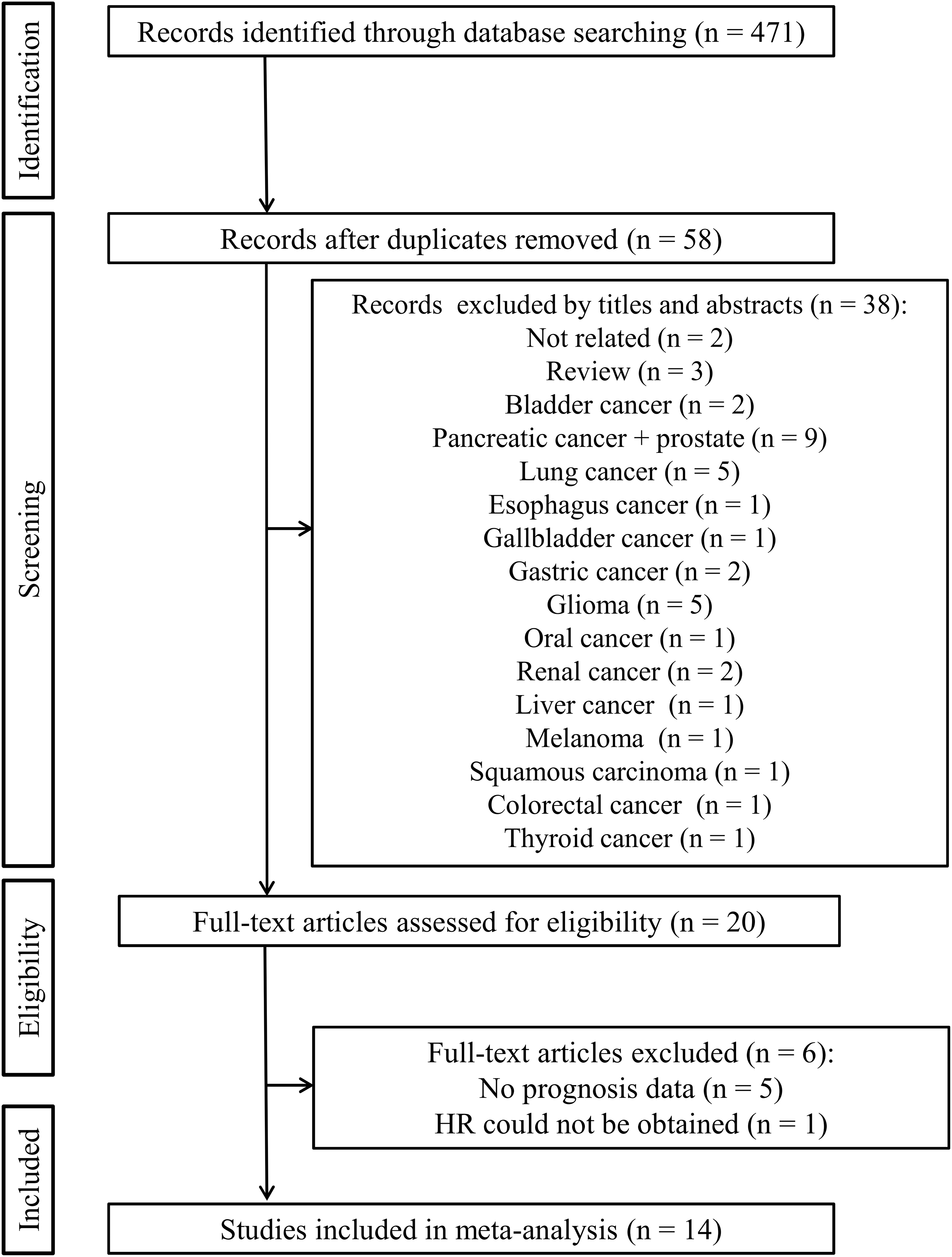
Flow diagram of the study selection process.
Characteristics of the Studies Included in the Analysis
OS, overall survival; DSS, disease-specific survival; DMFS, distant metastasis-free survival; DFS, disease-free survival; PFS, progression-free survival; qRT-PCR, quantitative real-time polymerase chain reaction; HR, hazard ratio; KM, Kaplan–Meier curves; Mul, Multivariate Cox regression; BC, breast cancer; EC, endometrial cancer; OC, ovarian cancer; CC, cervical cancer; FC, fold change; The Cancer Genome Atlas; METABRIC, The Molecular Taxonomy of Breast Cancer International Consortium.
Newcastle–Ottawa Scale Scores of Published Studies
Scoring: Each star is equal to 1 point.
Survival analysis of miR-205 through the KM plotter
In considering the fact that there were three published studies to investigate the prognostic value of miR-205 with large sample size using the high-throughput analysis data (sequencing in TCGA and microarray in GEO) (Madden et al., 2013; Kim et al., 2017; Chu et al., 2018) and the sample size of OC, EC, and CC in published articles was small, we aimed additional survival outcome data as a supplement through using the KM plotter database. The results showed that high expression of miR-205 was significantly associated with better OS in BC METABRIC data (HR = 0.75, 95% CI = 0.61–0.91; p = 0.0035; Fig. 2A), in BC GSE40267 data (HR = 0.58, 95% CI = 0.34–0.99; p = 0.043; Fig. 2C), and in OC TCGA data (HR = 0.71, 95% CI = 0.564–0.91; p = 0.0052; Fig. 2F); while the result was opposite in CC TCGA data (HR = 1.75, 95% CI = 1.09–2.8; p = 0.019; Fig. 2E); No significant difference was observed for BC TCGA (HR = 0.72, 95% CI = 0.51–1.02; p = 0.061; Fig. 2B) and GSE19783 (HR = 2.14, 95% CI = 0.8–5.72; p = 0.12; Fig. 2D) data, as well as EC TCGA data (HR = 0.67, 95% CI = 0.44–1.02; p = 0.059; Fig. 2G).
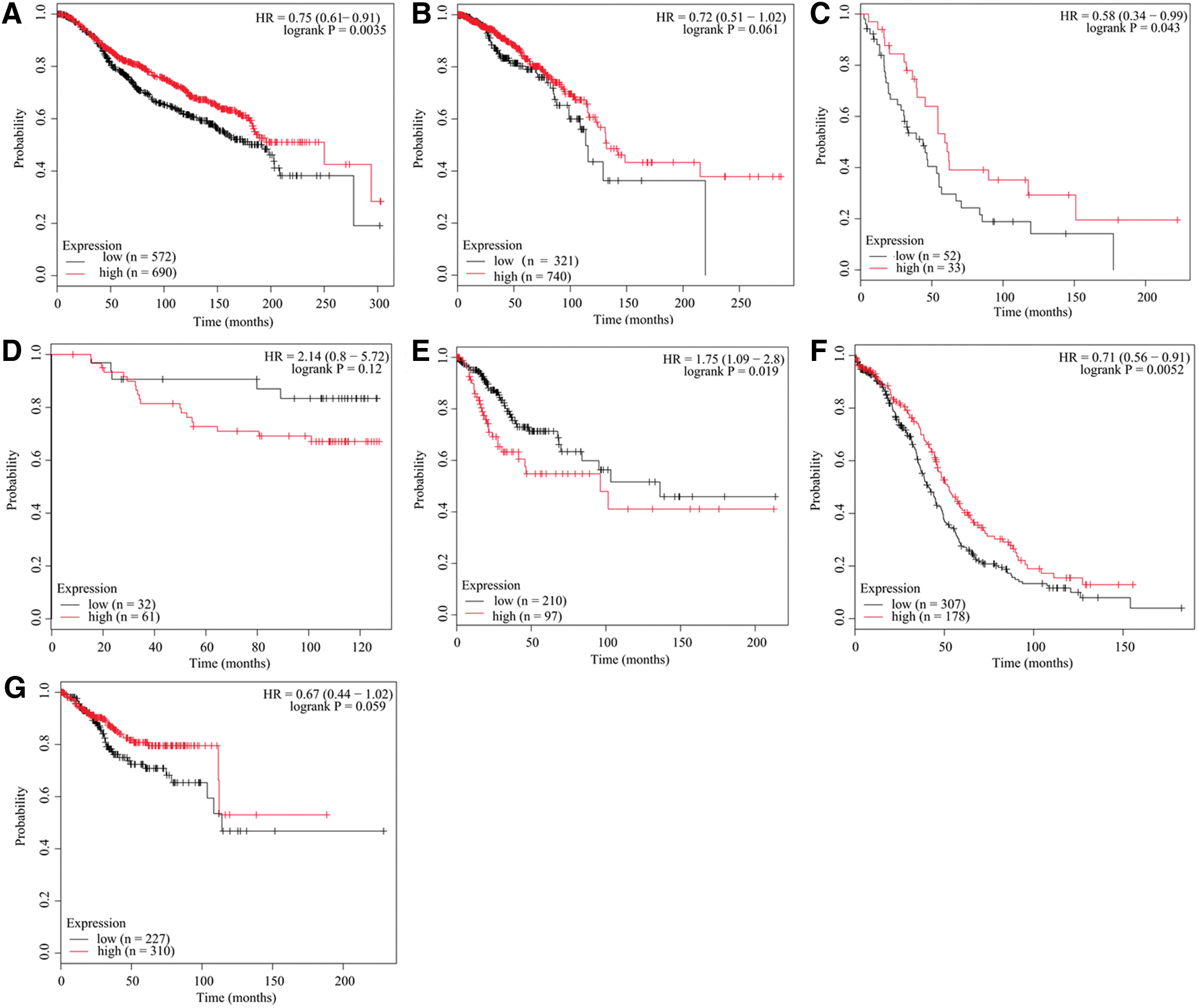
Kaplan–Meier survival curves for cancer patients stratified by miR-205 expression levels. This was performed using the online Kaplan–Meier plotter database.
Meta-analysis of the relationship between miR-205 expression and prognosis
Twenty-one datasets (including 14 published and 7 our analyses) were used to investigate the prognostic significance of miR-205 for OS in all gynecological cancer patients. A significant heterogeneity was present among the studies (I 2 = 70.6%, p < 0.001) and the pooled HR was estimated by using a random-effects model. Our results failed to demonstrate any significant association between miR-205 expression and OS (HR = 0.91, 95% CI: 0.77–1.07; p = 0.267; Table 3; Fig. 3).
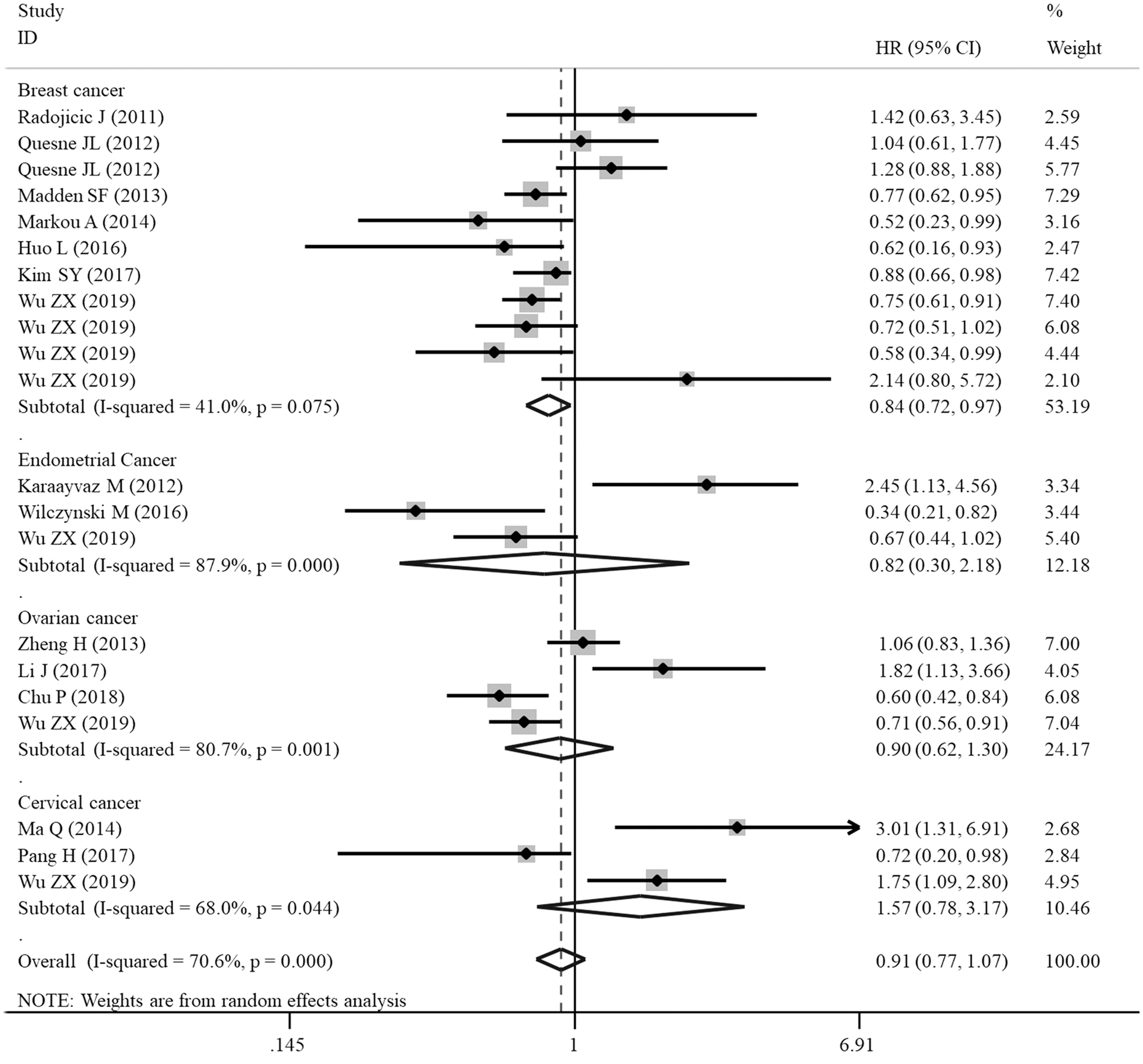
Forest plots of overall survival among breast cancer patients when high expression of miR-205 was compared with low expression.
Meta-Analysis of miR-205 Expression and Survival
p z in bold indicated the statistical significance for prognosis value.
p H is the statistical results for heterogeneity.
CI, confidence interval; Mul, multivariate Cox regression; Uni, univariate Cox regression.
Six studies were used to assess the DSS/DFS/DMFS/PFS. There was a statistically significant heterogeneity (I 2 = 70.4%, p = 0.005) and thus a random-effects model was used. The meta-analysis also showed no significant association between miR-205 expression and DSS/DFS/DMFS/PFS (HR = 1.17, 95% CI: 0.77–1.78, p = 0.457) (Table 3; Fig. 4).
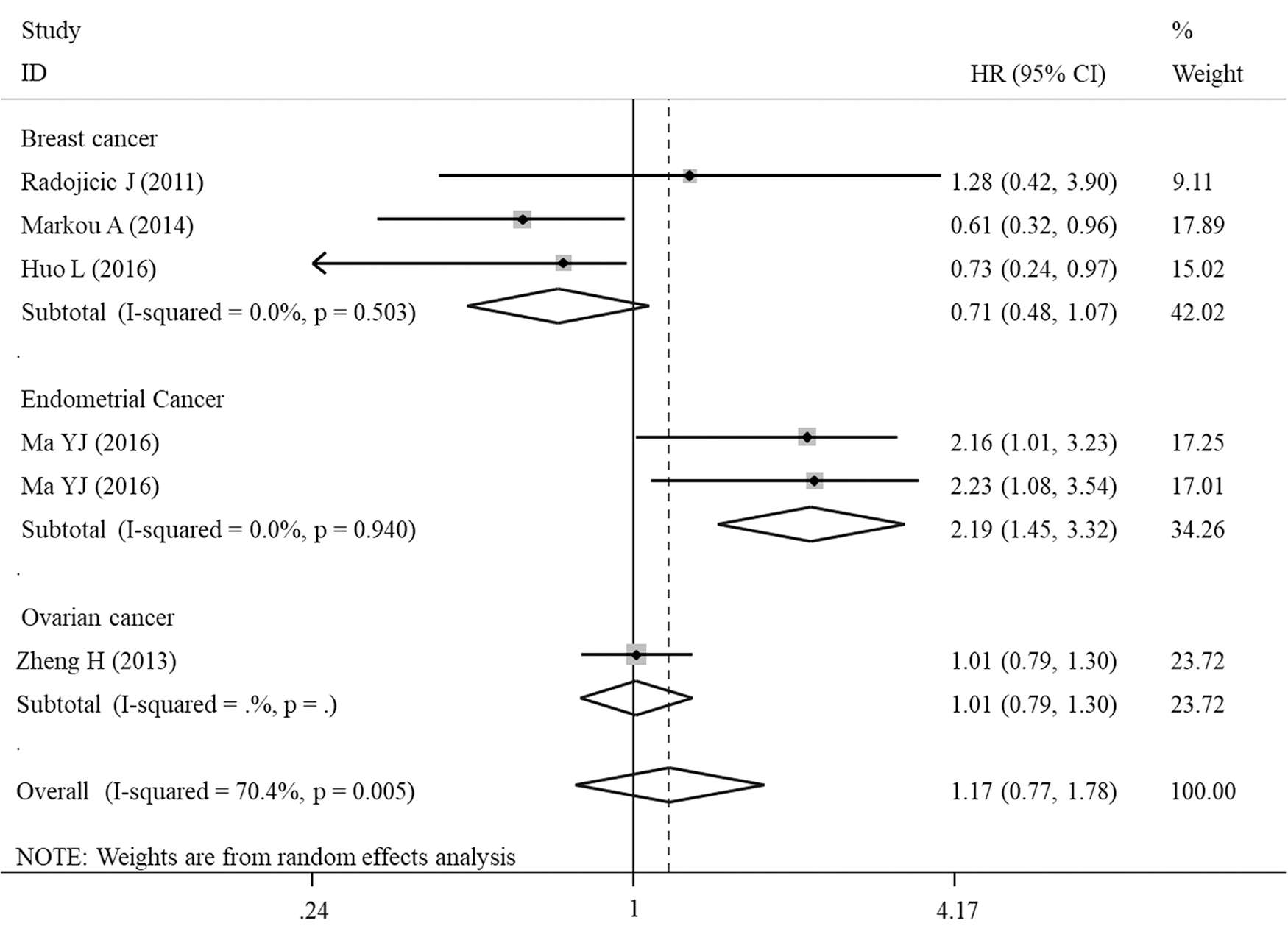
Forest plots of disease-specific survival/disease-free survival/ distant metastasis-free survival/progression-free survival overall survival among endometrial cancer patients when high expression of miR-205 was compared with low expression.
To lessen the heterogeneity for evaluation of OS and DSS/DFS/DMFS/PFS, subgroup analyses were performed according to ethnicity, cancer type, sample size, sample source, detection method, and statistical estimation. The results of subgroup analysis showed that elevated miR-205 predicted a reduced OS for BC patients (HR = 0.84, 95% CI: 0.72–0.98; p = 0.022) (Table 3; Fig. 3) and studies using high-throughput data (HR = 0.79, 95% CI: 0.68–0.92; p = 0.003) (Table 3), while higher miR-205 was associated with a poor DSS for EC patients (HR = 2.19, 95% CI: 1.45–3.32; p < 0.001) (Table 3; Fig. 4) and studies using multivariate analysis (HR = 2.19, 95% CI: 1.45–3.32; p < 0.001) (Table 3).
Publication bias and sensitivity analysis
Egger's linear regression test suggested no significant publication bias for OS (p = 0.202) and DSS/DFS/DMFS/PFS (p = 0.681). Sensitivity analysis also showed that pooled HR was not significantly altered when each study was successively deleted (Fig. 5).
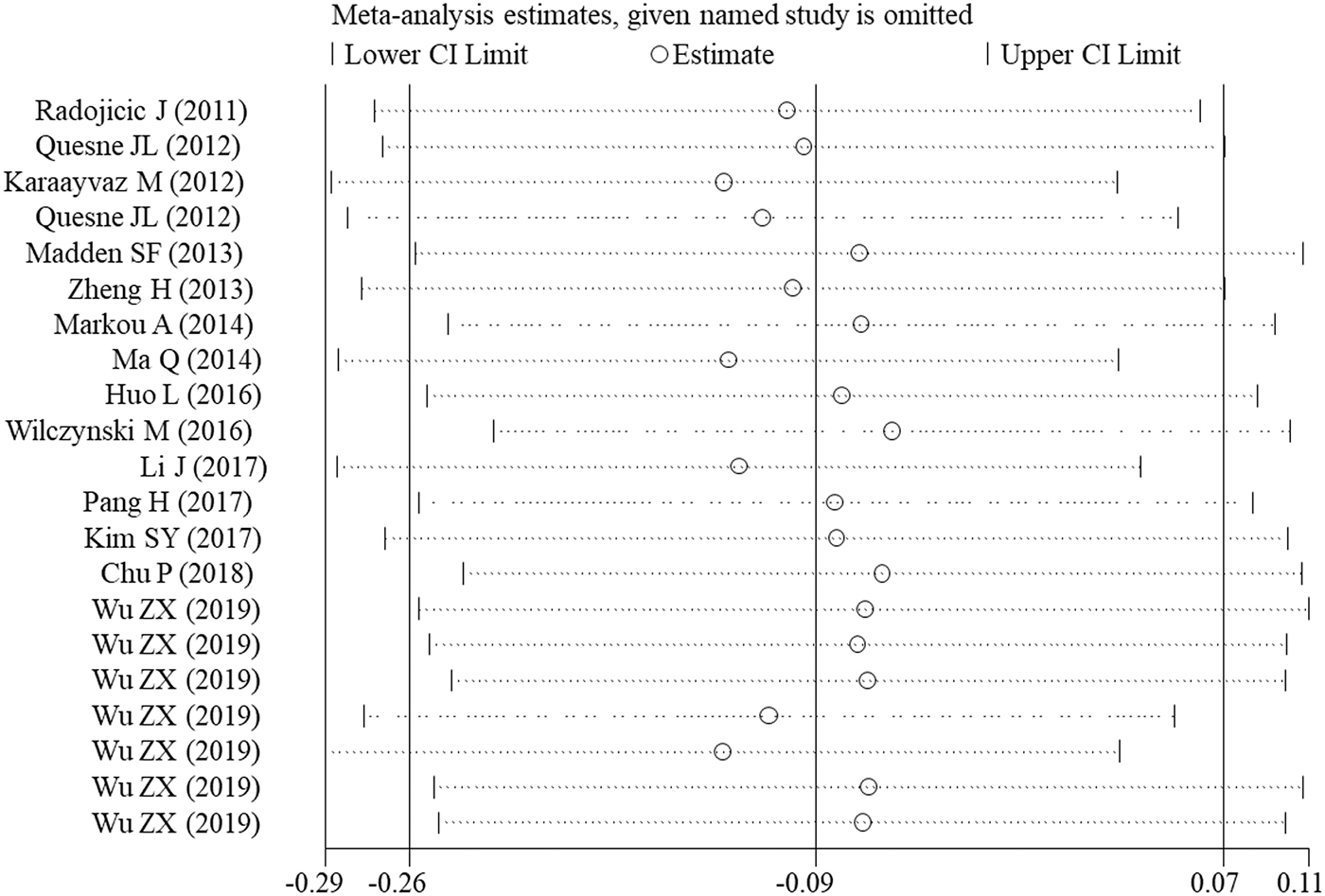
Sensitivity analysis of the association between miR-205 expression and overall survival in breast cancer patients.
Target gene prediction and functional enrichment for miR-205
A total of 245 target genes of miR-205 (such as miR-205-3p-SMARCA5; miR-205-5p-SIAH1/ACTB) were predicted by nine algorithms in the miRwalk2.0 database (Fig. 6A), 182 of which were found to interact with other genes to construct the PPI network. After calculating three topological characteristics and ranking of each protein in the PPI network (Table 4), 19 (DDX5, ACTB, VEGFA, KAT2B, SP1, PLCB1, LRP6, SUZ12, RUNX2, E2F1, PRKCA, CLTC, YWHAB, LRRK2, WNT5A, UBE2K, RAB1A, SMAD4, and QKI) were shown to be shared in the top 30 proteins for DC, BC, and CC; 3 (PIKFYVE, SIAH1, and RBMX) were common for DC and BC; 4 (CFL2, E2F3, SMARCA5, and CAPZA1) were common for DC and CC, suggesting they were hub genes for the development of cancer. Furthermore, four function-related modules were extracted from the PPI network (Fig. 6B). Hub genes, SIAH1 and UBE2K, were included in module 1; SMARCA5 was included in module 2; LRRK2, CLTC, PRKCA, and PLCB1 were enriched in module 3; and SMAD4 and RUNX2 were included in module 4.
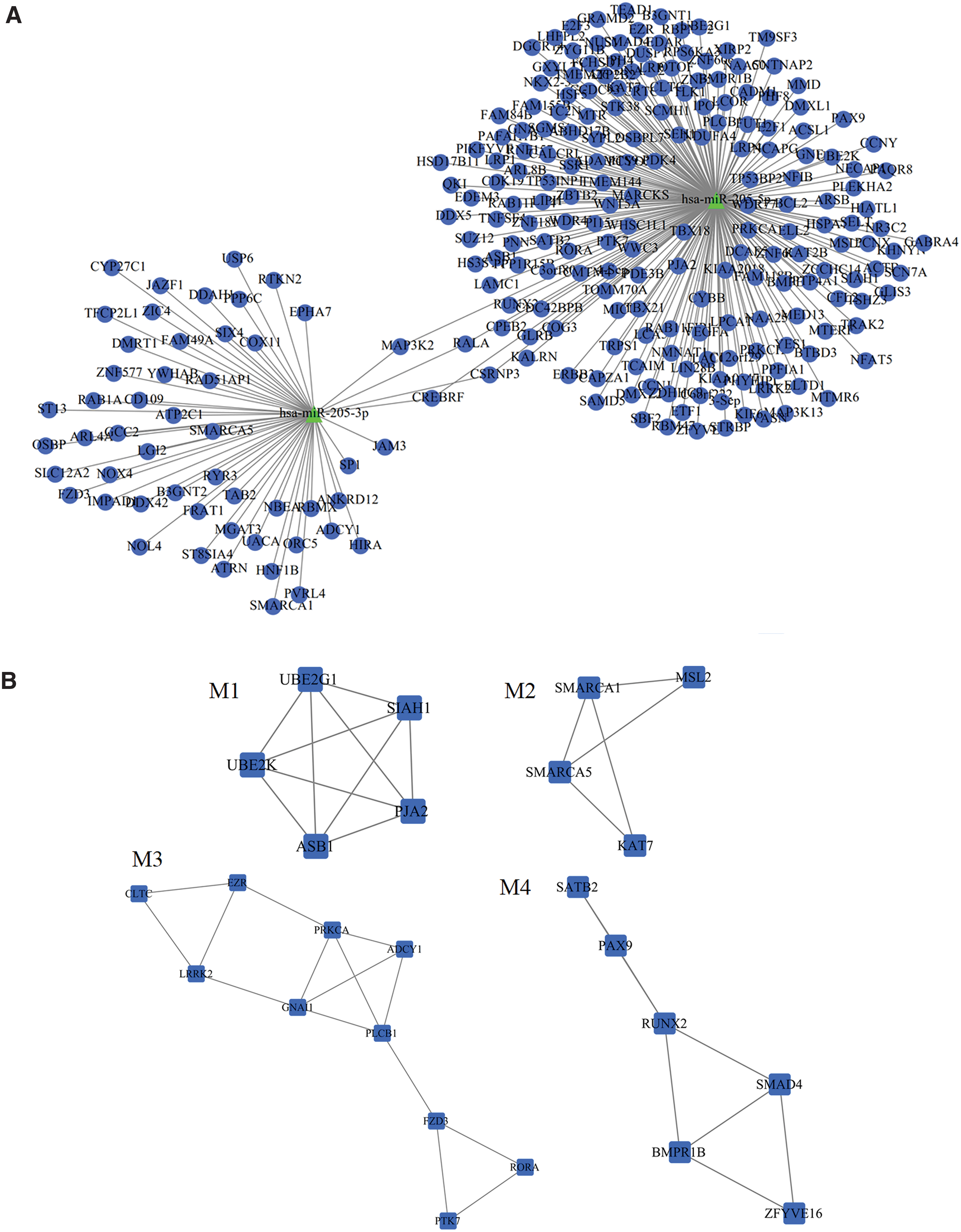
Identification of crucial target genes of miR-205.
Topological Characteristics of Each Protein in the Protein–Protein Interaction Network (Top Thirty)
After uploading all the target genes to the DAVID database, 90 GO biological process terms (Table 5) and 16 KEGG pathways (Table 6) were enriched. Seven of the above hub genes included in submodules were enriched into GO or KEGG pathways, such as GO:0045893∼positive regulation of transcription, DNA-templated (SMAD4, SMARCA5, PLCB1, and RUNX2), GO:0072593∼reactive oxygen species metabolic process (LRRK2), GO:0007049∼cell cycle (SIAH1), GO:0060828∼regulation of canonical Wnt signaling pathway (LRRK2), hsa04310:Wnt signaling pathway (PRKCA, SMAD4, SIAH1, and PLCB1), hsa04390:Hippo signaling pathway (SMAD4), and hsa05200:Pathways in cancer (PRKCA, SMAD4, and PLCB1). Therefore, these 7 genes may be significant target genes for miR-205.
Gene Ontology Enrichment Analysis for Target Genes of miR-205
GO, gene ontology.
Kyoto Encyclopedia of Genes and Genomes Pathway Enrichment Analysis for Target Genes of miR-205
To further confirm the associations of crucial target genes with BC or EC, survival analysis was also performed for them using KM plotter database based on the microarray or TCGA dataset. The analysis results of microarray data for BC showed that SMARCA5 (Fig. 7A) and SIAH1 (Fig. 7B) may be risk factors, with a shorter OS time in patients having a higher expression level of these genes, which was opposite to miR-205 in BC. TCGA analysis further showed that SMARCA5 was significantly associated with OS in BC (Fig. 7C). These findings revealed SMARCA5 may act as a potentially specific target for miR-205 to exert its protective roles for BC. No significant difference of any of these seven hub genes was observed for EC and thus we further investigated the association of all the genes in degree topological characteristic analysis with OS. The results showed that highly expressed BMPR1B was significantly associated with a reduced OS in EC (Fig. 7D), which was opposite to miR-205 in EC. Accordingly, we speculated that the tumor-promoting role of miR-205 in EC may be specifically achieved by inhibiting the expression of BMPR1B.
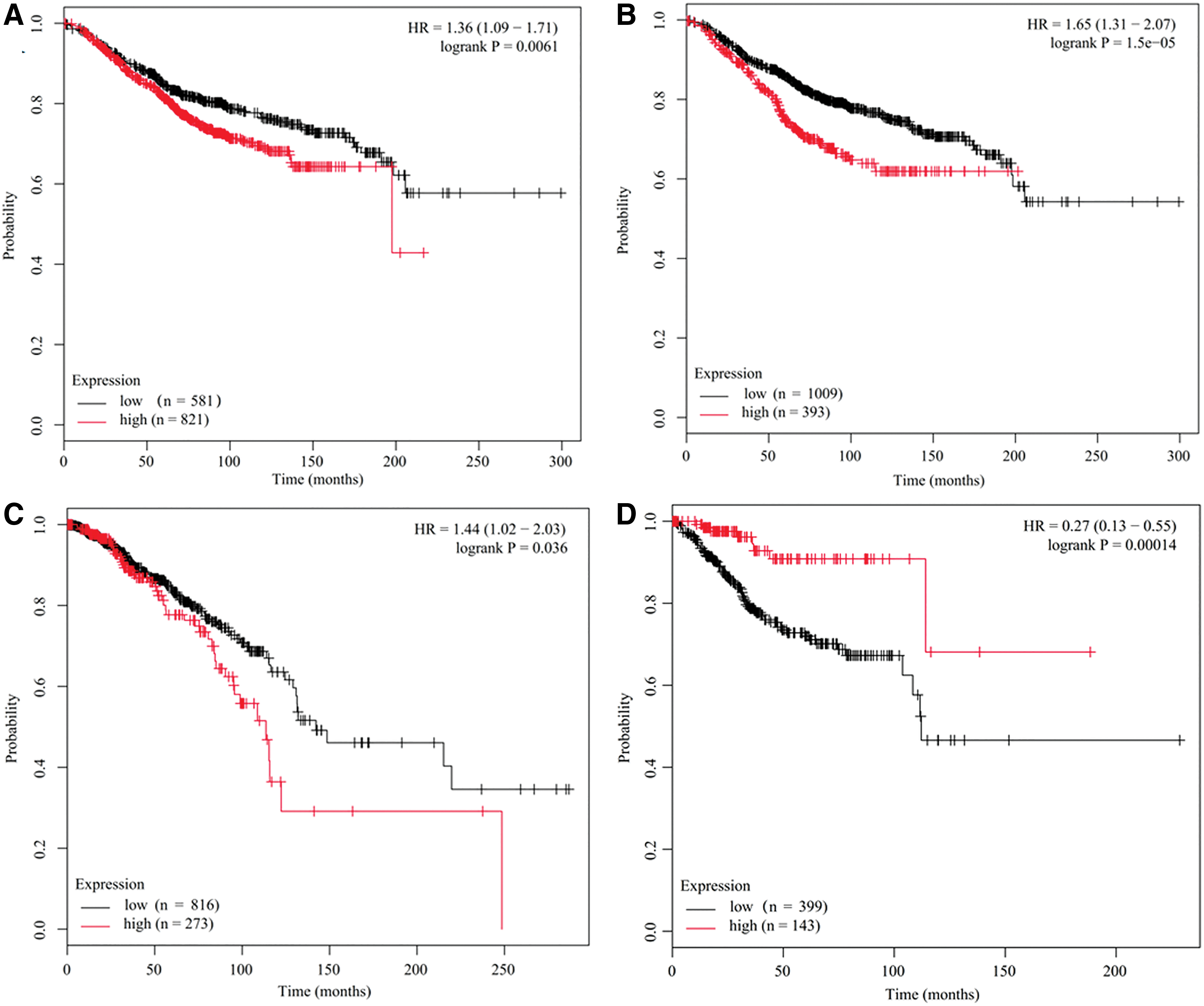
Kaplan–Meier survival curves for cancer patients stratified by expression levels of target genes of miR-205. This was performed using the online Kaplan–Meier plotter database.
Discussion
Although there were studies to use the meta-analysis to investigate the prognostic value of miR-205 for cancer (Zhang et al., 2015b; Li et al., 2017b), no study specifically evaluated the prognostic significance of miR-205 for patients with all gynecological cancers (including BC, EC, CC, and OC). In the present study, we, for the first time, integrated the data from 14 literatures updated to April 2019 and 7 bioinformatic analysis outcomes on the KM plotter database to provide robust evidence for miR-205. Our results indicated that elevated miR-205 was significantly associated with enhanced OS in the BC subgroup (HR = 0.84, 95% CI: 0.72–0.98, p = 0.022), but higher miR-205 was associated with a poor DSS for EC subgroup (HR = 2.19, 95% CI: 1.45–3.32, p < 0.001), indicating miR-205 may be a protective factor for BC, but a risk factor for EC. Our conclusion on BC was in line with the study of Zhang et al. (2015b) (HR = 0.78, 95% CI: 0.67–0.91, p = 0.001), although more articles were included (11 vs. 4), further validating the importance of miR-205 for BC prognosis. In the study of Zhang et al. (2015b), only one study (Karaayvaz et al., 2012) was screened to investigate the prediction potential of miR-205 for OS in EC patients and thus no subgroup meta-analysis was performed. In our study, three and two datasets, respectively, were enrolled to assess the prediction ability of miR-205 for OS and DSS in EC patients. Our meta-analysis results on OS (HR = 0.82, 95% CI: 0.31–2.18, p = 0.684) was significantly different from the individual study of Karaayvaz et al. (2012) (HR = 2.65, 95% CI: 1.11–6.25, p = 0.028), suggesting the necessity of this meta-analysis.
Extensive studies had observed that miR-205 was downregulated in BC patients (Zhang et al., 2015a; Huo et al., 2016). Ectopic expression of miR-205 not only inhibited cell growth, but also suppressed migration and invasion of BC cells by reversing epithelial–mesenchymal transition (Mayoral-Varo et al., 2017; Wang et al., 2019). The mechanism studies revealed the downregulation of miR-205 may be attributed to DNA methylation (Hasegawa et al., 2017) and downregulated miR-205 specifically upregulated a series of proto-oncogenes by binding to their 3′-UTR, such as high-mobility group box 1 (HMGB1) (Wang et al., 2019), HMGB3 (Elgamal et al., 2013), Krüppel-like factor 12 (KLF12) (Guan et al., 2016) and angiomotin (AMOT) (Zhang and Fan, 2015). Thus, increased miR-205 expression may be predictive of a better prognosis, which was confirmed in the meta-analysis of Zhang et al. (2015b) and ours. However, the mechanisms of miR-205 for BC remain unclear. Our PPI network, module, function enrichment analysis, and survival validation studies predicted SMARCA5 and SIAH1 may be specific targets for miR-205 in BC because of the presence of interactions with miR-205 at 3′-UTR and the opposite prognosis outcomes with miR-205 in BC samples. Furthermore, clinical and in vitro studies of SMARCA5 and SIAH1 in BC may also indirectly demonstrate our conclusion. For example, Jin et al. (2015) demonstrated chromatin remodeler SMARCA5 was overexpressed in BC specimens and associated with tumor, nodes, metastasis stage, tumor size, high proliferation index, and poor OS. Knockdown of SMARCA5 decreased cell proliferation, invasion, and arrested cell cycle in BC cells (Jin et al., 2015). Flores-Pérez et al. (2016) found the inducible E3 ubiquitin ligase SIAH1 was upregulated in breast tumors. Silencing of SIAH1 gene by RNA interference significantly impaired cell migration of BC cells (Flores-Pérez et al., 2016). The tumorigenic role of SIAH1 for BC was also confirmed in the study of Adam et al. (2015) who reported that knockdown of SIAH1 led to increased apoptosis, reduced proliferation, and decreased cell migration and invasion.
In contrast to BC, miR-205 was consistently found to be upregulated in EC by several authors (Chung et al., 2010; Torres et al., 2013). Transfection of miR-205 mimic enhanced the migration and invasion of EC cells (Jin and Liang, 2015), while the use of miR-205 inhibitor resulted in a significant inhibition of EC cell proliferation, migration, and invasion in vitro and EC xenograft growth in vivo (Jin and Liang 2015; Torres et al., 2016). Luciferase reporter system proved that the potential downstream targets of miR-205 in EC included junctophilin 4 (JPH4) (Chung et al., 2010), estrogen-related receptor-γ (ESRRG) (Su et al., 2013), and FOXO1 (Lu et al., 2019). Therefore, increased miR-205 expression may be predictive of a poor prognosis, which was verified in our meta-analysis of two datasets of Ma et al. (2016). However, the mechanisms of miR-205 for EC remain not well understood. Our study predicted BMPR1B may be a specific target for miR-205 in EC because of its interaction with miR-205 at 3′-UTR and the contrary prognosis outcomes with miR-205 in EC samples. This hypothesis was also proved by the studies on the roles of BMPR1B in EC and its interaction with miR-205 in other cancers. For example, Richards et al. (2016) reported that the expression of BMPR1B was significantly decreased in EC compared with benign samples. The findings of Yang et al. (2017) indicated that BMPR1B mRNA was significantly reduced by overexpression of miR-205, while it was increased by an inhibitor of miR-205 in A549 cells.
There are several limitations in this study. First, the sample size of wet experimental studies (qRT-PCR; Table 1) was still small. Second, the cutoff value was different or not reported in the included studies and thus the use of miR-205 for clinical prognosis prediction remains unenforceable. Third, the crude HR was used for the meta-analysis, which might introduce residual confounding caused by other prognostic factors. Fourth, in vitro and in vivo studies need to be performed to confirm the relationship between miR-205 and their specific target genes identified and their roles in BC or EC.
Conclusion
Based on the meta-analysis and bioinformatics, our findings suggest that low expression of miR-205 may indicate poor OS in BC patients and miR-205 may exert protective roles by regulating SMARCA5 and SIAH1. In contrast, high expression of miR-205 may predict worse DSS in EC patients and miR-205 may exert tumor-promoting roles by modulating BMPR1B. No significant associations were present between the expression of miR-205 and prognosis in patients with OC and CC.
Footnotes
Disclosure Statement
No competing financial interests exist.
Funding Information
No funding was received for this article.