







Abstract
We conducted an experiment to compare the effect of exercise in an outdoor natural environment with that of exercise in an indoor simulated natural environment on measures of exertion and emotions. Our objectives were to examine how the exercise environment changed emotion and the relationship between emotion and exertion. We tested the possibility that differences in physiological exertion across environments may explain the beneficial effect of green exercise on emotion. Seventy-four college students were randomly assigned to walk at a comfortable pace for 15 min on an outdoor path with views of natural and built elements or an indoor treadmill while watching a video of the sights seen along the outdoor path. We administered prewalk and postwalk measures of positive and negative emotions. We also measured heart rate and rate of perceived exertion during the walk. Participants who walked outdoors attained a higher average heart rate but did not perceive they were exerting themselves more than participants who walked indoors. Participants who walked outdoors also experienced a greater increase in energy than participants who walked indoors, though participants who walked indoors experienced a decrease in tension. There was no evidence that heart rate explained the difference between the indoor and outdoor groups with respect to energy or tension. Future studies could examine the association between environment, emotion, and exertion using other measures of exercise-induced emotions and physiological exertion.
Introduction
Despite the benefits of physical activity for mental and physical health, the majority of people exercise infrequently or not at all. The Centers for Disease Control and Prevention (CDC) recommends that adults achieve at least 150 min of moderate intensity aerobic exercise per week and perform muscle strengthening exercises at least 2 days per week (CDC, 2020a). Data from the CDC's Behavioral Risk Factor Surveillance System indicate that few adults meet this goal (CDC, 2019).
At the same time, nearly one in eight U.S. adults experience regular feelings of nervousness, worry, or anxiety (CDC, 2021), feelings that may be reduced by acute bouts of exercise (Herring, Hallgren, & Campbell, 2017). Furthermore, acute bouts of exercise have been found to increase positive affect and energetic arousal (Ekkekakis, Hall, VanLanduyt, & Petruzzello, 2000).
Does it matter where one exercises? Though some studies have produced null or inconsistent effects (Lahart, Darcy, Gidlow, & Galogiuri, 2019; Plante, Cage, Clements, & Stover, 2006; Plante et al., 2007), the majority of studies show that exercising in a natural environment (i.e., green exercise) is associated with increased revitalization (Byrka & Ryczko, 2018), energy (Plante et al., 2003), engagement (Focht, 2009), vitality (Ryan et al., 2010), and positive affect (Bodin & Hartig, 2003; Fuegen & Breitenbecher, 2018; Nisbet & Zelenski, 2011; Teas, Hurley, Ghumare, & Ogoussan, 2007).
Though Lahart et al. (2019) identified several methodological weaknesses in the literature, other reviewers of studies comparing indoor and outdoor exercise have concluded that exercising in natural environments is associated with greater revitalization and energy (Thompson Coon et al., 2011).
Researchers comparing the effects of green exercise with those of indoor exercise often do not report whether exercise-induced emotions are associated with physical exertion. Those few studies that have examined the relationship between exertion and emotions have yielded inconsistent findings. Marselle, Irvine, Lorenzo-Arribas, and Warber (2016) found that perceived walking intensity in natural environments was associated with postwalk positive mood. However, Mackay and Neill (2010) found no association between perceived exercise intensity and postexercise anxiety. Thus, one purpose of this article is to explore how measures of exercise intensity are related to changes in emotion caused by exercise.
Physical exertion across exercise environments
Many studies show no difference in perceived physical exertion between natural and urban environments. In an investigation of the effect of green exercise on self-esteem in children, Reed et al. (2013) found that children's ratings of perceived exertion were similar after running in urban and rural environments. Caloguiri et al. (2018) found that indoor walkers reported a higher level of perceived exertion than persons walking in a natural environment outdoors, though the two groups did not differ significantly in terms of heart rate. Gidlow et al. (2016) reported that neither perceived exertion nor heart rate differed among outdoor walkers who exercised in pleasant natural and urban environments.
In each of these studies, the authors used a within-groups experimental design, exposing each participant to each environment in a counterbalanced order. Participants were accompanied by an experimenter (Gidlow et al., 2016), other participants (Reed et al., 2013), or exercised in a laboratory (Caloguiri et al., 2018). The relationship between perceived exertion and emotions was not reported.
Other studies that include both a self-report measure of exertion and a physiological measure (e.g., heart rate) have revealed that the exercise environment influences physiological and perceived exertion differently. Experienced runners achieved a higher average heart rate when running on an outdoor track than when running on an indoor treadmill, despite being instructed to achieve the same levels of perceived exertion in both environments (Ceci & Hassmén, 1991). Similarly, LaCaille, Masters, and Heath (2004) found that runners ran at a faster pace on an outdoor road than on an indoor treadmill, though they perceived that they exerted themselves more when running on the treadmill.
The runners also reported greater energy, revitalization, and tranquility, and lesser exhaustion, after running outdoors than indoors. Similar findings were obtained by Krinski et al. (2017) in a sample of infrequent exercisers: participants walked faster and reported higher levels of positive affect while using an outdoor track than when using an indoor treadmill. Nonetheless, they perceived that their level of exertion increased more sharply as they completed the indoor walk than the outdoor walk.
These findings show that exercising outdoors produced a higher heart rate (Ceci & Hassmén, 1991) and faster pace (Krinski et al., 2017; LaCaille et al., 2004) than exercising indoors. Subjectively, exercisers perceived their exertion to be comparable across the environments (Ceci & Hassmén, 1991) or greater while exercising indoors (Krinski et al., 2017; LaCaille et al., 2004). Furthermore, exercisers reported more positive emotions while exercising outdoors than while exercising indoors (Krinski et al., 2017; LaCaille et al., 2004).
Taken together, the results suggest that more positive emotions may be related to lesser perceived exertion, though the associations between measures of exertion and emotions were not reported in these studies. The studies are also limited by the within-groups design, which may have caused participants to speculate about the researchers' hypotheses, potentially leading to demand characteristics. Also, the outdoor tracks and roads may not have been perceived as natural environments, limiting conclusions that may be drawn about green exercise.
A study by Byrka and Ryczko (2018) addressed these limitations. Using a between-groups experimental design, the researchers randomly assigned experienced dancers to practice in an indoor studio and in an outdoor park. Participants reported their emotions immediately before and after practice, and they wore an accelerometer while dancing. Dancing in the park was associated with more vigorous movement, and vigorous movement was associated with increased tranquility, revitalization, and positive engagement. Furthermore, greater vigorous movement mediated the effect of exercise environment on positive emotion.
These results provide evidence that the beneficial effect of green exercise on positive emotions may be attributed to greater physical exertion in natural environments. Nonetheless, study design characteristics affect the conclusions we may draw from the findings. The sample was likely physically fit: The majority of participants had engaged in regular physical activity for at least 6 months. Because participants exercised in groups, dancers' movements and emotions could have been influenced by other dancers or the instructor. In addition, responses may have been influenced by the novelty of the park environment and the familiarity of the studio environment.
The extant literature presents the tantalizing possibility that exercising in natural environments may improve physical health to a greater degree than exercising indoors because it spurs more physical movement (Byrka & Ryczko, 2018) and elevates heart rate (Ceci & Hassmén, 1991). At the same time, exercising in natural environments improves mental health by enhancing feelings of tranquility, revitalization, energy, positive engagement, restoration, and general positive affect (Byrka & Ryczko, 2018; Caloguiri et al., 2018; Gidlow et al., 2016; Krinski et al., 2017; LaCaille et al., 2004). Research findings are inconsistent regarding the effect of outdoor exercise on perceived exertion.
Some studies find that persons exercising outdoors perceive less physical exertion than those exercising indoors (Krinski et al., 2017; LaCaille et al., 2004), though many other studies find no significant difference between environments (Caloguiri et al., 2018; Ceci & Hassmén, 1991; Reed et al., 2013; Rogerson & Barton, 2015; Rogerson et al., 2016). Though studies have shown that perceived exertion is a good predictor of heart rate (Chen, Fan, & Moe, 2002; Scherr et al., 2013), these studies did not examine whether exercise environment affected the relationship between perceived exertion and heart rate. Thus, another purpose of this article is to compare the effects of exercise in an outdoor natural environment with those of exercise in an indoor simulated natural environment on measures of physiological and perceived exertion as well as emotions.
Present research
We compare the effect of exercise in a natural outdoor environment with the effect of exercise in a simulated natural indoor environment on measures of physiological exertion, perceived exertion, and emotions. A simulated natural environment for indoor exercisers enabled us to control for extraneous variables. Persons exercising indoors were exposed to the same sights and sounds as persons exercising outdoors. To control for possible emotional contagion, we had participants exercise alone. We measured emotion both before and after exercise using two commonly used scales.
Our goals were to examine how the exercise environment changed emotion and the relationship between emotion and exertion. We expected that exercise—both indoors and outdoors—would increase positive emotions (Ekkekakis et al., 2000; Loy, O'Connor, & Dishman, 2013; Reed & Ones, 2006) and decrease negative emotions (Biddle, 2000; Herring et al., 2017; Landers & Arent, 2007). We also expected that exercising in an outdoor natural outdoor environment would lead to a greater increase in positive emotions than exercising in an indoor simulated natural environment. Studies have demonstrated increased energy (Kjellgren & Burhkall, 2010) and faster recovery from stressful experiences (Kahn, Serverson, & Ruckert, 2009) after exposure to actual nature compared with exposure to simulated nature.
We anticipated that physiological exertion (i.e., heart rate) would be greater in the outdoor than in the indoor environment (Byrka & Ryczko, 2018; Ceci & Hassmén, 1991). We made no prediction for perceived exertion. There are two possibilities. If heart rate and perceived exertion are positively correlated (Chen et al., 2002; Scherr et al., 2013), then perceived exertion should be greater in the outdoor than in the indoor environment. In contrast, if heart rate and perceived exertion are not positively correlated, then perceived exertion will not differ between indoor and outdoor environments. We test the possibility that differences in physiological exertion across environments may explain the beneficial effect of green exercise on emotion.
The data presented here are part of a larger project examining the effect of environment and physical activity on cognitive, affective, and behavioral outcomes (Breitenbecher & Fuegen, 2019; Fuegen & Breitenbecher, 2018). We have previously reported how physical activity (exercising vs. resting) and environment (natural outdoor vs. simulated indoor) jointly influence attention, mood, and restoration. In this article, we focus on comparing emotions and exertion based on the exercise environment. To our knowledge, no research has examined how emotions produced by exercising in an outdoor natural environment and in an indoor simulated natural environment are associated with both physiological and perceived physical exertion.
Furthermore, studies that have compared indoor and outdoor exercise on measures of perceived exertion have produced inconsistent findings. Our aim is to address these gaps and inconsistencies in the literature. Because of our interest in comparing indoor and outdoor exercise, we do not report the effects of sedentary behavior on emotion; those effects are described elsewhere (Fuegen & Breitenbecher, 2018). In this article, we present a reanalysis of emotions data presented in a previous article (Fuegen & Breitenbecher, 2018) along with data on additional measures of emotion and exertion not previously published.
Method
Participants
Ninety-three university students participated. Before collecting data, we decided not to assign participants to exercise outdoors if the temperature was <0°C and/or there was outdoor precipitation. We excluded data from 19 participants who could not be randomly assigned to condition. The final sample was 74 students (50 women, 24 men). Seventy-four percent identified as White, 12% identified as African American, 4% identified as Asian/Pacific Islander, and 10% identified as multiracial/other. Participants ranged in age from 18 to 42 years (M = 20.08, SD = 3.79). They reported engaging in vigorous physical activity an average of 2.57 (SD = 2.01) days per week. They reported walking for at least 10 min an average of 5.71 (SD = 1.80) days per week.
The campus where the study took place has been designated a Tree Campus USA by the Arbor Day Foundation. Conducting the study on a college campus enabled us to carefully control the visual stimuli associated with the indoor and outdoor environments. No traveling was required to reach the outdoor location. Data collection occurred during the autumn, winter, and spring seasons.
Participants were recruited through the university's online research management system. Only those capable of ascending and descending stairs and walking for 15 min were eligible to participate. The study was approved by the university institutional review board. Participants provided informed consent and received partial course credit.
Measures
Emotions
We measured emotions before and after exercise using the Positive and Negative Affect Schedule (PANAS; Watson, Clark, & Tellegen, 1988) and the Activation-Deactivation Adjective Checklist (AD-ACL; Thayer, 1986). Each scale consists of 20 adjectives. For the PANAS, participants were asked to indicate the extent to which they feel this way right now on a scale ranging from 1 (very slightly or not at all) to 5 (extremely). The PANAS has two subscales: positive affect and negative affect. For the AD-ACL, participants were asked to indicate the extent to which they feel this way at this moment on a scale ranging from 1 (not at all) to 5 (extremely).
The AD-ACL differentiates affective states based on two bipolar and orthogonal dimensions: activation and valence. The AD-ACL has four subscales: calmness (deactivated positive affect), tiredness (deactivated negative affect), energy (activated positive affect), and tension (activated negative affect). Findings regarding how physical activity (i.e., exercising vs. resting) and environment (natural outdoor vs. simulated indoor) affect energy and tiredness have been previously reported (Fuegen & Breitenbecher, 2018).
Exertion
We measured physical exertion using a heart rate monitor (Garmin Forerunner® 210 GPS-enabled watch with a chest strap) and a self-report scale (rate of perceived exertion [RPE] scale; Borg, 1998). We used the heart rate monitor to gather participants' average heart rates while exercising. We used the RPE scale to assess participants' subjective perception of their physical exertion. The RPE scale consists of numerical values ranging from 6 (no exertion at all) to 20 (maximal exertion). Studies have supported the validity of the RPE for the assessment of perceived physical work intensity (Borg, 1998; Chen et al., 2002; Scherr et al., 2013).
Weather
During each session, the researcher obtained information about the outdoor temperature, wind speed, and the percentage of the sky covered in clouds from (www.noaa.gov).
Procedure
A researcher met the participant at a laboratory and guided each participant individually through the study. Participants first completed a letter unscrambling task designed to deplete attention. Next, they completed the measures of emotion.* The researcher then randomly assigned the participant to exercise outdoors (n = 36) or indoors (n = 38). Participants attached a heart rate monitor to their chest before being led to the indoor or outdoor exercise location. Participants removed the heart rate monitor immediately after returning to laboratory and before completing post-test measures of emotion.
Outdoor exercise
The researcher escorted the participant to an outdoor location near the building in which the laboratory was located (see Fig. 1). The researcher and participant descended two flights of stairs to leave the building and then another flight of steps to reach the walking path. The researcher gave the participant a map of the campus on which a walking route had been highlighted. This walking route included two loops that circled a lake. The route was ∼0.6 km and included views of both natural elements (i.e., trees, small plants, lake) and built elements (e.g., classroom buildings, parking lot). The surface was flat, paved, and without obstacles. The researcher stated the following:
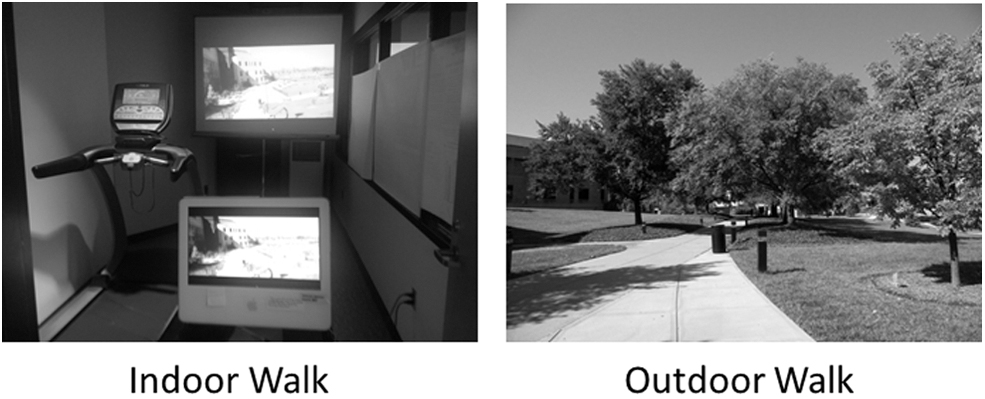
Indoor walk and outdoor walk conditions.
I would like you to walk this path at a comfortable pace for 15 minutes. While you're walking, I'd like you to focus on the sights and sounds around you. I will find you when 15 minutes have elapsed. Please avoid speaking to anyone while you are walking.
After giving these instructions, the researcher re-entered the building. After the participant had walked one loop around the lake (∼7 min), the researcher approached the participants and asked them to verbally report their level of perceived exertion using the RPE scale. The participant continued to walk along the path for another 7–8 min. After 15 min had elapsed, the researcher approached the participants on the path and informed the participants that they would return to the laboratory. The researcher escorted the participants back to the laboratory and administered the measures of emotion a second time.
Indoor exercise
The researcher escorted the participant to a laboratory room equipped with a treadmill, computer, projector, and screen (140 cm tall × 147 cm wide) (see Fig. 1). The researcher stated the following:
I would like you to walk on this treadmill for 15 minutes at a comfortable pace. Feel free to adjust the speed up or down so that you feel that you are walking at a comfortable pace.
The researcher then queued a video that represented the sights seen by an individual who was walking along the same path as an outdoor exercise participant.
†
The researcher stated,
This is a video of campus. I'd like you to look at this video and listen to the sounds while you exercise.
After giving these instructions, the researcher left the laboratory and waited in an adjacent room. After ∼7 min had elapsed, the researcher re-entered the laboratory and asked the participants to verbally report their level of perceived exertion using the RPE scale. The participant continued to walk on the treadmill for another 7–8 min. After 15 min had elapsed, the researcher re-entered the laboratory and informed the participants that they were finished with this part of the study. The researcher escorted the participant back to the original laboratory room and administered the measures of emotion a second time.
Data diagnostics and analysis strategy
We analyzed the data using SPSS v. 26.0. We screened the data for potential data entry errors and statistical outliers; none were identified. The data were normally distributed for all dependent measures except negative affect, which was positively skewed. We performed a log transformation on pretest and post-test negative affect to achieve normality.
Analyses of the weather variables revealed that wind speed and temperature, but not cloud cover, differed significantly between sessions occurring outdoors and indoors. Therefore, we included temperature and wind speed as covariates in all analyses. Because participants assigned to the outdoor condition walked through a building before reaching the outdoor walking path, their average walking time was longer than that of participants assigned to walk indoors.
Therefore, we included walking time, as measured with the GPS-enabled watch, as a covariate in all analyses. Because individual differences in physical activity levels may influence heart rate and perceived exertion, we included the number of days per week participants reported (1) engaging in vigorous physical activity and (2) walking for at least 10 min as covariates in our analyses of the exertion variables.
We examined whether scores on the measures of emotions differed significantly before the walk. Only AD-ACL calmness scores differed significantly by condition at pretest. Therefore, in our analysis of calmness, pretest calmness was added as a covariate, and post-test calmness was the dependent variable. For all other measures of emotions (i.e., AD-ACL energy, AD-ACL tension, AD-ACL tiredness, PANAS positive affect, PANAS negative affect), we conducted mixed model analyses of covariance (ANCOVAs). Time (prewalk, postwalk) was the within-subjects factor, environment (indoors, outdoors) was the between-subjects factor, and weather variables (temperature, wind speed) and walking time were covariates.
We conducted mixed model ANCOVAs on the measures of exertion (i.e., heart rate, RPE). Environment (indoors, outdoors) was the between-subjects factor. Weather variables (temperature, wind speed) and individual difference variables (walking days, vigorous activity days) were covariates. Differing degrees of freedom in the analyses reflect data missing at random. Unless otherwise indicated, means refer to estimated marginal means.
Results
Means, standard deviations, partial correlations, and internal consistency reliability coefficients are presented in Table 1.
Means, Standard Deviations, and Partial Correlations Among Dependent Measures
Values include controls for temperature, wind speed, and walking time. Means for calmness, energy, tension, tiredness, positive affect, and negative affect are change scores (post-test–pretest). Values on the diagonal are internal consistency reliability coefficients at pretest and post-test. * p < 0.05, **p < 0.01.
Because calmness scores differed significantly at pretest, we computed partial correlations between post-test calmness, the exertion variables, and the mood change variables while including pretest calmness as a covariate.
RPE, rate of perceived exertion; SD, standard deviation.
Exertion
The analysis of average heart rate revealed an effect of environment, F(1, 65) = 32.61, p < 0.001, ηp2 = 0.33. Participants who walked outdoors achieved a higher average heart rate (M = 122.57, SE = 2.58) than participants who walked indoors (M = 101.11, SE = 2.50) (M difference = 21.46; SE = 3.76; 95% confidence interval; CI [13.96–28.97]. Nonetheless, subjective perceptions of physical exertion did not differ significantly by environment, F(1, 66) = 1.12, p = 0.293, ηp2 = 0.02. Participants who walked indoors (M = 8.77, SE = 0.37) and those who walked outdoors (M = 9.35, SE = 0.37) reported an average level of exertion corresponding to “very light” on the RPE scale (M difference = 0.58; SE = 0.55; 95% CI [−0.51 to 1.68]).
Emotion
The pretest and post-test values for each measure of emotion are shown in Figure 2. The analysis of energy revealed only a time × environment interaction, F(1, 66) = 5.26, p = 0.025, ηp2 = 0.07. Participants who walked outdoors showed an increase in energy from pre- to postwalk (M difference = 0.40; SE = 0.12; 95% CI [0.16–0.64]), whereas participants who walked indoors showed little change (M difference = −0.01; SE = 0.12; 95% CI [−0.25 to 0.23]).
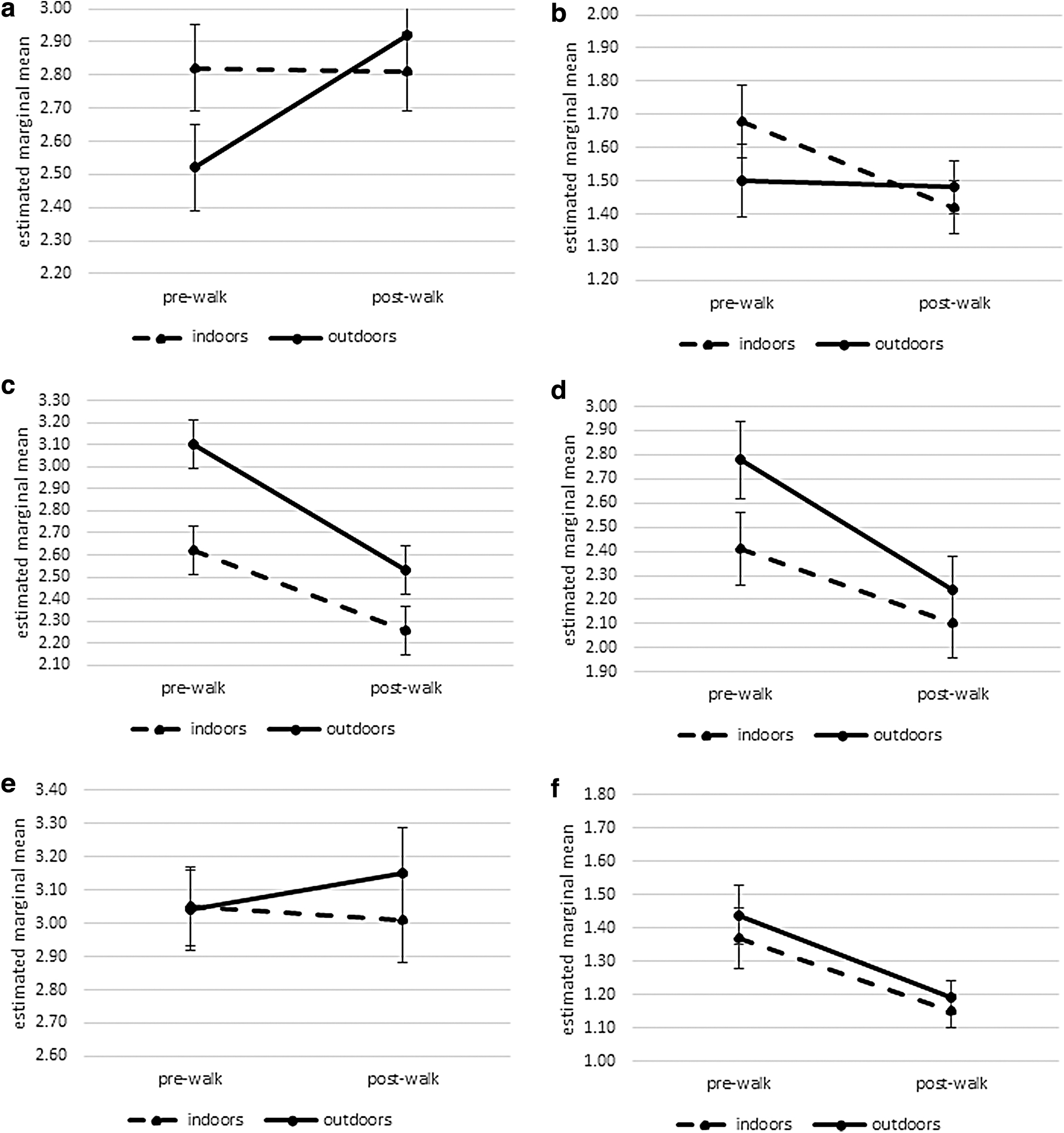
Estimated marginal means for effects of time and environment on emotion. Top row:
The analysis of tension also revealed a time × environment interaction, F(1, 68) = 4.43, p = 0.039, ηp2 = 0.06. Participants who walked outdoors showed little change in tension (M difference = −0.02; SE = 0.08; 95% CI [−0.17 to 0.14]), whereas participants who walked indoors showed a decrease in tension (M difference = −0.26; SE = 0.08; 95% CI [−0.41 to −0.11]).
The analyses of positive affect, tiredness, and log-transformed negative affect revealed no significant effects of time or environment. There was no effect of environment on postwalk calmness while controlling for prewalk calmness.
Relationship between emotion change and exertion
We computed partial correlations between the measures of emotion and exertion, controlling for temperature, wind speed, and walking time. To obtain change scores for the emotion measures, we subtracted prewalk means from postwalk means. Thus, a positive change score indicates an increase in the emotion from prewalk to postwalk, whereas a negative change score indicates a decrease in the emotion from prewalk to postwalk.
Across environments, higher average heart rate was associated with an increase in energy (r = 0.32) and an increase in tension (r = 0.31 from prewalk to postwalk, p's < 0.05 (Table 1). Heart rate was not significantly correlated with changes in tiredness, positive affect, or negative affect, nor was it correlated with postwalk calmness. Higher perceived exertion was associated only with an increase in tension (r = 0.31).
Notably, there was no association between heart rate and perceived exertion (r = −0.02). We explored whether this pattern was evident in both the indoor and outdoor environments. Though neither correlation coefficient was statistically significant, the direction of the associations differed. Heart rate and perceived exertion were positively associated in the indoor condition, r = 0.19, p = 0.329, but were negatively associated in the outdoor condition, r = −0.23, p = 0.223. The correlation coefficients were not significantly different from each other, Z = 1.73, p = 0.084 (two tailed).
Does the difference in heart rate explain the beneficial effect of outdoor exercise?
Because average heart rate was higher among outdoor than among indoor walkers, we tested whether heart rate mediated the effect of environment on energy change and tension change. We conducted two simple mediation analyses using the SPSS PROCESS macro (Hayes, 2013). One analysis included energy change as the outcome. The other analysis included tension change as the outcome. In each analysis, the predictor was environment, the mediator was heart rate, and the covariates were temperature, wind speed, and walking time. The indirect effect of environment on energy change was not significant (effect = 0.20, SE = 0.13, 95% CI [−0.01 to 0.51]), nor was the indirect effect of environment on tension change (effect = 0.11, SE = 0.09, 95% CI [−0.05 to 0.30]).
Thus, there was no evidence that heart rate mediated the relationship between environment and emotion.
Discussion
Though many studies have explored the beneficial effect of green exercise for mental health (e.g., Focht, 2009; Gidlow et al., 2016; Mackay & Neill, 2010; Marselle et al., 2016; Reed et al., 2013; Teas et al., 2007), none have compared the effect of exercising in outdoor natural environments with the effect of exercising in a simulated natural indoor environment on multiple measures of physical exertion and emotions. Consistent with previous research, we found that green exercise uniquely increases energetic arousal (Byrka & Ryczko, 2018; Frühauf et al., 2016; LaCaille et al., 2004; Thompson Coon et al., 2011).
Exercising outdoors increased energy, though exercising indoors did not. We also found that exercising indoors reduced tension, though exercising outdoors did not. Ratings of tension were very low at pretest, suggesting that the absence of a reduction across conditions may indicate a floor effect in the data. Exercise environment did not produce significantly different changes in tiredness, calmness, negative affect, or positive affect.
Previous studies measuring exertion have not included measures of emotions (Krinski et al., 2017; LaCaille et al., 2004; Rogerson & Barton, 2015) or have produced conflicting findings regarding the association between emotions and exertion (Mackay & Neill, 2010; Marselle et al., 2016). We found that physiological exertion (i.e., heart rate) was associated with energy: the higher the average heart rate, the greater the increase in energy. Heart rate was also associated with an increase in tension. Unlike previous studies (Mackay & Neill, 2010; Marselle et al., 2016), we found no significant association between the perceived intensity of exercise and positive emotions, though perceived exertion was associated with an increase in tension.
These differences in outcomes may be attributable to differences in samples. Participants in the study reported by Marselle et al. (2016) were aged 55 years and older and participated in small groups. Participants in the study reported by Mackay and Neill (2010) were members of outdoor exercise groups and were, on average, older than the participants in our study. Additional studies are needed to determine whether variations in sample or design characteristics affect the relationship between emotions and exertion.
Consistent with findings from other researchers (Ceci & Hassmén, 1991; Krinski et al., 2017; LaCaille et al., 2004), we found that the exercise environment influenced an objective measure of physical exertion. Perceived exertion was similar across indoor and outdoor environments (Caloguiri et al., 2018; Ceci & Hassmén, 1991; Reed et al., 2013; Rogerson et al., 2016), but exercising in actual nature resulted in a higher average heart rate than exercising in a simulated natural environment (Ceci & Hassmén, 1991).
This pattern of findings differs from those of Caloguiri et al. (2018) who found that perceived exertion, but not heart rate, differed between indoor and outdoor environments. The varying outcomes may stem from differences in the simulated natural environment: participants using a treadmill in the experiment reported by Caloguiri wore headsets to simulate an immersive virtual environment. Additional studies are needed to determine how characteristics of simulated natural environment affect exertion.
Though RPE is regarded as a reliable predictor of heart rate (CDC, 2020b), and studies show strong positive correlations between these measures (Chen et al., 2002; Scherr et al., 2013), we found that perceived exertion was not associated with heart rate. An exploratory analysis showed that the association between the measures of exertion was in the positive direction in the indoor simulated nature condition but in the negative direction in the outdoor natural environment. Researchers have speculated that perceived exertion predicts heart rate less well when exercisers are distracted. For example, Potteiger, Schroeder, and Goff (2000) randomly assigned physically active participants to cycle while listening to either upbeat jazz music, calming waltz music, music of their choice, or no music.
They found that participants achieved comparable average heart rates across conditions. However, participants in the no music condition perceived a higher level of exertion than those in the other three conditions. Presumably, music distracted participants from focusing on their internal states. Pennebaker and Lightner (1980) argued that environments with complex stimuli direct attention outward. Focusing on cues outside of the self, such as stimuli in the environment, distracts exercisers from internal stimuli, such as their breathing or fatigue (Chow & Etnier, 2017; LaCaille et al., 2004).
By extension, exercising in an outdoor natural environment rich in stimulation may alter perceptions of exertion. The findings presented here are consistent with earlier research showing that persons who exercised outdoors achieved a higher heart rate than those exercising indoors, though they perceived their exertion to be comparable across the environments (Ceci & Hassmén, 1991). Additional studies with larger samples are needed to test the robustness of this effect.
Lastly, we tested the possibility that differences in exertion may explain the beneficial effect of outdoor exercise on emotion. Byrka and Ryczko (2018) showed that physical exertion mediated the relationship between dance environment (outdoor park vs. indoor studio) and positive emotions. We did not find evidence that heart rate mediated the effect of environment on energy or tension. Nonetheless, with a larger sample, the indirect effect for energy may have been significant.
Strengths and limitations
Our results should be interpreted in light of strengths and limitations. We limited the potential for demand characteristics by having participants exercise alone and by keeping participants naive to the study's purpose. The fact that participants walked alone rules out social facilitation as an alternative explanation for elevated heart rate among outdoor exercisers. All participants were exposed to the same visual stimuli, ruling out the alternative explanation that the outdoor environment provided more novelty.
We included soundscapes in the indoor environment to more closely approximate the outdoor environment. Furthermore, all participants had access to the outdoor path and to a recreation center equipped with treadmills, making it unlikely that the findings are due to differences in familiarity and comfort with the environments. We also rule out the possibility that differences in emotion and exertion can be attributed to weather or total walking time.
There are weaknesses associated with measurement and design. Scant psychometric data are available for the AD-ACL (Thayer, 1986), despite its frequent use. Internal consistency reliability coefficients were lower than desired for the calmness subscale. Nonetheless, the AD-ACL was more sensitive to differences in exercise environment than the PANAS. This may be because the AD-ACL conceptualizes affect as varying in terms of activation and valence, whereas the PANAS reflects only valence. Future studies could examine whether similar associations between exertion and emotions are evident with other measures of exercise-induced emotions (e.g., Exercise-Induced Feeling Inventory; Gauvin & Rejeski, 1993; Physical Activity Affect Scale; Lox, Jackson, Tuholski, Wasley, & Treasure, 2000).
Our sole indicator of physiological exertion was heart rate. Future research should examine whether other measures of exertion, such as oxygen uptake and muscular output, differ based on exercise environment. More research is needed documenting how differences in air quality between indoor and outdoor environments influence emotional well-being (Allen et al., 2016). Future research could also examine whether physical characteristics (e.g., weight) affect the relationship between exertion and emotion.
Another potential weakness concerns the timing of measurement. We could have measured the emotions of outdoor exercisers immediately after the walk rather than in the laboratory. Though this change would have reduced time lag in the measurement of emotions for those exercising outdoors, it would have introduced error associated with measurement in different settings.
Our data do not enable us to provide a definitive explanation for why outdoor walkers achieved a higher average heart rate than indoor walkers. Because we instructed participants to select their own walking pace, we cannot rule out the possibility that outdoor exercisers walked at a faster pace than indoor exercisers. Thus, differences in heart rate could be attributed to differences in walking pace. Because participants assigned to the outdoor condition used stairs to reach the outdoor walking path, we cannot rule out the possibility that differences in heart rate reflect the taking of steps. It is also possible that treadmill walkers were focused on time rather than reaching a destination. Future studies should include measures of pace and distance traveled.
Conclusion
These findings are consistent with a large body of literature documenting that acute bouts of physical activity in a natural environment increase positive activated affect. Participants exercising outdoors in a natural environment achieved a higher average heart rate than those exercising indoors in a simulated natural environment, but they did not perceive they were exerting themselves to a greater degree than the indoor exercisers. The findings may be especially relevant for those encouraging physical activity in sedentary populations. To the extent that outdoor exercise is more energizing, outdoor walking may lead to greater enjoyment and persistence.
Footnotes
Author Disclosure Statement
No competing financial interests exist.
Funding Information
This research was supported by internal grants from the College of Arts and Sciences, the Undergraduate Research Council, and the International Education Center at Northern Kentucky University.