







Abstract
Abstract
No information is currently available on the emission of brominated flame retardant (BFR) compounds from stack flue gases of municipal solid waste incinerators (MSWIs) because of the limitations of standard methods of BFR sampling and analysis. This study presents sample cleanup procedures that are combined with a multiple column approach to determine the quantities of five persistent organic pollutants (polychlorinated dibenzo-p-dioxins/dibenzofurans [PCDD/Fs], polybrominated dibenzo-p-dioxins/dibenzofurans [PBDD/Fs], polybrominated diphenyl ethers [PBDEs], polychlorinated biphenyls [PCBs], and polybrominated biphenyls [PBBs]) simultaneously from single stack gas samples collected from a large-scale MSWI in Taiwan. Mean concentrations of PCDD/Fs, PBDD/Fs, PCBs, PBDEs, and PBBs in the flue gases of MSWI were 0.0719 ng WHO-TEQ/(N·m3), 0.00169 ng WHO-TEQ/(N·m3), 0.00546 ng WHO-TEQ/(N·m3), 20.7 ng/(N·m3), and 0.958 ng/(N·m3), respectively. Emission factors of PCDD/Fs, PBDD/Fs, PCBs, PBDEs, and PBBs were 0.300 μg WHO-TEQ/ton-waste, 0.00667 μg WHO-TEQ/ton-waste, 0.0207 μg WHO-TEQ/ton-waste, 84.5 μg/ton-waste, and 1.05 μg/ton-waste, respectively. Therefore, the emissions of not only PCDD/Fs but also BFRs from MSWIs should be of concern and further investigation is needed.
Introduction
Polybrominated diphenyl ethers (PBDEs) and biphenyls (PBBs) are examples of common additive brominated flame retardants (BFRs) that are used in a wide range of commercial and industrial applications to prevent fire (WHO, 1994). The structural similarity between both polybrominated dibenzo-p-dioxins/dibenzofurans (PBDD/Fs) and PCDD/Fs results in the similarity of mechanisms of formation of these compounds during thermal treatments in de novo synthesis and/or the thermolysis of precursor compounds (such as brominated aromatic compounds) (Weber and Kuch, 2003). The toxicity of PBDD/Fs is comparable to that of their chlorinated analogs (Wilken et al., 1990; Weber and Greim, 1997; Behnisch et al., 2003; Samara et al., 2009), so PBDD/Fs and other BFRs have become serious environmental concerns in the past decade.
BFRs have been identified in electronic recycling plants and other similar working environments (Sjödin et al., 2001), aluminum recycling plants (Sinkkonen et al., 2003), and municipal waste incinerators (Söderström and Marklund, 2000). With respect to PBDD/Fs, several studies have focused on their thermal treatments in laboratory-scale reactors (Sakai et al., 2001; Söderström and Marklund, 2002), but the data of PBDD/F emissions from combustion are rarely available. Wang and Chang-Chien (2007) observed that the mean concentrations of PBDD/Fs (sum of seven tetra- to hexa-PBDD/F congeners) were 2.28 and 18.2 pg/(N·m3) from municipal and industrial incinerators in Taiwan, respectively. The concentrations of total PBDD/Fs (sum of 17 tri- to octa-BDD/Fs) in flue gases of a U.S. waste combustor ranged from 1.41 to 16.5 pg/(N·m3) (Wyrzykowska et al., 2008). Recently, Wang et al. (2010a, 2010b) have reported that the total PBDD/Fs (sum of 12 tri- to octa-BDD/Fs) and PBDEs (sum of 30 BDEs) in the stack flue gases of the municipal solid waste incinerators (MSWIs) were 65.3–88.1 pg/(N·m3) and 26.1–109 ng/(N·m3), respectively. To the best of our knowledge, data on levels of BFRs (such as PBDD/F, PBDE, and PBB) along with PCB and PCDD/F in the stack flue gases of large-scale continuous MSWIs have not yet been studied.
In this study, the characteristics of five target compounds (2,3,7,8-substituted PCDD/Fs and PBDD/Fs, PBDEs, PCBs, and PBBs) in the stack flue gases of a large-scale continuous MSWI were investigated. The emission concentrations and factors of the five target compounds were determined. The congener profiles of these target compounds were analyzed to identify possible emission sources.
Experimental
Sampling
A large-scale continuous MSWI in southern Taiwan was investigated. The MSWI had a capacity of 1,350 tons day−1 and was equipped with air pollution control devices (APCDs), which were a dry scrubber, an activated carbon injector, and a bag filter. Table 1 presents basic information on the incinerator.
All the stack flue gases were sampled during normal operating periods and at least 1 month after the start-up procedure to eliminate any possible memory effect from the MSWI. The stack flue gas sampling procedures were collected isokinetically following USEPA Modified Method 23 (USEPA, 1996) using USEPA Modified Method 5 samplings train (USEPA, 2001). Ten stack flue gas samples were taken from the MSWI, and each stack gas sampling lasted for 2–3 h. Before sampling, XAD-2 resin was spiked with PCDD/Fs surrogate standards that had been prelabeled with isotopes (37Cl4-2,3,7,8-TeCDD, 13C12-2,3,4,7,8-PeCDF, 13C12-1,2,3,4,7,8-HxCDD, 13C12-1,2,3,4,7,8-HxCDF, and 13C12-1,2,3,4,7,8,9-HpCDF). The recoveries of PCDD/Fs surrogate standards were 82%–115%, which were within the acceptance criteria (70%–130%) for PCDD/Fs specified in the USEPA Modified Method 23 (USEPA, 1996), indicating good collection efficiency of the sampling train. The PCB surrogate standards are not specified in USEPA Modified Method 23, and those of PBDD/F, PBDE, and PBB could not be purchased. The recoveries of corresponding PCDD/F surrogate standards were used to check sampler collection efficiencies for PBDD/Fs, although the PBDE concentrations were not corrected for the sampler collection efficiencies (Wang and Chang-Chien, 2007; Wang et al., 2008), and PBBs and PCBs were also not corrected. Note that modification of presampling solutions is under consideration to provide necessary information on sampling efficiency and potential losses (or contamination) during transportation and sampling.
Extraction, cleanup, and gas chromatograph/mass spectrometer analysis
The internal standards used for identification and quantification of the known substances in this study were purchased from Cambridge Isotope Laboratories, Inc. and Wellington Laboratories. The analyses of the stack flue gases were performed according to the USEPA Modified Method 23 (USEPA, 1996). Figure 1 depicts the clean-up procedure for analyzing the PCDD/Fs, PBDD/Fs, PBDEs, PCBs, and PBBs samples. 13C-labeled ISs (PCDD/Fs, PBDD/Fs, PBDEs, and PCBs) were added to samples that were then extracted for 24 h in Soxhlet extractors with toluene. The extract was concentrated by rotary evaporation in an N2 gas stream, and then transferred to a vial. The concentrated extract was then treated by a series of simultaneous sample cleanup and fraction procedures, including the use of silica gel, alumina, and active carbon columns.
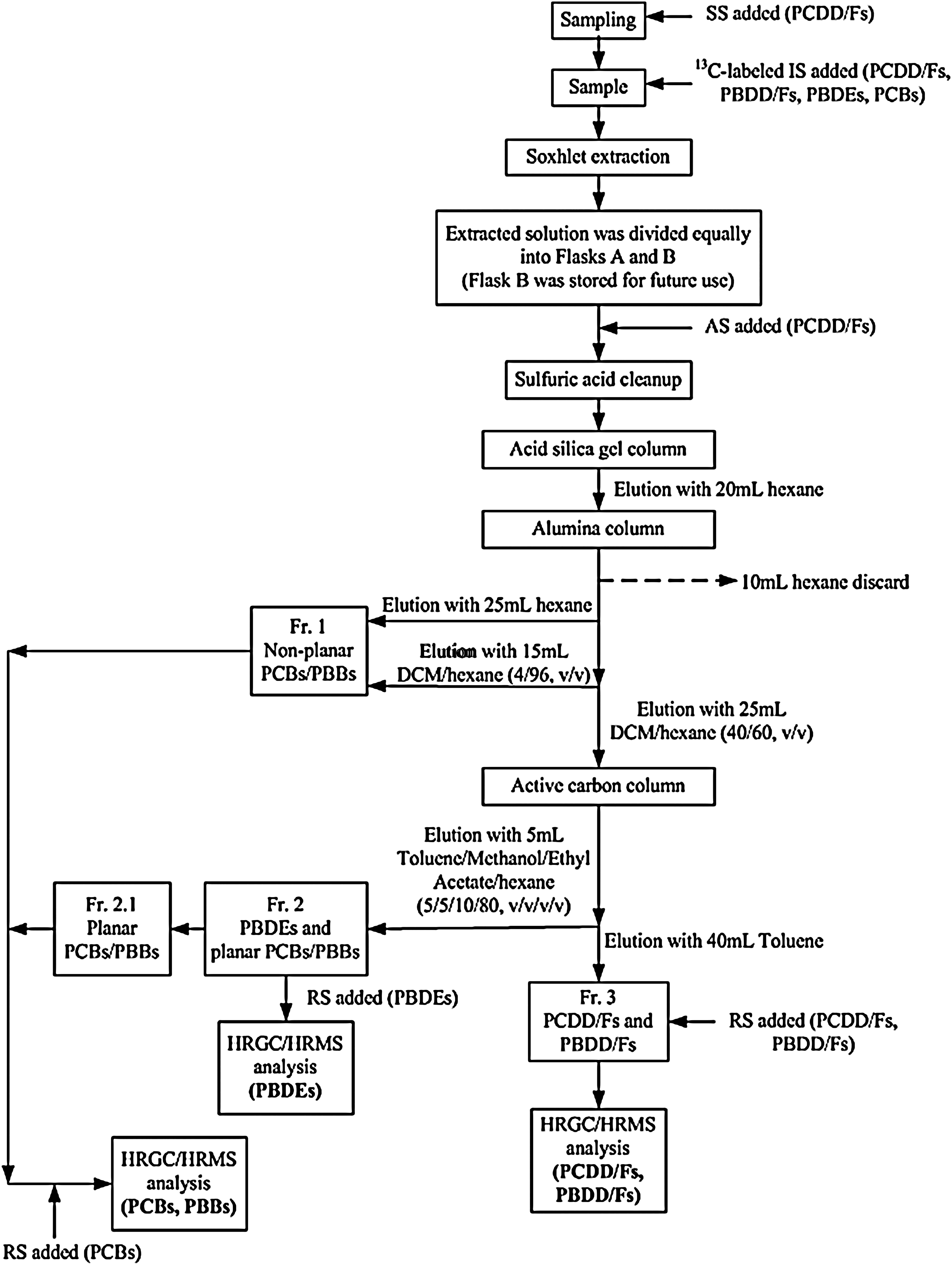
Scheme of sample clean-up and fractionation for the analysis of polychlorinated dibenzo-p-dioxins/dibenzofurans (PCDD/Fs), polybrominated dibenzo-p-dioxins/dibenzofurans (PBDD/Fs), polybrominated diphenyl ethers (PBDEs), polychlorinated biphenyls (PCBs), and polychlorinated biphenyls (PBBs).
After extraction, the extracted solution was divided equally into flasks A and B. Flask A was used to determine the amounts of POPs with the addition of alternate standards, whereas flask B was stored for future use. Ten gas samples from each sampling of MSWI were analyzed for PCDD/Fs, PBDEs, PCBs, and PBBs. The detection limit required that two or three gas samples were concentrated into a combined sample in the extraction stage for PBDD/Fs analysis. Therefore, only four PBDD/F datasets were obtained from the MSWI.
The instrumental analyses of five target compounds were conducted separately using a high-resolution gas chromatograph/high-resolution mass spectrometer. The high-resolution gas chromatograph (Hewlett-Packard 6970 Series gas) was equipped with a silica capillary column (J&W Scientific) and a splitless injector, and the high-resolution mass spectrometer (Micromass Autospec Ultima) had a positive electron impact source. The authors' earlier work detailed the conditions for the analysis of the target compounds (Wang et al., 2010c).
Quality assurance and quality control
Target compounds in the gas samples were identified using the following criteria. The relative retention time of the target compounds matched the corresponding authentic standards (tolerance relative retention time = ± 0.5%); the limit of detection was defined as the amount at which the signal-to-noise ratio was 3 or above; the isotopic ratio of at least two characteristic ions had practical values that deviated by up to 15%. The target compounds were quantified by analyzing calibration mixtures that contained isotopically labeled internal standards. The 13C12-labeled internal standards, as noted above, were spiked into the stack flue samples prior to their preparation for GC/MS analysis. Method detection limits (MDLs) of target compound analyses were determined using the standard deviations obtained from the analyses of seven matrix-spiked samples. The limit of quantification was determined at the signal-to-noise ratio of 10 or above. One field blank was taken during the individual sampling events to evaluate contamination during sampling. Field blanks were air-proofed and loaded into the sampling system. Such field blanks experienced the same handling, storage, and analysis procedures as the real samples. Laboratory blanks were analyzed for each batch of analyses.
Results and Discussion
Quality assurance and quality control results
The recoveries of target compounds in the flue gases were quantitatively checked before extraction and cleanup using 13C12-labeled internal standards. Table 2 presents the average recoveries and RSDs of the 13C12-labeled internal standards (PBDD/Fs, PCDD/Fs, PBDEs, and PCBs). The average recoveries of 13C12-labeled PBDEs ranged from 47% to 133% (RSD = 5.6%–27%), meeting the USEPA Method 1614 (USEPA, 2007) criteria of 25%–150% for the di- to nona-PBDE congeners and 20%–200% for deca-BDE. Mean recoveries of PCBs and PBDD/Fs were 93%–106% (RSD = 3.1%–7.2%) and 58%–133% (RSD = 6.9%–23%), respectively, fulfilling the criteria of USEPA Method 1668A (USEPA, 1999a) (25%–150%) and those of USEPA Method TO-9A (USEPA, 1999b) (40%–130%). The recoveries of 13C12-labeled internal standards added to the samples before extraction for the tetra- to hexa-PCDD/F congeners and the hepta- to octa-PCDD/Fs were within the USEPA Modified Methods 23 control limits of 40%–130% and 25%–130%, respectively. Because of limited availability of individual PBB standards, their recoveries could not be determined. The method detection limits (MDLs) for the developed sample preparation were determined from the standard deviations obtained from the analyses of matrix-spiked samples. The MDLs of air samples for PBDD/Fs, PBDEs, PCDD/Fs, PCBs, and PBBs were 0.070–25.7, 0.262–333, 0.202–6.27, 0.189–6.29, and 0.0731–8.3 pg, respectively.
The average recoveries of PBDEs Precision and Recovery (PAR) standards for sample batchs were 62%–137%, whereas those of PBDD/Fs PAR standards were 95%–127%, both meeting the criteria of being within the range 60%–140% set by the Taiwan EPA (2004). The recoveries of PCDD/Fs PAR standards for the tetra- through octa-chlorinated homologs were between 100% and 122%, satisfying the requirement for PCDD/F analysis (within 70%–130%). The recoveries of PCBs and PBBs ranged from 104% to 116% and from 96% to 104%, respectively, falling within the range 60%–140%, as required. Accordingly, the simultaneous preparation of five-group compounds using multiple columns yielded high recovery and efficiency of determination of their concentrations from one single sample extraction procedure.
PCDD/F and PBDD/F concentrations
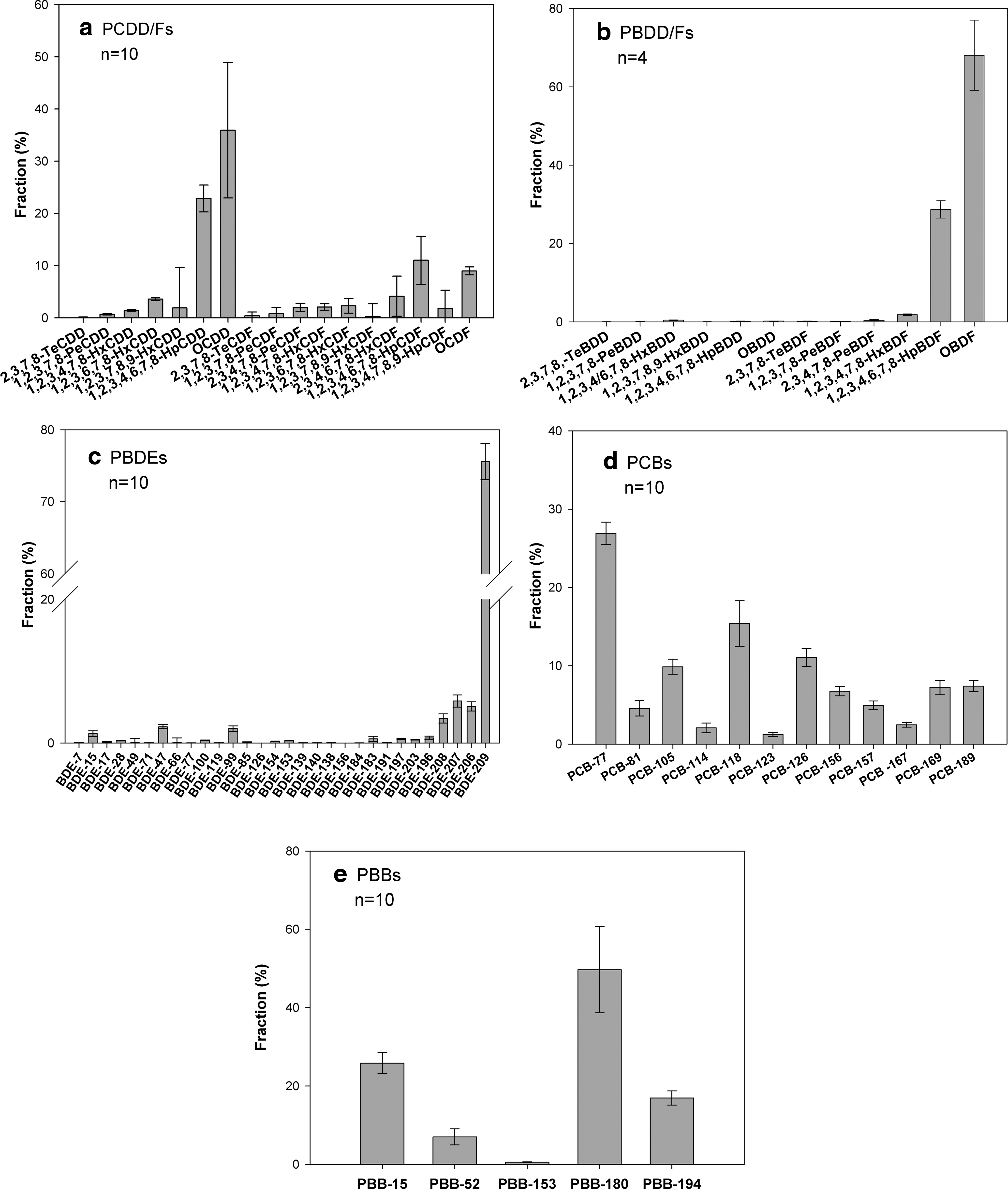
The mean PCDD/F International Toxic Equivalent (I-TEQ) was 0.059 ng I-TEQ/(N·m3) (0.072 ng WHO2005-TEQ/[N·m3]) (Table 3), lower than the PCDD/F emission standard (0.1 ng I-TEQ/[N·m3]) of large-scale MSWIs set by the Taiwan EPA (1997). The ratio of PCDD International Toxic Equivalent (I-TEQ) to PCDF equivalent was 0.595, indicating that most of the toxic equivalent in the stack flue gas of MSWI was associated with PCDFs. The PCDD/F levels obtained from this study are comparable to our previous findings (Wang et al., 2005; Wang and Chang-Chien, 2007; Chen et al., 2008). Figure 2a shows congener profiles of the 17 PCDD/Fs (mean ± SD) that were detected in the stack of MSWI. Each selected congener was normalized to the total weight of all 2,3,7,8-congeners. The concentrations of 2,3,7,8-PCDD/Fs homologs increased with the degree of chlorine substitution and so higher chlorinated congeners dominated in all flue gas samples. The five dominant PCDD/Fs were OCDD (35.9%), 1,2,3,4,6,7,8-HpCDD (22.8%), 1,2,3,4,6,7,8-HpCDF (10.9%), OCDF (8.96%), and 2,3,4,6,7,8-HxCDF (4.12%). The congener profile of the MSWI is similar to those presented in literature (Lee et al., 2004; Wang et al., 2005; Wang and Chang-Chien, 2007).
(
Because of the detection limit, only four PBDD/Fs data were obtained.
BD, below detection limit.
PCDD/Fs, polychlorinated dibenzo-p-dioxins/dibenzofurans; PBDD/Fs, polybrominated dibenzo-p-dioxins/dibenzofurans.
Compared with the PCDD/Fs with commonly reported 17 congeners, only 12 of possible 17 2,3,7,8-substituted PBDD/F congeners were reported in this study because standards of the left five congeners have not been commercially available yet. Presently, the existing information on toxic effects of PBDD/Fs is not sufficient to obtain complete toxicity equivalency factor (TEF) values of PBDD/Fs. According to some present surveys of several biological and toxicological parameters for animals, 2,3,7,8-TeBDD and 2,3,7,8-TeBDF are equipotent to 2,3,7,8-TeCDD and 2,3,7,8-TeCDF. To assess the toxicologically relevant information on PBDD/Fs, WHO (1998) recommends the use of the same TEF values for PBDD/Fs as described for the chlorinated analogs. Accordingly, we calculated the I-TEQ values for PBDD/Fs using the concentrations of seven 2,3,7,8-brominated substitutes and the TEFs of their chlorinated analogs. The mean PBDD/F content (sum of 12 2,3,7,8-substituted congeners) in the stack flue gases of MSWI was 223 pg/(N·m3) (range = 97.1–433, RSD = 69%), with a corresponding mean TEQ of 2.66 pg I-TEQ/(N·m3) (range = 1.71–3.68, RSD = 34%). The sum of the concentrations of seven tetra-hexa congeners (2.51 pg/[N·m3], TEQ content = 0.666 pg I-TEQ/m3) in this study slightly exceeds that (sum of concentrations of same seven congeners) (2.28 pg/[N·m3], TEQ = 0.557 pg I-TEQ/m3) in nine MSWIs in Taiwan, presented elsewhere (Wang and Chang-Chien, 2007). This result is attributed to the use of different furnaces and/or APCDs and the difference between the bromine contents in the feeding wastes in this and the cited studies. The mean PBDD/F concentrations of flue gases in this study are comparable to those in air. The mean PBDD/F content (223 pg/[N·m3]) obtained in this study is around 2 orders of magnitude greater than the PBDD/F levels (sum of levels of 11 mono- to octacongeners) (0.38–11 pg/[N·m3]) in the atmosphere of Osaka district in Japan (Hayakawa et al., 2004) and those (seven congeners) (15–30 pg/[N·m3]) in the air in urban Taiwan (Wang et al., 2008). The observed mean PBDD/F content (223 pg/[N·m3]) is ∼533 times higher than our previous finding for ambient air around the selected MSWI in southern Taiwan (Wang et al., 2010c). Accordingly, the MSWI might be a major source of PBDD/F emission in the local area. With respect to PBDD/Fs, PBDF was dominant in all samples and the most abundant congeners were 1,2,3,4,6,7,8-HpBDF and OBDF, accounting for 28.7% and 68.0% of the total PBDD/F mass, respectively (Fig. 2b). The PBDD/F congener profiles of stack are similar to those observed in the atmosphere (Hayakawa et al., 2004; Wang et al., 2008).
The total TEQ level of PBDD/Fs in the flue gas of MSWI was lower than that of PCDD/Fs, with a mean mass ratio of PBDD/F to PCDD/F of 14% (range = 2.1%–42%, RSD = 43%) and a corresponding mean TEQ ratio of 2.2% (range = 0.55%–5.1%, RSD = 48%) (Table 3), revealing that more PCDD/Fs were formed than PBDD/Fs during the combustion of waste. The Pearson correlation analyses were conducted to study the relationships between the PCDD/F and PBDD/F TEQ levels of the samples. A significant correlation (p = 0.040) exists between the PCDD/F and PBDD/F TEQ levels in the flue gas of MSWI, revealing that they are formed by similar mechanisms in the incineration system and have similar removal rates by APCDs. This finding is consistent with that in an earlier work (Wang and Chang-Chien, 2007).
PBDE concentrations
The concentration of total PBDE (sum of 30 BDEs) was in the range of 9.52–37.7 ng/(N·m3) with a mean of 20.7 ng/Nm3 (RSD = 47%) (Table 4). The emission of PBDEs from MSWIs with electronic recycling to the atmosphere has been identified (Agrell et al., 2004), but no information on PBDE emission from MSWIs is currently available.
PBDEs, polybrominated diphenyl ethers.
One previous work reported total atmospheric levels of 4.5–65 pg/(N·m3) for the mono- to nona-BDEs in Japan (Hayakawa et al., 2004), whereas Agrell et al. (2004) observed atmospheric PBDE concentrations in the range 2.24–21.3 pg/(N·m3) near an MSWI in Europe. The average concentrations of tri- to deca-BDE congeners ranged from 39.1 to 4,105 pg/m3 (mean = 1,068 pg/m3) in the daytime and from 33.7 to 1,649 pg/m3 (mean = 439 pg/m3) in the nighttime at an E-waste dismantling site (Guiyu) in China; BDE-47, −99, and −209 concentrations were extraordinarily high at the site (Chen et al., 2009). These observations are 2–3 orders of magnitude lower than that in this study (20,700 pg/m3). The 20,700 pg/m3 value is also much higher than the atmospheric concentrations (25.7–100 pg/[N·m3]) of total PBDE (sum of 30 BDEs) for the MSWI in our previous investigation (Wang et al., 2010c), leading to a high ratio (397) of the mean concentration of stack flue gas PBDE (20,700 pg/m3) to that in atmosphere (52.1 pg/[N·m3]). Therefore, the MSWI is an important local PBDE emission source.
Followed by BDE 206 and BDE 207, BDE 209 was the dominant congener among PBDEs in the stack flue gas, accounting for more than 76% of total PBDEs (Fig. 2c). Similarly, Hayakawa et al. (2004) and Agrell et al. (2004) found that BDE 209 dominated in PBDEs in the atmosphere in an urban area in Japan and at an MSWI in Europe, respectively. With 23,000 metric tons of market demand in 2001, deca-BDE formulation was historically main technical BDE-based flame retardant used in Asia, whereas penta-BDE had only 150 metric tons of market demand in the same year (Birnbaum and Staskal, 2004). As the used PBDE formulation has been changed from penta- to deca-BDE (Agrell et al., 2004), BDE-209 is the main congener of commercial deca-BDE mixtures and has a larger production volume than other commercial PBDE mixtures. Therefore, BDE-209 was dominant in concentration in the flue gases of the MSWIs and the atmosphere near MSWIs.
According to Pearson correlation analyses, a positive correlation (r = 0.310, p = 0.0165) exists between the PBDD/F concentrations and the logarithms of PBDE concentrations of flue gases. This finding suggests that PBDD/F emission via the flue gases of MSWI was associated with the use of PBDEs as BFRs in electrical products or thermal desorption of PBDEs from PBDE-based BFRs in the feeding wastes of incinerator (Hanari et al., 2006). Nevertheless, further study should be performed to identify emission sources of PBDEs and their effects on the atmospheric environment.
PCB and PBB concentrations
Table 5 presents the concentrations of PCB congeners (represented by their International Union of Pure and Applied Chemistry numbers) in flue gases. The TEQ concentrations of PCB congeners were calculated using WHO 2005 TEF values (Van den Berg et al., 2006). The concentrations of total TEQ ranged between 0.00319 and 0.00750 ng TEQ/(N·m3) (mean = 0.00489 ng TEQ/[N·m3], RSD = 34%), similar to those (mean = 0.006 ng TEQ/[N·m3]) in stack gases of an MSWI in Taiwan (Chi et al., 2006). However, the PCB levels in this study are lower than the mean PCB level (1.72 ng TEQ/[N·m3]) of nine MSWIs in Korea (Chang et al., 1999) and about 1–4 orders of magnitude lower than the total PCBs level (sum of 160 congeners) from eight incinerators in Japan (0.02–44 ng TEQ/[N·m3]) (Kim et al., 2004). In addition to variances of feeding materials and operating conditions, the APCDs may be responsible for the different MSWI PCB levels observed in different studies.
PCBs, polychlorinated biphenyls; PBBs, polybrominated biphenyls.
BD, below detection limit.
Figure 2d shows dioxin-like PCB congener compositions in the flue gas samples. PCB 77 (followed by PCB 118 [∼15.4%]) was predominant in the flue gases, accounting for 26.9% of total PCBs, consistent with the observation at an MSWI but different from that from an industrial waste incinerator in Taiwan (Chi et al., 2006). This result was attributed to unstable operating and waste feeding conditions of the industrial waste incinerator. The total TEQ level of PCBs was lower than that of PCDD/Fs, with a mean ratio of PCB TEQ to PCDDF TEQ of 3.4% (range = 2.0%–4.8%, RSD = 27%). Although PCBs and PCDD/Fs have similar properties and mechanisms of formation, higher distributions of PCBs in the vapor phase (Chi et al., 2006) may result in higher removal efficiencies for PCBs than for PCDD/Fs by APCDs.
Again, Pearson correlation analyses demonstrate a positive correlation (r = 0.794, p = 0.00205) between the PCDD/F and PCB concentrations in flue gases; the PCB TEQ concentrations were also significantly correlated with the PCDD/F TEQ concentrations (r = 0.975, p = 0.00107). The strong correlation between PCBs and PCDD/Fs in mass and TEQ concentrations may be explained by their similar mechanisms of formation and the potential precursors from PCBs to PCDD/Fs (Chang et al., 1999).
Table 5 presents the concentrations of total PBB, ranging from 0.849 to 1.36 ng/(N·m3) (mean = 0.958 ng/[N·m3], RSD = 16%). Among the investigated PBBs, PBB 180 was the dominant species in stack gases (Fig. 2e). Because of limitations in both the standard analytical methods and the reference materials, PBBs in the stack gases have not yet been reported. The mean concentration of PBBs in the MSWI stack gases (958 pg/[N·m3]) is much higher than that in the atmosphere (0.341 pg/[N·m3]) (Wang et al., 2010c), and the ratio of mean PBB mass (MWSI to the atmosphere) was 2,809, revealing that the MSWI is an important PBB emission source to the surrounding environment. For the MSWI, the PBB concentration was correlated positively with the PBDE concentration (r = 0.430, p = 0.0181) but negatively with the log(PBDD/F) concentration (r = −0.780, p = <0.00), indicating that more PBDD/Fs were generated than PBBs under poor combustion conditions. The positive correlation between PBBs and PBDEs in mass concentration is associated with the fact that technical PBDE formulations contain PBB impurities (Hanari et al., 2006).
TEQ contributions of dioxin-like compounds
The contributions of PCBs and PBDD/Fs to total WHO-TEQ (sum of WHO-TEQ concentrations of 17 PCDD/Fs, 12 PBDD/Fs, and 12 dioxin-like PCBs) were calculated based on the sample volume and their corresponding WHO-TEFs. As shown in Tables 3 and 5, the WHO-TEQ values of PCDD/Fs, PBDD/Fs, and dioxin-like PCBs were 0.0719, 0.00169, and 0.00546 ng WHO2005-TEQ/(N·m3), respectively; moreover, 6.9% of total WHO-TEQ was from the dioxin-like PCBs, whereas 2.1% was from the PBDD/Fs. Accordingly, PCDD/Fs contributed more than 91% of the total WHO2005-TEQ in stack gases. Although PBDD/Fs and dioxin-like PCBs contribute limitedly to total WHO-TEQ in the flue gases, the MSWI is a potential source of emission of dioxin-like compounds. Given the persistence and toxicity of PBDD/Fs and dioxin-like PCBs, a combined regulation is recommended to control their concentrations in stack flue gases of MSWIs.
Emission factors
Emission factors of POPs are useful parameters for evaluating their emission potentials. The emission factor (μg/ton-waste) of each target compound was calculated by multiplying the concentration of the compound in the stack gas with the gas flow rate on a dry basis and then dividing this product by the feeding rate of material (waste).
Table 6 lists the emission factors of PCDD/Fs, PBDD/Fs, PCBs, PBDEs, and PBBs in flue gases of the MSWI. The emission factor of PCDD/F (0.310 μg I-TEQ/ton-waste) herein is slightly higher than the value (mean = 0.223 μg/ton-waste) reported by Lin et al. (2007). Different feeding wastes and APCDs probably explain the discrepancy between studies. The total PCB emission factors (0.0207 μg WHO2005-TEQ/ton-waste [0.0204 μg WHO1998-TEQ/ton-waste]) observed from the MSWI in this study were comparable to that (0.014 ng WHO1998-TEQ/kg) from woodstove combustion in the United States (Gullett et al., 2003), but significantly lower than those (6.9–98.3 [mean = 26.4] μg WHO2005-TEQ/ton) from 43 small MSWIs (Choi et al., 2008).
The PBDEs had the highest mean emission factor of all compounds of interest (Table 6). The mean emission factors of PBDEs (84.5 μg/ton-waste) estimated in this study were 2–21 times lower than those (1,200–1,800 μg/ton) from e-waste (such as home TVs) incineration processes in Japan and were lower than those of some industrial processes (such as manufacturing of PBDEs, dismantling and crushing, textile processing, plastic processing, and others) (Sakai et al., 2006). Incinerators are important sources of PBDE emission to the atmosphere (Sakai et al., 2006). However, other potential sources, such as PBDE material manufacturing and recycling, should also be considered.
Conclusions
This study developed sample cleanup procedures combined with a multiple column approach to determine simultaneously the levels of five POPs (PCDD/Fs, PBDD/Fs, PBDEs, PCBs, and PBBs) from single stack gas sample. The mean PCDD/F, PBDD/F, PCB, PBDE, and PBB concentrations in stack gases of an MSWI were 0.0719 ng WHO-TEQ/(N·m3), 0.00169 ng WHO-TEQ/(N·m3), 0.00546 ng WHO-TEQ/(N·m3), 20.7 ng/(N·m3), and 0.958 ng/(N·m3), respectively. Although the dioxin-like PCBs and PBDD/Fs represented only 6.9% and 2.1%, respectively, of the total WHO-TEQ (the sum of PCDD/Fs, PBDD/Fs, and dioxin-like PCBs), the MSWI is a potential source for dioxin-like compound emission. The emission factors of PCDD/Fs, PBDD/Fs, PCBs, PBDEs, and PBBs were 0.300 μg WHO-TEQ/ton-waste, 0.00667 μg WHO-TEQ/ton-waste, 0.0207 μg WHO-TEQ/ton-waste, 84.5 μg/ton-waste, and 1.05 μg/ton-waste, respectively, in flue gases of the MSWI. Therefore, in addition to PCDD/Fs, the emissions from MSWIs of other dioxin-like compounds (such as BFRs) should also be considered.
Author Disclosure Statement
No competing financial interests exist.