







Abstract
Abstract
A batch photo-fluidized bed reactor was designed, and a novel immobilized iron oxide catalyst called “B1” was utilized for the heterogeneous photo-Fenton degradation of reactive black B (RBB). This catalyst adsorbs RBB well and can markedly accelerate the degradation of RBB under ultraviolet irradiation at λ = 365 nm. Effects of ultraviolet intensity, RBB concentration, H2O2 concentration, and the amount of B1 catalyst on RBB degradation were determined. It was found that removal of RBB could be up to 98% at [B1] = 5 g/L, [H2O2]0 = 63.75 mg/L, [RBB] = 100 mg/L, and pH = 4 in 180 min. Moreover, the most attractive quality of the B1 catalyst is that it can facilitate nearly total RBB desorption under alkali conditions (pH = 12), indicating high reusability for industrial applications.
Introduction
The azo dyes that have the -N = N- group as a chromophore in the molecular structure are the most widely used class of dyes in the textile industry and are used for dyeing natural and synthetic materials. Further, many types of dyes (acid, reactive, disperse, vat, metal complex, mordant, direct, basic, and sulfur) are used in textile industries, and reactive azo dyes are the most widely used (van der Zee et al., 2001) because of the simple dyeing procedure (Zhu et al., 2000). Reactive black B (RBB) is used extensively for dyeing cotton fabrics; therefore, it was selected as the representative textile wastewater dye pollutant.
Advanced oxidation processes, which employ highly reactive radical species (HO2, HO) to destroy organic pollutants in wastewater, are often used to treat hazardous organic pollutants (Mondal, 2008; Torrades et al., 2008). The most frequently used advanced oxidation processes include heterogeneous photocatalytic oxidation (Swarnalatha and Anjaneyulu, 2004; Hsueh et al., 2006a), ozone treatment (often combined with H2O2, ultraviolet [UV], or both) (Turan-Ertas and Gurol, 2002; Meriç et al., 2005), and H2O2/UV systems (Georgiou et al., 2002; Neamtu et al., 2002). Moreover, many studies have shown that a variety of organic pollutants can be treated with Fenton's reagents (Fe2+/H2O2) (Kuo, 1992; Walling, 1998), and the main reaction is shown as equation (1) (Walling, 1975). Additionally, there are some other reactions, called “Fenton-like” reactions, which apply Fe3+ instead of Fe2+ as a catalyst to generate hydroperoxyl radicals (shown as equations (2)–(5)). When the Fenton system introduces UV/visible irradiation, it is called the “photo-Fenton” process, and the hydroxyl radicals are generated as shown in equations (6) and (7) (Chen and Pignatello, 1997; Liao et al., 2000; Neyens and Baeyens, 2003).
The generated hydroxyl radicals attack the unsaturated dye molecules and the azo bond (N = N) in the chromogen, resulting in decolorization of the wastewater. Fenton's reagent is efficient in the destruction of organic compounds, but the slurry system caused by the precipitation of ferric hydroxide and difficult catalyst recovery are its main drawbacks. Recent investigations have shown that UV/visible irradiation accelerates both Fenton (Fe2+/H2O2) and Fenton-like (Fe3+/H2O2) reactions, improving the degradation rates of various azo dyes (Aplin and Waite, 2000; Arslan et al., 2000; Xu, 2001; Scheeren et al., 2002; Lee et al., 2003). Although photo-excitation can accelerate the degradation, Fe(III) sludge must also be removed after treatment.
The objective of this study was to use a heterogeneous photo-Fenton system in the photo-fluidized bed reactor (FBR) to treat dye. One specific waste iron oxide called B1, generated by a Fenton-FBR in a dye plant, was utilized as the catalyst. In our previous studies, some waste iron oxides were applied to the degradation of phenol (Huang and Huang, 2008, 2009). The advantages of the heterogeneous catalyst are the prevention of Fe(III) sludge generation in the Fenton system and easy removal. Moreover, the iron oxide used in this system is a kind of waste, which is another method of waste reuse. In this study, the variables that influence the heterogeneous photo-Fenton system are discussed, and the properties of B1 catalyst are investigated. This study can help us to better understand the efficiency of dye degradation and possible reactions.
Materials and Methods
Materials
The manufacture of the B1 catalyst was referred to in our previous study (Hsueh et al., 2006b), but the carrier is SiO2. The characteristics of B1 are listed in Table 1. It is easy to see that the total immobilization iron of B1 was 274 mg Fe/g solid. H2O2 and other chemicals used were purchased from Union Chemical, a chemical company in Taiwan. All the chemicals used were of analytical reagent grade. The RBB was purchased from Aldrich. As is common in procedures of this nature, the dye concentration was prepared in deionized water and used as the stock solution for all studies. The structure of RBB is shown in Scheme 1.
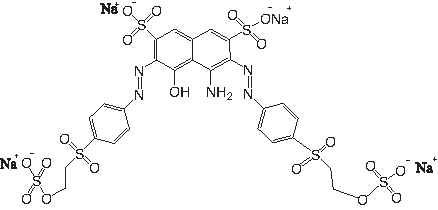
Reactive black B (molecular weight = 903.82 and λmax = 591 nm).
Experimental procedures
The experiments were carried out in a new batch photo-FBR reactor (1.0 L) with a recycle pump for mixing and with four 15-W UV lights (Fig. 1). The fluorescence was a fluorescent black light blue tube (UVP, emission 365 nm). The solution pH was adjusted using perchloric acid and sodium hydroxide using a pH meter (Action, A211). A predetermined quantity of B1 catalyst and H2O2 were dripped into the reactor and stirred with the recycle pump. The reaction time was recorded as the H2O2 solution was added. Samples were periodically pipetted from the reactor and were immediately analyzed after filtration by a 0.25-μm syringe filter made of poly(vinylidene fluoride).
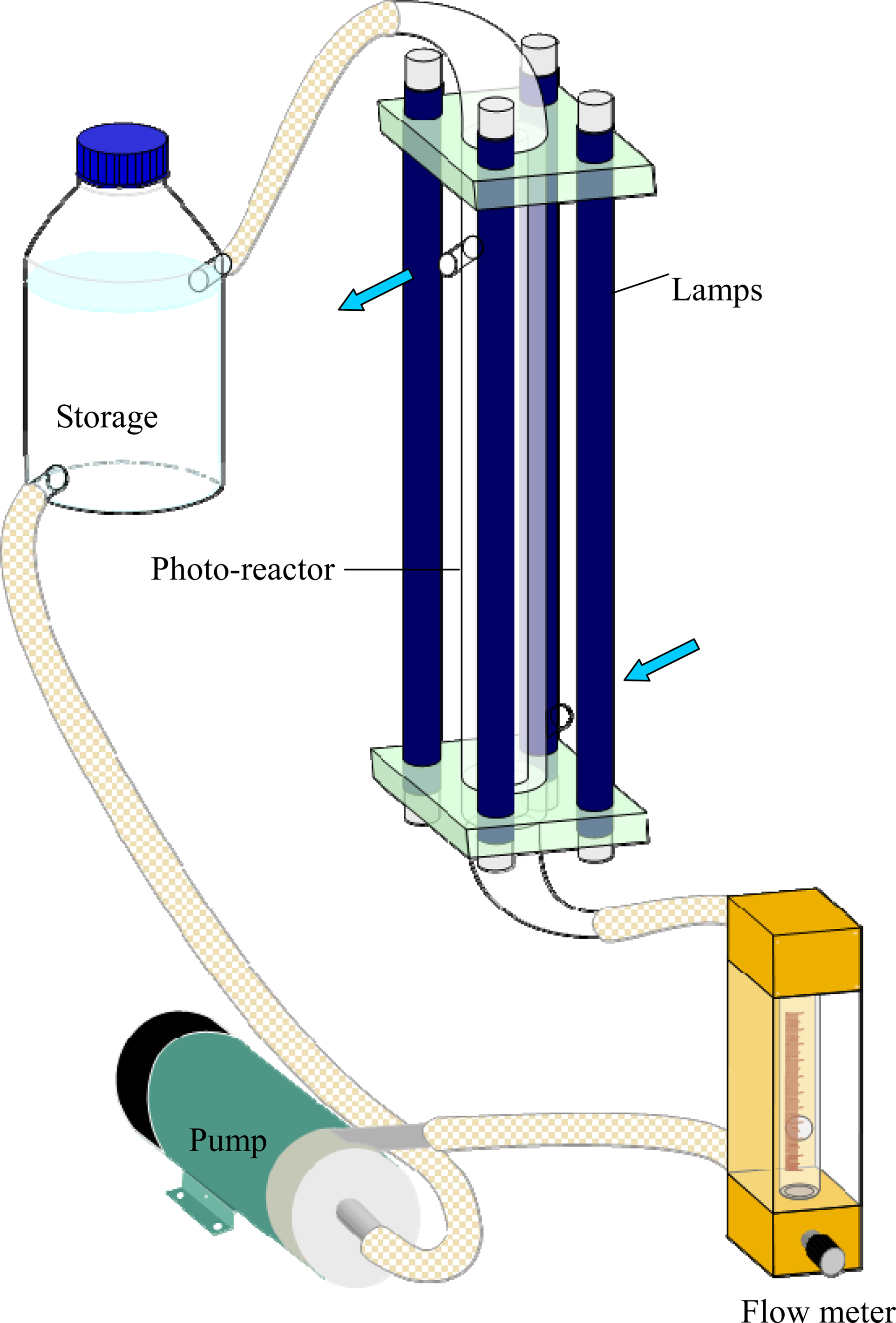
Photo-fluidized bed reactor.
Analytical methods
The UV–vis spectrum of the RBB was recorded from 200 to 800 nm using a UV–vis spectrophotometer (Jasco Model 7850). The maximum absorbance wavelength (λmax) of the RBB was 591 nm. Therefore, the concentration of the azo dye in water was determined by the absorption intensity at λmax. All RBB samples in the oxidation processes were analyzed immediately after sampling so as to prevent further reactions.
Results and Discussion
Effect of pH value
It is possible that the properties of some dyes will change obviously with changes in the pH value. Figure 2 shows the UV absorption diagram and pH value changes. From this diagram it can be clearly seen that the main absorbance at different pH values (pH = 2–11) all occurred at 591 nm. However, at higher pH levels, the absorbance was relatively lower, at 250 and 350–500 nm. At an extremely high pH of 12, the main absorbance, originally at 591 nm, shifted to 630 nm. In this study, the parameters of the pH were set from 2 to 11; therefore, differing pH values did not affect the main absorbance.
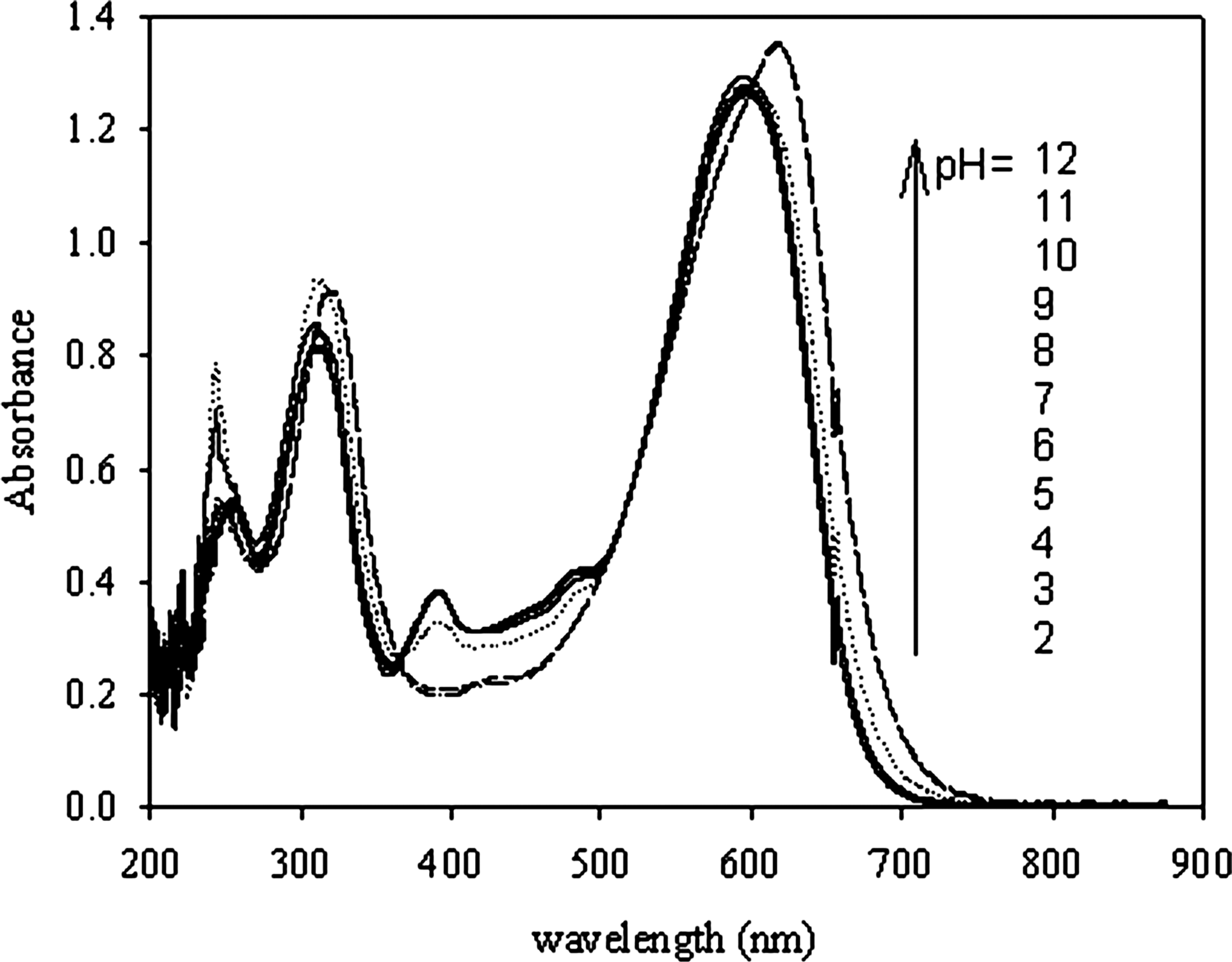
Ultraviolet (UV) absorption at various pH values.
Effect of adsorption and desorption
It can be seen from Table 1 that the B1 catalyst had a large surface area; therefore, the adsorption and desorption of RBB using B1 catalyst must be studied first. The adsorption and desorption curves with time are shown in Fig. 3. The reaction conditions included 10 mg/L RBB, 10 g/L B1 catalyst, and a reaction temperature of 30°C. The pH during adsorption was maintained at 4 and then increased to 12 with the addition of sodium hydride after 24 h of reaction to continue with desorption. Figure 3 clearly indicates that the B1 catalyst showed a high degree of RBB adsorption ability (up to 85% in a 24-h reaction). Moreover, it was noticed that the pH values remained stable (between 3.5 and 4.0) without specific pH control during the reactions. This characteristic benefited the following photo-assistance process because the photo-Fenton system performs best between pH values of 2.0 and 4.0. Moreover, it was observed that about 95% of the RBB could be desorbed from the B1 catalyst, which reveals that the pathways of RBB removal via adsorption or degradation in the following experiments can be realized.
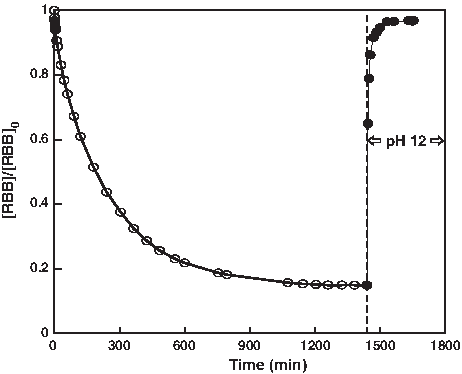
Adsorption and desorption of reactive black B (RBB) with the existence of B1 ([RBB]0 = 10 mg/L, [B1] = 10 g/L, pH = 4 [adsorption], pH = 12 [desorption], and temperature = 30°C). The open circles indicate adsorption, and the filled circles indicate desorption.
Effect of UV intensity
To examine the effects of UV intensity, the experiments were carried out under the following conditions: 100 mg/L RBB, 10 g/L B1 catalyst, 637.5 mg/L H2O2, and zero to four UV lamps at λ = 365 nm. The results are plotted in Fig. 4. It shows that as UV intensity increases, the reaction time required for complete RBB degradation decreases. For example, almost 100% of the RBB was degraded after a 240-min reaction with four UV lamps with an intensity of 3,278 μw/cm2, but only about 97% of the RBB could be degraded without the assistance of UV light. Moreover, previous studies have shown that oxalic acid does not contribute to easy degradation of total organic carbon (TOC) using the Fenton method during the degradation of RBB. However, it can be treated using the photo-Fenton system because UV can enhance the generation of ferrous ions from ferric ions and thus increase oxidation ability (Huang et al., 2008). A comparison of the reaction rates under different numbers of UV lamps is shown in Fig. 5. The reaction rates were calculated from a first-order reaction assumption using two different intervals, from 5 to 45 min and 45 to 90 min, and the kinetics constants were k1 and k2, respectively. This is because, from 0 to 5 min, the slopes were too steep, and there seemed to be turning points at 45 min. The calculated k1 and k2 values were 7.40 × 10⁻³ and 8.00 × 10⁻³, 8.90 × 10⁻³ and 9.70 × 10⁻³, 9.50 × 10⁻³ and 1.17 × 10⁻², 1.03 × 10⁻² and 1.56 × 10⁻², and 1.27 × 10⁻² and 1.48 × 10⁻² min−1 when the numbers of lamps were 0, 1, 2, 3, and 4, respectively. However, in general, the reaction rate increased with increased UV intensity, and the largest observed reaction rate occurred with four UV lamps. Therefore, to ensure sufficient irradiation and to shorten the reaction time, four UV lamps were used in all the experiments.
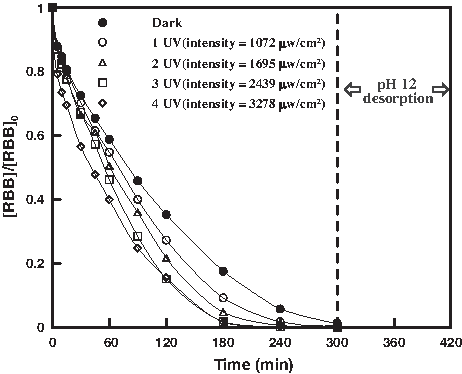
RBB degradation under different UV intensities ([H2O2]0 = 637.5 mg/L, [B1] = 10 g/L, [RBB]0 = 100 mg/L, pH = 4, and temperature = 30°C).
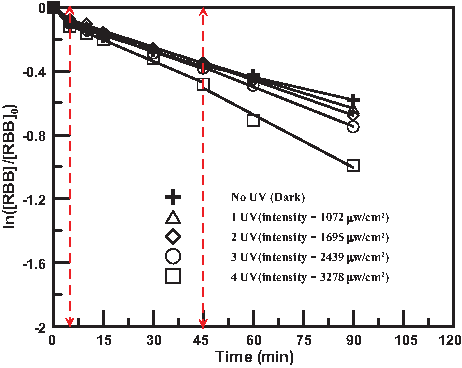
RBB degradation under different UV intensities ([H2O2]0 = 637.5 mg/L, [RBB]0 = 100 mg/L, pH = 4 and temperature = 30°C).
Effect of the initial concentration of RBB
The influence of different initial RBB concentrations in the photo-fluidized bed system is discussed in this section because pollutant concentration is an important parameter in wastewater treatment. RBB concentrations ranged from 10 to 100 mg/L. The results are shown in Fig. 6. It is possible to see that the degradation decreased as the initial RBB concentration increased. For instance, increasing RBB from 10 to 100 mg/L decreased degradation from 100% to 55% in 50 min. The dependence of the first-order kinetics constants (k) on the initial concentrations of RBB was also evaluated. The calculated results showed that the k values decreased significantly with the increase in the initial concentrations of RBB. The k values were 1.58 × 10⁻¹, 1.06 × 10⁻¹, 5.10 × 10⁻², 3.80 × 10⁻², and 2.40 × 10⁻² min−1 when the initial concentrations of RBB were 10, 20, 40, 60, and 100 mg/L, respectively. The increase of RBB concentration increases the number of RBB molecules but not the number of HO· radicals, thus decreasing the removal rate. Moreover, high concentrations of RBB can also influence the penetration of photons entering into the photo-fluidized bed system and thereby decrease the formation of HO· radicals.
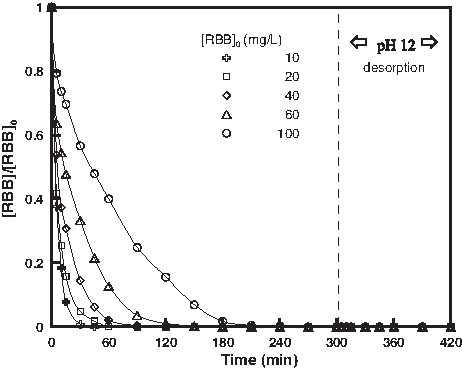
Effect of different initial RBB concentrations ([H2O2]0 = 637.5 mg/L, [B1] = 10 g/L, pH = 4, and temperature = 30°C).
Effects of differing amounts of H2O2 and B1 catalyst
Figures 7 and 8 show the relationships between different amounts of B1 catalyst and different H2O2 dosages. The dosage of H2O2 in Fig. 7 was calculated according to the theoretical value, but in Fig. 8, it is 10 times the theoretical value. When comparing these two figures, it can be seen in Fig. 8 that RBB using different amounts of B1 could be totally decomposed in 210 min, but not in Fig. 7. It is also apparent that the ability of RBB to degrade increased as H2O2 concentrations increased, when the amount of B1 was 15 g/L (from 85% to 95% in 120 min). However, the ability of RBB to degrade decreased when the amount of B1 was 5 g/L (from 52% to 44% in 120 min). Generally speaking, the increase of the H2O2 dosage can promote the generation of HO· radicals, expressed as equation (1). However, when a higher H2O2 dosage is employed, H2O2 is decomposed by the further generation of HO· radicals, and the “scavenging effect” occurs, as described in equation (8) (Hsueh et al., 2006a):
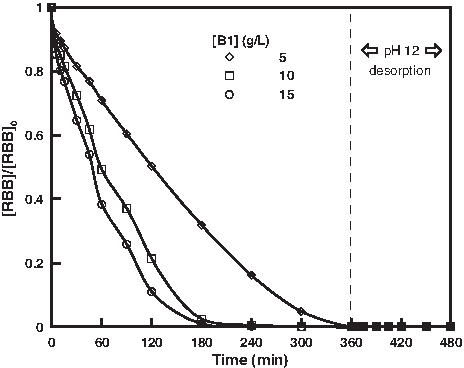
Effect of different amounts of B1 catalyst ([H2O2]0 = 63.75 mg/L, [RBB] = 100 mg/L, pH = 4, and temperature = 30°C).
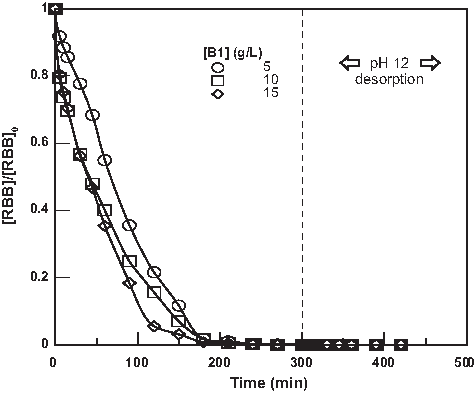
Effect of different amounts of B1 catalyst ([H2O2]0 = 637.5 mg/L, [RBB] = 100 mg/L, pH = 4, and temperature = 30°C).
The amount of B1 catalyst does affect RBB degradation. From Fig. 7, it can be seen that the B1 increase had a positive effect on RBB removal because of equation (7), but opposite results can be seen in Fig. 8. In other words, an increase in the amount of B1 means an increase in ferric ions. The retardation of RBB removal may be attributed to the free radical scavenging effect of the excessive or overdosed Fe3+/Fe2+ concentration, considering equations (7) and (9) (Tang and Huang, 1996):
After the experiment was over, the concentration of leaching iron was recorded as well. The data are not shown here. However, the results showed that the concentration was never higher than 1.0 mg/L. This result further indicated that the catalyst was reusable, as mentioned earlier in the Effect of adsorption and desorption section.
Mineralization efficiency
Although the final decolorization in all experiments was 100%, previous studies have shown that complete decolorization of organic dyes does not mean that they are completely mineralized into water and carbon dioxide. In the chemical oxidation of organic pollutants, mineralization should also be considered, and TOC should be used as the index. A comparison of variables' effects on the removal of TOC and RBB is summarized in Table 2. All samples were taken and analyzed at 300 min. It can be seen that even though the degradation of 100 mg/L RBB reached 100%, the removal of TOC did not reach 100%, but only 60% (see No. 5 and No. 11). Moreover, TOC removal increases with the number of UV lamps, amount of B1, and concentration of H2O2, but decreases as the concentration of RBB increases. The phenomena match the observation of RBB degradation in the previous results mentioned in this study. The residual TOC is proposed from some colorless organic intermediates in the solution after the total degradation of RBB. However, the results of the TOC removal were positive in that they provided information on the efficiency of different combinations of parameters.
RBB, reactive black B; TOC, total organic carbon; UV, ultraviolet.
Reusability study of B1 catalyst
The reusability is one important factor to evaluate the application of one catalyst. The B1 catalyst was used in three consecutive experiments by using fresh dye solution under the conditions of 100 mg/L RBB, 10 g/L B1 catalyst, 637.5 mg/L H2O2, pH 4, and four UV lamps (Fig. 9). Between each experiment, the B1 catalyst was removed from the reactor and then washed with deionized water for several times and dried at room temperature for 2 h using a fan. It is obviously seen that the curves of RBB degradation are similar and no decay of B1 catalyst is found in the three successive tests. Therefore, the results prove the great reusability of B1 catalyst in RBB degradation.
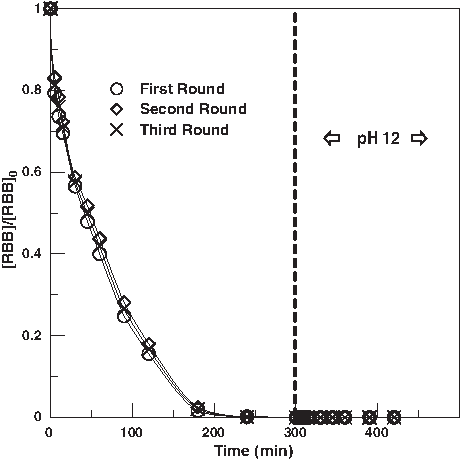
Reuse tests of B1 catalyst ([H2O2]0 = 637.5 mg/L, [RBB]0 = 100 mg/L, [B1] = 10g/L, pH = 4, and temperature = 30°C).
Conclusions
This investigation proposes a novel B1 catalyst to degrade RBB in a photo-FBR. In this study, this catalyst shows excellent ability for not only adsorption of RBB, but also the degradation of RBB at pH = 4. Further, the iron concentration was also measured during the reaction, and the results showed that the concentration was never higher than 1.0 mg/L, which is far below the standard 10 mg/L required by the Taiwan's Environmental Protection Administration. This means that it is not necessary to use other methods to deal with the iron problem. Under proper control, 100% RBB could be removed using this photo-fluidized bed system. Moreover, the most attractive quality of the B1 catalyst is its ability to almost completely desorb RBB under alkali conditions (pH = 12), indicating high reusability with respect to industrial applications.
Footnotes
Author Disclosure Statement
No competing financial interests exist.