







Abstract
Abstract
Rapid population growth and economic development have led to increasing reliance on water resources. For agricultural irrigation systems, reasonable water resource allocation is necessary to support a significant increase in food demand during the next decade. The de novo programming method was effective for seeking a portfolio of resource levels to deal with optimal design problems by allocating a budget. In this study, an inexact agriculture irrigation de novo model was developed to obtain optimal water-allocation strategies for agricultural irrigation systems through the design of optimal agricultural irrigation management systems under uncertainty. This model has the advantages in constructing optimal agricultural irrigation system design via an ideal system by introducing the flexibility toward the available resources in the system constraints. The inexact agriculture irrigation de novo model was then applied to a regional agricultural management problem to design an optimization agricultural irrigation management system under limited budget, instead of finding the optimum in a given system with fixed resources in an agricultural irrigation planning case. The model was taken account into conjunctive use of surface and groundwater resources and some other necessary resources input. Results demonstrate that the developed model efficiently produced stable solutions under different objectives during the planning period. Obtained results can help decision makers identify desired all kinds of resource input for agricultural sustainability within a given budget under uncertainty.
Introduction
In the existing planning models, uncertainty always exists in association with many modeling parameters, for example, spatiotemporal variations in such system components as stream flows and measures of net system benefits can contain a number of stochastic factors (Li et al., 2007a; Qin et al., 2007; Lu et al., 2009a; Ping et al., 2010). In agricultural irrigation management system, some resources input related to crop growth are often also expressed as uncertainties values rather than determinate numbers due to all various kinds of effect factors. Uncertainty analysis was incorporated into model frameworks to account for extensive parameter input and output uncertainties (Huang et al., 1998; Azaiez and Hariga, 2001; Li et al., 2007b; He et al., 2008a, 2008b; Xu et al., 2009a; Gao et al., 2010; Yan et al., 2010). Some optimization techniques considered uncertainties expressed as stochastic, fuzzy, and interval parameters have been developed and applied into various water resource management models for solving these difficulties (Chang and Chen, 2000; Guo et al., 2001; Maqsood et al., 2005; Liu et al., 2009; Xu et al., 2009b; Zhang and Huang, 2010, 2011). The above-mentioned modeling efforts are only capable of handling problems that are in the given agriculture irrigation system optimized by various kinds of traditional optimization approaches, they can hardly be used for solving complex problems in the existence of a limited budget to design the optimal agriculture irrigation system, in which more details of agriculture management system are considered. Meanwhile, they can hardly deal with multi-objective problems in an agriculture irrigation system designed under uncertainty.
In the area of system design, the de Novo method is a useful one and is applied to different kinds of planning problems. The de Novo programming method, initiated by Zeleny (1981), was effective for seeking a portfolio of resource levels to deal with optimal design problems by allocating a budget according to the resource price, where resource levels are considered as decision variables. This approach, therefore, results in an optimal system design, rather than in traditional optimization methods of optimizing the given system. Bare and Mendoza (1988) applied de novo programming to single and multi-objective forestry land management problems. It was proved that the system could be designed to perform in an ideal fashion within a constant budget level. Babic and Pavic (1996) applied the de novo programming approach to possibilities for optimal production plan designing defined taking into account financial constraints and given objective functions. Kotula (1997) used the de novo programming to deal with the control and adjustment of reservoir design and operation characteristics that led to optimal or near optimal system performance throughout the life of the reservoir. The inexact de novo programming (IDNP) can shift the traditional interval programming approach for optimization of a given water resources system to the design of an optimal system, which cannot be achieved through the conventional interval or fuzzy programming methods. Recently, Zhang et al. (2009) developed an IDNP, which can deal with interval information and applied it in water resources management. However, there is no application of IDNP to agriculture irrigation management systems.
Therefore, the objective of this study is to develop an inexact agriculture irrigation de novo model (IAIDM) to design an agriculture irrigation management system under uncertainty under given budget. The modeling parameters or variables can be represented as intervals. A hypothetical case study of regional agricultural irrigation systems planning will be used to demonstrate the applicability of the developed inexact de Novo model; the conjunctive use of surface and groundwater resources will be taken into account in the model; more needed resources input will also be considered in model construction in crop growth. The obtained results will be used to obtain a range of decision alternatives under various system conditions, and, thus, help decision makers identify desired agriculture irrigation management policies under uncertainty.
Model Formulation
In this study, the IAIDM is developed to design an optimization agricultural irrigation management system under uncertainty with a given budget. Surface rivers and groundwater sources are available for serving the water demands of nearby agricultural regions including i farms. Meanwhile, this will involve the consideration of other resource inputs, including seed, fertilizer, pesticide, machinery or equipment, and so on. These resources are also affected by agricultural production budgets. Therefore, to obtain irrigation benefit, the managers need to estimate how much of each resource input should be allocated to each area of irrigation districts and decide the quantity of each crop that should be planted under limited budget. Meanwhile, in agricultural irrigation management system, in terms of the interval uncertain feature of many parameters, such as water availability, resources demands of crops, and price of resources, the IAIDM under uncertainty detailed as follows.
Objective-function
For most of single-objective or multiple-objective planning problems, the objectives are to obtain a maximum/minimum system benefit/cost under a series of constraints. In this agricultural irrigation problem, since the benefit obtained from different water suppliers is predominant, the goals could be the maximization of system benefit. Thus, the objective-function of this problem can be formulated as follows:
Where
Constraints
For this IAIDM, the constraints in agricultural irrigation management system include all relationships among water allocation and other resources allocation-related restrictions, the budget constraints also should be considered. Therefore, detail constraints could be categorized into the following groups:
Agriculture resources mass constraints
In agriculture irrigation system, the income of farmers is mainly derived from the yield of farm; meanwhile, higher yield of crop is also dependent on enough resources inputs in crop growth. This agricultural irrigation planning model can provide estimates of the quantities of all resource inputs and the quantities and types of crops to plant. The detailed constraints are shown as follows:
where
Total budget constraints
The total budget in agricultural irrigation system is mainly originated from crop plant cost and all kinds of necessary resources input cost in crop growth. The total cost of each resource in study system can now be estimated. The details constraints are shown as follows:
where
Technical constraints
The manager of agricultural planning system, in real practice, often considers the minimum plant requirement to guarantee basic income demand. Therefore, some constraints can be presented as follows:
where
Solution method
The above definitions of IAIDM are essential, because there are two kinds of decision variables including design decision variables, such as
Solving Model (1) means finding the optimal allocation of the total budget so that the corresponding resource portfolio maximizes simultaneously the values
The submodel (I) of Model (1) corresponding to
subject to
Let
subject to
Solving problem (I-META) yields
The value
The optimum-path ratio
The submodel (II) corresponding to
subject to
Through solving Model (6), let
subject to
Solving problem (II-META) yields,
The value
The optimum-path ratio
Therefore, through solving the above process,
Summarily, the solution process of the AIDM with the objective being maximized is presented as follows:
Step 1. Formulate IAIDM (1). Step 2. Transform IAIDM into two submodels, where the upper bound of Step 3. Formulate and solve Step 4. Formulate and solve Step 5. Calculate Step 6. Formulate and solve Step 7. Formulate and solve Step 8. Calculate Step 9. Solutions of the IAIDM are: Step 10. Stop.
Case Study
The proposed IAIDM is applied to a case study in a regional agricultural irrigation management problem to demonstrate its superiority. The agriculture manager is responsible for allocating water from two water sources (i.e., one groundwater aquifer and one surface river) to three farms cultivating alfalfa, potato, and wheat (Fig. 1) in study area during three planning periods, with each period having a time interval of 1 year. Meanwhile, consider some main resources inputs affecting crop growth, which consist of fertilizer, pesticide, labor force, and seeds. The total agriculture budget is (550, 700)×106 dollars. To consider the maximum supply earnings for two water sources, the two criteria will be calculated. The unit benefit for each farm of water source during three planning periods is listed in Table 1. The minimum total land needs and minimum proportions of total allocated land to each farm in period are deliberated (Table 1). In this problem, three kinds of farm planning (alfalfa, potato, and wheat), three types of primary fertilizer (nitrogen, phosphorus, and potassium) and three types of primary pesticide (fungicide, herbicide, and insecticide) are considered. The unit quantity of fertilizers or pesticides for each farm at different periods and unit cost of each type fertilizer or pesticide are listed in Tables 2 and 3. Two types' labor forces (human labor and equipment labor) are involved, and the unit quantity of labor and the unit cost of labor for each farm during planning periods are shown in Table 4. The unit quantity and unit cost of seeds for each farm during planning periods are also shown as uncertainty form (Table 5).
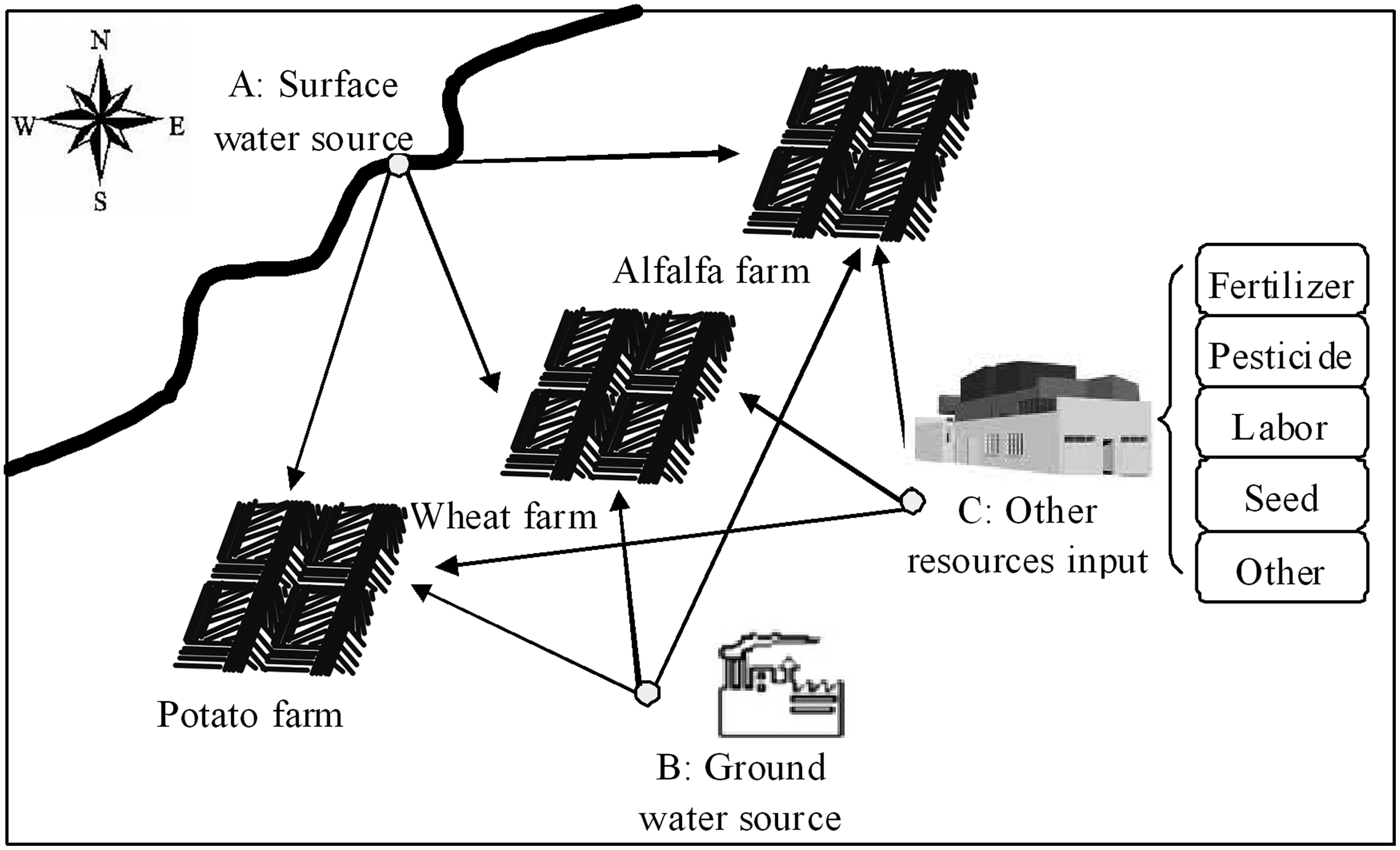
Study area.
The demand of fertilizer and pesticide application is essential to crop normal growth. The information about crops planting is mainly originated from all kinds of historical data, surveys, and research for planning crops in North china region (Chen et al., 2000; Liu et al., 2000; Li et al., 2002; Fan and Xie, 2005; Zhao and Yu, 2006). Consider the uncertainties of the agricultural irrigation systems; the value of fertilizer, pesticide inputs, and quantities fluctuation scope are expressed by interval numbers. Taking wheat as an example, total available Nitrogen required per bushel to maximize production ranges from <2 pounds to >3 pounds depending on the production system (Brown et al., 2005). For estimating specific unit water demands of crops, in the same way, take alfalfa as an example. Water resources supplied to alfalfa mainly consider preseason soil water and effective rainfall during the growing period (Lu et al., 2009b). The previous investigation results indicated that yielding a ton of forage dry alfalfa matter may require 101–254 mm of water (Stichler, 1997; Trostle, 2003; Faulkner et al., 2008) in different regions with changing weather conditions, and water demand peaks in July may be at the level of about 7 mm per day (Kizer, 1991). Therefore, water demands for supporting crops growing is presented as spatiotemporal variations, corresponding to large uncertainty resulting from their direct relations to various factors such as length of the growing season, temperature range, area under each crop, and rainfall periods when the crops are not irrigated. Through the above analysis, unit water demands of each farm during different planning periods may be expressed as interval number form to reflect a true level of parameters being fluctuated (Table 6).
The cost of water for each farm may include an allocated portion of the fixed costs and associated with the channel capacity and ground water pumps. Therefore, the cost of water allocating and pumping for two water sources for each farm during planning periods are considered (as presented in Table 7).
According to the previous contexts, this problem can be solved through the following model:
subject to
The above symbols denote the same meanings as those in Model (1). In agricultural irrigation planning problems, optimal land allocation for different farms will be emphasized due to conflicting revenue target of different water sources balance under a given agricultural investment budget for agriculture manager. To balance the earnings of the competitive water sources under the limited agriculture investment budget, the developed IAIDM could effectively deal with the optimal system design problems, where design parameters could be optimally determined under uncertainty.
Results and Discussion
The solution process is as follows: First, the submodel (I) based on Equation (2) is formulated and solved, for
The minimum budget
Similarly, the IADIM submodel (II) corresponding to
Table 8 indicates that when the budget reaches the upper bound, allocated lands, including land irrigating by surface water and ground water, are mainly used to guarantee basic demand of wheat, then potato and alfalfa in turn during the first planning period, and is up to 3,008.43 ha; similarly, during the next two periods, the allocated lands for wheat planting also are more than that for the potato and the alfalfa. This is mainly because of the highest benefit from planting wheat in each planning period, where land demand is satisfied under a limited budget. Corresponding, the benefits of the other kinds of crops will be increased with the time variation. Considering related water resources allocating, water demand of planting potato from surface water source and ground water source during three planning period would, respectively, be (i) 14,509,367.86 and 1,526,350.00 m3 in period 1, (ii) 1,665,091.11 and 550,020.00 m3 in period 2, and (iii) 1,751,700.00 and 600,300.00 m3 in period 3. The allocated water for potato in different planning periods is mainly derived from surface water source. Correspondingly, the solution of metaoptimum submodel for land and water allocated in different planning periods could be, when the budget is reduced to the lower bound, similarly interpreted based on the results presented in Table 8.
Table 9 shows the solutions about resource inputs obtained through the metaoptimum submodel, which consist of fertilizer, pesticide, labor, and seed applying to three farms in three planning periods. Considering the fertilizer applying in study area, the total quantity of nitrogen in three period would be (192,227.91, 211,655.41) kg in period 1, (26,911.50, 31,230.58) kg in period 2, and (29,451.07, 33,565.19) kg in period 3, and are higher than other kinds of fertilizer applying in the same period; this is mainly because the unit cost of nitrogen is lower than that of phosphorus and potassium in each planning period (Table 2), and the unit quantity of nitrogen for three farms in three planning periods is higher than that of phosphorus and potassium in each planning period, separately (Table 3).
The total quantity of insecticide in three periods, for three kinds of pesticides applying in study area in each period, would, respectively, be (43,593.70, 50,688.10) kg in period 1, (6192.50, 7448.27) kg in period 2, and (6944.52, 8211.37) kg in period 3, and is the highest of three types of pesticides in each planning period (Table 9). The first reason is mainly derived from the unit cost of insecticide, which is lower than that of fungicide and herbicide in the same planning period (Table 2), the other cause is that the unit quantity of insecticide is higher than that of fungicide and herbicide for alfalfa and potato in each planning period, separately (Table 3).
Tables 8 and Table 9 also indicate that the total demand of seed or planting stock for alfalfa, wheat, and potato are varied with allocated land for each farm in each planning period.
Table 10 illustrates that the total allocated land areas in three planning periods are (2518.44, 2617.33), (337.83, 363.47), and (354.58, 381.64) ha, separately. The results obviously show that the land allocation in period 1 is much higher than that of period 2 or period 3. This is mainly because the study agricultural irrigation system would be optimized with allocating all kinds of resource inputs associated with farm planting under limited budget during three planning periods. Meanwhile, the difference of unit benefits and cost for each farm in period 1 is the highest of that of three planning periods, the agriculture decision makers should focus on the basic demand of the farm in each planning period when the budget is low; whenever the budget is abundant, the decision makers can pay more attention to total earnings of study area.
Two water sources are considered to supply agriculture water use for three farms in three planning periods in this study area. Figure 2 shows the allocated water quantity to mainly farms from surface water source and ground water source in different periods. The total water quantity apply from two water sources in period 1 are more than that in period 2 and period 3, separately, which are similar with the allocated land conditions. Moreover, during period 1, the water demand of alfalfa planting is mainly derived from ground water; nevertheless, the water demand of potato planting mainly results from surface water; when the water requirement of wheat is fairly originated from two water sources, relatively. This is because the unit cost of water, which consists of delivering cost and pumping cost, is considered into study area for different farm types in different periods.
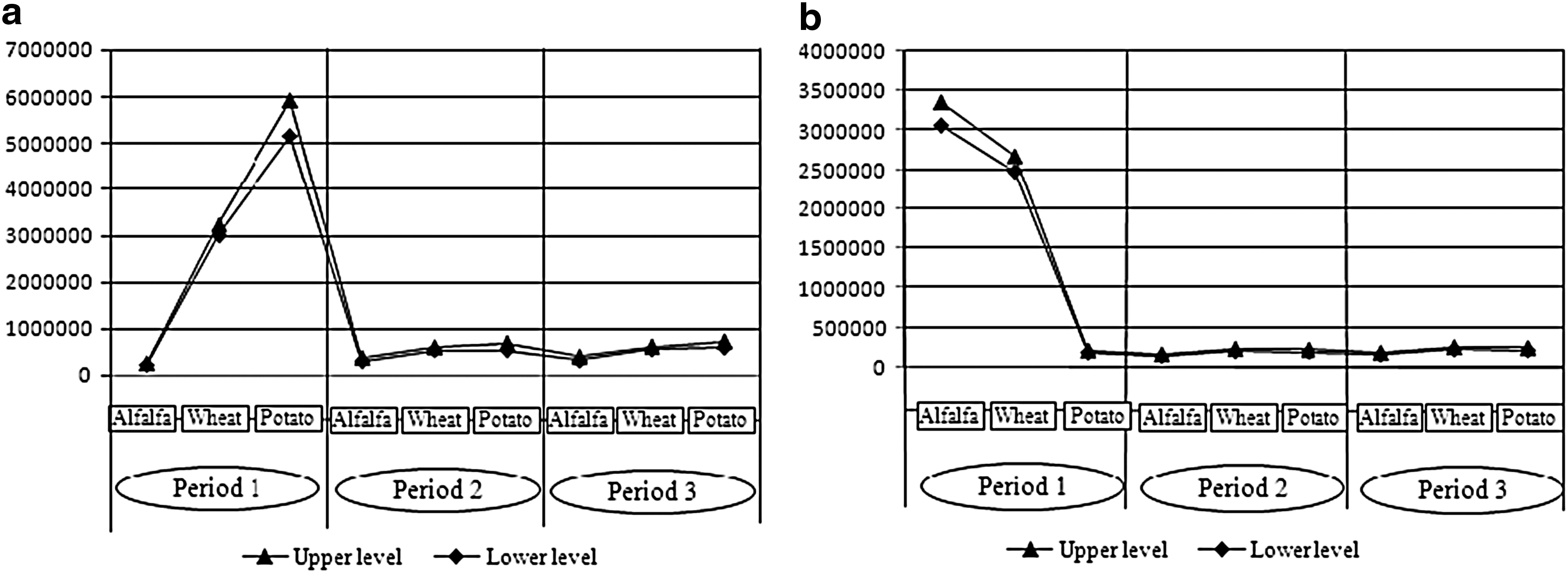
Allocation water quantity (m3) in different water sources:
The basic resource inputs are also critical factors for crop growth and farm land planning. Figure 3 reveals four kinds of resources input for agriculture irrigation. The total quantity of three fertilizers in three periods are presented in Fig. 3a, and similar with allocated land, the total using quantity of three fertilizers in period 1 are higher than that of the following two planning periods. At the same time, applying quantity of nitrogen is more than other fertilizers. Though the fertilizers applyied in period 2 and period 3 are less, the three types of fertilizer applying ratio are similar to conditions in period 1. For pesticide use, the insecticide quantity in each planning period is more than fungicide or herbicide. The insecticide percentage of total pesticide using would be separately 59.53%, 59.71%, and 59.95%, when the quantity of pesticide reaches the upper bound. Compared with labor force, machine labor using is mainly force form in each period, and the ratio of labor for machine labor is up to (71.85, 73.19)% during period 1. The agriculture manager should consider more machine labor applying in agriculture labor forms. For seed or planting stock of three farms, similar with other resources input, the quantity of seed for each farm would be needed more in each period. The potato seed requirement is much more than other farms due to the potato special planting form.
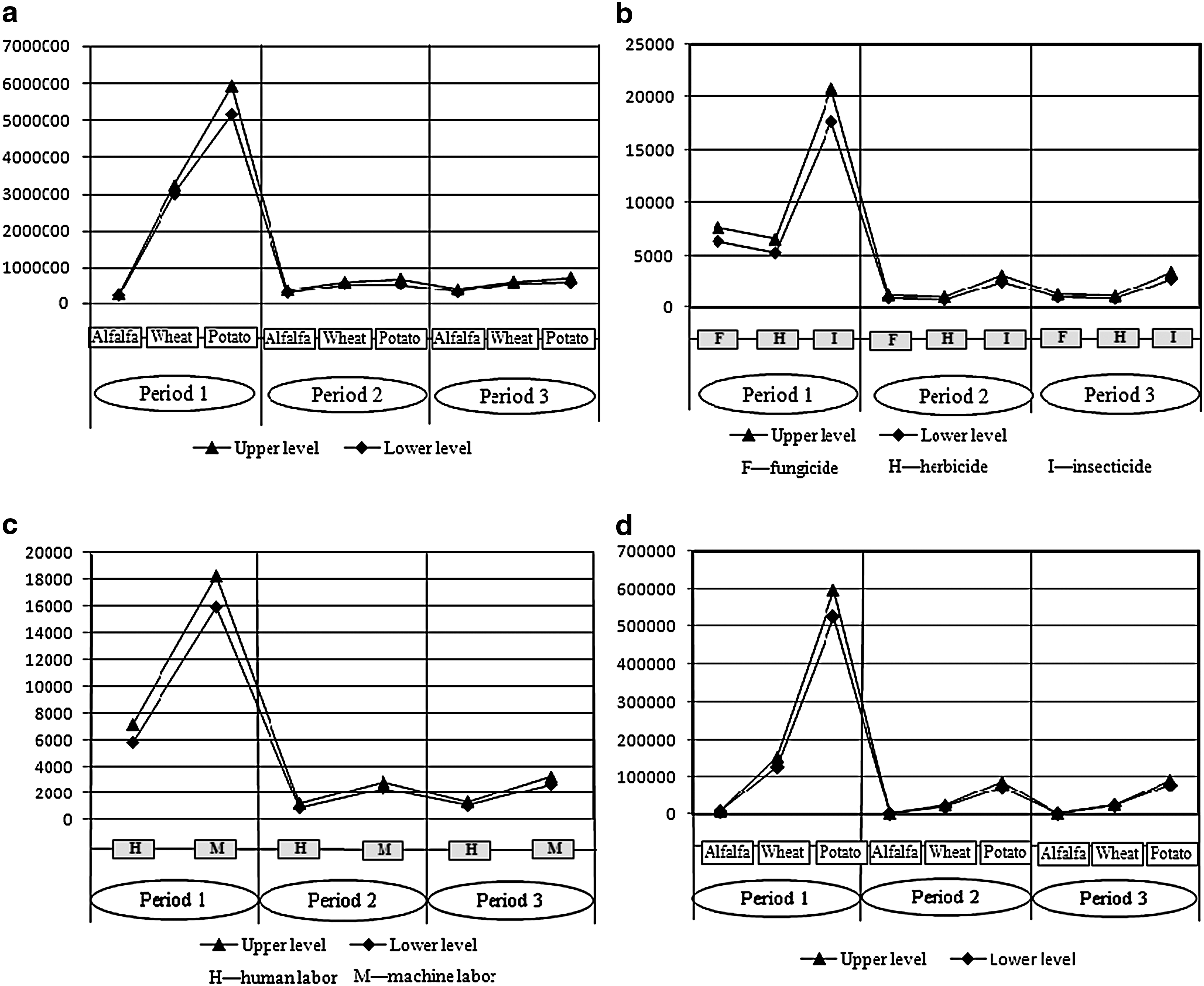
Allocation resources quantity in each planning period:
The inexact de novo approach first applied in an agricultural irrigation planning is especially useful to design an optimal IAIDM. Meanwhile, it can effectively deal with the system design problems involving multiple objectives in true practice agricultural planning system. The IAIDM can allow the decision makers to incrementally reduce the number of the objectives through transforming the objectives into the constraints and, thus, greatly improve the computational efficiency. Moreover, the obtained results can provide effective decision support for the decision makers to design an optimal system. On the other side, compared with conventional multi-objective programming model, the IAIDM is able to obtain two kinds of variables: design decision variables (various resources input for requirement of crop growth) and management variables (allocated land for different farm). Mostly multi-objective programming approaches have limitations in dealing with practice issues of designing optimal systems. The developed IAIDM has the advantages in designing optimal agricultural irrigation system via an ideal system by introducing the flexibility toward the available resources in the system constraints.
The conventional planning problems using fuzzy and/or stochastic program method to construct model mostly focused on optimizing a given system subject to a series of constraint resources that were assumed to be fixed or known. However, in real-world problems, with the example of agricultural irrigation system, the constraint resources have imprecise features, which are difficult to or cannot be determined precisely, such as water using, fertilizer or pesticide allocation, and so on. Compared with the above traditional agricultural irrigation management models, the IAIDM can effectively handle the optimal system design problems within the available resources. These resources are considered decision variables in IAIDM subject to the budgetary constraints, which can, thus, affect the values of the objective values. For example, various resources input target associated with crop growth can hardly be expressed as probability density functions; however, it can be easily defined as intervals.
For more closing to true agricultural irrigation management system, some critical resources input would be considered in agricultural irrigation model, for instance, water supplying, fertilizer and pesticide applying, labor force, and seed using; these are significant for crop planting. To confront the risk of water shortage, agriculture managers often need to supply water from multiple water sources. In this study, the quantity of surface water and ground water are considered in agricultural irrigation management system. The optimized water allocation schemes present that total allocated surface water is more than that of ground water; corresponding, the benefits of surface water source are higher than that of ground water source. In future studies, the details of these issues could be accounted for by respectively considering these costs in the model, which also affect the water allocation from different water sources; the insightful interactions between resources input and optimal strategy could be obtained.
Conclusions
The IAIDM was developed for designing an optimal agriculture irrigation system under uncertainty. The model integrated IDNP within an agricultural irrigation optimization framework. To explicitly examine various complexities in parameters, conventional intervals are communicated into the modeling framework. In its solution process, the IAIDM was transformed into two deterministic submodels, which corresponded to the lower and upper bounds, respectively. For each submodel, the design variables in the agricultural irrigation de novo model were constrained by the total budget. By function transformation, the maximum value of each objective function could be obtained, corresponding to the performance of the ideal design under a given budget. Lastly, a meta-optimum model was constructed and solved to get optimal design solutions.
The IAIDM is applied to a regional agricultural irrigation system where a surface river and a groundwater aquifer exist for supporting the water demand of three farms during three planning periods, and reasonable solutions are obtained. The parameters of the model were represented as intervals. Uncertainties of parameters and decision variables are effectively handled, which makes the model more real. Meanwhile, decision makers are confronted with allocating various resources input for requirement of crop growth. The IAIDM is such an integrated agricultural management model for planning, provision, and management of agricultural irrigation systems. Especially, it can shift the traditional programming approach for optimizing a given agricultural irrigation system to the design of an optimal system, which cannot be achieved through the conventional programming methods.
In multi-objective decision making framework, IAIDM may allow the agriculture managers to achieve a meta-optimal system performance and improve the performance of compromise solutions. The results also suggest that this IAIDM is applicable to many practical agricultural irrigation management problems involving optimal systems design, in which more details related to agricultural irrigation process may be considered. In agriculture irrigation system, fertilizer and pesticide have serious impacts on water quality and cause nonpoint pollution. Therefore, we considered the pollution sources control in this agricultural irrigation optimal designing. The deep study on effect mechanisms of migration and transformation about agricultural nonpoint pollution is not the concern of this research. In future research, we can apply water quality simulation models to control nonpoint pollution. Water quantity and quality problems of regional agricultural irrigation will be deeply identified through simulation and prediction models. The obtained results about water quantity and quality can improve the optimal agricultural irrigation management.
Footnotes
Acknowledgments
This research was supported by the Major State Program of Water Pollution Control, the CWN under the Networks of Centers of Excellence, and the NSERC. The authors are grateful to the editor and the anonymous reviewers for their insightful comments and suggestions.
Author Disclosure Statement
The authors declare that no competing financial interests exist.