







Abstract
Abstract
The novel approach using in situ clogging of small leaks by waterborne or water-formed particles might be used to extend the lifetime or improve the performance of vital water infrastructure assets. Addition of calcium carbonate particles (∼8.8 μm), silica particles (∼29 μm), or wood ash particles (∼160 μm) increased the percent of remediated leaks in iron pipes to 8.3%, 83%, and 83%, respectively, versus 0% in a control with no added particles. Smaller leaks were remediated with a higher percentage of remediated leaks over the 58 day duration of this experiment, as indicated by calcium carbonate with 33% remediated leaks for 280 μm leaks versus 0% for 400–1000 μm leaks; silica, which had 100% remediated leaks for 280–400 μm leaks versus 67% for 700–1000 μm leaks; and wood ash, which had 100% remediated leaks for 280–700 μm leaks versus 67% for 1000 μm leaks. The strength and durability of the clogged leaks could be strong: 27–73% of remediated leaks were able to withstand 100 psi pressure.
Introduction
M
Clogging of leaks by water-formed/waterborne particles
Successful clogging of pipe leaks with water-formed or waterborne particles such as calcium carbonate (CaCO3) or silica (SiO2) in potable water systems (Fig. 1) (Hearn and Morley, 1997; Hearn, 1998; Letterman et al., 2008; Parks et al., 2010; Tang et al., 2013) was applied in Ancient Rome (≈15 BC), where wood ash particles permanently sealed leaks in new terracotta pressure pipelines (Pollio, 1914; Etiegni and Campbell, 1991; Misra et al., 1993; Pitman, 2006; Tang et al., 2013). The concept was lost for almost 2000 years, before Letterman et al. (2008) and others re-discovered the idea and explored its possible application for repair of concrete pipe cracks in the Delaware Aqueduct.
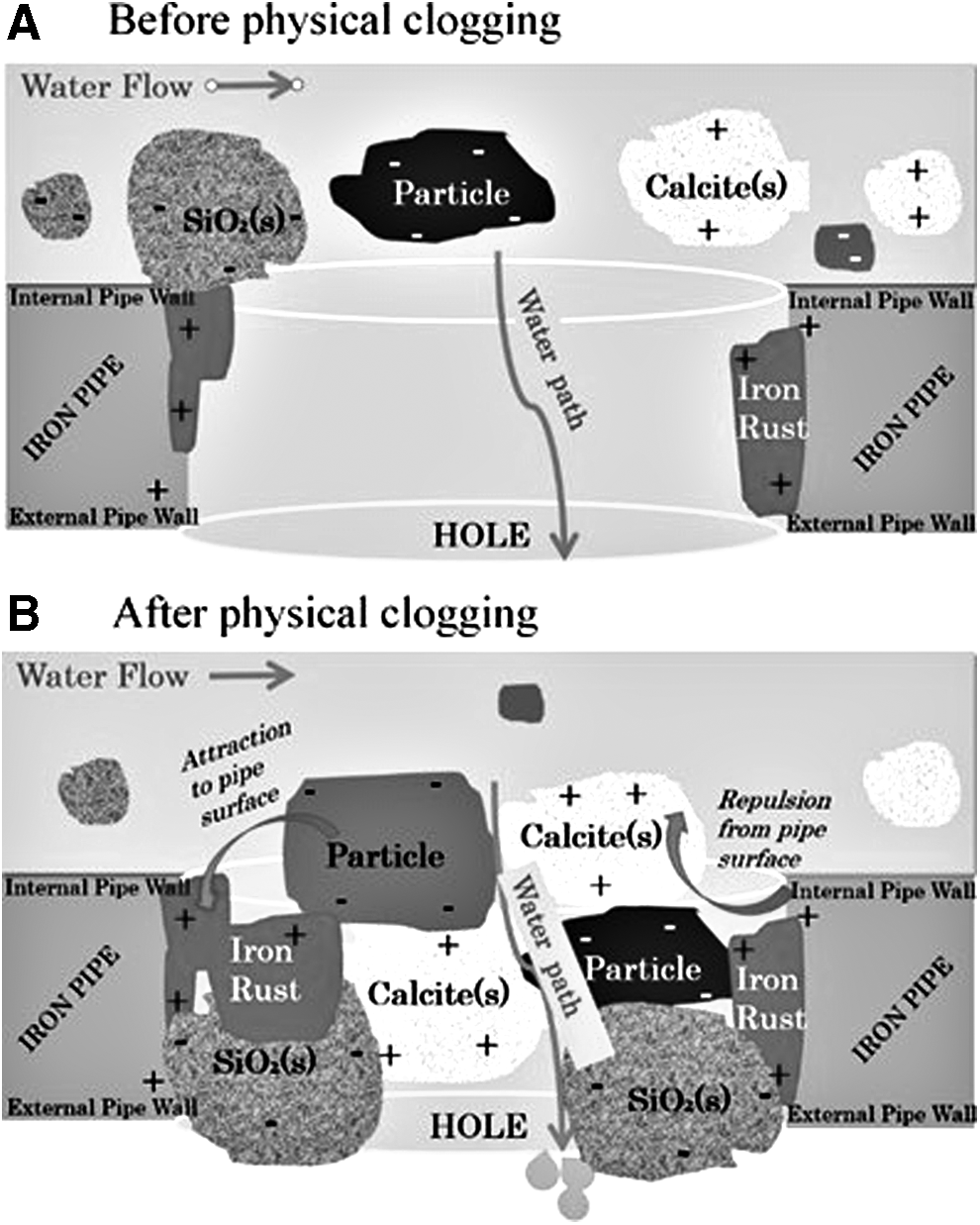
Physical clogging via sieving, diffusion, and charge attraction/repulsion could remediate iron water pipe leaks
Aside from the intentional use of particles to actively clog leaks, it is possible that some problems with declining and leaking water infrastructure may be an unintended consequence of well-intentioned efforts to improve public health and reduce aesthetic concerns. For example, minimizing the amount of particles entering potable water distribution systems as required by the United States Environmental Protection Agency (U.S. EPA) might decrease the likelihood of leak repair that once occurred from particles naturally present in our potable water systems (U.S. EPA, 1986; Tang et al., 2013).
A range of particles might be naturally present in, or purposely introduced to, potable water systems and physically clog leaks (Table 1). CaCO3 particles are naturally present in drinking water and may form in water mains and household plumbing systems when water chemistry is favorable or water temperature is increased (Montgomery, 1985; Brazeau and Edwards, 2011; Edzwald, 2011). Letterman et al. (2008) introduced CaCO3 particles to reduce the water leak rate through simulated concrete crack leaks by 55% within 2.5 h in their bench-scale study. SiO2 particles are also naturally present in drinking water and might contribute to physical clogging (Rushing et al., 2003). Treatment processes such as ballasted sedimentation and sand filtration can contribute silica fines to drinking water and could have a similar impact (Davis et al., 2001; Edzwald, 2011). Other naturally occurring particles, such as wood ash, used by Ancient Romans, can be generated by combustion and generally have varied compositions, including lime, calcite, portlandite, calcium silicate, and other trace chemicals such as aromatic hydrocarbons and polychlorinated biphenyls (Etiegni and Campbell, 1991; Misra et al., 1993; Bundt et al. 2001).
References: Montgomery (1985); Etiegni and Campbell (1991); Misra et al. (1993); Taylor (1995); McNeill and Edwards (2001); Brazeau and Edwards (2011); Edzwald (2011); Tang et al. (2013).
Measurements for particles in Blacksburg, VA tap water.
Physical and chemical parameters effect leak remediation
Particle size is expected to affect the likelihood of leak repair via physical clogging, which involves entrapment of particles by sieving, diffusion, and charge attraction/repulsion forces that are analogous to particle capture during filtration (Fig. 1) (Hearn and Morley, 1997; Benjamin and Lawler, 2013; Tang et al., 2013). Specifically, larger particles will more likely be trapped in leaks via sieving, resulting in improved blockage and leak remediation.
Likewise, water chemistry affects particle size and surface charge, which, in turn, affect the likelihood of capture and leak blockage in leak pores, as in the case of granular media filtration (Somasundaran and Agar, 1967; Kosmulski, 2009a, 2009b; Hanaor et al., 2012; Benjamin and Lawler, 2013; Tang et al., 2013). For instance, water at the particle pHpzc might induce a higher likelihood of remediation as particles tend to be unstable and grow larger, or tend to attach to the walls of leak holes. The reported pHpzc ranges from 8 to 10 for CaCO3, 2 to 4 for SiO2 and is around 8 for interior surfaces of aged iron pipes, which have been long industry standards and comprise ∼33% of the water pipelines in water mains and service lines (Taylor, 1995; Smith et al., 2000; Kosmulski, 2009a, 2009b; Edzwald, 2011). No experimental data for pHpzc of wood ash particles were found. The presence of corrosion inhibitors may also be influential in leak remediation, as the inhibitors could adsorb to CaCO3 particles and prevent them from agglomerating or growing larger (Lin and Singer, 2005).
This study evaluated in situ leak remediation via physical clogging by adding calcium carbonate, wood ash, or SiO2 particles to Blacksburg, VA tap water flowing in iron pipes. These representative waterborne particles had a range of zeta potentials and particle sizes, which could affect their ability to repair leaks. The effect of initial leak size (280–1000 μm) on the likelihood and speed of leak repair, and the strength of clogged leaks were also examined.
Materials and Methods
Materials
Blacksburg, VA tap water
Blacksburg, VA tap water served as the bulk solution in each pipe of our experimental setup (Supplementary Fig. S1). The typical water chemistry was: pH 7.3, alkalinity 40 mg/L as CaCO3, calcium 12.3 mg/L, chloride 25.7 mg/L, silica 6.9 mg/L as SiO2, sulfate 16 mg/L, disinfectant residual chloramine 2.1 mg/L, and zinc phosphate (corrosion inhibitor) 420 μg/L as phosphorus.
Particles
Food-grade calcium carbonate particles (>98% CaCO3) were purchased from Duda Energy (Supplementary Fig. S2). Silica particles (99.5% SiO2) were provided by U.S. Silica and were produced in Berkeley Springs, WV, as SIL-CO-SIL 75 ground silica. Wood ash was collected from an oak wood campfire at Blacksburg, VA, and it was sieved through an 840 μm sieve.
Methods
Experimental setup of galvanized iron coated pipes
Three ¾” OD (19 mm) galvanized iron pipes (Allied Tube and Conduit Corporation) were connected to a domestic Blacksburg tap water outlet at a pressure of 58 ± 3 psi (Supplementary Fig. S1). A one-way polyvinyl chloride (PVC) check valve was installed after the Blacksburg tap water outlet and a PVC ball valve was used to reduce the water pressure to a target pressure of 10 psi, as determined by a pressure gauge (0–100 psi). In each pipe, there were triplicates for all four leak sizes (1000, 700, 400, and 280 μm). All the predrilled leaks were oriented upward, presumably the most difficult leak orientation to clog by particles that are heavier than water, and the leaks were placed 3 in. (7.6 cm) apart (Scardina et al., 2008; Tang et al., 2015; Tang and Edwards, 2017a, 2017b). Each set of leak sizes was drilled every 1 ft (30.5 cm); the largest leak size was closest to and the smallest leak size was furthest from the domestic Blacksburg tap water outlet. All of the connecting elbows, couplings, and pipes were composed of PVC material to avoid the influence of galvanic corrosion between dissimilar metals.
Particle feeding system
CaCO3, SiO2, and wood ash particles (Supplementary Figs. S2 and S3) were continuously mixed with a stir bar in a reservoir (3.9 L) of Blacksburg tap water, before being pumped (Hanna Instruments BL5-1 Blackstone) to two galvanized iron-coated pipes at a water flow of 16 mL/min (pipe 1 and pipe 3 in Supplementary Fig. S1; Table 1).
For pipe 1, CaCO3 particles were pumped during the first 58 days, and then the pipe was flushed with only Blacksburg tap water for 12 days to clean the particulate debris. Afterward, it was pumped with wood ash particles from day 70 to 128. For pipe 3, SiO2 particles were pumped from day 0 to 58. Due to the small flow rate, some fraction of the added particles settled along PVC pipes, PVC pipe joints, and iron pipes, and it did not reach the leak holes.
As a control, the Blacksburg tap water was pumped through the third pipe (pipe 2 in Supplementary Fig. S1) without any added particles for 177 days. The particle feeding system stayed at a water pressure of 10 psi, as confirmed by a pressure switch and a pressure gauge connected to the domestic outlet. The water flowing through each pipe was not recirculated and was drained at the drainage conduit in the laboratory.
Particle size, crystal composition, and zeta potential
The particle-size distribution of CaCO3, SiO2, and wood ash particles in Blacksburg tap water was analyzed by a particle sizer (Model HORIBA LA 300). The zeta potential of particles in Blacksburg tap water was measured by a Zetameter (Model Zeta-Meter System 3.0). The crystal composition of CaCO3, SiO2, and wood ash was analyzed by X-Ray Diffraction (Model Panalytical X'Pert 3 Powder). The surface morphology of these particles was also examined by using an environmental scanning electron microscope with an attached X-ray energy-dispersive system (ESEM/EDS) (FEI Quanta 600 FEG).
Water turbidity and pH
The turbidities of the water leaking from the leak-holes that were closest to and furthest from the domestic Blacksburg tap water outlet were measured daily by using a Turbidimeter (HACH Model 2100N Turbidimeter), and they were denoted as the influent turbidity and effluent turbidity, respectively. The water pH flowing through each pipe was confirmed by a pH meter (Model Oakton 11 Series).
Leakage rate
Leakage rate (L/d) from leak-holes was measured in a graduated cylinder on a daily basis. The success of in situ remediation was defined as the point at which the leakage rate was reduced to zero (Tang et al., 2013, 2015; Tang and Edwards, 2017a, 2017b).
Pressure test
Two phases of pressure tests were conducted after completion of leak repair (Supplementary Fig. S1). In phase 1, the pressure test was conducted by increasing water pressure in 10 psi increments every 3 days up to 60 psi. The pressure test was conducted from day 177 to 196 for the control (pipe 2), from day 127 to 181 for the pipe remediated with CaCO3 and wood ash particles (pipe 1), and from day 67 to 181 for the pipe remediated with SiO2 particles (pipe 3).
In phase 2, all three pipes were disconnected from the domestic Blacksburg tap water outlet and then connected to a separate pressure test apparatus. The unrepaired leaks and the broken leaks in the first phase of the pressure test were covered with black rubber and stainless steel hose clamps. Then, these pipes were filled with water and capped at one end. The pressure test was conducted by pumping nitrogen gas from the other end of the pipes and gradually increasing pressure from 10 psi up to 100 psi in 5 psi increments. The maximum pressure that the repaired leaks could withstand was defined as the pressure at which water started leaking from the repaired holes in both phase 1 and phase 2.
Characterization of remediated leaks
After two phases of pressure tests, the remediated leaks that did not fail at 100 psi were photographed. As the exterior surface was covered with more rust than the interior surface, the rust on the interior pipe surface was carefully scratched off by using sandpaper. The sealing materials inside the leak surface were examined under ESEM/EDS (FEI Quanta 600 FEG). Then, the sealing materials were ejected from the hole by using a drill bit. They were digested in deionized water with 10% concentrated nitric acid and 10% hydroxylamine hydrochloride to ensure complete dissociation of iron corrosion rust. A 10 mL aliquot of the solution was collected and analyzed on a Thermo Electron X-Series Inductively Coupled Plasma-Mass Spectrometer (ICP-MS) according to Standard Method 3125-B (AWWA, APHA, WEF Standard Methods, 1998).
Statistical analysis
A p-value of <0.05 with an alpha (α) value of 0.05 was selected to determine the statistical significance. The proportion test was used to compare the fraction of remediated leaks, and the Spearman's test was used to examine the correlation between the maximum pressure that the remediated leaks could withstand and duration of the repair or water pressure.
Results and Discussion
Remediation of galvanized iron-coated pipe leaks
Natural remediation of iron pipe leaks without added particles (control condition)
The fraction of remediated leaks (i.e., remediation rate) for the control condition was a function of reaction time between the leak-hole and water flowing in the iron pipes at a water pressure of 10 psi (Fig. 2A and Supplementary Fig. S4). None of the 12 leaks was remediated after 58 days, whereas a significantly larger fraction (7/12) of the leaks remediated themselves at the end of the 177-day experiment as defined by the point at which the reduction of leakage rate fell to zero (Proportion test, p < 0.05). For instance, the leakage rate of a 280 μm leak started from 43 L/day and gradually decreased to zero after 87 days (Fig. 2B). Similarly, the leakage rate of a 400 μm leak was initially 72 L/d and reduced to zero after 107 days. This confirms that iron pipes have a natural capability for self-repair even without added particulates (Tang et al., 2015; Tang and Edwards, 2017a, 2017b).
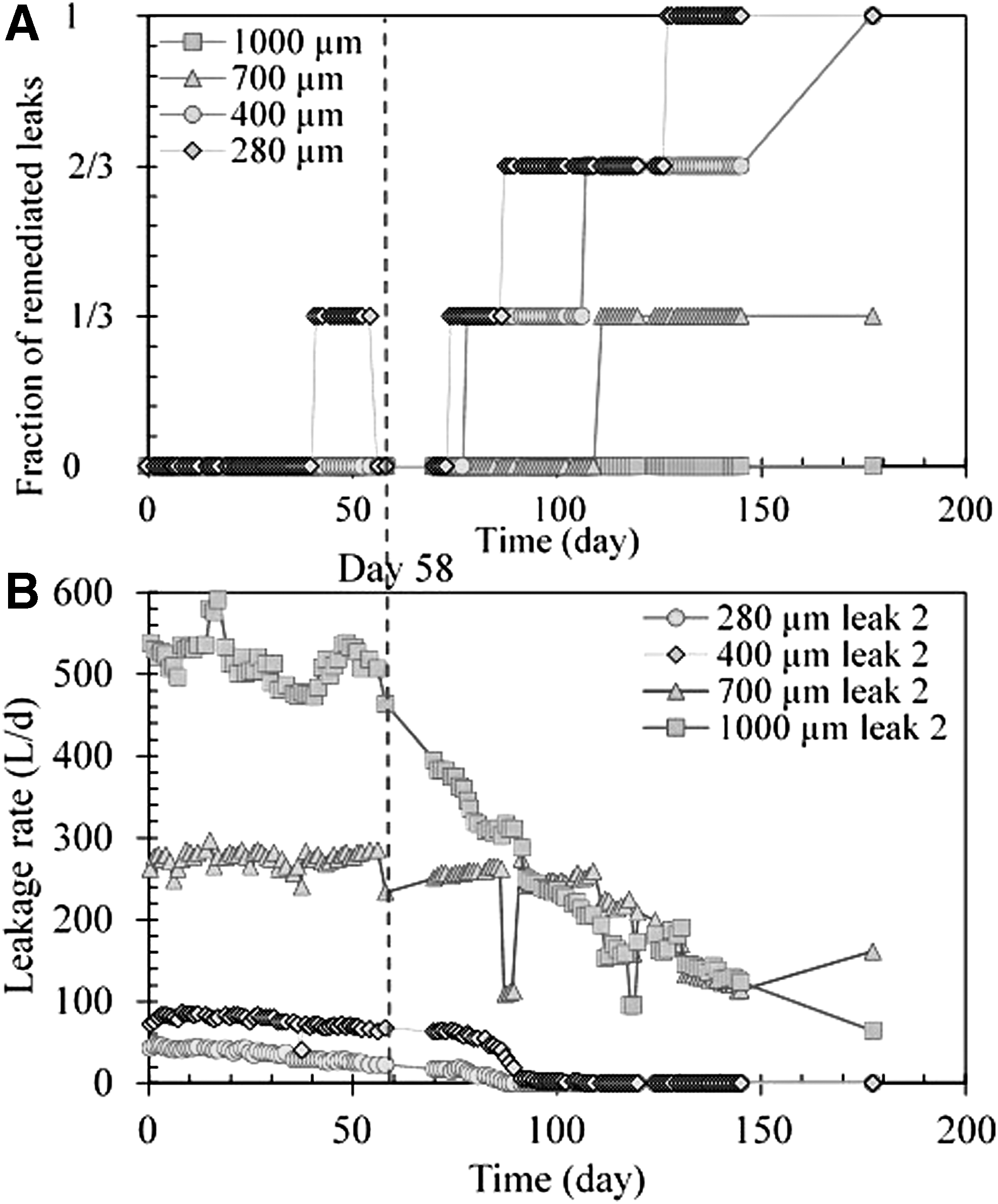
Leak repair of four sizes (280, 400, 700, and 1000 μm) in the 177-day control experiment without any added particles. Fraction of remediated leaks of four leak sizes was a function of the reaction time
Overall, smaller leaks (280 and 400 μm) had a higher remediation rate compared with larger leaks (700 and 1000 μm). At the end of the 177-day experiment, all the 280 (3/3) and 400 μm (3/3) leaks self-remediated but only one out of the three 700 μm leaks and none of the 1000 μm leaks were in situ remediated.
Reduction in the leak rate for all leak sizes during the 177-day experiment was probably caused by the increased water turbidity due to particulates formed from iron pipe corrosion, which has been previously validated for sealing metallic pipe leaks (Tang et al., 2013, 2015; Tang and Edwards, 2017a, 2017b). This was also suggested by the fact that the leaks of the same size further from the Blacksburg outlet always self-remediated faster than those closer to the outlet. The average influent turbidity of the Blacksburg tap water before the iron pipes was 0.18 NTU, which is less than EPA regulations that require less than 1 NTU under all circumstances and 95% of the water samples below 0.3 NTU (U.S. EPA, 1986). But as the tap water flowed through the pipe, more particles were present in the water, as indicated by the roughly doubled effluent turbidity of 0.39 NTU from the pipe rig.
Remediation with CaCO3 particles
When CaCO3 or calcite particles with a mean diameter of 8.8 μm (Supplementary Figs. S2, S5, S6, and S7; Table 1) were added for 58 days, the average effluent turbidity of the Blacksburg tap water was 344–369 NTU, 69–74 times higher than the immediate EPA action level of 5 NTU and 717–1845 times higher than the control condition.
The high level (∼0.3 g/L) of suspended calcite particles did not improve the fraction of remediated leaks significantly versus the control condition after 58 days of the experiment (Proportion test, p > 0.05) (Fig. 3). Only one leak (in the size of 280 μm) out of 12 leaks (8.3%) was remediated after 26 days with calcite particles, and none of the 12 leaks was repaired in the control.
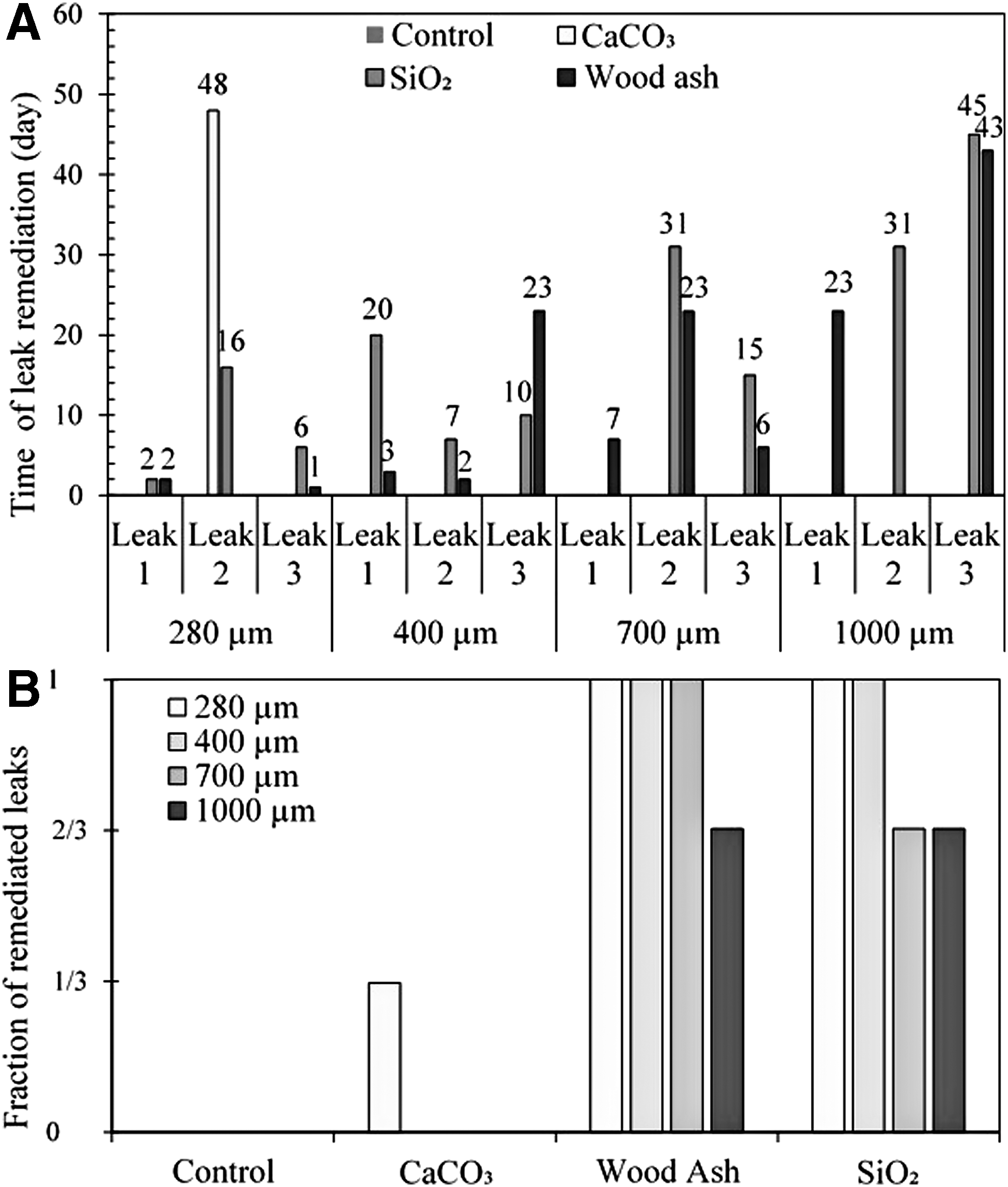
Time of leak remediation
Remediation with SiO2 particles
When larger SiO2 or alpha quartz particles with a mean diameter of 29 μm were continuously dosed to Blacksburg tap water, the average zeta potential of SiO2 was −15.2 mV, making the particles less likely to coagulate to form large particles, compared with CaCO3 particles of 2 mV (Supplementary Figs. S2, S5, S6, and S8; Table 1) (Hanaor et al., 2012). A high average turbidity of 363–383 NTU was measured in water flowing through the pipe with SiO2 particles. The leak remediation with silica particles occurred faster and at a significantly higher rate than the control and the condition with calcium carbonate particles (Proportion test, p < 0.05) (Fig. 3).
During the first 58 days of the experiment, none of the 12 leaks were remediated in the control, whereas all three 280 μm leaks were remediated after 16 days with SiO2 particles. The remediation time of the three 280 μm leaks was 0.7–12 times faster than the one 280 μm leak remediated with calcium carbonate particles. In addition, all three 400 μm leaks were completely sealed after 9 days. One 400 μm leak reappeared after 15 days and then was soon permanently re-sealed after another 4 days. Two 700 μm and two 1000 μm leaks were also clogged in 30 days.
Consequently, 10 out of 12 leaks (83.3%) were successfully remediated with SiO2 particles. The 10 times higher remediation rate with SiO2 particles versus with CaCO3 particles is likely due to both the 2.3 times larger particle size and the 3.3 times larger particle concentration (∼1.3 g/L) in water. Both aforementioned factors could increase the likelihood of leak blockage (Benjamin and Lawler, 2013).
Remediation with wood ash particles
As only one 280 μm leak was successfully remediated with CaCO3 particles after 58 days of testing, the remediation rate of wood ash particles utilized by Ancient Roman engineers was examined thereafter by using the same apparatus after flushing the apparatus with Blacksburg tap water for 12 days. The wood ash particles were then fed for 58 days and had an average size of 160 μm in Blacksburg tap water (Supplementary Figs. S2 and S6; Table 1).
The wood ash in this work was composed of mainly calcite and some minor SiO2 particles (Supplementary Figs. S2 and S5). Wood ash particles in Blacksburg tap water had an average zeta potential of −11.9 mV, similar to that of silica particles (Table 1). It makes the wood ash particles more resistant to coagulation than the CaCO3 particles (Hanaor et al., 2012). Even though the wood ash particle concentration was ∼0.04 g/L, the remediation rate of wood ash was the highest among three particles (Fig. 3).
After 23 days of adding wood ash particles, the remaining two 280 μm, all three 400 μm, all three 700 μm, and two 1000 μm leaks were sealed. After 43 days, the remaining 1000 μm leak was also remediated but another repaired 1000 μm leak broke and stayed open until the end of the 58-day experiment. Overall, 83.3% (10/12) of the iron leaks were remediated with wood ash particles, at the same rate with SiO2 particles. But it was significantly larger than the rate (1/12 or 8.3%) with CaCO3 particles (proportion test, p < 0.05). The remediation rate was the highest with wood ash particles, which were 4.5–17.2 times larger but 85–97% lower in concentration compared with either CaCO3 or SiO2 particles. It suggests that particle size is crucial in leak blockage, especially for larger leak sizes (Benjamin and Lawler, 2013; Tang et al., 2013).
Pressure test
Strength of repair when no particles were added (control, pipe 2)
When the strength of remediated leaks was examined by increasing water pressure in 10 psi increments every 3 days from 10 to 60 psi (the first phase of pressure test), six of the seven repaired leaks (i.e., three 280 μm leaks, three 400 μm leaks, and one 700 μm leak) remained sealed. The only exception was the 400 μm leak, which failed at 40 psi (Supplementary Fig. S9).
When the strength of remediated leaks in the same pipe was examined in another pressure test apparatus by increasing water pressure in 5 psi increments up to 100 psi (the second phase of the pressure test), the sealing materials in one of the six remaining repaired leaks was inadvertently physically disturbed, and the leak that had previously remained repaired at 60 psi could not withstand 60 psi pressure any more (Supplementary Table S1) (Tang et al., 2015; Tang and Edwards, 2017a, 2017b). This sort of disturbance also occurred for two other pipes, and a convention was developed to denote the leak that failed at above 60 psi. The repair under dynamic conditions by changing pressures from 60 to 0 psi was more likely to break than that under static conditions.
The repair was relatively strong, as indicated by the results from both phases of the pressure test (Fig. 4A). About 43% (3/7) of the repaired leaks could withstand more than 100 psi, a relatively high household plumbing pressure (LeChevallier et al., 2014), and 86% (6/7) of the leaks could withstand a typical household plumbing pressure of 55 psi (Joyce and Holder, 2011).
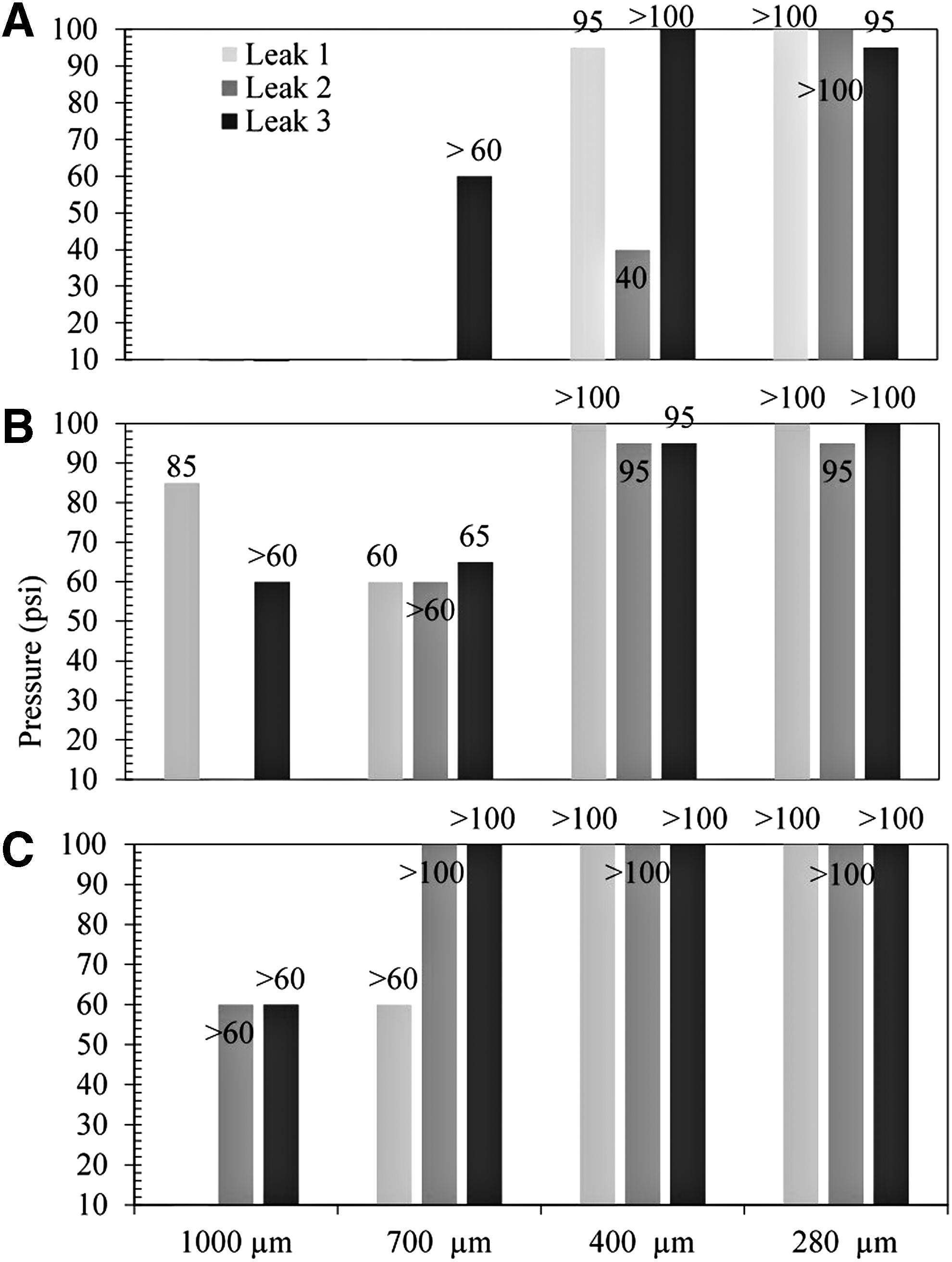
Maximum pressure that the repaired leaks could withstand before leaking again after the first phase and second phase of the pressure test (
Strength of repair when CaCO3 and wood ash particles were added (pipe 1)
The strength of repaired materials when CaCO3 and wood ash particles were added was also relatively strong and resilient (Fig. 4B). About 27% (3/11) of the repaired leaks could withstand a high household plumbing pressure of 100 psi, and 100% (11/11) of them could withstand a typical household plumbing pressure of 55 psi (Joyce and Holder, 2011; LeChevallier et al., 2014).
Strength of repair when SiO2 particles were added (pipe 3)
Overall, the sealing materials remediated with SiO2 particles were strong (Fig. 4C). All 11 repaired leaks (11/11 or 100%) could withstand a typical household plumbing pressure of 55 psi, and 8 of the repaired leaks (8/11 or 73%) could withstand a high household plumbing pressure of 100 psi (Joyce and Holder, 2011; LeChevallier et al., 2014).
It is worth noting that even though conventional wisdom suggests that leakage rate from leak-holes increases as water pressure increases (Hiki, 1981; Lambert, 2001; Greyvenstein and Van Zyl, 2005), one un-remediated 700 μm leak with SiO2 particles was remediated as the water pressure increased from 10 to 60 psi via the natural repair process of iron corrosion during the first phase of the pressure test (Tang et al., 2013, 2015; Tang and Edwards, 2017a, 2017b) (Supplementary Fig. S9). The repaired leak sustained 60 psi and was fully repaired at the end of the 6-month experiment.
Correlation between strength of repair and duration of repair or testing water pressure
It was hypothesized that the strength of clogged leaks could be influenced by the presence of particles, the ambient pressure during repair, or the length of time that a leak had been repaired before testing ( = duration of experiment–time to repair). Pressure testing results from Tang and Edwards (2017a) were compiled and synthesized with results from this work and further analyzed. Contrary to expectations, no strong correlation was observed between the maximum pressure that the remediated leaks could withstand and the duration of the repair or the water pressure of the test (Spearman's, p > 0.05) (data not shown). However, the fraction of clogged leaks that could withstand 100 psi was the highest with SiO2 particles at 73% versus 27–60% for other conditions (Supplementary Fig. S10), indicating that SiO2 particles created a more durable repair when compared with CaCO3 particles, wood ash particles, or no particles.
Surface morphology of the repaired leaks
For the control pipe, the sealing materials in the interior leak surface were identified as a typical iron corrosion rust under ESEM/EDS and on ICP-MS (Supplementary Fig. S11). Specifically, the rust was composed of 63% iron (Fe), 30% oxygen (O), and 7% zirconium on a normalized mass-percent basis with zirconium as a background element due to coating under ESEM/EDS and consisted of 56% Fe, 1.3% Ca, 1.1% Si, and 41.6% of other elements (possibly C and O, which could not be analyzed by ICP-MS) by weight on ICP-MS.
For the pipe remediated with CaCO3 and wood ash particles, the sealing materials inside the pipe surface of one 280 μm leak was 8% C, 29% O, 1% Si, 2% Ca, and 60% Fe on a normalized mass-percent basis under ESEM/EDS and 27.5% Fe, 5.6% Ca, 1% Si, and 65.9% of other elements by weight on ICP-MS. Thus, the clog itself was mostly iron rust with less than 7% of wood ash (mainly calcite) or CaCO3 particles.
For the pipe remediated with SiO2 particles, the inside rust of a 280 μm leak consisted of 33% O, 4% Si, and 63% Fe on a normalized mass-percent basis under ESEM/EDS and 21.8% Fe, 2.8% Ca, 1.2% Si, and 74.2% of other elements by weight on ICP-MS, again showing that the sealing materials were primarily rust products with less than 2.4% SiO2 particles.
Given the dramatic enhancement of the leak repair rate with either the wood ash or SiO2, it was somewhat surprising that the particles were such a minor component of the leak holes. This indicates that waterborne particles act to enhance the natural autogenous repair mechanism that is attributable to iron rust.
Discussion
Zeta potential did not influence remediation rate, as hypothesized. CaCO3, SiO2, and wood ash particles in Blacksburg tap water had a zeta potential of 2.0 mV, −15.2 mV, and −11.9 mV, respectively, making CaCO3 particles slightly more likely to grow and coagulate compared with the other two particles. However, the remediation rate (1/12) with CaCO3 particles was only slightly better than that (0/12) in the control condition (proportion test, p > 0.05), whereas it was significantly worse compared with that (10/12) (proportion test, p < 0.05) with wood ash particles and with that (10/12) with SiO2 particles (proportion test, p < 0.05). It is likely that surface charge controlled the interactions between water particles and iron oxide surfaces (Christl et al., 2012), which were not explored in this work.
Particle size was crucial in controlling the success of iron leak remediation. Overall, larger particles tend to clog the same size leaks at a greater success rate. Though the wood ash particle concentration (∼0.04 g/L) in water was only about 15% of that with the added CaCO3 particles, the 17.2 times larger wood ash particles versus CaCO3 led to 9 times larger remediation, as indicated by the fraction of remediated leaks. Likewise, with only 3.1% of the SiO2 particle concentration (∼1.3 g/L), the 4.5 times larger wood ash particles achieved the same remediation rate as the SiO2 particles.
Leak size was another important factor for determining the success rate of leak clogging (Tang and Edwards, 2017a). In the case of the control condition with no added particles, smaller leak size increased the remediation rate when the reaction time was sufficient. Specifically, none of the 12 leaks (280–1000 μm) was remediated during the first short reaction time of 58 days, whereas all smaller leaks (280–400 μm) and 0–33% of the larger leaks (700–1000 μm) self-remediated at the end of the 177-day experiment. When SiO2 and wood ash particles were added to Blacksburg tap water for 58 days, all smaller leaks (280–400 μm) and 67–100% of larger leaks (700–1000 μm) were successfully remediated. When CaCO3 particles were dosed for 58 days, only one of the smallest 280 μm leaks was remediated.
Observations cited earlier indicate that the addition of particles in a short term can sometimes enhance leak remediation rate. Consequently, efforts over the past century, and especially the past few decades, to minimize turbidity of effluent filtered water, might have reduced the likelihood of leak repair that once might have occurred naturally.
Limitations
This work was the first to investigate in situ iron pipe leak clogging with added water particles under realistic conditions and to demonstrate how particle type can strongly influence the likelihood of leak repair. The work is still preliminary. First, the changes in the fraction of remediated leaks was a cumulative result of all three examined factors (zeta potential, particle size, and leak size). Future work should delve deeper into the role of each individual variable. Second, this preliminary study did not provide a mechanistic explanation for the improved performance of wood ash and silica particles compared with calcium carbonate particles. The zeta potential and surface charge of interior iron oxides in the leak hole could play an important role. Third, particle-size distribution also likely plays an important role, deserving of an additional study. Fourth, flow regimes (turbulent and laminar) influence velocity and settling of water-formed particles and are worthy of future study.
Conclusions
Particle analysis, leakage rate measurement, pressure test, and characterization of sealing materials yielded the following conclusions:
• Without particles, leak repair occurred naturally in galvanized iron pipes, and the fraction of remediated leaks increased with time. • The addition of CaCO3, SiO2, and wood ash particles for 58 days increased the remediation rate from 0% (0/12) in the control condition to 8.3% (1/12) for CaCO3, to 83.3% (10/12) for SiO2, and to 83.3% (10/12) for wood ash. • Smaller iron leaks clogged with waterborne particles were remediated at a higher success rate than larger leaks. • The strength of leak repair was relatively strong and resilient in all three tested pipes. About 27–73% of the repaired leaks could withstand a high household plumbing pressure of 100 psi, and 86–100% of them could withstand a typical household plumbing pressure of 55 psi. • The iron corrosion rust was a dominant component in clogging materials even when particles were introduced, indicating that the addition of CaCO3, SiO2, or wood ash enhanced the natural ability of iron pipes to remediate themselves. • The strength of repair with SiO2 particles was stronger than that with CaCO3 particles, wood ash particles, or no particles.
Footnotes
Acknowledgments
The authors acknowledge the financial support of the National Science Foundation under grant CBET-1336616. They thank Alison Vick for her help with setting up the experiments and data collection. They also thank U.S. Silica for providing the silica particles in this study. Opinions and findings expressed herein are those of the authors and do not necessarily reflect the views of the National Science Foundation.
Author Disclosure Statement
No competing financial interests exist.
References
Supplementary Material
Please find the following supplemental material available below.
For Open Access articles published under a Creative Commons License, all supplemental material carries the same license as the article it is associated with.
For non-Open Access articles published, all supplemental material carries a non-exclusive license, and permission requests for re-use of supplemental material or any part of supplemental material shall be sent directly to the copyright owner as specified in the copyright notice associated with the article.
