







Abstract
Abstract
Heterogeneous photocatalysis with titanium dioxide (TiO2) has been shown to be a sustainable treatment technology to remove natural organic matter (NOM). This is of interest to the drinking water treatment industry. However, heterogeneous photocatalysis with TiO2 continues to suffer from several limitations such as the postrecovery of TiO2 particles, which impede its use in the drinking water treatment industry. In this study, the repeated use of the same photoactive TiO2 embedded into polyethylene pellets (PE-TiO2) made by the controlled-temperature embedding method was studied in the photocatalytic degradation of commercial humic acid (HA) to solve the postrecovery of TiO2 in slurry. Photocatalytic degradation percentage of dissolved organic carbon (DOC) removal with PE-TiO2 was stable after the second use of the same PE-TiO2 pellets, which was evaluated during five tests. PE-TiO2 removed 64.6% of the initial DOC during 270 min of photocatalytic degradation, and TiO2 in slurry removed 64.5% of the initial DOC during 180 min of photocatalytic degradation. Moreover, PE-TiO2 led to a considerable reduction in specific ultraviolet absorbances (SUVA = UV/DOC): SUVA254, SUVA280, SUVA365, and SCOA436 (specific color absorbance) and trihalomethane formation potential (THMFP). Therefore, PE-TiO2 is a promising material to remove NOM and solve the problem of postrecovery of TiO2 particles after water treatment.
Introduction
H
Photocatalytic degradation of NOM by TiO2 occurs in two steps: a preferential adsorption of large aromatic NOM compounds with high UV254 absorption onto TiO2 in the dark, followed by a preferential photocatalytic degradation of the adsorbed NOM into smaller compounds with low UV254 absorption upon irradiation with ultraviolet (UV) light (Tercero et al., 2009; Gora and Andrews, 2017).
NOM is a problem for drinking water production. NOM causes taste, odor and color, fouls membranes, and promotes biological growth in water distribution (Bhatnagar and Sillanpää, 2017). Indeed, NOM is well known as a precursor of carcinogenic and mutagenic disinfection byproducts (DBPs) in water treatment, such as trihalomethanes (THMs), haloacetic acids (HAAs), and so on. (DeMarini, 2011; Koumaki et al., 2015).
NOM is formed by the decomposition of plants and animals in the environment (Uyguner-Demirel and Bekbolet, 2011). Moreover, different activities can increase organic matter concentration and potentially affect organic matter quantity and chemistry such as wildfires in forested watersheds (Tsai and Chow, 2016; Wang et al., 2016). NOM is a complex mixture of organic compounds, ranging from largely aliphatic compounds to highly colored aromatic molecules. Fractionation of NOM based on the adsorption/desorption of the compounds onto/from XAD-8 resin at a specific pH value produces hydrophobic and hydrophilic compounds (Valencia et al., 2013b; Pan et al., 2016).
Hydrophobic compounds form the major fraction of aquatic NOM, constituting more than half of dissolved organic carbon (DOC) in water. Hydrophobic compounds mainly contain aromatic carbon, phenolic structures, and conjugated double bonds. The main components of the hydrophobic fraction are humic substances (HS). HS can be portioned in HA, FA, and humin. On the other hand, hydrophilic compounds contain aliphatic carbon and nitrogenous compounds such as carbohydrates and proteins, sugar, and amino acid (Thurman, 1985).
Heterogeneous photocatalysis with TiO2 continues to suffer from several limitations that impede the drinking water industry from using it. The main technical barriers that obstruct the commercialization of heterogeneous photocatalysis with TiO2 in drinking water treatment are the inefficient exploitation of visible light, the uneven distribution of TiO2 in aqueous suspension, and the postrecovery of TiO2 particles after treatment (Chong et al., 2010; Dong et al., 2015). Postrecovery of TiO2 slurry can be achieved through charge neutralization, coagulation–flocculation and a sedimentation process (Fernandez-Ibánez et al., 2003; Santos et al., 2013), cross-flow filtration (Doll and Frimmel, 2005), or several membrane filtrations (Zhang et al., 2008). Nevertheless, these processes of postrecovery are very expensive.
Several alternatives have been proposed to solve the postrecovery of TiO2 by immobilizing TiO2 particles on various substrates to provide a cost-effective solid–liquid separation. A variety of coating techniques have been used: the sol-gel process, chemical vapor deposition, electrodeposition, thermal treatment methods, grafting, reactive magnetron sputtering, spray pyrolysis, dip coating, spread coating, and so on. (Chang et al., 2009; Augugliaro et al., 2010; Shan et al., 2010; Lugo-Vera et al., 2016). However, these coating techniques are expensive and the required equipment is complex.
Velásquez et al. (2012) reported a controlled-temperature embedding method for immobilizing TiO2 particles on polymer pellets, which is a low-cost technique. In this method, Evonik-P25 TiO2 was dispersed in a polyalcohol medium (glycerine); then the suspension was heated to the melting point of a polymer; next, polymer pellets were added; and finally, the system was cooled. This results in TiO2-embedded polymer pellets. This method has led to a photoactive polymeric material with strongly adherent TiO2 on the surface. In addition, polymer pellets are abundant, easily available, and inexpensive compared with other immobilizer substrates.
In this study, the repeated use of the same photoactive Evonik-P25 TiO2 embedded into polyethylene pellets (PE-TiO2) made by the controlled-temperature embedding method was researched in the photocatalytic degradation of a commercial HA from Sigma-Aldrich (Aldrich-HA), as an aquatic HA representative, to solve the postrecovery of TiO2 in slurry after treatment. The changes on Aldrich-HA after the photocatalytic degradation with PE-TiO2 were monitored by measuring the DOC, and UV absorbance, specific ultraviolet absorbance (SUVA = UV/DOC), and the THM formation potential (THMFP) analysis.
Materials and Methods
Materials
Glycerine (USP), 4-chlorophenol (p.a.; Merck), isopropanol (99.8%; JT Backer), P25 TiO2 (Evonik), and linear low-density polyethylene (PE) pellets (DNDA 8320; specific gravity [sg] = 0.926) were used in this study. Sodium hydroxide (0.1 N), sodium sulfite, and hydrochloric acid (0.1 M) were obtained from Merck, and sodium salt of HA was obtained from Sigma-Aldrich (Aldrich-HA). Water obtained from a Milli-Q system (Millipore) was used for all experiments.
Aldrich-HA was chosen as a model organic matter for being good analog for aquatic HA. The results obtained from photocatalytic degradation of Aldrich-HA have been consistent with those obtained from aquatic HA and NOM from different sources (Huang et al., 2008; Liu et al., 2008; Valencia et al., 2013a). Aldrich-HA has an organic content of 69.98%, carboxylic acid groups equal to 4.38 ± 0.03 meq−1, phenol groups equal to 2.71 ± 0.034 meq−1, and an elemental composition of 5.26% H, 0.74% N, 4.24% S, and 43.45% O (Malcolm and MacCarthy, 1986; Shin et al., 1999).
Controlled-temperature embedding method for TiO2 coating on polyethylene pellets (PE-TiO2)
A TiO2 suspension was prepared by suspending 26 g of Evonik-P25 TiO2 in water at 40°C using a heating magnetic stirrer (Arex) with a digital thermoregulator (VTF; VELP Scientifica). The suspension was mixed using an overhead stirrer (RW 20 digital; Fisher Scientific) and was heated to the melting point of the PE (106°C). Then, 90 g of PE pellets was added. The system was held at the melting temperature for 20 min with mechanical agitation. After that, it was cooled down to room temperature. Finally, the coated pellets (PE-TiO2) were washed with water and dried at 25°C for 24 h (Velásquez et al., 2012).
Characterization, erosion, and reuse tests of PE-TiO2
Thermogravimetric analysis (TGA) of PE-TiO2 samples was recorded on a Linseis STA Platinum series 1600 instrument. The temperature was ramped from 25°C to up to 1,000°C at 10°C/min. The experiments were conducted in air atmosphere. Scanning electron micrographs (SEM) were obtained in a JEOL JSM-6490LV-SEM.
The PE-TiO2 erosion test was performed under extreme conditions to determine the resistance of the coating adhesion of TiO2. Pellets of PE-TiO2 were subjected to the erosion test by sonication and mechanical agitation to assess the erosion behavior of PE-TiO2, where the coated pellets (PE-TiO2) collided with each other. The sonication-erosion test was carried out using 60 mL of isopropanol 1:1 in a sonicating water bath (Elma Ultrasonic LC-30H) at 35 KHz for 1 h. The mechanical agitation-erosion test was done using 150 mL of Milli-Q water with an overhead stirrer (RW 20 digital; Fisher Scientific) at 500 rpm for 70 h. Then, PE pellets were dried at 25°C for 24 h and weighed. A detailed explanation of these methods has been reported elsewhere (Velásquez et al., 2012).
The PE-TiO2 reuse test was studied by repetitive use of the same PE-TiO2 (five tests) on photocatalytic degradation of the Aldrich-HA solution of ρ0(DOC) = 10 mg/L. The changes in the efficiency of photocatalytic degradation of TiO2 were monitored by DOC analysis. For each test of photocatalytic degradation, a new solution of ρ0(DOC) = 10 mg/L of Aldrich-HA was used.
Photocatalytic reactor
Photocatalytic degradation experiments of Aldrich-HA were performed with a batch photocatalytic reactor of Plexiglas with a volume of 4.5 L (external diameter = 13.3 cm, height = 33.0 cm, and thickness = 8.0 mm) and a cooling jacket using water (external diameter = 20.0 cm, height = 33.0 cm, and thickness = 8.0 mm) (Fig. 1a). The photocatalytic reactor was equipped with a stirrer system and an air injector system that pumps air through the suspension to maintain a saturated concentration of dissolved oxygen.
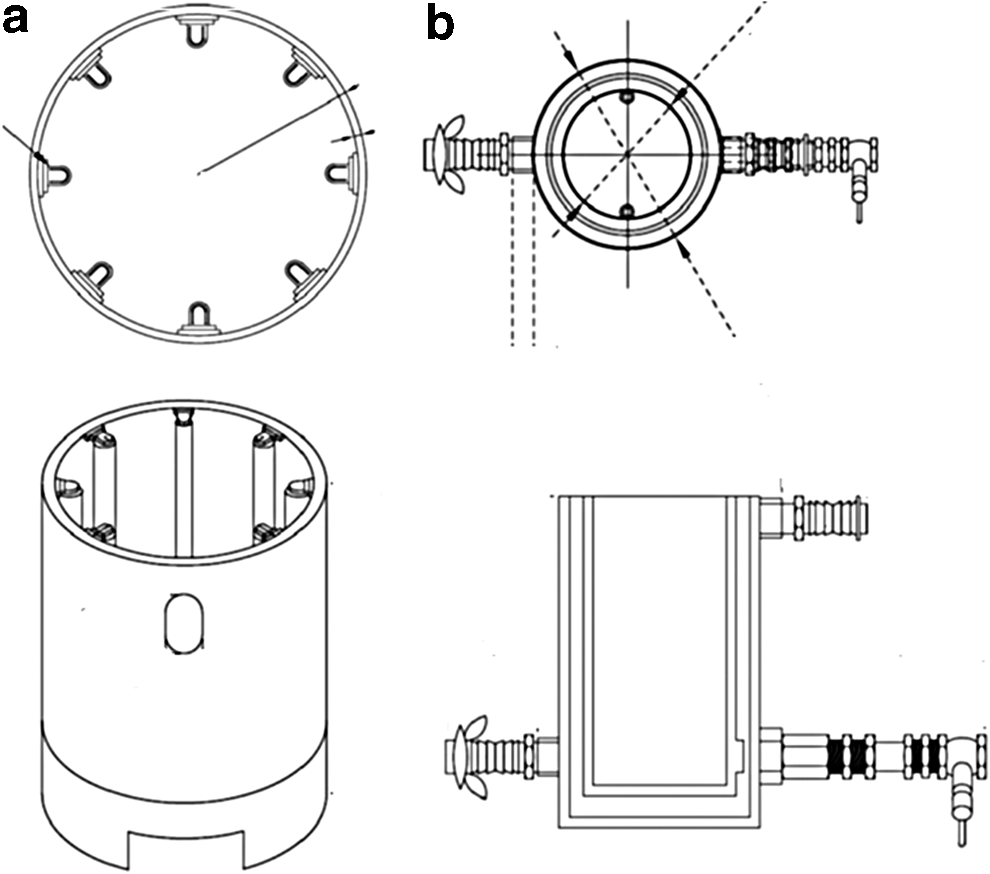
Schematic of photocatalysis system
The UV source was a set of eight UV lamps, each of them supplying 25 W of nominal power (Black Light Bulb; Sylvania) with an output between 310 and 410 nm and a maximum emission at 350 nm (Sylvania). UV lamps were placed vertically around the photocatalytic reactor (external UV lamps) in aluminum housing (outer reflective cylinder; external diameter = 35 cm, height = 46.8 cm, and thickness = 2.0 mm). Highly reflective polished raw aluminum (percent reflected = 56.5) was used as a reflector (Fig. 1b).
Radiometric measurements were performed with a UV-A radiometer, Solar Light (Model PMA 2200, with UV detector), with the detector placed at the center of the aluminum housing, the center of the reactor, and the center of the jacket-reactor at different positions (at the top, in the middle, and at the bottom). Before each measurement was taken, lamps were warmed up for a period of 30 min to stabilize lamp emission.
For each photocatalytic degradation experiment carried out, 3 L of Aldrich-HA with ρ0(DOC) = 10 mg/L and initial pH = 7 was used. PE-TiO2 pellets or TiO2 were loaded and the stirrer system was used. In the TiO2 slurry experiments, after photocatalytic degradation, TiO2 was immediately removed from the reaction medium by 0.4 μm HTTP membrane filters (Isopore; Millipore) before analysis. In this study, all photocatalytic experiments were performed in triplicate.
Aldrich-HA solution preparation
The Aldrich-HA solution was prepared by dissolving 1.0 g of Aldrich-HA in 5 L of water and pH was adjusted to 9 with NaOH, 0.1 N. The sample was stirred overnight; after that, pH was adjusted to 7 with HCl, 0.1 M. The sample was filtered through a 0.45 μm cellulose nitrate membrane filter to remove the undissolved HA. The Aldrich-HA solution obtained was diluted to ρ0(DOC) = 10 mg/L for experiments of photocatalytic degradation.
DOC analysis, UV-visible spectroscopy, and THMFP analysis
DOC was measured with a TOC/TN-analyzer (Torch; Teledyne Tekmar) following Standard Method 5310B (2012). Ultraviolet-visible (UV/Vis) absorbance of the Aldrich-HA was estimated with a spectrophotometer (Thermo Evolution 600). SUVA254, SUVA280, SUVA365 (the specific UV absorbance), and SCOA436 (specific color absorbance) parameters were calculated as indicative of the photocatalytic degradation efficiency of Aldrich-HA. SUVA is defined as the UV absorbance per milligram of DOC (L/[mg·m]), and SCOA436 is defined as Color436 per milligram of DOC (L/[mg·m]).
In the THMFP analysis, all samples were diluted to ρ(DOC) = 3 mg/L and buffered to pH = 7 using a 0.1 M phosphate buffer. Chlorination of the samples was performed using sodium hypochlorite at ρ(Cl2) = 10 mg/L in a ratio of ρ(DOC):ρ(Cl2) = 3:10. After 48 h of reaction in the dark, chlorination was stopped by the addition of sodium sulfite. THM (chloroform, bromodichloromethane, dibromochloromethane, and bromoform) measurements were carried out using gas chromatography on an Agilent Technologies 7890 A GC system gas chromatograph coupled to an Agilent Technologies 5975C VI mass detector (GC/MSD). For the extraction of THMs, headspace solid-phase microextraction (HS-SPME) was performed manually using 75 μm carboxen/polydimethylsiloxane-coated fiber (75-CAR.PDMS). The precision of the method was evaluated by calculating the relative standard deviation (%RSD) of five replicates using THM standards at 100 μg/L. %RSD for precision ranged between 1.4% and 3.3%. The reproducibility of the method was evaluated by peak area using 100 μg/L THM standard in five replicate samples. %RSD for reproducibility ranged between 3.5% and 6.7%. The accuracy was evaluated by the percent relative recovery (%REC) of five replicates. %REC for accuracy ranged between 94.1% and 108.6%. Thus, the method was precise enough to analyze THMs. In this study, all THM analyses were performed in triplicate. A detailed description of THM measurements has been reported elsewhere (Valencia et al., 2013a).
Results and Discussion
Material characterization
SEM of PE-pellet and PE-TiO2 (Fig. 2) show that the TiO2 particles were distributed homogeneously on the surface of pellets, although there were small agglomerated TiO2 particles on the surface and some areas of the pellet without TiO2 particles.
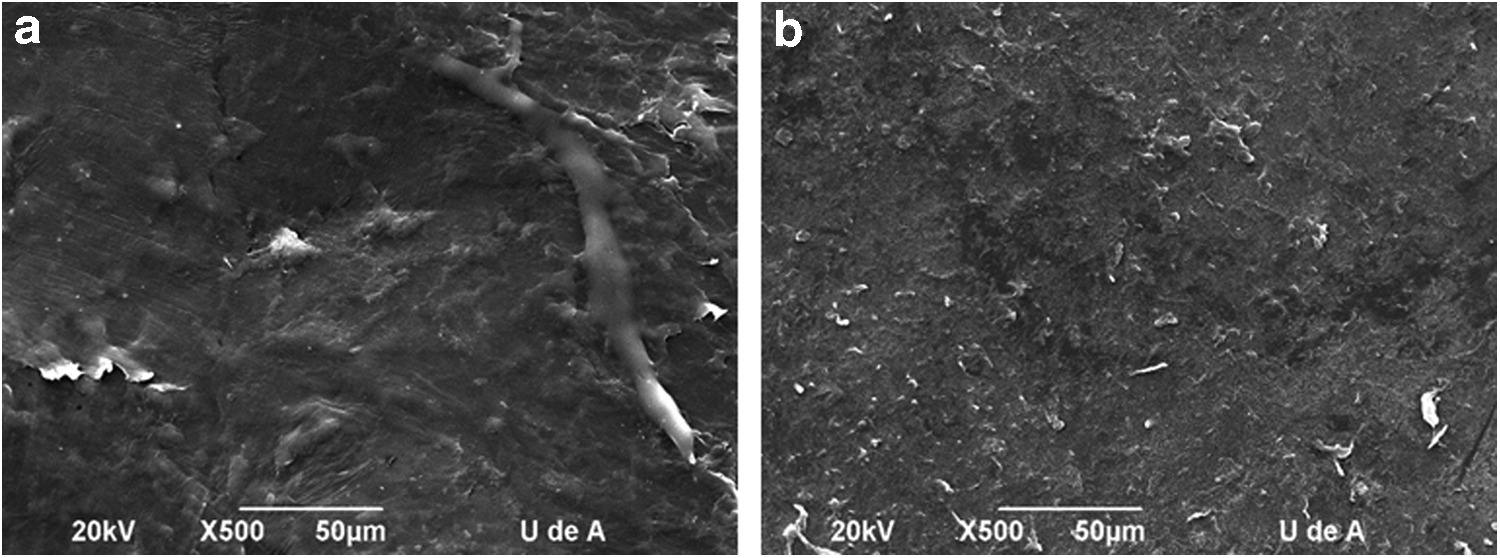
SEM images of PE pellets
TGA reveals that the total weight loss of PE samples heated to 1,000°C was 100% (data not shown). The total weight loss of PE-TiO2 was 95.3% (data not shown). Consequently, the residual weight of the samples calcined at 1,000°C represented the weight of TiO2 coating. The analysis was acquired in triplicate, and the RSD was 4.3%. The weight percentage of TiO2 coating was 4.7% for PE-TiO2. Each pellet of PE-TiO2 contained 1.2–1.5 mg of TiO2, and 100 pellets of PE-TiO2 weighed 3.6 g. Therefore, 3.6 g of PE-TiO2 contained 0.12–0.15 g of TiO2. A detailed characterization of PE-TiO2 material by the controlled-temperature encapsulation method has been reported elsewhere (Velásquez et al., 2012).
Erosion test analysis
Results obtained in the erosion test with sonication and mechanical agitation of PE-TiO2 demonstrated that TiO2 adhered to PE pellets was sufficiently resistant to erosion. There were weight losses of 0.8% and 0.5% under sonication and mechanical-agitation erosion test, respectively. The loss in weight of PE-TiO2 was due to the loss of TiO2 embedded into PE.
Photolysis experiments of Aldrich-HA
Table 1 shows intensities of incident radiation in the photocatalytic reactor (Fig. 1). Plexiglas absorbed 61% of incident radiation, while the water jacket did not absorb radiation.
Set of eight UV lamps, supplying 25 W of nominal power (Black Light Bulb; Sylvania), with output between 310 and 410 nm and a maximum at 350 nm.
UV, ultraviolet.
The photolysis experiment (in the absence of TiO2 or PE-TiO2) of Aldrich-HA with ρ0(DOC) = 10 mg/L at initial pH = 7 was performed using the photocatalytic reactor (Fig. 1) during 480 min of irradiation. There was a removal of DOC of 9% during the first 120 min of exposition; after that, no change in the DOC was observed (Fig. 3). In addition, the photolysis experiment did not lead to a significant decrease in the UV/Vis spectra absorption of Aldrich-HA (Fig. 4). The experiment was performed in triplicate. The repeatability was below 5% of RSD.
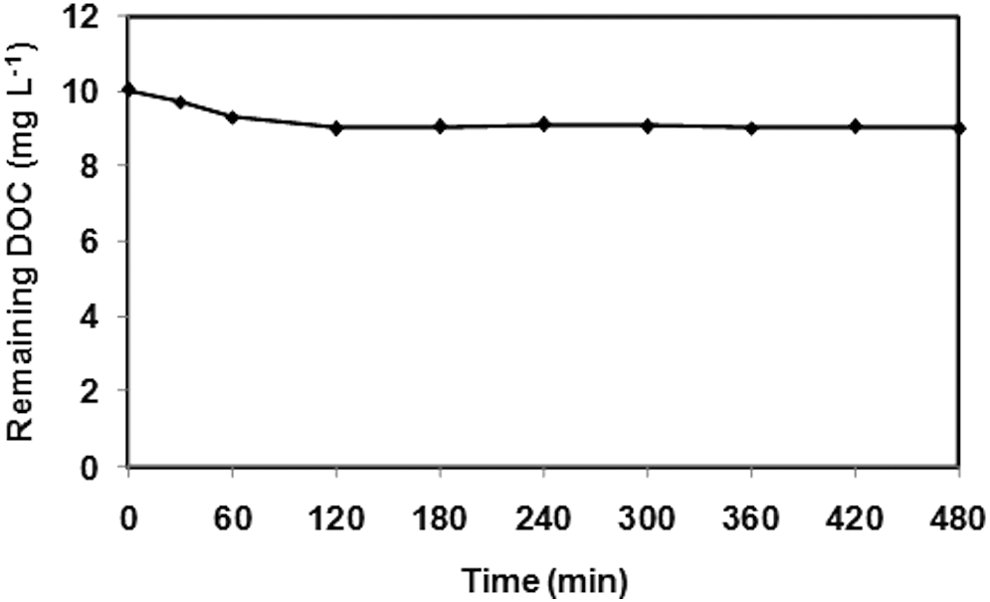
Effect of irradiation time on DOC during photolysis experiment of HA-Aldrich after 480 min of irradiation. ρ(DOC) = 10 mg/L at initial pH = 7. DOC, dissolved organic carbon; HA, humic acid; HA-Aldrich, humic acid from Sigma-Aldrich.
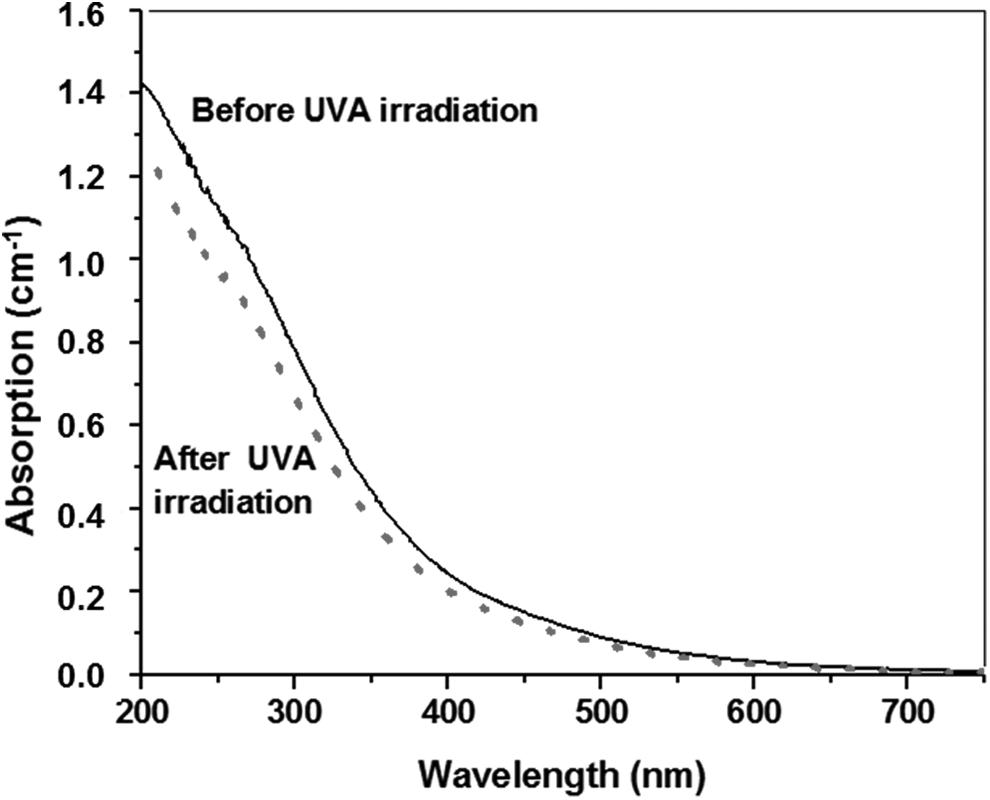
Effect of irradiation time on UV/Vis absorption spectral during photolysis experiment of HA-Aldrich after 120 min of irradiation. ρ(DOC) = 10 mg/L at initial pH = 7. UV/Vis, ultraviolet/visible.
Adsorption experiments of Aldrich-HA onto PE-TiO2 and TiO2
Adsorption experiments in the dark with 3 L of Aldrich-HA solution with ρ0(DOC) = 10 mg/L at initial pH = 7 and ρ(TiO2) = 0.6 g/L in slurry or ρ(PE-TiO2) = 18.1 g/L [approximately ρ(TiO2) = 0.6 g/L] showed that equilibrium of Aldrich-HA on TiO2 or PE-TiO2 was reached in <5 min (data not shown). An adsorption time of 60 min was chosen to ensure saturation for all subsequent experiments.
Photocatalytic degradation experiments on Aldrich-HA with TiO2 in slurry and PE-TiO2
Figure 5 shows the remaining DOC as a function of TiO2 dosage in slurry after adsorption in the dark to reach the equilibrium state, and after photocatalytic degradation with 180 min of UV irradiation time. The experiment was performed in triplicate. The repeatability was 4.5% of RSD. DOC removal during photocatalytic degradation in slurry was larger with increasing ρ(TiO2) between 0.1 and 0.6 g/L due to bigger number of active sites. At higher ρ(TiO2), DOC removal remained constant because the turbidity of TiO2 suspension reduced the effective UV irradiation. Therefore, the optimum ρ(TiO2) was 0.6 g/L in slurry.
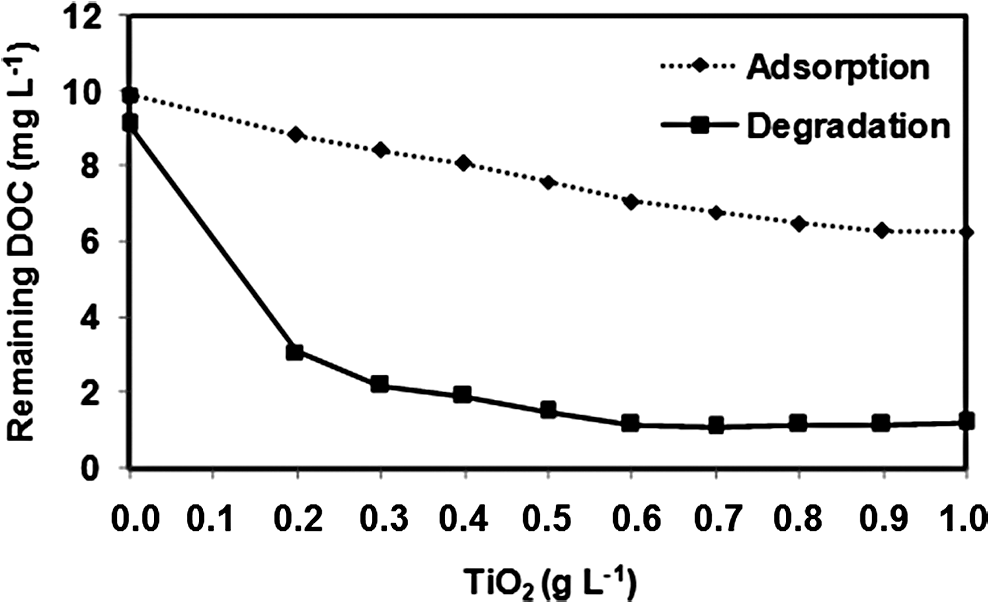
Effect of TiO2 dose in slurry on Aldrich-HA adsorption and photocatalytic degradation. ρ(DOC) = 10 mg/L, at initial pH = 7, adsorption time = 60 min, photocatalytic degradation time = 180 min.
Photocatalytic degradation kinetics of NOM generally can be approximated by first-order kinetics, and the first-order rate constant is the most accurate measurement of photoactivity of the catalyst. For a degradation that follows a kinetic first order the following equation was used: ln(C/C0) = −kat (Huang et al., 2008), where C0 is the initial concentration of DOC in the liquid phase, C is the actual DOC concentration in the liquid phase, and ka (min−1) denotes the pseudo-first-order reaction rate constant.
It was found that the photocatalytic degradation of Aldrich-HA with ρ(DOC) = 10 mg/L at initial pH = 7 and ρ(TiO2) = 0.6 g/L with TiO2 in slurry, followed a pseudo-first-order rate with ka = 0.011 min−1 (Fig. 6). The photocatalytic degradation of Aldrich-HA with PE-TiO2 with ρ(PE-TiO2) = 18.1 g/L, which is equivalent to ρ(TiO2) = 0.6 g/L in slurry (∼54.0 g of PE-TiO2 in 3 L of Aldrich-HA) also followed a pseudo-first-order rate with ka = 0.009 min−1 (Fig. 7). There were good fit of the data to a linear response. The correlation coefficients (R2) were 0.992 and 0.982, for TiO2 in slurry and PE-TiO2, respectively. The experiment was performed in triplicate. The repeatability was below 5% of RSD.
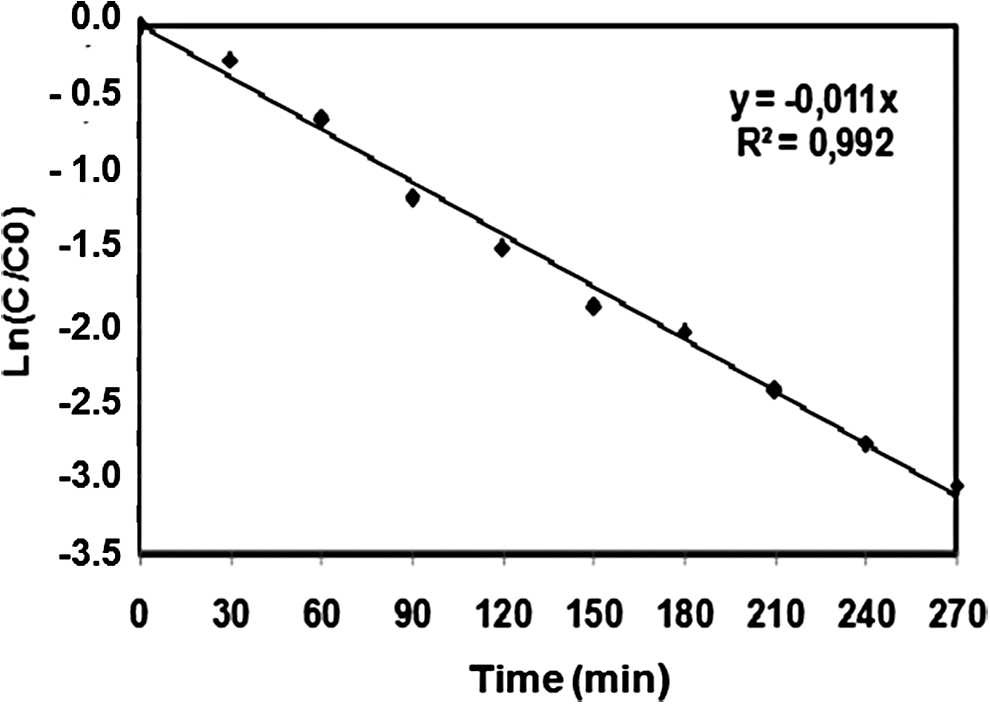
Photocatalytic degradation kinetics of Aldrich-HA with P25 TiO2 in slurry. ρ(DOC) = 10 mg/L, at initial pH = 7, ρ(TiO2) = 0.6 g/L, adsorption time = 60 min.
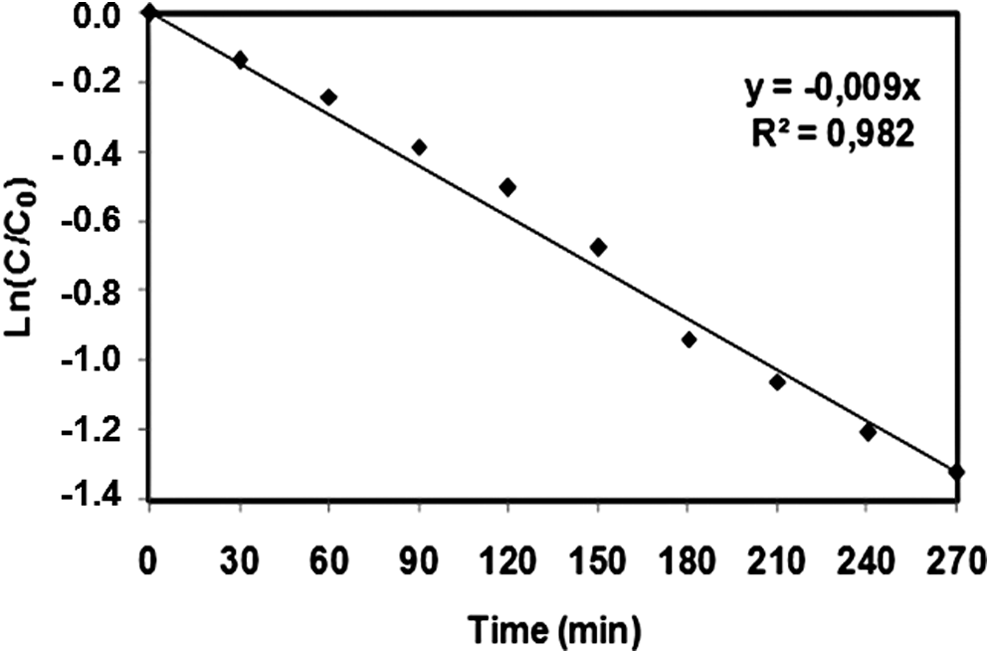
Photocatalytic degradation kinetics of Aldrich-HA with PE-TiO2. ρ(DOC) = 10 mg/L, at initial pH = 7, ρ(PE-TiO2) = 6.0 g/L [approximately ρ(TiO2) = 0.6 g/L], adsorption time = 60 min, photocatalytic degradation time = 270 min.
The ka of Aldrich-HA with PE-TiO2 was lower than that with TiO2 in slurry. This could be due to the reduction in the exposed surface area of PE-TiO2 and the reduction in the kinetic processes of the interfacial charge transfer. A certain amount of TiO2 was embedded into PE-pellets, where UV irradiation and Aldrich-HA could not reach TiO2. This led to a decrease in kinetics of degradation. ka increased as the exposed surface area augmented; it occurred because the number of reactive sites increases and the photocatalytic degradation of HA-Aldrich proceeds on the TiO2 surface by oxidation of the adsorbed Aldrich-HA, where hf+ reacts directly with Aldrich-HA (Valencia et al., 2011a, 2012).
In contrast, the increase in PE-TiO2 pellets in the solution led to a higher decrease in UV light penetration (screening effect), in comparison with TiO2 in slurry. As a result, photocatalytic degradation with PE-TiO2 required more UV irradiation time to achieve a similar DOC removal as the one obtained with TiO2 in slurry.
PE-TiO2 reuse test analysis for Aldrich-HA photocatalytic degradation
Figure 8 shows the photocatalytic degradation of ρ(DOC) = 10 mg/L of Aldrich-HA at initial pH = 7 with ρ(PE-TiO2) = 18.1 g/L1 [approximately ρ(TiO2) = 0.6 g/L] by the repeated use of the same PE-TiO2 pellets (five tests). Aldrich-HA photocatalytic degradation percentages achieved with the same PE-TiO2 pellets were relatively stable after repeated use in the five runs (61.1% of DOC) during 270 min of UV irradiation in comparison with TiO2 in slurry with only one use (95.7% of DOC). The loss in efficiency in the first two repeated uses of the same PE-TiO2 pellets might be due to the weight loss of TiO2 coating. After the second use of PE-TiO2 pellets, TiO2 embedded into PE pellets was stable and it was not detached. Therefore, PE-TiO2 can be used to provide a viable way to solve the problem of the postrecovery of TiO2 particles after water treatment.
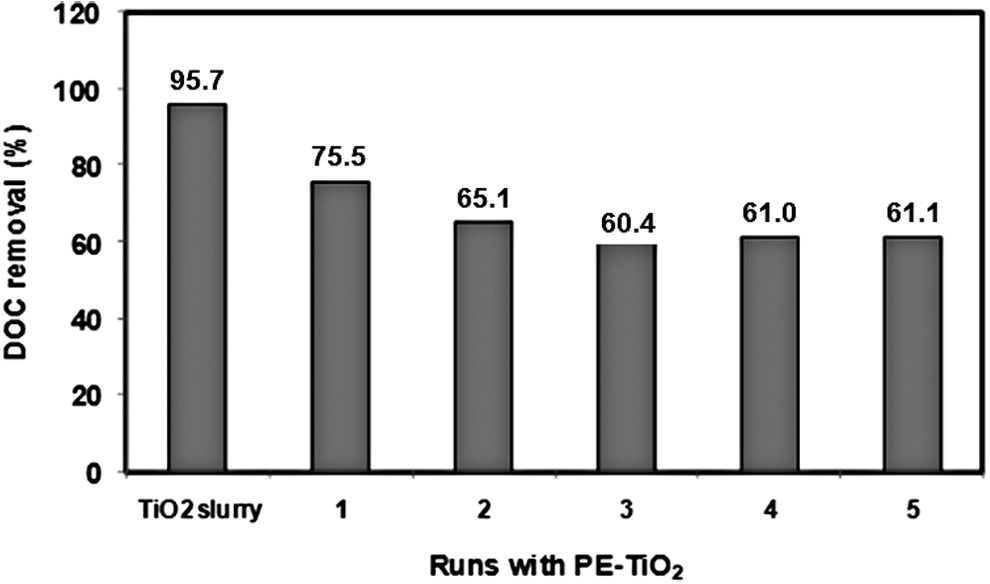
Catalyst-deactivation test using PE-TiO2 with ρ(PE-TiO2) = 18.1 g/L [approximately ρ(TiO2) = 0.6 g/L] (reuse of PE-TiO2), and TiO2 in slurry with ρ(TiO2) = 6.0 g/L in the photocatalytic degradation of Aldrich-HA, ρ(DOC) = 10 mg/L, at initial pH = 7. Adsorption time = 60 min, photocatalytic degradation time = 270 min.
Formation of DBPs
Chlorination was studied to determine the change in the total THMFP and specific THM formation potential (THMFP/DOC) of Aldrich-HA samples at initial pH = 7 as a function of irradiation time during photocatalytic degradation of Aldrich-HA with PE-TiO2 and TiO2 in slurry using the batch photocatalytic reactor of Plexiglas. Chlorination was performed using sodium hypochlorite at ρ(Cl2) = 10 mg/L in a ratio of ρ(DOC):ρ(Cl2) = 3:10. After 48 h of reaction in the dark, chlorination was stopped by the addition of sodium sulfite. After that, THMs were measured. The THM analysis only showed the formation of CHCl3 (chloroform). The brominated THMs were not detected.
For chlorination of the samples with PE-TiO2, ρ(PE-TiO2) = 6.0 g/L [approximately ρ(TiO2) = 0.2 g/L], using the batch photocatalytic reactor of Plexiglas, four samples (M1–M4) were analyzed: M1 represents the original sample of Aldrich-HA with ρ0(DOC) = 9.90 mg/L, at initial pH = 7; M2 is the sample after adsorption onto PE-TiO2 in the dark with ρ(DOC) = 8.55 mg/L; M3 is the sample after PE-TiO2-photocatalytic degradation with an irradiation time of 120 min, reaching ρ(DOC) = 6.21 mg/L; and M4 is the sample after PE-TiO2-photocatalytic degradation with a longer irradiation time of 270 min, reaching ρ(DOC) = 3.20 mg/L.
Table 2 shows specific absorbance parameters SUVA254, SUVA280, SUVA365, and SCOA436 of samples M1–M4 with ρ(PE-TiO2) = 6.0 g/L [approximately ρ(TiO2) = 0.2 g/L]. SUVA254 and SUVA280 (L/[mg·m]) represent the UV-absorbing aromatic structures and double bonds of NOM, respectively (Sarathy and Mohseni, 2007). SUVA254 also can be used to describe the composition of water in terms of hydrophobicity and hydrophilicity. A value of SUVA254 > 4 indicates mainly hydrophobic and especially aromatic material, whereas 2 < SUVA254 < 4 represents a mixture of hydrophobic and hydrophilic NOM, and SUVA254 < 2 represents hydrophilic material (Uyguner and Bekbolet, 2005). It has been shown that SUVA365 increases with increasing molecular weight (Peuravuori and Pihlaja, 2004). SCOA436 represents the functional groups that give the samples a yellow to brown color and it is used to estimate the content of quinones (Kumke et al., 2001).
Aldrich-HA, humic acid from Sigma-Aldrich; DOC, dissolved organic carbon; HA, humic acid; M1, the original sample of Aldrich-HA; M2, the sample after adsorption onto PE-TiO2 in the dark; M3, the sample after photocatalytic degradation time of 120 min; M4, the sample after photocatalytic degradation time of 270 min; SCOA, specific color absorbance; SUVA, specific ultraviolet absorbance; TiO2, titanium dioxide.
There was a considerable decrease in SUVA254, SUVA280, SUVA365, and SCOA436 from M1 to M4 with PE-TiO2 (Table 2) implying a reduction of aromatic compounds and double bonds, a decrease in molecular size, and a reduction of quinones for Aldrich-HA, respectively. Furthermore, SUVA254, SUVA280, SUVA365, and SCOA436 removals were significantly higher than DOC removal with PE-TiO2, showing that photocatalytic degradation with PE-TiO2 led to the loss of aromaticity and the decrease of the molecular weight of Aldrich-HA at a faster rate than the rate of mineralization.
These results are due to the fact that the hydrophobic compounds (larger molecular weight fractions) are preferably adsorbed onto the TiO2 surface. It favored the photocatalytic degradation of hydrophobic compounds and more hydrophobic intermediate oxidation products (smaller molecular weight fractions) that were then released (Huang et al., 2008; Tercero et al., 2009). These results are consistent with Liu et al. (2014), who worked with HA from Sigma-Aldrich and TiO2 in slurry, Valencia et al. (2012) who studied the photocatalytic degradation of NOM from Lake Hohloh (Germany) with TiO2 in slurry, and Valencia et al. (2013b) who worked with HA and FA from XAD fractions of NOM from a bog lake with TiO2 in slurry.
Table 3 shows THMFP and specific THMFP (STHMFP) evolution for Aldrich-HA at initial pH = 7 after photocatalytic degradation with ρ(PE-TiO2) = 6.0 g/L [approximately ρ(TiO2) = 0.2 g/L; samples M1–M4]. There was a high removal of THMFP after Aldrich-HA adsorption onto PE-TiO2 in the dark (M2; 34.7%), with a DOC removal of 8.6% (M2). Therefore, PE-TiO2 adsorption is a viable way to remove THM precursors from drinking water. Moreover, the photocatalytic degradation with PE-TiO2 led to a substantial reduction in THMFP and STHMFP. The reduction of THMFP was 86.4% (in 270 min), exceeding the percentage removal of DOC, 64.5% (in 270 min). Therefore, the organic fractions of Aldrich-HA that form DBPs were specially removed during photocatalytic degradation with PE-TiO2. These results agree with those of the specific absorbance parameters, where all of them decreased. Moreover, these results are in agreement with Liu et al. (2010) who worked with TiO2 in slurry.
M3, the sample after photocatalytic degradation with an UV irradiation time of 120 min; M4, the sample after photocatalytic degradation with an UV irradiation time of 270 min; STHMFP, specific THMFP; THMFP, trihalomethane formation potential.
On the other hand, there was an increase of STHMP in M3 with respect to M2. This is because, during photocatalytic degradation of Aldrich-HA with PE-TiO2, the compounds of large molecular weight are rather adsorbed onto PE-TiO2 and are preferably degraded, leading to increasing compounds of small molecular weight. These small compounds were hydrophobic intermediate products that were released from the PE-TiO2 surface (Tercero et al., 2009; Valencia et al., 2011b; Gora and Andrew, 2017).
For chlorination of the samples with TiO2 in slurry with ρ(TiO2) = 0.2 g/L, using the batch photocatalytic reactor of Plexiglas, four samples (M5–M8) were also analyzed: M5 represents the original sample of Aldrich-HA with ρ0(DOC) = 9.90 mg/L at initial pH = 7; M6 is the sample after adsorption onto TiO2 in the dark with ρ(DOC) = 7.78 mg/L; M7 is a sample after TiO2-photocatalytic degradation with an irradiation time of 105 min, reaching ρ(DOC) = 5.90 mg/L; and M8 is a sample after TiO2-photocatalytic degradation with a longer irradiation time of 180 min, reaching ρ(DOC) = 3.10 mg/L. The optimum dosage [ρ(TiO2) = 0.6 g/L] was not used because the DOC transformation and UV254 absorption occurred faster upon irradiation.
Table 4 shows specific absorbance parameters SUVA254, SUVA280, SUVA365, and SCOA436 of samples M5–M8 with ρ(TiO2) = 0.2 g/L in slurry, using the batch photocatalytic reactor of Plexiglas. A considerable decrease of SUVA254, SUVA280, SUVA365, and SCOA436 parameters from M5 to M8 with P25 TiO2 in slurry was found (Table 2), implying a reduction of aromatic compounds and double bonds, a decrease in molecular size, and a reduction of quinones for Aldrich-HA, respectively. Moreover, SUVA254 decreased from 11.21 (M5) to 1.34 (M8) implying that Aldrich-HA composition changed from hydrophobic to hydrophilic material with less aromatic compounds. On the other hand, SUVA254, SUVA280, SUVA365, and SCOA436 removals were significantly higher than the DOC removal with TiO2 in slurry (Table 2).
HA, humic acid; M5, the original sample of Aldrich-HA; M6, the sample after adsorption onto TiO2 in the dark; M7, the sample after photocatalytic degradation time = 105 min; M8, the sample after photocatalytic degradation time of 180 min.
Table 5 shows THMFP and STHMFP (STHMFP = THMFP/DOC) evolution for Aldrich-HA at initial pH = 7 before and after photocatalytic degradation with ρ(TiO2) = 0.2 g/L in slurry (samples M5–M8). There was a high removal of THMFP after Aldrich-HA adsorption onto TiO2 in slurry in the dark (M6; 39.3%), with a DOC removal of 13.6% (M6). Moreover, the photocatalytic process with TiO2 in slurry led to a substantial reduction in THMFP from M5 to M8 due to the overall reduction of DOC. The removal of THMFP was 85.8% (in 180 min), exceeding the percentage removal of DOC, 68.7% (in 180 min). In addition, an increase of STHMP in M7 with respect to M8 was found.
THM, trihalomethane.
Results obtained in this study with PE-TiO2 were similar to those with TiO2 in slurry. Therefore, PE-TiO2 has shown to be a sustainable treatment technology to remove HA, which is of interest to the drinking water treatment industry. Moreover, embedding of TiO2 onto PE pellets by the controlled-temperature embedding method did not change the properties of TiO2 for HA photocatalytic degradation. However, the photocatalytic degradation with PE-TiO2 requires a longer UV irradiation time than the required time with TiO2 in slurry to achieve a similar removal of parameters (SUVA and THMFP) (Tables 3 and 5). This result is explained by the incidence of PE-TiO2 pellets in the solution that led to a higher decrease in UV light penetration (screening effect) in comparison with TiO2 in slurry. On the other hand, the adsorption of DOC onto PE-TiO2 in the dark (with a removal of DOC of 8.6% in M3) was lower than that obtained with TiO2 in slurry (with a removal of DOC of 13.6% in M6). DOC adsorption is higher with an increasing superficial area of TiO2, and PE-TiO2 showed a lower area than TiO2 in slurry.
Results with PE-TiO2 pellets may imply a higher UV irradiation cost for photocatalytic degradation of HA in comparison to the cost associated with the use of TiO2 slurry. However, postrecovery of TiO2 slurry with coagulants can be more expensive than the longer UV irradiation time with PE-TiO2. The repeated use of PE-TiO2 pellets reduces the cost for the longer UV irradiation time and does not generate substantial waste. On the other hand, PE pellets are abundant, easily available, and inexpensive as an immobilizer substrate. PE and PE-TiO2 exhibit UV absorption and TiO2/UV degradation resistance, and UV irradiation does not lead to considerable surface damage of PE (Velásquez et al., 2012). Therefore, PE-TiO2 is a promising material to solve the problem of postrecovery of TiO2 particles after water treatment.
Conclusions
Polyethylene pellets coated with P25 TiO2 (PE-TiO2) using the controlled-temperature embedding method allowed the reuse of the same TiO2 in Aldrich-HA photocatalytic degradation with a relatively stable efficiency. PE-TiO2 led to a high photocatalytic degradation of Aldrich-HA and a large reduction in specific absorbance parameters: SUVA254, SUVA280, SUVA365, and SCOA436, and THMFP. Therefore, embedding of TiO2 onto PE pellets by the controlled-temperature embedding method did not change the properties of TiO2 for HA photocatalytic degradation, and PE-TiO2 is a promising material to remove NOM and to solve the problem of postrecovery of TiO2 particles after water treatment.
Footnotes
Acknowledgments
The authors thank Universidad de Antioquia and COLCIENCIAS for financial support.
Author Disclosure Statement
No competing financial interests exist.