







Abstract
Abstract
Formation of calcium carbonate (CaCO3) has long been a concern in potable water systems. CaCO3 formation is re-emerging as an important issue due to climate change, higher set-point temperatures in hot water systems, use of scaling and corrosion inhibitors, and self-repair of pipeline leaks. Ironically, actions we are taking to increase the lifespan of distribution systems via reduced corrosion (i.e., adding corrosion inhibitors) might have inadvertently worsened leaks and pipe lifespans, due to interference with natural self-repair from CaCO3 precipitation. These changes in practice, coupled with knowledge gaps over CaCO3 formation in water systems, make it important and timely to revisit this topic.
Introduction
P
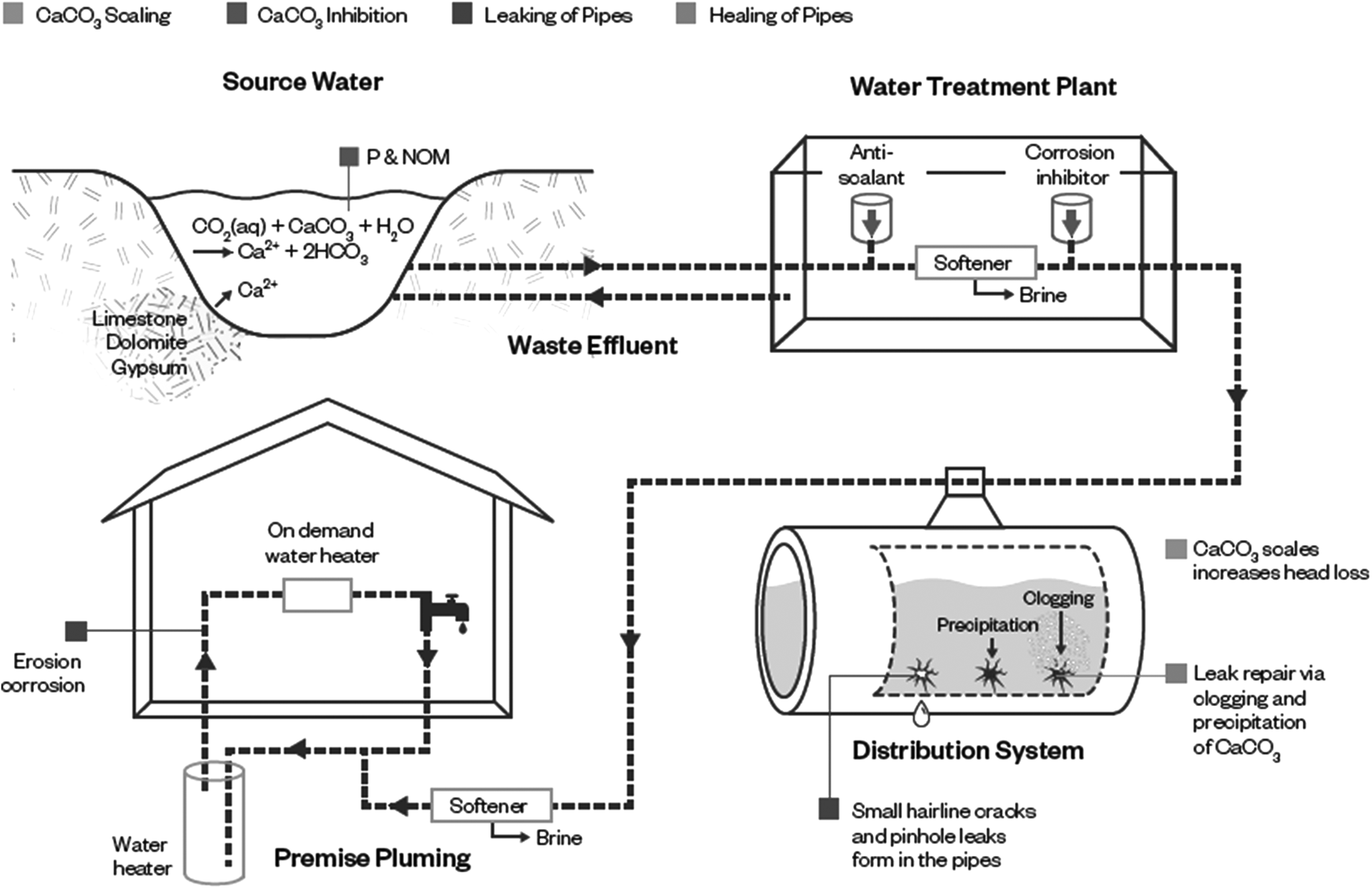
Beneficial and detrimental impacts of CaCO3 from source to tap. (1) Source water: surface waters equilibrate with CO2, controlling pH and adding inorganic carbon to the system. Natural inhibitors to CaCO3 precipitation such as phosphate and NOM enter water through runoff or wastewater discharge, whereas calcium-containing minerals in soils such as limestone can dissolve. (2) Water treatment plant: corrosion inhibitors are also antiscalants that can inhibit CaCO3 formation. Membrane-softening processes often scale and produce a brine reject stream with high hardness and treated water with lower hardness. (3) Distribution system: CaCO3 scale forms over distribution lines, protecting them from corrosive waters and potentially sealing leaks, but also increasing the head loss. (4) Premise plumbing: in households and buildings with ion exchange or RO membrane softeners, brine reject streams with high hardness are produced. Water heaters are very susceptible to scaling due to their high temperatures. Scale can easily coat heating elements and clog the narrow channels in on-demand water heaters. Particulate CaCO3 may accelerate erosion corrosion. CaCO3, calcium carbonate; CO2, carbon dioxide; NOM, natural organic matter: RO, reverse osmosis.
Scaling
Scaling is the most obvious manifestation of CaCO3 precipitation in potable water systems, resulting in flow restrictions by clogging plumbing devices and increased head loss (Krappe, 1940; Crabtree et al., 1999). CaCO3 scaling is also a problem in granular media filters in lime-softening plants, where its formation can “cement” together the filter bed, making it difficult to regenerate the media (Logsdon et al., 2002). In addition, scaling is a major issue in modern filters, such as reverse osmosis (RO) or ultrafiltration membranes, as the high concentrations of Ca2+ and inorganic carbon in the reject stream can lead to CaCO3 precipitation on the membrane surface (Bremere et al., 1999; Gwon et al., 2003), and it is recommended that feed water pH be lowered to prevent scaling on the membrane and brine discharge system (Seneviratne, 2007).
Increased propensity of CaCO3 to precipitate at higher temperatures makes scaling a troublesome issue in hot water systems, especially in water heater or water-cooling applications in which scale layers interfere with heat transfer and system efficiency. Water heating is extremely energy intensive. More specifically, the total energy demand for water-heating systems in buildings exceeds the energy demand for the entire water and wastewater utility sector (Brazeau and Edwards, 2011). It is estimated that hard water can lower the heat transfer efficiency of gas storage water heaters by 8.5% and of instantaneous gas water heaters by 30% over a 15-year lifecycle if no softening or deliming is practiced (WQRF, 2011). Softening hard water can reduce the life cycle cost of instantaneous gas water heaters by 22.5% and of gas storage water heaters by 6.6% over a 15-year lifecycle (WQRF, 2011). The annual cost of fouling for industrial operations in the United States alone was estimated to be around $3–10 billion in 1982 (Garrett-Price et al., 1985), including the cost of anti-scaling programs, downtime for maintenance, lost production, cleaning, higher energy costs due to reduced heat transfer, and over-sizing equipment where fouling is expected. The worldwide cost in 2000 was estimated at roughly $26 billion and $8–10 billion in the United States alone (Müller-Steinhagen, 2000).
Autogenous repair
A possible but overlooked benefit of CaCO3 formation in potable water systems is its ability to seal leaks in a process known as autogenous leak repair. This method may have been first discovered and applied in ancient Rome, where the addition of alkaline wood ash was used to seal leaking pipelines (Pollio 15 BC as translated by Morgan, 1960). Although the mechanism of leak repair is unspecified, the high pH of wood ash solutions of 11.7–13.1 (Pitman, 2006) would also cause solids to precipitate in the water and clog leaks, in addition to the particulates in wood ash that could directly block leaks. In modern times, the self-healing of concrete cracks and leaks is known to be critical to the satisfactory long-term performance of concrete structures and pipelines (Hearn, 1998; Edvardsen, 1999). Autogenous healing via hydration reactions in concrete have been frequently observed (Hearn, 1998). However, CaCO3 deposition is also a major contributor to concrete repair (Clear, 1985; Edvardsen, 1999). Parks et al. (2010) found that concrete can be repaired by magnesium-silicate precipitates, which also form autogenously at higher pH in certain waters.
Recent Trends Affecting CaCO3 Formation
Overview
In the past half-century, the science and practice of potable water treatment and distribution have changed markedly in ways that can profoundly alter the extent of CaCO3 formation and scaling in water main and premise plumbing pipe systems (Fig. 1). Inorganic carbon dissolves into natural water systems from carbon dioxide (CO2) in the atmosphere, or it is generated through biodegradation of organic matter in ground waters. Ca2+ is released in natural waters through dissolution of minerals such as calcite, portlandite, gypsum, and dolomite that come into contact with the water (Table 1). Deicing salt also contributes thousands of tons of Ca2+ to water supplies in regions where calcium chloride is used (Houska, 2007).
CaCO3 formation as a corrosion control method has fallen out of favor
Corrosion has taken a heavy toll on plumbing and distribution systems throughout the United States. The cost of maintaining the aging drinking water infrastructure in the United States alone will exceed $1 trillion over the next 25 years (AWWA, 2012). The original basis for controlling or reducing corrosion in potable water distribution systems was based on the premise that a layer of CaCO3 formed on pipe surfaces could almost completely protect all pipe materials from corrosive reactants in the water supply, including oxygen and free chlorine. Numerous corrosion indices based on this hypothesis were formulated to monitor and control the supposedly protective carbonate scales, including Langelier saturation index (LSI), Ryznar stability index (RSI), Puckorius scaling index (PSI), Larson–Skold index (LI), and measurement of temporary hardness (Langelier, 1936; Ryznar and Langelier, 1944; Larson and Skold, 1958; Puckorius and Brooke, 1991). Very early on, some of these indices were criticized because they oversimplified the process of scaling (Wiggin et al., 1938; Schneider and Stumm, 1964), but the notion that scales protected pipes from corrosion dominated potable water treatment until about the mid-1980s, when researchers studying corrosion began to notice that iron, lead, and copper corrosion had little to do with CaCO3 precipitation, and a consensus emerged that the overall approach should be abandoned (Stumm, 1956; Larson and Skold, 1957; Schock, 1989; AWWARF, 1996). However, that consensus neglected to consider the possible benefits of the approach in reducing pipeline leaks and extending the lifetime of assets through autogenous repair processes or clogging (Tang et al., 2013). In practice, many municipal water utilities continue to calculate and target specific levels of CaCO3 saturation (or undersaturation) to extend the lifetime of cement and mortar-lined surfaces, or in hopes of controlling corrosion of other materials.
CaCO3 scaling in building heating systems has recently become an increased concern
Many buildings are now beginning to target a higher hot water system temperature set point (>51°C) to reduce growth of pathogens (e.g., Legionella pneumophila). However, at such high temperature set points, scale formation on the surface of the heating element and throughout the system occurs more rapidly. The reason is that as temperature increases, the solubility of CaCO3 decreases and the rate of precipitation increases. Scaling can create serious problems, including loss of heat transfer efficiency in heating systems, head loss (energy loss) induced by pipe clogging, and, in some cases, erosion corrosion from particles (Krappe, 1940; Crabtree et al., 1999; Dobersek and Goricanec, 2007; Roy and Edwards, 2015). Lower heat transfer efficiency in heating systems can severely impair the proper operation of water heaters in homes and buildings as well as cooling towers and heat exchangers in industrial settings (Garrett-Price et al., 1985).
Tankless on-demand water heaters are emerging as an important energy-conserving device, due to their minimal hot water storage volumes and heat losses due to stagnation. The Department of Energy estimates that a centralized on-demand water heating system can reduce energy consumption by 8–34% (U.S. DoE, n.d.) compared with conventional tank systems. Homeowners with gas-heated on-demand systems are also eligible for federal tax credits (Energy Star, n.d.), and the lack of stored hot water can reduce the risk of opportunistic pathogen growth (Brazeau and Edwards, 2011). Although these factors incentivize home and building owners to install on-demand water heaters, their high surface area-to-volume ratio at heat transfer surfaces, which are inherent to their instant heating design, makes them highly susceptible to CaCO3 scaling and clogging in scaling waters (Thomas et al., 2006; Brazeau and Edwards, 2011). In some cases, scaling may also reduce or eliminate their energy savings relative to conventional water heaters.
CaCO3 may have the ability to clog leaks that have formed in pipes and extend the lifetime of distribution systems
It is hypothetically possible that, despite the sound scientific work discrediting Langelier and related indices as a guide to corrosion control, the indices might have actually been “working” as advertised in controlling pipe leaks and extending distribution system lifetimes (DeMartini, 1938) but for different reasons. Specifically, rather than forming a thin CaCO3 layer to protect pipes from corrosion and associated leaks (Langelier, 1936), it is possible that a high CaCO3 formation potential could have reduced leak frequency by autogenous repair or clogging of leaks (Tang et al., 2013). Autogenous repair is a process by which incipient existing leaks seal themselves, and CaCO3 formation is a well-known leak self-repair mechanism for concrete pipes (Edvardsen, 1999; Parks et al., 2010). This mechanism could also repair and heal leaks in metallic pipes before the leak holes grow to catastrophic failure, by clogging of holes, assisting the formation of stronger or thicker pipe scales, or formation of corrosion byproducts (Tang et al., 2013, 2015). More research is needed for correlating actual leaks to CaCO3 formation potential to test this hypothesis, especially given the poor condition of U.S. distribution system assets and the lack of financial resources for traditional repair and replacement.
CaCO3 precipitation inhibitors that are naturally present or added at the point of treatment have probably changed the propensity of water to form CaCO3 scales in the past few decades
Water treatment policies aimed at controlling lead and copper corrosion dramatically increased the use of phosphate and polyphosphate corrosion inhibitors starting around 1990. These inhibitors are known to slow CaCO3 precipitation kinetics in potable water systems (Lin and Singer, 2005a, 2006; Wang et al., 2017). The use of such corrosion inhibitors might prevent leak repair that occurs naturally for concrete pipe leaks or even possibly for metallic pipe leaks that would have occurred when the inhibitor was absent. Similarly, natural organic matter (NOM), which is a disinfection byproduct precursor in water treatment plants, has been shown to inhibit CaCO3 precipitation (Lin et al., 2005).
Climate change may play a role in CaCO3 formation
With rising atmospheric CO2 levels since the preindustrial era, the potential amount of CaCO3 to precipitate in potable water systems could increase at temperatures (25–84°C) that are relevant to potable water systems (Fig. 2). With the atmospheric CO2 concentration increases from the preindustrial era to 2050 (projected), the atmospheric partial CO2 pressure increases from 280 × 10−6 atm to 550 × 10−6 atm. Using MINEQL+ modeling to model waters with an initial amount of 40 mg/L Ca2+, the amount of CaCO3 to precipitate could increase from 11 to 14 mg/L (a 27% increase) at 84°C, which is a temperature that is commonly present at the heating element.
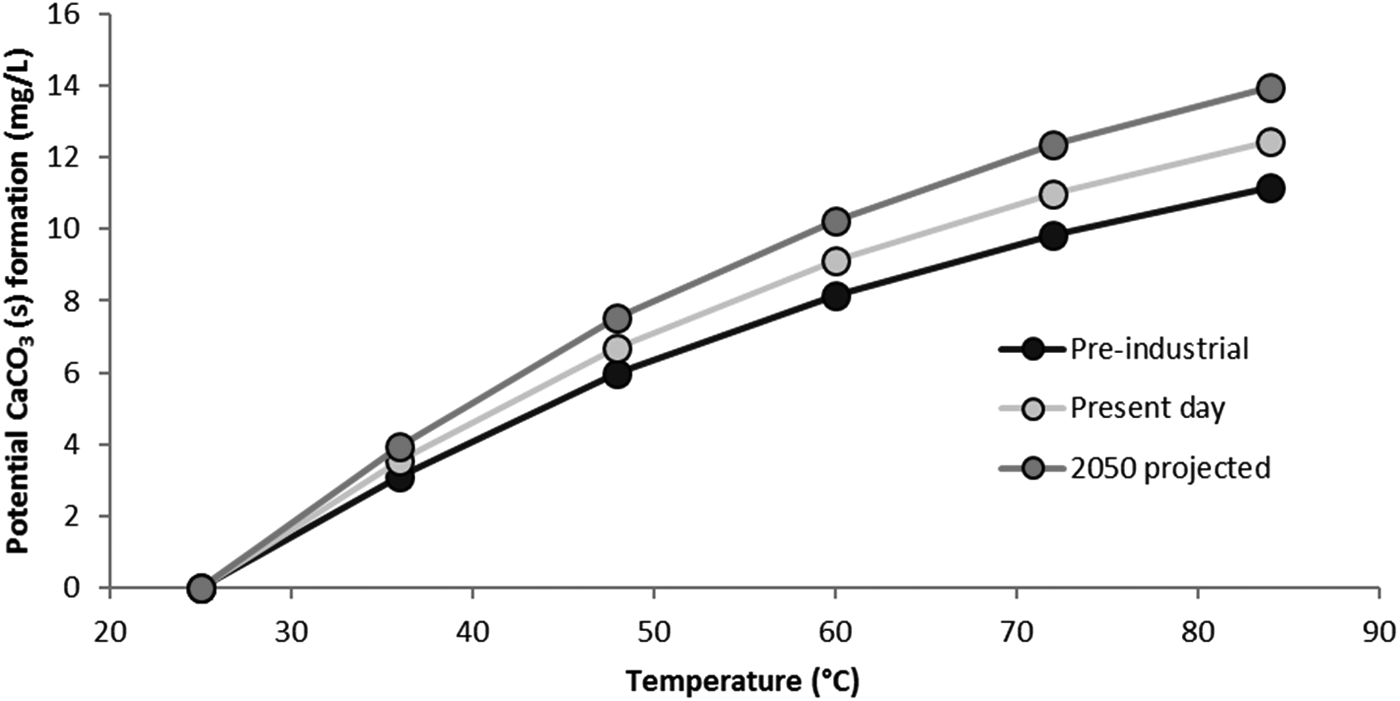
Calcite at equilibrium with atmospheric CO2 levels in the preindustrial era, present day, and those projected for 2050, and temperatures up to 84°C, a temperature commonly present at the heating element. Higher atmospheric CO2 can increase the precipitation potential. Using Mineql+, waters were equilibrated at [Ca2+] = 40 mg/L and PCO2 = 280 × 10−6, 390 × 10−6, and 550 × 10−6 atm. Using the equilibrium CaT, Alk, and pH from the open systems as starting conditions for the closed systems, the potential CaCO3 formation at equilibrium was calculated for the closed systems.
More frequent and longer droughts caused by global warming can also increase calcium levels in natural waters (Anderson and Faust, 1972; Mosley, 2015). Consequently, the potential amount of CaCO3 to precipitate in potable water systems may also be rising.
It is worth mentioning that some types of dissolved organic carbon (DOC), which are known to be a CaCO3 precipitation inhibitor (Lebron and Suarez, 1996), might be increasingly released into natural waters, and they might play a role in CaCO3 precipitation in potable water systems. Although the major cause of increased DOC levels in natural waters is attributed to a decrease in acid rain deposition (Evans et al., 2006), there is evidence that the increasing CO2 levels and the rising temperatures due to global climate change (Freeman et al., 2001) might contribute to DOC release. As a result, the increasing DOC release due to climate change might affect CaCO3 precipitation in potable water systems.
Scaling has been shown to affect biofilm growth in premise plumbing
One study conducted by Fox and Abbaszadegan (2013) found that scales on polyvinyl chloride (PVC) and copper, materials common in premise plumbing, promoted biofilm growth because scaling increased the surface roughness. An increase in biofilm growth was most pronounced on scaled copper surfaces, perhaps because the scale shielded the biofilm from the antimicrobial properties of copper.
Bulk precipitation of CaCO3 may contribute to erosion corrosion in plumbing systems
Erosion corrosion occurs via mechanical action of fluid and suspended particles, removing protective films on pipe surfaces. Roy and Edwards (2015) investigated erosion corrosion and found that aragonite, which is one polymorph of CaCO3, with a particle size <2 mm, is capable of creating leaks in copper pipes. Typically, the formation of large CaCO3 particles is not a concern in potable water systems; however, it has been shown that the CaCO3 scale can detach from premise plumbing materials (e.g., copper) by shear stress (Royer et al., 2010). The scale that gets released has the potential to cause or accelerate erosion corrosion, especially in hot water recirculating systems that are now required by code in many parts of the country.
The complexity of these phenomena and their profound impact on the infrastructure, energy, and sustainable water nexus make it an ideal time to revisit this important topic (Table 2). The objectives of this review are: (1) to re-evaluate CaCO3 formation in a modern context, such as global warming, autogenous repair, corrosion inhibitors, and increasing water heater temperatures in buildings; (2) to identify knowledge gaps regarding CaCO3 formation and control.
CaCO3, calcium carbonate; CO2, carbon dioxide; DBPs, disinfection byproducts; NOM, natural organic matter.
Chemistry of CaCO3 Formation
Background
To fully understand practical aspects of CaCO3 behavior in potable water systems, it is important to first review the chemistry of CaCO3 formation and dissolution. CaCO3 crystals are made of Ca2+ and CO32− lattice ions, both of which are ubiquitous in natural water systems. It can exist in three crystalline polymorphs as well as in an amorphous phase (ACC) or as a mono- and hexahydrate. The solubility product for each form varies with temperature, as noted in Table 3. CaCO3 has significantly lower solubility at higher temperatures, causing CaCO3 formation to be a major issue in many hot water systems even when it is not a problem in cold water systems for waters with moderate hardness and alkalinity (Fig. 3).
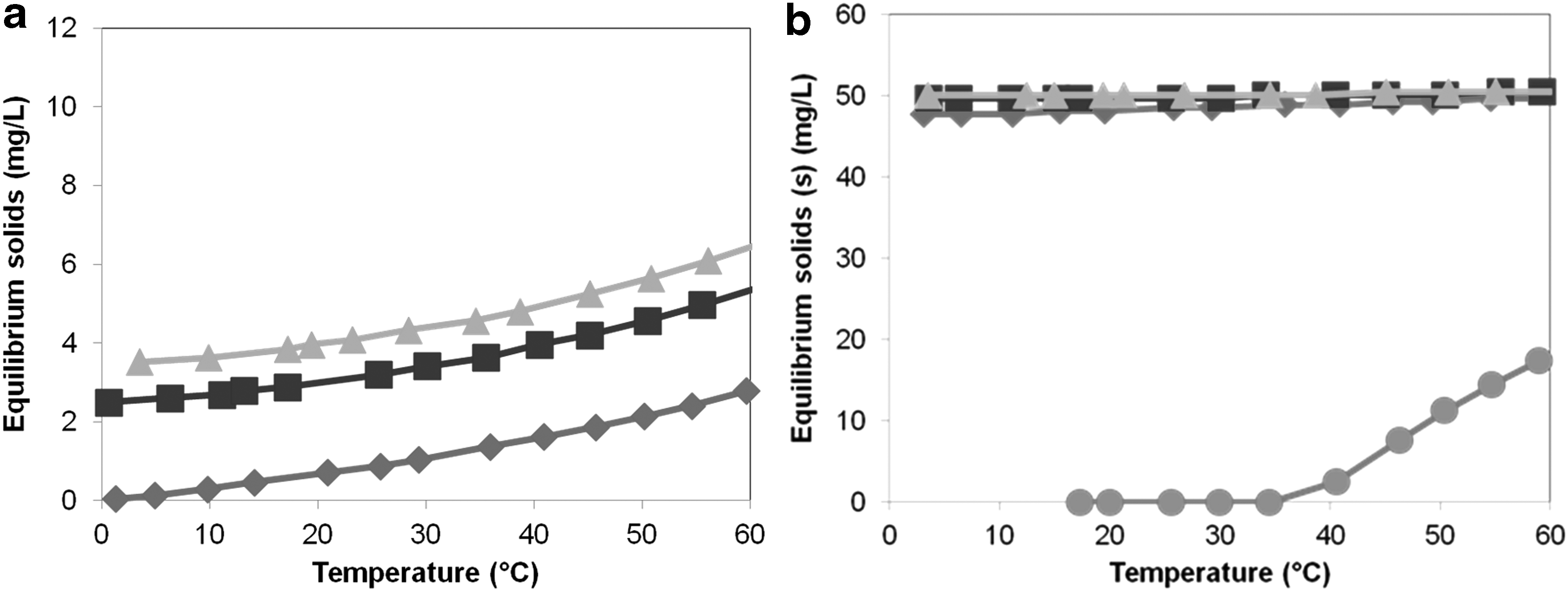
Amount of potential CaCO3 formation for all crystalline polymorphs vaterite [(diamond), aragonite (square), and calcite (triangle)] and ACC (circle) under different temperatures in water distribution systems. MINEQL+ simulations on a closed system with alkalinity = 100 mg/L as CaCO3 at pH 8.5 and
T is temperature in K.
ACC, amorphous phase.
The levels of Ca2+ in natural waters are usually governed by regional geology (limestone, dolomite, etc.), whereas the carbonate system is more complex. CO32− becomes the dominant form of inorganic carbon at pH 10.3 and higher (Plummer and Busenberg, 1982).
with Ω representing the degree of supersaturation, defined as
The ion activity product, Q, for CaCO3 is the product of the Ca2+ and CO32− activities, as shown in the equation given next.
When Q < Ksp, the solution is undersaturated, precipitation is not thermodynamically favored, and CaCO3 solid can dissolve. However, when Q > Ksp, CaCO3 is supersaturated and it can precipitate.
Precipitation and growth in plumbing and distribution systems
Homogeneous nucleation
Homogeneous nucleation of CaCO3 occurs less frequently in plumbing and distribution systems than heterogeneous nucleation due to the larger energy barrier of spontaneously forming CaCO3 nuclei in solution. As a result, homogeneous nucleation is mostly observed at Ω > 7, for experiments conducted at pH 8.50, 25°C, and up to 2 h of the reaction (Lioliou et al., 2007). Even in systems that are stagnant for long periods, homogeneous nucleation is likely to be the less common form of nucleation, because the scales already present or bare surfaces can lower the energy barrier for heterogenous nucleation.
Homogeneous nucleation of CaCO3 was believed to follow the classical nucleation theory (CNT). CNT states that a nucleus is not stabilized until a critical radius is reached in which the bulk energy and surface energy of the nuclei is balanced (Gebauer et al., 2014). However, the recent discovery of prenucleation clusters (PNCs) undermines CNT (Gebauer et al., 2008). PNCs contain CaCO3 lattice ions but do not have an explicit phase boundary with the solution. The structural characteristics of PNCs also indicate which polymorph nucleates. More stable PNCs yield ACC with a short-range order corresponding to calcite, whereas less stable PNCs yield ACC with a short-range order corresponding to vaterite (Lam et al., 2007; Gebauer et al., 2014).
Homogeneous CaCO3 precipitation roughly follows Ostwald's rule of stages. The rule of stages indicates that the least stable polymorph often crystallizes first before transforming into the most stable polymorph (Ng et al., 1996). For CaCO3, ACC is the first to precipitate, followed by vaterite, before transforming into calcite, which is its most stable form (Wolf et al., 2008). Ogino et al. (1987) observed the same at lower temperatures (14–30°C); whereas at higher temperatures (60–80°C), the transition of ACC to aragonite to calcite was observed. At intermediate temperatures (40–50°C), CaCO3 crystallization closely follows Ostwald's rule of stages that every polymorph forms before becoming calcite (Ogino et al., 1987).
Heterogeneous nucleation and deposition of scales
Heterogeneous nucleation occurs more readily than homogeneous nucleation because the surface of the foreign solids generally lowers the activation energy barrier for nucleation (Brezonik and Arnold, 2011). As a result, it is likely the most common route of nucleation for CaCO3 scale in plumbing and distribution systems.
In potable water systems, scaling is more likely related to heterogeneous nucleation combined with deposition. Mathematical modeling has been developed to describe such processes on different surface materials, such as a heat-flux exchanger (Hasson et al., 1968a, 1968b; Chen et al., 2005). These models assume that diffusion of Ca2+ and HCO3− ions from the bulk water toward the scale-liquid interface is the governing mechanism of scale deposition. This is also the reason why many characteristics of surface materials, including surface roughness (Keysar et al., 1994; MacAdam and Parsons, 2004a; Wu et al., 2010; Cheong et al., 2013), waterborne particles, and surface-free energy, influence the scaling.
Various materials may exhibit different susceptibility to CaCO3 scaling in potable water systems. Common pipe materials include plastic (PVC, chlorinated PVC, or high-density polyethylene), iron (cast, ductile, or steel), copper, and concrete (new and aged) (Tang et al., 2013). Also, nearly all the heating elements in water heaters are made of stainless steel (Whirlpool, 2017), and polypropylene pipes are gaining popularity and market share in building plumbing (Marks, 2017). As for the scaling susceptibly, plastic pipes are generally believed to be less likely to scale than metallic pipes (Githens et al., 1965). For example, copper pipes are scaled in heat exchangers with Ca-containing minerals at a rate twice that of polypropylene (Wu et al., 2009). As for metallic surfaces, aged cast iron would probably have a higher scaling potential than copper or stainless steel, because it has a rougher surface (Jaćimović et al., 2015). As for concrete, the mechanism for scaling is quite different. As concrete ages in water, Ca(OH)2 leaches out of its micropores and may cause scaling through localized homogeneous crystallization (Tang et al., 2013).
Waterborne particles can enhance the heterogeneous nucleation and subsequent CaCO3 precipitation in potable water systems (Andritsos and Karabelas, 2003; Pääkkönen et al., 2009). Although suspended calcite crystals are the most effective CaCO3 seeds (Nancollas and Reddy, 1971; Lin and Singer, 2005b), they are relatively uncommon in natural waters. Some clay particles that contribute to turbidity have been shown to induce CaCO3 precipitation. For example, montmorillonite, a type of clay, was shown to instantaneously lead to calcite precipitation in a solution with 0.01 mol/L of Ca2+ and 0.004 mol/L of total carbonate at pH 10 (Kralj and Vdović, 2000), which is equivalent to Ω = 472 for calcite according to MINEQL+ calculation.
Surface-free energy is believed to influence heterogeneous CaCO3 nucleation. For CaCO3 scales, lower surface energy can reduce the scale adhesion strength (Müller-Steinhagen and Zhao, 1997; Förster et al., 1999; Yang et al., 2000, 2002; MacAdam and Parsons, 2004b). As for CaSO4 scales that are very similar to CaCO3 scales, Müller-Steinhagen and Zhao (1997) successfully reduced its scaling rate on stainless steel, which is used to make almost all the heating elements in water heaters, by lowering its surface energy via SiF3+ ion implantation. Therefore, a similar result might be expected with CaCO3 scaling.
Growth rate
Previous models of seeded growth kinetics only considered Ω. Morse (1983) modeled the growth rate by using the equation given next.
where R is the rate of precipitation normalized to surface area, k is an empirical rate constant, and n is the reaction order.
The growth mechanism of CaCO3 crystallization, which can be either surface controlled or diffusion controlled, is related to the formation and growth of CaCO3 in potable water systems. In a surface-controlled mechanism, incorporation of lattice ions into the crystal structure is the rate-limiting process. In a diffusion-controlled mechanism, diffusion of lattice ions from the solution to the crystal surface is the rate-limiting process. As discussed in Heterogeneous Nucleation and Deposition of Scales, scaling in potable water systems is a combined effect of heterogeneous nucleation and scale deposition. Heterogeneous nucleation and subsequent crystal growth is essentially surface-controlled CaCO3 growth, whereas scaling deposition is governed by diffusion of Ca2+ and HCO3− ions from the bulk water toward the scale-liquid interface, which is essentially diffusion-controlled CaCO3 growth.
Dissolution
The dissolution rate of calcite (R) follows the rate Equation (7) and three reactions given next [Eqs. (8)–(10)], based on numerous comprehensive studies on calcite dissolution kinetics or the dissolution of carbonate minerals (Berner and Morse, 1974; Plummer et al., 1978; Dreybrodt, 1980; House, 1981a, 1981b; Chou et al., 1989; Liu and Dreybrodt, 1997; Morse et al., 2007; Mitchell et al., 2010). The first chemical reaction [Eq. (8)] is the largest contributor to dissolution and is often diffusion controlled (Berner and Morse, 1974; Plummer et al., 1978).
where k1, k2, and k3 are the first-order forward rate constants for the following three reactions that occur simultaneously when dissolution is far from equilibrium. The backward rate constant k4 is identified as significant only when dissolution is approaching equilibrium. k1, k2, and k3 are dependent on temperature; k4 is a function of both temperature and PCO2; and H2CO3* is CO2(aq) + H2CO3° (Plummer et al., 1978).
Morphology and polymorph stability
Although calcite is the thermodynamically stable polymorph in most cases, solution temperature can impact the stability and metastability of aragonite and vaterite. At temperatures >60°C, homogeneous precipitation yields aragonite as the dominant polymorph over a period of hours (Wray and Daniels, 1957; Sawada, 1997; Kellermeier et al., 2013). Temperature also affects the relative abundance of each polymorph during the early metastable stage of homogeneous precipitation. Vaterite is the dominant metastable phase at standard temperature; however, at temperatures below 25°C, calcite is the dominant metastable phase and at temperatures above 50°C, aragonite is the dominant metastable phase (Ogino et al., 1987).
The mechanism of CaCO3 precipitation and calcite formation occurs in stages via redissolution of ACC to vaterite and vaterite to calcite over a period of ∼3 h (Ogino et al., 1987; Sawada, 1997). Knowing the polymorph evolution as CaCO3 precipitates could have importance in predicting scale formation. Roy and Edwards (2015, 2016) noted that aragonite particles are physically harder (mineral hardness of 3.5–4.0), compared with calcite (mineral hardness of 3.0). However, this contradicts the claim that aragonite is “a removable soft scale,” compared with calcite, which is “a hard scale,” according to studies on magnetic water treatment (Raisen, 1984; Baker and Judd, 1996; Coey and Cass, 2000; Liu et al., 2010). Also, many newly developed water treatment technologies, such as electrically induced precipitation and electromagnetic treatment, have been claiming in their advertisements that the scales formed after such treatment are “soft and can be easily brushed off.” Therefore, we believe that further studies are greatly needed to verify these anecdotal claims of “soft and easily removed aragonite scales,” even though aragonite has a higher mineral hardness compared with calcite. Further, if this claim can be verified, the scale deposition could be predicted or even controlled in some real water systems.
Monitoring CaCO3 Formation in Potable Water Systems
The problems caused by scaling have led to the development of numerous scaling indices (Table 4) to monitor CaCO3 formation in potable water systems. Degree of supersaturation (Ω) is the most widely accepted scaling index. Obviously, calculation of Ω is the first and most important step to predicting scaling in potable water systems, as it definitively determines whether scaling is possible. However, Ω does not account for reaction kinetics. As discussed in the previous sections, CaCO3 precipitation and dissolution can occur very slowly, especially in the presence of natural and artificial scaling inhibitors—thus, calculation of Ω serves best as a first step to predicting scaling in potable water systems.
CCPP, calcium carbonate precipitation potential; LI, Larson–Skold index; LSI, Langelier saturation index; PSI, Puckorius scaling index; RSI, Ryznar stability index.
The LSI was first described in Langelier (1936) as a way to predict the formation of a corrosion-resistant CaCO3 coating in distribution systems. In his work, Langelier specifically addressed the degree of supersaturation in a very fundamental way. As a result, this simple index of CaCO3 precipitation based on fundamental chemical equilibria is still highly relevant to the present day, even if its use to predict corrosion control is out of favor.
The LSI has since been revised to predict scaling in specific systems. However, LSI is overly simplistic in that it assumes that pH and CaCO3 saturation are the most important factors for corrosion control (Schneider and Stumm, 1964) and it does not account for other dissolved calcium species or other forms of alkalinity (Kutty et al., 1992). Dąbrowski et al. (2010) tested the LSI on a water distribution system and found no correlation between waters with LSI <0 and a water's aggressiveness.
Indices developed after LSI are similar to LSI in that they express CaCO3 undersaturation or supersaturation, but they take into account and emphasize different factors such as equilibrium pH and noncarbonate hardness. The RSI still uses pHsaturated as does the LSI; however, it recognizes calcium and alkalinity as more important parameters in determining scale formation potential, and, thus, pHsaturated is multiplied by a factor of 2 (Ryznar and Langelier, 1944). The RSI was successfully tested on real waters where it was determined that at an RSI <6.2 scales should form. The PSI was formulated for cooling tower water and includes a term for pHequilibrium, which depends on alkalinity (Puckorius and Brooke, 1991). PSI stresses the importance of alkalinity in scale formation, because a higher alkalinity increases the water's buffering capacity such that more CaCO3 is able to precipitate before the water reaches equilibrium pH. Unlike the other indices, the LI does not use pHsaturated in its calculation. LI was originally intended for Great Lakes waters traveling through steel distribution lines (Larson and Skold, 1958), and it is best suited for waters of a similar quality. LI considers the effect of Cl− and SO42− on CaCO3 film formation, since higher Cl− and SO42− levels usually indicate a greater presence of noncarbonate hardness (e.g., CaSO4), which is not conducive to scale formation in potable water systems.
The calcium carbonate precipitation potential (CCPP) is unique in that it attempts to quantify the amount of CaCO3 that could precipitate. For the purpose of corrosion control, rule-of-thumb guidelines are that the CCPP should have a value of 4–10 mg/L for a thin protective coating to form (Merrill and Sanks, 1977a, 1977b; Merrill and Sanks, 1978; U.S. EPA, 1992). CCPP relies on the estimation of the equilibrium alkalinity, [Alk]equilibrium, through an iterative process. Rossum and Merrill's (1983) study comparing several scaling indices found that CCPP is the best estimate of a water's ability to deposit or dissolve CaCO3.
Temporary hardness represents the amount of hardness that precipitates by boiling water, and it was once widely applied as a practical way of describing the scaling potential of water-heating systems. In practice, temporary hardness does not often differentiate the precipitated solids, so it is a measure not only of CaCO3 precipitation but also of sulfate salts (Greth, 1910; Buswell, 1916; Goudey, 1933). Temporary hardness has also been defined strictly as carbonate hardness, which in the past was measured by titration and soap tests (Hehner, 1883; Norton and Knowles, 1916). Despite its simplicity, the temporary hardness test, or some modern modification, could have value as a quick practical test for scaling potential.
Control and Prevention of Calcium Carbonate Scaling
Control CaCO3 precipitation through water chemistry quality parameters
To control and prevent CaCO3 scaling issues, the first and foremost step is to monitor the scaling potential of drinking water (e.g., degree of supersaturation, LSI) at different points of the distribution system, as discussed in Monitoring CaCO3 Formation in Potable Water Systems. Once CaCO3 scaling potential is confirmed, different control and prevention methods might be applied for specific environmental conditions and water compositions, according to Table 5.
N/A, not available.
Saturation management (pH and dissolved Ca)
Reducing water pH and removing dissolved Ca content are the principle means of saturation management for potable water systems, including the process industry, nanofilters, and RO membranes. Either reducing pH or removing dissolved Ca can reduce the scaling potential by decreasing the ion activity product
Temperature
Reducing water temperature is very effective in reducing CaCO3 scaling potential in potable water systems. First, the solubility of all CaCO3 polymorphs (calcite, vaterite, aragonite, and amorphous CaCO3) is expected to increase with decreasing temperature (Plummer and Busenberg, 1982; Clarkson et al., 1992), causing less CaCO3 to precipitate at lower temperatures. Second, the reaction kinetics for CaCO3 formation is much slower at lower temperatures (Morse et al., 2007), thereby forming less CaCO3 precipitates. Finally, polyphosphates, which are widely present in potable water systems and are stronger inhibitors for CaCO3 precipitation than orthophosphate (Lin and Singer, 2005), are converted into orthophosphate much faster at a higher temperature through hydrolysis reactions (Holm and Edwards, 2003). Hence, at a lower temperature, more polyphosphates are present and will inhibit CaCO3 precipitation more. However, the temperature drop for hot water might cause opportunistic premise plumbing pathogens, including L. pneumophila, to grow and transmit in drinking water systems and cause potential human health problems (ASHRAE, 2015).
To further illustrate how effective reducing water temperature is in controlling CaCO3 precipitation, we compared the scaling potentials of all the potable water samples collected from a national survey at different temperatures relevant to potable water systems (Fig. 4) (U.S. EPA, 2000). In our calculation, we chose calcite saturation ratio (Ωcalcite) to represent the calcite scaling potentials for the 51,846 water samples collected from water utilities in the United States, and we only accounted for solubility change at different temperatures. As the hypothetical set point of the water heater temperature increased from an ambient temperature to higher temperatures, the percentage of water samples that are at risk of scaling (Ωcalcite > 1) is 59% (or 30,538 water samples) at 48°C and 62% (or 31,910) at 60°C, which is much higher than the 47% (or 24,468 water samples) at the ambient temperature (Fig. 4b). This clearly indicates that more waters are at higher scaling risks as temperature increases, due to the decreasing calcite solubility alone. In addition, most of these water samples do not have very high Ca hardness (soft and moderately hard), which might explain why most of these water samples do not have scaling potential at ambient temperatures (Fig. 4c).
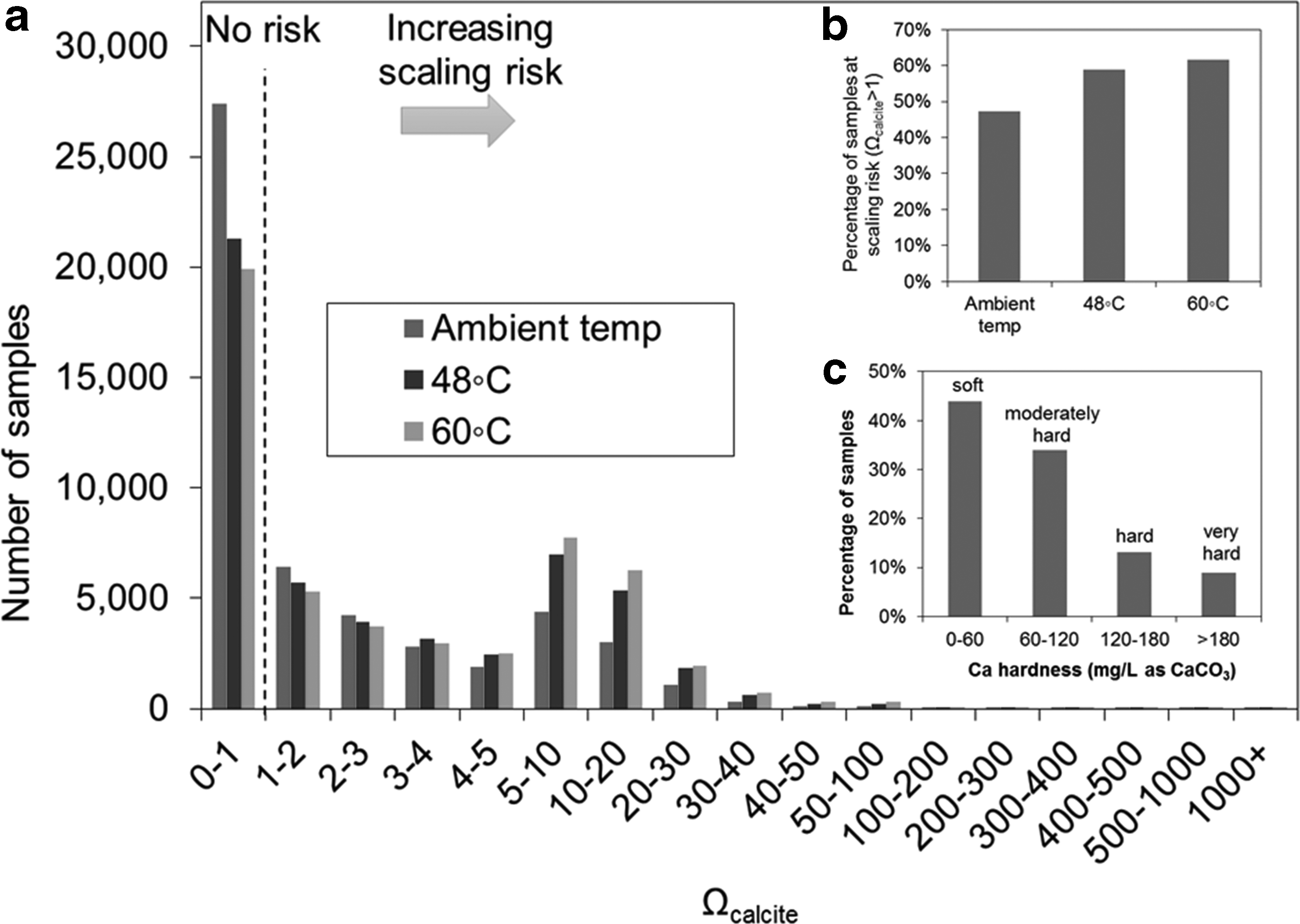
Scaling potentials of water samples collected from a national survey at different temperatures relevant to potable water systems (U.S. EPA, 2000).
Other methods that might be effective in controlling CaCO3 scaling
Stabilization of metastable CaCO3 polymorphs over calcite by using different additives might be effective in controlling CaCO3 scaling potential. Additives, including metal cations, silica, and organic species, can help stabilize metastable CaCO3 polymorphs, such as aragonite, vaterite, and ACC (Table 6). Zn2+ is the only additive that has been reported to help avoid massive calcite scaling when dosed at a concentration that is relevant to drinking water (1.5 × 10⁻⁷–1.5 × 10⁻⁴ M), by preferring aragonite nuclei to form instead of calcite. As a result, Zn can coprecipitate into aragonite nuclei or adsorb on aragonite nuclei and inhibit the further growth of CaCO3 crystals (Wada et al., 1995; Ghizellaoui and Euvrard, 2008). Other additives must be dosed at concentrations that are much higher than their typical concentrations in drinking water. For example, when silica is added at a concentration of 3.3 × 10⁻³–0.2 M, metastable CaCO3 polymorphs can be stabilized to coexist with calcite for as long as 2 h at 50°C and 80°C (Kellermeier et al., 2013).
OMM, organic matrix macromolecules; PAA, polyacrylic acid; PBTCA, 2-phosphonobutane-1,2,4-tricarboxylic acid.
Surface materials and roughness might affect CaCO3 scaling potentials as well as the physical and mechanical properties of scales. Since CaCO3 can form through heterogeneous nucleation on different surface materials, the surface energy and the nucleation energy barrier of different surface materials will affect CaCO3 scaling potentials. As discussed in Heterogeneous Nucleation and Deposition of Scales, copper has a higher scaling rate compared with steel (Macadam and Parsons, 2004a). In addition, the roughness of the surface materials can affect the physical and mechanical properties of CaCO3 scales (e.g., porosity and tensile strength). For mild steel surfaces, the rougher the surfaces, the lower porosity and higher tensile strength the CaCO3 scales possess (Keysar et al., 1994). This might be due to enhanced surface nucleation density and a certain orientation of the calcite structure.
Delay or prevent CaCO3 precipitation by using scale inhibitors
Scale inhibitors can effectively delay or even completely prevent CaCO3 scaling problems. Scale inhibitors are widely used to combat severe scaling issues in water processing equipment that handle large volumes of water, including cooling towers, nanofilters, and RO membranes, and production wells in oil and gas fields. These scale inhibitors generally include phosphonates, phosphate esters, polyacrylates, phosphates, and polyphosphates (Matty and Tomson, 1988; Xyla et al., 1991; Shakkthivel and Vasudevan, 2006). However, most of these inhibitors cannot be used in the finished drinking water, except phosphates or polyphosphates.
Inorganic cations Mg2+ and Zn2+ that are readily present in drinking water systems can also act as scale inhibitors (Table 7). Addition of Mg2+ at a concentration of 10−3 M and above can significantly inhibit calcite precipitation (Reddy and Wang, 1980; Lin and Singer, 2009). The mechanism behind the inhibiting effect of Mg2+ has been confirmed as the adsorption of Mg2+ onto calcite active crystal growth sites (or kinks) and subsequent kink blocking (Lin and Singer, 2009; Nielsen et al., 2013), rather than the previously proposed mechanisms of increasing the mineral solubility by incorporating Mg2+ into calcite (or incorporation inhibition) (Davis et al., 2000). Addition of Zn2+ at a much smaller concentration (∼10−7 M) can also significantly inhibit calcite precipitation (Ghizellaoui and Euvrard, 2008). It is possible that Zn2+ can inhibit CaCO3 (calcite or aragonite) precipitation through either kink blocking or incorporation inhibition, but the exact mechanism behind this inhibiting effect by Zn2+ has not yet been identified. However, no threshold values can be identified for either Mg2+ or Zn2+, because they reduce the CaCO3 precipitation rate even at very low concentrations, rather than abruptly halt calcite precipitation once a threshold value is reached.
Phosphates include orthophosphate, pyrophosphate, tripolyphosphate, and hexametaphosphate.
NOM includes Suwannee River fulvic acid, Pacific Ocean fulvic acid, and Williams Lake hydrophobic organic acid.
Other inhibitors that widely exist in drinking water systems are phosphates and NOM (Table 7). Lin and Singer systematically studied the inhibiting effects of orthophosphate (PO43−), pyrophosphate (P2O74−), tripolyphosphate (P3O105−), hexametaphosphate (P6O186−), and binary-polyphosphate blends. They suggested that orthophosphate at a concentration of 5 × 10⁻⁶ M, and polyphosphate or polyphosphate blends at a concentration of 5 × 10⁻⁸ M can inhibit calcite precipitation (Lin and Singer, 2005a, 2006). The reason for this inhibiting effect is the adsorption of phosphates onto calcite crystal growth sites and blocking further growth. NOM, such as fulvic acid and humic acid, can also inhibit calcite precipitation through a similar mechanism to phosphates (Hoch et al., 2000; Lin et al., 2005).
Phosphates can be used to advantageously control the location of CaCO3 formation in potable water systems. Addition of excess lime may only tend to coat the pipeline near the point of addition (Hatch, 1942). However, the addition of orthophosphate (Hatch, 1942) and polyphosphate (McCauley, 1960; Hasson and Karmon, 1981), including hexametaphosphate (Primus and Hunhoff, 1972), to supersaturated waters could delay precipitation or prevent it completely, potentially extending the distance that pipes are coated from CaCO3 formation.
Potential beneficial application of CaCO3 precipitation for autogenous repair
Although usually considered harmful, CaCO3 precipitation might be potentially beneficial when manipulated to repair leaks in drinking water systems via autogenous repair (i.e., leak self-repair) (Clear, 1985; Edvardsen, 1999; Tang et al., 2013). Autogenous repair is a promising and low-cost approach to leak repair that can be achieved by manipulating the water chemistry and formation of CaCO3 (e.g., calcite) to clog small leaks (holes typically ≈10 μm diameter) (Tang et al., 2013). If successfully applied, autogenous repair through CaCO3 precipitation might help reduce water losses that cost about $3 billion per year (FHWA, 2002), and extend the lifetime of the critically important and aging drinking water infrastructure that is expected to cost at least $1 trillion to repair, replace, and upgrade through 2035, according to an estimate by the American Water Works Association (Shanaghan, 2012).
With additional research, water utilities might achieve autogenous repair via CaCO3 precipitation, by either targeting the precipitation of CaCO3 to occur specifically in leaks (smart precipitation) or clogging the leaks when CaCO3 precipitates pass through the leaks (physical clogging) (Fig. 5) (Tang et al., 2013). It is even possible that these two mechanisms may be operative simultaneously. More specifically, to achieve smart precipitation, water utilities can appropriately adjust water pH, and “seed” small amounts of CaCO3 solids into holes by dosing them to water for a short period, or by adding high amounts of CaCO3 solids to water for a short period after temporarily removing a main from service. Then, water utilities can manipulate the saturation index of the supply water, such that CaCO3 solids form only within the leak holes to stop leaks, rather than in the bulk water. On the other hand, to achieve smart clogging, water utilities can control the addition of waterborne CaCO3 particles by pumping a few mg/L of suspended CaCO3 through the pipeline with the flowing water, such that a portion of the suspended CaCO3 particles can pass into leaks and seed the holes.
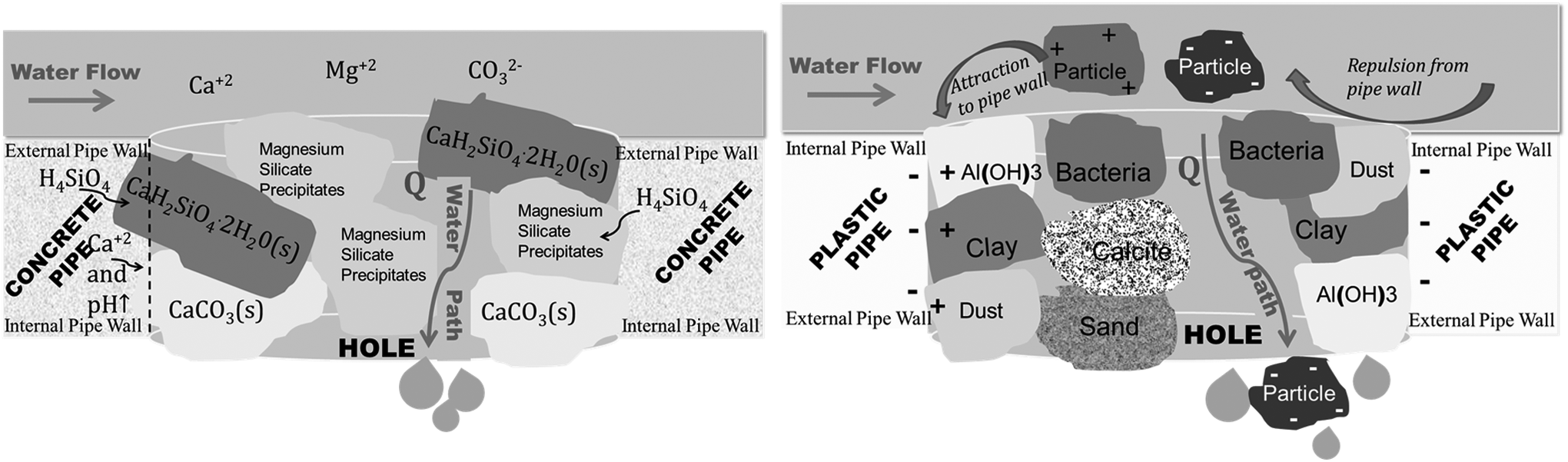
Autogenous repair of leaks by CaCO3 precipitation in drinking water pipelines by smart precipitation (left) and physical clogging (right). Adopted from Tang et al. (2013).
One potential problem of autogenous repair or clogging by CaCO3 precipitation is the long-term resistance to dissolution and longevity of the repair. It is possible that the repair materials (i.e., CaCO3) might start to dissolve, once a water that is undersaturated with respect to CaCO3 is pumped through the drinking water pipelines. However, since CaCO3 dissolution is not very fast at pH ≥5 (Morse and Arvidson, 2002) and ambient temperature, the repair might be relatively long-lived, even when the water is relatively undersaturated.
Combating scaling in homes and buildings
Various water treatment devices have become commercially available for homeowners to combat scaling issues (Table 8), and many of them have a strong scientific basis. First, ion-exchange softeners are designed to exchange Ca2+ with Na+, reducing the dissolved Ca2+ concentration and scaling potentials in drinking water. Second, membrane treatments (nanofilters and RO) can remove dissolved Ca2+ and inorganic carbon to reduce scaling potential, without introducing net extra salinity into the drinking water systems while considering both reject water and treated water streams. Third, surface-catalyzed crystallization induces CaCO3 precipitation during the treatment process itself, so that future scaling potential can be greatly reduced. Finally, reducing water heater temperature can be easily achieved by homeowners, and it reduces scaling potentials by making all CaCO3 solids more soluble at lower temperatures.
However, researchers are still dubious about the effects of magnetic antifouling, electronic antifouling, and electrostatic devices on treating CaCO3 scaling issues. These devices have been marketed for half a century, and vendors generally claim that these devices can reduce scaling by applying a magnetic field by using either a permanent magnet or a temporary electromagnetic field generated by electron currents (Powell, 1998). A literature review by Powell (1998) suggests that there are little scientific data to support the claims of these devices, and a systematic experimental study by Limpert and Raber (1985) proved that eight electrostatic, magnetic, and electromagnetic devices did not significantly reduce CaCO3 scaling. However, Al Nasser et al. (2011) has observed a slight decrease in the scaling rates of CaCO3 with the usage of electronic antifouling. They suggested that the conversion of calcite to vaterite, which is more soluble at 25°C, might contribute to the decreased scaling rates of CaCO3.
Knowledge Gaps
This review re-evaluated CaCO3 formation in potable water systems in the 21st century while considering global warming, autogenous repair/leak clogging, use of corrosion inhibitors, and rising water temperatures in buildings and homes. Because of these emerging issues, research on CaCO3 formation needs to be directed toward filling the following knowledge gaps: (1) Rising water heater temperatures, calcium levels, and atmospheric CO2 levels are changing the likelihood of CaCO3 formation in many potable water systems. (2) Many water treatment plants have relatively recently increased the dosage of inhibitors to combat lead and iron corrosion, and the temperature set point of water heaters is now being raised in many instances to reduce the likelihood of pathogen growth. Therefore, these changes will present new challenges to predicting CaCO3 scaling. (3) The newly discovered effects of scaling, especially autogenous repair of pipe leaks through precipitation, represents another important knowledge gap. Even though inhibitors, such as phosphates or Zn2+, can inhibit CaCO3 formation, scaling may be beneficial in protecting and repairing potable water pipelines, by forming CaCO3 in the leak holes to clog the leaks. This phenomenon could potentially alter our perceptions about the desirability of allowing CaCO3 scaling in potable water systems.
Footnotes
Acknowledgment
The authors acknowledge the financial support of the National Science Foundation under grant CBET-1336616. Opinions and findings expressed herein are those of the authors and do not necessarily reflect the views of the National Science Foundation.
Author Disclosure Statement
No competing financial interests exist.