







Abstract
Rural areas in the southern region of Brazil are primarily occupied by smallholder farms where a variety of food crops are cultivated. Sugarcane is one of the most common food crop in this region because it is used in animal feed and as feedstock in production of brown sugar, schimier, sugarcane syrup, cachaça, and hydrous ethanol fuel (HEF). This study evaluated a small farm in a basalt hill region of Rio Grande do Sul state, Brazil. The raw material was processed in a family agro-industry with small-scale HEF production and food products from sugarcane. The study was based in an average cultivation area of 15 ha. In industrial stage, an economic assessment was developed according to operational diversity of industrial production (HEF and food products). Payback for production of brown sugar, sugarcane syrup, schimier, and cachaça, were 0.53, 0.36, 0.77 and 3.85, respectively, whereas HEF was not economically viable. This study demonstrated that small-scale sugarcane production can be economically and environmentally attractive. This is because the technologies necessary for agricultural cultivation and industrial processing are simplified, the process is capable of generating a range of marketable products, and the wastes (specially bagasse) can be reutilized in the agro-industrial process. The proposed model has potential to be utilized in regions with similar characteristics as those considered in this study.
Introduction
Brazilian energy matrix has a large share of renewable sources and still has a high percentage of fossil energy. The main source of fossil energy is oil, which accounts for ∼36.4% of internal energy consumption (EPE, 2018). It is a better scenario when compared with the rest of the world, in which about 80% of energy consumption is supplied by fossil fuels (Pereira et al., 2012; REN21, 2018). The world energy consumption is ∼1.88 ton of oil equivalent per capita. In developed countries, such as the United States and Japan it is 7.02 and 3.61, respectively. The consumption in Brazil is ∼1.37; and in Africa only 0.67 (IEA, 2013).
The difference in this consumption refers to the concept of “energy poverty” (Barnes et al., 2011; Kaygusuz, 2011), where people are deprived of an energy service quality and spends a higher share of their income on energy. This lack of energy supply, or its high cost, implicates in the development of communities who live under such conditions, leading to poorer opportunities. Some degree of relationship between energy poverty and implications for the development can be observed (Groh, 2014; Lloyd, 2017). In recent years, Brazil has reduced the energy poverty through universalization of access to electricity (Pereira et al., 2011; Gómez et al., 2015; Bezerra et al., 2017), although liquid fuel for transportation remains as a barrier in rural development. Therefore, the production of hydrous ethanol fuel (HEF) from sugarcane along with certain food products arises as a solution to this problem, because it can provide more energy at a lower price, leading to a better scenario for low-income farmers.
In this context, the aim of this work is to evaluate the industrialization of sugarcane in a small-scale farm in the hillsides at the northeast region of Rio Grande do Sul (RS) state, Brazil. The production of food (brown sugar, sugarcane syrup, schimier, † and cachaça ‡ ) and HEF from sugarcane was evaluated, including a feasibility assessment.
Food versus biofuel dilemma
Around 8.63 million hectares of sugarcane were harvested in Brazil in the 2018/2019 harvest, with ∼90% of Brazilian sugarcane production in south-central Brazil, particularly in São Paulo state (National Company of Food and Supply, 2018). Most of the sugarcane harvested (56.5%) was used to produce ∼27.96 thousand m3 of ethanol, equivalent to 300 thousand barrels of oil equivalent per day (kboed−1). At the same period, 35 million hectares were used for soybeans, with about one-quarter of the harvest used to produce ∼50 kboed−1 of biodiesel (IEA, 2013). In Brazil, the consumption of diesel in agriculture and livestock activities is responsible for 12% of total diesel consumption, or ∼39.4 kboed−1 of diesel (EPE, 2013).
In general, the technologies for production of liquid fuels (e.g., HEF) are too complex and demand production on large-scale farms, removing small farmers from their traditional production regions (Veiga-filho and Ramos, 2006; Hira, 2010). Also, transportation of rural goods from small farms to consumers, generally involving large distances, are severely affected because of the cost of liquid fuels (Stifel and Minten, 2008; Gollin and Rogerson, 2013).
The use of renewable energy—particularly HEF—presents a direct relationship with the instability in oil price, and also with environmental issues (Rico et al., 2010; Stattman et al., 2013). In Brazil, this occurred during the 1970s, and resulted in the creation of the National Alcohol Program (PROALCOOL), which had the goal to reduce the expensive oil importation (Rosillo-Calle and Cortez, 1998; de Oliveira, 2002; Rico et al., 2010). Although the significant contribution of biofuels programs—with positive social, environmental, and economic impacts (Ravindranath et al., 2011)—these programs can also result in competition in land use (Runge and Senauer, 2007; Harvey and Pilgrim, 2011). The dilemma of producing energy instead of food (Tyner, 2013), remains unsolved, especially in large farms where the crops are mainly explored aiming the greatest immediate profit (e.g., production of soybean and sugarcane for export purposes) (Deininger and Byerlee, 2012). In its initial years of creation, PROALCOOL experienced the displacement of food crops by sugarcane, and it remains occurring at some level (Novo et al., 2012).
The prices of crops used for both food and ethanol production have their cost influenced by fuel prices (de Gorter and Just, 2010). It was indicated that a rise in Brazil's share in world ethanol market will increase food prices to a certain level (Monteiro et al., 2012). Considering the international context, it can be noted that large investments were carried in different programs of energy development—especially in grain exporting countries—aiming to use the excess of grain in biofuel production (Crago et al., 2010; Monteiro et al., 2012). However, if these countries choose to produce biofuels instead of exporting grains for human consumption, it can result in a decrease in the international food supply, leading to rising prices, hunger, and social pressures (Runge and Senauer, 2007; Wise and Brill, 2012). The risks of large-scale energy replacement programs, with policies of subsidies (Ravindranath et al., 2011), or their development influenced by market conditions can lead to: (i) land allocation for biofuel production (Gasparatos et al., 2011; Murillo, 2013), without a compatible increase in food production; (ii) environmental damage, mainly to the soil (Escobar et al., 2009; Buyx and Tait, 2011; Azadi et al., 2012); and (iii) increase of social inequality (Ribeiro, 2013).
Food end ethanol production in a complementary system
In Brazil—considering its available land and rural manual labor—incentives are needed for a new agro-industrial production model, affordable to the small farmers, and considering the role of small properties in the national economy. Small farms (under 50 ha) are responsible for >40% and 70% of value of production and employees, respectively, in the agricultural sector in Brazil (Paulino, 2014). Therefore, the compatibility between food and energy production in small farms is necessary (Practical Action Consulting, 2009; Egeskog et al., 2011; Maroun and La Rovere, 2014; Gonçalves et al., 2015). The use of sugarcane as feedstock may be an incentive in local manual labor and consequently help in the ending of misery belts in urban areas; mitigation of transportation infrastructure problems; increase in agricultural production and diversification; and return of people to the rural areas helping to develop small communities. The concept of small-scale productive arrangements was widely disseminated by Schumacher's book “Small is beautiful” (Schumacher, 1973). The main concepts were used in this study related to the proper use of land and intermediate technology.
These concepts are particularly important to the southern state in Brazil, RS. The last agricultural census of the RS indicates that RS has 365 thousand farms, 86% considered as family small farms with an average size of 16.3 ha, totaling >6.14 million hectares (IBGE, 2017). This production structure occupied >990 thousand people (∼10% of the RS population) in diversified agricultural activities, accounting for 80% of the state's production of beans, 92% of cassava, 67% corn, 84% milk, 80% poultry, and 70% of swine (IBGE, 2006). The agricultural production from family farms accounted for 26.6 billion dollars or 27.7% of the gross domestic product in 2006 (Guilhoto et al., 2007), highlighting the economic importance of these activities.
The region with the highest concentration of small farms in RS, with a diverse agricultural production, is the “basalt hillside” (Waquil, 2005), occupying about 20% of the state area. Smallholder properties from this region hold different agricultural and animal husbandry focused mainly in subsistence activities, which enables rapid recovery of soil fertility through the use of appropriate techniques. Appropriate use of production factors lead to increased production in smaller areas, optimizing land, manual labor, energy, and other inputs, allowing the introduction of other commercial crops. Sugarcane is one of these crops that becomes a real income option because of its commercial value, either in natura or industrially transformed. Sugarcane can be used as energy feedstock in this region because it can be cultivated in higher slope soils that normally are not used, providing protection against soil erosion. Additionally, local farms have been traditionally cultivating some sugarcane varieties for years, aiming at the production of brown sugar, sugarcane syrup, schimier, and cachaça. Also, sugarcane bagasse is used in animal feed.
Characteristics of sugarcane allow its integral utilization, even the residues from the industrial process can be used. The bagasse has the potential to be an alternative solid fuel (Teixeira et al., 2010) or animal feed (Tonissi et al., 2005; Teixeira et al., 2007). Egeskog et al. (2011) discuss the use of sugarcane bagasse as feed for dairy cattle supplemented with some source of protein and mineral. Vinasse is another important residue, with many applications: can be used in fertilization (Oliveira et al., 2009; Bustamante et al., 2010); in animal nutrition (Arrigoni et al., 1993; Yalçin et al., 2010; López-Campos et al., 2011; Coelho, 2012); substrate for cultivation of fungal protein (Barrocal et al., 2010; Nitayavardhana and Khanal, 2010; Silva et al., 2011; Ferreira et al., 2012); and even for biogas production (Szymanski et al., 2010; Salomon et al., 2011; Souza et al., 2012). A detailed discussion about sugarcane byproducts' utilization can be found in Mayer et al. (2015).
Materials and Methods
Location of sugarcane cultivation
Experiments were carried out in a typical family farm in the region of Furnas, located at the city of Três Coroas, about 110 km from the state capital Porto Alegre. This farm was chosen because it has the typical characteristics of the region. This micro region has favorable conditions for the cultivation of sugarcane. The rugged relief has 52.7% of the land with slope between 0% and 15%, 18.8% between 15% and 30%, 21.8% between 30% and 50%, and 6.7% above 50% slope. The temperature ranges from 5°C to 35°C, with rare occurrence of frosts from June to August. The relative humidity varies between 70% and 95% and the average annual rainfall is 1,400 mm, with maximum in winter and summer. An area of land with slightly steep slope hills was used, called marginal lands, which has high fertility profile but is not suitable for regular annual crops.
The agricultural period of sugarcane planting, development, and harvesting was 16 and 12 months after planting sugarcane was mature for harvest and industrialization. Sampling was used to verify the maturity of sugarcane by testing the sugar concentration in the juice. The main sugarcane variety cultivated was the CB 41–46. Sugarcane is divided in straw, tips, and stems, and their potential uses in industrialization are summarized in Fig. 1.
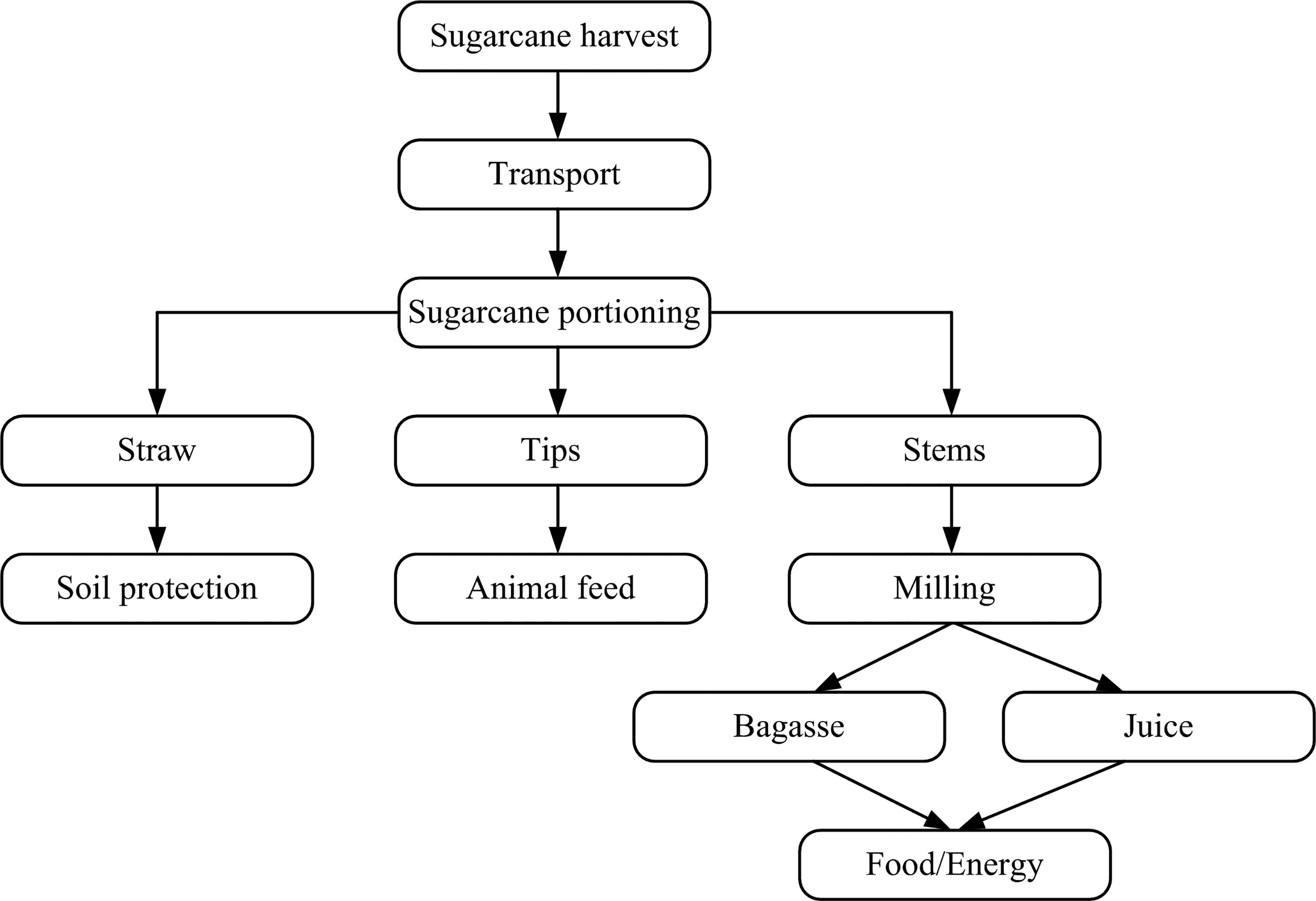
Main potential uses of sugarcane portions used in this investigation.
The sugarcane was harvested manually and transported by animal traction. Straw and tips were manually separated, and straw was used to cover and protect the soil, whereas the tips were intended for animal feed. Sugarcane stems were obtained by manual cutting and the juice extraction was realized by milling (25°C and 1.0 atm) using a pilot-scale mill (Max Badermann & Cia Ltda) with processing capacity of 1.2 sugarcane ton/h. As the extraction process was performed in pilot-scale milling—with several kilograms of sugarcane processed per day—it is difficult to control the replicates, thus a mean extraction yield (about 60%) was previously determined and assumed for all runs assessed in this study. Sugarcane bagasse was placed in sheds (avoiding rainfall), where it dried at room temperature for further use, for example, as solid fuel or in animal feed.
Sugarcane products
Resources, such as plows, oxen, hoes, cart, and others, were not computed, assuming that the regular structure of small farm has these tools. Moreover, the resources of installation for the small-scale industry were prorated proportionally to each product, that is, industrial building can be prorated in 20% for each of the 5 products (brown sugar, sugarcane syrup, schimier, cachaça, and HEF) (Fig. 2).
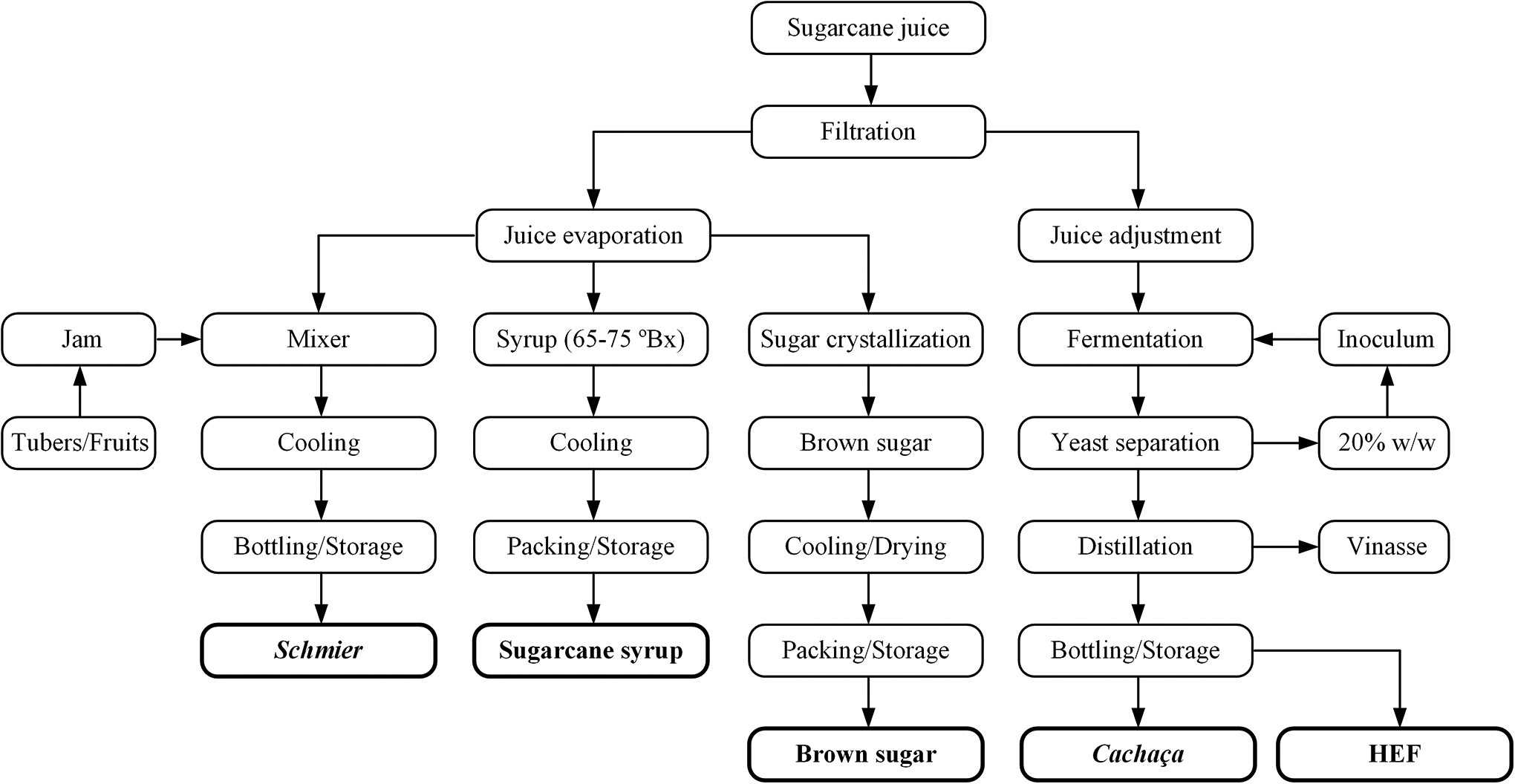
Food and HEF production process flowchart. HEF, hydrous ethanol fuel.
The process adopted includes simple technologies compatible with this farm scale, which is already presented in the Location of Sugarcane Cultivation section. A coarse cloth filter with random mesh performed the sugarcane juice filtration to obtain all products investigated in this study. As can be seen in Fig. 2, sugarcane products' manufacture involves several steps, which are described below for each sugarcane product.
Brown Sugar, sugarcane syrup, and schimier: juice was filtrated and transported to an opened metallic evaporator with maximum volume of 200 L. Evaporator was intermittently mixed while was heated by firewood until it reached the boiling point (controlled by the operator) and sustained for 1.5 h under heating. The supernatant was removed by gravity and with the aid of a skimmer. For brown sugar, when the sugarcane juice reached the sugar point (controlled by the operator), it was removed from the fire and placed in contact with the ambient temperature, and crystallization of sucrose occurred while a constant manual agitation was used. Finally, the brown sugar was placed into timber trays to dry at room temperatures. For the sugarcane syrup, when the sugarcane juice reached the sugarcane syrup point (controlled by the operator) it is removed from the fire and rapidly packed to avoid crystallization (packing temperature about 80°C). The process is similar in schimier manufacture by the addition of seasonal fruits (banana, grape, or orange) or vegetables (pumpkin, chayote, or sweet potato) in a ratio of 3:1 before the complete evaporation of the sugarcane juice. Also, sugarcane tips were tested as a potential feedstock in brown sugar production. Analysis of brown sugar composition followed the methodology presented elsewhere (Zenebon et al., 2008).
Cachaça and HEF: Sugarcane juice concentration was adjusted to 16°Brix and sugar concentration was measured using a portable refractometer. Sulfuric acid was added in the sugarcane juice until pH was in the range of 4.5–5.0, and then the juice was sent to the fermentation vessel, which was constructed of copper with a maximum operation capacity of 200 L. A commercial strain of Saccharomyces cerevisiae (Fleishmann) was used for the inoculum. Cell production for preinoculum was carried out in vessels with 1.0 L of medium containing (g/L−1): sucrose (20.0), yeast extract (5.0), K2HPO4 (5.0), NH4Cl (1.5), KCl (1.15), and MgSO4.7H2O (0.65). The preinoculum was maintained at room temperature (25°C) and mixed intermittently for 24 h. Fermentation vessel was inoculated with 20 g/L−1 of preinoculum and the process was interrupted after 24 h. Yeast was separated by decantation and the wine was sent to distillation. A pilot-scale distiller with a maximum operation capacity of 100 L was used to the cachaça production from wine, which was heated using firewood. A condenser put on top of the distiller was used to recover cachaça. After several experiments, an average yield of 16 L of cachaça per batch was considered for calculation purposes. HEF production was similar to the production of cachaça, presenting difference only in the ethanol concentration obtained at the end of the distillation (88% of ethanol by volume) and that was measured by a Gay-Lussac's densimeter.
Manual harvesting was done, transport with animal traction, sugarcane milling in one mill with manual feed, no use of additives, use of simple buildings for processing goods, and use of gravity in liquid transportation. The equipment and units used in sugarcane juice extraction, distillation, transportation setup, and harvest for its characteristics, could not be considered alone. The main energy sources were: diesel consumed by tractor; electricity used in sugarcane milling, available from a home-made small hydropower; and firewood in evaporation and distillation (burned in simple ovens). Firewood was obtained by selective cutting of existing forests, which does not exempt the planting and replanting of trees or even growing of energy forests.
Economic assessment and waste use alternative energy resources
Activities were divided according to its economic characteristic, as shown in Fig. 3, and were quantified in relation to the time consumed in feedstock processing and the requirement of equipment and utilities.
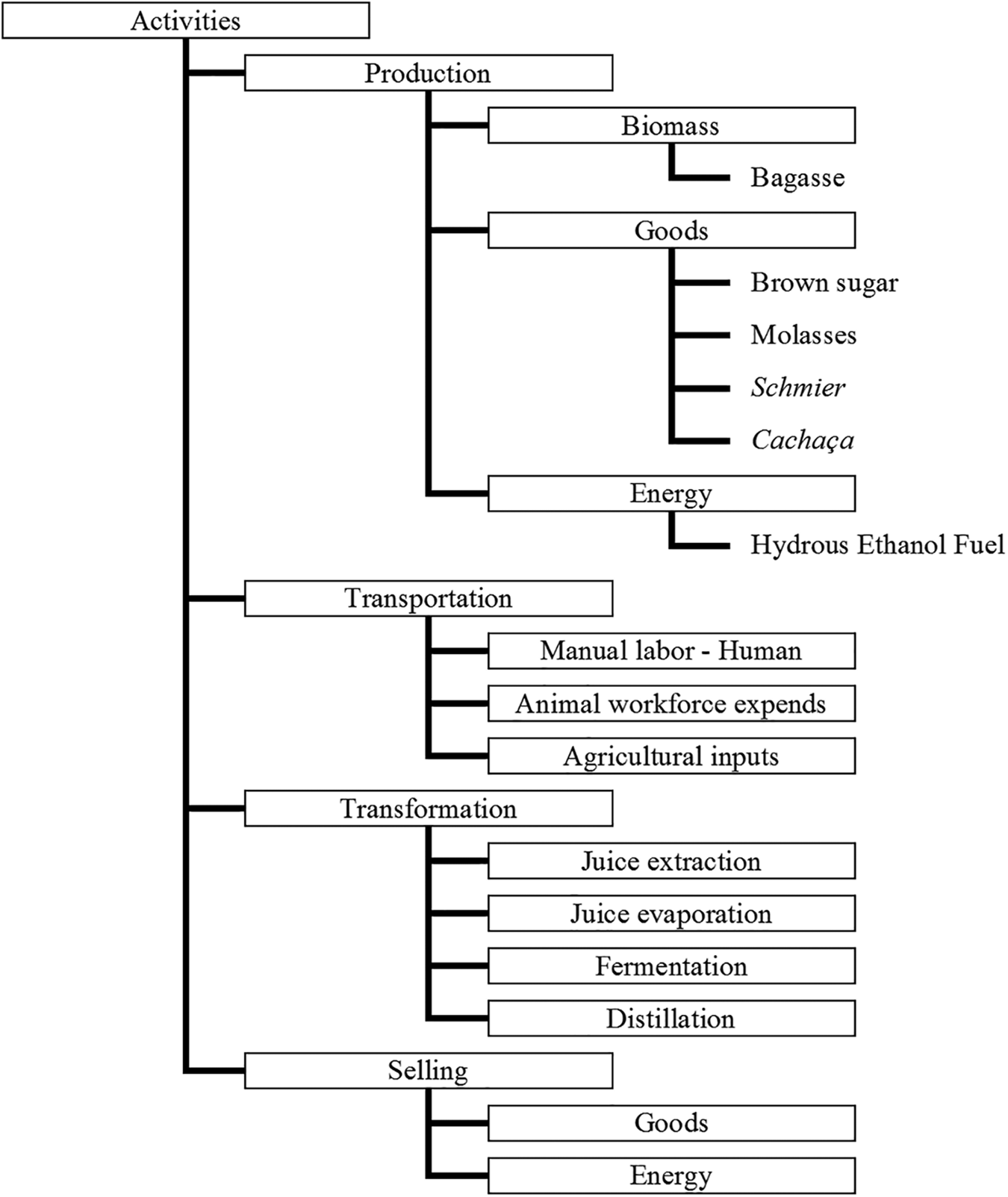
Flowchart of activities in the sugarcane industrial process.
Sugarcane products and their feasibility were assessed to obtain enough information to compare data from each product. The cost analysis involved both the initial investment and the production costs. In addition, the potential use of residues from the agro-industrial process was evaluated as alternative to reduce energy consumption. The feasibility of each product was assessed separately, considering payback as the indicator of feasibility.
In sequence, economic analysis was performed using the simplex method of linear programming, aiming to inform the amount of each product (brown sugar, sugarcane syrup, schimier, cachaça, and HEF) that should be produced in the most feasible scenario.
The structure of linear programming model was composed of one objective function, activities, and restrictions. The objective function was the maximization of net profit, that is, the difference between incomes and costs in all activities. The objective function to be maximized is presented in Equation (1):
where Pi is the specific profit (US$/kg or L of product); Xi is the amount of product which should be produced in a year (kg or L of product/year); and i is the i-product considered.
The activities were the decision variables considered according to the production shown in Fig. 2, and the inputs required in the production stages of each process. The values of the coefficients considered for each activity are presented in Table 1.
Coefficients Used in Simplex Linear Programming
Amount produced from 100 L of sugarcane juice with 16% by mass of sugar.
Data collected in this study.
Exchange rate is US$ 1.00 = R$2.30.
Man-hour required in all activities from farming to industrialization.
Time consumed in equipment utilization in each product batch; Brown sugar, sugarcane syrup, and schimier divide the same evaporator, whereas cachaça and HEF uses the same distillation apparatus.
HEF, hydrous ethanol fuel.
Restrictions were the limitations or impositions in which the activities are subject, and were considered as follows:
Consumption of feedstock: 240 t of sugarcane are available each year, considering a production area of 4.0 ha and a productivity of 60 t/ha; Man-hour: 8,640 man-hours, resulted from 4 men working 8 h/day in 270 days/year; Maximum output in each process was defined based in the maximum number of batches that could be performed working 8 h/day in 270 days/year; Time consumed in evaporation: Brown sugar, sugarcane syrup, and schimier divide the same equipment (evaporator), which have an availability of 2,160 h/year. Time consumed in distillation: cachaça and HEF divide the same equipment (distillation apparatus), which has an availability of 2,160 h/year. HEF production: a minimum of 800 L/year of HEF should be produced because it is used as fuel in the transportation of products from the farm to the consumer.
The problem was solved by establishing the competitiveness between the activities developed and maximizing the net income for successive limits of food and energy production plant. Payback was adopted as feasibility indicator.
Table 1 also presents the yield in industrialization of products (based on 100 L of sugarcane juice with 16% by mass of sugar) and the selling price (USD) for each main product generated by the processing of sugarcane. The price of HEF was assumed as the price of ethanol from the gas station (92.6% by mass), replaced by on-farm ethanol (88% by mass). The ethanol produced on-farm cannot be traded in the market because of legal restrictions related to fuel standards. The legislation that regulates the selling of HEF in Brazil establishes a chain of agents that, mandatorily, must be involved in this market. This legislation prohibits the direct commercialization of HEF from producer to the consumer, requiring the intervention of a distribution agent, increasing the final price of HEF (Mayer et al., 2015). Therefore, the HEF amount detailed in Table 2 aims to meet the self-consumption only.
Analysis of the Main Constituents of Brown Sugar from Sugarcane Base and Tips
TRS as a fraction (%) of sugarcane.
Including 5.0% of reducing sugars.
TRS, total reducing sugars.
Results and Discussion
Sugarcane cultivation
Sugarcane was cultivated mostly by its adaptation to soil and climate of the region, and also by its industrial versatility. Sugarcane was cultivated in rotation with other crops used in the production of schimier. This is because it did not affect subsistence crops (as sorghum), support soil protection (unlike cassava that exposes overused soil), enables the food production for men and animals (unlike forest), and produces liquid fuel through extraction/fermentation/distillation process. Sugarcane was cultivated on hillsides, with a slope between 15% and 30%, which demanded attention to soil conservation. This land type constitutes a portion of 3 to 4 ha on average, in areas located between the lower part of the Charrua (eutrophiclitholic) and the high of the Ciríaco (Reddish Brunizem). In regions where the decline is accentuated, manual planting and harvesting of sugarcane becomes a promising alternative for the agro-energy use of these regions that would not be useful on the farm.
After verifying the feasibility of using the soil, results were obtained from practical confirmation, complemented by literature and projection data when necessary, enabling the discussion of the small sugarcane agro-industry. The data were obtained from the evaluation of the agro-industrial aspects of the planting, harvest, and industrial processing of sugarcane. Some initial data regarding the fertility of the soil is demonstrated in Table 3. These data were collected before and after the cultivation of sugarcane. Water used in the process comes from springs that are at the top of the relief. Therefore, water was transported by gravity, minimizing the use of electric pumps.
Soil Chemical Analysis
Sampled at more accentuated slope within the studied area.
Clayey soils, with >40% of clay.
CEC, Cation Exchange Capacity in cmol L−1; ND, not detected; SMP, Shoemaker, Mac lean e Pratt.
Industrialization of sugarcane products
Industrialization of sugarcane, as described in Sugarcane Products section, depends on the desired product. However, the stage of sugarcane juice extraction is common to all products considered in this study. Sugarcane stems harvested are transported to the sugarcane mill, where the juice is separated from the bagasse. Commonly, sugarcane can be divided into longer tip and stem, at a ratio of 1:2. The sugarcane portioning can be justified by its natural size (between 2 and 3 m), which easies transport and milling. Sugarcane tip portion is the upper section of the stem containing three to six internodes, with less sucrose concentration but higher concentration of other sugars. Normally, sugarcane tips are chopped off from sugarcane stem in the harvest, remaining in the field.
Sugarcane tips could be used as feedstock for HEF production because fermentation using S. cerevisiae does not require sucrose but any hexose. The tips results in a reduction in juice extraction efficiency of ∼40%, due to its small size (40 cm average) and are difficult to manually feed the milling system, invalidating the initial scheme for this study. However, if the milling system is adapted to a new design the idea should be reconsidered, allowing the processing of chopped sugarcane—always aiming an affordable and efficient technology.
Although the disadvantages are presented, the use of sugarcane tips in brown sugar production was tested, and the results are presented in Table 2. A greater concentration of salts and lower concentration of sucrose was noted in the brown sugar made from tips. The aspect of brown sugar (with and without tips juice) was similar, with a more bitter or salty flavor in the brown sugar obtained from sugarcane tip.
Table 2 also shows the viability of sugarcane partitioning, even in large stems, especially for off-season periods when the sucrose content in the tips drops, decreasing the brown sugar yield. Results show that no apparent problems will be observed if using the whole sugarcane stem in the production of sugarcane syrup and schimier, and the use of sugarcane tip in the fermentation products is recommended.
A further analysis was carried out and other costs were added, such as depreciation, maintenance, and interest rates. The summary of production coefficients for the considered process can be observed in Table 4.
Summary of Production Coefficients for the Considered Process
Twenty kilograms of brown sugar per batch.
Twenty kilograms of sugarcane syrup per batch.
Thirty-five kilograms of schimier per batch.
Sixteen liters of cachaça per batch.
8.0 Liters of HEF per batch.
Although HEF production shows economic feasibility, it cannot be sold to the market because of legal restrictions.
The initial investment for sugarcane syrup industrialization is small (USD 16,448.00) compared with sales income (USD 81,763.00), which proves to be a better financial return (Table 4). This is the investment with the best financial return among the products assessed (Table 4). On the other hand, the production of HEF presented no economic feasibility. However, it is an essential product, because it is used as fuel in the transportation of goods to the consumer market. Additionally, HEF could be bartered for other products in an associative scheme, as suggested by Mayer et al. (2015).
Also, it is important to emphasize that the quantification of revenues consider that the consumer market is able to absorb all the production of the goods, which may not be possible if the selling is performed in a limited market. Nevertheless, it is important to note that brown sugar, sugarcane syrup, and schimier have large regional acceptance, which favors their sale. On the other hand, cachaça and HEF have a narrow market, especially HEF, which requires quality compliance with legislation.
In addition, the largest investments required are focused in the juice extraction and distillation steps. The sugarcane milling technology involves high costs—necessary for higher yields—not followed by the desired efficiency. Thus, the residual sugar in bagasse suggests a nobler destination to residual bagasse as well as other agricultural and industrial waste.
In a second analysis, a scenario was built considering the maximization of profits according to the availability of workforce, feedstock, equipment output, and costs. The analysis used a simplex algorithm, as discussed in Economic Assessment and Waste Use Alternative Energy Resources section. As a result, it is indicated to produce only sugarcane syrup and schimier, and also HEF to be used as fuel. In this scenario, the income was US$ 106,399.28 from these three products, and the profit was US$ 99,632.36, resulting in a payback of 0.37 year.
As stated early, these results are based on the assumption that there is a demand to absorb the entire production, which could be a weakness of this analysis. Although the proposed model may have some issues, it also pointed out that the feedstock could be used to produce other products outside the model resulting from simplex, like brown sugar and cachaça, or even increase the production of schimier. This flexibility may be the most important feature of the proposed model, allowing the process to be adapted to the demand of the consumer market.
Animal feed products
Sugarcane bagasse and tips—if not used in the sugarcane processing—can be used in animal feed, and their productivity was calculated and is presented in Table 5. Analysis made for animal nutrition purposes showed both bagasse and tips had potential as forage, but the tips are richer in protein and therefore more useful as animal feed. The large amount of total reducing sugars (TRS) remaining in the bagasse—the main reason for not using it as fuel—suggest its use as animal feed. These products tend to have a better use in ruminants if chopped and supplemented with protein or other nitrogen source, such as urea (Hassoun et al., 2002; Egeskog et al., 2011).
Productivity and Total Reducing Sugars from Sugarcane Bagasse and Green Tips
TRS as a fraction (%) of sugarcane.
However, the use of bagasse and tips for animal feed depends on technical and economic assessment, considering the advantages and limitations of their nutritional value (Sarmento et al., 2001). Therefore, the cultivation of perennial soybeans, a nitrogen-rich leguminous, planted between the sugarcane lines for coverage purposes, on hillsides with slope above 30% was also assessed. The results are shown in Table 6.
Analysis of the Studied Products for Animal Feed
Sarmento et al. (2001).
The bagasse and tips from sugarcane are considered bulky feedstocks in animal diets, requiring the combination of concentrates and other supplements for a satisfactory diet. These residues have high fiber content—a source of structural carbohydrates (cellulose and hemicellulose) metabolized as volatile fatty acids—used as an energy source by ruminants (Pereira et al., 2009). Soybean meal can be an alternative as concentrated food and may also replace the protein supplementation from urea, since the crude protein value is high (Table 6).
No-till farming with dry sugarcane straw
Sugarcane straw has a considerable share in sugarcane total weight (Table 7), so it is widely used as a “natural fertilizer” in the region considered in this study. The use of sugarcane straw for covering the soil—technique called no-till farming, has many advantages. The straw will degrade along the crop cycle, resulting in weed control, increased nutrient concentration, and decreased erosion (Mendonza et al., 2000).
Productivity and Fraction of Sugarcane Straw
Fraction of dry straw in relation to sugarcane.
Formerly, sugarcane straw and other portion of green mass were burned in large-scale sugarcane crops to facilitate harvesting. Currently, the sugarcane burning is forbidden in some regions of Brazil. The laboratorial analysis of samples of straw had values of 0.17%, 0.02%, 0.45%, 0.09%, and 0.03% by weight of nitrogen, phosphorus, potassium, calcium, and magnesium, respectively, showing the presence of important nutrients for soil fertility.
Vinasse in fertigation
Vinasse, the major byproduct in the production of ethanol fuel on small scale, is produced at a ratio of 14 to 17 L per liter of ethanol (Mayer et al., 2015). Its utilization is important to avoid environmental problems due to its high chemical oxygen demand, ∼3.88 to 30.4 g/L−1 (Craveiro, 1983; Nitayavardhana and Khanal, 2010; España-Gamboa et al., 2011). Vinasse had a wide range of uses, such as anaerobic digestion with many advantages as low energy demand, low sludge production, small area for the system deployment, and use of biogas as fuel. However, the main utilization of vinasse has been in the irrigation of sugarcane plantation, as a soil fertilizer, because of the large-volume production and the low concentration of total solids (Bustamante et al., 2010; Christofoletti et al., 2013).
The utilization of vinasse in fertigation could not be assessed due to the small scale and batchwise processing of ethanol, resulting in a low volume of vinasse. Nevertheless, vinasse could be used, together with other water supply, for irrigation of farm areas, mainly during the drought period.
Fermentation of residual sugar in bagasse
Sugarcane milling is the industrial step with lowest efficiency, ∼60%, bottlenecking the entire process. Therefore, an experiment was made to use the residual sugar present in the bagasse, which involved the following steps: bagasse shredding; addition of hot water (80°C) to sugar diffusion; addition of inoculum after cooling; fermentation with periodic stirring; and distillation on batch still. The experiment demonstrated that 18 kg of bagasse contains 3 kg of TRS—approximately 17.0% in weight or 65 kg TRS per ton of sugarcane—resulting after fermentation in 1.96 L of ethanol (100% in weight).
The fermentation of residual sugar from bagasse is an alternative for a milling system with low extraction efficiency (<70%), also appropriate to tips or the entire sugarcane. The amount of energy expended in the shredder and in the distillation step is higher than in the standard process. However, the bagasse use may increase the HEF production (virtually zero cost of residual sugar in bagasse), giving competitiveness to the alcohol fuel. This technique is particularly relevant if bagasse is not used as animal feed.
Barriers and perspectives to the proposed model
Production of goods on small scale is limited by factors from inside and outside the process boundaries. The limiting barriers within the process are related to the process efficiency and feedstock costs, which greatly affect the competitiveness of the proposed model, although it proved to be economically feasible using low-level technology. Low-level technology—or intermediary technology (Schumacher, 1973)—suffers with low efficiency, which is harmful to small-scale projects. In fact, a more efficient technology generally demands a more trained manual labor, often hindering its deployment (Wonder and Simpson, 1982; Maroun and La Rovere, 2014). On the other hand, utilization of a marginal crop (sugarcane in this case), ensures a low-cost raw material. However, its harvest demands the presence of manual labor, because the topography prevents the use of mechanized harvest.
External factors could be raised from local to national aspects. As example, HEF commercialization in Brazil is highly regulated (Mayer et al., 2015), that is, (i) HEF should attend to legal standards—minimum of 92.6% of ethanol by mass, and (ii) HEF cannot be directly traded without first passing through fuel distributor and then to fuel station. For that reason, the proposed model only considers the HEF produced for self-consumption, although it could be considered different in other countries. As a result, HEF from small scale has its commercialization price higher than gasoline or ethanol at the gas station, due to freight costs, profit margin, taxes, and, mostly because of process inefficiencies. Moreover, in the Brazilian case, large-scale ethanol production may experience a fierce competition with oil products (gasoline and diesel) from the recent “pre salt” giant oil fields (Moreira et al., 2014), suggesting an even darker scenario for small-scale ethanol production.
Nevertheless, the proposed model could be applied to cooperatives of small farmers (Maroun and La Rovere, 2014; Mayer et al., 2015), resulting in a larger production scale and higher process efficiency. Additionally, food products can be purchased by government through the Food Acquisition Program. This governmental program aims to purchase food products from family farming to attend schools (Sonnino et al., 2014). The model presented in this study depends on technology maturation, but especially on appropriate government policies, because, as in other cases (Huttunen, 2009; Bruins and Sanders, 2012; Kolfschoten et al., 2014; Gonçalves et al., 2015), rural farmers can be key factors in assuring energy security.
Conclusions
The small-scale production can be a viable alternative with easy assimilation for food and HEF production. Payback results suggest that all products from sugarcane have attractive results. HEF showed the lowest economic performance, with higher investments and lower incomes. However, HEF is essential to be used as fuel in the transportation of other products from the small farm, and could also be employed in agricultural implements and electricity generation. Additionally, sugarcane byproducts, such as bagasse, straw, and vinasse could raise the energy and economic outcomes of this production scenario. Therefore, agro-industrialization of sugarcane is able to assist in the raising of social and economic conditions of small-scale farms and consequently the involved regions, respecting the soil vocations and its conservation.
The prosperity of projects involving this subject should not be attached to residues, products, and other mechanisms that can overwhelm the small-scale technology. Therefore, the objective should be the utilization of available resources, with rationality and caution, introducing improvements in technology at the agricultural, industrial, and processing stages.
Footnotes
Author Disclosure Statement
No competing financial interests exist.
Funding Information
No funding was received for this article.