







Abstract
Nonylphenol ethoxylate-n (NPnEO) is a nonionic surfactant, and can be degraded in chemical and biological ways for short-chain NPnEO with n ≤ 10. However, when n is >10, the degradation of NPEO in wastewater was seldom reported. In this study, the electrochemical oxidation of long-chain NP40EO at high saline wastewater was investigated. The main influencing factors such as current density, plate distance, initial pH, salt type, and salt concentration on electrochemical degradation of high saline NP40EO wastewater were evaluated. The chemical oxygen demand (COD) removal efficiency increased with the increase of current density and reached 73.4% at 45 mA/cm2 after 6 h electrolysis. Plate distance had no effect on the COD removal. As compared with sodium sulfate (Na2SO4), sodium chloride (NaCl) solution led to better COD removal. A high COD removal efficiency was obtained at lower initial pH value. A possible electrochemical degradation pathway of NP40EO was proposed. The energy consumption increased with increasing current density, plate distance, initial pH value, and decreasing NaCl concentration. Based on the energy consumption analysis, the optimal operating parameters were obtained at current density of 30 mA/cm2, plate distance of 2.0 cm, NaCl concentration of 0.50 M, and initial pH value of 3.0. This result indicated that electrochemical advanced oxidation process is a feasible way for the treatment of long-chain NP40EO wastewater at high saline conditions.
Introduction
Nonylphenol ethoxylate (NPnEO) is a nonionic surfactant and widely used as dispersant, wetting agent, emulsifier, detergent, and penetration agent in various industries, for example, washing, dyeing, and chemical industries (Zgola-Grzeskowiak et al., 2009). Salt, for example, nitrate, chloride, sulfate, etc., is also widely used in chemical industry. Hence, high saline NPnEO wastewater is often discharged from many industrial factories.
In the biological process, NPnEO is slowly degraded to nonylphenol and NPmEOs (m = 1–4), which are considered as endocrine disrupting compounds and more toxic than their parent compound NPnEO (Hou and Sun, 2007; da Silva et al., 2015a; Iqbal and Bhatti, 2015). Meanwhile, the high salinity of wastewater increases the difficulty of NPnEO biodegradation. High concentration of salt inhibits the activity of activated sludge because of bacterial plasmolysis (Klontza et al., 2010). Therefore, physicochemical treatment is the primary selection for high saline wastewater, including evaporation, reverse osmosis, ion exchange, and electrodialysis (Sundarapandiyan et al., 2010; da Silva et al., 2015b).
Advanced oxidation processes have been widely used for the decomposition of refractory organic contaminants (Lefebvre and Moletta, 2006; Abou-Elela et al., 2010) and the treatment of NPnEO wastewater with high salinity. Iqbal and Bhatti investigated the degradation of NPnEO by gamma radiation/H2O2, and obtained >90% removal and the reduction in cytotoxicity and mutagenicity (Huang et al., 2020). Nearly 90% NP9EO degradation was achieved by ultraviolet (UV) and solar irradiation (Meng et al., 2019), and 98% NP10EO was degraded in UV/H2O2 process at low concentrations of NPnEO (50–150 mg/L) (Iqbal and Bhatti, 2015). The salts in the wastewater improved the mineralization of organic pollutants (Ashar et al., 2016). With the increase of the chain length, the degradation of NPnEO decreased. However, the electrochemical oxidation process of NPnEO with n > 10 has seldom been reported. Therefore, electrochemical oxidation may be considered as an alternative technique for the treatment of high saline long-chain NP40EO wastewater.
Electrochemical advanced oxidation processes (EAOPs) have many advantages, such as strong oxidation performance, mild condition, and environmental compatibility, for the treatment of refractory and complex organic wastewater (Chaplin, 2014; Moreira et al., 2017; Carotenuto et al., 2019). Electrochemical oxidation is divided into direct electrochemical oxidation (anodic oxidation) and indirect electrochemical oxidation (Tang et al., 2014). Anodic oxidation is based on the direct electron transfer to the anode surface, resulting in the generation of the powerful physically adsorbed hydroxyl radical (·OH) (Zhuo et al., 2011; Feng et al., 2013). The ·OH group is a nonselective oxidant with oxidation potential of 2.70 V, enhancing the degradation of organic matter (Panizza and Cerisola, 2009; Moreira et al., 2017). Indirect electrochemical oxidation is based on other weaker oxidant agents such as active chlorine (Deng et al., 2019; Meng et al., 2019). When chloride ions are presented in wastewater, active chlorine can be generated in the electrochemical process (Brillas and Martinez-Huitle, 2015), which enhances the oxidation of organic matter (Nidheesh et al., 2018). The chlorine evolution potential depends on the types of anodes, with the potential of the graphite anode being 1.36 V (Anglada et al., 2011). The electrochemical oxidative degradation of NP10EO in synthetic wastewater and actual wastewater was investigated, showing higher degradation efficiency (>85%) (Sivri et al., 2020), but longer NPnEO (n > 10) was also not reported in the previous studies.
In this work, the feasibility of NP40EO removal in high saline wastewater by electrochemical oxidation using graphite electrode was investigated. The influencing factors, including current density, plate distance, salt type and concentration, and initial pH on NP40EO removal, were explored. The possible degradation intermediates of NP40EO were identified, and then a possible electrochemical degradation pathway was proposed. The energy consumption of electrochemical wastewater treatment was also evaluated.
Materials and Methods
Materials
Nonylphenol ethoxylate (Tergitol NP-40) (NP40EO) was purchased from Shanghai Aladdin Bio-Chem Technology Co., Ltd (Shanghai, China) with a chemical oxygen demand (COD) value of 155,000 mg/L. Other chemicals were obtained from Sinopharm Chemical Reagent Co., Ltd (Shanghai, China) with reagent grade. All solutions were prepared using ultrapure water (resistivity ≥18.2 MΩ·cm). The graphite electrode plate was purchased from Jinglongtetan Tech Co., Ltd (Beijing, China). The stainless steel electrode plate was purchased from Quanfu metal Co., Ltd (Shenzhen, China). NP40EO wastewater was prepared by diluting the original NP40EO solution using ultrapure water. The pH value was adjusted by adding H2SO4 (1.00 M) or NaOH (1.00 M) solution. In this experiment, pH buffer was not used as it was causing a large change in the conductivity of the reaction system. The original NP40EO synthetic wastewater contained 1,550 mg/L COD and 0.50 M sodium chloride (NaCl), except the assays investigating the influence of different NaCl concentrations.
Electrochemical experiment setup
The electrochemical degradation of NP40EO was carried out in a 250 mL glass beaker with 200 mL working volume, and the solution was mixed using a magnetic stirrer. The graphite electrode plate (dimensions: 5.0 cm × 4.0 cm; thickness: 0.1 cm) was used as the anode, while stainless steel electrode plate of the same size was used as the cathode with immersed area of 16 cm2. The distance between the two electrodes was 2.0 cm. A regulated DC power supply (APS3005S-3D; ATTEN, China) was used as a power source.
The influence of current density (15, 30, and 45 mA/cm2), plate distance (2.0, 3.0, 4.0, and 5.0 cm), and initial pH (3.0, 5.0, 7.0, and 9.0) on NP40EO degradation was investigated. For investigating the effect of salt type on the degradation, sodium sulfate (Na2SO4) and NaCl were separately prepared as electrolytes. The effect of salt concentration on the NP40EO degradation was also explored at different NaCl concentrations (0.10, 0.15, 0.20, 0.25, and 0.50 M). The NP40EO degradation pathway was investigated at the conditions of current density 30 mA/cm2, plate distance 2.0 cm, initial pH value 3.0, and NaCl concentration 0.50 M. The experiment was carried out at ambient temperature (15–20°C) for 6 h. The liquid samples were collected every 1 h and filtered through 0.22 μm filters for analysis. All assays were performed in duplicate.
Analytical methods
Because of the long chain, it is very difficult to directly measure the NP40EO concentration. Thus, the degradation of NP40EO was assessed by COD reduction according to the standards (Fernandes et al., 2014) because COD change can easily quantify the NP40EO removal in the wastewater during oxidation process although the change of the structure cannot be identified. Active chlorine was determined by N,N-diethyl-1,4-phenylenediamine spectrophotometry according to the standard methods (Hine et al., 1974). The UV-vis spectra of NP40EO wastewater were measured by UV-vis spectrophotometer (UV2600; Unicosh, Shanghai). The solution pH was measured by pH meters (SG68; Mettler Toledo, Switzerland).
Degradation intermediates of NP40EO were identified using gas chromatography mass spectrometry (GC-MS, Elite-1; Perkin Elmer) and liquid chromatography mass spectrometry (LC-MS, Ultimate 3000; Dionex). In GC-MS analysis, the sample was first subjected to liquid–liquid extraction, 3.0 mL dichloromethane was added to the sample to perform the extraction three times, the three extracted organic phases obtained were then mixed together, dried by adding a little Na2SO4, blown to dryness under a nitrogen stream, and finally dissolved by adding 1.0 mL of dichloromethane. Then, a HP-5MS-fused silica capillary column (30 m × 0.25 mm, 0.25 μm; Perkin Elmer) was equipped for the separation, with helium as carrier gas at flow rate of 50 mL/min. Injection volume was 1 μL. Inlet temperature was 280°C. The temperature was programmed at 65°C for 2 min, ramping up to 160°C at 14°C/min, to 240°C at 5°C/min, and then to 290°C at 10°C/min and holding for 10 min. The range of m/z values was 40–500 in mass spectrometry. In LC-MS analysis, a BEH amide column (2.1 mm × 100 mm, 1.7 μm; Waters) was equipped for the separation. Gradient elution was used for the separation with mobile phase A (ultrapure water) and mobile phase B (acetonitrile). The flow rate of the mobile phase was first maintained at 0.30 mL/min for 1 min with 100% B; second, the flow rate was increased to 1.47 mL/min, and the mobile phase was changed to 75%B/25% water (v/v) over 29 min linearly; third, the flow rate was changed to 1.00 mL/min and the mobile phase was changed to 100% B for 5 min. Finally, the flow rate was returned to 0.30 mL/min for 10 min according to the method described by Shao et al. (2001). The injection volume was 10 μL. Mass spectrometry was Q Exactive™ Plus Hybrid Quadrupole-Orbitrap™ Mass Spectrometer with spray voltage 3,500.00 V, capillary temperature 300.00°C, and positive MS mode (+).
Results and Discussions
Electrochemical degradation of NP40EO
The electrochemical degradation of high saline NP40EO wastewater was assessed according to the change of COD in solution. As shown in Fig. 1, at current density of 30 mA/cm2, plate distance of 2.0 cm, NaCl concentration of 0.50 M, and initial pH value of 7.0, 64.3% COD removal was achieved after 6 h electrolysis, indicating that EAOP was an effective way for treating NP40EO wastewater under saline conditions. Meanwhile, active chlorine was also detected in the solution, implying that indirect electrochemical oxidation might participate in the degradation process. Therefore, the effects of factors such as current density, plate distance, salt type and concentration, and initial pH on electrochemical oxidation of NP40EO were further investigated.
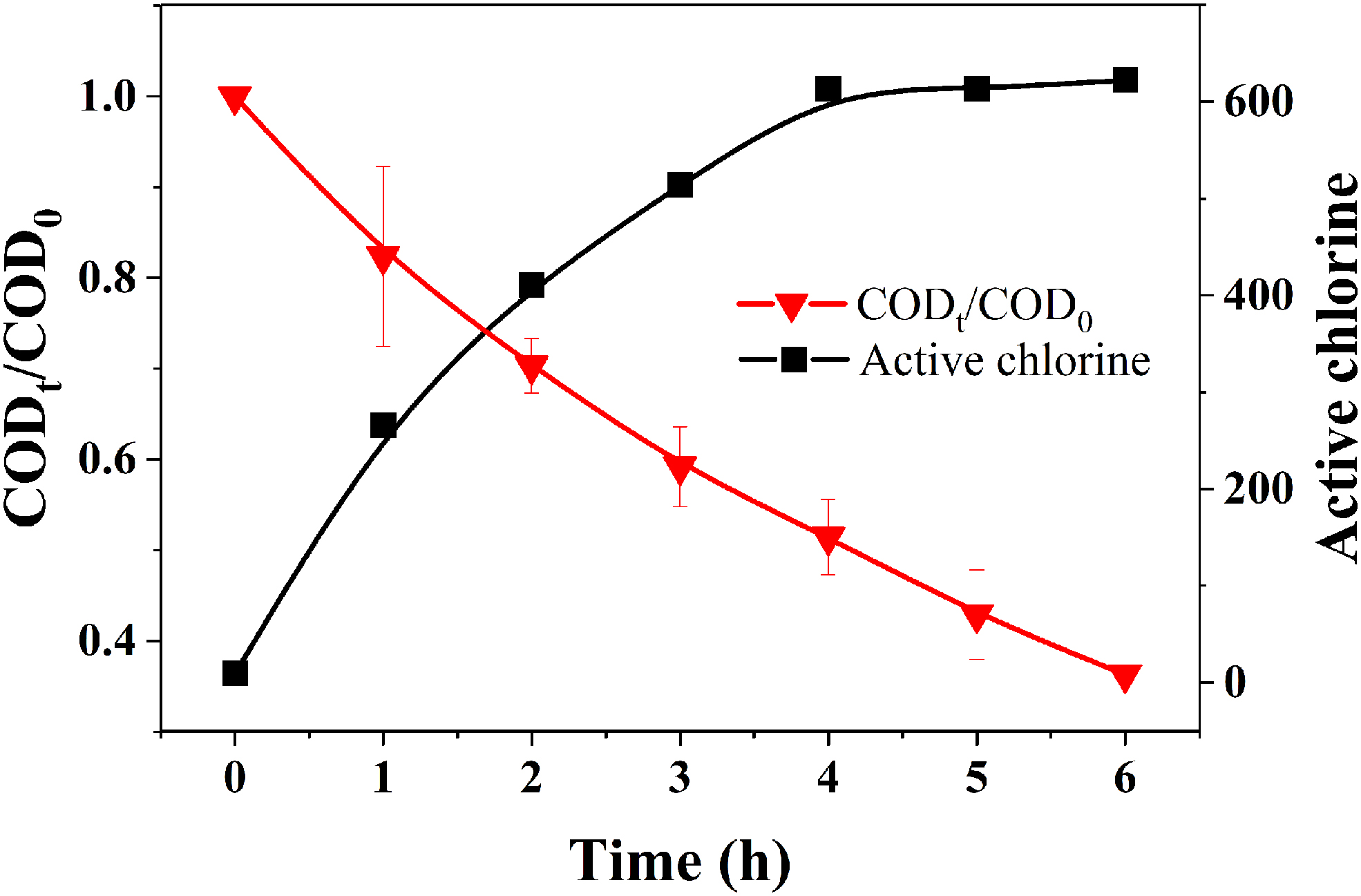
Effect of electrochemical degradation of NP40EO and variation of active chlorine in solution (Experiment condition: current density: 30 mA/cm2; plate distance: 2.0 cm; initial pH value: 7.0; and [Cl−]0 = 0.50 M). NP40EO, nonylphenol ethoxylate-40.
Factors affecting the electrochemical degradation of NP40EO
Current density
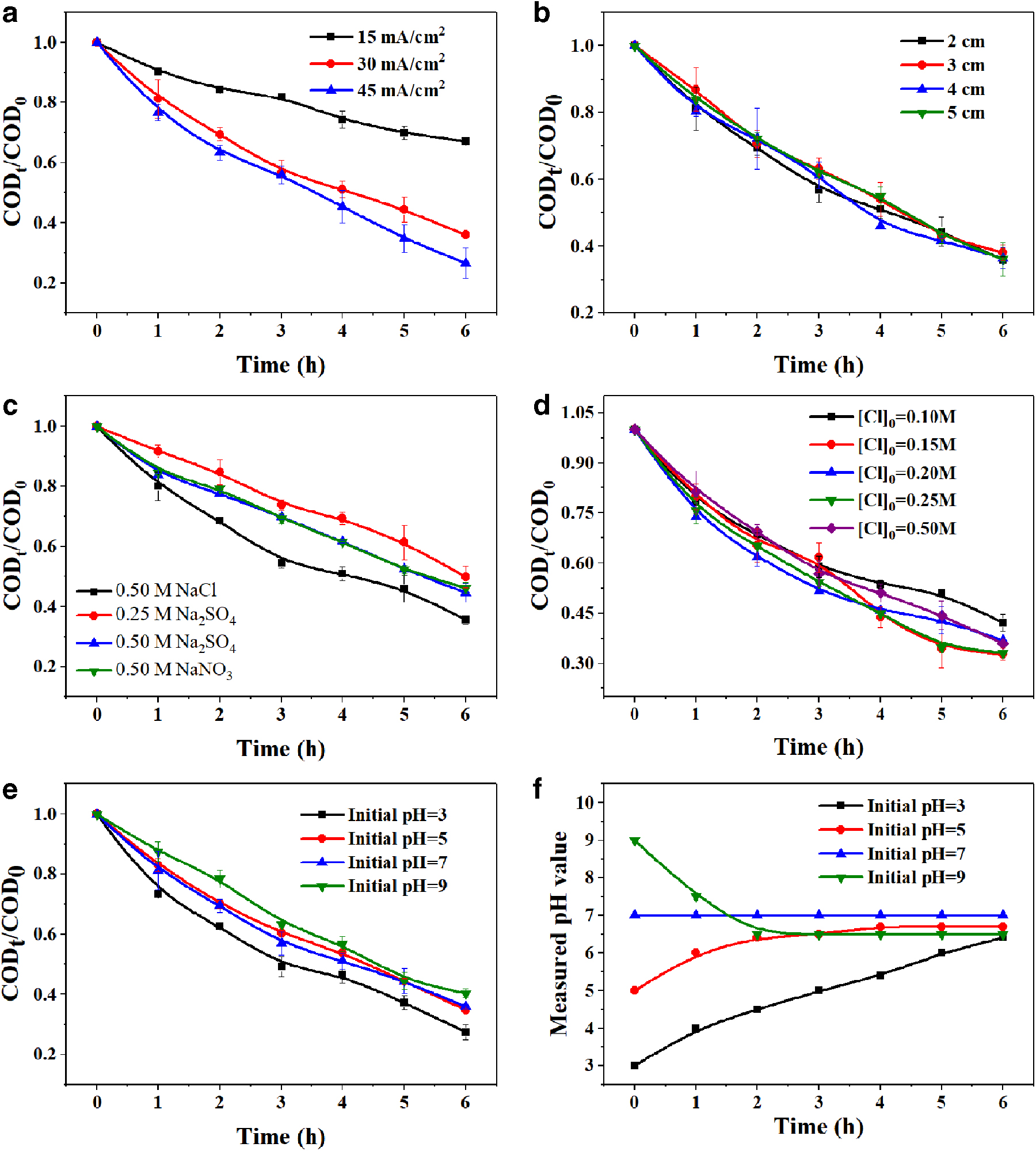
The effect of current density on NP40EO removal is shown in Fig. 2a. The COD removal efficiency of NP40EO wastewater after 6 h electrolysis was 33.1%, 64.3%, and 73.4% at 15, 30, and 45 mA/cm2, respectively, indicating that higher current density caused higher COD removal efficiency. The possible reasons were that current density affects the generation of ·OH and other electrogenerated oxidants, and thus affects the removal of NP40EO in high salinity wastewater (APHA, 2005). However, when current density increased from 30 to 45 mA/cm2, the COD removal only slightly increased ∼9.1%, which might be due to the parasitic reaction, resulting in the oxidation of ·OH to oxygen and the dimerization of •OH to H2O2 (APHA, 2005).
Effect of current density
Plate distance
It has been reported that plate distance is an important parameter in the electrochemical oxidation influencing mass transfer (Moreira et al., 2017). As presented in Fig. 2b, the COD removal efficiency of NP40EO was 64.3%, 61.9%, 63.5%, and 63.8% after 6 h electrolysis at plate distance of 2.0, 3.0, 4.0, and 5.0 cm, respectively, indicating that plate distance had no obvious effect on the COD removal, which was inconsistent with previous results. Longer plate distance resulted in lower degradation efficiency of perfluorooctanoic acid, which was due to the decrease of mass transfer with the increase of plate distance (Moreira et al., 2017). In this case, the mass transfer was not affected by the plate distances, which might be due to the high concentration of salt in the solution.
Salt type and concentration
NaNO3, Na2SO4, and NaCl are the most used salts in the industry. The differences in the electrochemical degradation of NP40EO by NaNO3, Na2SO4, and NaCl were studied. Correspondingly, the conductivity of the solution containing 0.50 M NaCl, 0.50 M Na2SO4, 0.50 M NaNO3, and 0.25 M Na2SO4 were 70.0, 133.0, 64.7, and 69.1 ms/cm, respectively. As indicated in Fig. 2c, NaCl as an electrolyte led to better removal efficiency (64.3%), which might be related to the generation of active chlorine in NaCl solution (Niu et al., 2016).
The effect of NaCl on COD removal was further investigated, as shown in Fig. 2d. The COD removal efficiency of NP40EO was 57.8%, 67.2%, 63.1%, 66.7%, and 64.3% after 6 h electrolysis at NaCl concentrations of 0.10, 0.15, 0.20, 0.25, and 0.50 M, respectively. At 0.10 M NaCl concentration, the COD removal efficiency was relatively low. High conductivity of the solution resulted in faster electron transfer and better degradation of organics (Lin et al., 2012). The low NaCl concentration was anticipated to decrease the conductivity of the solution and, subsequently, decrease the rate of electron transfer, which further led to a reduction in the COD removal efficiency. With the further increase of NaCl concentration, the COD removal also increased. However, when the concentration of NaCl was >0.15 M, the COD removal efficiency did not change a lot, which might be due to the generation of ClO2−, ClO3−, and ClO4−. These species had lower oxidation power than ClO− (Fajardo et al., 2017).
Initial pH value
Figure 2e shows the effect of initial pH on the electrochemical degradation of NP40EO. The COD removal efficiency of NP40EO wastewater was 72.4%, 65.2%, 64.3%, and 59.6% after 6 h electrolysis at initial pH 3.0, 5.0, 7.0, and 9.0, respectively. A higher COD removal efficiency was observed at lower pH value, suggesting that acidic medium was beneficial to the electrochemical degradation of NP40EO. The possible reasons were as follows: on the one hand, the oxidation performance of active chlorine was better in acidic solution than in alkaline solution (Niu et al., 2016). This could be explained by the preponderant active of chlorine species [Cl2 (E° = 1.36 V/SHE) at pH <3.0, HClO, HClO (E° = 1.49 V/SHE) at pH 3.0–8.0, and ClO− (E° = 0.89 V/SHE) at pH >9.0] (Niu et al., 2016). It has been reported that the release of Cl2O seems to be minimal compared with the Cl2 evolution (Martinez-Huitle et al., 2015). Therefore, the effect of Cl2O on NP40EO removal was ignored in this experiment. On the contrary, under alkaline condition, more OH- was absorbed on the surface of anode [Eq. (1)], which competes with pollutants and chlorine for active sites on the surface (Martinez-Huitle and Brillas, 2009; Mostafa et al., 2018).
NP40EO degradation pathway
The UV-vis spectra of NP40EO wastewater during electrochemical degradation are presented in Fig. 3. The UV-vis spectra of the original NP40EO wastewater showed a large peak between 210 and 240 nm, and a small peak between 260 and 300 nm, which was attributed to the absorbance of benzene ring (Niu et al., 2016). During the electrochemical degradation, both peaks decreased gradually, indicating the breakdown of the benzene ring.
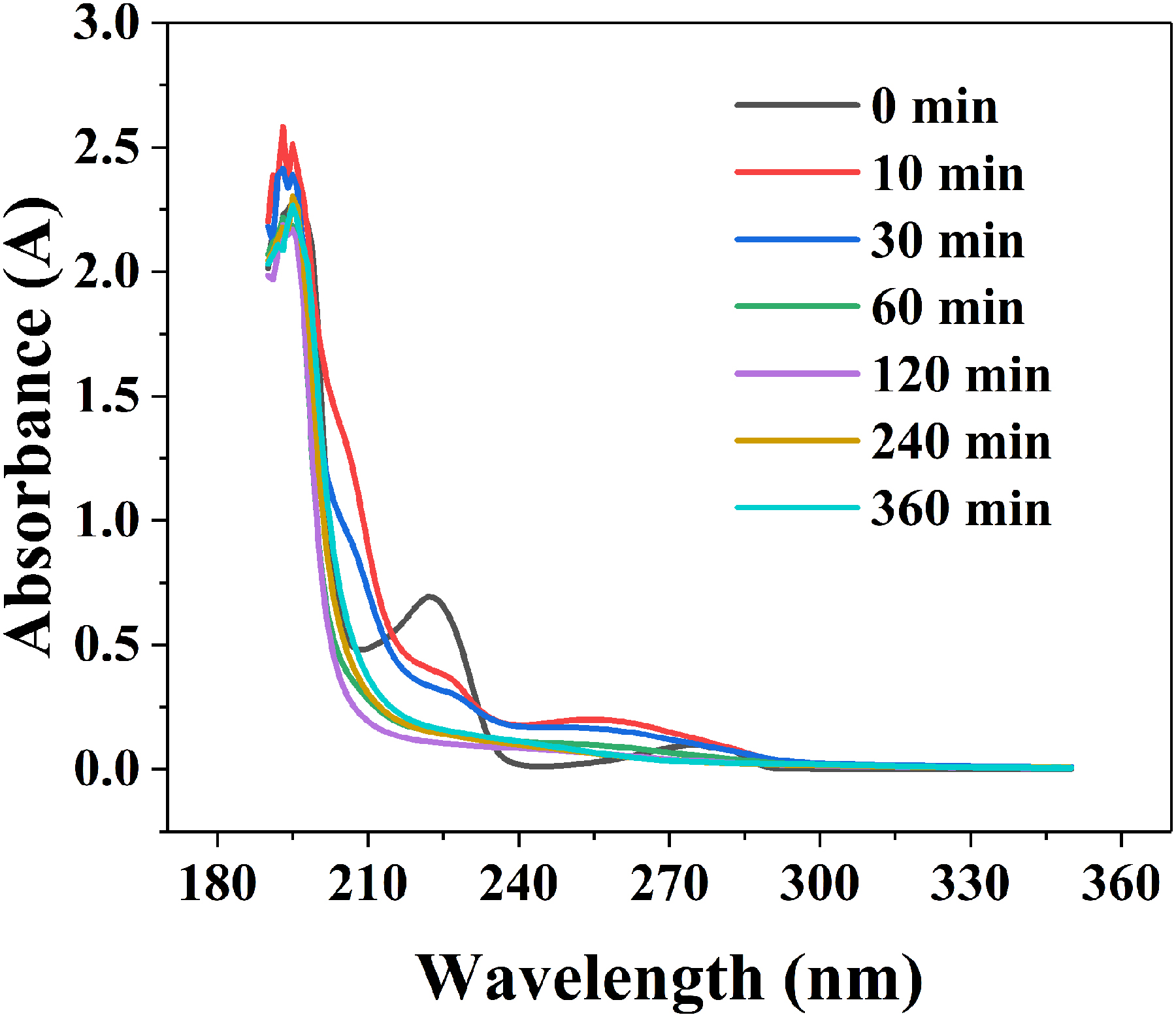
UV-vis spectra of the wastewater under different electrolyte times (Experiment condition: current density: 30 mA/cm2; plate distance: 2.0 cm; initial pH value: 3.0; [Cl−]0 = 0.50 M).
The degradation of organic pollutants in advanced oxidation processes usually proceeded through the following two stages: degradation of the parent pollutants into intermediates and mineralization of the intermediates to CO2 and H2O (Zhuo et al., 2012). Therefore, the identification of intermediates was necessary. And the degradation intermediates of NP40EO during electrochemical oxidation might be potential environmental pollutants. Thus, these degradation intermediates were further analyzed by GC-MS and LC-MS. As shown in the Supporting Information (Supplementary Figs. S1–S3), P1 was a possible intermediate that is inferred from the substance detected by GC-MS analysis and P6 was identified in GC-MS analysis. Supplementary Figure S3 presents the selected MS spectra of the degradation intermediates as hydrogen adduct ions [M+H] +. The compounds could be recognized by their equally spaced ions of Δm/z 44 or 14 and parent compound. The possible structure for the m/z 255 and 283 was NaOOC-(CH2) m-C6H4O-COONa (m = 1 and 3), and that for m/z 97 and 83 was CH3CH2COONa and CH3COONa.
Based on the results of the identified degradation intermediates, the degradation pathway was further proposed, as shown in Fig. 4. First, the breakdown of C-O bond of ethoxylate chain led to the shortening of the ethoxylate chain. Short-chain nonylphenol ethoxylate intermediates were formed in this process. This was consistent with the report that the ethoxylate chain was first attacked to break down during the NP40EO photoelectrooxidation (Chen et al., 2007). Then, shortening of the alkyl chain and further shortening of ethoxylate chain resulted in the formation of low molecular organic matters. In the research by Armijos-Alcocer et al., the alkyl chain and ethoxylate were also shortened during the electrochemical degradation of NP7EO (Liao et al., 2016). In the degradation process of the chain, low molecular organic matters were produced, such as P4 and P5. It was believed that these small molecules of organic matter are generated by the oxidation of NPnEO (da Silva et al., 2015a). Finally, these low molecular organic matters were further degraded to CO2 and H2O.
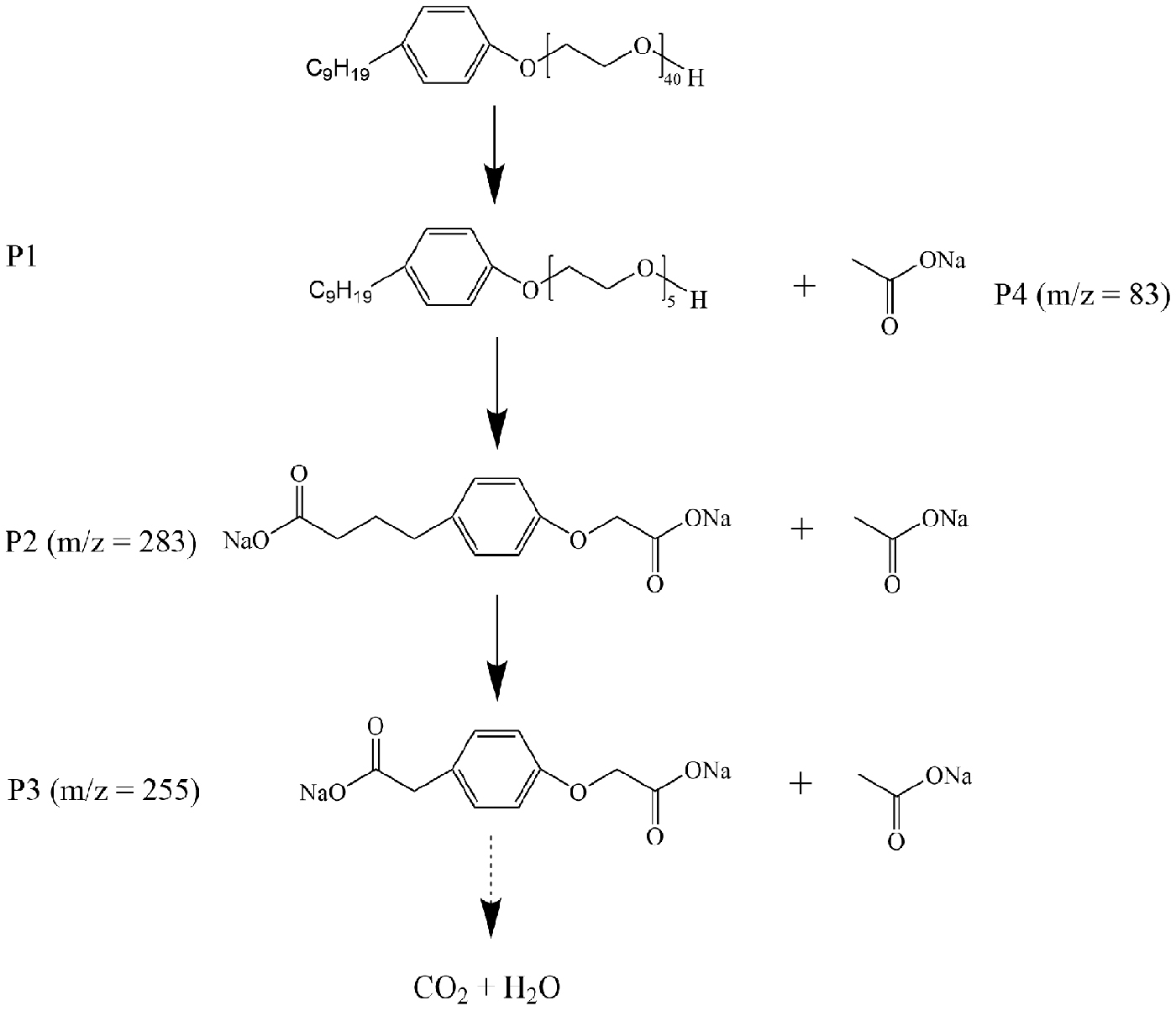
Proposed degradation pathway of NP40EO treated by electrochemical oxidation (Experiment condition: current density: 30 mA/cm2; plate distance: 2.0 cm; initial pH value: 3.0; [Cl−]0 = 0.50 M).
Energy consumption
Energy consumption is a key factor for evaluating the feasibility of electrochemical wastewater treatment. Thus, the effect of current density, plate distance, salt type, salt concentration, and initial pH value on the energy consumption was assessed. The energy consumption Esec (kWh/kg COD) was calculated in Equation (2):
where U is the average cell voltage (V), I is the applied current (A), Δt is the electrolytic time (h), V represents the volume of electrochemical wastewater treatment (L), and ΔCOD is the COD removed during the time Δt (kg/L).
The energy consumption under different experiment conditions is listed in Table 1. The increase of current density resulted in the increase of Esec, from 40.8 kWh/kg COD at 15 mA/cm2 to 81.0 kWh/kg COD at 45 mA/cm2, suggesting that excess energy was consumed in side reaction at high current density. For the plate distance, the COD removal efficiency did not change significantly with the increase of plate distance, but the applied voltage increased, resulting in the increase of energy consumption. For the salt type, NaCl as electrolyte had lower energy consumption. The faster oxidation kinetics and higher current efficiency could be achieved using NaCl as supporting electrolyte species (Armijos-Alcocer et al., 2017). Increasing NaCl concentration improved the wastewater conductivity and thus reduced the voltage (6.7 V for NaCl 0.10 M, 6.3 V for NaCl 0.15 M, 5.3 V for NaCl 0.20 M, 4.2 V for NaCl 0.25 M, and 4 V for NaCl 0.50 M). Regarding the effect of initial pH value, as the initial pH increases, the energy consumption also increased, as presented in Table 1.
The Specific Energy Consumption Under Different Experiment Conditions
COD, chemical oxygen demand; Na2SO4, sodium sulfate; NaCl, sodium chloride.
The analysis of variance for energy consumption is shown in Supplementary Table S1. Through single-factor analysis of variance, the p-value was <0.01 under different conditions, indicating that current density, plate distance, salt type and concentration, and initial pH value have a significant impact on energy consumption. It could be seen that, under different single-factor conditions, the random errors were much smaller than the systematic errors, showing that different sources have great impact on energy consumption.
Based on the above information, the application of optimal operating parameters could further reduce energy consumption and achieve higher COD removal. To obtain the optimal operating parameter, an additional experiment was carried out under the following conditions: applied current density of 30 mA/cm2, plate distance of 2.0 cm, NaCl concentration of 0.50 M, and pH of 3.0. Under this condition, 72.4% of COD removal efficiency was obtained and Esec was reduced to 47.5 kWh/kg COD.
Conclusions
The electrochemical oxidation of NP40EO with high salinity using graphite as anode material was investigated. The COD removal efficiency of NP40EO wastewater increased with increasing current density and reached 73.4% at 45 mA/cm2 after 6 h electrolysis. The plate distance had negligible effect on the COD removal efficiency. Addition of NaCl led to better removal efficiency than Na2SO4, and the COD removal efficiency of NP40EO wastewater was highest when the concentration of NaCl was 0.25 M. The COD removal efficiency increased with the decline of pH from 9.0 to 3.0. The degradation intermediates of NP5EO, NaOOC-(CH2)3-C6H4O-COONa (m/z = 283), NaOOC-CH2-C6H4O-COONa (m/z = 255), sodium acetate (m/z = 83), sodium propionate (m/z = 97), and 2,4,6-trichlorophenol were identified. Based on the intermediates, the degradation pathway was proposed. The energy consumption increased with increasing current density, plate distance, initial pH value, and decreasing NaCl concentration. Based on the energy consumption analysis, the optimal operating parameters were obtained at current density of 30 mA/cm2, plate distance of 2.0 cm, NaCl concentration of 0.50 M, and initial pH value of 3.0.
Footnotes
Author Disclosure Statement
No competing financial interests exist.
Funding Information
This research was supported by National Key R&D Program of China (2019YFC0408502), the National Natural Science Foundation of China (Grant No. 51578205, 51728801, 51538012), and the Science and Technology Major Project of Anhui Province (18030801102).

References
Supplementary Material
Please find the following supplemental material available below.
For Open Access articles published under a Creative Commons License, all supplemental material carries the same license as the article it is associated with.
For non-Open Access articles published, all supplemental material carries a non-exclusive license, and permission requests for re-use of supplemental material or any part of supplemental material shall be sent directly to the copyright owner as specified in the copyright notice associated with the article.
