






Abstract
Background and Purpose:
Obesity has been identified as a limitation of extracorporeal shockwave lithotripsy (SWL). The obesity metrics of body mass index (BMI) and skin-to-stone distance (SSD) have been evaluated as predictors of SWL success. While SSD has demonstrated a strong correlation with success, BMI has not. Bioimpedance analysis (BIA) is an accurate way of determining body adiposity. We evaluated fat mass percentage (FMP) as measured by BIA as a predictor of SWL success.
Patients and Methods:
We prospectively collected body composition data using the Imp-DF50 Body Impedance Analyzer on consecutive patients undergoing SWL. All generated variables, including FMP, along with demographics, BMI, stone size, and stone composition, were analyzed. Patients were evaluated for success, defined as no evidence of stones on radiography of the kidneys, ureters, and bladder at follow-up.
Results:
Fifty-two consecutive patients were enrolled in the study, of which 37 had the necessary metrics to be included in the analysis. Twenty-three (62.2%) patients were stone free while 14 (37.8%) were found to have residual stone at follow-up. There was no difference in sex, stone laterality, mean age, and stone size between the groups. For the success and failure groups, the mean BMI was 25.8 kg/m2 and 29.8kg/m2 (P=0.0091), and mean FMP 24.6% and 32.2% (P=0.0034). On mirrored multivariable analysis, both BMI (OR=0.735, P=0.026) and FMP (OR=0.806, P=0.010) were associated with success. Patients with a FMP ≥35% had a reduced success rate compared with those with a FMP <35% (14% vs 73%, respectively, P=0.0028).
Conclusions:
Both BMI and FMP both appear to be independent predictors of success. Based on these findings, a large study examining the relationship between BMI, FMP, SSD, and SWL success is warranted. A preoperative FMP ≥35% is associated with a 14% success rate, and alternative treatment strategies for urolithiasis should be considered.
Introduction
Bioimpedance analysis (BIA) uses low frequency current passed between several electrodes to measure total body resistance. 5,6 The results, along with patient metrics such as height and weight, are then used to very precisely calculate body composition, including fat mass (FM), fat mass percentage (FMP) and total body water (TBW). BIA devices used to establish body composition have been greatly simplified and yet have retained their accuracy (Fig. 1). 6 With BIA, simple electrodes are deployed on the patient, and results are obtained within seconds (Fig. 2). BIA is more accurate than BMI in calculating body adiposity and needs no ionizing radiation. Because BIA is a technique that can accurately predict body composition in an easy, cost-effective manner without the use of ionizing radiation, we compared BIA and BMI as predictors of stone-free status after SWL.
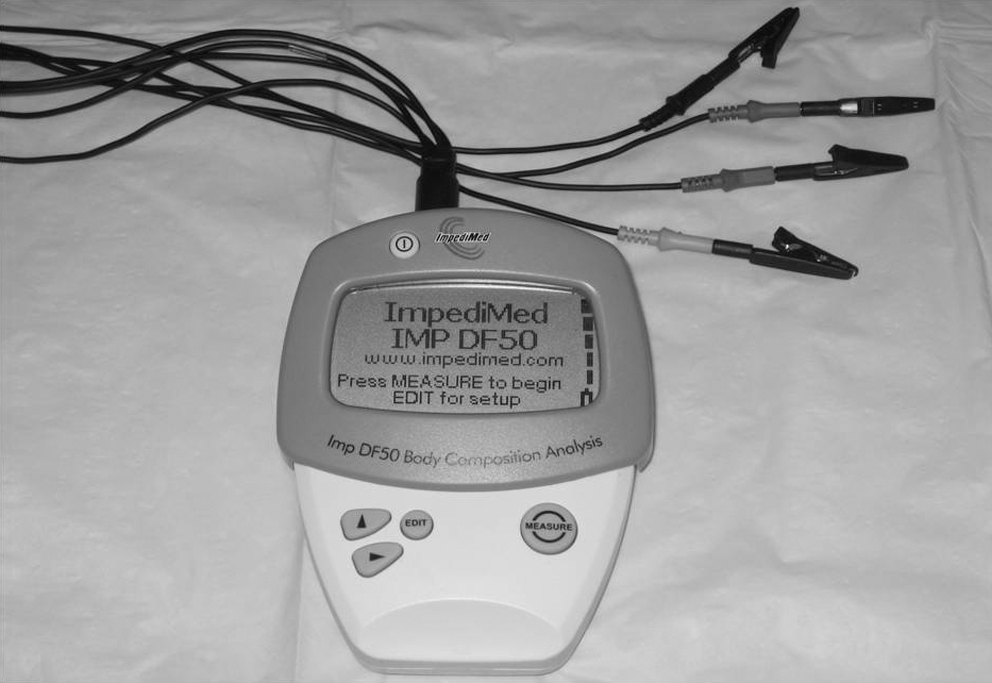
Bioimpedance analyzer and leads.
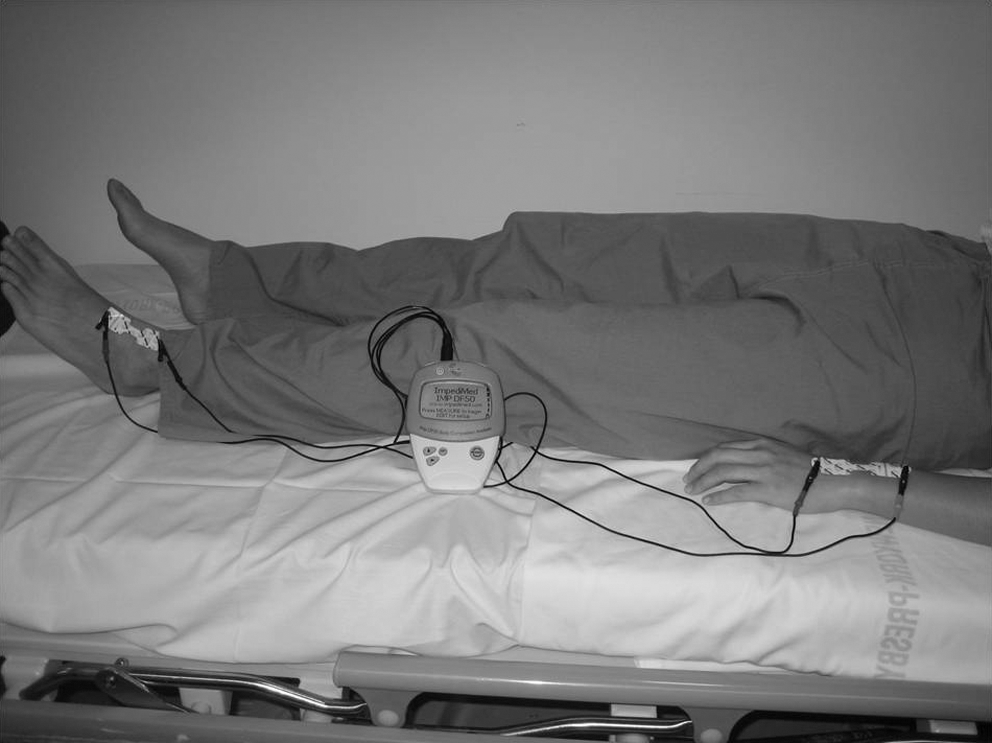
Recording body composition using bioimpedance analysis.
Patients and Methods
Institutional Review Board approval for data collection was obtained for the study. In this pilot registry, we prospectively collected body composition data using the Imp-DF50 Body Impedance Analyzer™ (ImpediMED Ltd., Brisbane, Australia) on 52 consecutive patients who were undergoing SWL. Total body resistance was measured at 50 kHz, and calculations were performed using the nonobese algorithm. All electrodes were placed on clean dry skin on either the patient's right or left side, and conductive materials (watches, jewelry, etc.) were removed. One of four electrodes was placed at the wrist joint, 1 cm proximal to the metacarpophalangeal joint, the anterior ankle, and 1 cm proximal to the metatarsophalangeal joint. All generated variables were recorded and tabulated, including FM, FMP, fat free mass (FFM), FFM percentage and TBW. Patient demographics, height, weight, stone size, and stone composition were collected. BMI for each patient was calculated using the equation BMI (kg/m2)=(weight (lb)/height (in) 2 )×703.
All SWLs were performed on a single lithotripter (Dornier U/15/50, Dornier MedTech, Munich, Germany). Patients were coupled to the lithotripter in standard fashion, and the stone was targeted using fluoroscopy. A gated shock delivery protocol was used and, therefore, shockwave rate varied for each patient according to individual unmodified heart rates. A maximum of 2500 shocks was delivered using escalating shock strength. Stone size, FMP, BMI, and absolute stone-free rates on radiography of the kidneys, ureters, and bladder (KUB) at follow-up were determined and correlated using both univariate and multivariable regression analysis. SWL success was defined as no evidence of stone fragments in the affected kidney at 1-month follow-up as determined by standard radiography of the KUB. Patients with incomplete data were excluded from analysis; however, stone location, multiple stones, and stone size were not factored into the inclusion/exclusion criteria.
Statistical analysis was performed using STATA 11.0 software. A two-tailed Student t test was used to compare continuous variables between the groups, while a Pearson chi-squared analysis was used to compare categorical variables. A univariate logistic regression analysis was performed to identify significant associations, while a mirrored multivariable logistic regression analysis was performed to look for independent associations and determine whether BMI or FMP was a better predictor of SWL success.
Results
Fifty-two consecutive patients were enrolled in the study, of which 37 had the necessary metrics to be included in the analysis. Twenty-three (62.2%) patients were stone free while 14 (37.8%) were found to have residual stone at follow-up. The mean age for the success and failure groups was 51.4 and 44.7 years, respectively (P=0.1843). There was no difference in sex and stone laterality between the groups (P=0.471 and P=0.330, respectively). For the success and failure groups, the mean stone size was 7.4 mm and 7.6 mm (P=0.7959); mean BMI, 25.8 kg/m2 and 29.8 kg/m2 (P=0.0091); and mean FMP, 24.6% and 32.2% (P=0.0034). There was no difference in the number of ureteral stents present at the time of SWL. Of the four patients with stents, there were three in the success group and one in the failure group (P=0.615). For a summary of cohort characteristics, see Table 1.
On univariate logistic regression analysis, age (odds ratio [OR]=0.968, P=0.472), sex (male OR 0.606, P=0.472), stone laterality (left side, OR=1.96, P=0.333), and stone size (OR=0.962, P=0.789) were not associated with success. In contrast, a low BMI (OR=0.767, confidence interval [CI]=0.607–0.968, P=0.26) and FMP (OR=0.848, CI=0.747–0.962, P=0.010) were both found to be associated with success (Table 2). On mirrored multivariable regression analysis, both BMI (OR=0.735, CI=0.561–0.963, P=0.026) and FMP as measured by BIA (OR=0.806, CI=0.684–0.951, P=0.010) were associted with success rates (Table 3). Patients with a FMP ≥35% had a reduced success rate compared with those with a FMP <35% (14% vs 73%, respectively, P=0.0028).
Discussion
Initially, there was great enthusiasm for SWL because it offered a noninvasive alternative to open surgery, the primary treatment for urolithiasis in the early 1980s. 2 Some of the excitement surrounding SWL, however, soon tempered, because the limitations were brought forth through experience. 2,7 Among the limitations of SWL is the limited efficacy of the technique in the obese population. 4,5 This finding is likely because of a combination of the extended distance from the skin entry site to the target stone and the energy dissipating effects of adipose tissue. Interestingly, however, BMI itself is not a highly predictive metric of SWL success. 5 The limited ability of BMI to predict SWL efficacy in the literature is likely because BMI is a calculated variable that takes into account only height and weight but does not account for actual body adiposity.
More recently, SSD has been identified as a variable associated with SWL success. SSD reflects not only BMI but also fat distribution in the area of interest (eg, the flank) as it pertains to SWL. 5 SSD necessitates CT scan imaging to directly measure, however, adding significant ionizing radiation exposure to a population of patients who will likely carry lifelong accumulation of radiation because of the recurrent nature of stone disease.
The most accurate method of determining body composition is dual X-ray absorptiometry (DXA). 6 DXA is expensive, however, and requires ionizing radiation to complete. BIA is safe in that it needs no radiation and is comparable to DXA for determining body composition. BIA uses low frequency electrical impulses to record total body resistance, which in turn is used to calculate body composition. 5,6 Traditionally, BIA was calculated over a range of frequencies; however, a recent study validated the use of 50 kHz BIA as a means to very accurately calculate body composition. 8,9 The advantages of BIA include ease of use, accuracy in determining body composition over that of BMI, and the ability to avoid ionizing radiation associated with SSD and DXA determinations.
Currently, the Imp-DF50 is commercially available for $2750.00. A pack of 100 disposable tabs costs $50. After the initial purchase of the BIA device, BIA becomes cost-effective, because each patient uses only four nonreusable tabs, an expenditure of about $2 per patient. Comparatively, according to the 2010 Medicare fee schedule, a routine CT scan of the abdomen and pelvis costs $616.19.
There are several limitations to this study that warrant mention. The first is the small sample size. Although 52 patients were enrolled in the study, only 37 patients were included because of incomplete or absent data. Patients were excluded primarily because of an inability to accurately assess SWL success or failure postoperatively. Despite the small cohort, BIA was found to independently predict SWL success on multivariable regression analysis. Interestingly, in the current study, BMI was also found to be significantly associated with success. While this finding suggests equivalence between the two metrics, the authors suggest that this compelling relationship needs further elucidation in a large prospective trial that examines the relationship between BMI, FMP, SSD, and SWL success.
Patients with truncal obesity are likely to have lower success rates than those patients with more distributed fat. The current BIA technology assumes that the body is composed of five cylinders (four limbs and one trunk) to calculate a shape coefficient (Kb ), which along with total body resistance is used in body composition determinations. 10 There are currently no lead placement templates or algorithms that can determine FMP solely in the flank area. Despite this limitation, however, the ability to measure adiposity appears more useful than BMI, which cannot distinguish between muscle mass and FM. Although, SSD accurately measures flank adiposity and has been demonstrated to be an independent variable of SWL success, 4 the need for ionizing radiation in the form of CT does limits its applicability. The current study does not directly compare SSD with BIA, and future studies on BIA and SWL should address this omission.
The overall success rate in the study was acceptable but somewhat low at 62.2%. This is likely in part because of the design of the study. First, only absolute stone-free status as determined by radiography of KUB at 1-month follow-up qualified as a success. Any patient with residual stones, even if the fragments were deemed clinically insignificant and the patient went on to observation, was considered a SWL failure. Moreover, the follow-up time of 1 month is relatively short, which may also affect the stone clearance rates, and therefore the success rates. Furthermore, all of the SWLs were performed on the same Dornier U/15/50 lithotriptor. While this benefits the study by effectively removing the lithotripter itself as a confounding factor, it may affect the reproducibility of the findings if a similar study were performed on a different lithotriptor.
In the current study, patients with a FMP below 35% collectively enjoyed a 73% success rate. For those patients with a FMP above 35%, the success rate falls to 14%. To the authors' knowledge, this is the first report of a FMP cutoff point that clearly demonstrates a difference in SWL outcomes. With such a low success rate, perhaps patients with a FMP above 35% should undergo an alternative treatment such as ureteroscopy or percutaneous nephrolithotomy.
Conclusions
BIA is safe and feasible to perform in the SWL population. In this preliminary pilot study, both BMI and FMP both appear to be predictive of success. Recognizing the limitations of the current study, FMP appears to be an independent predictor of SWL success and with more data may prove to be a surrogate for other predictors that necessitate ionizing radiation. Based on these findings, a large study examining the relationship between BMI, FMP, SSD, and SWL success is warranted. A preoperative FMP of <35% has a high success rate (73%) compared to those with a FMP ≥35% (14%). Performing SWL only on patients with a FMP <35% may increase the overall efficacy of the procedure. Correspondingly, patients with n FMP of ≥35% should undergo an alternative therapy because of the exceedingly low success rate.
Footnotes
Disclosure Statement
No competing financial interests exist.