







Abstract
Purpose:
To widen the understanding of the fluid mechanics during percutaneous nephrolithotomy (PCNL), a new in vitro model for empiric studies was developed. Our first aim was to characterize common PCNL systems with regard to their intrapyelocaliceal pressure and their irrigation flow volume as possible parameters of hydrodynamic invasiveness.
Materials and Methods:
The model is based on a watertight cylindrical cast. Low pressure miniaturized PCNL (miniPCNL) systems and conventional PCNL systems were tested. Intrapelvic pressure and the total of irrigation flow volume per minute were measured for each PCNL system at 10 predefined levels of irrigation pressure between 40 and 130 cm H2O.
Results:
Linear regression showed a linear relation between irrigation pressure and intrapelvic pressure. Compared with miniPCNL systems, conventional PCNL sheaths with closed Rutner sidearm generate significantly higher intrapelvic pressures. Opening the Rutner sidearm leads to a decrease in intrapelvic pressure to the level of the open mini PCNL systems. Polynomal regression revealed a square root relation between irrigation pressure and irrigation flow volume.
Conclusions:
Our in vitro model is suitable for obtaining reliable and valid data of intrapelvic pressure and irrigation flow volume of commonly used PCNL systems. Conventional PCNL sheaths with opened Rutner sidearm provide intrapelvic pressure and irrigation volume similar to miniPCNL. Consequently, a relevant difference of the hydrodynamic impact between conventional and miniPCNL systems are not necessarily to be assumed. Regression analysis revealed a new starting point for further empiric research of fluid mechanics during PCNL.
Introduction
P
MiniPCNL systems are assumed to be of different hydrodynamic characteristics, however, which might influence the invasiveness of PCNL. Only few data have been published dealing with these hydrodynamic conditions during PCNL. 7 –9 Consequently, there is a lack of data providing information about the commonly used PCNL systems and their hydrodynamic impact.
The aim of our study was to develop an in vitro model providing reproducible empiric data to widen the understanding of the hydrodynamics during PCNL. Because intrapyelocaliceal (intrapelvic) pressure and irrigation flow volume are considered to be relevant concerning hydrodynamic invasiveness, our first aim was to characterize these parameters in common PCNL systems.
Materials and Methods
Model
The model is constructed on the basis of a cylindrical cast consisting of acrylic glass. A cover plate to close the cast water- and airtight provides two access tunnels of 36F and 9F. The access tunnels are sealed with rubber valves to ensure airtight and watertight conditions. At the beginning of each experiment, the model is filled with water to the top. Gas bubbles are flushed out. A PCNL access sheath is introduced into the model using the 36F tunnel. To guarantee stable conditions and reduce artefacts from manipulation of the instrument throughout the measurement, the access sheath is securely mounted to a telescope arm.
The complete model is placed into a water collecting basin to allow for measurement of irrigation volume by assessing the weight difference. The PCNL sheath is connected with an irrigation system (B. Braun, Melsungen, Germany), and the irrigation solution reservoir is lifted to 10 predefined height levels between 40 cm and 130 cm to generate a range of irrigation pressures between 40 cm H2O and 130 cm H20. The simulated intrapelvic pressure in the model is recorded using an 8F cystomanometry catheter (Mediwatch, West Palm Beach, FL) introduced through the 9F working tunnel. The experimental setup is the model shown in Figure 1.
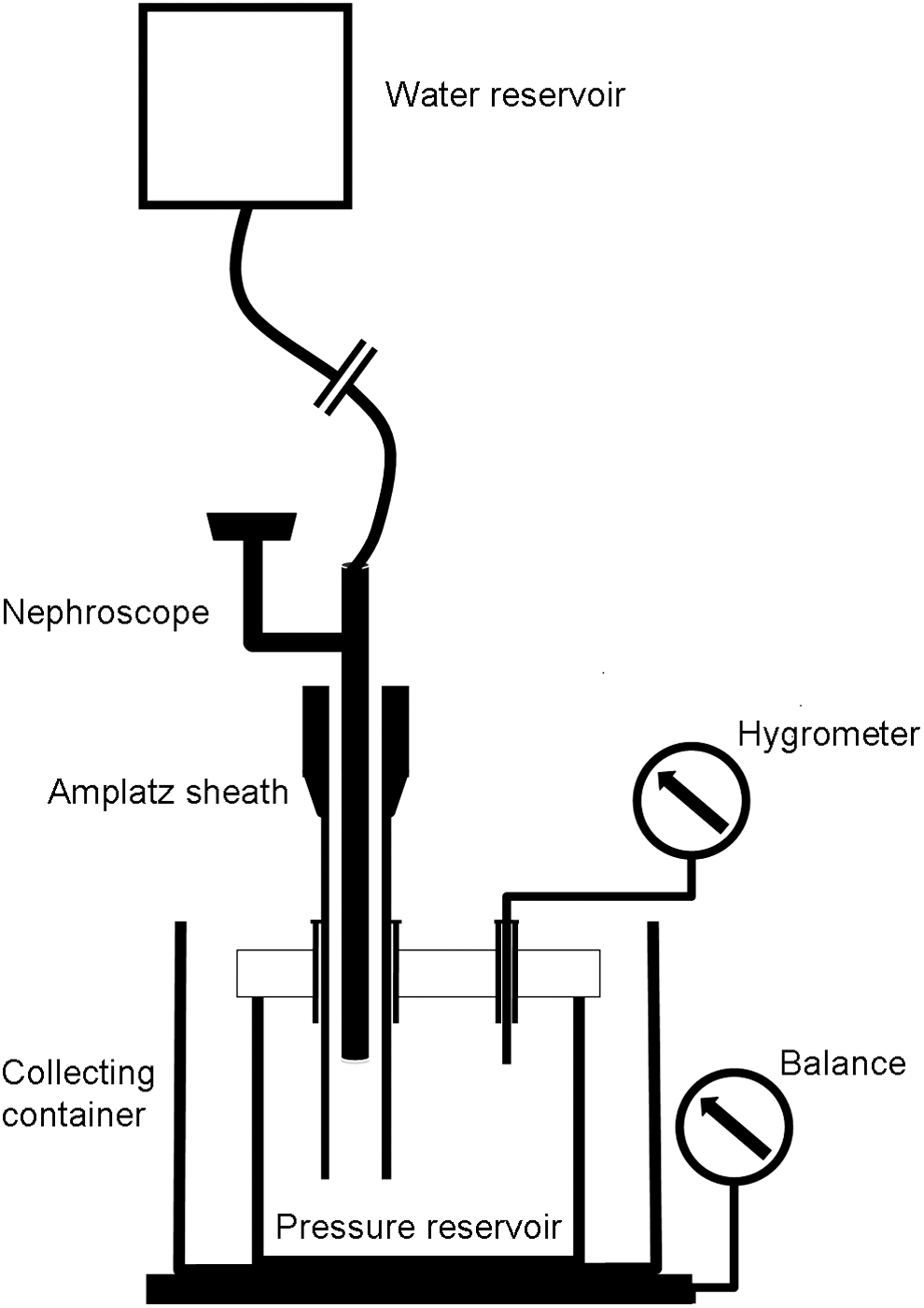
Experimental setup.
Experimental setting
A low pressure miniPCNL system and conventional PCNL Amplatz sheaths with Rutner adapter (Karl Storz, Tuttlingen, Germany) were tested (Table 1). The PCNL access sheath was inserted into the model and the irrigation system was started manually at one of the predefined levels of irrigation pressure. In miniPCNL systems, the tip of the nephroscope was uniformly positioned 1 cm proximal to the tip of the sheath. In conventional PCNL, nephroscopes were permanently fixed watertight to their original sheath (Table 1). After reaching steady-state conditions of intrapelvic pressure, the irrigation was lifted to the next level.
Because of its open proximal end, there is continuous outflow in miniPCNL systems. In conventional PCNL systems, because of watertight fixation between nephroscope and sheath, no outflow occurs as long as the Rutner sidearm is closed. PCNL=percutaneous nephrolithotomy.
In vitro irrigation flow studies were performed by introducing open miniPCNL or conventional PCNL sheaths with opened Rutner sidearm. Consumed irrigation volume flushed out of the open proximal end in miniPCNL sheaths or the open Rutner sidearm in conventional PCNL instruments was collected in the basin. The weight difference was measured every 60 seconds and converted to volume by
Statistical analysis
Collection and analysis of data were conducted using Excel (Microsoft, Redmond, WA), Bias (epsilon, Frankfurt, Germany), and Prism4 (GraphPad, La Jolla, CA). To model the relationship between irrigation pressure and intrapelvic pressure or irrigation flow volume, linear and polynomial regression was performed. To assess the differences among PCNL sheaths, analysis of variance was used.
Results
The intrapelvic pressure's dependency on the irrigation pressure is shown in Figure 2. There is a strong proportional relation between the height of the irrigation solution reservoir, the irrigation pressure, and the resulting intrapelvic pressure. Linear regression modeling proved linear relation (R 2 =0.9992, P<0.0000001) for conventional closed PCNL systems, indicating a hydrostatic regularity. Compared with miniPCNL systems, conventional PCNL sheaths with closed Rutner sidearm generate significantly higher intrapelvic pressures (P<0.05). Opening the Rutner sidearm leads to a decrease in intrapelvic pressure to the level of open miniPCNL systems. Therefore, intrapelvic pressure between miniPCNL access sheaths and conventional PCNL sheaths with open Rutner adapter showed no significant difference. Considering linear curve characteristics of open PCNL systems, linear regression was performed. Linear fit achieved significance for all systems.
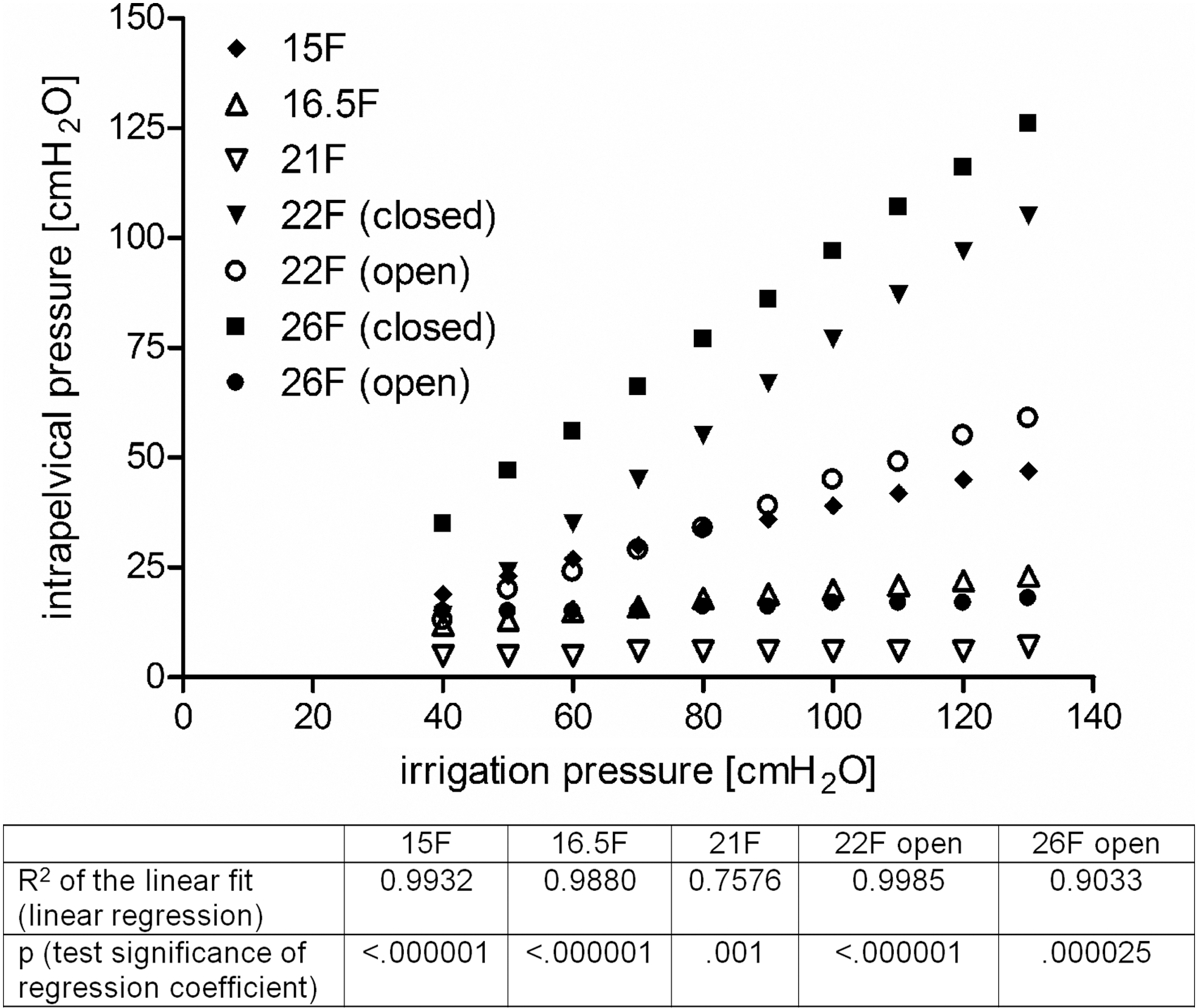
Intrapelvic pressure vs irrigation pressure and the results of linear regression analysis.
Irrigation flow volume studies are depicted in Figure 3. Observations are given in means, and bars represent the range of three measurements at each level of irrigation pressure. Using the open 22F conventional PCNL system results in significantly higher irrigation flow volume compared with the 15F system in the range of 50 to 130 cm H2O, the 26F system in the range of 60 to 130 cm H2O, the 16.5F system in the range of 70 to 130 cm H2O, and the 21F system in the range of 90 to 130 cm H2O. There was no significant difference between these four PCNL systems. In view of flattened curve characteristics, polynomial regression was performed to compare the goodness of fit. Square root fit achieved high coefficients of determination and test significance for all systems.
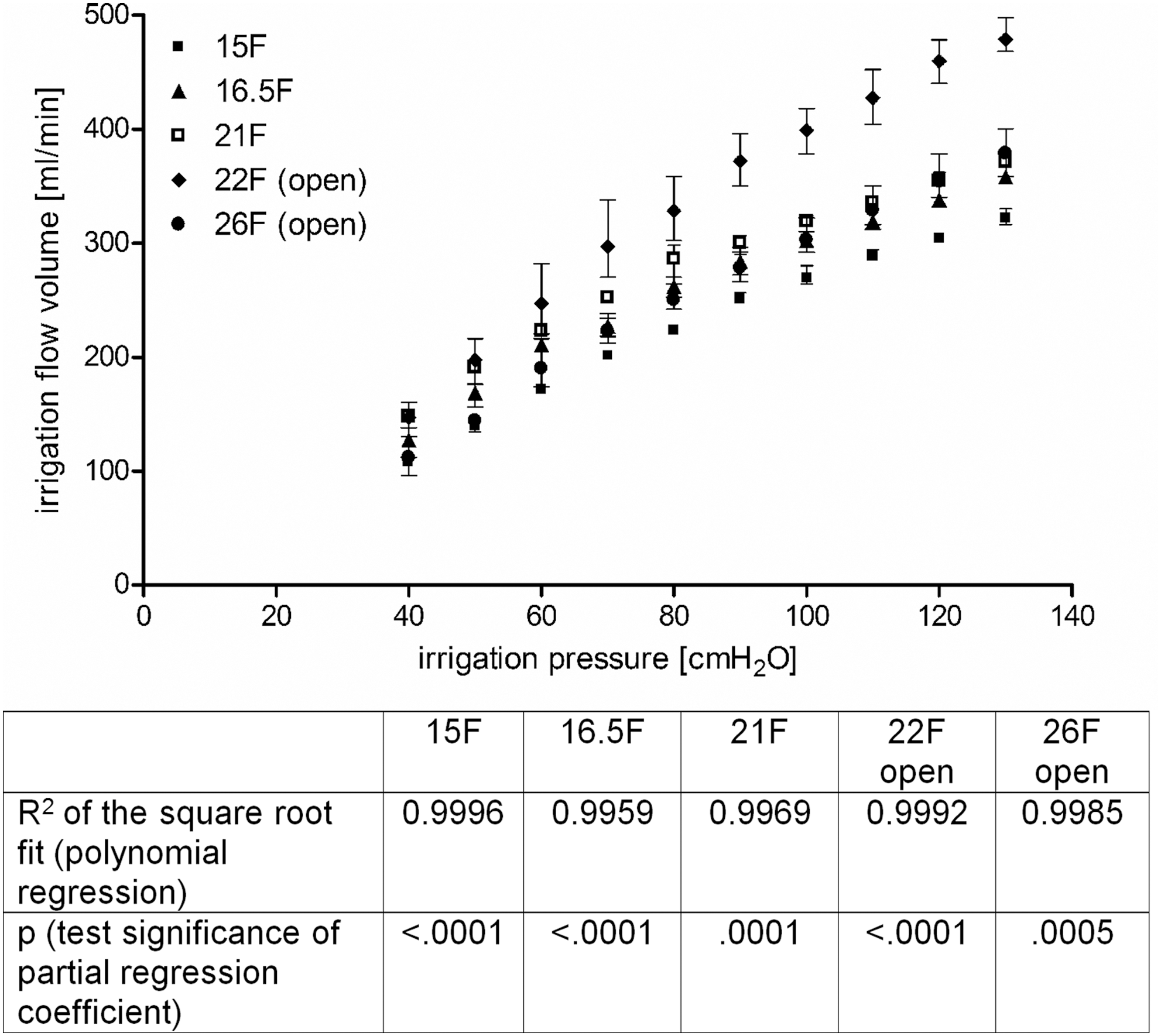
Irrigation flow volume vs irrigation pressure and the results of polynomial regression of each curve.
Discussion
We achieved our aim to develop an in vitro model to obtain reproducible data of intrapelvic pressure and irrigation flow volume of common PCNL systems. In accordance with our findings from the in vitro model, Nagele and associates 8 published data of intrapelvic peak pressure from an in vitro porcine PCNL model showing a linear relation between intrapelvic pressure and rising inflow pressure of irrigation fluid using a conventional miniaturized Amplatz sheath of 18F, which was compared with an 18F open sheath with a curved outlet. Open miniPCNL sheaths showed constantly lower intrapelvic pressures compared with closed conventional systems, which are in hydrostatic relationship with the irrigation pressure.
Opening the Rutner sidearm of the conventional Amplatz sheath leads to a decrease of intrapelvic pressure in conventional systems because of the continuous outflow of fluid. 9 This effect is most distinctive for the 26F sheath and much weaker for the 18F sheath used by Nagele and colleagues 8 and for the 22R sheath used in our study where intrapelvic pressure levels remain higher than in any open miniPCNL system.
To assess the impact of irrigation pressure, Nagele and associates 8 used colored irrigation fluid and showed staining in collecting ducts and even in the cortex, after use of a conventional PCNL system with intrapelvic pressures up to 136 cm H2O. These findings are similar to demonstrated pyelolymphatic backflow in the porcine kidney by Cuttino and coworkers 10 and in the human cadaveric kidney model by Hinman 11 where peripelvic extravasation is documented for intrapelvic pressures exceeding 30 to 40 mm Hg. Since peripelvic extravasation has been discussed to be responsible for septicemia, maintaining an intrapelvic pressure of less than 30 mm Hg is recommended. 3
In a recently published randomized controlled trial, duration of irrigation and volume of irrigation fluid were discussed as parameters of invasiveness. 2 In our in vitro approach, we evaluated this by measuring the total of irrigation flow volume. Our data reveal a slightly higher irrigation flow volume when using a 22F conventional sheath compared with each other measured PCNL system.
In summary, high intrapelvic pressure with a closed Rutner sidearm and high irrigation flow volume with an unlocked Rutner valve might characterize the 22F conventional sheath as the hydrodynamically most invasive PCNL system. Considering that the PCNL routine means manipulation, like opening the Rutner sidearm, removing the nephroscope, or reduction of irrigation flow, the statistical difference between the 22F system and other PCNL systems might be of only slight clinical relevance.
Our results might provide clinical applicability: Closed PCNL systems should be avoided because of high pelvic peak pressures. When using the 22F system (open Rutner sidearm) or the 15F miniPCNL system, irrigation height should be restricted to less than 80 cm above the kidney level to prevent pelvic pressure critical for peripelvic extravasation. With 16.5F, 21F, and 26F (open Rutner sidearm) PCNL systems, continuous low pressure below 25 cm H2O is guaranteed even if irrigation pressure rises to 140 cm H2O.
Curve fit revealed new details about the hydrodynamic effects of PCNL. Whereas intrapelvic pressure obeys a linear relationship with irrigation pressure, the irrigation flow volume is determined by a square root relationship. Physical reasons for these effects are not answered yet. The square root equation characteristic of irrigation flow curves might point to the applicability of the Bernouilli principle:
Solving the equation for flow velocity
results in statistical fitted square root relationship between irrigation flow volume, which is proportional to
The present study is limited by its in vitro approach using a rigid model. Transferability of our results into the elastic system of a human kidney in vivo during PCNL might be limited. Because our results are in line with data from similar instruments used in porcine and human ex vivo kidney models, we assume to produce valid data. 7 –9 Compared with ex vivo cadaveric models, our rigid in vitro approach promises to be advantageous in obtaining reproducible results from standardized measurement conditions.
Conclusions
Our in vitro model is suitable for measuring reliable and valid data of intrapelvic pressure and irrigation flow volume during PCNL. The model, equipped with different miniPCNL and conventional PCNL systems, revealed similar findings for intrapelvic pressure and irrigation flow volume for miniPCNL sheaths compared with conventional PCNL sheaths as long as the Rutner adapter is unlocked. Therefore, based on our in vitro studies, there is no evident reason to suppose more invasive hydrodynamic conditions during miniPCNL compared with conventional PCNL and vice versa. The physical characterization of hydrodynamics of PCNL and its mathematic modeling remains incomplete and needs further empiric research.
Footnotes
Disclosure Statement
No competing financial interests exist.