






Abstract

Chairman
Jean de la Rosette, M.D.
Amsterdam (The Netherlands)
Adrian Joyce, M.S.
Leeds (UK)
Stavros Gravas, M.D.
Larissa (Greece)
Jorge Gutierrez-Aceves, M.D.
Winston Salem (USA)
Dean Assimos, M.D.
Birmingham (USA)
Ying-Hao Sun, M.D.
Shanghai (China)
Tadashi Matsuda, M.D.
Osaka (Japan)
John Denstedt, M.D.
London (Canada)
Sonja van Rees Vellinga
Amsterdam (The Netherlands)
JOIN THE PREMIER RESEARCH OFFICE IN THE FIELD OF ENDOUROLOGY
Take part in publications and presentations that offer exposure to your institution
Become a member of the global research network of Endourologists
Be recognized as a centre of excellence in the field of Endourology
INVITATION TO JOIN THE UPPER TRACT UROTHELIAL CANCER REGISTRY
Introduction
U
As the disease is rare, high level evidence recommendations for diagnosis, treatment, and follow-up are lacking. The European Association of Urology has published a guideline on this subject and an international consultation on upper tract urothelial cancer (UTUC) is recently published by collaborative work of the Societé International d'Urologie (SIU) and the International Consultation on Urological Diseases (ICUD). 1,2 Both the guidelines and the consultations have looked at published evidence and produced recommendation on the evaluation and treatment of UTUC. However, the majority of available literature is of low evidence. Although the highest level of evidence is provided through a randomized controlled trial (RCT), because of the rarity of UTUC and the complexity of the different parameters involved, it is almost a mission impossible to conduct such a study. Therefore, alternative trial designs, such as the so-called cohort-embedded randomized controlled studies, are explored. An observational cohort receives an intervention and will be compared with another cohort that receives the standard of care. Consequently, various treatment modalities can be evaluated against the standard of care, accelerating the availability of data for a certain intervention. As a result, primary objectives can be obtained within mid-term follow-up and validity should be strengthened by the utilization of available long-term data of the existing database registries. 3
Having said this, the UTUC registry offers unique opportunities to collect data on a global base captured in the same data management system. Within the concept of cohort-embedded randomized controlled studies, high-level data are expected to be collected.
Study Objectives
Multiinstitutional studies are needed to provide evidence of prognostic factors and clinical consequences of these factors. The Clinical Research Office of the Endourological Society (CROES) initiated a registry with the aim to evaluate the incidence, indications, and outcomes of patients presenting with UTUC in relation to the different treatment modalities used. Secondary objective of the study is to assess the impact of imaging enhancement on the recurrent rate of UTUC.
This is an observational international multicenter study in which data on consecutive patients with UTUC are collected over a 5-year period. Centers from all over the world can apply for this registration study. Patients' data at baseline visit, 1, 3, and 5 years after inclusion in the registry are recorded as well as data on intraoperative and postoperative complications, recurrence, and survival in the study period.
All patients presenting with a (suspected) primary UTUC planned for any form of treatment: RNU, ureteroscopic diagnostics, or ureteroscopic treatment, segmental resections or percutaneous resection can be included in this observational study.
Data from all participating centers are collected through electronic case report forms using an online data management system. All analyses will be performed by members of the CROES.
Study Parameters
Main study parameters are the incidence of UTUC, indications and outcomes, and recurrence and survival for patients presenting with a primary UTUC. Further the distribution of different treatment types for UTUC and complications intraoperative and postoperative. Secondary parameters are tumor progression, cytology, biopsies, and the value of imaging enhancement techniques. Finally, we look at the recurrence rate of UTUC stratified by imaging modality.
Update
The first patient included in this study was in December 2014, and till now (April 2016) almost 700 patients are included. From all over the world, we now have 81 active participating centers (Fig. 1) with a mean number of 7 included patients per center (range 1–37). Approximately 10 new patients per week are entered in the database.
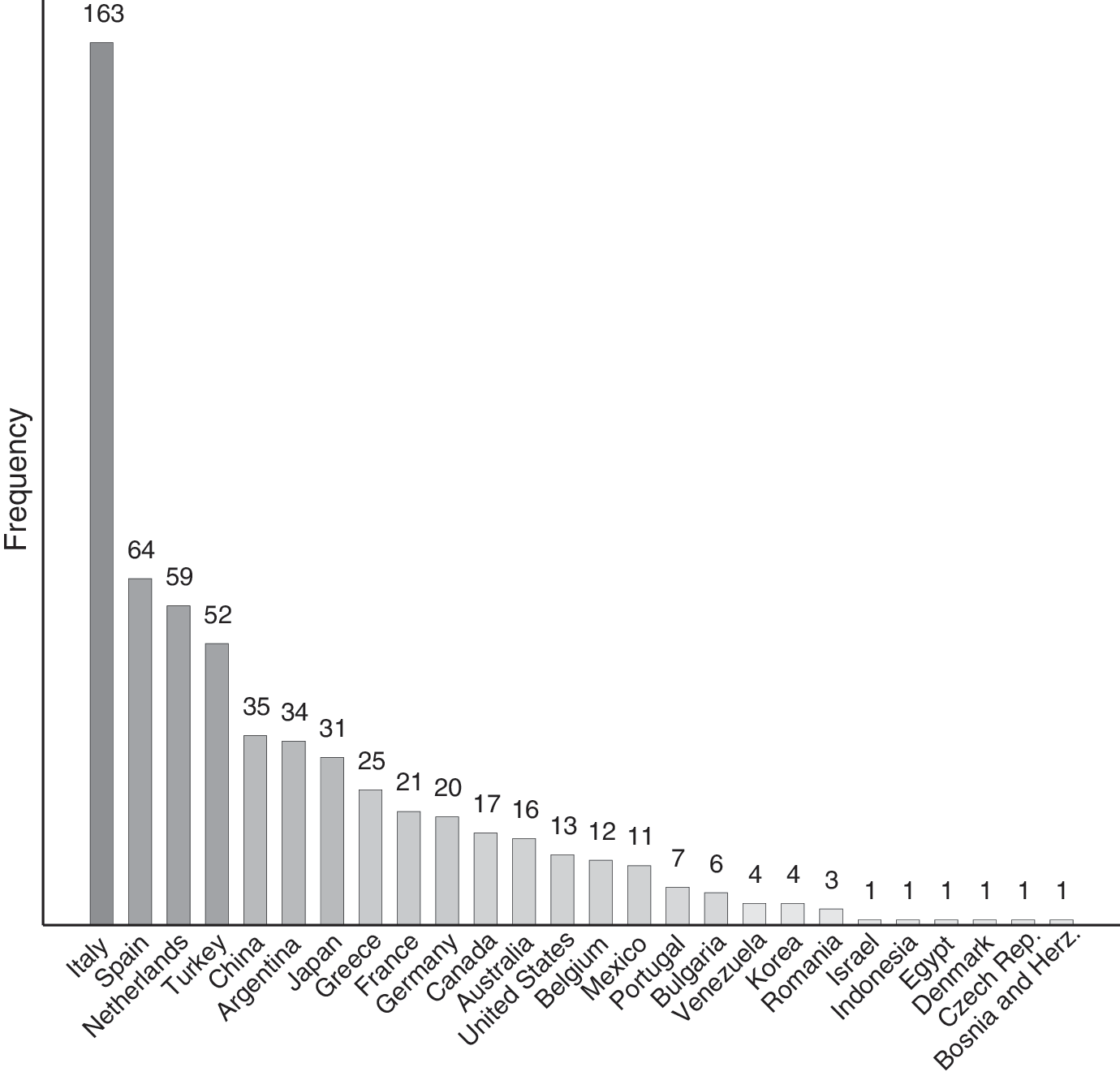
Patient inclusion by country (April 18, 2016).
The recruitment of patients will take 5 years and the patients will be followed for 5 years, resulting in a total study duration of 10 years. In this period, we expect to have included ∼3000 patients. By this, the multicenter international registry unique large data will be available for evaluating the treatment and outcomes of UTUC. This offers unique opportunities to provide new insights into the diagnosis and treatment of this rare condition. Therefore, CROES encourages every center worldwide, treating patients with UTUC, to actively contribute to this project by including every eligible patient. With your help, we will be able to provide the best possible care at the lowest morbidity rate to our patients.