







Abstract
Introduction:
Moses technology is a novel Holmium:YAG laser system designed to minimize stone retropulsion and improve stone ablation when the laser is not in direct contact with the stone. Our aim was to assess the efficiency of Moses technology relative to short- and long-pulse lithotripsy using an automated in vitro “dusting model” of stone comminution.
Methods:
All tests were conducted using a Lumenis Pulse 120H Holmium:YAG laser with a 365 μm Moses D/F/L fiber. “Hard” (15:3) and “soft” (15:6) Begostones mimicking calcium oxalate monohydrate and uric acid stones, respectively, were used. To assess ablation efficiency and fiber tip degradation, a dusting model was employed: the laser was moved by a three-dimensional positioning system in a spiral motion across a flat Begostone surface submerged in water. Ablation efficiency was measured as stone mass loss after 4 kJ of energy delivery. Fiber tip degradation was measured at 1 kJ intervals. Comparative trials with short pulse, long pulse, Moses contact, and Moses distance settings were completed with the laser tip positioned at 0, 1, and 2 mm distances from the stone at energy settings of 0.4 J delivered at 70 Hz.
Results:
In our dusting model, stone ablation was significantly greater the closer the laser was to the stone. On hard stones, pulse type did not have a significant impact on ablation at any distance. On soft stones at 0 mm, Moses contact produced the greatest ablation, significantly greater than long pulse (p < 0.05). At 1 mm, Moses distance produced significantly greater ablation than all other settings (p = 0.025) and was as effective as long or short pulse at 0 mm. At 2 mm distance, no pulse type demonstrated significantly different ablation. Fiber tip degradation was minimal and not significant between settings.
Conclusions:
Moses technology delivers greater ablation of soft stones when in contact and 1mm from the stone surface.
Introduction
T
Methods
Flat 2 cm diameter circular stone phantoms, made of BegoStone powder (BEGO USA, Lincoln, RI), were created. “Hard” stones mimicking calcium oxalate monohydrate (COM) were made with a powder to water ratio of 15:3. “Soft” stones mimicking uric acid (UA) or magnesium ammonium phosphate hydrogen stones were made with a powder to water ratio of 15:6 as reported by Esch and colleagues. 8 Stone phantoms were immersed in water for at least 60 minutes before testing. All tests were performed with the phantoms submerged in water. The dry weights of the phantoms were measured before testing and after 72 hours of drying at room temperature after testing.
A stage controller and three-dimensional positioning system (VXM-2 step motors with BiSlide-M02 lead screws; Velmex, Bloomfield, NY) was used to position the laser fiber over the stone phantom (Fig. 1). A custom MATLAB program (MathWorks, Natick, MA) was used to control the laser fiber tip distance from the stone phantom surface as well as move the fiber tip over the stone in a rectangular outward spiral at constant speed to mimic a “dusting” lithotripsy technique. As “dusting” is commonly performed at relatively low energy and high frequency, 9 laser energy was held constant at 0.4 J and frequency set to 70 Hz for all tests. Laser fiber-to-stone distance was automatically adjusted by incremental fiber tip advancement onto a fixed surface after every kilojoule of energy delivered, with fiber tip degradation measured in a similar fashion. Four kilojoules of total energy was applied to each stone phantom.
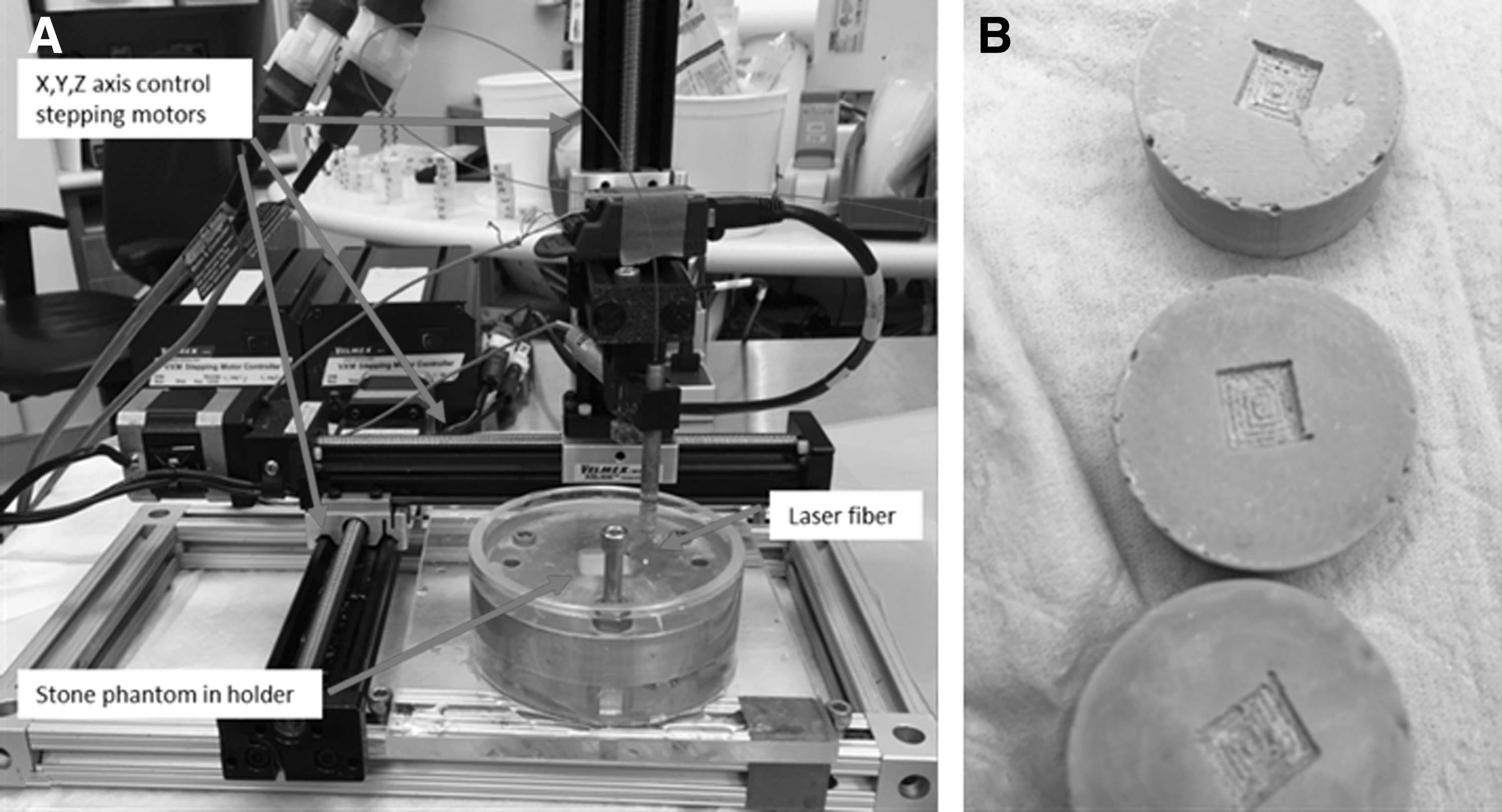
All tests were conducted using a Lumenis Pulse 120H Holmium:YAG laser (Lumenis, Yokneam, Isreal). In this system, the laser pulse can be manipulated with five different settings: short pulse (500 μsec), medium pulse (800 μsec), long pulse (1200 μsec), Moses contact, and Moses distance. As per the manufacturer, Moses contact is optimized for use at about 1 mm from the stone surface, whereas Moses distance is optimized for use about 2 mm from the stone surface. 3 Thus, we performed comparative trials at short-pulse, long-pulse, Moses contact, and Moses distance with the laser tip positioned at 0, 1, and 2 mm distances from the stone surface. Three hundred sixty-five micrometers of Moses fibers were used in all tests. One fiber was used for all tests on hard stone phantoms and one fiber for all tests on soft stone phantoms. We planned to use a new fiber after 1 mm of tip degradation as this was measured during testing as described above; however, this threshold was never surpassed.
Ablation efficiency was measured as the loss of stone mass after 4 kJ of energy delivery. Each pulse type and distance combination was tested four times on each stone type.
Differences between trials were analyzed for significance with one-way analysis of variance performed with Tukey's honest significant difference post hoc test to make pairwise comparisons. Statistics were performed with the SPSS (v25; IBM Corp., Armonk, NY). A p-value <0.05 was considered statistically significant for all comparisons.
Results
Under all tested conditions, stone ablation was significantly greater, the closer the laser tip was to the stone surface. Regardless of stone composition, all pulse types provided the greatest stone mass loss when in contact with the stone surface with the exception of Moses distance, which was not tested in contact with the stone. However, similarly, the Moses distance setting resulted in greater mass loss at 1 mm from the stone surface than at 2 mm distance (Tables 1 and 2 and Fig. 2).
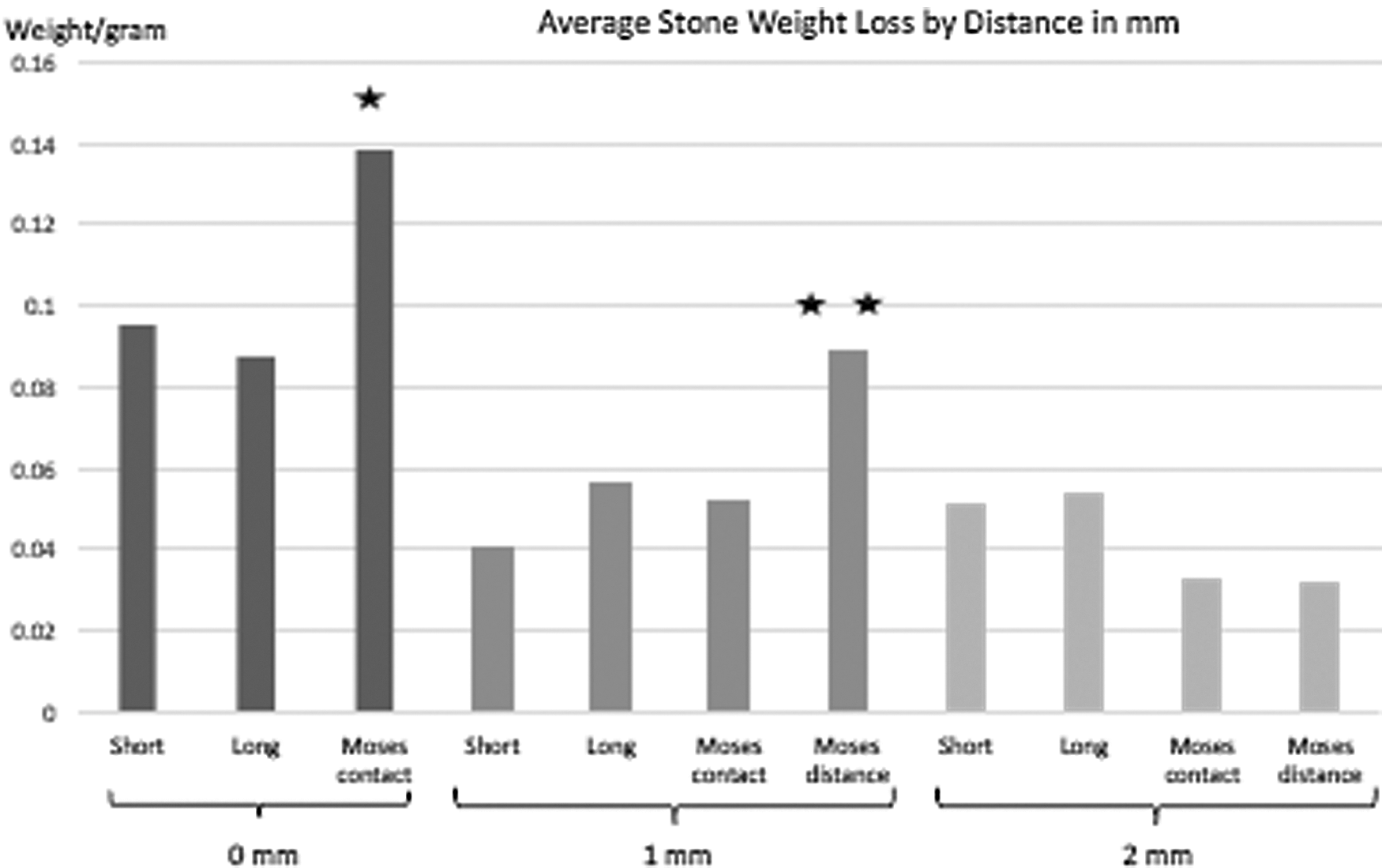
Average soft stone mass lost per 4 kJ by stone distance and pulse type. ★, Superior dusting over long pulse at 0 mm (p < 0.05); ★★, improved dusting over all other pulse types at 1 mm (p = 0.025).
On hard stones, pulse type did not have a significant impact on stone ablation at any distance from the stone surface (Table 1). On soft stones, with the fiber in contact with the stone surface, Moses contact produced the greatest amount of ablation, significantly greater than long pulse (p < 0.05) and trending toward significance relative to short pulse (Table 2). At a fiber tip-to-stone surface distance of 1 mm, Moses distance produced significantly greater ablation than all other settings (p = 0.025) and was as effective as long or short pulse when they were tested in contact with the stone surface. There was no significant difference in ablation between any pulse type when the laser fiber was 2 mm from the stone surface (Table 2 and Fig. 2).
Fiber tip degradation was minimal at all tested conditions (<0.05 mm) and there was no significant difference between any laser settings.
Discussion
The Ho:YAG laser is widely used within urology for lithotripsy. The wavelength of the Ho:YAG laser is 2120 nm, nearly the same as the absorption peak of water at 1910 nm. 10 This property provides safety by limiting the transmission of laser energy to material in contact or very near contact with the tip of the laser fiber when utilized in a fluid-filled environment. However, it also limits efficiency. When any significant fiber-to-stone distance is introduced, the laser energy is primarily absorbed by the intervening water and lost to heat and the creation of a vapor bubble rather than stone ablation. The Moses effect is a principle that can decrease lost laser energy through careful timing of laser pulses. The relatively long pulse length of the Ho:YAG laser creates a pear-shaped bubble that has minimal acoustic shockwave creation, but does provide an elongated fluid-free conduit through which a precisely timed second pulse of energy can be delivered to a surface not in direct contact with the laser fiber. 1,11 The Moses technology on the Lumenis Pulse P120 takes advantage of this effect by delivering a double pulse of energy: the first to create the water-parting vapor bubble, and the second to deliver energy intended for stone comminution.
This is the first bench-top study evaluating the ablation efficiency of Moses technology relative to short- and long-pulse lithotripsy in an automated and hands-free method. We found the Moses contact setting provided significantly greater stone ablation than long pulse when in contact with soft stones. Additionally, as the laser is moved 1 mm from the stone surface, we found the Moses distance setting provides an equivalent ablation efficiency to short and long pulse when those settings are used in contact with a soft stone. Thus, the Moses distance setting may provide the same reduced retropulsion advantage of long pulse, but additionally allow efficient stone ablation without the need for direct contact. Clinically, the Moses distance setting may be the most useful as some distance between fiber tip and stone surface is likely common, especially when trying to maintain continuous movement across an uneven stone surface for efficient dusting. In reporting similar findings, Elhilali and colleagues 3 used plaster of Paris phantoms, which, similar to the 15:6 BegoStone used in this study, have been established as representative of softer stones such as UA. 12
The advantage of the Moses distance setting was only observed at 1 mm laser tip to stone distance. The manufacturer has offered improved stone ablation at 2 mm using the Moses distance setting, but we could not substantiate this claim in our model. Nondusting lithotripsy settings with greater pulse energy and/or decreased frequency may be required to observe this effect.
Interestingly, our findings suggest the advantage provided by the Moses modes was seen on soft stones only. On harder phantoms mimicking COM stones, only the distance between the laser tip and the stone surface had an impact on ablation efficiency. Pulse type had no significant impact, suggesting that the advantage of the Moses technology is most pronounced with softer stones when utilizing a dusting technique. This finding has been reported by others using similar settings of 0.2 J/80 Hz on COM and UA stones. 13
A dusting model is not ideal for evaluating lithotripsy of hard stones. Clinically, dusting is rarely employed for hard stones. 9 Hard stones, such as COM, may have an energy minimum above 0.4 J for significant lithotripsy, which has been previously suggested by Sea et al. 14 Additionally, because the Moses technology splits the laser energy into two peaks, it is possible that the energy delivered to the stone surface during dusting is inadequate for significant lithotripsy of a hard stone, even if less total energy is lost to intervening fluid relative to short or long pulse. The impact of Moses technology on hard stones when nondusting settings are used requires further study.
In our model, we found almost no laser fiber tip degradation without a difference at any tested setting. Low-energy, high-frequency settings, such as those used in this study, have been utilized to create less fiber degradation than high-energy, low-frequency fragmentation settings. 15 However, Finley and colleagues 16 suggested that long pulse may provide more efficient lithotripsy relative to short pulse not only due to reduced stone retropulsion but also due to reduced fiber degradation when higher energy is used. Wollin and colleagues 5 likewise found that short pulse created increased fiber degradation. The impact of Moses technology on fiber degradation at higher energy fragmentation settings relative to long pulse remains unknown.
The advantages of the Moses technology have been investigated in several studies. Mullerad and colleagues 2 reported the subjective experience of 3 urologists using Moses technology in 23 cases. The Moses technology was rated as superior to standard short-pulse lithotripsy, and although it did not reach statistical significance, the Moses mode delivered more efficient lithotripsy at 95 mm/min vs 58 mm/min for short-pulse lithotripsy.
Elhilali and colleagues 3 demonstrated in vitro that the Moses technology provides a significant reduction in stone retropulsion. Additionally, they reported that Moses contact provides greater stone ablation than short-pulse lithotripsy with the greatest differences seen at low-energy, high-frequency settings such as those used when dusting a stone. The difference in ablation between the pulse types was also reported to be more profound with larger diameter laser fibers. In a separate study, they report that the increased ablation and reduced retropulsion translated into a potential 35% time reduction in the operating room when Moses technology was applied. 4 These studies certainly suggest an advantage to the Moses technology, but also created more questions as all comparisons were made relative to standard or short pulse mode and tested only the Moses-contact mode.
Before the introduction of Moses technology, changes to the Ho:YAG laser pulse length were reported to provide improvements in stone ablation and retropulsion. Finley and colleagues 16 found that a longer pulse (700 μsec) provided more efficient stone fragmentation relative to a short pulse (350 μsec). Additionally, Wollin and colleagues 5 reported greater stone comminution with long pulse (1000 μsec) at high-energy (>2 J) settings as well as 5 × less retropulsion relative to short pulse. Bell et al. 6 similarly demonstrated reduced retropulsion with long pulse relative to short pulse. Given the current state of the literature, we thought a comparison between long pulse and Moses modes would be the most relevant and provide a better delineation of the characteristics of the two Moses modes on the Lumenis laser.
We used a dusting model and 365 μm fibers as the prior work by Elhilali and colleagues 3 suggested Moses to differentiate itself most profoundly when at low-energy, high-frequency settings with larger diameter laser fibers. Ablating stone with the dusting technique rather than fragmenting stones lent itself to the use of an automated system to provide identical conditions with each pulse type. We recognize that many urologists may prefer smaller diameter fibers, especially when using flexible ureteroscopes due to decreased impact on irrigant flow. Our results can be extrapolated to smaller diameter fibers based on the work of Kronenberg and Traxer. 17 They demonstrated that although larger diameter fibers create wider, shallow fissures, whereas smaller fibers create narrow, deeper fissures, there is no difference in ablation volume at equivalent pulse energy.
Several recent studies have examined the production of heat during high-energy laser lithotripsy and the resulting possibility of renal or ureteral injury. 18 –20 Aldoukhi and colleagues 20 demonstrated caliceal temperatures in the pig to exceed the threshold for tissue injury in under 20 seconds when 0.5 J and 80 was were applied with low or no irrigation. The impact of Moses and other nonstandard laser pulse types on heat production has not yet been evaluated. Certainly, caution is advised when using the Ho:YAG laser for long, uninterrupted periods of time as can occur when attempting to dust a large stone.
This in vitro study has several limitations. The use of a robotic system to provide consistent conditions across pulse type provides objective conditions for comparison, but reduces the fidelity of the model to actual clinical conditions. Additionally, although they have been used in numerous Ho:Yag lithotripsy studies, BegoStone phantoms are validated as excellent phantoms for acoustic, not photothermal lithotripsy. There may be properties unique to human stones that are lost through the use of artificial stone phantoms. Finally, in the clinical setting, low-energy, high-frequency dusting settings are typically used for softer stones. Nevertheless, we evaluated both hard and soft stones in our model as many stones encountered clinically are of mixed composition and may share lithotripsy characteristics of both types of stones. Therefore, we chose to include results for both stone types.
Conclusions
In an automated in vitro dusting model, the novel Moses Holmium:YAG laser technology provides greater ablation of soft stones when in contact with the stone surface relative to long-pulse lithotripsy. Additionally, Moses technology enables significant stone ablation at 1 mm from the stone surface relative to other laser pulse modifications. Further studies are warranted to assess the clinical utility of this new technology.
Footnotes
Author Disclosure Statement
No competing financial interests exist.