







Abstract
Background:
Transrectal ultrasound-guided prostate biopsy (TRUS) is the gold standard for undertaking prostate biopsy, however, it has been associated with higher rates of post-biopsy sepsis than transperineal prostate biopsy (TP).
Objective:
To compare complication rates between transrectal prostate biopsy and TP for a single surgeon.
Materials and Methods:
Data were collected for all prostate biopsies undertaken by a single experienced urologist through his private rooms between February 2012 and March 2018. In total, 693 cases were included (560 individual men) in the final analysis (transrectal = 276 and transperineal = 417). All patients were followed up 2 weeks post-biopsy, and complications were recorded (sepsis, urinary tract infection [UTI], bleeding, and acute urinary retention [AUR]).
Results:
Complications occurred in 37 cases (transrectal = 3 and transperineal = 34). Sepsis occurred in one case following transrectal biopsy (0.36%) and two cases following TP (0.48%). UTI occurred in two cases following transrectal biopsy (0.72%) and two cases following transperineal (0.48%). Bleeding occurred in one case following TP (0.24%). The most common complication was AUR, which occurred in 28 cases following TP (6.71%).
Conclusions:
Data from this study compared complication rates for both transperineal and transrectal prostate biopsies in a single-surgeon study.
Introduction
Prostate cancer is the leading cause of cancer affecting Australian men and its diagnosis and surveillance are primarily undertaken by prostate biopsy. There are two main techniques for performing biopsy of the prostate—transrectal ultrasound-guided prostate biopsy (TRUS biopsy) and transperineal template-guided biopsy (TP biopsy). TRUS biopsy has been the gold standard for undertaking prostate biopsy, 1 however, this technique has been reported to have higher rates of infective complications when compared with TP biopsy. 2,3
Rates of infective complications following prostate biopsy are rising and multiresistant bacteria are increasingly implicated. 4 –6 Prostate biopsy-associated infections are often associated with high morbidity and mortality rate and are both costly and difficult to treat. Consequently, there has been significant effort to investigate techniques for reducing rates of biopsy-associated infections. Various techniques have been proposed, but as yet, the evidence to support these interventions is limited. A systematic review published by Toner and colleagues 7 suggested that at present, there is little evidence to support the use of simple techniques such as cleansing or disinfecting enemas or needle disinfection to decrease prostate biopsy-associated sepsis rates. Toner and colleagues suggested, however, that there is some evidence to support the efficacy of augmented antibiotic prophylaxis, targeted antibiotic prophylaxis, and use of the transperineal method to decrease rates of prostate biopsy-associated infection. These techniques are costly to implement, however, and some may contribute to the further development of antibiotic resistance. Furthermore, it is impractical to abandon the use of TRUS biopsy in favor of TP biopsy in all cases.
Despite its associated rates of infective complications, TRUS biopsy is a useful test. It is simpler and cheaper to perform than TP biopsy as it does not require general anesthesia (although TP biopsy is increasingly performed without general anesthesia also) and requires less specialized equipment. It is also associated with a lower rate of biopsy-associated acute urinary retention (AUR) than TP biopsy. Consequently, it would be beneficial to find methods for improving the safety of TRUS biopsy.
During TRUS biopsy, the biopsy needle traverses the rectal mucosa before entering the prostate gland, and thus, bowel flora can be directly inoculated into the prostate, and potentially the systemic circulation by the biopsy needle. The same biopsy needle is used to collect all specimens during the course of a TRUS biopsy, and thus, with each pass of the needle, it is likely to carry a higher number of enteric flora with it. Aseptic theory would suggest that disinfecting the TRUS biopsy needle between passes should decrease the rates of biopsy-associated infection by decreasing the bacterial inoculum. Furthermore, it would be reasonable to assume that other interventions such as careful selection of patient population and use of prophylactic antibiotics should lower the rates of TRUS-associated infective complications.
The hypothesis of this study was that when aseptic principles were adhered to and patient populations were selected appropriately, the TP and TRUS biopsies would have a similar rate of infective complications. The objective of this study was to evaluate and compare the complication rates of TRUS biopsy with TP biopsy in a single-surgeon series.
Materials and Methods
Data were collected for all prostate biopsies undertaken by a single experienced urologic surgeon (J.S.P.) through his private rooms between February 2012 and March 2018. In total, there were 695 individual prostate biopsies (TP or TRUS biopsy) undertaken in this time period and 693 cases (where complete data were available) were included in the final analysis. Of these 693 cases, 133 were repeat biopsies undertaken on men who had already been included in our sample. The total number of individual participants included in this study was 560.
Patients underwent TRUS or TP biopsy depending on prostate size, previous biopsies, and risk factors for resistant intestinal microbes. TP biopsy was the method of choice for repeat biopsy, large prostate size (>50 cc), and in patients who had traveled to Southeast Asia in the previous 12 months (due to increased risk of resistant gastrointestinal microbiota). TRUS biopsy was preferred for first biopsy in patients with a prostate size <50 cc. Despite these criteria, some patients still elected to have TP or TRUS biopsy according to preference, and therefore, patient demographics were not entirely homogenous across the two groups.
Patient demographics, mode of biopsy, number of biopsies, histopathology, and complications were prospectively recorded using a biopsy audit data sheet. Recorded complications were as follows: sepsis (defined as the development of a fever ≥38°C following biopsy, thus requiring hospital admission and intravenous antibiotics); bleeding (requiring intervention and hospitalization); AUR; and urinary tract infection (UTI; requiring further oral antibiotics).
Study data were collated by three separate researchers (B.N., F.R., and R.Y.) and then were analyzed by a single researcher (R.Y.). The authors utilized Fisher's exact test and chi-square test to analyze whether there was any statistically significant difference between the recorded complications for the TP and TRUS groups.
Biopsy preparation
All patients received a 10 mg bisacodyl suppository before undergoing biopsy to reduce fecal content in the rectum. Patients undergoing TRUS biopsy also received a total of 6 doses of 250 mg oral ciprofloxacin every 12 hours commencing the night before biopsy. Early in the study period, patients undergoing TP biopsy also received oral antibiotics before biopsy (n = 24), but this practice was discontinued as the literature increasingly demonstrated low rates of post-TP biopsy sepsis in the absence of prophylactic oral antibiotics. All patients received a single dose of intravenous or intramuscular antibiotics before biopsy (gentamicin, amoxicillin, or other).
Transperineal biopsy procedure
All TP biopsies were performed under a general anesthetic in the exaggerated lithotomy position using a biplane transrectal ultrasound probe in conjunction with a brachytherapy stepper and template grid. TP biopsies were undertaken according to a standard grid determined by the urologist (right base, right anterior, right apex, left base, left anterior, and left apex). A standard total of 18–28 cores were taken during each TP biopsy, although in some cases, fewer than 18 biopsy cores were taken at the surgeon's discretion.
TRUS biopsy procedure
All TRUS biopsies were performed under intravenous sedation in the left lateral position using a biplane transrectal ultrasound probe. In this study, the urologist took a standard 18 cores during each TRUS biopsy (3 base, 2 midprostate, 2 apex, and 2 anterior biopsies from each side of the prostate). Between each pass, after handing off the biopsy core, the biopsy needle with its overlying sheath was vigorously (see Fig. 1) flushed in a large kidney dish full of cetrimide solution (cetrimide 0.5% w/v and chlorhexidine gluconate 0.05% w/v) and then rinsed in physiologic saline with the inner chamber of the biopsy needle exposed. The biopsy needle was then reloaded for subsequent biopsies.
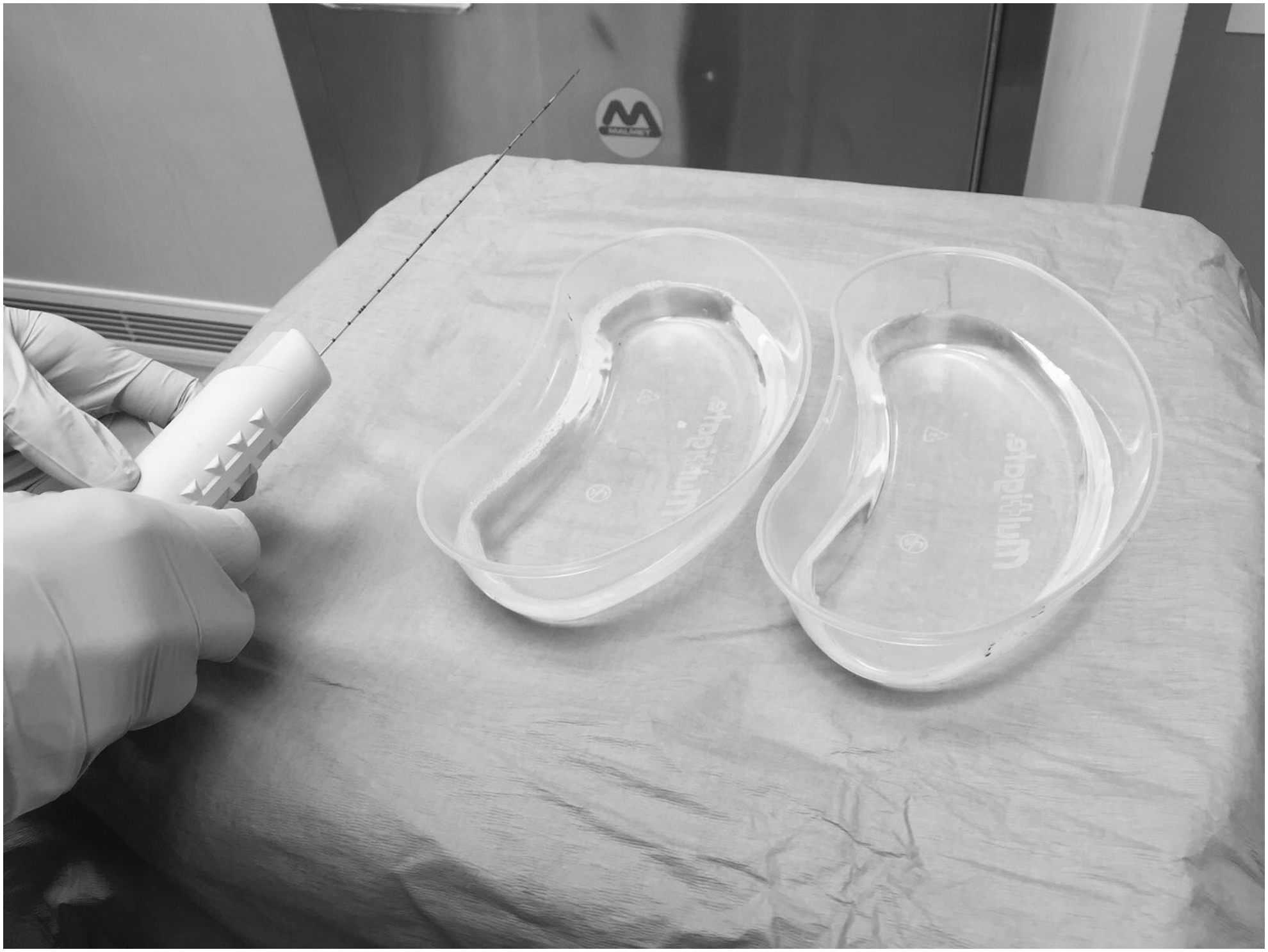
Setup for biopsy needle flush.
Complications
All patients were reviewed by the surgeon in his private rooms 2 weeks following biopsy to discuss biopsy results and document any complications. If patients presented to the hospital before this review, complications were documented at the time of presentation.
Results
Of the 693 cases of prostate biopsy included in the final analysis in this study, there were 417 cases of transperineal biopsy and 276 cases of TRUS biopsy (Table 1). The age range of the men included in this study ranged from 39 to 91 years (median = 64 years) and 37% of biopsy results were positive for cancer. Of the 693 included cases, 59% (n = 412) of these were biopsies being performed for the first time, with the rest of the cases being undertaken in men who had previously been biopsied (Table 2). In 193 of the 276 cases of TRUS biopsy, fewer than 18 cores were taken during biopsy.
Patient Characteristics in Transperineal Prostate Biopsy vs Transrectal Ultrasound-Guided Prostate Biopsy
Biopsy Number and Complication Rate
TP = transperineal prostate biopsy; TRUS = transrectal ultrasound-guided prostate biopsy.
Complication rate
Of all included biopsies, complications occurred in 37 cases (5.34% of cases) (Table 3). In 3 cases, complications occurred following TRUS biopsy (1.09%) and in 34 cases, complications occurred following TP biopsy (8.15%). Of these complications, sepsis was recorded to have occurred in three cases (0.43%) with two of these occurring after TP biopsy (0.48%) and one after TRUS biopsy (0.36%). Postbiopsy UTIs were recorded to have occurred in four cases (0.58%) with two occurring after TP biopsy (0.48%) and two after TRUS biopsy (0.72%). Bleeding was noted in only one case following TP biopsy (0.24%). The most commonly recorded complication was AUR, which occurred in 28 cases in total (4.04% of all biopsies), all of which occurred following TP biopsy (6.71% of TP biopsies). For cases in which AUR occurred postbiopsy, 8 cases occurred in men with a prostate volume ≤50 cc and 19 cases occurred in men with a prostate volume >50 cc (prostate volume was not recorded for one case in which AUR occurred). There was no statistically significant difference in complication rates between TRUS and TP biopsy for sepsis, UTI, or bleeding. The difference in rates of AUR between groups, however, was significant (p < 0.01).
Complications
Discussion
This study demonstrated comparable complication rates between TRUS and TP biopsies undertaken by a single surgeon. The findings of this study suggest that when simple measures (such as appropriate selection of patients, antibiotic cover, and use of a needle wash to reduce bacterial inoculation) are used, TRUS biopsy can be performed with sepsis rates equivalent to TP biopsy.
The limitations of this study include generalizability of results in the context of different practitioners reproducing this technique, the lack of control group, and the possibility of confounding bias. As the biopsies in this study were all undertaken by a single operator, the data are unable to suggest whether or not sepsis rates would be reduced across multiple different operators using this technique. Given the ease of the population selection and cetrimide wash, however, it is unlikely that data would vary significantly between operators.
As this study did not include a direct control group, it cannot be definitively stated that the low complication rates in this study were directly attributable to one factor in particular. It may be beneficial for future studies to include a matched comparison group to more clearly ascertain which factors reduce TRUS-associated infective complications. Despite these limitations, a key strength of this study was 100% follow-up of all patients included in the sample population. As such, the study is unlikely to have underestimated the rate of complications that occurred in the sample population.
Several studies have previously investigated factors associated with an increased risk of developing sepsis following prostate biopsy. There is evidence to suggest that factors such as recent overseas travel, prostatic enlargement, prior antibiotic exposure, preceding hospitalization or surgery, recent antibiotics, previous TRUS biopsy, diabetes mellitus, immune deficiency, recurrent UTIs, and obesity are associated with an increased risk of developing infective complications of prostate biopsy. 8 –13 This study did not specifically collect data pertaining to all of these risk factors, however, it did stratify patients with large prostate volume and recent overseas travel to Southeast Asia into a high-risk group. It is possible that TP biopsy should be the treatment of choice for these high-risk patients due to its lower complication rates, however, it would be interesting to investigate whether a simple technique such as a cetrimide needle wash is beneficial in reducing TRUS-associated sepsis rates in high-risk populations. A future controlled study of TRUS biopsy with and without a cetrimide needle wash in high-risk patients would be beneficial for answering this question.
In this study, routine antibiotic prophylaxis and bisacodyl enemas were given to all patients before biopsy. This study implemented a needle wash in adjunct to standard techniques for reducing sepsis risk in prostate biopsy (i.e., use of antibiotics and bisacodyl enemas, preferential TP biopsy for high-risk groups) rather than assessing a needle wash as an isolated intervention. As such, it is possible that confounding bias impacted on the observed low post-TRUS sepsis rates in this study. Nevertheless, the data suggest that the addition of a needle wash as part of a standard TRUS biopsy protocol (which is a simple and low-cost intervention) may be useful for reducing sepsis rates. Future trials looking at the characteristics of patients who develop infection-related complications following biopsy may assist with providing recommendations about which patients may benefit from which combination of interventions (such as cetrimide wash along with targeted antibiotic prophylaxis, povidone/iodine enema or other) to reduce their risks of sepsis.
There are several factors that are known to place individuals at a higher risk of urinary retention following prostate biopsy such as prostate volume and the number of cores taken during biopsy. These factors were not controlled for in this study, and thus, it is possible that the observed rates of urinary retention following TP biopsy may, in part, be due to inclusion of higher risk patients in the TP sample group. Although prostate volume varied between groups, TP biopsy was the method of choice for men with prostate volumes >50 cc and the overall number of biopsy cores taken for a standard TP biopsy in this study was greater than that for TRUS biopsy. It would be beneficial for future studies to assess rates of urinary retention post-TP biopsy when these factors are controlled for.
Conclusion
This study suggested comparable sepsis rates between TRUS and TP biopsy across a single-surgeon series when patients were appropriately allocated to TRUS or TP groups, received prophylactic antibiotics, and when aseptic principles were adhered to. The interventions in this study are simple and cost-effective to implement and may be beneficial for improving the safety of prostate biopsies.
Footnotes
Author Disclosure Statement
No competing financial interests exist.