







Abstract
This article approaches the theme of climate change adaptation in Brazil and the need for interaction between an agenda of rights and justice within the framework of climate change public policies. To verify how climate justice and inequalities are expressed in this part of the Global South, a literature review was performed with selected descriptors referring to climate justice in Latin America.
An analysis of the Brazilian National Adaptation Plan (NAP) was also made, taking it as a case study to verify if guidance exists to combat inequalities and climate change impact at once. The literature analysis has shown that studies on climate justice in Latin America are still scarce and present, mainly, a critical theory conception pointing towards capitalism and colonialism as the cause of climate problems, as well as the need for equitable distribution in terms of climate change. With the analysis of the Brazilian NAP, it was observed that the climate justice discourse has not yet been systematically incorporated.
Introduction
In the most urbanized of Earth's territory, Latin America, inequalities persist, as in other territories of the Global South. In those parts of the planet, the call for action against climate change impacts will be, above all, against environmental inequalities. In this sense, adaptation, poverty, rights, and justice must be intertwined within planning, policies, and social mobilization, so that adaptation does not simply become an empty or reproductive model of the production of inequalities in the territory.
In current research and publications on climate change, whether in academia, government, or civil society, a comparison is often observed in those approaches addressing adaptation, vulnerability, and risk, especially in countries that are prominently poor with high levels of social inequality, as is the reality in most of today's territories of the Global South. 1
However, vulnerability and risk do not necessarily have their roots in the construction and analysis of the demand for recognition, rights, and justice. The authors gathered here draw attention to the necessary interface between inequality, a rights and justice agenda within the climate change debate, and more specifically, in relation to the issue of climate change adaptation. It is imperative that those issues are considered in the construction of adaptation policies, projects, and plans, whether municipal, provincial, or federal regions, even as a strategy for community planning, both insurgent and participatory.
In this sense, this article seeks to contribute to the broadening of the debate on climate justice, as a decolonial point of view, problematizing the issue by taking contemporary Global South literature as a reference and using the Brazilian National Adaptation Policy (NAP) as an analysis case.
Methodology
First, we conceptualize climate justice in the Latin American context. A literature review was carried out using Google Scholar and Web of Science with the descriptors “climate justice,” “climate injustice,” “justicia climática,” “justicia climática America Latina,” and “justiça climática,” as can be seen in Figure 1. The list of articles and where published can be seen in Table 1.
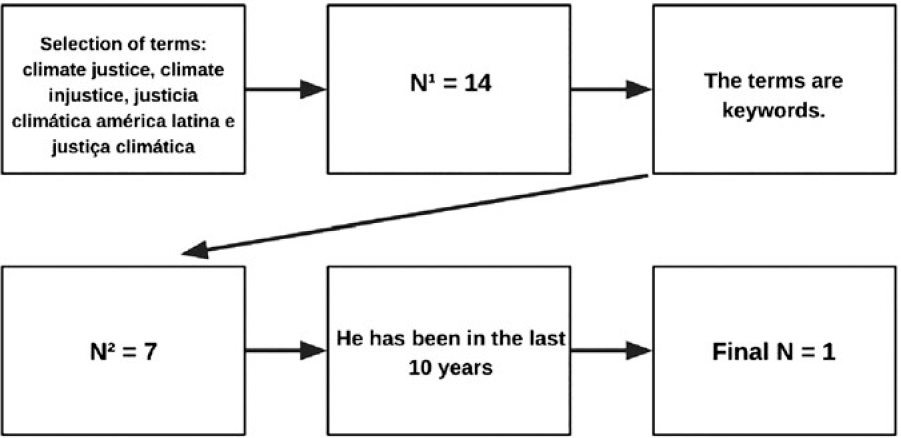
Search performed with selected descriptors. Source: Authors (2020).
Articles, Name and Year
Source: Own elaboration, 2020.
Second, we analyzed the NAP, looking for how the concept of inequality, justice, and demands of rights is addressed—or not—within the document. In these documents, we looked for specific terms related to justice: “justiça,” “justa(s),” “justo(s),” “direito,” “vulnerabilidade(s),” “ambiente/ambiental (ais),” and development (“desenvolvimento”).
Results
Rammê 2 addresses the fact that those who have contributed to the global climate change process the least assumed climate risks unequally and unfairly. Rasmussen and Pinho 3 emphasize that the distribution of the negative effects of climate change is not only a biophysical phenomenon but also mainly a political and social process that motivates the search for environmental justice from within a context of global climate change and places climate justice as a relevant issue within the movement.
Several authors who were analyzed have been working on the issue of climate justice from two aspects. (1) That which is related to international law and the discussion of shared responsibility while considering the history of higher emissions from industrialized countries. 4 (2) Discussion of climate justice movements in Latin America, for example, highlighting the Bolivian indigenous movement that seeks to face global capitalism. 5
Others focus on development and economic growth where it opposes the idea of infinite development, measurable only by indicators of inequality and inequality. It proposes that “it is not possible to develop and live well at the expense of others […] and that we must seek sustainability based on respect and equity between human beings and gratitude and reciprocity with Nature. 6 ”
For Beltrán, the Global South countries suffer the most devastating consequences of global warming because of the irrational accumulation system, a devastating development practiced by the Global North. With this understanding, there is a need to demand climate justice for the poorest countries and communities in the distributive dimension, referring to the administration of justice processes in the resolution of disputes and the allocation of resources, as well in the restorative dimension, which promotes the commitment to repair the rights of victims of climate change. 7
With that focus, the climate justice movement derives from the global environmental justice movement, which receives theoretical contributions from political ecology and ecological economics. Climate justice arises as a result of a geopolitics, which immodestly expropriates natural resources, inside and outside national borders, benefiting mainly rich countries.
Climate justice research necessarily presupposes a change in the current economic model, since injustices come, not only from the climate problem but also from the development model. In addition, according to the literature review, capitalism cannot solve the ecological crisis that it itself has created. Therefore, for those authors, any ecological perspective that lacks an anticapitalist orientation is doomed to failure. 8
As seen in the literature review (Table 1), climate justice is a theme that, in the context of Latin America, is expressed through the fact that in the face of a climate emergency scenario affecting the countries of the globe unevenly, it is due to a system of unequal relationships between the north and the south. It contributes both to building antihegemonic development models, which mainly encompass the traditional populations and movements of the region, and investing in the poorest countries so that they may undertake adaptive measures.
Regarding the NAP, a platform was created to help capacity building based on the content: AdaptaClima. 9 The Ministry of Environment coordinated the development of the platform. The authors did not find a single mention of the descriptor “justice” in the extensive list of content or suggested literature. The platform was launched in 2017 to achieve the first objective of the NAP, which includes, among its objectives, an “online platform for knowledge management in an adaptation created and available to society.” The NAP was published in May 2016, with the aim of promoting the management of climate risk reduction “in order to take advantage of emerging opportunities, prevent losses and damages and build instruments that allow adaptation of natural, human systems, production and infrastructure.” 10
The main strategy presented is based on the “insertion of climate change risk management in existing sector and thematic public plans and policies, as well as in national development strategies.” 11 The document recognizes the vulnerability of traditional populations (indigenous, “quilombola,” “ribeirinhos”) to risks associated with climate change, and that there must be approaches with racial, ethnic, and gender criteria.
Among the sectoral strategies presented by the NAP, one refers to vulnerable people and populations and how to promote their adaptation through three goals. (1) “Vulnerability diagnosis of impact of climatic change of populations attended by the National Policy of Territorial and Environmental Management of the Indigenous Lands (PNGATI),” under the responsibility of FUNAI—National Indian Foundation (Brazil). (2) “Diagnosis of vulnerability to climate change of populations served by the National Plan for Food and Nutrition Security (Plansan),” under the responsibility of the Ministry of Social Development. (3) “Elaborated diagnosis and reduction of vulnerability to climate change promoted within vulnerable populations and beneficiaries of agro-extractive public policies,” under the responsibility of the Ministry of Environment.
Although the NAP mentions the most vulnerable population, the term “justice” does not appear in the executive summary or in Volume 1. The term “fair” appears between the principles, referring to “adaptation as a strategy to promote the productive sector with a fair transition for workers and economic growth. This is aligned with poverty reduction strategies, inequalities socioeconomic and regional, including consideration of the principle of prevention and precaution.” 12
The second volume of the NAP deals with sectoral and thematic strategies and in its scope uses the term “justice” four times, one of them to explain the scope of another plan (National Plan for the Promotion of Sociobiodiversity Products), articulated with NAP as a guide to promote adaptation through the Food and Nutrition Security strategy. 13 In chapter 3, entitled City Strategy, the term appears with the same wording discussed in this chapter and where “although all are affected in some way, the impacts of climate change affect especially the poorest.” 14 This is mainly due to the concentration in high-risk areas and with limited access to services and resources of a population that already faces the effects of extreme events under the stress of climate change.
Discussion
In the case of Brazil, there is an historical need for urban territorial policies that address the unequal and unfair production of space, considering socio-environmental vulnerability. 15 The stability of the institutional arrangements that perpetuate this model is linked to the “discursive hegemonies” of this space-time context, but external pressures such as climate change challenge stable planning cultures and result in an institutional reflection process. 16
It must be recognized that adaptation to climate change requires a new paradigm that takes into account a range of possible future climates, conditions, and changes associated with natural and human systems, not only through management based on past experience, which will require innovations for the field of planning, its technicians, and decision makers.
This opportunity allows institutional change and, breaking the discursive hegemonies, discovers unknown contexts of uncertainty that encourages the planners. However, what we see in Brazil is that the ruling class, which has “discursive hegemony,” resists incorporating climate problems into decision making, despite concern for the issue. 17
In Brazil, specific plans for adaptation to climate change are still few. 18 This, on the one hand, confirms that the country has focused its actions in recent decades mainly on the issue of mitigation, rather than its adaptation, primarily related to deforestation in the Amazon—Brazil's highest emitter. On the other hand, it opens the possibility that future adaptation plans incorporate fundamental aspects of the fight against poverty and social inequality from their conception.
And how to incorporate? Making sure that is a community-based bottom-up process, strengthen community oversight, and making sure projects really get implemented in the way they were planning, incorporating distributive equity, historical responsibility and restorative justice, or a per capita equity approach to emission allowances, application of existing social rights to the problem of climate change.
According to the literature review, the dialogue between the north and the south regarding academic production on climate justice occurs, mainly, when the allusion between sustainable development and the need for climate justice is a motivator toward achieving global mitigation objectives. The issue of adaptation to climate change as a planning attribute is presented as a challenging aspect, especially considering the fact that the countries of the Global South are those that contributed least to the phenomenon, and yet will be the most affected. 19
Some researches indicate that the term climate justice is a derivation of the environmental justice concept. However, it seems that was Weiss who first used in the academy the term “climate justice” in 1989. 20 A pivotal moment in this process comes in 2005 as Hurricane Katrina hit New Orleans, clearly revealing who would be most affected by the extreme events of climate change: African American and the poor.
However, Schlosberg and Collins believe that despite the importance of the Katrina event, a relationship was emerging before that monstrous hurricane. An initiative, started 4 years earlier, as a result of the first Climate Justice Summit during the COP6 meeting of the UNFCCC, founded the Environmental Justice and Climate Change Initiative. The initiative with focus in the US historical put together a diverse group of “environmental justice, climate justice, religious, policy, and advocacy groups that represent hundreds of communities.” From there the group laid out 10 principles of climate justice in 2002. So 3 years earlier than Katrina.
This seems to be a key point to understand why climate justice gained more ground in the Global North and so little adherence of works and social organizations in Latin America, precisely in one of the most vulnerable parts of the planet that tends to feel the rise of extreme weather events in the coming years and decades.
Almost 10 years after the Environmental Justice and Climate Change Initiative foundation in the Global North, in 2010, Bolivia hosted the World People's Conference on Climate Change and the Rights of Mother Earth, in Cochabamba. Somehow we can see the influence of the outcomes of the meeting as a mark of the Latin American production found mainly regarding an anticapitalist agenda, and may explain that most articles date from after 2010 (Table 1). According to Cochabamba's resolutions, it was the dominant growth-based model of social and economic system, based on the submission and destruction of human beings and nature, which has brought Mother Earth to face climate change.
Conclusions
Adaptation must directly address the needs of the poor, placing them at the center of political decisions and their financing. The argument for equitable adaptation is clear: in addition to a moral duty, it contributes to the distribution of wealth, social cohesion, health, and peace. 21 The NAP analysis has shown that climate justice discourse has not been systematically incorporated into the country's main policies while considering the social demands of the affected communities.
The harmful effects of climate change are already manifest and will tend to worsen, mainly affecting the poorest populations of the countries of the Global South, which contributed the least to the problem. In addition to integrating with other existing policies and actions and taking into account the direct impact of local characteristics on the need for regulation on the impact of climate variability, it is recommended for climate adaptation policies to be developed at the local level in a community-based codesigned strategy.
Existing policies cannot be properly implemented because the participation of several actors and stakeholders only occurs in their elaboration, which is not reflected in subsequent actions. In the current Brazilian scenario, long-term planning focused on climate adaptation is not projected, although studies indicate that important climatic changes must occur in the country in the 21st century, likely causing negative social and economic impacts, especially in the most vulnerable centers.
In 2011, Milanez and Fonseca 22 demonstrate that, although climate injustice events were already noticeable in Brazil, the Climate Justice notion had not been consistently incorporated into the country. After 10 years, the conclusion remains.
Footnotes
Author Disclosure Statement
No competing financial interests exist.
Funding Information
This research was funded by The São Paulo Research Foundation - FAPESP. Grant number 2018/06685-9, 2019/05644-0, 2019/18462-7, 2018/02464-8 and 2015/03804-9.