







Abstract
Racial and spatial segregation in cities generate uneven exposure to current and future urban flood risks and worsen the economic and health consequences of flooding for Black, indigenous, and people of color (BIPOC) communities. In this article, we present a tool for practitioners to center racial justice in urban flood resilience policy and planning. This tool includes and operationalizes five principles for centering racial justice to produce policies and plans that drive transformative urban resilience. The five principles are: (1) focus on root causes; (2) institutionalize representation; (3) co-own planning efforts with communities; (4) center equity in data collection and analysis; and (5) facilitate cross-sector collaboration. Along with these principles, we have developed an open-source resource hub with case studies, decision-making supports, and policy briefs that can help practitioners put the principles into practice in partnership with community. We acknowledge that this work is incremental, and to fully operationalize these principles, more work needs to be done to dismantle current systems and rebuild them in a racially equitable way. Future work, we argue, should especially focus on developing robust project and policy evaluation methods that similarly center racial justice.
INTRODUCTION
Many cities are facing the simultaneous and intertwined challenges of climate change adaptation and racial inequality. Urban flooding in particular is a growing challenge, and Black, indigenous, and people of color (BIPOC) communities are often most affected. Racial and spatial segregation in cities generate uneven exposure to current and future urban flood risks and worsen the economic and health consequences of flooding for BIPOC communities. Decision makers, planners, advocates, and residents increasingly recognize the need to respond to these intertwined challenges and are taking steps to do so. Our research provides a tool for local policymaking, programs, investments, and advocacy that can help prepare for climate change and empower decision makers to center racial justice in urban flood resilience planning.
PURPOSE OF THE TOOL
Racial and spatial segregation in cities generate uneven exposure to current and future urban flood risks and worsen the economic and health consequences of flooding for BIPOC communities.
1
Failing to center racial justice in urban adaptation and resilience planning not only neglects those communities most affected by climate change, but it can also produce decisions and investments that uphold and/or exacerbate current inequalities.
2
A growing number of city governments, planners, stakeholders, and advocates are committed to centering racial justice in urban flood adaptation, and a growing number of tools and resources are available to inform this work. To support communities and decision makers in moving forward, we have worked collaboratively with practitioners to develop an integrated set of decision-making tools and resources: five principles for centering racial justice in urban flood adaptation; an interactive checklist for operationalizing these principles; and an online open-source hub for compiling case examples, decision support tools, and policy briefs. A full reporting of the process and findings can be found at <
RATIONALE FOR TOOL DEVELOPMENT
Cities throughout the United States are facing the simultaneous and intertwined problems of climate change and racial inequity. 3 Urban flooding is of particular concern, causing extensive economic loss as well as impacts to human health and well-being. 4 From 1980 to 2020, the United States had 33 billion-dollar weather and climate disaster events that caused a total of $150 billion in economic losses and 617 deaths. 5 The frequency and costs of these high-intensity flooding events is increasing, reaching an average of 1.8 billion-dollar disasters per year and $8.2 billion per year in economic losses over the past 5 years. 6 The impacts of urban flooding are expected to grow, with more extreme precipitation events. We define resilience as “the ability of people and their communities to anticipate, accommodate, and positively adapt to or thrive amidst changing climate conditions and hazard events” 7 and view adaptation to urban flooding events as a foundational component of achieving resilient cities.
The need for urban flood resilience planning to directly consider issues of racial justice is becoming increasingly apparent as BIPOC are being disproportionately exposed to urban flooding. 8 BIPOC communities are more likely to live in low-lying, high flood risk areas and often do not receive the same level of investment as predominantly white communities. 9 These patterns, coupled with historical and current racially biased and oppressive systems foundational to planning institutions, make BIPOC communities more susceptible to the impacts of urban flooding. If no action is taken to center racial justice in urban flood resilience planning practices and organizations, it is likely that racial disparities in flood risk will continue to grow.
These challenges have not been lost on urban decision makers, planners, advocates, and residents. Indeed, there are a growing number of tools, best practices, resources, and examples available to decision makers and other stakeholders. 10 The expanding but ad hoc information environment creates a challenge for those with limited time and capacity, and a need for a more integrated and accessible resource for policy and planning.
PROCESS USED TO DEVELOP THE TOOL
In April 2020, our team of academics and practitioners received funding from the Graham Sustainability Institute at the University of Michigan to address the need for greater attention to justice in climate change adaptation, and specifically, the lack of clear guidance or a common understanding at the local level about how to measure, monitor, and evaluate justice in climate change planning and implementation processes. Our work coincided with the onset of the COVID-19 pandemic, and a summer of racial tension in the United States, which compelled us to focus our attention more specifically on racial justice in urban flood adaptation policy and planning. The aim of our efforts was to develop a set of principles that could guide decision making and to systematically compile case examples and decision support tools that aligned with these principles. Over the course of 1 year, our team reviewed peer-reviewed literature, read and synthesized white papers and reports, held virtual workshops and meetings with our partners and other practitioners, and reviewed current city adaptation planning documents in our region, the Laurentian Great Lakes (Fig. 1). Racial segregation and inequality have always characterized Great Lakes cities but have been exacerbated by the deindustrialization, population loss, and disinvestment of the past 50 years. Many cities in the region that were once industrial powerhouses have seen a sustained loss of jobs and residents (particularly white residents) as political and economic patterns have shifted. Today, racial segregation and inequality are pressing problems for Great Lakes cities, with 15 of the 25 most segregated U.S. cities located in the region. 11
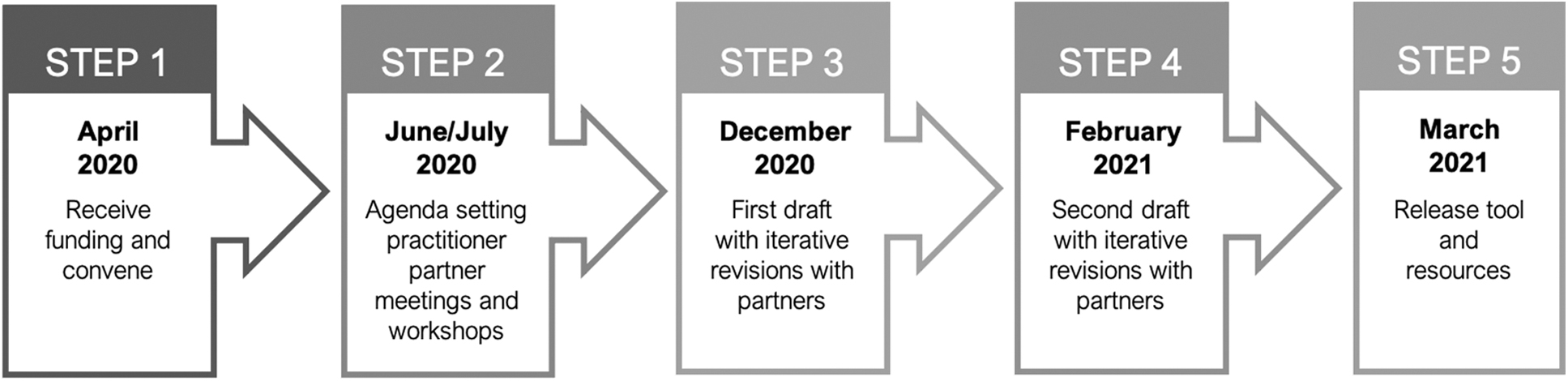
Project timeline and process.
Our iterative process with partners involved early conversations aimed at identifying the needs urban decision makers and stakeholders have, and the varying perspectives on those needs in different places. We then had virtual feedback meetings to improve and refine our approach to addressing these needs. The principles, checklist, and resource hub developed and described here are the product of these efforts, and a full reporting of the findings can be found at <
USES OF THE TOOL
The principles, checklist, and resource hub can be used to directly support urban flood resilience policy and planning. Local decision makers and practitioners can use the principles and supporting checklist to inform and guide their (1) urban flood adaptation policy development, (2) program construction and implementation, (3) hiring and organizational strategies, and (4) collaboration and empowerment processes. Local advocates can similarly use these tools to promote racially just approaches to climate change adaptation in their cities. Decision makers at the state level can use these tools to identify opportunities and guide investment that supports local action. The resource hub can be used to identify examples of successful projects in other cities and to identify additional decision support tools that can further guide local decision making and planning.
RELEVANT RESEARCH FINDINGS
At the heart of our tools are five principles that can support and guide urban flood adaptation and resilience planning:
Focus on root causes Institutionalize representation Co-own planning Center equity in data collection and analysis Facilitate cross-sector collaboration
Principle 1: focus on root causes
Root causes of racial inequity—such as poverty, racial segregation, and income and wealth inequality—contribute to disproportionately high urban flood risk among BIPOC communities. Identifying and addressing these root causes through adaptation policy and planning is critical to ensuring that these inequalities are not perpetuated or worsened. 12 Central to this principle is adopting an explicitly anti-racist systems approach to urban flood adaptation. We identified three specific ways urban flood adaptation can adopt a root causes focus.
First, policy and planning can seek to improve and ensure equitable access to environmental amenities that reduce flood vulnerability, and particularly green infrastructure. BIPOC neighborhoods in segregated urban areas have often experienced historical disinvestment and more restricted access to environmental amenities than white neighborhoods. Green infrastructure has been used as an adaptive strategy in urban communities to allow water to infiltrate the ground rather than running off and pooling in low-lying areas. 13 Planners and decision makers can help to reduce disproportionate exposure to flood risk by identifying these investment disparities and prioritizing these areas for flood prevention measures. This not only reduces flood risk but can also help to improve community well-being by providing co-benefits—improving air and water quality, increasing recreational opportunities, and beautifying public spaces. 14 These investments must be co-designed and co-identified with affected communities and underpinned by racially just data collection processes (see Principles 3 and 4).
Second, planners and decision makers can improve housing security and stability of BIPOC residents through urban flood adaptation planning. Green infrastructure and other stormwater adaptation projects can attract investment, businesses, and residents to the neighborhood, potentially leading to rising housing costs for existing residents. If these costs become unaffordable, they can catalyze the displacement of low-income and BIPOC residents to other neighborhoods, often with greater environmental and health risks. This process is often referred to as green gentrification or eco-gentrification. 15 To prevent displacement and improve neighborhood stability, adaptation programs and policies can include affordable housing projects, institute renter protections to protect low-income renters, and adopt a “just green enough” approach informed by participatory planning processes. 16
Finally, planners and decision makers can use urban flood adaptation programs and investments to create new jobs and business opportunities for BIPOC communities. There is a strong relationship between race and income, and BIPOC communities often face disproportionately high levels of unemployment. 17 Such targeted investments build skills and capacities with residents and communities that support livelihoods and well-being beyond the life span of the project or program, helping to address historical racial disparities. Specifically, the literature suggests decision makers and program managers should seek to: hire locally, including the formerly incarcerated; award contracts to minority-owned businesses; and develop training and skill-building programs geared toward un- or underemployed residents, with graduates given priority for jobs.
Principle 2: institutionalize representation
Racially just climate adaptation planning requires that local organizations, including relevant city agencies, also commit to transformative change. Failure to apply a racial justice lens internally can perpetuate historical racial inequities and lead to efforts on racial justice being perceived as disingenuous or illegitimate. Residents are more likely to trust those who look like them 18 and organizations that value diversity are more likely to effectively engage with diverse communities. However, in many cities, local government agencies are not representative of the populations they serve, limiting their ability to advance racial justice. 19
Institutionalizing representation requires equitable representation within organizations. City governments can consider whether the racial composition of their workforce is representative of the city's population. Ideally, the racial composition should reflect those reported in the Census Bureau's American Community Survey (ACS)—including gender composition and racial subgroup division. Exclusionary hiring practices and unnecessary job requirements have historically barred or removed qualified candidates from the hiring pool for local government positions. 20 Institutionalizing representation also involves equitable hiring and advancement practices, and wage equity based on race and gender.
These goals can be supported by more inclusive hiring practices and retention strategies that target language used in job descriptions, notice and distribution of job openings, and assessment strategies of candidates and employees. Hiring practices can also remove restrictions related to incarceration, as this has been shown to be racially biased. 21 Departments can improve workplace culture and retention by valuing racial equity literacy as a qualification for employment and then building on this foundation through policies and practices. Organizational culture can be critical to the retention of BIPOC employees. Conducting internal surveys or focus groups can help organizations better understand employee perceptions of workplace culture and climate and develop an action plan to address any findings of concern.
Principle 3: co-own planning
Justice in urban flood adaptation requires an active relationship with affected communities. Through a model of participation that centers on the co-production of knowledge in adaptive processes, and co-ownership of decision making between communities and decision makers, flood adaptation can become a transformative process. There are three key strategies we identify as holding the potential to center racial justice and fostering co-ownership.
First, urban flood resilience planning can focus on knowledge co-production. Urban flood risk and adaptation planning can tend to rely on top-down, technocratic approaches that fail to educate and engage community members and thereby are not able to capture additional forms of knowledge such as community histories and lived experiences. An equitable and participatory design process can help planners to bridge the gap between engineers, planners, government officials, and community members. This provides community members with more technical knowledge and capacities, while providing technical experts with local knowledge. For BIPOC communities, this is especially important when their concerns and experiences may have historically been under- or overreported, or failed to be considered at all when managing flood risk. 22 Community members possess unique knowledge on climate change impacts and flood resilience not captured by quantitative data-driven, technocratic approaches. Incorporating lived experiences can help planners to build awareness and response capacity across neighborhood blocks, as well as to understand the impacts on the daily health of community members, such as an increase in mold-related asthma, greater social vulnerability for senior citizens, and mobility issues for disabled community members in historically flood-prone areas. 23
Second, planners and decision makers can ensure fair representation and accessibility for BIPOC communities throughout the planning process (see Principle 2). There are various approaches that can be used to engage community members on these issues, including digital outreach, localized community workshops, and networking between advocacy groups and organizations. 24 Employing a diversity of engagement approaches ensures that planning processes do not reinforce inequities and perpetuate ableism in the planning process such as through inaccessible digital platforms and technologies. Centering BIPOC communities throughout the planning process enables communities to actively shape the planning process through mutual communication with agencies that can facilitate and connect resources to community needs. These co-ownership models can likewise extend throughout the funding and resource allocation stage of decision making, through models such as participatory budgeting.
Finally, urban flood resilience practices can incorporate coalition-building and systems-based framing. Communities who have been historically harmed, displaced, or face greater exposure to hazardous and toxic environments from historical planning practices may view planning authorities with distrust, as historic harms are embedded in these spaces and processes. 25 It is important to address these past harms and create spaces that enable reconciliation and healing for these community members. Planning agencies can recognize the historic systemic inequities—such as racial segregation that especially targeted Black communities or dispossession of land from Indigenous communities—and their role in perpetuating current inequities for BIPOC communities. Through a co-ownership model, a participatory planning process can address histories of harm with identifiable actions and treat local community members as experts with embedded knowledge on the ongoing sociopolitical processes in their communities. 26
Principle 4: center equity in data collection and analysis
How data are collected and analyzed can also impact racial justice in urban flood resilience planning. Planners often rely on quantitative, ready-to-process data and do not consider whether there are other sources of data that may be necessary for understanding and centering racial justice. Here, we identify strategies for urban climate change resilience that center equity in data collection and analysis: (1) using data to identify frontline communities; (2) disaggregating data along racial lines and spatial scales; (3) valuing and incorporating both quantitative and qualitative data; and (4) conducting a root cause analysis.
First, planners can identify frontline communities—that is, communities exposed to flood risks—and involve these communities in the research design, data collection, and analysis process. Social vulnerability indices are often used to identify impacted communities, 27 but these approaches are limited and may be too generalized for understanding vulnerability in a specific community. Environmental justice indicators, such as exposure to environmental hazards (e.g., hazardous waste facilities, brownfields, poor air and water quality) and lack of access to environmental amenities, also contribute to compounding and accumulating risks and exposures associated with flooding. 28
Second, when applying these data for understanding the intersection with racial justice, planners can disaggregate the indicators by race. 29 This will reveal disparities across groups. Planners and decision makers can review indicators at the smallest geographic level possible to locate clusters of high vulnerability. 30
Third, qualitative forms of data can be used to supplement these quantitative data. As discussed in Principle 3, community histories and lived experiences can help to understand community needs, as well as the sociopolitical processes that contribute to the inequitable distribution of vulnerability and environmental amenities. This includes considering the results from the root cause analysis, which may provide further insight into the qualitative aspects of racial justice.
Failure to seek out and incorporate qualitative data can contribute to increasing inequities present in data collection and data-informed decision making. Planners and decision makers can also survey or interview communities to gather insight into where flooding is happening beyond known (FEMA-identified) floodplains. Inclusive data collection could allow residents to mark flood locations on maps or identify intersections. Maps should be approachable and incorporate community landmarks rather than resemble more technical maps used by professional planners.
Principle 5: facilitate cross-sector collaboration
There are often several government departments/agencies and nongovernment organizations working on addressing flood risk at the city, regional/state, and federal levels. 31 Governance is often fragmented, and the management of flood risk is often poorly coordinated. To ensure that plans are not contributing to new vulnerabilities, these departments and organizations should coordinate their planning efforts. 32 Responding to the challenges of urban flooding, and centering racial justice in that response, will require greater cooperation and coordination of resilience planning efforts. 33 Planners should seek to engage staff from different government departments/agencies, as well as consider other diverse and nontraditional partners. Cross-sector collaboration may involve partnerships between the planning and zoning, transportation, water quality, public works, waste and sanitation, emergency management, public health, sustainability, and economic development agencies. Planners should also consider engaging nonprofit organizations, community groups, and neighborhood associations. Specifically, planners should consider whether there are any organizations that may have been excluded from planning in the past that may offer expertise for advancing racial justice. 34
LIMITATIONS, LESSONS LEARNED, OR BEST PRACTICES RELATED TO THE USE OF THE TOOL
We acknowledge that this work is incremental, and these principles are not intended to be a universal approach to creating racial equity through urban flood resilience. Our tool is intended to be a guide to initiate action around racial equity, helping practitioners identify opportunities to dismantle racial inequity both internally and externally through policymaking and planning. While we provide broad recommendations and point to useful strategies, local context will always need to guide the use and interpretation of these tools. Through the process of developing these tools, we also came to appreciate the risk of further marginalizing communities by highlighting their vulnerability or status. For example, in the maps we developed of urban flood risk and BIPOC communities in cities of the Great Lakes region, we highlight areas of opportunity: where resources and engagement have the greatest potential to address both flood risk and racial justice.
Future work should explore how evaluation of urban flood resilience plans and policies can similarly center racial justice, using these five principles and corresponding case studies and resources as guides. However, evaluation that centers racial justice will face several challenges. Current evaluation approaches are often not well suited to monitoring and evaluating progress toward racial justice in urban flood resilience policy and planning. Many cities struggle to systematically track how flood mitigation funding is spent across neighborhoods. Understanding where investments are being distributed at a more granular level is needed for evaluating racial justice. Additionally, vulnerability and resilience data are often not disaggregated in a way that is useful for evaluating racial justice. Cities need better access to disaggregated, accessible, and updated data to understand how flood hazards and environmental amenities are distributed across racial groups. Similarly, evaluation needs to consider the impacts of flood resilience projects on equity over the long-term, ensuring that projects such as green infrastructure do not cause inequitable outcomes in the future. Green infrastructure projects can contribute to green gentrification, displacing low-income BIPOC residents. Taking a more holistic approach to evaluation that considers all dimensions of equity throughout the life span of the project will be key for effective evaluation. Finally, long-term monitoring of flood resilience projects should be community-led. This contributes to the continued education and awareness of residents while creating a platform for co-production of knowledge that captures their lived experiences. This requires training; local accessible technology and mutual data collection systems; and intergenerational transitions and archiving.
These tools and resources were developed in conversation with U.S.-based partners and with the features and drivers of racial inequality in the United States in mind. At the same time, inequality is not unique to U.S. cities 35 and indeed is increasing in many cities around the world. 36 While recognizing the unique historical roots of racial inequalities in different places, there may be elements of this tool that can help support racial justice in urban adaptation planning in international contexts and these could be explored.
IMPACT OR SOCIAL CHANGE RELATED TO THE USE OF THE TOOL
This tool and corresponding resources are intended to help initiate a transformation toward racially just urban flood resilience practices in local planning and policy. Practitioners often face time and resource constraints that can make it difficult to access available information and planning resources. By bringing current knowledge, resources, best practices, and case studies into a single information hub, our goal is to support practitioners in initiating or implementing actions that can adapt to urban flooding conditions and promote racial justice in their communities.
Racial and spatial segregation in cities generate uneven exposure to current and future flood risks and worsen the economic and health consequences of flooding for BIPOC communities. It is becoming increasingly clear that BIPOC are particularly vulnerable to the impacts of climate change. When cities create planning or evaluation tools without acknowledging the presence of institutional and structural racism, climate change adaptation may reinforce existing inequality and preclude transformative change. As we undertake the challenge of adapting our cities to climate change, it is critical that these disparities are accounted for. Failing to center racial justice in urban adaptation not only neglects those communities most affected by climate change, it can also produce decisions and investments that exacerbate current inequalities.
Footnotes
ACKNOWLEDGMENTS
We would like to acknowledge the significant contributions of our collaborators, Joyce Coffee, Richard Norton, and Kelly Turner, and practitioner partners, Kristen Baja, Missy Stults, Joel Howrani Heeres, and Matt Naud.
AUTHOR DISCLOSURE STATEMENT
No competing financial interests exist.
FUNDING INFORMATION
This project was funded a Catalyst Award from the Graham Sustainability Institute at the University of Michigan.