







Abstract
Even in high-income countries, significant water inequity exists, particularly in marginalized and rural communities like the Black Belt, an 18-county region arcing through south-central Alabama in the southeastern U.S. Originally named because of the rich, dark soils that fostered cotton production in the Antebellum South, the region has long since fallen on hard times, with a median household income ∼50% of the national average. In addition, the once-rich soils also have layers with substantial shrink-swell clays, making conventional onsite wastewater treatment systems/septic systems inadequate. As a result of failing or sometimes even non-existent septic systems, a substantial fraction of rural homes in the predominately Black region have raw sewage on the ground. The situation has been deemed “America’s dirty secret,” and the sanitary conditions have been likened to a third-world country. However, a recent agreement between the U.S. Department of Justice and the Alabama Department of Public Health in Lowndes County has arguably shifted the burden of providing proper sanitation to the State of Alabama, at least presumptively. Although laws governing water and sanitation are complex, the U.S. government does not explicitly recognize the human right to water as a civil right, and the provision of sanitation has heretofore largely been largely a matter of individual responsibility. Birthplace of the U.S. civil rights and voting rights movements, this proud region is once again pioneering the advancement of civil rights with the right to adequate sanitation.
Keywords
THE ALABAMA BLACK BELT
Despite global progress toward expanding access to safe water and sanitation pursuant to Sustainable Development Goal six, significant water inequity continues to exist, even in high-income countries like the United States 1 . Such inequities are especially pronounced in marginalized and rural communities 2 such as the Alabama Black Belt 3 in the southeastern U.S. Although a longstanding problem 4 , a more recent visit by United Nations officials 5 , as well as articles in the New York Times, Newsweek, The Guardian, Al Jazeera, and other publications, have drawn national and international attention. Award-winning activist Catherine Coleman Flowers of the Center for Rural Enterprise and Environmental Justice has detailed her personal fight against unsanitary conditions in Lowndes County, which she dubbed “America’s dirty secret” 6 .
The Black Belt of Alabama is traditionally defined as an 18-county (although there are inconsistent definitions of the Black Belt, 18 primary counties are generally included 7 ) region arcing through the south-central part of the state (Fig. 1). This region is part of the U.S. Gulf South Coastal Plain and is characterized by dark, “black” soils derived from the weathering of an exposed limestone base, the Selma Chalk, a remnant of an ancient ocean floor. The soils are Vertisols, 8 containing a high percentage of shrink-swell clays that shrink and crack when dry and swell when wet 9 . These “Blackland Prairie” soils are poorly drained and thus not conducive to traditional onsite wastewater treatment systems (OWTS) that require infiltration of effluent into the subsurface (e.g., septic systems).
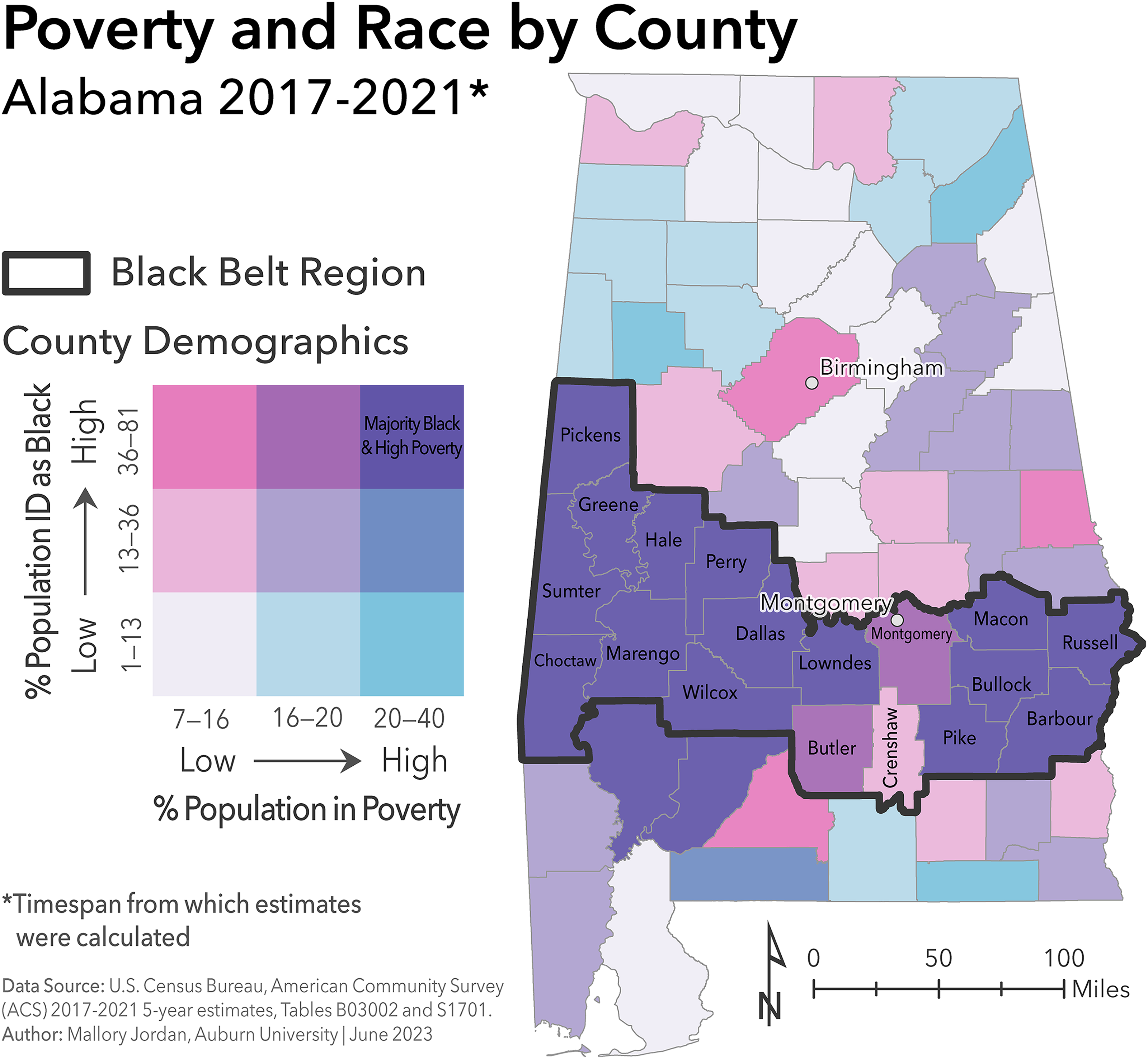
Poverty and Race by County in the Alabama Black Belt.
A poor region in a poor state, demographically, these counties are largely rural in character, with (1) a low population density (41% of the state average and 44% of the national average), (2) a low median household income (67% of the state average and 54% of the national average), (3) a low college graduate rate (64% of the state average and 51% of the national average), and (4) a high disability rate (33% above the state average and 75% above the national average) 10 . These and other problems in the region have stunted development and economic prosperity, resulting in a low (county) tax base (for education and infrastructure), a lack of job opportunities, poor education performance, and a general lack of wastewater infrastructure (sewer and functional onsite systems). Despite its challenges, the Black Belt, location of the Edmund Pettus Bridge, the Selma to Montgomery March, and the Montgomery bus boycott, has a proud history and culture as the birthplace of the U.S. civil rights and voting rights movements. In early 2023, President Biden signed the Alabama Black Belt National Heritage Area Act to recognize its unique history 11 .
WASTEWATER IN THE BLACK BELT
With the exception of relatively populous Montgomery County’s ∼90,000 households, wastewater management in the ∼128,000 primarily rural households in the other 17 counties is challenging. Centralized sewer collection and treatment systems are found only in a few small towns in the rest of the region. Wilcox County, for example, has two publicly owned treatment works (POTWs) serving ∼26% of the county’s residents in Camden (population 1,919) and Pine Hill (population 912). Nonetheless, recent research has shown that, even excluding Montgomery County, ∼50% of Black Belt residents are on centralized systems 12 . However, the centralized systems that service these small municipal areas (e.g., population of 10,000 or less) are more frequently in violation of discharge permits than centralized systems in the rest of the state 13 .
The remaining ∼63,000 households that are not connected to centralized systems must provide their own wastewater management onsite 14 . In many areas, soil conditions and costs make traditional onsite wastewater treatment (e.g., conventional septic systems) infeasible, resulting in raw wastewater on the ground surface—via either failing infiltration trenches/mounds or direct straight pipes from the homes 15 . The percentage of housing units with inadequate or failing OWTS is not precisely known, but it is substantial. A field survey of ∼700 rural homes in the Black Belt counties of Wilcox and Hale found ∼50% had raw sewage on the ground surface 16 . The estimated percentage of Black Belt housing units without any system at all (e.g., straight pipes) is likely variable from location to location, but can be as high as 45% 17 .
Negative publicity aside, numerous failing systems or straight pipes in the Black Belt potentially pose both environmental and public health risks. A 2017 study of 24 households in Lowndes County found that over 40% of residents’ stool samples tested positive for hookworm or other gastrointestinal pathogens 18 , although subsequent larger confirmatory studies have fortunately not found an association between sanitary conditions and the presence of enteric pathogens in children of the Black Belt. Nonetheless, raw sewage on the ground is still a concern, and, unfortunately, the problem is not easily rectified, as the cost of a functioning onsite wastewater system may be unaffordable for many households. A complete conventional system (septic tank and field lines) properly installed can cost $10,000 or more. Non-conventional systems, more appropriate for the Black Belt soils (e.g., mound systems), can cost $20,000 or more, likely above the means of most households in this region, which have an average median annual household income of $37,000. Programs to provide proper OWTS to families in economic need or to finance installations are clearly needed.
While the Alabama Department Public Health (ADPH) and the Alabama Department of Environmental Management (ADEM) permit and regulate wastewater management in Alabama, neither agency has the authority, nor the means, to directly provide wastewater management systems. ADEM does administer the Clean Water State Revolving Fund (CWSRF) program, whereby eligible recipients (typically wastewater utilities) can apply for low-interest loans for water infrastructure projects. Although most CWSRF funding goes to centralized wastewater treatment systems, the funding can, at least in principle, be used for decentralized systems as well 19 . Other U.S. government entities, such as the Environmental Protection Agency (EPA) and the Departments of Agriculture (USDA) and Housing and Urban Development (HUD), also have funding mechanisms that address wastewater infrastructure 20 . Unfortunately, most federal funding structures implicitly incorporate biases toward larger municipalities and conventional technologies that are not appropriate for small communities 21 .
Health and environmental concerns notwithstanding, wastewater infrastructure is key for economic prosperity and development. As with roads, electricity, and potable water, business and industry cannot thrive without functioning wastewater systems. Although improving sanitation in the Black Belt will not mitigate all the region’s challenges, it is difficult to foresee major economic growth without adequate wastewater infrastructure.
THE RIGHT TO SANITATION
Like so much else in Alabama, race also plays a role (Fig. 1), as the Black Belt is predominately Black (originally called the Black Belt because of the color of the soil, the title later took on a racial connotation as well 22 ). In labama, it is a misdemeanor “to build, maintain or use an insanitary sewage collection, treatment and disposal facility [including septic tanks]…that is or is likely to become a menace to the public health…” 23 . Individuals not in compliance have been cited by ADPH, which in a small number of instances has ultimately led to arrest 24 . Carrera and Flowers 25 argue that the heirs’ property system, whereby land ownership is divided among a large number of heirs, segregated and substandard housing, and public health enforcement have led to structural racism and sanitation inequity. Scott Harris, the State’s Public Health Officer, maintains that structural racism is at the root of the sanitation problem in the Black Belt 26 .
The recent implementation guidance for the Clean Water and Drinking Water State Revolving Funds approved in the Bipartisan Infrastructure Law reminded program managers that they have “…a responsibility to ensure that federal funds are not being used to subsidize discrimination based on race, color, or national origin” 27 . However, a recent complaint by the Southern Poverty Law Center on behalf of the Center for Rural Enterprise and Environmental Justice and the Natural Resources Defense Council alleges that Alabama’s implementation of the CWSRF funds both directly and indirectly does precisely that 28 . In response 29 , EPA is now investigating whether ADEM’s implementation of the CWSRF “…excludes from participation, denies benefits to, or subjects to discrimination, residents in the Black Belt region of Alabama, on the basis of race in violation of Title VI of the Civil Rights Act of 1964…,” a poignant and ironic development given the Black Belt’s pivotal role in the Civil Rights movement 30 .
Further, in November 2021, the U.S. Departments of Justice and Health and Human Services began investigating whether the ADPH was engaging in racial discrimination in violation of the Civil Rights Act and Patient Protection and Affordable Care Act in the way ADPH administers its onsite wastewater and infectious disease and outbreak programs in Lowndes County 31 . After noting that conventional disposal systems are often ineffective in the Black Belt, the investigation concluded that most Lowndes County residents do not have the means necessary to obtain, operate, and repair an onsite system. The investigation further identified areas of concern with ADPH’s current operations, including the enforcement of state laws that threaten and/or impose criminal and financial sanctions against such residents and ADPH’s insufficiency in informing residents of the resultant public health risks.
Although the investigation did not officially find, nor did ADPH admit to, any noncompliance with relevant federal laws, on May 3, 2023 the agencies entered into a voluntary agreement
32
in which ADPH agreed to:
Impose a moratorium on the enforcement of sanitation-related criminal and financial penalties, provided the residents i) respond to a planned ADPH sanitation survey, ii) submit an application for funding for an onsite system, and iii) confine any wastewater to their own property; Conduct a public health information campaign on the risks of exposure to raw sewage; Share relevant health information with area health care providers; Request technical assistance from the U.S. Center for Disease Control in assessing the risks of inadequate sanitation in the county. This public health assessment will include both the risks of onsite systems and failing centralized lagoon systems; Conduct a comprehensive site assessment for each residence; Develop a draft Public Health and Infrastructure Improvement Plan (PHIIP), including plans for obtaining state or federal funding and plans for implementing interim measures until permitted systems are installed; and Apply for any needed funding to meet the terms of the agreement.
The agreement will terminate three years from the date the PHIIP is approved, provided the federal government determines that ADPH has substantially complied with the terms of the agreement.
The agreement 33 is expansive: an individual who “does not have the means to install or repair an ADPH-permitted onsite wastewater system” includes any county resident or homeowner who i) lacks sufficient financial means, ii) lacks clear title to the property, or iii) has “other non-legal or non-financial factors/barriers that limit an individual’s ability to complete the process of obtaining a functioning, ADPH-permitted onsite wastewater system.” Further, under the agreement, the presumption is that any resident who does not currently have a permitted system meets these criteria. In effect, the responsibility for providing functioning wastewater systems has arguably shifted from the homeowners to the ADPH (i.e., a policy that recognizes “sanitation provision as an obligation of government” 34 ). Although laws governing water and sanitation are complex, the U.S. government does not explicitly recognize the human right to water as a civil right 35 , and the provision of sanitation has heretofore largely been largely a matter of individual responsibility 36 .
CONCLUSIONS
Although the wastewater challenges in the Alabama Black Belt are particularly acute, there are other communities in the United States with unfavorable soil and geological conditions coupled with financial challenges that prevent reliably accessing safely managed sanitation 37 , resulting in residents relying on cesspools, failing outhouses, bucket latrines, failing septic tank systems, open defecation, and other unsafe disposal methods 38 . Nationally, the U.S. government has launched the Justice40 initiative 39 and included specific language in recent legislature to designate resource set asides for disadvantaged communities 40 . The EPA has launched initiatives to address wastewater challenges throughout the country, including Closing America’s Wastewater Access Gap Community 41 , environmental justice grants 42 , and the EJScreen: Environmental Justice Screening and Mapping Tool 43 .
Nonetheless, few places face the challenges of the Alabama Black Belt due to its unique demographic, socioeconomic, historical, and geographic milieu. Fortunately, through a combination of negative publicity, state and local efforts, available funding, energized stakeholders, and the threat of federal government intervention, the challenges are being addressed, although much work remains. In particular, the threat of federal government intervention has arguably shifted the burden of providing sanitation to the State of Alabama in one county, at least presumptively. Meeting the terms of the agreement in Lowndes County alone will be a major effort. Although the agreement only covers Lowndes County at present, similar conditions exist in many of the other Black Belt counties. Addressing these problems in the entire region will require a herculean effort, but to the state’s credit, Alabama is attempting to do so. Of the $463 million ADEM awarded statewide for water and wastewater projects in 2022, 34% went to Black Belt counties whose residents make up less than 11% of the state’s population 44 .
To the best of our knowledge, this federal “mandate” (technically a voluntary agreement between the federal government and the state) is one of the most expansive and progressive sanitation-related federal actions in the United States. The proud and historic Alabama Black Belt is once again leading the country in the fight for another civil right—the right to adequate sanitation.
Footnotes
AUTHOR DISCLOSURE STATEMENT
This is an original piece of work, not published anywhere before. There is no conflict of interest in relation to the publication of this article.
FUNDING INFORMATION
The authors would like to thank the following for funding that made this work possible: USDA TAT-RWTS 00-69526, USEPA Cooperative Agreement MX-00D87019, the Richard Lounsbery Foundation, and Columbia World Projects “Transforming Wastewater Infrastructure in the United States.”