






Abstract

The Rosalind Franklin Society (RFS), in partnership with Mary Ann Liebert, Inc., publishers, enthusiastically congratulate our distinguished recipient of the 2023 annual
Lariah Edwards, Lubna Ahmed, Leslie Martinez, Sophia Huda, Bhavna Shamasunder, Jasmine A. McDonald, Robert Dubrow, Beaumont Morton, and Ami R. Zota, “Beauty Inside Out: Examining Beauty Product Use Among Diverse Women and Femme-Identifying Individuals in Northern Manhattan and South Bronx Through an Environmental Justice Framework,” Environmental Justice 16, no. 6 (December 2023): 449–460, https://doi.org/10.1089/env.2022.0053.
Abstract
The disproportionate use of chemical straighteners and skin lighteners by women of color is a growing public health concern given the link between product use and adverse health effects. Prior studies examined product use as an individual choice but neglected social-structural factors, which influence beauty perceptions and personal decisions around product use. We used a community-based participatory research approach to characterize product use by demographics and investigated how racialized beauty norms impact use among 297 women and femme-identifying individuals in Northern Manhattan and the South Bronx. Product use varied by race/ethnicity, nativity, and messaging from family and peers. Black respondents were more likely to ever use chemical straighteners than non-Black respondents (OR = 2.0; 95% CI = 1.2–3.2), as were respondents who heard that family members express a preference for straight hair compared with respondents whose family members expressed mixed preferences about hairstyles (OR = 2.0; 95% CI = 1.1–3.7). Compared with non-Asian respondents and respondents born in the United States, Asian respondents and respondents born in other countries, respectively, had threefold higher odds of ever using skin lighteners (Asian: OR = 3.2; 95% CI = 1.4–7.0; born in other countries: OR = 3.4; 95% CI = 1.9–6.1). Respondents’ perceptions that others believe straight hair or lighter skin confer benefits such as beauty, professionalism, or youth were associated with greater use of chemical straighteners and skin lighteners. These findings highlight the pervasiveness of racialized beauty norms and point to the need to reduce the demand for and sale of these products through community education, market-based strategies, and public policy.
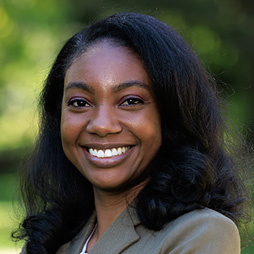
Biosketch
Dr. Lariah M. Edwards is an environmental health scientist with multidisciplinary training in molecular toxicology, environmental epidemiology, and exposure assessment related to environmental endocrine-disrupting chemicals and metabolic health. She earned her PhD in Environmental Health from Boston University School of Public Health and her B.S. in Chemistry from North Carolina Agricultural and Technical State University.
In her current role as an Associate Research Scientist at Columbia University’s Mailman School of Public Health, Dr. Edwards leads impactful environmental health projects addressing intersectional environmental justice issues. Her research focuses on understanding the health effects of endocrine-disrupting chemicals commonly found in consumer and personal care products and addressing exposure disparities.
Beyond her research endeavors, Dr. Edwards serves as the co-Deputy Director of the Community Engagement Core at the NIEHS Center for Environmental Health and Justice in Northern Manhattan, amplifying community involvement in research initiatives. Additionally, she serves as an Assistant Director for the Agents of Change in Environmental Justice program, actively shaping the next generation of environmental health and justice scientists.