







Abstract
In many countries, the method of choice in inspecting meat for Trichinella spiralis infection is artificial digestion. We conducted a study of the sensitivity of the artificial digestion method recommended by the International Commission on Trichinellosis for detecting T. spiralis larvae in meat and of the effect of modifications of some procedures used in the method on its sensitivity. As part of this, we evaluated the effects on larval recovery of the vessels used for larval settling, sieve sizes, and temperatures at which larvae passed through the sieves, using larvae from T. spiralis-infected mice. We observed the effects on larval recovery of digestion duration and of modified artificial digestion by using 10-g samples of infected mouse muscle alone or mixed with uninfected pork. The percentages of larvae recovered with the respective use of separatory funnels and conical cylinders were 51.20% and 98.70%. The rates of recovery of T. spiralis larvae at 4°C after passage through sieves of 425-μm mesh (No. 40), 250-μm mesh (No. 60), and 180-μm mesh (No. 80) were 98.42%, 90.59%, and 81.63%, which exceeded the 97.79%, 85.10%, and 61.12% rates of recovery of motile larvae at 40°C and the 95.12%, 78.60%, and 44.16% rates of recovery of dead larvae at 90°C. The larval recovery rate after digestion for 2 hours (96.18%) was greater than that after 0.5 hours (88.00%). We then examined a modified digestion method in which 10-g samples of pork mixed with 300 mL of digestive solution were digested for 2 hours at 43°C followed by chilling of digest solution to 4°C before passing it through a 425-μm mesh (No. 40) sieve and allowing it to settle in a 1-L conical cylinder. With this procedure, the modified method detected T. spiralis in samples of pork meat weighing 10 g and containing either 1 larva per gram or 0.1 larva per gram. Further validation of digestion method incorporating these modifications is required with the use of larger samples of infected muscle from species such as swine, which are routinely tested for T. spiralis for the purpose of food safety.
Introduction
The effective inspection of meat for Trichinella larvae is essential for ensuring food safety, meeting food-related regulations, and facilitating international trade. The technique of trichinelloscopy is a simple method that can be used in any laboratory or field setting. It is, however, a laborious and time-consuming method for inspecting the individual carcasses of food animals. Its sensitivity is lower than that of artificial digestion methods for detecting Trichinella larvae in meat from food animals (Forbes et al., 2003; Beck et al., 2005), and the larvae of nonencapsulated Trichinella spp. (e.g., T. pseudospiralis) are difficult to detect with trichinelloscopy because they are not contained within a thick collagen capsule. Consequently, trichinelloscopy is not recommended either by the International Commission on Trichinellosis (ICT) or the World Organization for Animal Health (OIE) for the routine examination for Trichinella in pork intended for human consumption. The principle on which the method of artificial digestion is based is the digestion of muscle tissue with an acidified pepsin solution to release live Trichinella larvae from this tissue, followed by direct miscroscopic observation of the released larvae. The method of artificial digestion is more sensitive, efficient, reliable, and cost-effective than trichinelloscopy. It allows the examination of a pooled sample of at least 1 g of muscle tissue weighing up to 100 g total, permitting a single assay to be used to test up to 100 carcasses (OIE, 2008). The artificial digestion method has therefore become the method of choice for the routine inspection of food-animal carcasses in most countries and is recommended for this purpose by the ICT, OIE, and EU (Gamble et al., 2000; Webster et al., 2006).
The theoretical sensitivity of the artificial digestion method is 1 Trichinella larva per gram (lpg) of muscle tissue, the minimum level of infection considered to be of concern for public health. However, because of nonuniform larval distribution and technical limitations, the actual sensitivity of the method is 3–5 lpg when examining the 1 g of meat sample (Gamble, 1998; Forbes and Gajadhar, 1999). Because this level of sensitivity could yield false-negative results for samples containing sufficient larvae to cause human Trichinella infection, the efficiency of the artificial digestion method is important for ensuring the accuracy of testing for Trichinella, meat safety, and public health. Optimization of some critical components of the assay may improve its sensitivity. We conducted a study of several of the factors affecting the sensitivity of the artificial digestion method, including the containers used for larval settling, the sieve size used in the method, the duration of sample digestion, and the temperature of the digestion mixture during the sieving process, with the goal of optimizing these factors.
Materials and Methods
Parasites and experimental animals
For the study, we used Trichinella spiralis obtained from domestic pigs in Nanyang city in Henan Province, China, maintained by serial passage in male Sprague–Dawley rats at 6- to 8-month intervals. For inoculation of the mice used in the study, we used muscle larvae of T. spiralis recovered from the infected rats at 42 days postinfection (dpi) by artificial digestion in pepsin–HCl, as described later. Six-week-old, specific pathogen-free male Kunming mice weighing 20–25 g each were used in the study. The mice were purchased from the Experimental Animal Center of Henan Province located in Zhengzhou city and were bred in plastic microisolator cages. One hundred twenty mice were randomly divided into three groups of 40 mice each. The mice in each group were inoculated orally with 300, 20, or 5 muscle larvae of T. spiralis, respectively (Cui et al., 2008). The infected mice were killed at 42 dpi by exposure to ether and cervical dislocation, and their carcasses were then skinned and eviscerated. The carcasses of mice infected with 300 T. spiralis larvae were digested by an artificial digestion solution of 0.33% pepsin–1% HCl at 43°C for 2 hours, as described later, and larvae were collected and used to determine how the vessels for larval settling and the sieves used for larval screening in the artificial digestion method affect the recovery of T. spiralis larvae. The diaphragms and foreleg muscles of mice, respectively, infected with 20 and 5 larvae were compressed between two glass slides until they became translucent. Compressed samples were examined for T. spiralis larvae using an Olympus microscope (Tokyo, Japan) with 40 × magnification. The larvae were enumerated and used to test the factors affecting the sensitivity of the artificial digestion method. Because of the limitations inherent in acquiring pigs naturally infected with Trichinella, hind leg muscle samples of Trichinella-free pig meat obtained from specific pathogen-free pork in supermarkets in Zhengzhou city and mixed with mouse muscle tissue containing encapsulated T. spiralis larvae were used in the study.
Standard artificial digestion method
The standard method of artificial digestion for detecting Trichinella larvae in meat was used in the study, with the magnetic stirring method recommended by the ICT for the mixing of meat samples with digestion fluid (Gamble et al., 2000). Briefly, meat samples were trimmed free of all fat and fascia and macerated several times in a blender at 5-second intervals until no visible pieces of meat remained. Samples of the macerate weighing 10 g each were mixed with 300 mL of digestion solution consisting of 0.33% pepsin (1:31,000 U.S. National Formulary) and 1.0% HCl in a ratio of 1:30 and were digested at 43°C for a minimum of 30 minutes. A magnetic spin-bar was used to provide continuous mixing during the digestion process. At the conclusion of the digestion process, the entire digest from the beaker was poured through a 180-μm mesh (No. 80) sieve into a 2-L separatory funnel, the beaker and sieve were rinsed with 100 mL of warm (37°C) water, and the digest was allowed to settle for 30 minutes. Samples of material remaining on the sieves were digested with freshly added digestion solution until no residue remained. A volume of 40 mL of the digest fluid was then drained from the funnel into a 50-mL glass centrifuge tube, where sedimentation was allowed for another 10 minutes, after which all but 10 mL of the fluid in the bottom of the tube was removed by aspiration, the 10 mL of fluid remaining in the tube was examined under a Olympus microscope with 40 × magnification, and larvae in the fluid were counted.
Modified digestion method
To validate the efficiency of the standard artificial digestion method for the inspection of meat for Trichinella larvae, and to improve the recovery of larvae, we modified some of the key procedures in the method and evaluated the results. In brief, we mixed 10-g samples of meat with 300 mL of digestion solution in a 500-mL conical glass beaker (Beijing Glass Instruments Factory, Beijing, China) for a 1:30 ratio of meat to digestion solution. Digestion was done for 2 hours at 43°C to ensure that no meat remained. At the conclusion of digestion, the digest was then kept at 4°C for 0.5 hours and the mixture was then chilled to 4°C and passed through a 425-μm mesh (No. 40) sieve and into a 1-L conical cylinder. The beaker and sieve were then rinsed with 100 mL of warm (37°C) water, which was added to the digestion mixture in the conical cylinder, where the mixture of digest and rinse water was allowed to sediment for 30 minutes. In lieu of infected pork, samples of T. spiralis-infected mouse muscle alone or mixed with normal pathogen-free pork were digested with the modified procedure. The remaining steps in the procedure were identical to those in the standard method of artificial digestion.
Factors affecting the sensitivity of artificial digestion
We also observed the effects on larval recovery of the glass beakers used in our modified artificial digestion method, using tap water containing T. spiralis larvae. The ICT recommends the use of separatory funnels for larval settling following the digestion of meat samples. To check the effects on larval settling of the vessels used in artificial digestion, we put naked T. spiralis larvae into tap water for our experiment. We counted and suspended about 100 muscle larvae of the organism in 100 mL of warm tap water at ∼37°C and poured this suspension either into a 1-L, pear-shaped glass separatory funnel with a glass stopcock (Beijing Glass Instruments Factory) or a 1-L glass conical cylinder (Beijing Glass Instruments Factory). The beakers that had contained the larvae were then rinsed with 100 mL of tap water, which was also decanted into either the separatory funnel or conical cylinder. After 30 minutes of sedimentation, 40 mL of fluid was drained from the funnel directly into a 50-mL centrifuge tube, while the uppermost fluid in the conical cylinder was carefully removed, and the remaining 40 mL and another 10 mL of water, used to rinse the conical cylinder, were transferred to another 50-mL centrifuge tube. The contents of each centrifuge tube were then allowed to settle for 10 minutes, after which all but 10 mL of the fluid in the bottom of the tube was removed by aspiration and the remaining fluid was examined under a microscope, with the larvae in the fluid being counted and the number of recovered larvae being expressed as a percentage of the total number of larvae. Following five replicate counts of larvae in the fluid from each tube, all of the glassware used in the procedure were washed extensively in hot water to ensure that no larvae remained. Ten replications each were done with the separatory-funnel and conical-cylinder techniques.
To study the effect of sieve size on larval recovery, we counted ∼100 muscle larvae of T. spiralis and placed them in 100 mL of tap water at either 4°C or 40°C for 10 minutes at each temperature, or at 90°C for 1 minute. As seen microscopically, the larvae kept at 4°C were coiled, those kept at 40°C were motile, and those killed by heating at 90°C had a fishhook or “C” shape. The tap water containing larvae was poured into a conical cylinder through prewetted, 8-cm-diameter brass sieves with 425-μm mesh (No. 40), 250-μm mesh (No. 60), and 180-μm mesh (No. 80). Each sieve was rinsed with 100 mL of tap water, the larval samples with the rinse water were allowed to settle for 30 minutes, and the larvae in the lowermost 30 mL of fluid were counted as described earlier. After replicate runs of this step, the sieves were washed with boiling water and then washed extensively with tap water and brushing, with the collected fluid then being examined to ensure that no larvae remained. The number of larvae recovered from each replicate was expressed as a percentage of the total number of larvae counted in each run of the procedure. For each combination of sieve size and larval treatment, the percentage of larvae recovered was averaged for comparison among the different treatments. Ten replications were done of each procedure.
To observe the effect of the duration of digestion on the digestion of samples and the larval recovery, we divided the diaphragms of mice infected with five larvae collected at 42 dpi into 30 samples of about 0.01 g each and examined each sample by trichinelloscopy and contained 10 larvae. Each sample was mixed with 9.99 g of pork to yield a final 10-g sample. The samples were then macerated in a blender and digested in 300 mL of digestion fluid for 0.5, 1, or 2 hours, respectively. At the conclusion of digestion, the digest was poured through a 180-μm mesh (No. 80) sieve into a conical cylinder, the beaker and sieve were rinsed with 100 mL of tap water, and the sample material recovered from the sieve was blotted dry and weighed.
Comparison of standard and modified artificial digestion methods for detecting Trichinella larvae in muscle tissue from mice with low-level infection
Muscles of mice experimentally infected with T. spiralis were used to compare the sensitivity of the standard and modified methods of artificial digestion for detecting Trichinella larvae in meat. For this part of the study, 10 mice infected with five T. spiralis larvae each were killed at 42 dpi, and their carcasses were then skinned, eviscerated, digested, and examined, respectively, with the standard and modified methods, as described earlier. Single 1-g pieces of foreleg muscle from each of 20 additional mice infected with five larvae per mouse were collected at 42 dpi and mixed with 9 g of normal pork, and the mixtures were digested with each of the two methods.
Sensitivity of the modified method for inspecting meat for Trichinella
To determine the sensitivity of the modified digestion method for inspecting meat for Trichinella, we cut the diaphragms taken at 42 dpi from the 20 infected mice into 10 samples of about 0.01 g each containing 10 encapsulated T. spiralis larvae, and 10 further samples of about 0.01 g each containing 1 encapsulated larva. The collective total of 110 encapsulated larvae in the samples was ascertained by trichinelloscopy. Each 0.01-g sample was mixed with 9.99 g of pork to yield 10-g final samples, which were digested with the standard and modified methods, respectively.
Statistical analysis
All statistical analyses of data were done with SPSS for Windows version 13.0 (SPSS, Inc., Chicago, IL), Quantitative variables were described (average and standard deviation [SD]). The effects on larval recovery of the different vessels and methods were compared with Student's t-test. The groups were compared among each other by the analysis of variance, and later the Student–Newman–Keuls test (q-test) was made for multiple comparisons. The Mann–Whitney U-test was used for the comparative assessment of the effect of duration of digestion on larval recovery data. The Spearman rank correlation (r) was used to find out correlation between the percentage of larvae recovered and the sieve mesh size (and the temperatures at which the digestion mixtures were sieved). The level of significance used was 5% (p < 0.05).
Results
The effects on larval recovery of the different vessels used in the modified artificial digestion method are shown in Table 1. The mean (±SD) percentages of larvae recovered with the use of a separatory funnel and conical cylinder were 51.20% ± 4.26% and 98.70% ± 1.56%, respectively. The percentage of larval recovery with the use of a conical cylinder was almost twice that with a separatory funnel, and the difference was statistically significant (t = 33.090; p < 0.05).
The mean (±SD) percentages of larval recovery with the various sieves used for filtration at each of the three different temperatures used in this part of the study (corresponding to the larval physical state) are shown in Figure 1, with the comparative statistical significance of these values shown in Tables 2 and 3. The differences among the tests with different sieves were significant at all three temperatures examined in the study: 4°C, 40°C, and 90°C (F 4 = 9.087, F 40 = 20.077, F 90 = 199.913, respectively; p < 0.05). At all three temperatures there was a highly significant positive correlation between the percentage of larvae recovered and the sieve mesh size (r 4 = 0.597, r 40 = 0.772, r 90 = 0.996; p < 0.01). Larval recovery showed an increasing trend with increasing sieve mesh size (F 4 = 16.121, F 40 = 40.059, F 90 = 398.640, respectively; p < 0.01). The differences in results of larval filtration at the three temperatures used were significantly different with 425-μm (No. 40), 250-μm (No. 60), and 180-μm (No. 80) sieves (F 40 = 89.538, F 60 = 664.529, F 80 = 261.998, respectively; p < 0.05), and there was a significant negative correlation between the percentage of larvae recovered and the temperatures at which the digestion mixtures were sieved (r 40 = −0.931, r 60 = −0.975, r 80 = −0.956 for the three sieve mesh sizes used, respectively; p < 0.01). Larval recovery showed an increasing trend with a decreasing temperature at which the digestion mixture was passed through the three mesh sizes of sieve used in the study (F 40 = 178.807, F 60 = 1288.365, F 80 = 503.226, respectively; p < 0.001).
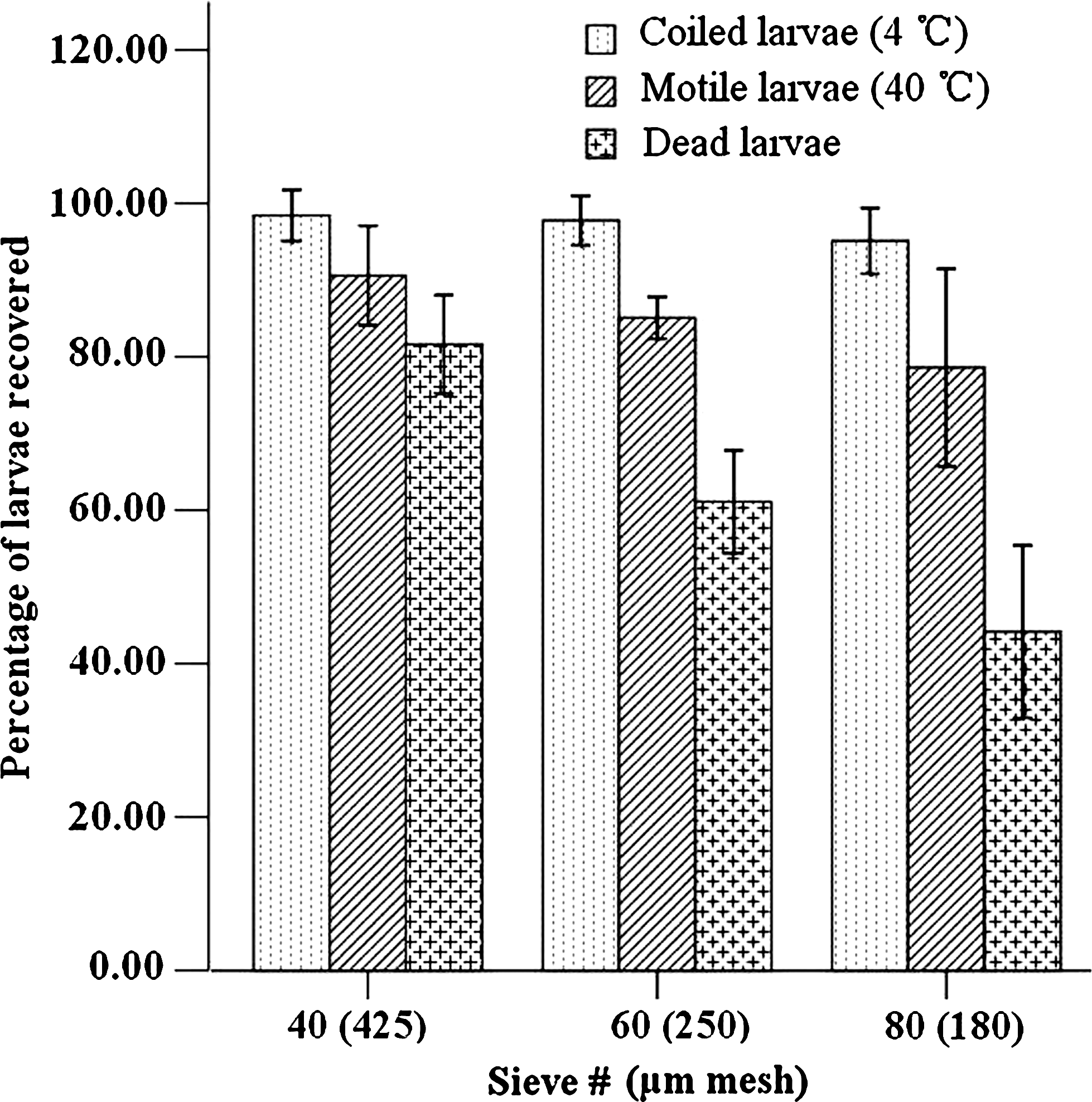
Comparison of the recovery of Trichinella spiralis muscle larvae after filtration through sieves of various sizes at 4°C (coiled larvae), 40°C (motile larvae), and 90°C (dead larvae). Values are expressed as means ± standard deviation for 10 replications per test.
The larval recovery data and the weights of the residual samples digested for 0.5, 1, and 2 hours are shown in Table 4. Differences in the weights of the 0.5-hour versus 1-hour and in the 1-hour versus 2-hour digests were not significant (U = 28.500, p > 0.05 and U = 42.000, p > 0.05, respectively), but the larval recovery following digestion for 2 hours was significantly greater than that following digestion for 0.5 hours (U = 24.000, p < 0.05).
Ten mouse carcasses infected with five T. spiralis muscle larvae each were digested at 42 dpi with the standard and modified methods, respectively. The mean (±SD) values of larval recovery from the carcasses digested with each method are shown in Table 5. Although the rate of detection of larvae from the infected carcasses was 100% with both the standard and modified methods, larval recovery with the modified method was significantly greater than with the standard method (t = 3.819, p < 0.01). The differences in larval recovery when the mixed samples consisting of 1 g of foreleg muscle from infected mice mixed with 9 g of normal pork were digested with each method are shown in Table 6 and were not significant in terms of either the rate of larval recovery or the rate of detection of larvae (t = 0.770, p > 0.05), despite a slightly greater rate of larval recovery with the modified method.
The mixed samples contained 1 g of foreleg muscle from mice infected with five T. spiralis larvae.
The sensitivity of larval recovery from the mixed samples of infected mouse muscle and normal pork with the modified artificial digestion method is shown in Table 7. The modified method detected T. spiralis larvae in meat samples containing both 1 and 0.1 lpg.
The mixed samples contained 9.99 g of normal pork and 0.01 g of mouse muscle with either 10 or 1 T. spiralis larvae.
lpg, larva per gram.
Discussion
The purpose of inspecting meat for Trichinella infection is to reliably detect larvae of the parasite in meat at levels capable of causing human trichinellosis. Several factors may affect the sensitivity of the artificial digestion method used for this purpose. Our results indicated that the use of conical cylinders for larval settling is more efficient for the recovery of larvae than are the separatory funnels used in the standard method of artificial digestion. The difference may be related to the ready trapping of larvae on the exposed surface of the stopcock of the separatory funnel between the drain hole through the stopcock and the drainage channel at the bottom of the separatory funnel. If both the diameter of the stopcock drain hole and the drainage channel of the funnel are small, the velocity of fluid flow through the funnel may be insufficient to move all of the larvae in a fluid sample out of the separatory funnel. The duration of digestion has an obvious effect on the accuracy of the method of artificial digestion for detecting Trichinella in meat, because the failure to completely digest meat samples containing larvae of the organism raises the risk of obtaining false-negative results. As shown in Table 4, the time needed for complete digestion of meat samples at 43°C was 2 hours; shorter periods of digestion resulted in the incomplete digestion of samples, leaving muscle fibers that interfered with the observation of T. spiralis larvae. Nevertheless, digestion may be terminated before 2 hours have passed if intact pieces of meat are no longer microscopically visible in a sample. When the same mesh-size sieve was used, the temperature of the digestion mixture determined the percentage of larval recovery following digestion. Larvae maintained at 4°C were more readily recovered from all three mesh-size sieves used in the study than were larvae maintained at 40°C, and motile larvae passed more easily through the sieves than did dead larvae. Larval recovery was most effective with larvae that were spirally coiled at 4°C. Beyond this, the largest sieve examined in the study, of 425-μm mesh size (No. 40), was significantly more effective than the two smaller mesh-size sieves, of 250-μm (No. 60) and 180-μm (No. 80), for the recovery of coiled (4°C), motile (40°C), and dead (90°C) larvae. These results differ to some extent from those of Gamble (1999), who found an insignificant difference in the recovery of T. spiralis larvae (Beltsville pig isolates) at 4°C and 40°C with a 180-μm (No. 80) sieve and a 355-μm (No. 45) sieve. The differences in our findings and those of Gamble (1999) may be related to the sieve mesh sizes and different T. spiralis isolates used in the two studies. A No. 40 sieve may be more efficient for the recovery of motile and dead larvae than a No. 45 sieve. Apart from sieve size, however, the relative proportions of spirally coiled or disc-like muscle larvae of different T. spiralis isolates at 4°C is different for different isolates of the organism (Shen et al., 2005; Zhao et al., 2007), resulting in dissimilar rates of larval recovery after filtration through sieves of various mesh sizes. Accordingly, sieves of larger mesh size and digestion mixtures of a lower temperature at the conclusion of digestion may increase larval recovery and the sensitivity of the artificial digestion method. The additional step of adding ice after digestion has been used in two of the artificial digestion methods (Methods IV and V) described in the Directives of the EU for the inspection of meat for Trichinella (European Economic Community, 1997; Webster et al., 2006), but it is not certain whether the larvae in the digestion mixture of the Trichinella infected meat were dead or alive at the conclusion of digestion, and whether reducing the temperature of the digestion mixture is by itself sufficient to cause the coiling of motile Trichinella larvae. However, the 180-μm mesh (No. 80) sieve used in the standard method could limit the recovery of larvae (especially dead larvae) and might consequently decrease the sensitivity of the standard method of artificial digestion. We suggest that sieves of the largest, 425-μm mesh size (No. 40) be used to ensure the optimal recovery of all larvae in artificial digestion methods for the inspection of meat for Trichinella.
Other factors, such as sample size, also affect the sensitivity of artificial digestion methods (Kapel et al., 2005). In an earlier study in which we used artificial digestion to examine 2-g samples of pork containing 1 and 2 lpg, the rates of larval detection were only 10% and 30%, respectively, and rose to 100% only with pork containing 3–5 lpg (Li et al., 2008). Gamble (1998) found that the artificial digestion of 5-g samples revealed infections with 1 lpg of tissue, but to increase the efficiency of inspection, countries with a lower prevalence of trichinellosis in swine commonly use 1-g samples of pork in a pooled-sample digestion process. The modified method of artificial digestion that we have described here detected T. spiralis larvae in all carcasses of mice infected with five larvae, with a significantly greater rate of larval recovery than that with the standard method. The modified method can detect larvae of T. spiralis at 1 and 0.1 lpg of meat, demonstrating that it has sufficient sensitivity for the inspection of small samples of meat.
The national criterion (GB/T18642-2002) act by the General Administration of Quality Supervision, Inspection, and Quarantine of the People's Republic of China (2002) requires that both trichinelloscopy and the artificial digestion method be used to inspect pork for Trichinella. Because trichinelloscopy is less sensitive than artificial digestion, and does not detect larvae of T. pseudospiralis, the ICT, OIE, and EU do not recommend it as a reliable test for inspecting food-animal carcasses intended for human consumption for the presence of Trichinella (OIE, 2008; Gajadhar et al., 2009). Accordingly, the Chinese national criterion for the inspection of pork for Trichinella should be revised, and freshly chilled pork for export must also be inspected with this revised method.
Footnotes
Acknowledgments
This work was supported by a grant (no. 2010CB530000) from the National Basic Research Program of China, a grant (no. 30972492) from the National Natural Science Foundation of China, and a grant (no. 2008-145) from the Major Public Research Project of Henan Province.
Disclosure Statement
No competing financial interests exist.