







Abstract
Enterococci are Gram-positive, facultative anaerobic cocci. They are found in many environments (including milk and dairy products, vegetables, plants, cereals, and meats). Enterococci are considered commensal organisms, but can also be opportunistic pathogens associated with morbidity and mortality of humans and animals. A longitudinal study of antibiotic resistance of Enterococcus to ampicillin, erythromycin, and tetracycline was conducted on an academic teaching farm. Environmental samples were collected by drag swabs at select locations prior to and after the introduction of livestock. All samples were initially processed and screened with specialized media, and then replica plated on tryptic soy agar containing a predetermined amount of antibiotic. There was some variation in the quantity of bacterial and antibiotic-resistant colonies; however, resistance to tetracycline was extremely high. The increases of too numerous to count populations were not time-dependent and appeared consistently after the placement of cows. There is little information on the prevalence and epidemiology of antibiotic resistance of Enterococci outside of the hospital setting, including on dairy farms. Longitudinal studies are important in providing insight into the dynamics of establishment and proliferation of bacteria and of antibiotic resistance.
Introduction
E
Enterococci are considered commensal organisms in humans, but can also be opportunistic pathogens associated with significant morbidity and mortality (Marrow et al., 2009). They typically cause infections in patients who have severe underlying disease, are immunocompromised, or are elderly (Garcia-Migura et al., 2007; Ogier et al., 2008). In addition, enterococci can cause many economically important veterinary diseases such as bovine mastitis and diarrhea (Gilmore, 2002; Petersson-Wolfe et al., 2007). The role that non-human sources and reservoirs other than hospitalized patients may play in the spread of Enterococcus is controversial and poorly understood (Hershberger et al., 2005). The epidemiology of Enterococcus in bovine mastitis has not been totally clarified, but enterococci are generally associated with infections related to poor hygiene (Gilmore, 2002).
There have been numerous studies of the presence of enterococci on cattle farms, such as in manure (Klein et al., 2011), water (Soupir et al., 2010), and feed (Pradhan et al., 2009), as well as in bedding (Godden et al., 2008) and on the animals themselves (e.g., on hides and in mammary glands) (Fluckey et al., 2009; Petersson-Wolfe et al., 2007). However, to our knowledge, prior to 2011 (Shipp and Dickson, 2011), there have been no longitudinal studies published regarding relocating dairy cattle to previously unused farm land. Longitudinal studies are those that collect data from the same sample elements (such as location) on multiple occasions over time (Lynn, 2009). In addition, there are few studies regarding the establishment and proliferation of antibiotic-resistant enterococci in farm environments (Esiobu et al., 2002; Walczak and Xu, 2011).
In this article, we present the results of a longitudinal study on the Iowa State University's Dairy/Animal Science Education Facility (henceforth referred to as the “ISU Dairy Farm”) regarding the establishment and spread of antibiotic resistance. The study aimed to provide insight into the epidemiology of Enterococcus (and other bacteria of importance to food safety) in dairy farm environments.
Methods
The ISU Dairy Farm is located on an 887-acre site, 3 miles south of ISU's central campus. The farm houses 450 milking cows, plus a similar number of heifers, dry cows, and calves. A complex of buildings was constructed on 27 acres of land, including a free-stall barn, maternity barn, and a calf research barn for nutrition and husbandry research. The land the ISU Dairy Farm now occupies was donated to the university. The farm had been recreational, and no livestock had ever been introduced. Experiments were conducted to review antibiotic resistance of enterococci specifically resistant to ampicillin, erythromycin, and tetracycline before and after the placement of livestock.
Environmental samples were collected at selected locations on the ISU Dairy Farm on two occasions before the introduction of livestock in order to determine initial antibiotic resistance in the enterococci occurring in such samples (if any) (Table 1). Additionally, sampling took place on five occasions after cattle placement (Table 1). All sampling was conducted in monthly intervals during the morning hours (beginning at 9:00 AM Central Standard Time). A total of 140 drag swabs were processed in this study; one swab was used for each sampling location for a total of 20 drag swabs per sampling date (Fig. 1) and seven sampling dates/groups in total (A–G, Table 1).
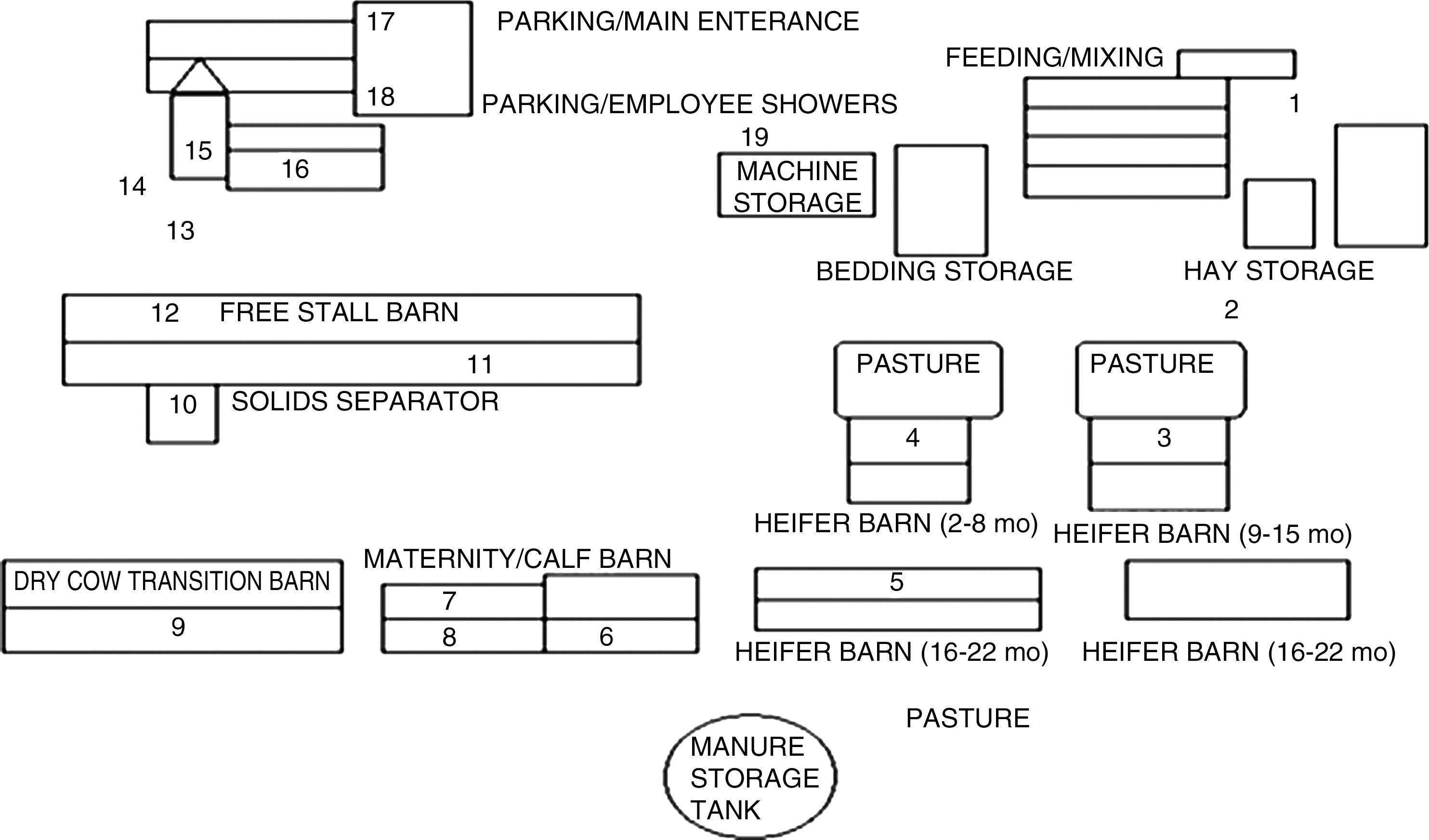
Diagram of sampling locations at the Iowa State University Dairy/Animal Science Education and Discovery Facility. (1) Feed Storage Area (FSA); (2) Open Field NE (OF); (3) Heifer Barn 9–15 months (H9); (4) Heifer Barn 2–8 months (H2); (5) Heifer Barn 16–22 months (H16); (6) Maternity/Calf Barn (MC 6); (7) Maternity/Calf Barn (MC 7); (8) Maternity/Calf Barn (MC 8); (9) Dry Cow/Transition Barn (DC); (10) Solids Separator (SS); (11) Free Stall Barn (FS11); (12) Free Stall Barn (FS12); (13) Free Stall Barn Walkway (FW); (14) Holding Area Walkway (HW); (15) Holding Area/Milking (HM); (16) Special Needs/Hospital Barn (SH); (17) Parking Main Entrance (PM); (18) Parking/Employee Showers (PS); (19) Equipment Storage (ES); (20) Machine Storage Area (MS).
During sampling, one sterile 3 cm×3 cm drag swab moistened with 10 mL of skim milk (Solar Biologics, Ogdensburg, NY) was used per sample. Briefly, a drag swab was pulled through the environment for 60 s at normal walking pace (approximately 6.7 m). Care was taken to obtain samples in the same locations during subsequent sampling periods. Each drag swab was placed in a sterile bag and stored in a container kept at 4°C. After collection, samples were taken to the laboratory and immediately processed. Each drag swab was aseptically added to a sterile Whirl Pack 24 oz/720 mL homogenizer bag (Nasco, Fork Atkinson, WI) containing 10 mL of buffered peptone water (BPW; Difco, Becton Dickinson Company, Sparks, MD) to moisten sample for pipetting. The sample was homogenized for 45 s at 250 rpm (Seward 400 Circulator Stomacher; Seward Laboratory Services, Bohemia, NY). One milliliter of sample was then added to a tube containing 9 mL of BPW creating a diluent concentration of 10−1. The samples were serially diluted until a concentration of 10−5 was reached. The 10−3 and the 10−5 dilutions were plated on Enterococcosel agar (Becton Dickinson Company, Sparks, MD). Plates were incubated for 48 h at 37°C.
Resistance to antibiotics was investigated over time via replica plating (Natarajan et al., 2007; Osterblad et al., 1995). Colonies from the 10−3 and 10−5 Enterococcosel plates were replica plated (using a replica plating cylinder covered with sterile velvet) onto tryptic soy agar (TSA) (Becton Dickinson Company, Sparks, MD) containing ampicillin (48 μg/mL; Sigma, St. Louis, MO), erythromycin (48 μg/mL; Sigma), and tetracycline (24 μg/mL; MP Biomedicals, Solon, OH); these quantities were at least 1.5 times the concentrations recommended by the National Antimicrobial Resistance Monitoring System (NARMS) (Gilmore, 2002). All TSA plates were prepared using the guidelines of the Clinical and Laboratory Standards Institute (CLSI) (Wilker, 2007) and refrigerated 1–2 weeks before sampling was carried out. Data were analyzed by EpiInfo (version 3.5), a public domain program created by the Centers for Disease Control and Prevention's PulseNet Program (Atlanta, GA).
Medications used to treat conditions such as mastitis, diarrhea, and upper respiratory infections were prescribed by an ISU faculty veterinarian who disclosed uses and doses given. Sick cattle were treated individually. Additionally, a detailed protocol was strictly followed by the ISU Dairy Farm staff. BAC-STOP udder predip dip (Esteam Manufacturing Ltd., Calgary, Alberta, Canada) and Transcend udder post dip (IBA, Millbury, MA) were used prior to and after milking. FC-98 Udder Wash (IBA) was also used throughout the farm as a boot sanitizer.
Results
When assessing sampling dates and antibiotic resistance (Table 1, A–G), the number of colony-forming units (CFU) growing on 10−3 and 10−5 TSA plates containing varying amounts of ampicillin, erythromycin, and tetracycline were as shown in Table 2. The number and percentages of bacterial CFU detected on Enterococcosel plates varied (e.g., in the 10−3 plates, there were increases in farm groups A–E and a noticeable decrease in groups F and G). In TSA antibiotic-resistance plates, there was also variation; however, resistance to tetracycline in both the 10−3 and 10−5 plates was extremely high.
Data not shown, minimal/no CFU detected; total CFU, CFU counted on Enterococcosel plates; CFU resistance, grown on TSA with specified antibiotic (10−3 and 10−5 concentrations); percentages, percent of resistant colonies.
We also reviewed trends regarding too numerous to count (TNTC) locations on the ISU Dairy Farm. Table 3 depicts where TNTC Enterococcosel plates were found (farm location and farm number). Prior to the introduction of dairy cattle, no TNTC locations were detected. However, after dairy cattle were introduced, TNTC locations were consistent throughout the study (from six to eight TNTC plates/locations) detected.
Example: Date C, Location 2, Sampled on January 27, 2008; open field NE.
Discussion
In this longitudinal study, the numbers and percentage of bacterial CFU varied. However, antibiotic-resistant CFU increased as cattle were placed at the facility; this is to be expected since many bacterial organisms (including pathogens) originate in the ruminant intestinal tract (Lefebvre et al., 2006; Oliver et al., 2005; Pradhan et al., 2009). It is important to note that, in this study, antibiotic-resistant Enterococcus grew on TSA plates containing extremely high levels of ampicillin (48 μg/mL), erythromycin (48 μg/mL), and tetracycline (24 μg/mL)—much higher than the amount deemed resistant by CLSI. In addition, there were enterococci present that were multi-drug resistant. In the 10−3 dilutions plated on antibiotic-containing TSA, 25 out of 38 (66%) of plates were multi-drug resistant; of those 25 antibiotic-resistant plates, 18 (72%) exhibited resistance to erythromycin and tetracycline. In the 10−5 dilutions plated on antibiotic-containing TSA, 19 of 25 plates (76%) were multi-drug resistant. Nine of those plates (26%) demonstrated ampicillin and tetracycline resistance. This is significant because multi-drug resistance is becoming more prevalent (French, 2008) and is compromising the treatment of disease in both humans and animals (Leclercq, 2009; Sawant et al., 2007).
In Table 3, TNTC Enterococcosel plates by farm locations are diagrammed. In locations A and B (before dairy cattle placement), there were no TNTC plates (farm locations) detected. However, immediately after the placement of cattle, TNTC plates (farm locations) were detected. The numbers of TNTC plates were consistent throughout the sampling periods: C (n=8); D and G (n=7); and E and F (n=6). Since the TNTC Enterococcosel plates could not be replicated on antibiotic-containing TSA, the actual numbers of bacterial CFU and the antibiotic resistant profiles (derived from antibiotic-containing plates) are likely much higher and more extensive.
One limitation of this study is that slight differences in making specialized media (e.g., concentration of powdered agar mix, length of time autoclaving) could have influenced microbial counts. Additionally, this study took place over a 9-month period, but it would have been better to continue sampling over a longer period of time. Measures based on long-term data collection would be more useful in devising strategies to limit the spread of resistant infectious bacterial organisms in farming environments (Burgos et al., 2005).
Conclusion
There is little information on the prevalence and epidemiology of antimicrobial resistance in Enterococci outside the hospital setting, including on dairy farms (Hershberger et al., 2005). However, there have been many studies of antibiotic resistance of enterococci in food items such as cheeses, meats, and fermented foods (Teuber et al., 1999). Increased resistance of enterococci in foods is of interest because the ability of these organisms to infect immunocompromised hosts and cause serious medical conditions in humans (Teuber et al., 1999). In dairy cows, animals that develop diseases such as mastitis and post-parturient disease may become chronically infected and be sent to slaughter prematurely (Makovec and Ruegg, 2003; Sischo, 2006). The lack of surveillance data is especially evident in important agricultural environments such as dairy farms (Burgos et al., 2005). When completing a literature review concerning Enterococcus resistance in a new dairy farm environment (analysis of bacteria prior to, and after placement of dairy cattle), no information was found at the time of this writing. To our knowledge, this is the second study of the establishment and proliferation of bacteria (and antibiotic resistance) before and after the introduction of production livestock on previously unused farm land. As noted, the first was conducted in our laboratory (Shipp and Dickson, 2011).
While there may be an abundance of information regarding treatment of conditions in dairy cattle such as mastitis and post-parturient disease (DeGaris and Lean, 2008; Petersson-Wolfe et al., 2008; Sischo, 2006; Zhao and Lacasse, 2008), the role that non-human sources and reservoirs (other than hospitalized patients) may play in the spread of Enterococcus is controversial and poorly understood (Hershberger et al., 2005). Most antimicrobial studies have focused on bacteria such as Salmonella, enterotoxigenic Escherichia coli, and bacteria isolated from clinical cases (Sawant et al., 2007). While there are studies that question the risks of using antibiotics in animal production (Cox et al., 2009; Wilhelm et al., 2009), the general consensus is that increased surveillance of bacteria (such as Enterococcus) and compliance with appropriate use of antibiotics would be beneficial to human and animal health (Allerberger and Mittermayer, 2008; Cox et al., 2009; Prescott, 2008). Minimizing antibiotic resistance requires a multidisciplinary approach (French, 2008). Efforts such as creating new antibiotics (Leclercq, 2009), conducting research to minimize bacterial infections in livestock and in humans (Anderson et al., 2008; Chingwaru et al., 2003; Makovec and Ruegg, 2003), improving diagnostic skills of laboratory workers (Emori and Gaynes, 1993; Hageman et al., 2003), using antibiotics in a responsible (or “prudent”) fashion (Prescott, 2008), and better farm management (Sischo, 2006) would be helpful in addressing the issue of antibiotic resistance among humans and animals.
Footnotes
Acknowledgments
We thank Kay Christiansen, Joe Detrick, Bruce Leuschen, D.V.M., and Leo Timms, Ph.D., for their assistance.
Disclosure Statement
No competing financial interests exist.