







Abstract
In October 2018, bongkrekic acid (BKA) poisoning cases caused by consuming wet rice noodles contaminated with Burkholderia gladioli were first reported in Guangdong Province, resulting in three cases, and two of them died. Due to the high fatality rate, the Guangdong Health Commission issued a code. The core risk-control elements of the code were storage temperature and storage time management, and the storage time is controlled through adopting a small sealed package with a clearly labeled production date and shelf life. In this study, we followed up on the code’s implementation and compared the incidence of related foodborne diseases before and after the implementation of the code. Due to the rarity of B. gladioli contamination, monitoring its prevalence directly was challenging. Therefore, we also assessed the levels of B. cereus, a more common foodborne pathogen in wet rice noodles, to infer trends in microbial contamination. Then the feasible and effective measures to control BKA poisoning caused by wet rice noodles were analyzed. A questionnaire survey revealed that the implementation rate of packaging management—utilizing complete independent small sealed package with clearly marked shelf life to control storage duration—reached 81.25%. However, the adoption rate of cold storage management was only 41.96%. The annual average number of BKA poisoning cases in Guangdong Province dropped from 6.25 before implementing the code to 0.5 after implementing the code. The detection rate of B. gladioli and B. cereus in the samples decreased from 1.56% (1/64) to 0.45% (1/220) and 42.26% (71/168) to 5% (11/220), respectively. The reduction of B. gladioli and B. cereus may reflect the improvement in microbial status. This study indicated that although the storage temperature control was not ideal, controlling the storage time through adopting a complete independent small sealed package with a clearly marked shelf life could still effectively mitigate BKA poisoning caused by wet rice noodles.
Introduction
Wet rice noodles are one of the traditional foods of Guangdong province and are indispensable parts of the Guangdong province diet industry. However, the wet rice noodles have become popular worldwide. A previous study indicated that the size of the rice noodle market in Europe and Asia Pacific was estimated to increase from USD 1.7 billion in 2014 to USD 3.6 billion in 2022. (Mohammadi et al., 2024) The production of wet rice noodles includes soaking the raw materials and grinding, heating, molding, cooling, drying, and packaging (Li et al., 2021). Despite their optimal nutritional profile and high moisture content, wet rice noodle products are prone to spoilage and microbial contamination, which is one of the primary factors compromising their quality and safety. (Lin et al., 2015; Zhang et al., 2024).
Common pathogenic bacteria that cause foodborne diseases induced by wet rice noodles are Bacillus cereus, Staphylococcus aureus, and Burkholderia gladioli (Zhang et al., 2024; Lin et al., 2015). The prognosis for foodborne illnesses caused by Bacillus cereus and Staphylococcus aureus is generally favorable. However, bongkrekic acid (BKA), which is produced by B. gladioli pathovar cocovenenans, could cause serious damage to the liver, kidney, heart, brain, and other important organs (Anwar et al., 2017). The fatality rate can be as high as 40% to 60% (Han et al., 2023).
In October 2018, a family poisoned by BKA, which was suspected to have been caused by the consumption of expired wet rice noodles, was reported in Guangdong Province, China (Li et al., 2019). Since then, BKA poisoning caused by the consumption of wet rice noodles attracted the attention of regulatory authorities (Chen et al., 2022; Wang et al., 2019; Shi et al., 2019; Li et al., 2019). More recently, in March 2024, fatal cases of BKA poisoning linked to the consumption of wet rice noodles (Kway Teow) were reported in Taipei (Lai et al., 2024). BKA, which is produced by B. gladioli pathovar cocovenenans, is flavorless, odorless, colorless, thermally stable, and highly unsaturated methoxy tricarboxylic acid (Han et al., 2023). The contaminated wet rice noodles are misunderstood by consumers as still edible, thus increasing the risk of BKA poisoning. Victims of BKA poisoning typically experience gastrointestinal symptoms and are diagnosed with liver failure and acute kidney damage (Shi et al., 2019). Since 1975, over 3000 cases of BKA toxication have been officially documented with a remarkably high case-fatality rate from 40% to 60% (Han et al., 2023). Given the severity of BKA poisoning and its high fatality rate, it is crucial to implement effective measures to control contamination of wet rice noodles with BKA.
Based on an analysis of key risk points of microbial contamination, the Health Commission of Guangdong Province issued the local food safety standard “Hygienic Code for Processing and Operation of Wet Rice Noodles” (DBS 44/017-2021) in December 2021. This code outlines regulations for various stages, including raw material, processing, storage, packaging delivery, and marketing. In this study, we evaluated the impact of the code on the microbial contamination levels in wet rice noodles and its influence on BKA poisoning cases associated with wet rice noodles in Guangdong province. In addition, we conducted a survey to evaluate the implementation of the code by manufacturers and explored practical and effective control measures to mitigate the risk of BKA poisoning caused by wet rice noodles.
Method
Implementation of the hygienic code
In order to develop hygienic standards for the production and operation of wet rice noodles, we investigated the production process of wet rice noodles, developed a whole-chain monitoring plan, and carried out an analysis of key risk points for microbial contamination. The results showed that the primary factors affecting microbial contamination levels in wet rice noodles were the storage temperature and time from sale to consumption. Based on these findings, the local government formulated a hygienic standard for the production and operation of wet rice noodles.
The content of the standard mainly involves the production and processing stages, as well as storage and sales practices. The core risk-control elements of the code focus on cold storage and storage time management. The storage time is controlled through packaging management. Specific provisions are as follows:
Temperature Control: For products with a shelf life exceeding 24 h, the storage and sales temperature must be lower than 10°C. Packaging Management: Products must be packaged in small, fully sealed, independent units with clear labeling of the production date and shelf life. This packaging approach aims to reduce the storage time from sale to consumption, while clear labeling of the production date and shelf life ensures consumers eat the product within its safe consumption period. Post-Sterilization Products: For products using post-sterilization process, transportation, storage, and sales temperatures should be determined based on scientific evidence.
Data collection
Questionnaire survey
A questionnaire survey was conducted to assess the implementation of the code. The contents of the questionnaire included the basic information of the interviewees, the production status of the manufacturer, and their knowledge and implementation of the code. Implementation-related items were divided into five parts: raw material management, personnel management, hygiene management, packaging management, and storage management. After drafting the initial version of the questionnaire, four experts were invited to review and revise it to ensure clarity and conciseness. The questionnaire was further refined and validated through pre-survey interviews with four manufacturers. Study participants were selected from Guangzhou, Shenzhen, and Dongguan using random sampling. A total of 115 managers from manufacturers were invited to take part in the survey, and 112 manufacturers completed the questionnaire.
Disease surveillance
From 2018 to 2023, cases and deaths of BKA poisoning caused by the consumption of wet rice noodles in Guangdong Province were monitored through the National Foodborne Disease Surveillance System. The surveillance system has been in operation for more than 10 years since 2010 and involves over 2000 medical institutions in Guangdong Province responsible for diagnosing and treating foodborne diseases. The system covers all prefecture-level cities and districts in Guangdong Province, ensuring comprehensive data collection.
Samples
Wet rice noodles were collected from May 2020 to November 2021 and April 2022 to March 2023 before and after, respectively, the implementation of the local food safety standard “Hygienic Code for Processing and Operation of Wet Rice Noodles “(DBS 44/017–2021). Samples were collected in the marketing phase from three districts of Guangdong Province, such as Guangzhou, Shenzhen, and Dongguan. These regions were the most populated region in the province. All collected samples were products that are normally sold and within their shelf life. Each sample weighed 1 kg and was transported to the laboratory at 4°C, with testing conducted within 24 h. B. gladioli and B. cereus in samples were tested according to the method of the National Standard for Food Safety. The quantitative detection method was used for B. cereus, with a detection limit of 1 log colony-forming unit (CFU)/g. For B. gladioli, the method was qualitative detection.
Data analysis
Descriptive statistics were used to analyze the implementation of the intervention strategies. The effect of the code was assessed by comparing data before and after its implementation, focusing on disease surveillance and microbial contamination levels in wet rice noodles.
Disease surveillance
The number of cases and deaths caused by wet rice noodles were the primary outcomes to evaluate the effect on the intervention strategies. Descriptive statistics and t-tests were used to analyze the data.
Survey of microbial contamination in wet rice noodles
Descriptive statistics and chi-square test (or Fisher’s exact test, if the conditions for the chi-square test were not met) were used to analyze the detection rates of B. gladioli and B. cereus in the samples. For B. cereus-positive samples, the range and average level were also analyzed.
Results
Implementation of the code
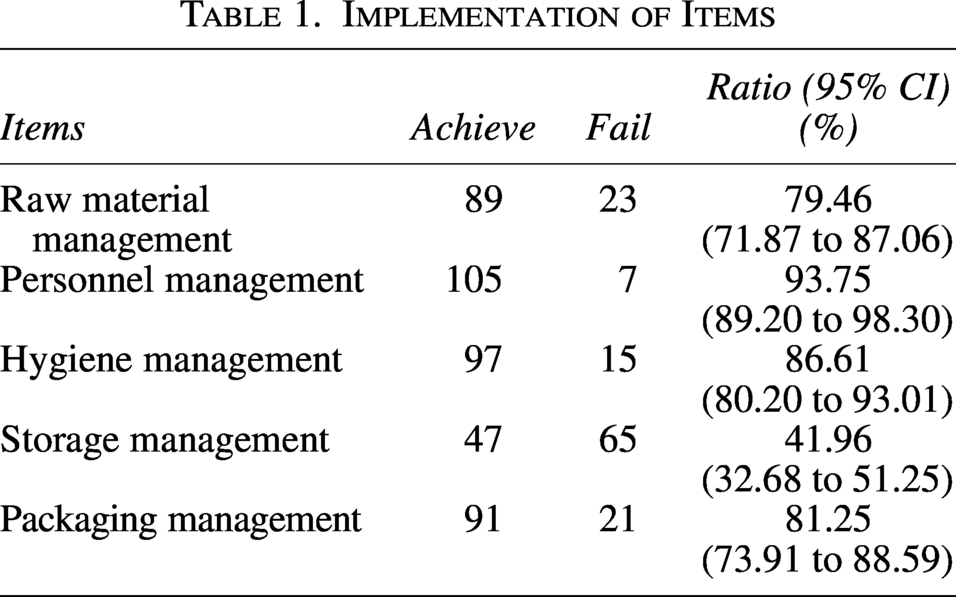
From May to July 2023, a questionnaire survey was conducted among 112 wet rice noodle manufacturers in Guangdong Province. The results indicated strong implementation of the code across most areas, except for cold storage. The implementation rates (with 95% confidence intervals) for raw material management, personnel management, hygiene management, and packaging management were 79.46% (71.87% to 87.06%), 93.75% (89.20% to 98.30%), 86.61% (80.20% to 93.01%), and 81.25% (73.91% to 88.59%), respectively. Cold storage had the lowest implementation rate at 41.96% (32.68% to 51.25%). Detailed results are presented in Table 1.
Implementation of Items
In addition, 16 of the 112 manufacturers were selected for on-site investigation. Of the 16 manufacturers in this survey, packaging management was well-implemented. All products were sealed and clearly labeled with production dates and shelf-life information. Only one did not carry the warning “Do not eat after the expiration date,” and 3 manufacturers included the warning but did not emphasize it in bold text.
In terms of storage temperature, the code specifies that products with a shelf life exceeding 24 h need to be stored below 10°C. For products using post-sterilization processes, transportation, storage, and sales temperatures can be adjusted based on scientific evidence to ensure food safety. All of the 16 manufacturers did not choose cold chain storage. Among them, 15 manufacturers labeled their products with a shelf life of less than 24 h and stored them at room temperature. One manufacturer used post-sterilization process, labeling their products with a 48-h shelf life and storing them at room temperature, which complied with the code. Communication with manufacturers revealed several reasons for avoiding cold storage. Firstly, the high-water content of wet rice noodles would accelerate product deterioration if refrigeration is not maintained throughout the production-to-consumption chain. Secondly, noodles can break easily after refrigeration and rewarming. Thirdly, cold storage also increases costs.
Disease surveillance before and after the implementation of the code
Between 2018 and 2023, Guangdong Province reported 7 incidents of BKA poisoning induced by wet rice noodles. Twenty-six cases were reported. Ten of these patients died, and all the deaths occurred before the implementation of the code. The average annual number of cases dropped from 6.25 (range 0–13; total 25 cases) during 2018–2021 to 0.5 (range 0–1; total 1 cases) during 2022–2023. However, the difference was not significant and may have been due to the small sample size (p = 0.241). The average annual number of deaths dropped from 2.5 (range 0–5; total 10 cases) to 0 (total 0 cases) (p = 0.127; Fig. 1).
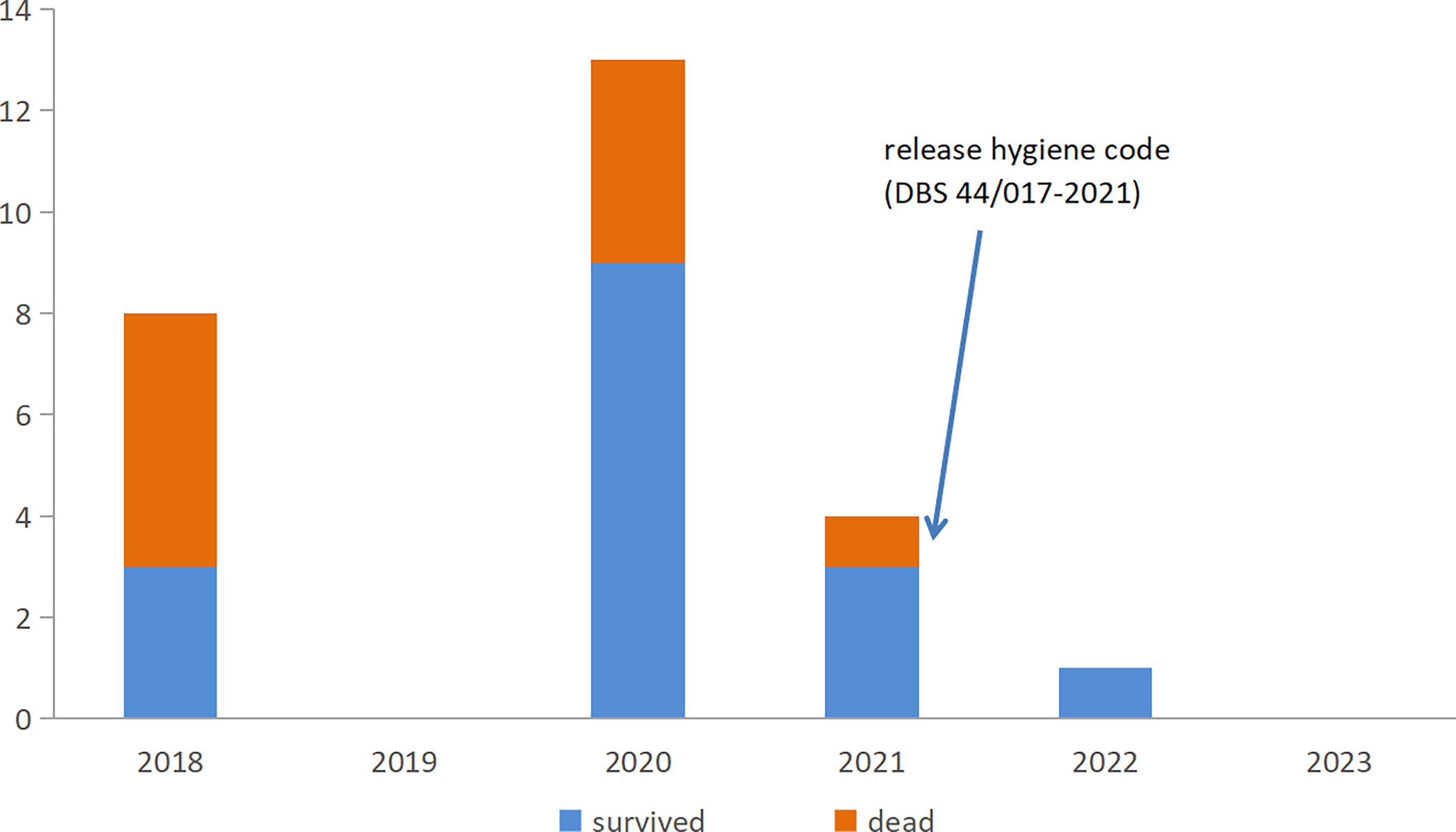
Wet rice noodles induced bongkrekic acid poisoning cases and deaths, by year, Guangdong Province, 2018–2023. Arrow indicates the enactment of the code.
Contamination levels of B. gladioli and B. cereus in wet rice noodles
Qualitative detection of B. gladioli in food samples
Before the code’s implementation, the detection rate of B. gladioli in samples was 1.56% (1/64), compared with 0.45% (1/220) after implementation. The difference was not statistically significant. (Fisher’s exact test, p = 0.401).
Contamination level of B. cereus in food samples
Before the code’s implementation, the detection rate of B. cereus in samples was 42.26% (71/168), which dropped to 5% (11/220) after implementation. The difference was statistically significant (χ2 = 79.35, p < 0.001).
In positive samples, the count range of B. cereus before implementation was 1 to 6.32 log CFU/g (geometric mean: 2.91 log CFU/g). After implementation of the code, the range decreased to 1 to 4.38 log CFU/g (geometric mean: 2.44 log CFU/g).
Discussion
Because of the high mortality rate associated with BKA poisoning, it is particularly important to control the BKA contamination in food. Through the Foodborne Disease Surveillance System, only one case of BKA poisoning caused by consumption of wet rice noodles was reported in rural areas after the implementing of the code. Both the number of cases and deaths decreased a lot, indicating that the code has contributed to improved food safety and risk management. The detection rate of B. gladioli in the samples also decreased a lot, although the difference was not statistically significant. This is likely due to the rarity of B. gladioli contamination, making it difficult to observe a clear downward trend. Besides, we monitored B. cereus contamination. The detection rate and contamination levels of B. cereus in wet rice noodles also decreased, further demonstrating the code’s effectiveness in reducing microbial contamination.
The core risk-control elements of the code focus on cold storage and packaging management. Results from the questionnaire survey indicated that it was difficult to implement the cold storage requirements as stated in the code. Most manufacturers adopted small, sealed packaging with clear labeling of production date and shelf life, effectively controlling storage time. Other aspects of the code, which align with general food production hygiene regulations, were well implemented. The implementation rates for raw materials management, personnel management, and hygiene management were 79.46% (95% CI: 71.87% to 87.06%), 93.75% (95% CI: 89.20% to 98.30%) and 86.61% (95% CI: 80.20% to 93.01%), respectively.
Research shows that B. gladioli pathovar cocovenenans does not produce BKA at 4°C (<0.005 μg/mL), and BKA production at 15°C is minimal (2.11 μg/mL) (Li et al., 2022). Although controlling the temperature during storage and transportation plays an important role in controlling microbial contamination and toxic production in wet rice noodles, practical challenges exist. Communication with manufacturers revealed that noodles can break easily after refrigeration and rewarming, and cold storage also increases costs. Despite these challenges, the implementation of the code has led to a reduction in BKA poisoning cases and B. gladioli contamination in wet rice noodles. This suggests that controlling storage time through packaging management is both feasible and effective.
This study may show a few limitations. First, due to the short observation time and the rarity of BKA poisoning (Zhang et al., 2023), no statistically significant difference was observed in the number of cases and deaths before and after the code’s implementation. However, following the 2018 incident, the high fatality rate spurred more intensive diagnosis and reporting of BKA poisoning. As a result, underreporting has likely diminished. The decline in the number of cases and deaths that we have observed may still be an indication of the effectiveness of the code in controlling BKA poisoning. Second, while the contamination rate of B. gladioli decreased after the code’s implementation, the change was not statistically significant, likely due to the low prevalence of this pathogen. However, B. cereus is a spore-forming bacterium (Stenfors et al., 2008). In other words, B. cereus has strong resistance to various sterilization measures, and if measures targeting microbial contamination in wet rice noodles can reduce the degree of pollution of B. cereus, theoretically it will also have an effect on B. gladioli. The current research has observed a decrease in the contamination rate of B. cereus, which may also indicate an improvement in the microbial contamination status of the product. Third, sampling was limited to three cities with relatively high economic levels. The implementation of the code, which requires additional costs, may differ in other regions with varying economic conditions.
Conclusion
Controlling storage time through adopting small sealed packages and clearly labeling the production date and shelf life has proven effective in reducing BKA poisoning caused by wet rice noodles.
Authors’ Contributions
Q.H.: Conceptualization. C.L., H.C., Z.C., P.H., J.P., J.S., J.W., J.Z., J.L., M.W., and H.G.: Investigation. Z.L., C.L., and Q.H.: Formal analysis. Z.L. and C.L.: Article drafting. Z.L., C.L., and P.G.: Article revision. All authors approved the final version of this article.
Footnotes
Funding Information
This work was supported by the Guangdong Key Areas Research and Development Plan Project [2019B111103001].
Ethics and Consent
No ethical approval is required because the survey was conducted using anonymized information data, and study participants cannot be directly identified.
Disclosure Statement
No competing financial interests exist.